Home › Crypto Regulation › Angola
Bitcoin & Cryptocurrency Regulation in Angola
Quick answer — Angola, 2026
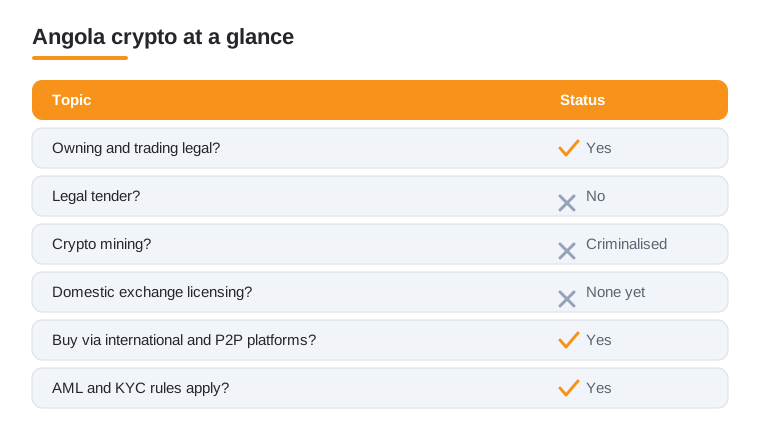
- Owning and trading crypto is legal for individuals, but it is not legal tender and there is no licensed domestic exchange regime.
- Tax is uncertain: no dedicated crypto tax code, but general tax rules may apply, so keep records.
- Most residents buy via international exchanges or P2P, settling in kwanza.
- Crypto mining is criminalised under Law No. 3/24.
Angola is one of Africa's more cautious crypto jurisdictions. For ordinary people, owning and trading Bitcoin and other cryptocurrencies is not prohibited, but the country has drawn two firm lines: it protects the kwanza and the exclusive monetary authority of the central bank, and it has criminalised cryptocurrency mining outright under a 2024 law. The result is a market where buying and holding crypto happens largely through international platforms, while a dedicated licensing regime for crypto businesses does not yet exist.
This guide explains how digital assets are treated as of 2026: whether crypto is legal, who the regulators are, the laws that actually apply, exchange and registration rules, taxation, AML and KYC, buying and using crypto in practice, mining, recent developments, consumer risks, and how to verify the current position with official sources. It is general information as of 2026 and is NOT legal, tax, or financial advice. Angola's framework is new and evolving, so confirm the current rules with the named regulators, in particular the Banco Nacional de Angola (BNA) and the Comissao do Mercado de Capitais (CMC), and with a qualified local lawyer or tax advisor before acting. See also our general guide to crypto regulation and our country regulation hub.
On this page: Legal status · Who regulates it · Taxes · How to buy · Mining
Legal status: is Bitcoin and crypto legal in Angola?
For ordinary users, buying, holding, and trading Bitcoin and other cryptocurrencies is not prohibited in Angola. There is no law that makes simply owning crypto a crime. At the same time, crypto is not legal tender. Only the Angolan kwanza (AOA) has legal-tender status, and the issuance of currency, whether physical or digital, is the exclusive competence of the central bank. Private crypto assets are not issued, backed, or guaranteed by the state.
The most important distinction in Angola is between using crypto and mining it. Mining cryptocurrency has been criminalised under a 2024 law (see the mining section below). Trading and investing, by contrast, sit in a developing space that is not yet covered by a dedicated crypto statute or a formal licensing regime. Because no comprehensive virtual-asset framework is in force beyond the mining prohibition, much of the consumer protection you get today comes from the platform you choose rather than from a mature domestic rulebook.
This is general information as of 2026 and not legal advice. Verify the current status with the BNA or a qualified Angolan lawyer.
Who regulates crypto in Angola?
No single authority has been formally designated as the dedicated crypto regulator. Instead, oversight is shared across Angola's existing financial bodies:
- Banco Nacional de Angola (BNA) is the central bank and monetary authority. It holds exclusive authority over the issuance of currency, sets foreign-exchange rules and prudential standards for banks and payment institutions, and has cautioned the public that crypto assets are not legal tender, fall outside prudential protection, and carry significant risk. Official site: bna.ao.
- Comissao do Mercado de Capitais (CMC) is the capital-markets regulator, responsible for the regulation, supervision, and development of the securities market. It is the most likely supervisor for any future virtual-asset framework and already enforces AML rules in the capital markets. Official site: cmc.ao.
- Unidade de Informacao Financeira (UIF) is Angola's financial intelligence unit, which receives suspicious-transaction reports under the AML framework.
- Administracao Geral Tributaria (AGT) is the tax authority that administers general tax obligations.
Because responsibilities are spread across these bodies and no crypto-specific licence exists yet, always confirm which authority applies to your activity before transacting.
Key laws and frameworks
Angola does not yet have a single, comprehensive crypto or virtual-asset law. The rules that actually apply come from a small number of instruments:
Law No. 3/24 (mining prohibition)
Law No. 3/24, published on 10 April 2024 and in force from that date, establishes the legal regime that prohibits the mining of cryptocurrencies and other virtual assets across the national territory. It is important to be precise about its scope: this law targets mining and mining-adjacent activity, such as connecting equipment to the national electricity system or using electrical-installation licences for mining. It does not create a licensing regime for exchanges or other crypto businesses, and it does not by itself regulate the issuance, circulation, or trading of crypto assets. Independent legal analysis has noted that the law contains an apparent drafting error in the articles on penalties for legal persons.
AML and CFT framework
Anti-money-laundering and counter-terrorist-financing obligations flow from Law No. 5/20 of 27 January, complemented by instruments such as BNA Notice No. 02/24 and Instruction No. 05/24, and CMC Regulation No. 5/21. These apply broadly to financial and non-financial obliged entities handling value, which is relevant to any business dealing in crypto-related transfers.
No dedicated VASP regime yet
As of 2026 there is no comprehensive licensing regime for virtual-asset service providers (VASPs) in force beyond the mining ban. Reports indicate the BNA and the Ministry of Finance are studying a broader digital-asset framework, but until any such law is enacted and published in the official gazette, you should not assume specific licensing, registration, or conduct rules exist for crypto exchanges. This is general information, not legal advice; confirm the current scope with the CMC, the BNA, or a qualified Angolan lawyer.
Licensing and registration of exchanges and VASPs
As of 2026, Angola has no dedicated licensing or registration regime specifically for cryptocurrency exchanges or other virtual-asset service providers. Unlike the European Union, which licenses crypto-asset service providers under the MiCA regulation, Angola has not yet enacted an equivalent crypto-specific framework. The only crypto-specific statute in force is the Law No. 3/24 mining prohibition, which is about mining rather than trading services.
Crypto businesses are not outside the regulatory perimeter. Lei n.º 5/20 already defines both activos virtuais and prestador de activo virtual in Article 3, and Article 10(3) requires the competent authorities to ensure that anti-money-laundering regulation applies to virtual asset providers, that those providers hold prior authorisation or registration, and that they are subject to effective supervision. General financial-services rules, foreign-exchange controls administered by the BNA, and the AML and CFT obligations under Law No. 5/20 can still reach activity that involves money transmission, currency exchange, or value transfer, depending on how a business is structured and what it does. Because the position is unsettled and a broader framework may be under development, any business considering offering crypto services in Angola should obtain qualified local legal advice rather than rely on the apparent absence of a specific rule.
For users, the practical consequence is that there is no domestic register of licensed crypto exchanges to consult. Most activity happens on international platforms, so due diligence falls on you. This is general information, not legal advice.
Taxation of crypto in Angola
Angola does not have a clear, dedicated crypto tax code aimed at everyday investors, and the treatment of gains, income, and business activity involving crypto is not spelled out in the same way as for traditional assets. That uncertainty is itself important: the absence of specific crypto rules does not mean crypto activity is automatically tax-free.
Depending on the facts, existing tax principles could apply. For example, income from a trade or business, or gains realised through commercial activity, may fall within general tax obligations administered by the Administracao Geral Tributaria (AGT). How any particular transaction is characterised can depend on whether you are an occasional individual investor or operating commercially.
There is no crypto-specific rate and no AGT ruling applying existing taxes to crypto. AGT Circular n.º 01/2026 of 5 January 2026, which sets out the tax measures for the 2026 budget year under Lei n.º 14/25 de 30 de Dezembro de 2025, lists 18 measures and none of them concerns crypto. The rates that do exist in Angolan law include Imposto Industrial at 25% on business profits and VAT at a standard 14%, since doing so would risk being wrong or out of date. Keep thorough records of every transaction (dates, amounts, kwanza values at the time, counterparties, fees, and platforms) so you can report accurately if required. See our general guide to crypto taxes for context. This is general information, not tax advice; crypto tax treatment in Angola is uncertain and changing, so confirm your obligations with the AGT or a qualified local tax professional.
AML, KYC, and reporting rules
Angola has a developed anti-money-laundering and counter-terrorist-financing framework, even though it is not crypto-specific. The core instrument is Law No. 5/20 of 27 January on combating money laundering and the financing of terrorism, supplemented by sectoral rules from the BNA (including Notice No. 02/24 and Instruction No. 05/24) and the CMC (including Regulation No. 5/21).
These rules impose obligations on financial and certain non-financial entities, including:
- Customer due diligence (KYC): verifying customer identity, understanding the purpose of transactions, and applying a risk-based approach.
- Transaction monitoring and suspicious-transaction reporting: watching for unusual patterns and filing reports with the Unidade de Informacao Financeira (UIF).
- Record-keeping: preserving transaction documentation, commonly for ten years.
For everyday users, the practical effect is that any reputable platform you use should require identity verification before you can trade or withdraw. Platforms that skip KYC are higher-risk and best avoided. Penalties for breaching the AML law can be severe, including large administrative fines and, for the crime of money laundering, imprisonment.
Angola's AML regime is under active international scrutiny. In October 2024 the Financial Action Task Force (FATF) added Angola to its list of jurisdictions under increased monitoring, commonly called the grey list, after Angola made a high-level commitment to address identified deficiencies. As of the FATF's February 2026 update, Angola remained on that list while working through its action plan. Being on the grey list can lead to more cautious handling of Angola-linked transactions by international banks and platforms, which may affect how easily some services work with Angolan users. See the FATF's country page for the current status: fatf-gafi.org.
Buying and using crypto in practice
Most people in Angola who buy crypto do so through international exchanges and peer-to-peer (P2P) marketplaces rather than a domestic, licensed exchange industry, which does not yet exist. P2P trading is popular because it can bridge the gap between the kwanza and crypto when direct bank rails are limited.
- Identity verification (KYC): reputable exchanges require you to verify your identity with a government ID before you can trade or withdraw. This is a standard anti-money-laundering measure and a sign of a more compliant platform.
- Funding and the kwanza: on-ramping and off-ramping local currency can be the hardest part. P2P methods, where a buyer and seller settle in kwanza via bank transfer or mobile money while the platform holds crypto in escrow, are widely used; verify counterparties and use the platform's escrow rather than settling off-platform.
- Foreign-exchange context: Angola operates currency and capital-flow controls administered by the BNA, and the kwanza has been volatile. Moving value across borders touches FX rules, so understand how your activity fits before transacting at scale.
- Choosing a platform: prefer established providers with strong security, clear fees, and proper KYC. Watch for spreads and withdrawal costs. Holding your own keys (self-custody) removes counterparty risk but makes security entirely your responsibility.
Cross-border remittances are a common real-world reason people look at crypto, since traditional transfers can be slow and expensive. The trade-offs include reliance on local on-ramps and off-ramps, FX rules, price volatility, and fees. This is general information, not financial advice; verify currency and cross-border rules with the BNA.
Crypto mining in Angola
This is where Angola is strictest. Cryptocurrency mining has been criminalised under Law No. 3/24, which came into force on 10 April 2024. The law prohibits mining of cryptocurrencies and other virtual assets throughout the national territory, prohibits using any electrical-installation licences for mining, and prohibits connecting mining systems and equipment to the National Electricity System.
The penalties are serious. Reports of the law describe prison sentences of roughly one to five years for possessing computer and communications equipment intended for mining, and longer terms, reported as three to eight years (with summaries citing penalties up to twelve years), for using electrical installations for mining or connecting equipment to the national grid, alongside seizure of equipment. For legal persons the law sets fines of 150 to 450 times the value of the licensing fee, or 30 to 50 times estimated monthly energy consumption, with dissolution as an alternative. Law firm CMS reported in May 2024 that the numbering of the articles setting penalties for legal persons contains an apparent error that had not been rectified, so which fine attaches to which offence is not clear on the face of the text.
The stated driving concern was the strain that energy-intensive mining places on Angola's power system, framed by officials as protecting the country's energy and environmental resources. Enforcement has been real rather than theoretical. During Interpol's Operation Serengeti 2.0, run between June and August 2025 across many African countries, Angolan authorities dismantled 25 cryptocurrency mining centres and confiscated 45 illicit power stations, with equipment reported to be valued at more than 37 million US dollars; 60 foreign nationals were reported to have been involved in the operations. Officials said the seized equipment would be repurposed to support power access in underserved communities. The practical takeaway is simple: do not mine cryptocurrency in Angola, and seek qualified local legal advice if you have any involvement with mining hardware. This is general information, not legal advice.
Recent developments (2024 to 2026)
The defining development is Law No. 3/24, which took effect on 10 April 2024 and made Angola one of the relatively few countries to criminalise crypto mining outright, primarily to protect its electricity system. The bill passed parliament with 104 votes in favour, 2 against, and 71 abstentions. Enforcement followed. In 2025, during Interpol's Operation Serengeti 2.0, Angolan authorities dismantled 25 mining centres and confiscated 45 illicit power stations, with equipment reported at more than 37 million US dollars that officials said would be repurposed for community power access.
Separately, in October 2024 the Financial Action Task Force (FATF) placed Angola on its grey list of jurisdictions under increased monitoring for anti-money-laundering shortcomings; Angola was still on that list as of the FATF's February 2026 review. This is an AML matter rather than a crypto-specific rule, but it shapes how banks and platforms treat Angola-linked activity.
On the broader question of trading and service-provider rules, the picture is one of study rather than enacted law. Public reporting and the BNA's own conference activity on virtual assets indicate that the central bank and the Ministry of Finance have been examining a wider digital-asset framework, potentially covering licensing, reserve requirements for stablecoin-type instruments, and AML and CFT standards aligned with international practice. As of 3 August 2026 no comprehensive crypto law is in force and no crypto bill is before the National Assembly. The only crypto-specific statute is the mining ban in Lei n.º 3/24, and the Comissão do Mercado de Capitais list of AML/CFT diplomas in force contains no virtual asset instrument.
Because the situation is evolving, treat dated summaries with caution and check whether any new law, regulation, or BNA or CMC notice has been published since this guide was written. This is general information as of 2026, not legal advice.
Consumer risks and protection
Crypto in Angola carries the usual market and security risks, plus jurisdiction-specific ones. Because there is no dedicated crypto consumer-protection regime and no licensed domestic exchange industry, protection comes mainly from the platform you choose and your own caution. The biggest user risks are price volatility, fraud, difficulty converting to and from kwanza, and legal uncertainty, including the bright line around mining.
Scams to watch for
Fraud follows adoption, and newer markets are heavily targeted. Common schemes include fake or cloned exchange sites; investment offers promising guaranteed or unusually high returns, including Ponzi structures and bogus token sales; phishing messages that capture your login or recovery phrase; and pig-butchering or romance scams that build trust before pushing a fake platform.
How to protect yourself
- Use only reputable, established providers with strong security and proper KYC.
- Verify website addresses carefully and enable two-factor authentication.
- Never share your seed phrase or recovery words with anyone.
- Treat any unsolicited opportunity or guaranteed return as a red flag.
- Move larger holdings to a personal hardware wallet you control, and back up your recovery phrase offline.
- Invest only what you can afford to lose, and avoid leverage.
This is general information, not financial, legal, or tax advice.
Official sources and how to verify
Because Angola's crypto rules are new and evolving, the safest approach is to verify the current position directly with the responsible authorities rather than rely on summaries, including this one. Key official sources:
- Banco Nacional de Angola (BNA), the central bank and monetary authority, for currency, foreign-exchange, and prudential matters and for public warnings on crypto: bna.ao.
- Comissao do Mercado de Capitais (CMC), the capital-markets regulator, for securities, AML in the capital markets, and any future virtual-asset rules: cmc.ao.
- Governo de Angola, the government portal, for legislation and ministerial communications, including the mining-law proposal: governo.gov.ao.
When you need certainty, check the official gazette text of any law, confirm the latest BNA and CMC notices, and consult a qualified Angolan lawyer or tax advisor. For broader context, see our crypto regulation guide and our country regulation hub. This is general information as of 2026 and is NOT legal advice; readers should verify the current rules with the BNA, the CMC, and a qualified local professional.
What is changing: status as of August 2026
Nothing in 2026 changed the legal position of holding or trading crypto in Angola. What moved is the anti-money-laundering framework around it, and the central bank's willingness to name operators publicly.
- On 30 June 2026 the Banco Nacional de Angola was reported to have issued a communiqué naming nine entities carrying on foreign exchange, credit and payment services without authorisation, and a tenth entity, Makanda Transfer, for advertising the sale of crypto assets on digital platforms. The BNA cited Article 10(3) of Lei n.º 11/24, Article 372 of Lei n.º 14/21 and Carta-Circular n.º 01/DCF/2022 de 3 de Fevereiro, and recommended that financial institutions and the public avoid any commercial or financial relationship with them (Mercado, 30 June 2026, PTI, 3 July 2026).
- On 25 June 2026 the National Assembly approved the revision of the anti-money-laundering law in the final global vote by 152 votes in favour (O País). It had passed na generalidade on 21 May 2026 by 162 votes to zero (Voz de Angola).
- On 21 May 2026 the National Assembly approved the Regime Jurídico do Beneficiário Efectivo by 179 votes to zero with no abstentions (Ministério da Justiça e dos Direitos Humanos).
- Neither text could be confirmed as promulgated or published in the Diário da República, and no law number was located for either, so both remain bills awaiting signature rather than laws in force.
- Angola remained on the FATF list of jurisdictions under increased monitoring after the plenary of 17 to 19 June 2026, one of 22 listed jurisdictions. Algeria and Namibia were removed at that plenary and Bosnia and Herzegovina and Iraq were added (FATF grey list update, 19 June 2026).
- There is still no licensing or registration regime for exchanges or virtual asset service providers, and no crypto-specific tax rule. The CMC's own list of AML/CFT diplomas contains no virtual asset instrument (CMC).
Legislation adopted and in progress
Four instruments are in force and two have passed parliament and were not confirmed as promulgated. None of them creates a crypto licence.
| Instrument | Stage | What it does | Timing |
|---|---|---|---|
| Lei n.º 3/24, de 10 de Abril | In force | Prohibits crypto and virtual asset mining nationwide and creates the related offences | In force since publication, Diário da República I Série n.º 66 of 10 April 2024 |
| Lei n.º 5/20, de 27 de Janeiro | In force | AML law. Article 3 defines activos virtuais and prestador de activo virtual. Article 10(3) requires competent authorities to ensure AML rules apply to virtual asset providers, that they hold prior authorisation or registration, and that they are effectively supervised | In force since 2020, currently being amended |
| Lei n.º 11/24, de 4 de Julho | In force | Amends Lei n.º 5/20. Its Article 10(3) is the provision the BNA cited in June 2026 against crypto promotion outside the legal framework | In force since 4 July 2024 |
| Lei n.º 14/21, de 19 de Maio | In force | Regime Geral das Instituições Financeiras. Article 372 is cited by the BNA when it names unauthorised operators | Diário da República I Série n.º 91 of 19 May 2021 |
| Revision of the AML law | Passed, promulgation not confirmed | Strengthens the autonomy of the Unidade de Informação Financeira, clarifies money laundering as an autonomous offence, redefines Pessoa Exposta Politicamente. Reporting does not mention virtual assets | Generalidade 21 May 2026 (162 to 0), especialidade 10 June 2026 (29 to 0, 6 abstentions), globalidade 25 June 2026 (152 in favour). No law number located as of 3 August 2026 |
| Regime Jurídico do Beneficiário Efectivo | Passed, promulgation not confirmed | Identifies the natural persons ultimately controlling legal entities. Reported as 56 articles in five chapters with a table of fines, and a Central Register under the Ministério da Justiça e dos Direitos Humanos | Council of Ministers 26 November 2025, especialidade 13 May 2026, final vote 21 May 2026 (179 to 0). No law number located as of 3 August 2026 |
| Dedicated virtual asset framework | Announced only | Instruments for virtual assets, announced by the BNA governor in April 2022 within the Conselho de Supervisores do Sistema Financeiro | No bill, no consultation and no timetable located as of 3 August 2026 |
Sources: Lei n.º 3/24 full text, Lei n.º 5/20 full text, Lei n.º 14/21, CMC AML/CFT diplomas, especialidade vote, 10 June 2026, beneficial ownership bill structure, Council of Ministers approval, 26 November 2025.
What the BNA actually says about crypto, and under which provisions
Angola's central bank has not issued a crypto framework, but it has taken a public position and it names the provisions it relies on. In its communiqué reported on 30 June 2026 the BNA stated that the commercialisation, intermediation or promotion of crypto assets outside the applicable legal framework is a violation of legislation in force, and identified Makanda Transfer for advertising the sale of crypto assets on digital platforms.
- The provisions cited are Article 10(3) of Lei n.º 11/24 de 4 de Julho, Article 372 of Lei n.º 14/21 de 19 de Maio, and Carta-Circular n.º 01/DCF/2022 de 3 de Fevereiro.
- Nine further entities were named for conducting foreign exchange, credit or payment services without authorisation: Money Card Tecnologia, Ango Digital Pay, Expansão Digital, TransferWise (Wise) Angola, Sociedade Comércio e Prestação de Serviços, Soluções de Crédito Rápido & Facilitado, Pay Stream, Pagaki Futungo, and Compra e Venda de Divisas USD/EUR.
- The BNA recommended that financial institutions and the general public avoid establishing any commercial or financial relationship with these entities or their promoters.
The practical reading for a user is that buying and holding crypto for yourself is not what the BNA is targeting. Local intermediaries advertising crypto services to the Angolan public are. Sources: Mercado and PTI, 3 July 2026.
Tax: there is no crypto rate, and the 2026 circular is silent
Angola has no crypto-specific tax rule and the tax authority's own current guidance does not mention crypto. AGT Circular n.º 01/2026 of 5 January 2026, which implements the tax measures of Lei n.º 14/25 de 30 de Dezembro de 2025 (the 2026 State Budget), lists 18 measures and none concerns crypto assets. That does not make a disposal tax free. It means characterisation decides which existing tax applies.
| Tax | Rate | What it attaches to |
|---|---|---|
| Imposto Industrial (corporate income tax) | 25% | Profits from business activity. Trading carried on as a business would be assessed here |
| VAT | 14% standard | Standard rate on taxable supplies of goods and services |
| Special contribution on foreign exchange operations | 2.5% where the transfer is made by individuals, 10% where made by legal entities | Listed as a 2026 budget measure in AGT Circular n.º 01/2026 |
Rates confirmed at PwC Worldwide Tax Summaries, Angola corporate income tax, last reviewed 24 June 2026 and PwC Angola other taxes; the 2026 measures at Circular n.º 01/2026. No AGT ruling or circular applying any of these to crypto has been published.
Mining offences and penalties, article by article
Lei n.º 3/24 does not set one penalty. It grades them by conduct, and has a separate regime for companies.
| Article | Conduct | Penalty |
|---|---|---|
| Article 4 | General prohibition of crypto and other virtual asset mining throughout national territory | Prohibition |
| Article 5 | Possession of computing material intended for or used in mining | 1 to 5 years imprisonment, with seizure and forfeiture of equipment |
| Article 6 | Mining crypto, directly or through third parties | 3 to 12 years imprisonment |
| Article 7 | Misuse of an electrical installation licence for mining | 3 to 8 years imprisonment |
| Article 8 | Connecting equipment to the National Electricity System for mining | 3 to 12 years imprisonment |
| Legal persons | Companies committing the above offences | Fine of 150 to 450 times the value of the licensing fee, or 30 to 50 times estimated monthly energy consumption, or dissolution. Which range attaches to which offence is unclear because of an acknowledged numbering error in the law |
Law firm CMS reported in May 2024 that the numbering of the articles setting penalties for legal persons contains an apparent error that had not been rectified, which is why the corporate fine mapping should not be stated with confidence.
Enforcement has continued into 2026. Reporting in February 2026 recorded 41 sites dismantled over ten months with at least 100 people detained, predominantly Chinese nationals, and a Serviço de Investigação Criminal operation in Ramiros, Belas, where a facility with more than 2,000 processors and a high capacity transformer station connected to the public network was found and ten people were detained, two Chinese nationals and eight Angolans. Sources: Lei n.º 3/24 full text, CMS analysis, May 2024, Expansão, 23 February 2026.
Frequently asked questions
Is Bitcoin legal in Angola?
Owning and trading Bitcoin is not prohibited for individuals in Angola, but crypto is not legal tender; only the kwanza is. There is no dedicated crypto-trading law and no domestic licensing regime yet, so much of your protection comes from the platform you use. Crucially, crypto mining has been criminalised under Law No. 3/24. This is general information, not legal advice; confirm the current position with the Banco Nacional de Angola (BNA) or a local lawyer.
Is crypto mining allowed in Angola?
No. Cryptocurrency mining has been criminalised under Law No. 3/24, in force since 10 April 2024. Reported penalties include roughly one to five years in prison for possessing mining equipment and longer terms for connecting equipment to the national grid or using electrical-installation licences for mining, plus equipment seizure. The stated aim is to protect the national electricity system. Do not mine crypto in Angola, and seek local legal advice if you have any involvement with mining hardware.
Who regulates cryptocurrency in Angola?
No single dedicated crypto regulator has been designated. Oversight is shared: the Banco Nacional de Angola (BNA) is the central bank and monetary authority and has warned that crypto is not legal tender; the Comissao do Mercado de Capitais (CMC) is the capital-markets regulator and the likely supervisor for any future virtual-asset framework; the Unidade de Informacao Financeira (UIF) handles AML reporting; and the tax authority (AGT) administers tax. No comprehensive VASP licensing regime is in force as of 2026.
Do I have to pay tax on crypto in Angola?
Angola does not have a clear, dedicated crypto tax code for everyday investors, but the absence of specific rules does not mean crypto activity is automatically tax-free; general tax principles could apply depending on the facts. We do not state any rates or thresholds here because the position is uncertain. Keep detailed records and confirm your obligations with the tax authority (AGT) or a qualified local tax professional. This is general information, not tax advice.
Are crypto exchanges licensed or registered in Angola?
As of 2026, Angola has no dedicated licensing or registration regime specifically for crypto exchanges or other virtual-asset service providers. There is no domestic register of licensed crypto exchanges to consult, and most people use international platforms. General financial-services, foreign-exchange, and AML rules can still apply depending on the activity. Reports suggest a broader framework may be under study, so verify the current position with the BNA and CMC.
How do people buy Bitcoin in Angola?
Most buy through established international exchanges or peer-to-peer marketplaces, often settling in kwanza via bank transfer or mobile money using the platform's escrow. Complete identity verification (KYC), be mindful of Angola's currency and cross-border foreign-exchange rules administered by the BNA, and move larger holdings to a personal hardware wallet you control. Avoid platforms that skip identity checks and treat any unsolicited or guaranteed-return offer as a red flag.
Has Angola actually enforced its crypto mining ban?
Yes. In 2025, during Interpol's Operation Serengeti 2.0, Angolan authorities dismantled 25 cryptocurrency mining centres and confiscated 45 illicit power stations, with seized equipment reported at more than 37 million US dollars; 60 foreign nationals were reported to have been involved. Officials said the equipment would be repurposed to help supply power to underserved communities. Enforcement of the Law No. 3/24 mining prohibition is real, so do not mine crypto in Angola.
Is Angola on the FATF grey list, and does that affect crypto users?
Yes. The Financial Action Task Force (FATF) added Angola to its grey list of jurisdictions under increased monitoring in October 2024, and Angola remained on it as of the FATF's February 2026 update, while it works through an action plan to fix anti-money-laundering deficiencies. This is not a crypto-specific rule, but grey-list status can make international banks and platforms more cautious with Angola-linked transactions, which may affect how smoothly some services work for Angolan users. Check the FATF country page for the current status.
Has Angola passed a crypto law in 2026?
No. The only crypto-specific statute remains Lei n.º 3/24 de 10 de Abril, the mining ban. What parliament voted on in 2026 was adjacent: the revision of the anti-money-laundering law, approved in the final global vote on 25 June 2026 by 152 votes, and the Regime Juridico do Beneficiario Efectivo, approved on 21 May 2026 by 179 votes to zero. Neither creates a crypto licence, and neither could be confirmed as promulgated or published in the Diario da Republica as of 3 August 2026, so neither is yet law.
Is Angola still on the FATF grey list in August 2026?
Yes. Angola remained on the FATF list of jurisdictions under increased monitoring after the plenary held from 17 to 19 June 2026, one of 22 listed jurisdictions. Algeria and Namibia were removed at that plenary; Bosnia and Herzegovina and Iraq were added. Angola has been listed since October 2024 and Angolan officials have targeted exit by 2027. For a crypto user the practical effect is bank-side friction on international transfers and stricter source-of-funds questions, not a ban.
What did the Banco Nacional de Angola say about crypto in June 2026?
On 30 June 2026 the BNA was reported to have published a communique naming nine entities providing foreign exchange, credit or payment services without authorisation, plus a tenth, Makanda Transfer, for advertising the sale of crypto assets on digital platforms. It stated that commercialising, intermediating or promoting crypto assets outside the applicable legal framework breaches legislation in force, citing Article 10(3) of Lei n.º 11/24, Article 372 of Lei n.º 14/21 and Carta-Circular n.º 01/DCF/2022 de 3 de Fevereiro, and recommended that institutions and the public avoid dealings with them.
What tax rate applies if I sell crypto in Angola?
There is no crypto-specific rate and no AGT ruling applying existing taxes to crypto. AGT Circular n.º 01/2026 of 5 January 2026 sets out the 2026 tax measures and none of the 18 measures concerns crypto. Rates that do exist include Imposto Industrial at 25% on business profits and VAT at a standard 14%, so a lot turns on whether your activity is characterised as a business. Which tax applies to a personal disposal is not settled by any published Angolan rule. Keep full transaction records and take local advice.
What is the actual prison sentence for crypto mining in Angola?
It depends on the conduct. Under Lei n.º 3/24, possessing computing material for mining carries 1 to 5 years (Article 5), mining itself carries 3 to 12 years (Article 6), misusing an electrical installation licence carries 3 to 8 years (Article 7), and connecting equipment to the National Electricity System for mining carries 3 to 12 years (Article 8). Companies face fines of 150 to 450 times the licensing fee value, or 30 to 50 times estimated monthly energy consumption, or dissolution, though an acknowledged numbering error in the law makes it unclear which range attaches to which offence.
Is a licence for crypto exchanges coming to Angola, and when?
There is no announced date. The BNA governor said in April 2022 that instruments for virtual assets were being prepared within the Conselho de Supervisores do Sistema Financeiro, but gave no timetable, and no bill, draft text or public consultation has been published since. The CMC list of AML/CFT diplomas in force contains no virtual asset instrument. Do not plan around a licensing regime arriving on a known date.
Does any Angolan law already cover crypto companies?
Yes, through anti-money-laundering law rather than a crypto statute. Lei n.º 5/20 de 27 de Janeiro defines activos virtuais in Article 3 and separately defines prestador de activo virtual to cover exchange of virtual assets for fiat currency, exchange between forms of virtual assets, transfer, custody or administration, and participation in operations and financial services related to the offer or sale of a virtual asset by an issuer. Article 10(3) requires the competent authorities to ensure anti-money-laundering rules apply to those providers, that they hold prior authorisation or registration, and that they are effectively supervised. That obligation exists on paper even though no registration system has been built.
Facts reviewed: 4 August 2026. Page updated: 12 August 2026.