Home › Crypto Regulation › Democratic Republic of Congo
Bitcoin & Cryptocurrency Regulation in Democratic Republic of Congo
Quick answer — Democratic Republic of Congo, 2026
- Legal: Virtual asset activities prohibited since 1 July 2025, not legal tender, holding not expressly criminalised
- Tax: No confirmed crypto tax; proposals only, general rules may apply
- Buying: Global exchanges and P2P via mobile money
The Democratic Republic of the Congo (DRC) is one of Africa's largest countries by population and territory, yet it remains heavily cash-based, with a large unbanked population, widespread mobile-money use and a long history of currency instability. Against that backdrop, Bitcoin and other cryptocurrencies have spread mainly through peer-to-peer trading, mobile money and informal remittance channels rather than through a formal, licensed market.
As of 2026, the DRC has no dedicated, fully enacted cryptocurrency statute. Crypto is not recognised as legal tender, and the central bank, the Banque Centrale du Congo (BCC), has issued public warnings against crypto-based savings schemes. At the same time, the country has built a broader digital-economy legal framework (the 2023 Digital Code and its 2026 implementing decrees) that does not specifically govern crypto-assets, while crypto-industry reports describe a separate digital-asset bill and tax proposals that, on current information, are not confirmed as enacted law. This page explains the legal status, who regulates what, how taxation and exchanges work in practice, and the realities of mining and remittances. It is general information as of 2026 and is not legal, tax or financial advice; verify any specific point with the Banque Centrale du Congo or a qualified Congolese professional before acting. For background, see our guide to crypto regulation.
On this page: Legal status · Who regulates it · Taxes · How to buy · Mining
Is Bitcoin and crypto legal in the Democratic Republic of the Congo?
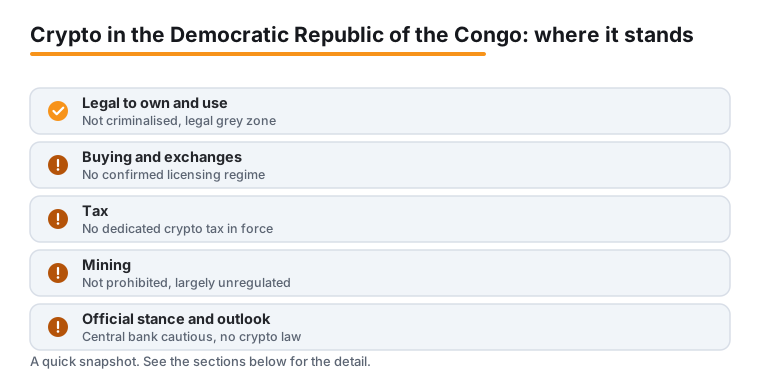
In practical terms, article 22 bis of Law 22/068 of 27 December 2022, inserted by Law 25/048 of 1 July 2025, provides that virtual asset activities and virtual asset service provider activities are prohibited in the Democratic Republic of the Congo, and the law entered into force on the date of its promulgation. The prohibition is written as a ban on activities, so simply holding Bitcoin is not expressly criminalised, but there is no licensed venue, no safe harbour and no implementing guidance. The key points:
- Not legal tender. The Congolese franc (CDF) is the national currency. Cryptocurrency is not recognised as money, and merchants are under no obligation to accept it. Day-to-day prices, wages and official payments are denominated in CDF, with the US dollar widely used informally.
- No dedicated crypto law in force. Researchers and practitioners note that neither the monetary and financial framework, the foreign-exchange rules, nor the electronic-money rules contain explicit, crypto-specific provisions, leaving a genuine legislative gap.
- Official caution. The Banque Centrale du Congo has publicly warned that crypto-based savings schemes are not authorised and carry high risks of fraud, cyber-crime and money laundering, and that participants do so at their own risk with no state backstop. A BCC public notice dated 9 November 2018 flagged the illegal collection of public savings through crypto-related schemes by unlicensed structures, and later notices named specific unauthorised operators. The bank's interventions have taken the form of informational warnings rather than binding, crypto-specific rules.
In short, the activity is prohibited on paper and unenforced on the public record. GABAC's fourth enhanced follow-up report of March 2026 records that the DRC produced no evidence allowing the conclusion that any action has been taken to identify or sanction virtual asset service providers operating illegally, and that no risk assessment of virtual assets has been carried out. That gap explains why peer-to-peer trading continues openly, but it does not create a lawful route: there is no licence, no supervised venue, and a fine of up to three times the sum converted for converting virtual assets into a currency quoted by the BCC.
Who regulates crypto in the DRC?
No single authority has a clear, statutory mandate over crypto-assets, so responsibility is shared and partly informal:
- Banque Centrale du Congo (BCC). The central bank is the primary authority over money, payments and the financial system. It operates under Law No. 005/2002 of 7 May 2002 and the organic Law No. 18/027 of 13 December 2018, and its core mandate is price and currency stability and the supervision of credit and microfinance institutions. It has been the main official voice on crypto, issuing cautionary public notices rather than a detailed licensing regime.
- Ministry in charge of the digital economy and the digital regulator. The DRC's 2023 Digital Code creates a digital-economy policy ministry and an Autorité de Regulation du Numerique (digital regulation authority); pending that authority's full establishment, implementation has been delegated provisionally to ARPTIC, the Autorite de Regulation des Postes, des Telecommunications et des Technologies de l'Information et de la Communication, created by Decret n° 23/13 of 3 March 2023 in place of the former ARPTC and invested by a ministerial decree of 17 August 2024 with the Digital Code roles of the digital regulation authority, the electronic certification authority and the data protection authority. It has no virtual asset mandate.
- Ministry of Finance and tax administration. Generally responsible for tax policy, including how any gains or conversions involving digital assets would be treated under general tax rules.
You can consult the central bank directly via the Banque Centrale du Congo and the digital/telecoms regulator via the ARPTC. A fully enacted, crypto-specific supervisory regime was not confirmed in force as of 2026.
Key laws and frameworks
Several instruments shape the environment around digital assets, even though none of them is a dedicated crypto statute:
- Digital Code (Ordonnance-Loi n° 23/010 of 13 March 2023). Published in the Official Journal in April 2023, this is the DRC's comprehensive framework for digital activities, services, infrastructure, electronic transactions, cybersecurity and data protection. It establishes institutions such as a digital regulation authority, an electronic-certification authority, a national cybersecurity agency and a national digital council. It does not contain crypto-specific provisions, but it is the backbone of digital-sector regulation.
- Implementing decrees of 11 March 2026 (Arretes n° 004 and n° 005). These ministerial orders operationalise the Digital Code by creating an authorisation regime (for data centres, qualified trust-service providers, hosting providers and dominant platforms, including fintech platforms) and a lighter declaration regime (for non-dominant platforms and start-ups). Commentators have noted these decrees say nothing explicit about crypto-assets specifically, so they should not be read as a crypto licensing scheme.
- Monetary, foreign-exchange and electronic-money rules. These general financial rules apply to licensed institutions but do not, on current analysis, set out a bespoke crypto regime.
- Reported digital-asset bill (not confirmed enacted). Crypto-industry coverage describes a digital-asset bill that would license digital-asset service providers. No such bill appears in any DRC official record located for this update, and the position runs the other way: GABAC's March 2026 assessment states that the DRC does not authorise virtual asset service provider activity on its territory and that no approval is possible. Always confirm the status through official government channels.
Licensing and registration of exchanges (VASPs)
As of 2026 there is no confirmed, in-force licensing regime specifically for crypto exchanges or virtual-asset service providers (VASPs) in the DRC. The Banque Centrale du Congo has not authorised a domestic crypto exchange, and the 2023 Digital Code and its 2026 decrees regulate digital services generally rather than crypto trading as such.
The practical consequences:
- Congolese users mostly rely on international exchanges and peer-to-peer (P2P) platforms, whose compliance standards are set offshore, not by a Congolese licence.
- Crypto-industry reports describe a proposed digital-asset service provider (DASP) licence under a future bill, but that licence is not confirmed to exist in law and should not be assumed to be available.
- A digital service that qualifies as a regulated platform under the 2026 decrees may still face authorisation or declaration duties under the Digital Code, independent of any crypto-specific status.
Before assuming any registration or licence applies, confirm directly with the central bank or the digital regulator, because requirements are evolving and depend on the exact activity.
Crypto taxation in the DRC
There is no crypto tax in the DRC, and the reason is that the underlying activity is prohibited rather than licensed. The tax administration is the Direction Generale des Impots (DGI), which publishes the tax code, decrees and service notes and publishes nothing on digital assets. The general schedule is corporate income tax at 30 percent including mining companies, a minimum corporate tax of 1 percent of yearly turnover for companies other than micro and small sized ones, VAT at 16 percent standard, and personal income tax bands of 3, 15, 30 and 40 percent capped at 30 percent of taxable salary, all last reviewed on 21 April 2026 in PwC's DRC tax summaries. PwC also records that incomes other than salaries are not, in practice, subject to personal income tax.
A 5% withholding tax on crypto-to-fiat conversion is repeated widely on crypto sites. No such measure appears in any DRC text located for this update, and the DGI publishes no crypto guidance at all. The only crypto-specific monetary figure that could be verified runs the other way: article 22 bis, as quoted by GABAC, punishes conversion of virtual assets into any currency quoted by the BCC with a fine whose maximum equals three times the sum converted. Do not rely on any specific rate or threshold: verify your obligations with the Ministry of Finance or the tax administration, or consult a qualified Congolese tax professional. For general background on how crypto is commonly taxed, see our crypto taxes guide. This is not tax advice.
AML and KYC rules
The DRC's central concern about crypto, as expressed in the BCC's public warnings, has been money laundering, fraud and cyber-crime. The bank has highlighted that many crypto operators are based outside the country and outside its supervision, that blockchain transactions can involve anonymity, and that unauthorised schemes have collected public savings illegally.
Key points on AML and KYC:
- Licensed institutions. Banks, microfinance institutions and mobile-money operators supervised by the BCC are expected to identify their customers and report suspicious activity, including suspicious flows that may be linked to crypto.
- No confirmed VASP-specific AML regime. Because there is no enacted crypto-licensing law confirmed in force, there is no domestic VASP-specific AML regime to point to; reported figures (such as thresholds for reporting crypto-linked flows) come from industry coverage and proposals, not a verified statute.
- Practical expectation. Any crypto business operating with the DRC should treat strong KYC, transaction monitoring and record-keeping as essential, both to manage risk and to be ready for future requirements.
Confirm current obligations with the BCC and the relevant supervisory bodies before designing compliance processes.
Buying and using crypto in practice
Because there is no confirmed licensed domestic exchange regime, Congolese users typically buy crypto through international platforms and peer-to-peer channels rather than locally regulated venues. Common routes include:
- Global exchanges with mobile-money on-ramps. Some international platforms have connected to local mobile-money services such as Airtel Money and Orange Money, letting users fund accounts from a phone-based balance rather than a bank account. Availability changes, so confirm current support for the DRC.
- Peer-to-peer marketplaces. P2P trading, where buyers and sellers are matched and settle via mobile money or cash, is widely used where banking access is limited. Escrow on reputable platforms reduces, but does not eliminate, counterparty risk.
- Mobile money as a bridge. With low bank penetration and high mobile-money usage, mobile wallets are often the practical link between Congolese francs and crypto.
A typical buying process: choose a reputable platform that supports the DRC; create and verify your account (expect identity checks and enable two-factor authentication); fund it via mobile money or a P2P trade in CDF or USD; place your order after checking fees and the exchange rate; and, for meaningful amounts, move the crypto to a wallet you control, backing up your recovery phrase offline and never sharing it. Throughout, be alert to scams, verify website addresses, and ignore anyone guaranteeing profits. Internet and electricity reliability vary by region and can affect access.
Bitcoin mining in the DRC
Bitcoin mining is not specifically prohibited in the DRC, and the activity is largely unregulated rather than governed by a confirmed, dedicated mining statute. The country's most distinctive mining story involves its substantial hydropower potential. Eastern DRC, including areas associated with national-park hydroelectric projects, has seen small-scale mining operations powered by hydro electricity, sometimes presented as a way to monetise surplus or stranded power and help fund local energy infrastructure.
Key considerations include:
- Energy access and reliability. The DRC has enormous untapped hydro capacity but limited grid reach and frequent supply constraints. Mining can compete with local demand, so projects must weigh community energy needs.
- Renewable angle. Hydro-based mining can be lower-carbon than fossil-fuelled operations, though real-world impact depends on how a project is run.
- Regulatory uncertainty and security. Reports that authorities have begun issuing crypto mining licences are not supported by any official record located for this update, and GABAC's March 2026 assessment states that no approval of a virtual asset service provider is possible in the DRC. No Congolese source located here addresses mining itself, but the conversion of virtual assets into any currency quoted by the BCC is punishable under article 22 bis by a fine of up to three times the sum converted. Future rules on registration, energy use, taxation or environmental compliance could change the picture, and security conditions in some eastern mining regions are a serious practical concern.
Anyone considering a mining venture should obtain current local legal and energy-sector advice, since the framework is evolving and conditions vary sharply by region.
Remittances and everyday transfers
Remittances are a major source of income for many Congolese households, and the cost and speed of traditional transfers are a real pain point. Conventional money-transfer services often charge a mix of fixed fees and a percentage of the amount sent, and funds can take time to arrive after passing through several intermediaries.
Crypto is sometimes used as an alternative because transfers can settle quickly and, depending on the network and the off-ramp used, may carry lower costs than legacy corridors. The typical flow is: a sender abroad buys crypto, sends it to a recipient's wallet, and the recipient converts it to Congolese francs or US dollars, often via mobile money or a P2P trade. The trade-offs matter:
- Volatility. Crypto prices can move sharply; holding value in Bitcoin between sending and cashing out adds risk that stablecoins or fast conversion can reduce but not remove (and stablecoins carry their own issuer and counterparty risks).
- Off-ramp friction. Real savings depend heavily on conversion fees, exchange rates and the availability of a reliable local cash-out method.
- Technical and security demands. Both parties need basic wallet literacy, a connection, and care to avoid scams and address errors.
Crypto can be a useful remittance tool in the DRC's context, but it is not automatically cheaper or safer in every case. Compare the full end-to-end cost against established services before choosing.
Recent developments (2025-2026)
The most concrete, verifiable development is the build-out of the broader digital-economy framework rather than a crypto-specific law:
- Implementing decrees of 11 March 2026. Two ministerial orders (Arretes n° 004 and n° 005) operationalised the 2023 Digital Code, setting authorisation and declaration regimes for digital services and provisionally delegating implementation to the ARPTC pending a dedicated digital regulator. These decrees are not crypto-specific.
- Reported crypto initiatives. Crypto-industry coverage has described a draft digital-asset bill (with DASP licensing), a possible Congolese-franc-linked stablecoin, mobile-money on-ramps from global exchanges, and exploratory tax measures. On current information these are proposals, pilots or reports rather than confirmed enacted law, and several specific figures (such as tax rates and reporting thresholds) trace back to secondary sources rather than official texts.
- Continued central-bank caution. The BCC's stance has remained one of warning the public about unauthorised crypto schemes while not formally licensing a domestic market. Its warnings trace back to a public notice of 9 November 2018 on the illegal collection of public savings through crypto, with later notices naming specific unlicensed operators (for example schemes described in Congolese reporting as World Cryptocurrency Exchange Incorporated, Standard Capital and Rathe Investissement Group). These interventions have been informational rather than a licensing framework.
Because the situation is fluid, treat any specific rule, figure or service as something to verify against current official sources before relying on it.
Consumer risks and protection
The central tension in the DRC is between strong grassroots demand for digital money and a regulatory framework that has not yet caught up. The main risks for consumers:
- No local consumer protection. Because there is no confirmed crypto-licensing regime, there is no domestic safety net if a platform collapses, is hacked or turns out to be fraudulent. The BCC has expressly warned about schemes promising excessive returns.
- Volatility. Crypto prices can rise and fall dramatically. Money you cannot afford to lose should not be exposed to that risk.
- Fraud and scams. Unsolicited investment offers, guaranteed-return promises and fake platforms are common. Verify website addresses and never share private keys or recovery phrases.
- Infrastructure limits. Power and internet reliability affect access and security, and a poor connection can complicate buying or cashing out when you need to.
Treat crypto as a high-risk asset, avoid promises of guaranteed or fast returns, and consider speaking with a qualified financial professional. This is not financial advice.
Official sources and how to verify
Because the DRC's crypto position is evolving and is often reported through secondary crypto sites, verify any important point against primary, official sources before acting:
- Central bank: the Banque Centrale du Congo, including its public notices (avis au public) on crypto-related schemes.
- Digital and telecoms regulator: the Autorite de Regulation de la Poste et des Telecommunications du Congo (ARPTC), which provisionally implements the Digital Code's digital-services regime.
- Legislation: the text of the 2023 Digital Code (Ordonnance-Loi n° 23/010) and related laws can be consulted via the Congolese legal repository Leganet.cd.
For wider context, see our country-by-country regulation hub. This page is general information as of 2026 and is not legal, tax or financial advice; confirm the current rules with the Banque Centrale du Congo or a qualified Congolese professional before making decisions.
What changed, and what did not, in 2026
Two things moved between the last review and August 2026, and neither loosens the prohibition. A third thing that crypto coverage treats as movement did not happen.
- The ban was assessed for the first time, and the rating did not improve. GABAC, the FATF style regional body that evaluates the DRC, adopted its fourth enhanced follow-up report on the DRC in March 2026, examining progress up to September 2025. It is the first GABAC assessment to analyse article 22 bis. The country stayed Partially Compliant with FATF Recommendation 15 on new technologies, a rating it has held since the second follow-up report of September 2023, and the report states that the Partially Compliant ratings for Recommendations 15, 22 and 34 remain unchanged because the efforts made were not judged sufficient to justify an upgrade. The DRC did leave the GABAC follow-up process, but the report ties that to the programme of third round mutual evaluations rather than to any crypto measure, and says the country will report on its action plan at that evaluation, for which no date is given.
- The ban is not being enforced on the record. The same report states that the country produced no evidence allowing the conclusion that any action has been taken to identify or sanction virtual asset service providers operating illegally. It also records that neither the DRC nor the financial institutions operating on its territory have carried out the risk assessment required by Recommendation 1 for virtual assets and VASP operations, and that no risk assessment yet exists to serve as a basis for risk based measures. A prohibition with no published enforcement is still a prohibition, but it explains why peer to peer trading continues visibly.
- A digital sector fee schedule arrived, without a crypto category. Interministerial order n° 015 sets duties and fees for digital activities. Radio Okapi reports USD 5,000 for financial platforms including online banks and fintech applications, USD 3,000 for local and USD 10,000 for foreign transport and travel platforms, USD 25,000 to USD 75,000 for data centres, USD 100 for Congolese startup developers, and penalties of up to 200 percent of the required title for operating without authorisation. The government deferred its application on 1 August 2026 to clarify scope, then confirmed the text days later with startups exempt. Congolese outlets give its signature date variously as 20, 24 or 28 July 2026, and the official text was not located.
No digital asset bill, licensing framework or repeal of article 22 bis was found in any DRC official record for this update. The direction of travel since 1 July 2025 is prohibition, not licensing, and claims on crypto sites that the DRC is preparing exchange licences are unsupported.
What article 22 bis prohibits, and what it costs
The prohibition is short and its consequences are specific. The detail below comes from GABAC's technical compliance analysis of Recommendation 15 in its March 2026 follow-up report, which quotes the law criterion by criterion. The statute itself is published by CENAREF as an image scan of Law 25/048 with no readable text layer, so the wording below is GABAC's quotation.
- What is banned. Virtual asset activities and virtual asset service provider activities in the DRC. The wording targets activities, not possession, and no provision criminalising simple holding was located.
- No licence exists. GABAC records under criterion 15.4 that the DRC does not authorise VASP activity on its territory and that no approval is possible. Measures to keep criminals out of VASP ownership and management are treated as inapplicable for the same reason.
- Who enforces it. The Banque Centrale du Congo is named as the competent authority for detecting and sanctioning illicit virtual asset and VASP activity, and article 22 bis requires the competent authority to identify persons carrying on those activities without approval or registration and to apply the penalties provided.
- The penalty. Anyone who engages in the conversion of virtual assets into any currency quoted by the BCC is liable to a fine whose maximum equals three times the amount of the sum converted. This is the one crypto specific monetary figure in Congolese law that could be verified.
- Money transfer rules apply on top. Article 69 of Law 22/068 as amended provides that no one may carry on the professional transfer or transport of funds or values without BCC approval, reinforced by article 74 of BCC Instruction n° 15 (modification 3), with approval conditions in BCC Instruction administrative n° 006 on messageries financières at articles 7 to 20. A cash out desk needs that approval regardless of the crypto question, and cannot obtain a crypto one.
What tax applies when there is no crypto tax code
The DRC has no crypto specific tax. The tax administration is the Direction Générale des Impôts (DGI), which publishes the tax code, decrees and service notes, and which publishes nothing on digital assets or cryptocurrency. What exists is the general schedule below, taken from PwC's DRC tax summaries, each last reviewed 21 April 2026.
| Tax | Rate |
|---|---|
| Corporate income tax | 30 percent, including mining companies |
| Minimum corporate tax | 1 percent of yearly turnover, for companies other than micro and small sized companies |
| VAT | 16 percent standard, 1 percent on specified essential goods, 5 percent on national air tickets, 0 percent on exports |
| Personal income tax (IPR), annual bands | 3 percent to CDF 1,944,000; 15 percent to CDF 21,600,000; 30 percent to CDF 43,200,000; 40 percent above, with total IPR capped at 30 percent of taxable salary |
Two practical points follow. First, PwC records that incomes other than salaries are not, in practice, subject to IPR, which is why no Congolese authority is currently assessing individual crypto gains. Second, a business trading crypto in the DRC does not have a tax problem so much as a legality problem, because the activity itself is prohibited. No withholding tax on crypto to fiat conversion appears in any DRC text located for this update.
Named institutions to check, and one correction
- Banque Centrale du Congo (BCC). Monetary authority, supervisor of credit institutions and money transfer businesses, and the authority named under article 22 bis for detecting and sanctioning illicit virtual asset activity. GABAC cites a BCC public alert of 2 July 2020 on the proliferation of online platforms offering virtual asset services. The BCC website did not respond during this update, and no BCC notice dated 2025 or 2026 on virtual assets was located.
- CENAREF, the Cellule Nationale des Renseignements Financiers. The financial intelligence unit, which receives suspicious transaction reports and publishes the AML legislation, including Law 22/068 and Law 25/048. It does impose penalties: its public notice of 22 April 2026 records a USD 1,500 monetary sanction applied on 23 January 2026 to Comptoir DM SARL, a precious stones and metals dealer, for failing to meet its client identification obligation.
- ARPTIC, not ARPTC. The former ARPTC was replaced by the Autorité de Régulation des Postes, des Télécommunications et des Technologies de l'Information et de la Communication, created by Décret n° 23/13 of 3 March 2023. A ministerial decree of 17 August 2024 has the regulator exercise the Digital Code roles of the digital regulation authority, the electronic certification authority and the data protection authority until those three bodies are actually created. It has no virtual asset mandate.
- Direction Générale des Impôts (DGI). Tax administration, publishing the tax code and service notes, with no crypto guidance.
- GABAC. The regional AML body that evaluates the DRC and whose follow-up reports are the most reliable public record of what Congolese financial law actually says about virtual assets.
Frequently asked questions
Is cryptocurrency legal in the Democratic Republic of the Congo?
Owning and trading cryptocurrency is not criminalised in the DRC, so it is broadly tolerated in practice, but crypto is not legal tender and there is no dedicated, in-force crypto statute. The Banque Centrale du Congo has publicly warned against unauthorised crypto savings schemes, and the market is largely unregulated with limited consumer protection. Users generally engage with crypto at their own risk. Confirm the current position with the Banque Centrale du Congo, as the framework is evolving. This is not legal advice.
Who regulates crypto in the DRC?
No single authority has a clear statutory mandate over crypto-assets. The Banque Centrale du Congo (BCC), the central bank, is the primary authority over money and payments and has been the main official voice on crypto. The 2023 Digital Code creates a digital regulation authority and a digital-economy ministry, with implementation provisionally delegated to the telecoms regulator ARPTC, and the Ministry of Finance handles tax policy. A fully enacted, crypto-specific supervisory regime was not confirmed in force as of 2026.
Is there a crypto law or licensing regime for exchanges in the DRC?
As of 2026 there is no confirmed, in-force law that specifically licenses crypto exchanges or virtual-asset service providers in the DRC. The 2023 Digital Code and its March 2026 implementing decrees regulate digital services generally, not crypto trading, and commentators note they contain no crypto-specific provisions. Crypto-industry reports describe a proposed digital-asset bill with a DASP licence, but that is a proposal rather than confirmed law. Verify directly with the central bank or the digital regulator before assuming any licence applies.
How are crypto gains taxed in the DRC?
There is no widely publicised, dedicated crypto tax code confirmed in force, so gains or income could in principle fall under general tax rules, though their application to crypto is unsettled. Crypto-industry coverage has referenced proposals such as a withholding tax of around 5% on larger crypto-to-fiat conversions, but these figures relate to proposals or drafts rather than a confirmed, enacted tax. Do not rely on any specific rate or threshold; verify with the Ministry of Finance or a qualified Congolese tax professional. This is not tax advice.
Is Bitcoin mining allowed in the DRC?
Mining is not specifically prohibited and is largely unregulated. The DRC's significant hydropower potential has supported some small-scale, hydro-powered mining, particularly in the east. Reports of licences being issued to mining companies should be verified directly with the relevant ministry. Because there is no confirmed dedicated mining law, future rules on registration, energy use, taxation or the environment could apply, and security conditions in some eastern regions are a real concern. Seek current local legal and energy-sector advice before starting.
Has the Banque Centrale du Congo banned crypto in the DRC?
No. The Banque Centrale du Congo has not enacted a general ban on owning or trading crypto. Its action has been to warn the public against unauthorised schemes that illegally collect public savings through crypto. A BCC public notice dated 9 November 2018 raised this concern, and later notices named specific unlicensed operators reported in Congolese media (such as schemes described as World Cryptocurrency Exchange Incorporated, Standard Capital and Rathe Investissement Group). These warnings are informational rather than a binding, crypto-specific law, and there is no confirmed domestic licensing regime. Check the BCC's avis au public for the latest notices. This is not legal advice.
How can I verify the current rules before buying or transacting?
Check primary official sources rather than relying on secondary crypto sites. Consult the Banque Centrale du Congo (bcc.cd), including its public notices on crypto schemes, and the digital and telecoms regulator ARPTC (arptc.gouv.cd). The text of the 2023 Digital Code and related laws can be consulted via the Congolese legal repository Leganet.cd. For any specific tax, licensing or compliance question, confirm with the relevant authority or a qualified Congolese professional. This is general information as of 2026, not legal advice.
Can I be fined for cashing out crypto in the DRC?
Yes, on the face of the law. Article 22 bis of Law 22/068, inserted by Law 25/048 of 1 July 2025, is quoted by GABAC as punishing anyone who engages in the conversion of virtual assets into any currency quoted by the Banque Centrale du Congo with a fine whose maximum equals three times the amount of the sum converted. The Banque Centrale du Congo is the authority named to detect and sanction illicit virtual asset activity. In practice, GABAC's March 2026 follow-up report records that the DRC produced no evidence of any such identification or sanction, so the exposure is legal rather than a pattern of observed prosecutions. This is not legal advice.
Has anything changed for crypto in the DRC in 2026?
Nothing has changed in the prohibition itself. In March 2026 GABAC published its first assessment of the ban and kept the DRC at Partially Compliant with FATF Recommendation 15, a rating held since September 2023, stating that the ratings for Recommendations 15, 22 and 34 remain unchanged because the efforts made were not judged sufficient for an upgrade. It also noted that the DRC has not assessed virtual asset risk and has shown no enforcement. The DRC left the GABAC follow-up process, which the report links to the start of the third round of mutual evaluations rather than to any crypto measure. In July 2026 the government adopted interministerial order n° 015 setting duties for digital activities, including 5,000 US dollars for financial platforms such as online banks and fintech applications, but it has no crypto category. No bill to license crypto exchanges has been introduced.
Does the July 2026 digital tax order let a crypto exchange operate in the DRC?
No. Interministerial order n° 015 sets authorisation duties for digital services and lists financial platforms, meaning online banks and fintech applications, at 5,000 US dollars. No source reports a crypto category in it, and it cannot override the prohibition in article 22 bis of the anti money laundering law. GABAC's March 2026 report states plainly that no approval of a virtual asset service provider is possible in the DRC. Its application was deferred on 1 August 2026 and then confirmed days later, and Congolese outlets give its signature date variously as 20, 24 or 28 July 2026.
Who is the DRC financial intelligence unit and does it matter for crypto?
CENAREF, the Cellule Nationale des Renseignements Financiers, is the financial intelligence unit. It publishes the anti money laundering laws that contain the crypto prohibition and it imposes monetary sanctions on reporting entities, for example a 1,500 US dollar penalty applied on 23 January 2026 to a precious stones and metals dealer for failing to identify a client. It matters for crypto because banks, microfinance institutions and mobile money operators report suspicious flows to it, and crypto linked transactions passing through those channels are visible to that reporting chain.
Facts reviewed: 13 August 2026. Page updated: 13 August 2026.