Home › Crypto Regulation › Congo
Bitcoin & Cryptocurrency Regulation in Congo
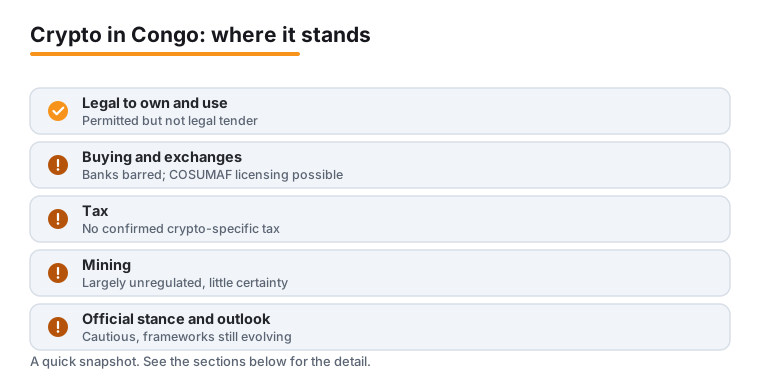
Quick answer — Congo, 2026
- Legal: Not legal tender; virtual asset activities prohibited in the DRC since 1 July 2025; banks barred under CEMAC in Brazzaville
- Tax: No crypto tax in either country; in the DRC, converting crypto into currency is instead punished by a fine of up to three times the sum converted
- Buying: Mostly global exchanges, P2P and mobile money
"Congo" can mean two separate neighbouring countries, and their cryptocurrency rules are not the same. The Democratic Republic of the Congo (DRC), capital Kinshasa, uses the Congolese franc (CDF) and has its own central bank, the Banque Centrale du Congo (BCC). The Republic of the Congo (Congo-Brazzaville) is a member of the CEMAC monetary union, uses the Central African CFA franc (XAF) and sits under the regional central bank, the Bank of Central African States (BEAC), with its financial market supervised by COSUMAF. Because of this, the legal treatment of Bitcoin and other crypto-assets differs between the two countries. This guide explains the current 2026 position in both, covering legal status, regulators, key frameworks, exchange and VASP licensing, taxation, anti-money-laundering rules, practical use, mining, recent developments, consumer risk and how to verify everything with official sources. For wider background see our guide to crypto regulation.
This page is general information current as of 2026 and is not legal, tax or financial advice. Crypto rules in Central Africa are evolving and several measures are still draft proposals. Always confirm the current position with the named official regulator and a qualified local professional before acting.
On this page: Legal status · Who regulates it · Taxes · How to buy · Mining
Legal status of Bitcoin and crypto in Congo
In the Democratic Republic of the Congo, virtual asset activities and virtual asset service providers are prohibited. Article 22 bis, inserted into the anti-money-laundering law by Law 25/048 of 1 July 2025, states that virtual asset activities and virtual asset service provider activities are prohibited in the Democratic Republic of the Congo, and punishes anyone who converts virtual assets into any currency quoted by the Banque Centrale du Congo with a fine of up to three times the sum converted. The prohibition is written as a ban on activities, so simply holding Bitcoin is not expressly criminalised, but there is no safe harbour and no implementing guidance. Crypto is not legal tender and is not an official means of payment: prices must be charged and settled in Congolese francs or, in practice, US dollars, so merchants are not obliged to accept Bitcoin. The Banque Centrale du Congo has taken a cautious, sceptical stance and has issued public warnings about unapproved schemes presenting themselves as cryptocurrency.
In the Republic of the Congo (Brazzaville), the position is set at the CEMAC regional level. Neither the national government nor the regional central bank treats crypto as currency. Banks, microfinance institutions and payment providers are barred from facilitating crypto transactions, while specialist digital-asset service providers can in principle be licensed by the regional financial market regulator. Individual ownership is not explicitly criminalised, but the formal financial system is largely closed to crypto.
Neither country has made Bitcoin legal tender. For context, the nearby Central African Republic briefly adopted Bitcoin as legal tender in 2022 and reversed that status in 2023; neither Congo has followed the legal-tender route.
Who regulates crypto in Congo
There is no single "Congo" regulator, because two different monetary systems are involved.
Democratic Republic of the Congo
- The Banque Centrale du Congo (BCC) oversees monetary policy and the payment system. It has issued cautionary public notices about crypto and is expected to play the central role if a dedicated framework is enacted. Official site: Banque Centrale du Congo.
- Government ministries responsible for finance and the digital economy have led work on a future digital-asset framework that could license exchanges and token issuers.
Republic of the Congo (Brazzaville)
- The Bank of Central African States (BEAC) is the common central bank for the six CEMAC states, including Congo-Brazzaville. Official site: BEAC.
- The Central African Banking Commission (COBAC) supervises banks and is the source of the 2022 restriction on financial institutions handling crypto.
- The Financial Market Supervisory Commission (COSUMAF) regulates the regional capital market and is the body that can authorise digital-asset service providers. Official site: COSUMAF.
Key laws and frameworks
Neither country has a licensing code for crypto, but the DRC has taken the opposite route and legislated a prohibition. Article 22 bis of Law 25/048 of 1 July 2025, which amends anti-money-laundering Law 22/068 of 27 December 2022, bans virtual asset activities and virtual asset service providers outright and entered into force on the date of its promulgation. For Congo-Brazzaville the rules sit at the CEMAC regional level, where supervised banks are barred from crypto and a licensing route exists on paper but has not been used.
CEMAC zone (Congo-Brazzaville)
- COBAC Decision D-2022/071 of 6 May 2022 prohibits banks, microfinance institutions and payment service providers under COBAC supervision from holding, exchanging, converting or settling cryptocurrency transactions, including against the CFA franc.
- The COSUMAF General Regulation of 23 May 2023 created a framework recognising digital-asset service providers as market intermediaries. Its provisions require a digital-asset service provider to obtain a COSUMAF licence and define services such as custody, exchange and operating a trading platform. This produces a split system: traditional banks are barred from crypto, while specialist VASPs can in principle be authorised. In practice no such licence has yet been reported as issued.
Democratic Republic of the Congo
- The DRC now has an express statutory prohibition. Law 25/048 of 1 July 2025 amended anti-money-laundering Law 22/068 of 27 December 2022 and inserted article 22 bis, which prohibits virtual asset activities and virtual asset service providers, requires the competent authority to identify providers operating without a licence or registration, and punishes conversion of virtual assets into any currency quoted by the Banque Centrale du Congo with a fine of up to three times the sum converted.
- A draft Digital-Asset Bill reported as under inter-ministerial review in 2025 has not been traced to any published Congolese text. What is on the statute book is the prohibition in article 22 bis of Law 25/048 of 1 July 2025, which bans virtual asset activities rather than licensing them. As of 2026 this should be treated as proposed rather than confirmed enacted law; verify its status with the BCC and official gazette before relying on it.
Licensing and registration of exchanges and VASPs
Requirements differ sharply between the two countries.
Republic of the Congo (Brazzaville)
Under the COSUMAF General Regulation of 23 May 2023, a digital-asset service provider must apply to and be licensed by COSUMAF to operate legally in the CEMAC market. The regulation covers services including custody of digital assets, exchanging crypto against legal tender or other crypto, operating a trading platform, and order reception, portfolio management or advice. At the same time, COBAC-supervised banks and payment providers cannot facilitate these transactions, which constrains how a licensed VASP can connect to the banking system. Anyone planning to offer exchange services should check the current instructions on the COSUMAF site.
Democratic Republic of the Congo
The DRC does not licence exchanges at all: under article 22 bis of Law 25/048 of 1 July 2025 virtual asset service provider activity is prohibited, so there is no application to make. Reported drafts describe a future Digital-Asset Service Provider (DASP) licence regime, but until the bill is enacted there is no established domestic licence to obtain, and most users rely on international platforms and peer-to-peer trading. Treat any specific licensing terms circulating online as draft proposals until officially confirmed.
Crypto taxation in Congo
No crypto-specific tax provision could be traced in any published text in either country, and you should not rely on a quoted rate or threshold seen online. In the DRC the question is largely academic, because article 22 bis of Law 25/048 of 1 July 2025 prohibits virtual asset activities and penalises conversion into currency.
In the DRC, reporting around the draft Digital-Asset Bill has referenced a 5% withholding on crypto-to-fiat conversions above roughly US$5,000. No such levy appears in Law 22/068 of 27 December 2022 or in Law 25/048 of 1 July 2025, and the figure should be disregarded. The number that does exist is a penalty rather than a tax: article 22 bis punishes conversion of virtual assets into any currency quoted by the Banque Centrale du Congo with a fine of up to three times the sum converted. Where crypto activity produces income or gains today, it may fall under existing tax categories such as income or business profits depending on how the activity is characterised.
In Congo-Brazzaville, there is no widely publicised crypto-specific tax. General income, business-profit and capital rules may apply depending on circumstances.
Because outcomes depend on residency, the nature of the activity and the amounts involved, confirm your obligations with a qualified local tax adviser and the national tax authority before assuming any treatment. See our crypto tax overview for general concepts. This section is informational only and is not tax advice.
AML, KYC and reporting rules
Anti-money-laundering and know-your-customer obligations are the area where formal rules most clearly touch crypto in the region.
In the CEMAC zone, including Congo-Brazzaville, financial institutions operate under regional anti-money-laundering and counter-terrorist-financing standards, and COBAC supervises compliance. The COSUMAF framework for digital-asset service providers brings licensed VASPs within the supervised market, which implies customer due-diligence and reporting expectations consistent with the wider regime. The 2022 COBAC restriction itself was justified partly on financial-stability and consumer-protection grounds.
In the DRC, anti-money-laundering law now addresses crypto directly. Law 22/068 of 27 December 2022, as amended by Law 25/048 of 1 July 2025, defines virtual assets and virtual asset service providers, prohibits their activities, and requires the competent authority to assess the money-laundering and terrorist-financing risks they create. The enacted law sets an express statutory threshold, where the 2022 law had left the figure to a ministerial order. Article 92 bis, inserted by Law 25/048, requires an electronic money institution to report to the Cellule nationale des renseignements financiers any funds transmission carried out from a cash deposit or by means of electronic money, as a single operation or several apparently linked operations, in Congolese francs or another currency, globally equal to or above USD 3,000.
In practice, reputable international exchanges already apply identity verification (KYC) to users in both countries. Complete those checks honestly, keep records, and be aware that foreign-exchange and reporting rules may apply to larger transfers. Verify the current requirements with the BCC or COSUMAF as relevant.
Buying and using crypto in practice
Neither Congo hosts a significant base of domestically licensed crypto exchanges, so most users rely on global platforms, peer-to-peer (P2P) marketplaces and mobile-money rails.
In the DRC
Buying and selling is generally possible through international exchanges and P2P services, often funded via mobile money or US dollars. Because there is no confirmed domestic licensing or deposit-protection regime, users carry counterparty and custody risk themselves.
In the Republic of the Congo (Brazzaville)
The 2022 COBAC restriction on banks and payment providers makes bank-based on-ramps unreliable, so users frequently turn to P2P trading and international platforms, accepting greater operational risk and weaker legal protection.
There is no established, well-documented network of Bitcoin ATMs in either country; physical crypto kiosks are rare to non-existent across most of Central Africa. Most residents convert between cash and crypto through mobile money combined with P2P trades or online exchanges. Practical pointers for either country: prefer reputable platforms with strong security records, complete identity verification truthfully, keep transaction records, watch for scams on informal P2P channels, confirm a service genuinely supports your country before depositing, and never transfer funds you cannot afford to lose.
Crypto mining in Congo
The DRC is of particular interest for mining because of its substantial hydropower potential, including in the east of the country, where small operations have reportedly used cheap renewable electricity. Mining is not named in Congolese law, but it no longer sits in neutral space. Article 22 bis of Law 25/048 of 1 July 2025 prohibits virtual asset activities generally, and separately punishes conversion of virtual assets into any currency quoted by the Banque Centrale du Congo with a fine of up to three times the sum converted, which is the step a miner takes to be paid in local money. There is no mining licence to obtain and no exemption.
Several factors complicate mining in the region:
- Energy and infrastructure: access to reliable power and connectivity is uneven, and grid constraints can limit larger projects.
- Environmental and community impact: energy use, local heating, noise and e-waste are genuine concerns, with limited monitoring capacity.
- Governance and security risk: conditions in some eastern areas, together with weak enforcement infrastructure, add operational risk.
In the Republic of the Congo, there is no notable regulated mining industry, and the broader CEMAC stance offers little encouragement. Anyone considering a mining operation in either country should assess electricity rights, environmental obligations, hardware import rules and political risk, and obtain local legal advice before committing capital.
Recent developments in 2025 and 2026
The most important recent theme is that Central African authorities are actively working on crypto policy rather than ignoring it.
- BEAC and IMF work on a regional framework. From 23 to 27 February 2026 the BEAC and the IMF held a strategic seminar in Yaounde with COBAC, COSUMAF and GABAC, to build institutional capacity on central bank digital currency and to define a harmonised and secure framework for crypto-assets. No draft text, consultation or publication date has been announced. As of mid-2026, treat the framework as work in progress and confirm the current text and status on the BEAC site.
- Digital CFA franc. The BEAC has publicly favoured developing a digital CFA franc as its response to dollar-backed stablecoins, rather than opening the zone to private tokens, with the governor stressing a single parity of one CFA franc to one digital CFA franc.
- DRC Digital-Asset Bill. What the DRC Parliament actually adopted in 2025 was a prohibition, not a licensing regime. Law 25/048 of 1 July 2025 inserted article 22 bis into the anti-money-laundering law, banning virtual asset activities and virtual asset service providers and penalising conversion of virtual assets into any currency quoted by the Banque Centrale du Congo. No DASP licensing text and no conversion levy could be traced to any published Congolese text. Reporting also described plans for a regulatory sandbox. As of 2026 readers should treat these specific terms as proposals pending official enactment.
Because these measures are evolving, dates and details should be re-checked against primary sources before you rely on them.
Consumer risks and protection
The defining feature of crypto in both Congos is uncertainty, and consumer protection is limited. Key risks to keep in mind:
- Weak recourse: with little or no confirmed domestic licensing and deposit-protection framework, recovering funds after fraud, hacks or platform failure can be very difficult.
- Scams: the BCC has warned about schemes posing as cryptocurrency to collect savings illegally; guaranteed-return offers and unknown P2P counterparties are common danger points.
- Market volatility: Bitcoin and other crypto-assets are highly volatile and can lose value rapidly. This guide makes no price predictions and does not recommend buying or selling.
- Conversion friction: turning crypto back into spendable local currency can be harder than in markets with mature, regulated exchanges, especially under the CEMAC restrictions affecting Brazzaville.
- Regulatory change: rules could tighten, impose new taxes or reporting duties, or change access.
If you choose to participate, common-sense risk management applies: only commit money you can afford to lose, be wary of guaranteed returns, use reputable services, keep good records, and consider professional advice. This section is informational only and is not financial advice.
Official sources and how to verify
Because rules are fragmented and changing, always check primary sources rather than relying on general summaries. The key official bodies are:
- Banque Centrale du Congo (DRC central bank): public notices, monetary policy and warnings at bcc.cd.
- Bank of Central African States (BEAC): regional monetary policy and crypto-framework announcements at beac.int.
- COSUMAF (CEMAC financial market regulator): the regulation and instructions governing digital-asset service providers at cosumaf.org.
For independent context on the DRC business and legal environment, the US State Department 2025 Investment Climate Statement for the DRC is a useful government reference. You can also compare with our overview pages on crypto regulation by country and how crypto regulation works. This page is general information current as of 2026 and is not legal advice; confirm any specific point with the named official regulator before acting.
What is changing: August 2026 status
Two things have moved since this page was last reviewed, and they point in opposite directions. The Democratic Republic of the Congo now has an express statutory prohibition on virtual asset activity, in force since 1 July 2025. The CEMAC zone that governs Congo-Brazzaville still has no crypto rulebook, and its ministers adopted none at their most recent session.
| Date | What happened | Status now |
|---|---|---|
| 1 July 2025 | DRC: Law 25/048 amends anti-money-laundering Law 22/068 and inserts article 22 bis, which prohibits virtual asset activities and virtual asset service providers and punishes conversion of virtual assets into any currency quoted by the Banque Centrale du Congo. Article 4 of the same law brings it into force on the date of promulgation (promulgated text published by CENAREF) | In force since 1 July 2025 |
| 23 to 27 February 2026 | BEAC and the IMF hold a seminar in Yaounde with COBAC, COSUMAF and GABAC on central bank digital currency and a harmonised CEMAC crypto-asset framework (report, and a second account of the same seminar) | Capacity building only. No draft text and no date announced |
| April 2026 | Congolese media report that the BCC will bar cash transactions in foreign currency from 9 April 2027 and become the sole importer of foreign banknotes (reported 11 April 2026) | Reported announcement. No instruction number published |
| June 2026 | Congolese reporting of the June 2026 FATF plenary states that the DRC was recognised as having completed all 23 items of its action plan in a largely satisfactory manner, with a FATF expert mission to Kinshasa expected in August 2026 and a decision at the October 2026 plenary (report of 28 June 2026) | Grey list exit pending, on national reporting |
| 22 July 2026 | The UMAC Ministerial Committee meets in N'Djamena. The communique records no crypto-asset decision. COBAC reported progress on revising the CEMAC payment service provider framework (communique, also listed by the Congo-Brazzaville finance ministry) | No CEMAC crypto text exists |
What has not changed: no digital asset service provider licence had been granted by COSUMAF as of the last traceable reporting, on 27 June 2025 (Investir au Cameroun); the COSUMAF website could not be reached to check the 2026 position. Neither Congo has made Bitcoin legal tender, and no crypto-specific tax provision could be traced in either country.
Article 22 bis: what the DRC prohibition actually says
The operative text is article 22 bis, inserted into Law 22/068 of 27 December 2022 by article 2 of Law 25/048 of 1 July 2025. That article inserts articles 22 bis, 34 bis, 34 ter, 73 bis, 73 ter, 92 bis, 130 bis, 158 bis, 161 bis and 168 bis. Article 3 repeals earlier provisions contrary to the law and article 4 provides that it enters into force on the date of its promulgation, the certified copy being dated Kinshasa, 1 July 2025 (text published by CENAREF, the Congolese financial intelligence unit, alongside the 2022 law it amends).
| Provision | What it does |
|---|---|
| The prohibition | Virtual asset activities and virtual asset service provider activities are prohibited in the Democratic Republic of the Congo. The French text reads: Les activites d'actifs virtuels ou des prestataires de services d'actifs virtuels sont interdites en Republique Democratique du Congo. |
| Supervisory duty | The competent authority identifies and assesses the money-laundering and terrorist-financing risks arising from virtual asset activities and from the activities or operations of virtual asset providers. |
| Unlicensed operators | The authority also takes measures to identify natural or legal persons carrying on virtual asset provider activity without being licensed or registered as required, and to apply to them the sanction in the following paragraph. |
| The penalty for cashing out | A fine whose maximum equals three times the amount of the sum converted, for anyone who engages in the conversion of virtual assets into any currency quoted by the Banque Centrale du Congo. The French reads: Est puni d'une amende dont le maximum est egal a trois fois le montant de la somme convertie en actif virtuel, quiconque se livre a la conversion d'actifs virtuels en toute monnaie cotee par la Banque Centrale du Congo. |
| Companies | Where conversion activity is carried out for or on behalf of a legal person by one of its organs or its representative, the penalties in points 1 to 5 of article 126 apply in addition to the fine. Those five are a ban on certain professional activities permanently or for up to five years, permanent or temporary closure of the establishments used, dissolution where the entity was created to commit the acts, publication of the judgment, and exclusion from public procurement for six months to five years or permanently. |
| Mobile money reporting (article 92 bis) | An electronic money institution reports to the Cellule nationale des renseignements financiers information on funds transmission operations carried out from a cash deposit or by means of electronic money, whether one operation or several apparently linked, in Congolese francs or another currency, globally equal to or above USD 3,000. |
| The definitions it relies on | Article 22 bis does not define its terms, but the law it amends does. Law 22/068 defines a virtual asset as a digital representation of value that can be traded or transferred digitally and used for payment or investment purposes, excluding digital representations of fiat currencies, securities and other financial assets; and defines a virtual asset service provider as a person who, as a commercial activity, provides crypto-to-fiat or crypto-to-crypto exchange, transfer, custody or administration, or services connected with an issuer's offer or sale of a virtual asset (Law 22/068). |
| What it does not say | It does not mention mining, and it does not expressly criminalise simply holding crypto. It bans activities. No BCC instruction or other implementing text applying article 22 bis was found. |
One point is unresolved on the face of the statute. Article 22 bis prohibits virtual asset provider activity outright, yet it also tells the authority to find providers operating without a licence or registration, and article 83 of the 2022 law, which Law 25/048 does not amend, still requires the competent authorities to subject virtual asset providers to prior licensing or registration. Article 3 of the 2025 law repeals earlier contrary provisions, which leaves the interaction to be settled by an implementing text or a court. A Congolese legal analysis published on 12 May 2026 makes a related point on scope, noting that the text bans activities but does not expressly mention simple holding of crypto-assets, and that on a strict reading of criminal law any conversion or commercial dealing would be caught (analysis of article 22 bis). Until that is settled, treat any crypto activity in the DRC as legally exposed.
Who this affects, and how
| You are | Democratic Republic of the Congo | Republic of the Congo (Brazzaville) |
|---|---|---|
| Holding crypto | Not expressly criminalised. Article 22 bis bans activities, not possession, and the definition of a provider it relies on requires activity carried on as a commercial activity. There is no safe harbour and no regulator guidance confirming that reading. | Not criminalised. BEAC's own report records that crypto-assets are bought and exchanged freely between CEMAC citizens. |
| Selling or cashing out | An offence. Converting virtual assets into any currency quoted by the BCC carries a fine of up to three times the sum converted. | Not an offence for the individual, but no COBAC-supervised bank or payment provider may settle it for you under Decision D-2022/071 of 6 May 2022. |
| Running an exchange or broker | Prohibited. There is no licence to apply for. | Requires a COSUMAF licence under the general regulation adopted in May 2023. None had been granted as of reporting on 27 June 2025. |
| A bank, microfinance institution or e-money issuer | Bound by the anti-money-laundering law as amended. Electronic money institutions must report cash-funded or e-money funds transmissions of USD 3,000 or more to CENAREF. | Not authorised to subscribe to or hold cryptocurrencies or virtual currencies of any kind, for their own account or for third parties, the prohibition covering any operation linked to crypto-assets, and it reaches technical partners in payment services too. |
| Mining | Not named in the law, but article 22 bis prohibits virtual asset activities generally and separately penalises conversion into any currency quoted by the BCC, which is the step a miner takes to be paid in local money. There is no mining licence and no exemption. | No crypto mining regime was found in any CEMAC or national text. |
| A taxpayer | No crypto tax provision was traced in any published Congolese text, and no tax authority guidance was found. | No crypto-specific tax provision was traced. |
One consequence is worth flagging for anyone in the DRC who trades peer-to-peer. Congolese media reported in April 2026 that the BCC intends to bar cash transactions in foreign currency from 9 April 2027 and to become the sole importer of foreign banknotes. No instruction number was published with that reporting. If it is applied as reported, the US dollar cash leg that many peer-to-peer trades settle on becomes harder at the same time as conversion is already an offence.
Frequently asked questions
Which Congo does this page cover?
Both. "Congo" commonly refers to two separate countries: the Democratic Republic of the Congo (DRC, capital Kinshasa) and the Republic of the Congo (Congo-Brazzaville). They have different currencies and regulators, so their crypto rules differ. The DRC is overseen by the Banque Centrale du Congo, while Congo-Brazzaville falls under the CEMAC regional central bank, the BEAC, with its financial market supervised by COSUMAF.
Is Bitcoin legal in Congo?
In the DRC, no. Article 22 bis, inserted into the anti-money-laundering law by Law 25/048 of 1 July 2025, prohibits virtual asset activities and virtual asset service providers, and punishes conversion of virtual assets into any currency quoted by the Banque Centrale du Congo with a fine of up to three times the sum converted. The ban is written as a ban on activities, so simply holding crypto is not expressly criminalised, but it is not legal tender and merchants are not obliged to accept it. In Congo-Brazzaville, individual ownership is not explicitly criminalised, but banks and payment providers are barred from handling crypto under a 2022 CEMAC regional rule. Neither country has made Bitcoin legal tender.
Can banks in Congo handle crypto transactions?
In Congo-Brazzaville, a COBAC decision of 6 May 2022 prohibits banks, microfinance institutions and payment providers across the CEMAC zone from holding, exchanging or settling cryptocurrency transactions, so bank-based on-ramps are unreliable. In the DRC there is no confirmed dedicated licensing regime, and access typically runs through mobile money, US dollars and international or peer-to-peer platforms rather than formal bank crypto services.
Do I have to pay tax on crypto in Congo?
No crypto-specific tax provision could be traced in either country. The widely repeated claim that the DRC applies a 5% withholding on crypto-to-fiat conversions above US$5,000 does not appear in Law 22/068 of 27 December 2022 or in Law 25/048 of 1 July 2025 and should be disregarded. What the DRC does have is article 22 bis, which punishes conversion of virtual assets into any currency quoted by the Banque Centrale du Congo with a fine of up to three times the sum converted. Where crypto produces income or gains today, existing tax categories may apply. Confirm your obligations with a qualified local tax adviser and the national tax authority. This is not tax advice.
How do you get a crypto exchange licence in Congo?
In Congo-Brazzaville, the COSUMAF General Regulation of 23 May 2023 requires a digital-asset service provider to be licensed by COSUMAF to operate in the CEMAC market, covering services such as custody, exchange and running a trading platform; check current instructions at cosumaf.org. In the DRC there is no confirmed dedicated exchange licence yet, though a future Digital-Asset Service Provider (DASP) licence has been proposed in draft legislation.
Is there a CEMAC-wide crypto regulation coming?
The regional authorities are working on one. From 23 to 27 February 2026 the Bank of Central African States (BEAC) and the IMF held a seminar in Yaounde with the banking supervisor COBAC, the market regulator COSUMAF and the regional anti-money-laundering body GABAC, on central bank digital currency and a harmonised crypto-asset framework, and no publication date was announced. The UMAC Ministerial Committee met in N'Djamena on 22 July 2026 and adopted nothing on crypto-assets. As of mid-2026 this should be treated as work in progress rather than a finished code. The BEAC has also said it favours developing a digital CFA franc rather than opening the zone to private tokens or dollar stablecoins. Check the current status at beac.int and cosumaf.org.
Is crypto mining legal in the DRC?
Mining is not named in Congolese law, but article 22 bis of Law 25/048 of 1 July 2025 prohibits virtual asset activities generally and punishes conversion of virtual assets into any currency quoted by the Banque Centrale du Congo, which is how a miner is paid in local money, so there is neither a licence nor an exemption. Some small operations have reportedly used cheap hydropower in the east of the country. Anyone considering mining should weigh unreliable power and connectivity, environmental and community impact, and security and governance risk in some areas, and take local legal advice before committing capital.
Where can I verify the official crypto rules for Congo?
Use primary sources: the Banque Centrale du Congo (bcc.cd) for the DRC, and for Congo-Brazzaville the Bank of Central African States (beac.int) plus the CEMAC financial market regulator COSUMAF (cosumaf.org), which publishes the digital-asset service provider rules. Because the law is evolving and some measures are still draft proposals, always check these official sites and seek qualified local advice before acting.
Is crypto banned in the Democratic Republic of the Congo?
Yes, as an activity. Article 22 bis, inserted into anti-money-laundering Law 22/068 of 27 December 2022 by Law 25/048 of 1 July 2025, states that virtual asset activities and virtual asset service provider activities are prohibited in the Democratic Republic of the Congo. The law entered into force on the date of its promulgation, 1 July 2025. It bans activities rather than possession, and the definition of a provider it relies on requires activity carried on as a commercial activity, so simply holding crypto is not expressly criminalised. No regulator has published guidance confirming that reading, and there is no licensing route of any kind.
What is the penalty for cashing out crypto in the DRC?
Article 22 bis punishes anyone who engages in the conversion of virtual assets into any currency quoted by the Banque Centrale du Congo with a fine whose maximum equals three times the amount of the sum converted. Where the conversion is carried out for or on behalf of a company by one of its organs or its representative, the penalties in points 1 to 5 of article 126 of the same law apply in addition. Those five are a ban on carrying on certain professional activities permanently or for up to five years, permanent or temporary closure of the establishments used, dissolution where the company was created to commit the acts, publication of the judgment, and exclusion from public procurement for six months to five years or permanently.
Does the DRC ban apply in Congo-Brazzaville as well?
No. They are separate countries with separate legal systems. Law 25/048 is Congolese law from Kinshasa and has no effect in Brazzaville. In the Republic of the Congo the position is set at CEMAC level: COBAC Decision D-2022/071 of 6 May 2022 means supervised institutions and their technical partners in payment services are not authorised to subscribe to or hold cryptocurrencies of any kind for their own account or for third parties, and the prohibition covers any operation linked to crypto-assets. COSUMAF can in principle licence a digital asset service provider under the general regulation it adopted in May 2023, but no such licence had been granted as of reporting on 27 June 2025.
Is a CEMAC crypto rulebook coming, and when?
There is a mandate but no text and no date. The CEMAC heads of state summit of 17 March 2023 in Yaounde reaffirmed the CFA franc as the only legal currency of the six member states and tasked BEAC with creating a regulatory framework for crypto-assets. BEAC and the IMF then held a seminar in Yaounde from 23 to 27 February 2026 with COBAC, COSUMAF and GABAC on central bank digital currency and a harmonised crypto-asset framework. The UMAC Ministerial Committee met in N'Djamena on 22 July 2026 and its communique records no crypto-asset decision. Treat the framework as unpublished work with no announced timetable.
Does the DRC report mobile money transactions to the financial intelligence unit?
Yes, above a threshold. Article 92 bis, also inserted by Law 25/048 of 1 July 2025, requires an electronic money institution to report to the Cellule nationale des renseignements financiers any funds transmission carried out from a cash deposit or by means of electronic money, as one operation or several apparently linked operations, in Congolese francs or another currency, globally equal to or above USD 3,000. Under the 2022 law that threshold had been left to a ministerial order; the 2025 law puts the figure in the statute.
Facts reviewed: 12 August 2026. Page updated: 12 August 2026.