Home › Crypto Regulation › Tanzania
Bitcoin & Cryptocurrency Regulation in Tanzania
Quick answer — Tanzania, 2026
- Legal: Unregulated grey zone, not legal tender; discouraged but not criminalised
- Tax: 3 percent withholding on digital-asset exchanges under Finance Act 2024
- Buying: No licensed local exchange, use global exchanges and P2P via mobile money
Tanzania occupies an unusual middle ground on digital assets. The Bank of Tanzania (BoT), the country's central bank, has repeatedly cautioned the public against trading or using virtual currencies, and government officials have publicly described crypto activity as illegal and to be avoided. Yet there is no dedicated statute that criminalises simply owning Bitcoin, and two important developments have shifted the picture: the Finance Act 2024 introduced a 3% withholding tax that explicitly recognises "digital assets" for tax purposes, and in December 2024 the High Court held that cryptocurrency transactions are not inherently illegal. This page explains how the rules stand as of 2026, who the relevant authorities are, and what individuals should keep in mind around buying, taxes, mining and remittances.
This article is general information as of 2026 and is NOT legal, tax or financial advice. Cryptocurrency policy in Tanzania is unsettled and evolving. Always verify the current position directly with the Bank of Tanzania and the Tanzania Revenue Authority, and consult a qualified local professional before acting. See our broader guide to crypto regulation for global context.
On this page: Legal status · Who regulates it · Taxes · How to buy · Mining
Is Bitcoin and crypto legal in Tanzania?
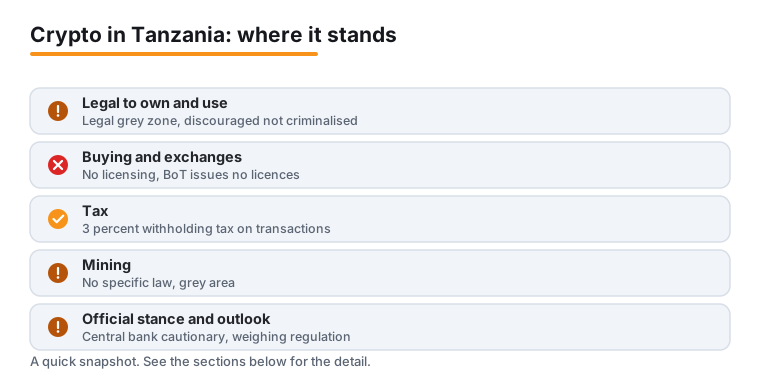
The honest answer is that crypto sits in a legal grey zone rather than being cleanly legal or banned. The Bank of Tanzania has issued public notices stating that the Tanzanian shilling (TZS) is the only recognised legal tender and warning citizens against trading in or transacting with virtual currencies. Senior officials have gone further, describing crypto as an illegal business that the public should avoid and use "at their own risk."
At the same time, no Tanzanian statute expressly makes it a crime to own or hold Bitcoin, and a landmark High Court ruling in December 2024 (the Yellow Card case) found that cryptocurrency transactions are not inherently illegal and that contracts involving them are not automatically void. The court reasoned, in part, that parties dealing in digital assets have been paying tax on those transactions, so the activity could not be declared unlawful.
The practical result is a discouraged-but-not-prosecuted environment. Crypto is not regulated, not recognised as legal tender, and not supervised by any local authority, so users have little formal recourse if a platform fails. Treat any claim that crypto is "fully legal" or "fully banned" in Tanzania with caution, and confirm the current stance with the regulator named below.
Who regulates crypto in Tanzania?
There is no single dedicated crypto regulator and no crypto-specific licensing authority. Instead, oversight is shared across existing bodies:
- Bank of Tanzania (BoT) is the central bank and the leading voice on virtual currencies. Its authority flows from its mandate over legal tender, the national payment system and foreign-exchange regulations. Its public notices warning against crypto remain the clearest official statement.
- Tanzania Revenue Authority (TRA) administers tax, including the withholding tax on digital-asset transactions introduced by the Finance Act 2024.
- Financial Intelligence Unit (FIU) sits at the centre of Tanzania's anti-money-laundering and counter-terrorism-financing framework and receives suspicious-transaction reports from banks and other reporting entities.
Official sources: Bank of Tanzania and the Tanzania Revenue Authority. Because no agency licenses or supervises crypto businesses, the absence of regulation should not be mistaken for a green light or a complete ban.
Key laws and frameworks
Tanzania does not yet have a comprehensive, crypto-specific law. Digital assets are instead touched by a patchwork of existing rules and guidance:
- Bank of Tanzania public notices on cryptocurrencies, which state that the shilling is the only legal tender and that trading virtual currencies conflicts with the country's foreign-exchange regulations. You can read the BoT notice via the Bank of Tanzania public notice on cryptocurrencies (PDF).
- Finance Act 2024, which amended the Income Tax Act to add Section 83C, introduced a withholding tax on digital-asset exchanges and provided a statutory definition of "digital assets." This was the first time Tanzanian tax law expressly recognised virtual assets.
- Foreign-exchange regulations administered by the BoT, which the central bank has cited as a reason crypto trading is problematic.
- Anti-money-laundering and counter-terrorism-financing law, administered through the FIU, which imposes know-your-customer and reporting obligations on regulated financial institutions.
Because there is no dedicated crypto act, treat these rules as the current framework and watch for change, as the government has signalled it is weighing whether to regulate the sector more formally.
Licensing and registration of exchanges and VASPs
As of 2026 Tanzania has no licensing or registration regime specifically for crypto exchanges or virtual-asset service providers (VASPs). There is no Tanzanian-regulated exchange in the sense found in jurisdictions with clear rules, and the BoT does not issue crypto-exchange licences.
In practice, Tanzanians who buy crypto generally use either global exchanges that accept local users (applying their own KYC checks) or peer-to-peer (P2P) marketplaces that settle in shillings via mobile money or bank transfer. Because none of this activity is locally supervised, the operative "rules" are the platform's own terms plus general law such as tax and AML expectations. The Finance Act 2024 does, however, place a tax-collection obligation on operators of digital-asset exchange platforms (see Taxation below), which is the closest thing to a statutory recognition of these businesses. Anyone using a platform should verify its reputation, complete identity checks honestly, keep transaction records, and understand that consumer-protection backstops common in regulated markets generally do not apply here.
How crypto is taxed in Tanzania
This changed materially in 2024. The Finance Act 2024 added Section 83C to the Income Tax Act, effective 1 July 2024, requiring residents or non-residents who own a digital-asset exchange platform, or who facilitate the exchange or transfer of digital assets, to withhold tax at 3% on payments made to resident persons for exchanging or transferring those assets. The Act defines "digital assets" broadly as anything of value that is not tangible, generated through cryptographic or other means and capable of being transferred, stored or exchanged electronically, which includes cryptocurrencies and tokens.
This 3% withholding is administered by the Tanzania Revenue Authority; see the TRA's own materials on the Tanzania Revenue Authority site. Under the mechanics set out by the TRA and tax advisers, a platform operator that facilitates these exchanges acts as the withholding agent, and the tax collected is remitted to the authority in Tanzanian shillings, or in an equivalent convertible currency converted at the Bank of Tanzania prevailing rate on the payment date. Beyond this withholding, general income-tax principles may apply depending on whether activity amounts to a business or generates other taxable income, but the detailed treatment of individual gains is still developing and we will not quote thresholds we cannot verify. Keep detailed records of every transaction and consult the TRA or a qualified local tax adviser. For background on how crypto tax works more generally, see our crypto taxes guide.
AML and KYC rules
Tanzania has anti-money-laundering (AML) and counter-terrorism-financing (CFT) obligations administered through its Financial Intelligence Unit, and the country follows the international standards set by the Financial Action Task Force (FATF). Banks, mobile-money operators and other reporting entities are required to verify customer identity (KYC) and file suspicious-transaction reports.
There is, however, no crypto-specific AML licensing or registration scheme of the kind FATF encourages for VASPs. In practice this means that while a crypto business itself is not separately supervised, the banks and mobile-money channels that fund or cash out crypto trades apply their own KYC and monitoring, and may flag or block transactions they suspect are crypto-related. For the individual user, the practical takeaway is to expect identity verification on reputable platforms, to keep clean records, and to be aware that cross-border crypto flows can attract AML and foreign-exchange scrutiny.
Buying and using crypto in practice
If you choose to buy and are comfortable with the legal grey zone and the risks described here, the general process most Tanzanians follow looks like this:
- Choose a platform. Typically an established global exchange that accepts local customers, or a reputable P2P marketplace.
- Complete identity verification. Expect to provide ID so the platform can meet its KYC and AML obligations.
- Fund your account. Common methods are mobile money and bank transfer, settling in shillings. Check supported options and fees, and be aware a 3% tax may be withheld on exchange or transfer payments.
- Place your order and review costs. Check the price, spread and fees before confirming.
- Secure your holdings. For anything beyond a small amount, move coins to a wallet you control and safeguard the recovery phrase. Never share private keys or seed phrases.
Throughout, keep records for tax and compliance, stay alert to scams and impersonation, and remember that platform terms, not Tanzanian financial regulation, govern most of your protections. Crypto remittances (using Bitcoin or stablecoins to send value home, then converting to shillings) are a common real-world use case, but they operate outside the supervised remittance system and carry volatility, fee, platform and foreign-exchange risks; weigh them against regulated money-transfer services.
Stablecoins and remittances
Much of the practical crypto use reported in Tanzania is not speculation on Bitcoin's price but the use of dollar-pegged stablecoins such as USDT and USDC for everyday value transfer. Industry reporting through 2025 described these tokens being used for remittances, merchant payments and digital savings, typically funded and cashed out through mobile money in shillings. The appeal is speed and cost: traditional cross-border transfers into and out of the region can carry high fees, and stablecoin transfers settled over mobile money have been reported at lower cost in some corridors.
The same features that make stablecoins useful also carry risk. A stablecoin is only as sound as the issuer and reserves behind it, it is not legal tender in Tanzania, and it sits in the same unregulated grey zone as other crypto here. Users depend on the platform's own terms rather than local consumer protection, and cross-border flows can attract anti-money-laundering and foreign-exchange scrutiny. The 3% withholding on digital-asset exchanges can also apply. Treat stablecoins as a tool with real utility but real counterparty and regulatory risk, keep records, and prefer reputable platforms. For background see our guide to crypto remittances.
Bitcoin mining in Tanzania
Bitcoin mining is the process of running specialised computers to validate transactions and secure the network in exchange for newly issued coins. There is no Tanzanian law that specifically authorises or bans mining, so it falls into the same grey area as other crypto activity, and the country is not a notable mining hub.
The practical constraints are mainly about electricity. Mining is energy-intensive, and access to cheap, reliable power is the single biggest factor in whether it is viable. Parts of Tanzania face grid-reliability challenges, which complicates uninterrupted large-scale mining, though the country has real renewable potential in solar, wind and hydro that could in principle support cleaner operations. Anyone considering mining should weigh power cost and stability, equipment import duties, cooling, the 3% withholding on disposals of mined assets, and the unsettled legal status, and should seek local legal advice before committing capital.
Recent developments (2024 to 2026)
Several developments have reshaped the picture in recent years:
- Finance Act 2024 (effective 1 July 2024) introduced the 3% withholding tax on digital-asset transactions and a statutory definition of digital assets, the first formal recognition of virtual assets in Tanzanian law.
- High Court ruling, December 2024 (Yellow Card Tanzania v Nyamwero). The court held that cryptocurrency transactions are not inherently illegal and that related contracts are enforceable, partly because parties had been paying tax on them. This is a precedent on enforceability, not a regulatory licence.
- Central bank digital currency (CBDC) study. The Bank of Tanzania completed a study on a possible "digital shilling" (reported finalised around August 2025) and said it is awaiting a government directive on next steps. A CBDC would be state-issued central-bank money and is distinct from decentralised cryptocurrencies like Bitcoin.
- Stablecoin and remittance use grew in practice. Industry reporting through 2025 pointed to rising real-world use of dollar-pegged stablecoins such as USDT and USDC in Tanzania for remittances, savings and payments, funded and cashed out through mobile money. During a national internet disruption in late 2025, some users reportedly turned to Bitcoin to move value across borders when normal channels were unavailable, as covered by TechCabal.
- Ongoing policy debate. Officials and legal commentators have increasingly argued Tanzania should regulate rather than ban crypto, but as of 2026 no dedicated regulatory framework had been enacted.
Because the situation is evolving, confirm the latest position through the official channels before relying on any of the above.
Consumer risks and protection
The defining feature of crypto in Tanzania is uncertainty, and that creates real risks for users:
- No local supervision of platforms. Exchanges and P2P services serving Tanzanian users are not licensed locally, so formal recourse is limited if a platform fails or funds are lost.
- Regulatory risk. The rules are provisional and could move toward clearer regulation or tighter restriction; access and value could be affected.
- Volatility and irreversibility. Prices swing sharply, and lost keys, mistaken transfers or scams can mean permanent loss.
- Fraud and impersonation. Schemes targeting new users are common, and rising digital fraud has prompted the BoT to draft stronger cybersecurity rules for financial-service providers.
- AML and foreign-exchange scrutiny. Cross-border activity may attract attention under existing controls.
Sensible precautions apply: deal only with reputable platforms, enable strong security, never invest more than you can afford to lose, secure your private keys, and keep clear records. Consider speaking with a qualified financial or legal professional familiar with Tanzanian conditions.
Official sources and how to verify
Crypto policy in Tanzania can change with little notice, so verify the current position before acting rather than relying on secondary summaries. The authoritative sources are:
- Bank of Tanzania for the central bank's stance, public notices on virtual currencies, foreign-exchange rules and CBDC updates. Its Bank Supervision regulations page lists current financial-sector rules.
- Tanzania Revenue Authority for tax obligations, including the 3% withholding on digital-asset transactions under Section 83C of the Income Tax Act.
- The Bank of Tanzania public notice on cryptocurrencies (PDF) for the central bank's formal warning.
This page is general information as of 2026 and is NOT legal advice. The accurate description of Tanzania today is a legal grey zone: unregulated, not legal tender, taxed at source, and discouraged by the central bank, but not criminalised by statute. Always confirm with the Bank of Tanzania and the Tanzania Revenue Authority and seek qualified local advice. For our wider coverage, see crypto regulation by country.
Frequently asked questions
Is cryptocurrency banned in Tanzania?
Not by a clear statute. The Bank of Tanzania discourages virtual-currency use and stresses that the Tanzanian shilling is the only legal tender, and officials have called crypto an illegal business to be avoided. However, no dedicated law criminalises ownership, and in December 2024 the High Court held that crypto transactions are not inherently illegal. The accurate description is an unregulated legal grey zone rather than a formal ban. Confirm the current position with the Bank of Tanzania before acting.
Who regulates crypto in Tanzania?
There is no single dedicated crypto regulator. The Bank of Tanzania is the leading authority through its control of legal tender, payments and foreign exchange. The Tanzania Revenue Authority handles tax, and the Financial Intelligence Unit oversees anti-money-laundering reporting. As of 2026 there was no licensing regime specifically for crypto exchanges or virtual-asset service providers.
How is crypto taxed in Tanzania?
The Finance Act 2024 added Section 83C to the Income Tax Act, effective 1 July 2024, requiring operators of digital-asset exchange platforms (or those facilitating exchanges or transfers) to withhold 3% tax on payments to resident persons for exchanging or transferring digital assets. The law defines digital assets broadly to include cryptocurrencies and tokens. Other general tax may also apply depending on circumstances. Keep records and confirm details with the Tanzania Revenue Authority or a qualified local tax adviser.
Can crypto exchanges get a licence in Tanzania?
No. As of 2026 Tanzania had no licensing or registration regime specifically for crypto exchanges or virtual-asset service providers, and the Bank of Tanzania does not issue crypto-exchange licences. Most Tanzanians use global exchanges or peer-to-peer marketplaces, which are not supervised locally. The main statutory touchpoint is the Finance Act 2024 obligation on platform operators to withhold 3% tax.
What did the December 2024 High Court ruling mean for crypto?
In Yellow Card Tanzania Limited v Nyamwero (decided 13 December 2024) the High Court held that cryptocurrency transactions are not inherently illegal and that contracts involving them can be enforced, noting that parties had been paying tax on such dealings. It is an important precedent on the enforceability of crypto-related contracts, but it does not create a licensing framework or change the Bank of Tanzania's cautionary stance.
Is Tanzania launching a digital currency?
The Bank of Tanzania has studied a possible central bank digital currency, a digital version of the shilling, with the study reported finalised around August 2025, and says it is awaiting a government directive on next steps. A CBDC is state-issued central-bank money and is distinct from decentralised cryptocurrencies like Bitcoin. No launch had been confirmed as of 2026; check the Bank of Tanzania for the latest.
Are stablecoins like USDT used in Tanzania?
Yes, industry reporting through 2025 described dollar-pegged stablecoins such as USDT and USDC being used in Tanzania for remittances, payments and savings, usually funded and cashed out through mobile money in shillings. This use is not separately regulated, stablecoins are not legal tender, and the 3% withholding on digital-asset exchanges can apply. A stablecoin depends on its issuer and reserves, so treat it as a useful tool that still carries counterparty and regulatory risk, and keep records.
Does the 3% tax apply when I sell or transfer crypto in Tanzania?
The Finance Act 2024 requires operators of digital-asset exchange platforms, or those facilitating an exchange or transfer, to withhold 3% on payments made to resident persons for exchanging or transferring digital assets. In practice the platform acts as the withholding agent and remits the tax to the Tanzania Revenue Authority in shillings, or in a convertible currency at the Bank of Tanzania rate on the payment date. Other general tax may also apply depending on your circumstances. Confirm your position with the TRA or a qualified local tax adviser.
Facts reviewed: 30 June 2026. Page updated: 3 August 2026.