Home › Crypto Regulation › Zimbabwe
Bitcoin & Cryptocurrency Regulation in Zimbabwe
Quick answer — Zimbabwe, 2026
- Legal: Legal to own and use, not legal tender; businesses now licensed under Finance Act No. 7 of 2025
- Tax: No dedicated crypto tax code; ZIMRA applies income, capital gains, IMTT and withholding rules
- Buying: Via international exchanges and P2P with KYC; stablecoins common, no large licensed local exchange yet
Zimbabwe has one of Africa's most eventful cryptocurrency stories. After years of high inflation, currency reforms and tight foreign-exchange controls, many Zimbabweans turned to Bitcoin and dollar-pegged stablecoins to store value and move money across borders. The official response has swung from a 2018 banking directive that cut exchanges off from the financial system toward a formal, licence-based framework that took shape through 2025 and is being enforced in 2026. The turning point was the Finance Act No. 7 of 2025, which for the first time defined virtual assets in Zimbabwean law and created a dual-regulator licensing and anti-money-laundering regime for virtual asset service providers (VASPs).
This page explains where things stand for residents, businesses and travellers: whether crypto is legal, who regulates it, the key laws, how exchanges must register, how crypto is taxed, and the practical realities of buying, using and holding digital assets. For background, see our guide to crypto regulation and the wider regulation hub.
This article is general information as of 2026 and is not legal, tax or financial advice. Zimbabwe's crypto rules are new and still being implemented, so always verify the current position directly with the named official regulators (the Securities and Exchange Commission of Zimbabwe, the Financial Intelligence Unit, the Reserve Bank of Zimbabwe and the Zimbabwe Revenue Authority) and a qualified local professional before acting.
On this page: Legal status · Who regulates it · Taxes · How to buy · Mining
Is Bitcoin and crypto legal in Zimbabwe?
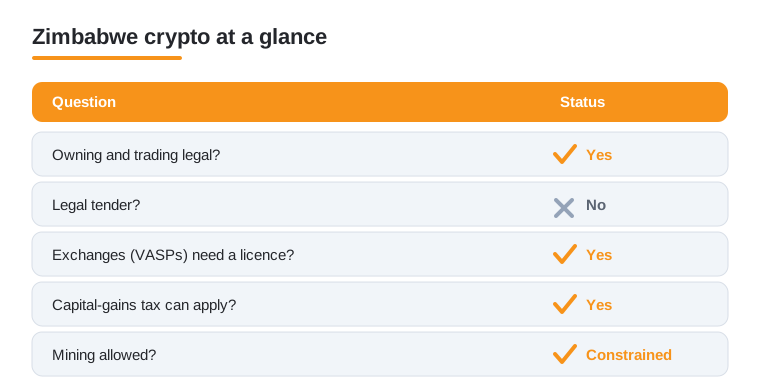
Owning, buying, selling and holding Bitcoin and other cryptocurrencies is legal for individuals in Zimbabwe, and the country has now moved from a tolerated grey zone toward formal regulation. However, cryptocurrency is not legal tender. The official currency is the Zimbabwe Gold (ZiG), introduced in April 2024, used alongside the US dollar under the multi-currency regime. No merchant is obliged to accept crypto, and you cannot demand it to settle a debt.
The legal direction changed decisively with the Finance Act No. 7 of 2025, which defined virtual assets in law and required businesses that provide crypto services to register and be licensed. So as of 2026, the position is: personal use is legal, but operating a crypto business is now a regulated, licensed activity rather than an informal one. Because the regime is brand new and being phased in, treat any blanket claim of legal or banned with caution and confirm the latest position with the official regulators named on this page.
Who regulates crypto in Zimbabwe?
Zimbabwe uses a multi-regulator model. Three institutions matter most:
- Securities and Exchange Commission of Zimbabwe (SECZ) is the primary licensing authority for virtual asset service providers under the new framework. It assesses applicants and issues virtual asset business licences. Official site: seczim.co.zw.
- Financial Intelligence Unit (FIU) handles anti-money-laundering and counter-financing-of-terrorism oversight. VASPs are treated as reporting entities and must register with the FIU and file reports through its goAML system. Official site: fiu.co.zw.
- Reserve Bank of Zimbabwe (RBZ) is the central bank, responsible for monetary policy, banking supervision and financial stability. It issued the early crypto directives, runs a fintech regulatory sandbox, and oversees the banking relationships that licensed crypto firms must maintain. Official site: rbz.co.zw.
The Zimbabwe Revenue Authority (ZIMRA) administers tax. In short, a compliant crypto business in Zimbabwe must satisfy the SECZ (licensing), the FIU (AML registration) and the RBZ (banking and monetary rules), and account for tax with ZIMRA.
Key laws and frameworks
There is no standalone "crypto act," but the rules are now anchored in specific legislation:
- Finance Act No. 7 of 2025 is the cornerstone. It defines a virtual asset as a digital representation of value that can be digitally traded or transferred and used for payment or investment, excluding regulated fiat currency and securities. It distinguishes virtual currency tokens (such as Bitcoin), asset tokens and non-fungible tokens.
- It amends the Money Laundering and Proceeds of Crime Act [Chapter 9:24], bringing VASPs within AML/CFT obligations and FIU supervision.
- It inserts a new Part VA into the Securities and Exchange Act [Chapter 24:25], creating the SECZ licensing regime for virtual asset businesses, including a requirement that the business be directed and managed from Zimbabwe.
- Earlier, the SECZ had issued guidance to virtual asset service providers, and the broader corporate framework (the Companies and Other Business Entities Act) and data-protection rules continue to apply.
The result is a dual-layered framework: AML registration through the FIU and business licensing through the SECZ, sitting alongside the RBZ's monetary and banking oversight. Because regulations and statutory instruments under these acts are still being rolled out, verify the current detail with the regulators directly.
Licensing and registration of exchanges (VASPs)
Under the Finance Act No. 7 of 2025, virtual asset service providers such as exchanges and custodians face a two-part requirement:
- AML registration with the FIU. VASPs are classified as reporting entities subject to anti-money-laundering and counter-terrorism-financing duties, including customer due diligence and reporting.
- Business licensing with the SECZ. Applicants typically must submit founding documents, a detailed business plan with financial projections, compliance and customer-due-diligence policies, proof of any international regulatory registration, and application fees. The SECZ applies a fit-and-proper assessment covering financial soundness, qualifications and experience, integrity and governance.
A notable feature is the local substance requirement: the business must be directed and managed from Zimbabwe (assessed by where strategy is set, where executives and the board operate, and where decisions are made), discouraging shelf-company arrangements. Licensed firms are also expected to maintain local banking relationships.
The AML registration side became concrete in June 2026. The Minister of Finance gazetted the Money Laundering and Proceeds of Crime (Virtual Asset Service Providers Registration) Regulations as Statutory Instrument 99 of 2026 on 10 June 2026, and the FIU issued a public notice bringing the rules into effect on 16 June 2026. Under these regulations, any business that exchanges crypto for fiat, transfers or safeguards virtual assets, or provides custody must register annually with the FIU. The registration fee is reported as US$500 for the initial certificate and US$400 for annual renewal. The regulations are broad on decentralisation: if an operator can adjust smart contracts, route funds or set transaction fees, the FIU can treat it as a VASP. The FIU has stated that operating without registration is a criminal offence.
Importantly, FIU registration is for AML/CFT purposes and does not by itself authorise a firm to carry on business. Depending on the model, a VASP may still need separate operational approval from the SECZ or the RBZ. Confirm current application steps, fees and any deadlines with the FIU and the SECZ.
Crypto taxation in Zimbabwe
Zimbabwe has not yet enacted a dedicated crypto tax code, so the Zimbabwe Revenue Authority (ZIMRA) generally applies existing tax rules to crypto activity. In practice this can mean:
- Capital gains and income tax. ZIMRA treats crypto as a taxable asset under the Income Tax Act. Gains on disposals may be treated under capital gains rules, while crypto from trading as a business, mining, staking, airdrops or crypto-denominated income can fall under income tax. Rates and treatment depend on your circumstances, so confirm the current figure that applies to you rather than assuming one.
- Intermediated Money Transfer Tax (IMTT). Zimbabwe's transaction levy can apply when value moves through formal banking and payment channels, which touches crypto on-ramps and off-ramps. It is reported at 2% on US-dollar transfers and 1.5% on ZiG transfers.
- Digital services withholding tax. A 15.5% withholding tax on payments to offshore or non-resident digital service providers took effect from 1 January 2026 and can apply to payments made to foreign crypto exchanges.
- VAT. Broad tax changes from the Finance Act No. 7 of 2025 raised standard VAT to 15.5%. Crypto transactions themselves are reported as VAT-exempt, but the 15.5% rate can be withheld on payments to non-resident providers that are not registered for VAT, from 1 January 2026.
In April 2026, ZIMRA publicly asked online earners and crypto traders to voluntarily declare and start paying tax, with penalties waived (though interest still charged) for those disclosing by 30 June. Because crypto-specific guidance is still developing and rules change frequently, confirm your exact obligations with ZIMRA or a qualified Zimbabwean tax adviser. For general concepts, see our crypto tax basics. Keep full records of every purchase, sale, transfer and conversion.
AML, KYC and the Travel Rule
Anti-money-laundering compliance is now central to Zimbabwe's crypto regime. By amending the Money Laundering and Proceeds of Crime Act [Chapter 9:24], the Finance Act No. 7 of 2025 brings VASPs within the AML/CFT framework supervised by the Financial Intelligence Unit. Expect:
- Customer due diligence (KYC). Identity verification, proof of address and ongoing monitoring of customers.
- Reporting duties. Registration as a reporting entity and submission of suspicious-transaction and other reports, including through the FIU's goAML system.
- Risk-based controls. Documented risk classifications and record-keeping, in line with global Financial Action Task Force (FATF) standards, which include the funds-transfer "Travel Rule" for sharing originator and beneficiary information.
For individuals, the practical effect is that reputable platforms serving Zimbabweans will require identity verification and may ask about source of funds. Serious or repeated AML breaches by firms can attract substantial FIU penalties. Verify current AML obligations with the FIU.
Buying and using crypto in practice
With no large licensed domestic exchange operating openly during the transition, most Zimbabweans buy crypto through reputable international exchanges and peer-to-peer (P2P) marketplaces, often funding purchases with US dollars, mobile money or bank transfers. A typical path:
- Choose a reputable platform with a strong security record, and check whether it is permitted to serve Zimbabwean customers as the licensing regime takes effect.
- Complete KYC by providing a government ID and, often, proof of address.
- Fund and buy. Foreign-exchange controls and banking limits can complicate funding and cashing out, so many users rely on P2P, which adds counterparty risk. Use escrow and trade only with reputable counterparties.
- Prefer stablecoins for value in transit. Given currency volatility, dollar-pegged stablecoins (such as USDT) are widely used for saving and remittances, with Bitcoin held as a longer-term, higher-risk asset.
- Secure your holdings. Move significant amounts to a wallet you control; a hardware wallet offers strong protection. Never share your recovery phrase.
- Keep records for tax and compliance.
Physical Bitcoin ATM infrastructure is very limited, so do not rely on kiosks. As licensing matures, expect clearer rules on which providers may serve residents.
Bitcoin mining in Zimbabwe
Crypto mining is technically possible but constrained by Zimbabwe's biggest infrastructure challenge: electricity. Persistent power shortages and load-shedding make grid reliability a serious obstacle for operations that need continuous, low-cost power, and high or unpredictable energy costs can quickly erode profitability.
Because of this, much interest centres on renewable and off-grid energy, especially solar, to reduce reliance on an unstable grid, though the upfront capital is substantial. There is no widely publicised dedicated mining-licensing regime, so miners operate amid the same general uncertainty affecting the sector, and mining income can be taxable. Anyone considering mining should weigh power reliability and tariffs, import duties and logistics for hardware, business-registration requirements, AML expectations where services are offered to others, and tax treatment. Confirm the current rules with the RBZ, ZIMRA and the relevant energy authorities before committing capital.
Recent developments (2025-2026)
The pace of change has been rapid:
- 2023: the policy mood shifted, with the Ministry of Finance encouraging the RBZ to pursue a regulated framework rather than outright prohibition.
- 2025: public consultation with local and international crypto businesses informed the design of the regime, and the Finance Act No. 7 of 2025 (passed in December 2025) introduced legal definitions of virtual assets and brought VASPs within the Money Laundering and Proceeds of Crime Act.
- 1 January 2026: broad tax changes took effect, including VAT at 15.5%, a 15.5% digital services withholding tax on payments to offshore providers, and IMTT on money movements.
- April 2026: ZIMRA asked online earners and crypto traders to voluntarily declare income, with penalties waived for disclosures made by 30 June.
- 10 June 2026: the Minister of Finance gazetted the VASP Registration Regulations as Statutory Instrument 99 of 2026, and the FIU issued a public notice bringing them into force on 16 June 2026. This is the first dedicated crypto registration framework, requiring annual FIU registration (reported at US$500 initial and US$400 renewal) and making unregistered operation a criminal offence.
The RBZ also continues to run a fintech regulatory sandbox for supervised testing of new products. The overall trajectory for 2026 is clear: more licensing, stronger AML enforcement, and a push to bring crypto activity into supervised, compliant channels. Because statutory instruments and operational guidance are still being issued, check the official sources for the latest position.
Consumer risks and protection
The central tension is between grassroots adoption, driven by inflation, the diaspora and a search for stable value, and a tightening official framework. Key risks to weigh:
- Regulatory change. The regime is new and being implemented in stages; rules on licensing, reporting and taxation can shift quickly.
- Volatility and liquidity. Prices swing widely, and converting to spendable funds depends on available off-ramps, which are thinner than in larger markets.
- Fraud and scams. Fake platforms, Ponzi schemes and theft remain common. Anything promising guaranteed or unusually high returns is a red flag.
- Counterparty risk in P2P. Informal trades carry settlement and fraud risk; use escrow and reputable counterparties.
- Infrastructure. Power instability and banking constraints affect mining and on/off-ramps.
Formal consumer protection is improving as licensing introduces fit-and-proper standards and supervision, but it is still maturing. Protect yourself: use reputable, ideally licensed, providers; invest only what you can afford to lose; use strong security and self-custody where appropriate; keep good records; and avoid concentration. None of this is legal, tax or financial advice.
Official sources and how to verify
Because Zimbabwe's crypto rules are new and evolving, always confirm the current position with the official bodies rather than secondary summaries:
- Securities and Exchange Commission of Zimbabwe (SECZ) for VASP licensing and securities matters: seczim.co.zw.
- Financial Intelligence Unit (FIU) for AML/CFT registration and reporting obligations: fiu.co.zw.
- Reserve Bank of Zimbabwe (RBZ) for monetary policy, banking rules and the fintech sandbox: rbz.co.zw.
- Zimbabwe Revenue Authority (ZIMRA) for tax obligations and the text of the Finance Act: zimra.co.zw.
For broader context, see our introduction to crypto regulation and the regulation hub. This page is general information as of 2026 and is not legal advice; verify your specific situation with the named regulators and a qualified Zimbabwean professional.
Frequently asked questions
Is cryptocurrency legal in Zimbabwe?
Yes, owning and trading crypto is legal for individuals, and the country has moved to formal regulation under the Finance Act No. 7 of 2025. However, crypto is not legal tender; the official currency is the Zimbabwe Gold (ZiG), used alongside the US dollar. Businesses that provide crypto services must now be registered and licensed. Verify the current position with the SECZ and FIU.
Who regulates cryptocurrency in Zimbabwe?
A multi-regulator model applies. The Securities and Exchange Commission of Zimbabwe (SECZ) licenses virtual asset service providers, the Financial Intelligence Unit (FIU) supervises anti-money-laundering compliance, and the Reserve Bank of Zimbabwe (RBZ) oversees monetary policy, banking and the fintech sandbox. The Zimbabwe Revenue Authority (ZIMRA) administers tax. Their official sites are seczim.co.zw, fiu.co.zw, rbz.co.zw and zimra.co.zw.
What is the Finance Act No. 7 of 2025?
It is the law that, for the first time, defined virtual assets in Zimbabwe and created a licensing and AML framework for crypto businesses. It amends the Money Laundering and Proceeds of Crime Act [Chapter 9:24] to bring VASPs under FIU supervision and inserts a new Part VA into the Securities and Exchange Act [Chapter 24:25] for SECZ licensing, including a requirement that the business be directed and managed from Zimbabwe.
Do crypto exchanges need a licence in Zimbabwe?
Yes. Under Statutory Instrument 99 of 2026, virtual asset service providers such as exchanges and custodians must register annually with the FIU (reported at US$500 initial and US$400 renewal), and the FIU says operating without registration is a criminal offence. FIU registration is for AML purposes and does not by itself authorise a business; depending on the model, a firm may also need operational approval from the SECZ or the RBZ. Confirm current details with the FIU and SECZ.
Do I have to pay tax on crypto in Zimbabwe?
Likely yes, in some form. Zimbabwe has no dedicated crypto tax code yet, so ZIMRA applies existing rules, which can include capital gains or income tax on gains and crypto earnings, the Intermediated Money Transfer Tax on money movements, and broader VAT and withholding changes affecting service providers. Rates and treatment vary, so confirm your obligations directly with ZIMRA or a qualified tax adviser rather than relying on general figures.
Was crypto ever banned in Zimbabwe?
Effectively restricted, not outright banned. In May 2018 the RBZ issued Circular No. 2/2018 directing banks to stop serving crypto exchanges (naming Golix and Styx24), cutting the sector off from the banking system. The Harare High Court granted a provisional order suspending the directive after a challenge by Golix. Since 2025 the approach has shifted firmly toward regulation, with formal registration replacing the earlier prohibition.
What is Statutory Instrument 99 of 2026?
It is Zimbabwe's first dedicated crypto registration framework. Gazetted on 10 June 2026 as the Money Laundering and Proceeds of Crime (Virtual Asset Service Providers Registration) Regulations, and brought into effect by an FIU public notice on 16 June 2026, it requires any business that exchanges, transfers, safeguards or provides custody of virtual assets to register annually with the Financial Intelligence Unit. The fee is reported as US$500 for the initial certificate and US$400 for renewal, and the FIU says operating without registration is a criminal offence. The rules can also capture operators of smart contracts who route funds or set fees.
How is crypto taxed in Zimbabwe in 2026?
ZIMRA treats crypto as a taxable asset under the Income Tax Act, so gains can attract capital gains or income tax depending on the activity. Money movements through banks can attract the Intermediated Money Transfer Tax, reported at 2% on US-dollar transfers and 1.5% on ZiG. A 15.5% digital services withholding tax on payments to offshore providers took effect from 1 January 2026 and can apply to foreign exchanges, and standard VAT is 15.5%. In April 2026 ZIMRA asked crypto traders to voluntarily declare income by 30 June. Confirm your position with ZIMRA or a qualified adviser.
Facts reviewed: 30 June 2026. Page updated: 3 August 2026.