Home › Crypto Regulation › Uganda
Bitcoin & Cryptocurrency Regulation in Uganda
Quick answer — Uganda, 2026
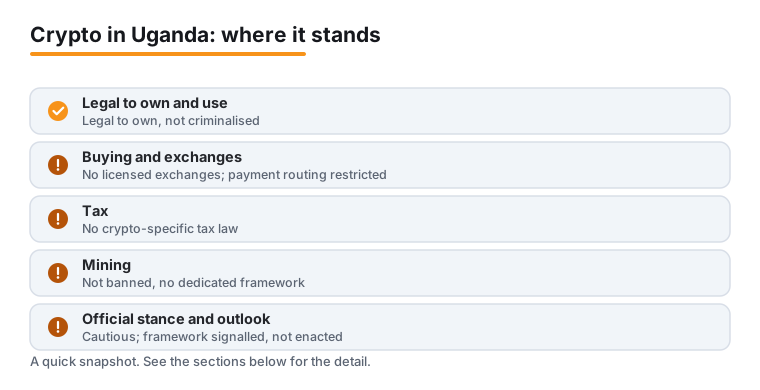
- Legal: Legal to own but unregulated, not legal tender; licensed payment providers barred from crypto
- Tax: No crypto specific tax law; gains folded into existing income or business tax
- Buying: No licensed local exchanges, use global exchanges or P2P settled via mobile money
Cryptocurrency sits in an awkward middle ground in Uganda. Bitcoin and other digital assets are not banned outright, and a growing number of Ugandans buy, hold, and trade them, yet the country has no dedicated virtual-assets law, no locally licensed exchanges, and no recognition of any token as legal tender. The Bank of Uganda has repeatedly warned the public that crypto is unregulated and high-risk, courts have upheld a restriction on routing crypto through licensed payment providers, and the Financial Intelligence Authority now brings virtual asset service providers under anti-money-laundering supervision. In late 2025 the central bank publicly outlined foundational principles for a future framework. This page explains where Uganda actually stands as of 2026: the legal status, the regulators involved, how tax may apply, what buying and using crypto looks like in practice, the risks, and how to verify everything with official sources.
This article is general information as of 2026 and is not legal, tax, or financial advice. Crypto rules in Uganda are unsettled and evolving; always confirm the current position with the Bank of Uganda, the Capital Markets Authority, the Financial Intelligence Authority, or the Uganda Revenue Authority, or consult a qualified Ugandan professional, before acting.
On this page: Legal status · Who regulates it · Taxes · How to buy · Mining
Legal status: is Bitcoin and crypto legal in Uganda?
Owning and trading Bitcoin is not a criminal offence in Uganda. No statute prohibits individuals from buying, holding, or selling crypto, and a sizeable peer-to-peer and exchange-based market operates in the open. In that narrow sense, crypto is legal to use.
Two limits matter, though. First, no cryptocurrency is recognised as legal tender, so no business is obliged to accept it and the state offers no backing or protection for crypto holdings. Second, using crypto as a payment instrument through the regulated financial system has effectively been shut off: the Bank of Uganda has directed licensed payment service providers not to facilitate crypto transactions, and Uganda's High Court has upheld that directive under the National Payment Systems Act. So while a private trade between two individuals is not illegal, routing crypto payments through licensed banks or payment service providers is not permitted.
In short, treat crypto in Uganda as legal to own but unregulated, unprotected, and restricted as a formal payment method. Because the lines between "unregulated," "discouraged," and "restricted as a payment method" are easy to confuse, confirm the latest position with official sources before relying on crypto for anything significant. For background on how countries approach these questions, see our overview of crypto regulation.
The regulators: who oversees crypto in Uganda
There is no single dedicated crypto regulator in Uganda yet. Instead, several institutions apply existing powers to the sector:
- Bank of Uganda (BoU) is the central bank. It has issued public warnings that crypto is unregulated and risky, and it directed licensed payment service providers not to process crypto transactions. The BoU also runs a regulatory sandbox, used with the Capital Markets Authority, to study virtual assets. In a keynote at the Kampala Blockchain Summit in late 2025, Governor Dr. Michael Atingi-Ego set out foundational pillars to guide future crypto regulation.
- Capital Markets Authority (CMA) promotes, develops, and regulates Uganda's capital markets. To the extent a crypto offering resembles a security or investment product, such as a security token, it can fall within capital-markets rules. The CMA partners with the BoU on the sandbox and on assessing how virtual assets should be supervised.
- Financial Intelligence Authority (FIA) supervises anti-money-laundering compliance. Under amendments to Uganda's Anti-Money Laundering Act, virtual asset service providers are treated as accountable persons that must register with and report to the FIA. This is currently the closest thing Uganda has to a formal touchpoint for crypto businesses.
- Uganda Revenue Authority (URA) administers tax and is increasingly focused on the sector.
The BoU and CMA have been confirmed as the lead regulators expected to shape a future virtual-assets regime, with the FIA covering AML. Browse related country guides on our regulation hub.
Key laws and frameworks
Uganda does not yet have a standalone virtual-assets act. The sector instead sits across existing laws and supervisory powers:
- Anti-Money Laundering Act (as amended) brings virtual asset service providers within the definition of accountable persons, requiring registration with and reporting to the Financial Intelligence Authority. This aligns Uganda with global Financial Action Task Force (FATF) standards for virtual assets.
- National Payment Systems Act underpins the Bank of Uganda's authority over licensed payment providers. It is the basis on which the BoU directed payment providers not to facilitate crypto, a position the High Court upheld.
- Capital Markets Authority Act may apply where a crypto offering behaves like a security or collective investment scheme.
- Income Tax Act and related tax law apply generally to gains and income, including from crypto activity, since there is no crypto-specific tax statute.
The direction of travel is toward a dedicated framework with licensing, consumer protection, and clearer supervision, but until that is enacted the rules remain a patchwork. Anyone running a crypto business should take AML registration seriously and seek local legal advice.
Licensing and registration of exchanges and VASPs
Uganda does not currently operate a dedicated licensing regime for crypto exchanges or virtual asset service providers, so there are no locally licensed crypto exchanges. The state has not licensed any organisation to issue or facilitate crypto trading.
The one formal obligation that does apply is AML-related: under the amended Anti-Money Laundering Act, virtual asset service providers are accountable persons that must register with the Financial Intelligence Authority and comply with reporting and monitoring requirements. This is supervision for anti-money-laundering purposes rather than a full conduct or prudential licence covering things like capital, custody, or consumer protection.
That gap is exactly what the Bank of Uganda's proposed framework aims to close. In its late-2025 keynote, the BoU outlined foundational pillars expected to inform future legislation: licensing and fit-and-proper standards; client asset protection; compliance with AML and counter-terrorism-financing rules; cybersecurity and operational resilience; market integrity and conduct; and transparency and data reporting. Until such a regime is enacted, businesses should treat FIA registration as a starting point, not a complete licence, and confirm requirements directly with the regulators.
Crypto and Bitcoin tax in Uganda
Uganda has no crypto-specific tax law, and there is no special exemption for digital assets either. That means crypto gains and income are most likely assessed under Uganda's existing tax rules rather than a bespoke regime. In broad terms, profits from trading or business activity, and gains realised when you dispose of an asset, can fall within income tax; Uganda does not levy a separate standalone capital-gains tax, so such gains are generally folded into income or business taxation.
The Uganda Revenue Authority has signalled growing interest in the sector, including concern about protecting the tax base from anonymous transactions. Reporting and enforcement are likely to tighten over time, and Uganda's annual tax-amendment cycle could introduce more explicit treatment in future.
Because the treatment is general rather than crypto-specific and is evolving, do not assume a particular rate, threshold, or exemption applies to your situation. Keep detailed records of every transaction (dates, values in shillings, counterparties, and fees), and confirm your obligations directly with the URA or a Ugandan tax adviser. Outcomes vary by whether you are an occasional holder, an active trader, or a business. For general principles, see our guide to crypto taxes.
AML and KYC rules
Anti-money-laundering compliance is the most concrete part of Uganda's crypto rulebook today. Under the amended Anti-Money Laundering Act, virtual asset service providers are accountable persons supervised by the Financial Intelligence Authority. In practice that means registering with the FIA, applying customer due diligence and know-your-customer (KYC) checks, monitoring transactions, keeping records, and filing suspicious-transaction reports.
The FIA has been active here: it convened a national working group on money-laundering and terrorism-financing risk for virtual assets and virtual asset service providers, and it has worked toward a risk assessment of the sector using internationally recognised toolkits. The broad aim is to align Uganda with FATF standards, including the so-called travel rule expectations for virtual-asset transfers.
This work sits within a wider AML clean-up that has already paid off. Uganda had been on the Financial Action Task Force grey list of countries with strategic AML and counter-terrorism-financing deficiencies since 2020, and it was removed from that list at the FATF plenary on 23 February 2024 after completing an action plan. That exit is not crypto-specific, but it reflects the same supervisory push, run through the FIA, that now extends to virtual asset service providers.
For individual users, the practical effect is that reputable platforms will ask for identity verification. Treat full anonymity as a red flag rather than a feature: services that promise it are more likely to be scams or to expose you to legal and counterparty risk.
Buying and using crypto in practice
Because there are no locally licensed crypto exchanges, Ugandans typically access crypto through:
- Global exchanges that accept Ugandan users, sometimes with mobile-money or bank deposit options where available.
- Peer-to-peer (P2P) marketplaces, where buyers and sellers match directly and settle via mobile money or bank transfer. P2P is especially popular because it works around the lack of direct exchange-to-bank rails.
- Local over-the-counter dealers and informal brokers, which carry higher counterparty and fraud risk.
Mobile money (such as MTN and Airtel services) is central to how value moves in Uganda, so many on-ramps and off-ramps lean on it. Because licensed payment providers are directed not to facilitate crypto, the link between crypto and the formal banking system can be indirect, inconsistent, or subject to account scrutiny. Remittances are a major driver of interest: crypto and stablecoins can settle quickly and may be cheaper on some corridors, with recipients converting to shillings via P2P, though volatility, exchange spreads, and reliance on informal channels are real trade-offs.
Given the absence of local licensing, choose platforms with strong security, clear KYC, and a track record; use escrow on P2P; start small; avoid anonymous or guaranteed-return offers; and remember that if a platform fails or a P2P trade goes wrong, Ugandan regulators offer little recourse.
Bitcoin mining in Uganda
Uganda has no specific law that bans or licenses cryptocurrency mining, so small-scale mining is not prohibited, but it is not encouraged or supported by any dedicated framework either. The practical constraints are mostly economic and infrastructural rather than legal.
The country's grid is heavily hydro-based, which in principle offers a relatively low-carbon power source, and Uganda has additional solar and renewable potential. In reality, however, retail electricity costs, grid reliability, limited access to specialised mining hardware, cooling challenges in a warm climate, and high upfront capital make large-scale, profitable mining difficult for most individuals. Uganda is not a notable global mining hub.
Anyone considering mining should factor in power tariffs and reliability, hardware import costs and duties, the likely tax treatment of any rewards (probably as income or business profit), and the possibility that future regulation could impose registration or other obligations. Confirm the current position with the relevant authorities before committing capital.
Recent developments (2025 to 2026)
The clearest recent shift is in tone and intent. At the Kampala Blockchain Summit in late 2025, Bank of Uganda Governor Dr. Michael Atingi-Ego used a keynote to set out foundational pillars for a future crypto framework, signalling that the central bank wants to move from ambiguity toward a comprehensive, risk-based regime rather than leaving activity underground. Those pillars span licensing and fit-and-proper standards, client asset protection, AML and counter-terrorism-financing compliance, cybersecurity and operational resilience, market integrity and conduct, and transparency and data reporting.
Alongside this, the BoU and Capital Markets Authority have continued to use a regulatory sandbox to study virtual assets, and the two have been described as the lead regulators for the emerging sector. The Financial Intelligence Authority has advanced its money-laundering and terrorism-financing risk work on virtual assets. Regionally, neighbours such as Kenya advanced dedicated virtual-asset service-provider legislation in 2025, and the Bank of Uganda governor has publicly urged Uganda to act to keep pace, adding pressure on Uganda to formalise its own approach.
Two features of the market help explain the urgency. Most virtual-asset activity in Uganda happens on decentralised platforms rather than centralised, supervised venues, which is well above the Sub-Saharan average and puts a large share of activity outside any oversight. And earlier restrictions did not stop use so much as push it into informal channels, so the policy question is now how to bring existing activity into a supervised framework rather than whether crypto exists at all.
None of this means a law is in force. As of 2026, Uganda still lacks an enacted, dedicated virtual-assets statute; the most likely path is a framework introducing licensing and consumer protection alongside tighter obligations. Check the official regulators for the latest status.
Consumer risks and protection
The headline risk in Uganda is the absence of a clear, protective framework. Users carry the full burden of volatility, security, and counterparty risk, with little regulatory recourse if things go wrong. There is no deposit insurance, no licensed local venue, and limited dispute mechanism if a platform collapses or you are defrauded.
Scams are widespread and a recurring theme in official warnings: Ponzi and "investment group" schemes, fake apps, impersonation, romance scams, and pressure to act quickly. The informal, P2P-heavy nature of much of the market makes redress hard. Regulatory risk is also live: a future law could introduce licensing, restrictions, or reporting that changes how individuals and businesses operate, potentially with little lead time.
Sensible precautions apply: only commit money you can afford to lose; use reputable platforms with strong security and KYC; enable two-factor authentication and consider self-custody (a hardware wallet for larger sums) with your recovery phrase stored safely offline; be deeply sceptical of guaranteed returns; keep records for tax; and verify any provider or scheme against official warnings before sending funds.
Official sources and how to verify
Crypto rules in Uganda are unsettled and changing, so verify the current position before you act rather than relying on summaries. The most authoritative sources are the regulators themselves:
- Bank of Uganda for the central bank's position, payment-system directives, and public warnings.
- Capital Markets Authority of Uganda for whether a token or offering may fall under securities and capital-markets rules.
- Financial Intelligence Authority for AML obligations and VASP registration as accountable persons.
- Uganda Revenue Authority for tax obligations on crypto gains and income.
When you check, look for the most recent date on any guidance, note that warnings and directives can be updated, and confirm anything material with the relevant authority or a qualified Ugandan professional. This page is general information as of 2026 and is not legal, tax, or financial advice; the official regulators above are the definitive source. For broader context, see our crypto regulation guide.
Frequently asked questions
Is cryptocurrency legal in Uganda in 2026?
Owning and trading crypto is not illegal for individuals, and a sizeable market operates openly. But no cryptocurrency is legal tender, there are no locally licensed exchanges, and the Bank of Uganda has directed licensed payment providers not to facilitate crypto transactions, a position upheld by the High Court under the National Payment Systems Act. So crypto is legal to hold but unregulated, unprotected, and restricted as a formal payment method. Always confirm the latest status with the Bank of Uganda.
Who regulates crypto in Uganda?
There is no single dedicated crypto regulator yet. The Bank of Uganda (the central bank) issues warnings and restricts payment providers and is leading work on a future framework; the Capital Markets Authority engages where offerings resemble securities and partners with the BoU on a regulatory sandbox; and the Financial Intelligence Authority supervises virtual asset service providers for anti-money-laundering purposes. The Uganda Revenue Authority handles tax. A comprehensive framework has been signalled but is not yet enacted.
Do I need a licence to run a crypto exchange in Uganda?
Uganda does not yet operate a dedicated licensing regime for crypto exchanges, so there is no full conduct or prudential crypto licence to obtain. The one formal obligation is AML-related: virtual asset service providers are accountable persons that must register with and report to the Financial Intelligence Authority. The Bank of Uganda has outlined foundational pillars, including licensing and fit-and-proper standards, for a future regime. Treat FIA registration as a starting point and confirm requirements with the regulators and a local lawyer.
Do I have to pay tax on crypto in Uganda?
Uganda has no crypto-specific tax law and no special exemption, so gains and income are generally assessed under existing income and business tax rules. There is no standalone capital-gains tax, so such gains are typically folded into income or business taxation. Because the treatment is general and evolving, do not assume any particular rate or threshold; keep full records of your transactions and confirm your obligations with the Uganda Revenue Authority or a qualified tax adviser. This is not tax advice.
What did the Bank of Uganda announce about crypto regulation in 2025?
At the Kampala Blockchain Summit in late 2025, Bank of Uganda Governor Dr. Michael Atingi-Ego set out foundational pillars expected to guide future crypto legislation: licensing and fit-and-proper standards, client asset protection, AML and counter-terrorism-financing compliance, cybersecurity and operational resilience, market integrity and conduct, and transparency and data reporting. It signalled intent to build a comprehensive framework, but no dedicated law was in force as of 2026.
How do Ugandans buy Bitcoin without local exchanges?
Most use global exchanges that accept Ugandan users or peer-to-peer marketplaces, settling via mobile money or bank transfer. P2P is popular because it works around the lack of direct exchange-to-bank rails, given the restriction on licensed payment providers facilitating crypto. Choose reputable platforms with strong security and KYC, use escrow on P2P, start small, secure your holdings with two-factor authentication and ideally self-custody, and be cautious of scams and guaranteed-return schemes.
Is Uganda still on the FATF grey list?
No. Uganda had been on the Financial Action Task Force grey list of countries with strategic anti-money-laundering and counter-terrorism-financing deficiencies since 2020, and it was removed at the FATF plenary on 23 February 2024 after completing its action plan. This exit is not crypto-specific, but it reflects the wider supervisory push, run through the Financial Intelligence Authority, that now also covers virtual asset service providers. Confirm the current status with the FIA.
Does Uganda have a licensed crypto exchange?
No. As of 2026 Uganda has no dedicated licensing regime for crypto exchanges and no locally licensed crypto exchange. The only formal obligation is that virtual asset service providers must register with the Financial Intelligence Authority for anti-money-laundering purposes, which is narrower than a full conduct or prudential licence. Most Ugandans access crypto through global exchanges that accept Ugandan users or through peer-to-peer marketplaces settled by mobile money or bank transfer.
Facts reviewed: 30 June 2026. Page updated: 3 August 2026.