Home › Crypto Regulation › Turkey
Bitcoin & Cryptocurrency Regulation in Turkey
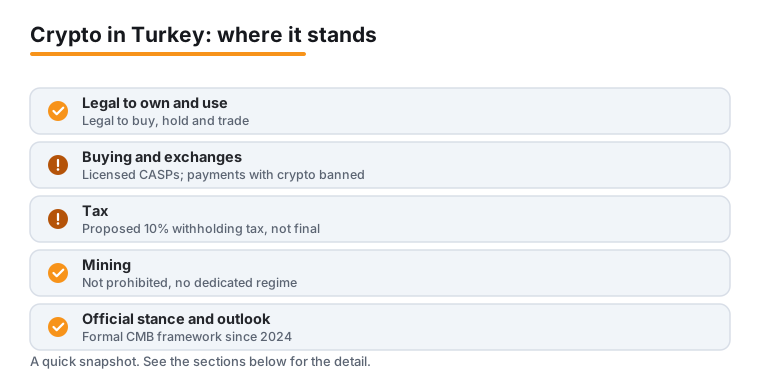
Quick answer — Turkey, 2026
- Legal: Legal to own and trade, banned as payment
- Tax: No dedicated crypto tax in force as of mid-2026
- Buying: Via CMB-licensed local exchanges
Turkey is one of the world's most active retail crypto markets. Millions of citizens hold Bitcoin and dollar-pegged stablecoins, partly to hedge against persistent lira inflation, and the country routinely ranks among the largest crypto markets globally by user activity. For years crypto operated in a legal grey zone, but that has changed. An amendment to the Capital Markets Law (Law No. 7518), enacted on 2 July 2024, brought crypto-asset service providers (CASPs) under formal supervision, and in 2025 a wave of detailed secondary rules took effect covering exchange authorisation, anti-money-laundering checks, transfer limits and consumer protection. In early 2026 the government proposed a dedicated crypto tax, but the tax provisions were withdrawn from the omnibus bill in March 2026 and are not in force.
This page explains how Bitcoin and other crypto assets are treated in Turkey as of 2026: what is legal, who regulates the sector, how exchanges are licensed, and where mining, taxation and consumer protection stand. Crypto law in Turkey is still evolving and some measures remain proposals before parliament. This article is general information as of 2026 and is NOT legal, tax or financial advice; always verify the current position with the named official regulator before acting. For wider context, see our guide to crypto regulation.
On this page: Legal status · Who regulates it · Taxes · How to buy · Mining
Is Bitcoin and crypto legal in Turkey?
Yes. It is legal in Turkey to buy, hold, sell and trade Bitcoin and other crypto assets. There is no ban on individuals owning cryptocurrency as a personal investment, and trading through licensed domestic platforms is widespread and mainstream.
There is one important limit. Crypto assets are not legal tender and cannot lawfully be used to pay for goods and services. In April 2021 the Central Bank of the Republic of Turkey (CBRT) issued the Regulation on the Disuse of Crypto Assets in Payments (published in the Official Gazette No. 31456 dated 16 April 2021, in force from 30 April 2021), which prohibits using crypto assets, directly or indirectly, as a means of payment and bars payment and electronic-money institutions from facilitating crypto-based payments. So while you may invest in and trade crypto freely, settling everyday purchases in Bitcoin is not permitted.
In short: owning and trading crypto is legal and now formally regulated; paying with crypto is not.
Who regulates crypto in Turkey?
Several authorities share responsibility, with one clear lead:
- Capital Markets Board (CMB / Sermaye Piyasasi Kurulu, SPK) is the primary regulator. It authorises and supervises crypto-asset service providers, including trading platforms and custodians, and sets rules on capital, governance, client-asset segregation and information-system security. Its official site is cmb.gov.tr (also reachable as spk.gov.tr).
- Financial Crimes Investigation Board (MASAK), part of the Ministry of Treasury and Finance, oversees anti-money-laundering (AML) and counter-terrorist-financing compliance. CASPs are designated obliged parties and must verify customers and report suspicious activity. See masak.hmb.gov.tr.
- Central Bank of the Republic of Turkey (CBRT / TCMB) issued the 2021 payments ban and is running the digital lira research project. See tcmb.gov.tr.
- TUBITAK, the national scientific body, is involved in setting technical and custody-security standards for platforms.
For tax matters the relevant authority is the Turkish Revenue Administration (Gelir Idaresi Baskanligi). Anyone relying on a specific platform should confirm its authorisation status directly with the CMB.
Key laws and frameworks
Turkey is not an EU member, so the EU's MiCA regulation does not apply. Instead, Turkey has built its own framework over 2024 and 2025:
- Law No. 7518 (2024): An amendment to the Capital Markets Law enacted on 2 July 2024 that defined crypto assets and crypto-asset service providers and placed them under CMB supervision, making CMB authorisation mandatory to operate as a CASP.
- CMB Communiques III-35/B.1 and III-35/B.2 (2025): Published in the Official Gazette on 13 March 2025, these secondary regulations set the detailed rules on establishment, operating principles, governance and capital adequacy for platforms and custodians, with provisions phasing in through 2025.
- MASAK rules and the Travel Rule (2025): The FATF-aligned Travel Rule took effect on 25 February 2025. A separate instrument, MASAK General Communique No. 29 (Official Gazette No. 32940, 28 June 2025), then imposed a 48-hour delay on crypto withdrawals, 72 hours on a customer's first withdrawal, and caps on stablecoin withdrawals of 3,000 US dollars per day and 50,000 US dollars per month, doubling where full Travel Rule information is applied.
- 2021 CBRT payments ban: Still in force, prohibiting crypto as a means of payment.
Turkey is also researching a digital lira, a central-bank digital currency run by the CBRT and distinct from decentralised crypto such as Bitcoin. It remains in testing rather than general release, and there is no announced launch date. On 3 August 2026 the CBRT reported that of 85 ecosystem applications received between 4 September and 15 October 2025 from 16 banks and 25 payment and electronic money institutions, 51 reached phase two and 23 projects from 12 banks and 6 payment and electronic money institutions passed into phase three, where development work and sandbox testing take place.
Licensing and registration of exchanges (CASPs)
Under Law No. 7518 it is mandatory to be authorised by the CMB to operate as a crypto-asset service provider serving Turkish users. The 2025 communiques set out the detail:
- Local establishment: A CASP must be a joint-stock company incorporated in Turkey with fully paid-up, cash share capital and transparent ownership. Foreign platforms cannot simply operate via a branch; the rules point toward a locally incorporated, capitalised entity.
- Minimum capital: Article 34 of Communique III-35/B.2 sets minimum founding capital at 150,000,000 Turkish lira for a trading platform and 500,000,000 Turkish lira for a custody institution, paid in full and in cash. Custody is the more capital-intensive permission, not the lighter one. Article 53 lets the CMB redetermine these amounts each year using the Treasury and Finance revaluation rate, and for 2026 the Board reset them in Bulletin 2025/68 to 250,000,000 Turkish lira for platforms and 630,000,000 Turkish lira for custody institutions, applying a revaluation rate of 25.49 percent.
- Governance and security: Licensed providers must run internal controls, risk management and independent audit, segregate client assets, and meet information-system and custody-security standards (with TUBITAK involved in technical benchmarks).
- Transition regime: Under Provisional Article 1 of Communique III-35/B.1, existing platforms had to apply for an operating licence by 30 June 2025, add an independent information-systems audit report by 30 September 2025, and hold the authorisation certificate by 30 June 2026, failing which the liquidation provisions apply. That deadline has now passed. The CMB's list of operating providers, headed 30 June 2026, still carries 56 entities and is still headed as a provisional list, with the Board stating expressly that inclusion does not mean a firm is authorised. Its liquidation list, headed 18 June 2026, names 52 entities. Article 55 of the same Communique allows the Board to extend any period it sets.
The CMB publishes lists of providers that have applied for or hold authorisation. Always check a platform's status on the CMB site before depositing funds.
Crypto and Bitcoin tax in Turkey
Crypto taxation is the area to treat with the most care, because it is changing. Historically Turkey did not levy a dedicated crypto-specific tax, and there was no separate capital-gains regime aimed squarely at crypto trading for ordinary investors; general income-tax principles could apply depending on the nature and frequency of activity.
On 2 March 2026 Turkey's ruling party introduced a draft economic bill before the Grand National Assembly that would create a clearer crypto tax framework. As reported, the proposal includes a 10% withholding tax on net gains realised through licensed domestic platforms, calculated and withheld quarterly by the platform on behalf of clients, with the President able to adjust the rate within a 0% to 20% band; a separate 0.03% transaction levy on service providers on the value of crypto they broker; and a requirement for investors trading outside licensed venues to declare gains annually. Investors may reportedly deduct same-year losses and trading commissions.
These measures were withdrawn before becoming law. On 26 March 2026, after negotiations between the ruling party and the opposition, the crypto tax articles were removed from the omnibus bill and dropped from the legislative agenda. Government officials indicated the plan could return later as a separate bill, so a crypto tax may still be introduced in future. As of mid-2026 there is no dedicated crypto tax in force. This means the pre-2026 position still applies: no separate crypto-specific tax, with general income-tax principles potentially relevant depending on the nature and frequency of activity. Confirm your obligations with the Turkish Revenue Administration (Gelir Idaresi Baskanligi) or a qualified Turkish tax advisor. See also our crypto taxes guide. This is general information, not tax advice.
AML, KYC and the Travel Rule
CASPs are designated obliged parties (treated as financial institutions) under MASAK supervision, so anti-money-laundering and know-your-customer controls are mandatory. Platforms must verify customer identity, monitor transactions and report suspicious activity.
Turkey's FATF-aligned Travel Rule took effect on 25 February 2025. For crypto transfers of 15,000 Turkish lira and above, platforms must collect and share identifying information about both sender and recipient (such as name, trade name and tax identification number). Transfers below that threshold do not require the same information verification, though all transfers fall within the framework. For transfers to self-hosted or unregistered wallets, providers apply a risk-based approach, gather additional information on the source and destination of funds, and may block transfers where there is a suspicious situation. Transactions with incomplete information may be rejected or returned.
In practice this means full identity verification on sign-up, and additional checks and possible delays on larger transfers and withdrawals.
Buying and using crypto in practice
For most people in Turkey, buying crypto follows a regulated path:
- Choose a licensed platform. Use a CASP that is authorised by the CMB or appears on its official list. Verifying status first reduces counterparty risk.
- Complete identity verification. Expect full KYC, typically national ID and supporting details, because platforms must comply with MASAK rules.
- Fund your account. Deposit Turkish lira via supported methods, commonly bank transfer. Remember crypto cannot be used to pay merchants, so this is an investment and trading account, not a payment wallet.
- Place an order and decide on custody. Buy listed assets through market or limit orders, mindful of fees and spreads. You can hold assets on the platform or withdraw to a personal wallet, but expect a wait of at least 48 hours from purchase or deposit before a withdrawal executes, at least 72 hours on your first ever withdrawal, a cap of 3,000 US dollars a day and 50,000 US dollars a month on stablecoin withdrawals, and a mandatory transaction description of at least 20 characters on every transfer.
- Keep records. Retain transaction history for any future tax reporting, which may change as new tax legislation is finalised.
Crypto ATMs have only ever had a marginal presence in Turkey and are constrained by the payments ban and AML rules; the standard route to buy crypto is a regulated online exchange, not a physical kiosk.
Bitcoin mining in Turkey
Bitcoin mining is not specifically prohibited in Turkey, and there is no dedicated nationwide licensing regime aimed solely at miners. Mining is therefore treated under general rules, including electricity supply and tariffs, business registration, and environmental and tax obligations, rather than a bespoke crypto-mining statute.
The biggest practical factor is energy. Turkey is heavily dependent on energy imports and electricity costs can be significant, which affects mining profitability. Claims that the government runs specific mining-targeted tax breaks, grants or subsidies should be treated cautiously and verified against official sources. Anyone planning to mine at scale should budget around real electricity prices, confirm the tax treatment of mining revenue with a Turkish advisor, and ensure compliance with local commercial and environmental requirements.
Recent developments (2024 to 2026)
The pace of change has been rapid:
- July 2024: Law No. 7518 brought crypto assets and CASPs under CMB supervision for the first time.
- February 2025: The FATF-aligned Travel Rule and MASAK AML controls took effect, with a 15,000 TRY information threshold.
- March 2025: CMB Communiques III-35/B.1 and III-35/B.2 set detailed licensing, governance and capital rules, alongside transfer limits and withdrawal delays.
- 2025 to 2026: A transition regime ran for existing platforms to apply for and obtain full authorisation, consolidating the market around licensed providers.
- Early March 2026: A draft economic bill proposing a 10% withholding tax on crypto gains and a 0.03% transaction levy on service providers was introduced in parliament.
- 26 March 2026: The crypto tax articles were withdrawn from the omnibus bill and removed from the legislative agenda. Officials signalled the plan could be reintroduced later as a separate bill, but as of mid-2026 no crypto tax is in force.
- 30 June 2026: The deadline for existing platforms to hold a CMB authorisation certificate passed. The CMB's list of operating providers, headed 30 June 2026, contains 56 entities, against 52 on its liquidation list headed 18 June 2026. The Board continues to label the operating list provisional and to state that inclusion does not itself confer authorisation.
Three things to watch. Whether the CMB publishes a definitive register of authorisation certificate holders or keeps extending under Article 55 of Communique III-35/B.1. Whether the withdrawn crypto tax articles return as a separate bill; officials said only that they would be reconsidered, and no successor bill was found as of 3 August 2026. And whether the digital lira moves beyond phase three sandbox testing, for which no launch date has been announced.
Consumer risks and protection
The new framework is designed to strengthen consumer protection over time through licensing, client-asset segregation, security standards and AML oversight. But users should keep clear risks in mind:
- Regulatory change: Rules, deadlines and tax proposals are still evolving in 2026; what is true today may shift within months.
- Platform and licensing risk: Using an unlicensed or non-compliant provider could expose funds to legal and operational uncertainty. Check the CMB list first.
- Payments ban: Crypto cannot be used to pay for goods and services; treating it as money is not lawful.
- Market risk: Bitcoin is highly volatile and can fall sharply; stablecoins carry issuer and de-pegging risk; and transfer limits, withdrawal delays and Travel-Rule checks can affect how easily assets move. Using crypto as an inflation hedge substitutes one set of risks for another.
This page makes no price predictions and recommends no asset. Treat crypto as a high-risk allocation, never invest more than you can afford to lose, and consider independent advice.
Official sources and how to verify
Because the rules are evolving, always confirm the current position with the official authorities rather than relying on secondary summaries. The key official sources are:
- Capital Markets Board (CMB / SPK) for CASP licensing, the official list of providers, and the 2024 to 2025 framework.
- Central Bank of the Republic of Turkey (CBRT / TCMB) for the 2021 payments ban and the digital lira project.
- Financial Crimes Investigation Board (MASAK) for AML, KYC and Travel-Rule requirements.
- Turkish Revenue Administration (Gelir Idaresi Baskanligi) for tax obligations once the 2026 bill is finalised.
For broader background, see our country regulation hub. This article is general information as of 2026 and is not legal, tax or financial advice; verify the current rules with the named official regulators or a qualified Turkish professional before acting.
What is changing: Turkey in August 2026
The 30 June 2026 licensing deadline in Communique III-35/B.1 has now passed, and the outcome is visible on the regulator's own registers rather than in press reporting. The Capital Markets Board's list of providers currently operating is headed "Faaliyette Bulunanlar Listesi 30 Haziran 2026 (Geçici Liste)" and contains 56 entities: 47 trading platforms and 9 entities marked "(Saklama Başvurusu)", meaning custody applicant. Geçici means provisional, and the Board states on the same page that the existence of the list does not mean the listed institutions are authorised under the relevant legislation. The Board's crypto section publishes only two lists, this one and the liquidation list, and no separate register of firms holding a full authorisation certificate.
The consolidation behind those numbers is real. The Board's liquidation list, headed 18 Haziran 2026, names 52 entities that will not continue as crypto-asset service providers. Note also that Article 55 of Communique III-35/B.1, titled Süreler, provides in a single sentence that the periods specified in the Communique may be extended by the Board, so 30 June 2026 is a deadline the regulator retains power to move.
Two other things moved in the same window. In bulletin 2026/34 of 4 June 2026, under the heading New Operating Licences, the Board decided to look favourably on the applications of Akbank, Türkiye Garanti Bankası and Yapı ve Kredi Bankası for an operating licence as crypto-asset custody institutions. All three nonetheless still appear as custody applicants on the 30 June 2026 list. And on 3 August 2026 the central bank announced that 23 digital lira projects, from 12 banks and 6 payment and electronic money institutions, have passed into phase three out of 85 original applications. The crypto tax articles withdrawn in March 2026 have not returned to parliament.
Minimum capital: the figures the Communique actually sets
Article 34 of Communique III-35/B.2, published in Official Gazette No. 32840 on 13 March 2025, sets minimum founding capital at 150,000,000 Turkish lira for a trading platform and 500,000,000 Turkish lira for a custody institution. Custody is the more capital-intensive permission, not the lighter one.
Article 53 allows the Board to redetermine every amount in the Communique each year using the revaluation rate announced by the Ministry of Treasury and Finance. The Board did so for 2026 in Bulletin 2025/68, on a Board decision dated 30 December 2025, applying a 2026 revaluation rate of 25.49 percent. The bulletin sets out the crypto entries in a table:
- Platform founding capital: 150,000,000 lira redetermined to 250,000,000 lira for 2026.
- Custody institution founding capital: 500,000,000 lira redetermined to 630,000,000 lira for 2026.
- Client-asset threshold triggering the 1.5 percent additional equity requirement for custody institutions: 1,000,000,000 lira redetermined to 1,250,000,000 lira.
- Equity level at which that additional requirement ceases: 1,500,000,000 lira redetermined to 1,900,000,000 lira.
The custody figure tracks the 25.49 percent rate almost exactly. The platform figure is well above it, so the Board used its discretion to raise platform capital by more than revaluation alone would give. A further rule sits alongside the capital figure: at least 25 percent of a provider's equity must be paid-in or issued capital as at the sixth month of each year.
Withdrawal delays and stablecoin caps: the actual limits
The controls that ordinary holders actually notice do not come from the Travel Rule. They come from MASAK General Communique No. 29, published in Official Gazette No. 32940 on 28 June 2025 and in force from that date, which is a separate instrument issued four months after the February 2025 Travel Rule.
- Withdrawal delay: under Article 4(3) a platform must execute a crypto withdrawal no earlier than 48 hours after the asset being transferred was bought, swapped or deposited. This applies to transfers to other platforms too. For a customer's first crypto withdrawal the wait is at least 72 hours.
- Stablecoin caps: under Article 4(4), withdrawals of crypto assets designed to hold a stable value by reference to another value, right or official currency are limited to the equivalent of 3,000 US dollars per day and 50,000 US dollars per month, including transfers to other platforms. Where the full Travel Rule information requirement is applied, both limits may be doubled.
- Transaction note: Article 4(5) requires the platform to obtain from the customer a description of the transaction at least 20 characters long, on every crypto transfer.
- Exemptions: Article 4(6) allows a platform to disapply the delay and the caps where it is satisfied transfers are for liquidity provision, market making or cross-market arbitrage, but only on a board resolution taken separately for each customer and with continuous monitoring.
Failure to comply attracts the penalties set out in Law No. 5549 on the Prevention of Laundering Proceeds of Crime.
What happens to unlicensed and foreign platforms
Turkey does not simply decline to license foreign platforms, it blocks access to them. In September 2025 the Capital Markets Board obtained a court order blocking 16 websites, including the Dubai-based exchange Darkex, for offering unauthorised leveraged foreign exchange and crypto services to Turkish residents (report, 14 September 2025).
The practical response from large international exchanges has been incorporation rather than exit. The Board's 30 June 2026 list shows Binance, Bybit, Gate, MEXC, OKX, WhiteBit, Bitbns and Rain all present through Turkish joint-stock companies carrying the statutory name Kripto Varlık Alım Satım Platformu AŞ. If you use one of these brands from Turkey, you are dealing with a Turkish entity under Turkish supervision, not the offshore parent. Check the list for the specific brand you use, because not every international name appears on it.
Frequently asked questions
Is cryptocurrency legal in Turkey in 2026?
Yes. Buying, holding, selling and trading crypto is legal and now regulated under the Capital Markets Board's licensing regime introduced by Law No. 7518 (2024) and the 2025 communiques. However, crypto is not legal tender and cannot be used to pay for goods or services, because the Central Bank banned crypto payments in 2021.
Who regulates crypto in Turkey?
The Capital Markets Board (CMB / SPK) is the lead regulator and licenses crypto-asset service providers. MASAK, under the Ministry of Treasury and Finance, enforces anti-money-laundering, KYC and Travel-Rule rules; the Central Bank (CBRT) handles the payments ban and the digital lira project; and TUBITAK helps set technical and custody-security standards. You can verify current rules at cmb.gov.tr.
Do I have to pay tax on crypto in Turkey?
As of mid-2026 there is no dedicated crypto tax in force. A draft bill introduced in early March 2026 proposed a 10% withholding tax on gains made through licensed platforms (with the President able to set it between 0% and 20%) plus a 0.03% transaction levy on service providers, but those articles were withdrawn from the omnibus bill on 26 March 2026. Officials said the plan could return as separate legislation, so this may change. General income-tax principles could still apply depending on your activity. Verify your obligations with the Turkish Revenue Administration or a qualified tax advisor. This is not tax advice.
How much capital must a crypto exchange hold in Turkey?
Article 34 of Communique III-35/B.2, published on 13 March 2025, sets minimum founding capital at 150,000,000 Turkish lira for a platform and 500,000,000 Turkish lira for a custody institution, paid in full and in cash. Custody requires more capital than trading, not less. The amounts are revalued annually under Article 53; for 2026 the CMB reset them in Bulletin 2025/68 to 250,000,000 Turkish lira for platforms and 630,000,000 Turkish lira for custody institutions.
When must Turkish crypto exchanges be licensed by?
Existing platforms had to apply to the CMB for an operating licence by 30 June 2025 and to obtain that licence by 30 June 2026. Entities that miss those deadlines are subject to liquidation under Communique III-35/B.1. Check a platform's current status on the CMB list before depositing funds.
Can I use a foreign crypto exchange in Turkey?
Platforms serving Turkish users must be locally established joint-stock companies authorised by the CMB, so a foreign platform cannot serve Turkey through a branch. Enforcement is active: in September 2025 the CMB obtained a court order blocking 16 websites, including the exchange Darkex, for offering unauthorised services to residents. Most large international brands responded by incorporating locally, and Binance, Bybit, Gate, MEXC, OKX, WhiteBit, Bitbns and Rain all appear on the CMB's 30 June 2026 list under Turkish company names. Using those brands from Turkey means dealing with a supervised Turkish entity, not the offshore parent. Not every international name is on the list, so check the specific brand you use before depositing funds.
What is the crypto Travel Rule in Turkey?
Effective 25 February 2025, MASAK's FATF-aligned Travel Rule requires platforms to collect and share sender and recipient information (such as name and tax identification number) for crypto transfers of 15,000 Turkish lira and above. Transfers to unregistered or self-hosted wallets trigger additional risk-based checks, and transactions with incomplete information may be rejected or returned.
Is Bitcoin mining allowed in Turkey?
Mining is not specifically banned and has no dedicated licensing regime; it falls under general business, tax, environmental and electricity rules. High energy costs are the main practical constraint on profitability. Confirm the tax treatment of mining income and local compliance requirements with a Turkish professional.
Did Turkish crypto exchanges have to be licensed by 30 June 2026, and what happened?
Yes. Provisional Article 1(3) of CMB Communique III-35/B.1 required existing platforms to hold an authorisation certificate by 30 June 2026 or fall under the liquidation provisions. That date has passed. The CMB's list of providers currently operating, headed 30 June 2026, contains 56 entities, 47 trading platforms and 9 custody applicants, while its liquidation list headed 18 June 2026 names 52 entities. Importantly, the CMB still publishes the operating list as a provisional list and states expressly that inclusion does not mean a firm is authorised, and it has not published a separate register of certificate holders. Article 55 of the Communique also lets the Board extend any deadline it has set.
How long do I have to wait to withdraw crypto from a Turkish exchange, and is there a limit?
Under MASAK General Communique No. 29, published in Official Gazette No. 32940 on 28 June 2025, a platform must wait at least 48 hours after the asset was bought, swapped or deposited before releasing a withdrawal, including transfers to another platform. For your first ever crypto withdrawal the wait is at least 72 hours. Withdrawals of stablecoins and other stable-value crypto assets are capped at the equivalent of 3,000 US dollars per day and 50,000 US dollars per month, and a platform applying the full Travel Rule information requirement may double both limits. You must also supply a transaction description of at least 20 characters on every transfer.
How much capital does a Turkish crypto exchange or custodian actually need?
Article 34 of CMB Communique III-35/B.2 sets minimum founding capital at 150,000,000 Turkish lira for a trading platform and 500,000,000 Turkish lira for a custody institution, paid in full and in cash. Custody requires far more capital than trading. Article 53 lets the CMB revalue these amounts each year, and for 2026 the Board reset them in Bulletin 2025/68 to 250,000,000 Turkish lira for platforms and 630,000,000 Turkish lira for custody institutions, using a revaluation rate of 25.49 percent. Providers must also keep at least 25 percent of equity as paid-in or issued capital as at the sixth month of each year.
Can Turkish banks hold crypto for their customers?
Bank custody is being authorised, but it is not yet fully settled. In bulletin 2026/34 dated 4 June 2026, under the heading New Operating Licences, the CMB decided to look favourably on applications by Akbank, Türkiye Garanti Bankası and Yapı ve Kredi Bankası for an operating licence as crypto-asset custody institutions. All three still appear as custody applicants on the CMB's 30 June 2026 list, alongside Türkiye İş Bankası, İstanbul Takas ve Saklama Bankası (Takasbank), Misyon Yatırım Bankası, and non-bank custodians run by BtcTurk and Paribu. Banks dominate this list because of the 500,000,000 Turkish lira custody capital requirement, revalued to 630,000,000 lira for 2026, which few non-bank firms can meet.
Has Turkey reintroduced the crypto tax since it was withdrawn?
No. The bill submitted to parliament on 2 March 2026 would have imposed a 10 percent withholding on gains through licensed platforms, withheld quarterly, plus a transaction tax of three per ten thousand (0.03 percent) on service providers. Articles 1, 3, 4 and 5 were withdrawn on 27 March 2026 after opposition objections, on the stated basis that they would be reconsidered given rapid change in the sector. As of 3 August 2026 no successor bill was found and no timetable has been announced. This is not tax advice; confirm your position with the Turkish Revenue Administration or a qualified Turkish tax adviser.
Facts reviewed: 5 August 2026. Page updated: 5 August 2026.