Home › Crypto Regulation › Timor Leste
Bitcoin & Cryptocurrency Regulation in Timor-Leste
Quick answer — Timor Leste, 2026
- Legal: Undefined grey area, neither banned nor licensed, not legal tender
- Tax: No crypto-specific tax; general income and business tax may apply
- Buying: No licensed local exchange, use international platforms and P2P
Timor-Leste (East Timor) is one of Asia's youngest and smallest economies, and its relationship with Bitcoin and other cryptocurrencies is best described as undefined rather than restrictive. As of 2026 the country has no dedicated crypto or virtual-asset law, no licensing regime for exchanges or wallet providers, and no published government guidance that either authorises or prohibits owning digital assets. The practical reality is shaped less by a crypto rulebook and more by the country's unusual monetary setup: Timor-Leste uses the US dollar as its official currency, and its small, developing financial system is supervised by the central bank, the Banco Central de Timor-Leste (BCTL).
This page explains what is and is not settled about crypto in Timor-Leste, covering legal status, the regulator, the laws that can still reach crypto activity (in particular anti-money-laundering rules), taxation, how people buy and use crypto in practice, mining, recent developments, consumer risks, and how to verify the position with official sources. It is general information as of 2026 and is NOT legal, tax, or financial advice; because the situation is evolving and thinly documented, always confirm the current rules with the BCTL, the tax authority, and a qualified local professional before acting. For background on how other countries approach these questions, see our guide to crypto regulation.
On this page: Legal status · Who regulates it · Taxes · How to buy · Mining
Is Bitcoin and crypto legal in Timor-Leste?
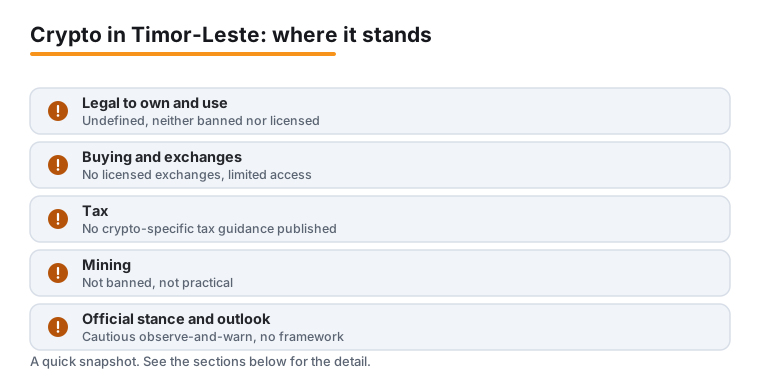
There is no law in Timor-Leste that makes owning, buying, or selling Bitcoin and other cryptocurrencies a crime, and there is also no law that formally recognises or regulates them. Crypto therefore sits in a legal grey area: it is neither banned nor licensed. A few points are clear:
- Crypto is not legal tender. The official currency and only legal tender is the US dollar (supplemented by locally minted centavo coins for small change). No business is obliged to accept Bitcoin, and crypto cannot be used to settle taxes or official obligations.
- There is no crypto-specific consumer-protection framework. If you lose funds to a hack, a failed platform, or a scam, there is generally no dedicated local regulator to appeal to and little prospect of recovery.
- General laws still apply. Anti-money-laundering, anti-fraud, and criminal laws of general application can reach crypto-related conduct even without a crypto-specific statute.
In short, an individual is not breaking a specific crypto law by holding or trading digital assets, but does so without the legal safety net found in more developed markets. Treat the absence of a ban as the absence of protection, not as official endorsement.
The regulator: Banco Central de Timor-Leste (BCTL)
The financial system of Timor-Leste is supervised by the Banco Central de Timor-Leste (BCTL), the central bank and monetary authority. The BCTL was formally established on 13 September 2011, replacing the earlier Banking and Payments Authority (BPA). Its mandate centres on domestic price stability, the soundness of the banking and payment system, and the country's foreign-exchange arrangements.
There is no separate securities commission or standalone virtual-asset authority in Timor-Leste, so financial-sector oversight, including anything touching crypto, runs through the BCTL and its supervisory and anti-money-laundering functions. The BCTL has taken a cautious, observe-and-warn posture toward crypto rather than issuing a dedicated licensing framework: it monitors international developments and has issued public advisories about the risks of investing in highly volatile digital assets and about fraud and scams. There is no confirmed central bank digital currency (CBDC) and no announced timeline for one.
You can reach the regulator directly through its official website, Banco Central de Timor-Leste.
Key laws and frameworks that apply to crypto
Timor-Leste has not enacted a comprehensive cryptocurrency or digital-asset law, and no dedicated licensing regime exists for exchanges, custodians, or token issuers. Instead, several general frameworks can apply to crypto activity:
- Anti-money-laundering and counter-terrorism-financing (AML/CFT). The principal statute is Law No. 17/2011 of 28 December on the legal regime for the prevention and combating of money laundering and the financing of terrorism (subsequently amended). It created the Financial Intelligence Unit (FIU, or UIF in Portuguese) and imposes customer due diligence and suspicious-transaction reporting on reporting entities such as banks and money-transfer operators.
- The Penal Code. Money laundering is criminalised under Article 313, and terrorism financing under Article 133, with significant prison terms.
- Banking and payments supervision. The BCTL supervises licensed financial institutions, which is the practical channel through which crypto-linked transfers can be scrutinised, even though crypto itself is not separately licensed.
- International standards. Timor-Leste is a member of the Asia/Pacific Group on Money Laundering (APG), which assesses the country against the global FATF standards; those standards now extend AML expectations to virtual assets and virtual-asset service providers.
Because Timor-Leste is a small jurisdiction with limited published guidance, rules are applied through banking supervision and AML practice rather than through a single, easily searchable crypto act. Anyone running a crypto-related business should seek direct confirmation from the BCTL and qualified local counsel rather than relying on the general silence of the law.
Licensing and registration of exchanges and VASPs
As of 2026, Timor-Leste has no dedicated licensing or registration regime for cryptocurrency exchanges or virtual-asset service providers (VASPs), and there are no confirmed licensed domestic crypto exchanges. There is no published application process, fee schedule, or supervisory framework aimed specifically at crypto businesses.
That does not mean crypto businesses operate entirely outside the law. A provider that touches the formal financial system, accepts customer funds, or offers money-transfer-like services could fall within existing financial-services, payments, and AML/CFT obligations supervised by the BCTL, and could need to register or report under the AML regime. Because the boundaries are untested and undocumented, the only reliable course for anyone planning to offer exchange, custody, or transfer services from Timor-Leste is to ask the BCTL directly and obtain qualified local legal advice before launching. Do not assume that the absence of a crypto licence means no authorisation or reporting duties apply.
Crypto and Bitcoin tax in Timor-Leste
Timor-Leste has not published crypto-specific tax rules, so there is no official guidance stating exactly how Bitcoin gains, trading profits, or crypto received as payment are taxed. This does not mean crypto activity is automatically tax-free. The general tax framework is set by the Taxes and Duties Act 2008 (Decree-Law No. 8/2008) and administered by the Autoridade Tributaria Timor-Leste (ATTL), the national tax authority. Corporate income is generally taxed at a flat rate of 10 percent, and gains arising from the alienation (disposal) of assets are also brought within that 10 percent corporate income tax under the general rules; wage income is collected through PAYE withholding, and taxes are payable in US dollars.
In broad terms, and without stating any crypto-specific rate or threshold:
- Income from a business or trade settled or earned in crypto may fall within ordinary income or business taxation, just as it would if earned in dollars.
- Profits from trading or disposing of crypto could be treated as taxable depending on whether the activity is investment or business income under domestic rules and any applicable interpretation.
- Record-keeping matters. Because crypto value must be converted to US dollars, keep clear records of acquisition cost, disposal value, dates, and counterparties.
Tax treatment of new asset classes is uncertain in many small jurisdictions, and Timor-Leste is no exception. Do not assume gains are exempt and do not rely on rates quoted on general crypto websites. Confirm your position with the Autoridade Tributaria Timor-Leste or a qualified local tax adviser, and see our general guide to crypto taxes for context. This section is informational only and is not tax advice.
AML and KYC rules
Anti-money-laundering and know-your-customer obligations are the part of the legal framework most likely to touch ordinary crypto users in Timor-Leste, because they apply through the banks and money-transfer operators that crypto buyers rely on to move funds. The framework is set by Law No. 17/2011 and enforced through the BCTL and the Financial Intelligence Unit (FIU/UIF).
In practice this means:
- Banks and transfer operators must verify identity and apply customer due diligence, so funding or cashing out of crypto through a Timorese bank account is subject to standard KYC.
- Suspicious-transaction reporting applies: reporting entities must notify the FIU of transactions that appear unusual or linked to money laundering or terrorism financing.
- Reputable international exchanges apply their own KYC, and the documents they accept from Timor-Leste residents can vary by platform.
There is no crypto-specific AML rulebook published for VASPs, but the general AML regime and the FATF/APG standards that Timor-Leste is assessed against increasingly expect virtual-asset activity to be covered. You can read the central bank's description of its anti-money-laundering function on the official BCTL Financial Information Unit page.
Buying and using crypto in practice
There are no licensed domestic cryptocurrency exchanges in Timor-Leste. In practice, residents who want to buy crypto rely on international platforms, peer-to-peer (P2P) trading, or acquiring coins while abroad. Several structural factors make this harder than in larger markets:
- Banking and card access is limited. Account ownership and card penetration are relatively low, and not every international exchange supports customers or payment methods tied to Timor-Leste, which narrows the realistic set of platforms.
- US-dollar economy. Because the local currency is the US dollar, there is no exotic foreign-exchange step, but funding an account still depends on a bank transfer or card the platform accepts.
- Identity and AML checks. Reputable exchanges require KYC verification, and accepted documentation varies by platform.
- Thin local liquidity. Few liquid local options can mean wider spreads, higher effective costs on P2P trades, and a greater risk of dealing with unreliable counterparties.
If you do buy, favour established, well-reviewed platforms, complete proper identity verification, plan your exit to US dollars before you deposit, and be cautious with informal P2P deals where there is little recourse if a trade goes wrong. There is no reliable public evidence of operating Bitcoin ATMs in Timor-Leste, so do not plan on finding a working crypto machine in Dili or elsewhere; the practical route to cash out is selling on a supported international platform or a trusted counterparty and withdrawing dollars through a bank or card.
Bitcoin mining in Timor-Leste
There is no specific law that bans or licenses cryptocurrency mining in Timor-Leste, but the country is not a practical mining destination. Mining at any meaningful scale depends on cheap, abundant, and reliable electricity, robust internet connectivity, and access to specialised hardware, and Timor-Leste faces real constraints in each area:
- Electricity access and grid reliability are still developing, particularly outside the capital, raising both cost and downtime risk for mining hardware.
- Importing and maintaining specialised mining equipment is difficult and expensive in a small, remote market.
- There is no targeted regulatory framework, incentive scheme, or guidance for miners, so anyone operating would do so without clear rules and without official support.
Small-scale or hobby mining is not specifically prohibited, but it is unlikely to be economically sensible given local power costs and infrastructure, and commercial-scale mining is not realistic under current conditions. Anyone considering it should confirm electricity, import, and business-registration requirements with local authorities first. Reports that the government is drafting mining-specific rules are unconfirmed, so treat any such claim cautiously and verify it with the BCTL or relevant ministry.
Remittances and the case for crypto
Remittances are economically important to Timor-Leste. Money sent home by Timorese working abroad makes up a meaningful share of household income, and the cost of sending those transfers through traditional channels is a recognised problem. This is exactly the gap that Bitcoin and stablecoin remittances are often proposed to fill, and the theoretical advantages, potentially lower fees, faster settlement, and reach without a shared bank, are genuine.
The obstacles are equally real, which is why crypto remittances remain a niche rather than the norm here:
- The last mile is hard. The recipient still needs to convert crypto into spendable US dollars, and with no confirmed crypto ATMs and limited local exchange options, cashing out can be slow, costly, or dependent on informal P2P deals.
- Volatility. Bitcoin's price can move sharply between sending and cashing out; stablecoins reduce price risk but add counterparty and platform risk.
- Digital access. Reliable internet, smartphones, and wallet confidence are not universal, particularly in rural areas.
- Compliance. Banks and transfer operators apply AML/KYC checks that can complicate moving money between crypto and the formal financial system.
Crypto remittances can work for individuals comfortable with the technology who have a trusted way to cash out, but they are not yet a mainstream, frictionless replacement for established services in Timor-Leste.
Recent developments (2024-2026)
Timor-Leste's crypto landscape is evolving slowly rather than dramatically. The most relevant recent themes are:
- Continued cautious supervision. The BCTL has maintained an observe-and-warn stance, issuing public advisories about volatility and scams rather than introducing a crypto-specific licensing law. No CBDC and no legal-tender plan for crypto have been announced.
- High-profile scam exposure. Investigative reporting in 2025 and 2026 (including by OCCRP) described a promoted "AB Digital Technology Resort" venture in Timor-Leste, marketed as an artificial-intelligence and blockchain innovation centre, that was linked to three individuals sanctioned by the United States in October 2025 over ties to the Prince Group, an alleged large-scale cyber-fraud syndicate. Those individuals were removed from the project after the sanctions, and journalists who visited the proposed site in February 2026 reported finding an empty plot. Separately, an August 2025 police raid on a hotel in the Oecusse exclave uncovered a suspected online-scam operation. These episodes underline why the central bank emphasises caution.
- AML alignment pressure. As a member of the Asia/Pacific Group on Money Laundering, Timor-Leste faces ongoing pressure to extend AML/CFT coverage to virtual assets in line with FATF standards, which is the most plausible direction for any future formal rules.
Because so little is formally documented, treat optimistic projections from promotional sources with caution and watch official BCTL communications for the most reliable signals. This section is informational only and not legal or financial advice.
Consumer risks and protection
The central risk in Timor-Leste is regulatory uncertainty combined with thin infrastructure. Without a dedicated crypto law or a crypto-specific complaints regulator, the protections found in larger markets, deposit guarantees, licensed custodians, and a dedicated dispute channel, are largely absent, and the universal crypto risks fall squarely on the individual:
- No local safety net. If a platform fails, is hacked, or turns out to be a scam, recovery is unlikely and there is generally no domestic regulator to compensate you.
- Volatility. Prices can rise and fall sharply; only consider funds you can afford to lose entirely.
- Access and exit friction. Limited on-ramps and off-ramps mean buying and especially cashing out can be harder and more expensive than headline prices suggest.
- Custody risk. Self-custody puts the full burden of securing private keys on you; custodial platforms expose you to their solvency and security.
- Scams. Given documented scam activity connected to the country, be especially wary of guaranteed-return schemes, celebrity or politically connected endorsements, and unsolicited investment offers.
For most people, crypto should be treated as a high-risk, speculative holding sized accordingly, not as a savings substitute. This is informational only and not financial advice.
Official sources and how to verify
Because crypto rules in Timor-Leste are evolving and thinly documented, always confirm the current position with primary official sources rather than relying on general crypto websites (including this one). The most authoritative starting points are:
- Banco Central de Timor-Leste (BCTL) for the central bank's role, financial-sector supervision, payment rules, and any public advisories or instructions.
- BCTL Financial Information Unit (FIU/UIF) for anti-money-laundering and suspicious-transaction reporting requirements.
- Autoridade Tributaria Timor-Leste (ATTL) for tax laws, forms, and how income or business tax may apply.
This page is general information as of 2026 and is NOT legal, tax, or financial advice. Crypto rules in Timor-Leste can change with little notice and are not comprehensively published, so verify your specific situation with the Banco Central de Timor-Leste, the tax authority, and a qualified local professional before acting. For wider context, browse our crypto regulation by country hub.
Frequently asked questions
Is Bitcoin legal in Timor-Leste?
There is no law specifically banning Bitcoin or other cryptocurrencies in Timor-Leste, so owning and trading them is not prohibited. However, there is also no law that recognises or regulates crypto, and it is not legal tender; the only legal tender is the US dollar. The absence of a ban means an absence of regulatory protection, not official endorsement. This is general information as of 2026, not legal advice; verify with the Banco Central de Timor-Leste.
Who regulates crypto in Timor-Leste?
The financial system is supervised by the Banco Central de Timor-Leste (BCTL), the central bank, established in 2011. There is no separate securities commission or dedicated virtual-asset authority, so any oversight of crypto runs through the BCTL and its anti-money-laundering function (the Financial Intelligence Unit). As of 2026 the BCTL has taken a cautious observe-and-warn approach and has not issued a crypto-specific licensing law.
Do crypto exchanges need a licence in Timor-Leste?
As of 2026 there is no dedicated licensing or registration regime for crypto exchanges or virtual-asset service providers, and there are no confirmed licensed domestic exchanges. That does not guarantee a provider is free of all obligations: existing financial-services and anti-money-laundering rules under Law No. 17/2011, supervised by the BCTL, could apply. Anyone planning to offer such services should confirm requirements directly with the BCTL and qualified local counsel.
How is crypto taxed in Timor-Leste?
There is no published crypto-specific tax guidance, which does not mean crypto activity is automatically tax-free. The general framework is the Taxes and Duties Act 2008, administered by the Autoridade Tributaria Timor-Leste (ATTL), and income or business tax principles may apply depending on your circumstances. Because the position is unclear, keep detailed records and confirm your obligations with the ATTL or a qualified local adviser. This is informational only and not tax advice.
What anti-money-laundering and KYC rules apply to crypto in Timor-Leste?
The main statute is Law No. 17/2011 on the prevention of money laundering and terrorism financing, which created the Financial Intelligence Unit (FIU/UIF) and imposes customer due diligence and suspicious-transaction reporting on banks and money-transfer operators. There is no crypto-specific AML rulebook for service providers, but because Timor-Leste is assessed against FATF/APG standards, AML expectations increasingly extend to virtual assets. In practice, funding or cashing out crypto through a local bank is subject to standard KYC.
Was there a crypto scam linked to Timor-Leste?
Yes. In 2025 and 2026, investigative reporting including by OCCRP described a promoted "AB Digital Technology Resort" in Timor-Leste, pitched as an artificial-intelligence and blockchain centre, that was linked to three people sanctioned by the United States in October 2025 over ties to the Prince Group, an alleged cyber-fraud syndicate. Those individuals were dropped from the project after the sanctions, and reporters who visited the site in February 2026 said they found an empty plot. Timor-Leste also saw an August 2025 police raid on a suspected online-scam operation in the Oecusse exclave. These cases are a reason to be cautious with investment offers tied to the country. This is general information as of 2026, not financial advice.
Is crypto legal tender in Timor-Leste?
No. The only legal tender in Timor-Leste is the US dollar, supplemented by locally minted centavo coins for small change. Bitcoin and other cryptocurrencies are not legal tender, no business is required to accept them, and they cannot be used to pay taxes or official obligations. There is no announced plan to give crypto legal-tender status and no confirmed central bank digital currency.
How can I verify the current crypto rules in Timor-Leste?
Check primary official sources rather than general crypto sites. The Banco Central de Timor-Leste (bancocentral.tl) covers financial supervision, payment rules, and advisories; its Financial Information Unit page covers AML reporting; and the Autoridade Tributaria Timor-Leste (attl.gov.tl) covers tax. Because the rules are evolving and not comprehensively published, confirm your specific situation with these regulators and a qualified local professional before acting.
Facts reviewed: 30 June 2026. Page updated: 3 August 2026.