Home › Crypto Regulation › Sao Tome and Principe
Bitcoin & Cryptocurrency Regulation in Sao Tome and Principe
Quick answer — Sao Tome and Principe, 2026
- Legal: Not banned but unregulated, not legal tender; no crypto law
- Tax: No crypto-specific guidance; no broad capital gains tax, income tax may apply
- Buying: No licensed local exchange; use international platforms or P2P
Sao Tome and Principe is a small Portuguese-speaking island nation in the Gulf of Guinea. As of 2026 it has no dedicated cryptocurrency legislation: no law specifically authorizes, licenses, taxes, or bans Bitcoin and other crypto-assets. Owning, buying, and selling crypto is not illegal, but users operate in a largely unregulated space without the licensing regimes, consumer protections, or tailored tax guidance found in more developed markets. Bitcoin is not legal tender; only the national currency, the dobra (STN), is.
This guide explains what is and is not settled about crypto in Sao Tome and Principe as of 2026: the legal status, the relevant authorities, how anti-money-laundering and tax rules may apply, recent developments such as the country's blockchain-based citizenship program, and the practical realities of buying, mining, and sending value with crypto. It is general information only and is not legal, tax, or financial advice. Always verify your situation with the named official regulator, the Banco Central de Sao Tome e Principe, and a qualified local professional. For background, see our overview of crypto regulation.
On this page: Legal status · Who regulates it · Taxes · How to buy · Mining
Is Bitcoin and crypto legal in Sao Tome and Principe?
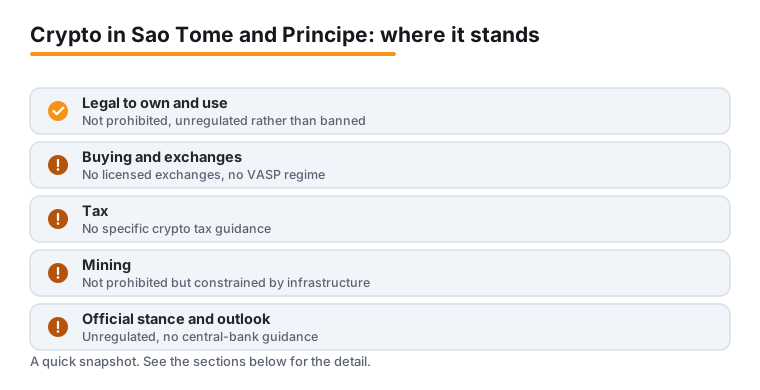
Holding, buying, and selling Bitcoin and other cryptocurrencies is not prohibited in Sao Tome and Principe. No statute makes ownership of crypto-assets an offence, but no law grants crypto any official status either. Bitcoin is not legal tender, and merchants are under no obligation to accept it; the dobra (STN) remains the only legal currency.
The honest description is unregulated rather than banned. The country's own 2024 anti-money-laundering assessment confirms there is no licensing or registration regime for crypto businesses, and the central bank has not issued public crypto guidance. For residents this cuts both ways: there are no restrictions on personal use, but there is also no licensed exchange ecosystem, no deposit protection, and no government-backed recourse if a platform fails or a transaction goes wrong. Anyone engaging with crypto here effectively carries the full risk themselves.
Who regulates crypto: the financial authorities
No authority in Sao Tome and Principe holds a dedicated crypto mandate. The institutions most relevant to digital assets are:
- Banco Central de Sao Tome e Principe (BCSTP) the central bank, established in 1992. It issues the dobra, conducts monetary policy, supervises banks, microfinance, insurance and payment-service providers, and regulates foreign-exchange operations. Any future crypto rules would most plausibly originate here. Official site: bcstp.st.
- Unidade de Informacao Financeira (Financial Information Unit) the national financial intelligence unit, which receives and investigates suspicious-transaction reports under the country's anti-money-laundering law.
- Ministry of Finance responsible for tax policy and the national budget, including how general tax rules might reach crypto income.
Because no rule explicitly names crypto, how these bodies' existing powers apply to a given digital-asset activity is uncertain. If you run a business that touches crypto, seek a formal legal opinion rather than assume the absence of a rule means there are no obligations.
Key laws and frameworks
There is no crypto-specific legislation in force. Activity is instead touched by general financial, criminal, and exchange-control laws written without digital assets in mind:
- Anti-money-laundering / counter-terrorist-financing (AML/CFT) law Sao Tome and Principe adopted an updated AML/CFT framework (substantially revised in 2013) intended to meet international standards, with the Financial Information Unit as the central reporting agency.
- GIABA membership the country is a full member of the Inter-Governmental Action Group against Money Laundering in West Africa, a FATF-style regional body it joined in 2013. See GIABA's country page.
- FATF standards on virtual assets FATF Recommendation 15 expects members to register or license virtual-asset service providers and apply AML rules to them. The 2024 mutual evaluation found Sao Tome and Principe has not yet done so, which is the most likely driver of any future framework.
- Foreign-exchange controls the BCSTP regulates foreign-currency operations. Because crypto can move value across borders, exchange-control rules are an area to watch for larger transactions.
Sao Tome and Principe does not belong to the European Union, so the EU's MiCA regulation does not apply here; it is a separate sovereign jurisdiction from Portugal despite the shared language.
Licensing and registration of exchanges and VASPs
There is no licensing or registration framework for crypto exchanges or other virtual-asset service providers (VASPs) in Sao Tome and Principe. This is confirmed directly by the country's 2024 FATF/GIABA mutual evaluation, which found that licensing, registration, and fitness-and-propriety checks to keep criminals out of the financial sector are non-existent for some sectors, including VASPs, and that the country has neither recorded nor assessed the money-laundering and terrorist-financing risk of VASP activity.
In practice this means no domestic platform is locally authorized, and residents who trade crypto rely on international exchanges or peer-to-peer arrangements. The absence of a regime is a regulatory gap rather than a green light: a future framework could introduce registration obligations, and a business operating in this space today should obtain legal advice on how existing financial and AML rules might already apply. You can read the full assessment in the FATF 2024 Mutual Evaluation Report.
Crypto and Bitcoin taxation
Sao Tome and Principe has not published crypto-specific tax guidance. There is no announced crypto capital-gains regime, income classification, or reporting form dedicated to digital assets, so the treatment of crypto gains is not formally settled.
What is documented about the general tax system: the country does not levy a broad capital-gains tax, and personal income tax applies at progressive rates up to roughly 25 percent, with corporate income tax around 25 percent. Tax residents are generally assessed on worldwide income while non-residents are taxed on locally sourced income. How these general rules would treat a given crypto transaction depends on the facts (investment, trading, or business activity) and has not been clarified by the authorities for digital assets specifically.
Practical takeaways: keep detailed records of every acquisition, disposal, and conversion to dobra; do not assume gains are automatically tax-free simply because no crypto-specific rule exists; and confirm your position with the Ministry of Finance tax administration or a qualified local accountant before filing. For general principles see our crypto taxes guide. This section is informational only and is not tax advice.
AML and KYC rules
Sao Tome and Principe has an AML/CFT law and a Financial Information Unit that collects and investigates suspicious-transaction reports, and it is a GIABA member subject to FATF-style evaluation. However, the 2024 mutual evaluation found that the country has not yet extended these obligations to virtual-asset service providers, has not assessed crypto-related money-laundering risk, and lacks supervision of the sector. In other words, formal KYC/AML duties tailored to crypto businesses are not in force locally.
For individual users this has a practical consequence: even though local law does not require it, reputable international exchanges apply their own identity-verification and anti-money-laundering checks regardless of where you live, so expect to provide government ID and proof of address. Over time, as a GIABA member exposed to FATF Recommendation 15, Sao Tome and Principe may be expected to register VASPs and apply AML rules to them, but until that happens the local crypto AML environment remains undeveloped.
Buying and using crypto in practice
There is no licensed domestic crypto exchange and no local licensing framework for one, so residents who buy crypto typically use international platforms or peer-to-peer arrangements. Several practical frictions apply:
- Payment rails local banking and card infrastructure is limited, and many global exchanges restrict support for very small markets, so funding an account in dobra can be difficult.
- Foreign-exchange rules because buying crypto can move value across borders, the central bank's foreign-exchange controls may be relevant, especially for larger amounts.
- Identity checks expect to complete KYC verification on any reputable platform even though local law does not require it.
- Cashing out converting crypto back into spendable dobra is the hardest step, given thin local liquidity and limited on/off-ramps. Plan your exit before you enter.
When choosing a platform, favour ones with a credible regulatory track record elsewhere, strong security, and clear withdrawal terms, and be cautious of informal sellers and guaranteed-return offers, which carry high fraud risk in markets without local oversight.
Bitcoin mining
No law specifically permits or prohibits Bitcoin mining in Sao Tome and Principe. In practice, mining is constrained less by regulation than by infrastructure. The country has a small electricity grid, historically reliant on imported fuel, with reliability and capacity challenges that make energy-intensive mining costly and uncertain. Industrial-scale operations would also face the hardware-import and logistics hurdles typical of a remote island nation.
The tropical location gives the islands solar potential, and renewable energy is sometimes promoted as a way to power mining sustainably. In reality, intermittency, the cost of storage and equipment, limited land, and grid limitations mean any such project would require significant investment and is far from guaranteed to be viable. Treat solar-mining narratives as long-term possibilities rather than current opportunities, and verify energy, permitting, and import requirements with local authorities before committing capital.
Recent developments (2025 to 2026)
The most notable recent development is not a crypto law but a blockchain-based citizenship-by-investment (CBI) program. Launched in 2025 in partnership with the UAE-based technology firm IOPn, the program uses blockchain (the OPN Chain and ATLAS platform) and Web3 identity tools for verification and record-keeping, with the first passports reported as issued in early 2026 and an initial five-year governance arrangement between the parties. Important caveat: contributions to the program are made in conventional currency to a national fund, so this is the government using blockchain technology for administration, not a legalization or official adoption of cryptocurrency.
On the regulatory side, the headline 2024 to 2025 development is the FATF/GIABA mutual evaluation, which formally documented the absence of VASP licensing and crypto risk assessment. No crypto-specific framework, tax regime, or central-bank guidance had been announced as of 2026. Realistic future catalysts include pressure to meet FATF Recommendation 15, demand for cheaper remittances, and regional regulatory momentum, but no firm timetable exists. Rely on the official sources below for the latest position.
The blockchain citizenship program in detail
Because it is the country's single most-reported link to blockchain, the citizenship-by-investment (CBI) program is worth setting out plainly, and separating from cryptocurrency. Announced in 2025 with UAE technology firm IOPn, it is described by the partners as a blockchain-enabled CBI scheme, said to run on a dedicated ledger called OPN Chain with an application platform named ATLAS, so that applications, approvals and payments are recorded on-chain. The citizenship unit handling applications is reported as based in Dubai, under an initial five-year governance arrangement with the national government.
Two points matter for anyone reading this as a crypto story. First, the qualifying contribution is made to a national fund (widely reported from around 90,000 US dollars) in conventional money, not in cryptocurrency, so the program does not make crypto a means of buying citizenship or grant crypto any legal status. Second, using a blockchain database for record-keeping is a technology choice by the government; it is not a crypto law, a token launch by the state, or central-bank adoption of digital currency. Treat marketing that frames the passport as a crypto product with care, and confirm any figure or requirement against official program materials before relying on it.
Consumer risks and protection
The defining risk in Sao Tome and Principe is the regulatory vacuum. With no crypto law, users lack licensing safeguards, formal dispute mechanisms, and clear tax rules, while still facing global price volatility, scam exposure, and cybersecurity threats. Thin local liquidity and limited on/off-ramps make it hard to move between crypto and dobra, and foreign-exchange and AML obligations may apply in ways that are not yet spelled out.
Because there is no local investor-protection regime, recourse against fraud or platform failure is minimal. If you choose to use crypto, the usual principles apply: only commit money you can afford to lose, use platforms with a strong security and compliance record elsewhere, move meaningful holdings to a wallet you control and back up the recovery phrase, keep full records, and be sceptical of any scheme promising guaranteed or outsized returns. This page is informational only and is not investment advice.
Official sources and how to verify
Crypto rules can change, and the position in a small jurisdiction can be hard to confirm, so verify the current status with primary official sources before acting:
- Banco Central de Sao Tome e Principe (BCSTP) the central bank and the authority most likely to issue any crypto guidance, foreign-exchange rules, and supervisory notices.
- FATF 2024 Mutual Evaluation Report the most authoritative assessment of the country's AML/CFT framework and its treatment (or non-treatment) of virtual-asset service providers.
- GIABA member-state page regional AML body tracking the country's compliance and follow-up actions.
- US State Department Investment Climate Statement (2025) independent overview of the financial sector, banking regulator, and AML environment.
For wider context, browse our country regulation hub. This guide is general information as of 2026 and is not legal, tax, or financial advice; readers should confirm their situation with the Banco Central de Sao Tome e Principe and a qualified local professional.
Frequently asked questions
Is Bitcoin legal in Sao Tome and Principe?
There is no law banning Bitcoin, so owning, buying, and selling it is not illegal. However, there is also no law that regulates or officially recognizes crypto, and Bitcoin is not legal tender; only the dobra is. The practical status is unregulated rather than prohibited, which means no local consumer protections apply.
Who regulates cryptocurrency in Sao Tome and Principe?
No authority has a dedicated crypto mandate. The Banco Central de Sao Tome e Principe (BCSTP) oversees the financial system, currency, and foreign exchange, and the Financial Information Unit handles anti-money-laundering reporting. Any future crypto rules would most likely come from the central bank. Verify the current position at bcstp.st.
Do crypto exchanges need a license in Sao Tome and Principe?
No. There is no licensing or registration regime for crypto exchanges or virtual-asset service providers. The 2024 FATF mutual evaluation confirmed that licensing and registration for VASPs is non-existent and that the country has not assessed crypto-related money-laundering risk. This is a regulatory gap, not an endorsement, and could change in future.
Do I have to pay tax on crypto in Sao Tome and Principe?
The country has not issued crypto-specific tax guidance. It does not levy a broad capital-gains tax, and personal income tax runs at progressive rates up to about 25 percent, but how these general rules apply to crypto is not formally settled. Keep full records and confirm your obligations with the Ministry of Finance tax administration or a qualified accountant. This is not tax advice.
What was the 2025 blockchain citizenship program?
In 2025 Sao Tome and Principe launched a citizenship-by-investment program that uses blockchain technology (via UAE firm IOPn) for identity verification and record-keeping, with first passports reported in early 2026. It is the government using blockchain for administration; contributions are paid in conventional currency, so it is not a legalization or official adoption of cryptocurrency.
Can I use Bitcoin to send remittances to Sao Tome and Principe?
Technically yes, and crypto transfers can settle quickly across borders. In practice the main challenge is cashing out into dobra reliably, alongside price volatility and possible foreign-exchange or AML requirements. Regulated money-transfer services remain the more dependable option for most people today.
Can I pay for Sao Tome citizenship with cryptocurrency?
Based on reported program terms, no. The qualifying contribution to the national fund is made in conventional currency (widely reported from around 90,000 US dollars), even though the citizenship-by-investment program uses a blockchain database for record-keeping. The blockchain element is an administrative technology choice, not acceptance of crypto as payment. Confirm current terms with official program materials before relying on any figure.
Is there a licensed crypto exchange based in Sao Tome and Principe?
No. There is no locally licensed or registered domestic exchange, because the country has no VASP licensing regime, a gap the 2024 FATF mutual evaluation documented. Residents rely on international platforms or peer-to-peer arrangements, and cashing out into dobra is often the hardest step given thin local liquidity.
Facts reviewed: 30 June 2026. Page updated: 3 August 2026.