Home › Crypto Regulation › Paraguay
Bitcoin & Cryptocurrency Regulation in Paraguay
Quick answer — Paraguay, 2026
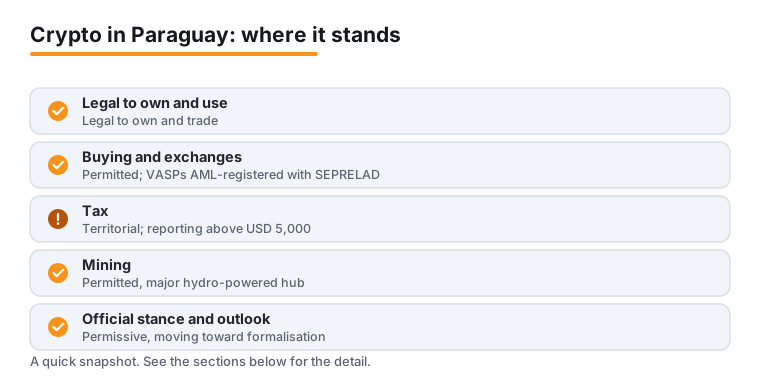
- Legal: Legal to own and trade, not legal tender, no State backing
- Tax: Territorial system, no new crypto tax, DNIT reporting above USD 5,000
- Buying: Via global platforms and P2P with KYC, some Bitcoin ATMs
Paraguay is one of South America's more permissive places for cryptocurrency. It has not made Bitcoin legal tender, but owning, buying, selling and trading crypto is legal, and the country's abundant, low-cost hydroelectric power has made it a regional hub for Bitcoin mining. The legal framework is built piecemeal rather than through a single crypto law: anti-money-laundering rules from SEPRELAD, a 2025 capital-markets reform that reaches tokenised assets, and a 2026 tax-reporting obligation from the revenue authority all now touch the sector.
This guide explains how Bitcoin and other cryptocurrencies are treated in Paraguay as of 2026: the legal status, who the regulators are, the key laws, AML/KYC and exchange obligations, taxation, mining, recent developments, and how to verify everything against official sources. It is general information as of 2026 and is not legal, tax, or financial advice; you should confirm any specific point with the named official regulators or a qualified local professional. For broader background see our overview of crypto regulation.
On this page: Legal status · Who regulates it · Taxes · How to buy · Mining
Legal status: is crypto legal in Paraguay?
Yes. Buying, holding, selling and using Bitcoin and other cryptocurrencies is legal in Paraguay for both individuals and businesses. There is no law banning crypto and no general prohibition on private parties transacting in it.
What crypto is not is legal tender. The only legal tender in Paraguay is the Guarani (PYG), issued by the Central Bank of Paraguay (Banco Central del Paraguay, BCP). The Superintendencia de Valores, under the BCP, has stated publicly that cryptocurrencies are not registered or authorised by the BCP, do not have legal course (curso legal) in the country, and do not have State backing. Because crypto has no cancellation force, no merchant or creditor is obliged to accept it, and acceptance is voluntary and a matter of private agreement.
The practical picture is permissive but unprotected: you are free to use crypto, but you generally do not enjoy the consumer protections, deposit guarantees or central-bank backing that apply to the Guarani and the regulated banking system.
Who regulates crypto in Paraguay
Oversight is shared among several authorities, each touching crypto from a different angle:
- Banco Central del Paraguay (BCP) is the monetary authority. It issues the Guarani and, through its Superintendencia de Valores, publishes warnings that crypto assets are not money, are high-risk, and are not authorised or backed by the State. The BCP has historically been cautious about a dedicated crypto regime.
- SEPRELAD (Secretaria de Prevencion de Lavado de Dinero o Bienes) is the anti-money-laundering and counter-terrorist-financing authority and the most operationally relevant regulator for crypto businesses. It treats virtual-asset service providers as obliged subjects.
- Superintendencia de Valores (SIV), the securities supervisor consolidated under the BCP by the 2025 capital-markets reform, oversees tokenised assets and tokens that represent property, credit or investment rights.
- Direccion Nacional de Ingresos Tributarios (DNIT) is the tax/customs revenue authority. In 2026 it introduced a mandatory information-reporting regime for crypto-asset transactions.
There is no single agency that issues a dedicated crypto-exchange licence; instead these bodies apply their respective AML, securities and tax mandates to crypto activity.
Key laws and frameworks
Paraguay does not have one comprehensive cryptocurrency statute. A crypto-and-mining bill passed Congress in 2022 but was vetoed by the Executive and shelved, so the framework has been assembled from separate instruments:
- SEPRELAD Resolution No. 008/2020 first designated persons engaged in mining, exchange, transfer, custody and administration of virtual assets as AML obliged subjects.
- SEPRELAD Resolution No. 314/2021 created the dedicated AML/CFT regime for Virtual Asset Service Providers (Proveedores de Servicios de Activos Virtuales, PSAV), covering natural and legal persons established or domiciled in Paraguay that carry out virtual-asset activities.
- Law No. 7572/2025 on the Securities and Products Market, passed in November 2025, modernised capital-markets oversight, consolidated it under the BCP via the Superintendencia de Valores, and formally extends regulation to tokenised assets and tokens representing property or credit rights. It recognises distributed-ledger technology and aims to enable tokenisation projects. Implementation continues through 2026.
- DNIT General Resolution No. 47/2026 established a crypto-asset transaction reporting obligation (covered below under taxation).
Because this area is evolving, treat any single summary as a starting point and confirm current rules against the official sources listed at the end of this guide.
Licensing and registration of exchanges and VASPs
Paraguay has no standalone crypto-exchange licence comparable to a banking licence, and there is no rule preventing Paraguayans from using international platforms. The relevant obligation is AML registration rather than a product licence.
Under SEPRELAD Resolution No. 314/2021, Virtual Asset Service Providers (PSAV) established or domiciled in Paraguay are obliged subjects. In practice this means a VASP is expected to:
- register with SEPRELAD and be enrolled as an obliged subject;
- implement customer identification and verification (KYC) controls;
- conduct risk analysis and ongoing transaction monitoring;
- appoint a compliance officer; and
- file suspicious-transaction reports to SEPRELAD.
Separately, if a token qualifies as a security or is offered publicly, the Superintendencia de Valores can have jurisdiction under Law No. 7572/2025. There is no comprehensive crypto licensing law beyond these AML and securities mandates, so businesses should obtain local legal advice on which obligations apply to their specific model.
Crypto taxation in Paraguay
Paraguay's tax system rests on a territorial principle: in general, only income generated within Paraguayan territory is taxable, and there has not historically been a tax regime written specifically for crypto. The major 2026 change is informational reporting, not a new tax.
DNIT General Resolution No. 47/2026 created an obligation to report crypto-asset transactions through the DNIT's Marangatu tax-management system, via a sworn informative declaration (Declaracion Jurada Informativa de Criptoactivos). Key features reported in official and press coverage:
- It applies to individuals, legal entities and platforms once cumulative crypto operations exceed about USD 5,000 in the fiscal year.
- It covers buying, selling, swaps between cryptoassets, payments, transfers between wallets, mining, staking, yield, airdrops and lending income.
- Reportable data includes transaction type, date and time, amount, USD value, the transaction hash, origin and destination addresses, and wallet type.
- DNIT has stated it does not create a new tax and does not change the territoriality principle; it is an information-gathering measure, with filings phased in for fiscal year 2026 (and later closing dates from 2027).
The informative declaration is filed annually within three months after the close of the fiscal year, following DNIT's information-return calendar, so those with a 31 December close first report for fiscal year 2026 during 2027. Late filing of the crypto informative declaration carries a fine of one million guaranies (roughly USD 160 at 2026 exchange rates), without prejudice to any other administrative consequences.
Exact thresholds, scope and deadlines are set by the resolution and can change, so verify them directly with DNIT or a qualified local accountant. See our general explainer on crypto taxes for how reporting obligations differ from tax liability.
AML and KYC rules
Anti-money-laundering compliance is the backbone of Paraguay's crypto oversight. SEPRELAD applies standards aligned with the Financial Action Task Force (FATF), and Virtual Asset Service Providers are obliged subjects under Resolutions 008/2020 and 314/2021.
For users, this means you should expect identity verification (KYC) when dealing with regulated providers: an ID document, sometimes proof of address, and verification steps that scale with transaction size. Providers are required to monitor transactions, keep records, and report suspicious activity to SEPRELAD.
Paraguay has also pursued cross-border AML cooperation. In 2025 SEPRELAD signed a memorandum of understanding with El Salvador's Comision Nacional de Activos Digitales (CNAD) to coordinate on the virtual-asset sector, including detecting and controlling unlicensed crypto operations and strengthening AML practices. Keep records of the source and purpose of funds, especially for larger transfers.
Buying and using crypto in practice
There is no Paraguay-specific barrier to buying crypto, and most residents use global platforms or peer-to-peer trades. A typical first purchase looks like this:
- Choose a platform: a reputable international exchange that serves Paraguay, or a well-reviewed P2P marketplace. Check supported deposit methods (USD, Guarani or stablecoins) and fees.
- Complete KYC: most platforms require identity verification, reflecting SEPRELAD's AML expectations.
- Fund and trade: deposit via bank transfer, card or stablecoins, then place a market or limit order and review the all-in cost including spread and fees.
- Secure your holdings: for more than small amounts, withdraw to a wallet you control, ideally a hardware wallet, and back up your recovery phrase. Leaving large balances on an exchange exposes you to platform risk.
- Keep records: save transaction details for the DNIT reporting obligation and any tax position.
Using crypto for payments is legal but voluntary on the merchant's side, since crypto is not legal tender. Crypto is also used for remittances; many people prefer dollar-pegged stablecoins to reduce volatility, then convert to Guarani locally, noting that the conversion step is where fees and spreads accumulate. Bitcoin ATMs exist mainly in larger cities such as Asuncion but are sparse and come and go, so check a live ATM locator before relying on one.
Bitcoin mining in Paraguay
Mining is where Paraguay stands out globally. The country is a net exporter of electricity thanks to large hydroelectric capacity, most notably the binational Itaipu Dam shared with Brazil (which supplies the bulk of domestic demand), plus Yacyreta and Acaray. Low-cost, renewable power has attracted both domestic and international Bitcoin miners.
Key points:
- Legality: mining is permitted and there is no dedicated miner-licensing regime; operations are generally treated as industrial electricity consumers, and AML obligations apply to mining as a virtual-asset activity.
- Illegal-mining crackdown: rapid inflows led to widespread electricity abuse, with operators tapping the grid illegally or misclassifying activity to avoid industrial tariffs. Authorities have raided clandestine operations and seized large quantities of equipment.
- Harsher penalties for power theft: in July 2024 the Senate approved a change to the electricity-theft offence in Article 173 of the Penal Code that raises the maximum prison term to up to 10 years where the stolen power is used for cryptocurrency mining, compared with up to 3 years for ordinary electricity theft, and allows confiscation of the mining equipment. This targets clandestine operators rather than legally contracted miners.
- State involvement: the state electricity utility ANDE has explored a government-run Bitcoin mining program using seized rigs and surplus hydroelectric power, with pilot activity announced in 2025.
- Policy uncertainty: lawmakers have at various times proposed special tariffs, restrictions or temporary bans, so the energy-cost advantage is not guaranteed to remain unchanged.
If you are considering mining, the electricity contract and its legal basis matter as much as the hardware; confirm current tariff arrangements with ANDE and seek local legal advice.
Recent developments (2025-2026)
Several changes define Paraguay's current outlook:
- Capital-markets reform: Law No. 7572/2025 (November 2025) modernised securities oversight, consolidated it under the BCP via the Superintendencia de Valores, and extended formal regulation to tokenised assets and security tokens, with rules rolling out through 2026.
- Crypto tax reporting: DNIT General Resolution No. 47/2026, published in March 2026, introduced mandatory wallet-level reporting of crypto transactions above roughly USD 5,000 per year through the Marangatu system, phased in for the 2026 fiscal year and first due during 2027, with a one-million-guarani fine for late filing. DNIT stresses it is informational and does not create a new tax.
- Mining-theft penalties: a July 2024 Senate-approved amendment to the Penal Code set prison terms of up to 10 years for stealing electricity to mine cryptocurrency, well above the penalty for ordinary power theft, alongside equipment seizures by the utility ANDE.
- State mining: ANDE's exploration of government Bitcoin mining using seized rigs and surplus power signals growing state interest in monetising electricity.
- International cooperation: the 2025 SEPRELAD and El Salvador CNAD memorandum points to gradual, FATF-aligned regional coordination on virtual assets.
These measures point toward formalisation: openness to crypto combined with maturing reporting and supervision.
Consumer risks and protection
Because crypto is not recognised within Paraguay's national financial system, users carry most of the risk themselves:
- No local backstop: there is generally no deposit insurance or central-bank protection if a platform fails or funds are stolen. The BCP has repeatedly warned that crypto assets are high-risk.
- Volatility: Bitcoin and altcoins can swing sharply; only commit capital you can afford to lose.
- Irreversibility: crypto transactions cannot be reversed by a bank, so a mistaken address or a scam cannot be undone.
- Scams and custody: phishing, fake platforms and exchange failures are real risks; self-custody puts you in control but makes you solely responsible for keys and backups.
- Compliance: larger transfers may fall under AML monitoring and the DNIT reporting obligation, so keep documentation.
The single most useful habit is to check primary sources (BCP, SEPRELAD, the Superintendencia de Valores and DNIT) before acting. Compare countries on our crypto regulation hub.
Official sources and how to verify
Crypto rules in Paraguay are issued and updated by official bodies, and you should confirm specifics directly with them rather than relying on summaries. The primary sources are:
- Banco Central del Paraguay (BCP) and its Superintendencia de Valores, for monetary status, securities/tokenised-asset rules under Law No. 7572/2025, and official warnings that crypto is not legal tender or State-backed.
- SEPRELAD, the AML/CFT authority, for the Virtual Asset Service Provider regime (Resolutions 008/2020 and 314/2021) and the official resolutions register.
- Direccion Nacional de Ingresos Tributarios (DNIT), for the crypto-asset reporting obligation under General Resolution No. 47/2026 and the Marangatu filing system.
This article is general information as of 2026 and is not legal, tax, or financial advice. Laws, taxes and regulator structures in Paraguay can change; confirm any specific point with the relevant official authority named above, in particular SEPRELAD, the BCP and DNIT, or a qualified local professional before acting.
Frequently asked questions
Is Bitcoin legal tender in Paraguay?
No. The only legal tender in Paraguay is the Guarani (PYG), issued by the Central Bank of Paraguay. Bitcoin and other cryptocurrencies are legal to own and trade, but they are not legal tender, have no legal course (curso legal), and carry no State backing, so no one is obliged to accept them as payment.
Who regulates cryptocurrency in Paraguay?
Oversight is shared. The Central Bank of Paraguay (BCP) and its Superintendencia de Valores cover monetary status and tokenised assets under Law No. 7572/2025; SEPRELAD is the anti-money-laundering authority that registers and supervises Virtual Asset Service Providers; and the DNIT, the tax authority, runs the crypto-transaction reporting regime introduced by General Resolution No. 47/2026.
Do crypto exchanges need a licence in Paraguay?
There is no standalone crypto-exchange licence in Paraguay. Instead, Virtual Asset Service Providers established or domiciled in Paraguay are AML obliged subjects under SEPRELAD Resolutions 008/2020 and 314/2021, meaning they must register with SEPRELAD and apply KYC, transaction monitoring, a compliance officer and suspicious-transaction reporting. Tokens that qualify as securities can also fall under the Superintendencia de Valores.
Do I have to report or pay tax on crypto in Paraguay?
Paraguay uses a territorial tax principle and has not created a tax written specifically for crypto. However, DNIT General Resolution No. 47/2026 requires individuals, entities and platforms to report crypto transactions through the Marangatu system once yearly operations exceed about USD 5,000, including wallet addresses and transaction hashes. DNIT says this is informational and does not itself create a new tax. Confirm your specific position with DNIT or a qualified local accountant.
Is Bitcoin mining allowed in Paraguay?
Yes. Mining is permitted and Paraguay is a notable hub because of its cheap hydroelectric power from Itaipu and other dams. There is no dedicated miner-licensing regime, but operators are treated as industrial electricity users and authorities have cracked down hard on illegal, power-stealing operations, seizing equipment. Secure a properly metered, legally contracted electricity supply with ANDE and seek local advice.
What changed for crypto in Paraguay in 2025-2026?
Two main changes: Law No. 7572/2025 (November 2025) modernised the securities market and extended regulation to tokenised assets under the BCP's Superintendencia de Valores, and DNIT General Resolution No. 47/2026 introduced mandatory wallet-level reporting of crypto transactions above roughly USD 5,000 per year. SEPRELAD also signed a 2025 cooperation memorandum with El Salvador's digital-assets commission.
What happens if I do not file the DNIT crypto report on time?
Under DNIT General Resolution No. 47/2026, the crypto informative declaration is filed through the Marangatu system once yearly operations exceed about USD 5,000, within three months after the fiscal year closes. Late filing carries a fine of one million guaranies (roughly USD 160 at 2026 exchange rates), without prejudice to other administrative consequences. The first declaration covers fiscal year 2026 and is due during 2027. Confirm your deadline and position with DNIT or a qualified local accountant.
What is the penalty for illegal Bitcoin mining in Paraguay?
Legal mining under a properly contracted electricity supply is permitted. Stealing electricity to mine, however, is treated harshly: a July 2024 amendment to Article 173 of the Penal Code set prison terms of up to 10 years where stolen power is used for cryptocurrency mining, compared with up to 3 years for ordinary electricity theft, and allows confiscation of the mining equipment. The utility ANDE has raided clandestine sites and seized rigs. Secure a metered, legally contracted supply with ANDE before mining.
Facts reviewed: 30 June 2026. Page updated: 3 August 2026.