Home › Crypto Regulation › Pakistan
Bitcoin & Cryptocurrency Regulation in Pakistan
Quick answer — Pakistan, 2026
- Legal: Legal to hold and trade via licensed providers, not legal tender
- Tax: Taxable under general income tax rules; the Finance Act, 2026 created no crypto specific rate
- Buying: Via PVARA-licensed or NOC-holding exchanges after KYC
Pakistan has moved from a banking-sector restriction to an explicit licensing regime for cryptocurrency. For years the State Bank of Pakistan (SBP) advised banks not to service crypto businesses, which effectively cut off formal rupee on-ramps even though personal ownership was never criminalised. That changed in 2025 and 2026: the country created a dedicated regulator, the Pakistan Virtual Assets Regulatory Authority (PVARA), and gave the sector a statutory basis. This page explains where Pakistan stands as of 2026: whether holding Bitcoin is legal, who regulates the market, the laws involved, how exchanges are licensed, how crypto is taxed, AML and KYC rules, the practicalities of buying, mining and recent developments. This is general information as of 2026 and NOT legal, tax or financial advice; the rules are new and changing quickly, so verify the current position with the named official regulators before acting. For background concepts, see our guide to crypto regulation.
On this page: Legal status · Who regulates it · Taxes · How to buy · Mining
Is Bitcoin and crypto legal in Pakistan?
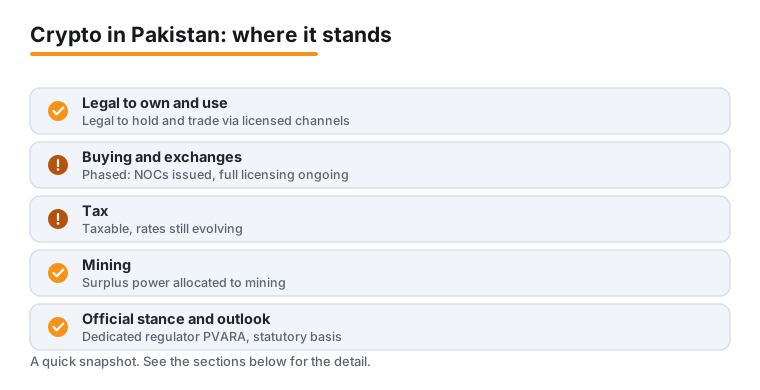
As of 2026, holding, buying and trading cryptocurrencies through licensed channels is legal in Pakistan. This is a clear shift from the prior environment, where a 2018 SBP advisory directed banks and payment institutions not to facilitate crypto transactions. Pakistan never criminalised personal ownership of crypto, but that banking restriction made it difficult to move money into and out of exchanges through the formal system.
- Legal to hold and trade, but not legal tender. The law explicitly states that virtual assets are not legal tender in Pakistan. The Pakistani rupee remains the only currency that must be accepted to settle debts, and crypto is generally not permitted as a means of payment to retailers for goods and services.
- Channelled through licensed providers. The framework legalises the sector by routing it through authorised, supervised firms. Using an unlicensed service can expose you to legal and financial risk.
Because the framework is new and implementing rules are still being issued, treat any specific permission as something to verify with PVARA rather than assume.
Who regulates crypto in Pakistan?
The lead regulator is the Pakistan Virtual Assets Regulatory Authority (PVARA), an autonomous federal body that licenses and supervises Virtual Asset Service Providers (VASPs) - exchanges, custodians, wallet operators, token issuers and investment platforms. PVARA can grant, suspend and revoke licenses, investigate suspicious activity, enforce penalties and set consumer-protection standards. It maintains an official website at pvara.gov.pk. PVARA has been chaired by Bilal Bin Saqib, who also serves as chief executive of the Pakistan Crypto Council. PVARA has also published sandbox guidelines that let approved firms test virtual-asset products under supervision before full licensing. Several other bodies play a role:
- Pakistan Crypto Council (PCC), launched in 2025 under the Ministry of Finance, coordinates national crypto and blockchain policy and engages industry.
- State Bank of Pakistan (SBP) sets monetary policy and the rules for how banks may interact with the sector. Its official site is sbp.org.pk.
- Securities and Exchange Commission of Pakistan (SECP) oversees securities and capital markets where assets fall within its remit.
- Federal Board of Revenue (FBR) handles taxation of crypto gains and income.
| Body | Role |
|---|---|
| PVARA | Licenses and supervises VASPs; enforcement and consumer protection |
| Pakistan Crypto Council | Sets national crypto policy direction; industry engagement |
| State Bank of Pakistan | Monetary policy; rules for bank dealings with licensed firms |
| SECP | Securities and markets oversight where applicable |
| FBR | Taxation of crypto gains and income |
Key laws and frameworks
Pakistan's crypto rulebook was built quickly across 2025 and 2026:
- Virtual Assets Ordinance, 2025. Signed into law in July 2025, this temporary ordinance first established PVARA and the licensing concept. As an ordinance it had a limited life and was extended while Parliament worked on permanent legislation. The text is published on the official law portal at pakistancode.gov.pk.
- Virtual Assets Act, 2026. In early 2026, Pakistan's Parliament passed the Virtual Assets Act, converting the temporary measure into permanent legislation. It cements PVARA as the national regulator, defines virtual assets and VASPs, sets licensing requirements, imposes anti-money-laundering (AML) and counter-terrorism-financing (CFT) obligations aligned with Financial Action Task Force (FATF) standards, and provides penalties for operating without authorisation.
Operating a crypto business without a PVARA license can carry serious consequences. The Virtual Assets Act, 2026 introduced criminal penalties for unlicensed operation, reported as fines of up to 50 million Pakistani rupees and imprisonment of up to five years. Penalty levels and procedures are set out in the official text, so review the statute rather than summaries. The 2025 ordinance has been superseded. The Virtual Assets Act, 2026 is the operative statute, and the State Bank's April 2026 circular records that it has been enacted and that PVARA is the statutory authority for licensing, regulation, supervision and oversight. What remains outstanding is the secondary layer: the Pakistan Virtual Asset Services Regulations, 2026 were still in draft on 3 August 2026, which is why PVARA is issuing No Objection Certificates rather than full licences.
Licensing and registration of exchanges (VASPs)
Under the framework, the intended route to offer or use crypto services in Pakistan is through a PVARA-licensed VASP. The category covers exchanges, brokers, custodians, wallet operators, token issuers and investment platforms, and each must obtain authorisation before serving customers.
- Phased, supervised entry. PVARA began with a staged approach, issuing No Objection Certificates (NOCs) to major platforms as a first step before full licensing. On 12 December 2025 PVARA announced that it had granted No Objection Certificates to major global exchanges including Binance and HTX, allowing them to set up local units and prepare full licence applications.
- Operational standards. Licensed providers are expected to safeguard customer funds, maintain cybersecurity, make clear disclosures, keep records and follow KYC and AML procedures.
- Verify status first. Because licensing is recent and ongoing, an NOC is not the same as a full license. Confirm a platform's current authorisation status with PVARA before depositing funds.
Crypto and Bitcoin tax in Pakistan
Crypto is within Pakistan's tax net, and the Federal Board of Revenue (FBR) is the relevant authority. The broad principles are clearer than the precise, still-evolving numbers:
- Gains can be taxable. Profits from disposing of crypto can be subject to tax, and income such as mining or staking rewards may be treated as ordinary income rather than capital gains.
- Rates are evolving. The budget cycle produced no crypto tax. The Finance Act, 2026 (Act No. XLIII of 2026) was published in the Gazette of Pakistan Extraordinary on 26 June 2026 and came into force on 1 July 2026, and the enacted Act contains no provision on virtual assets: its amendments to the Income Tax Ordinance, 2001 make no reference to virtual assets, cryptocurrency, digital assets, blockchain or PVARA. The rates discussed during the 2026-27 budget debate were not enacted, so there is no crypto specific rate, exemption threshold or statutory holding period in Pakistani tax law. Treatment follows the general rules of the Income Tax Ordinance, 2001 and depends on whether your activity is characterised as investment, trading, mining or business.
- Reporting. Taxpayers generally file through the FBR's online IRIS portal, and crypto activity should be disclosed like other income or gains, within the usual filing deadlines. We found no published FBR rule or PVARA instrument requiring licensed exchanges to report user data to the FBR. The hook exists but has not been switched on: section 66 of the Virtual Assets Act, 2026 requires licensed providers to comply with the Income Tax Ordinance, 2001 and any Rules or Regulations issued by the FBR, and regulation 92 of PVARA's draft Pakistan Virtual Asset Services Regulations, 2026 would restate that duty. Those Regulations were still in draft on 3 August 2026.
Tax treatment can differ depending on whether you are an investor, trader, miner or business, and the rules are changing. Confirm current rates, thresholds and deadlines directly with the Federal Board of Revenue (FBR) or a qualified Pakistani tax adviser. See also our general crypto taxes guide. This section is informational only and is not tax advice.
AML, KYC and compliance rules
A central goal of the new framework is to bring crypto within Pakistan's anti-money-laundering and counter-terrorism-financing regime and to align the country with FATF standards. Practically, this means:
- Identity checks. Licensed VASPs must verify customer identities (know-your-customer, or KYC), so expect to provide identity and address documents and, in some cases, evidence of source of funds.
- Transaction monitoring and reporting. Providers are required to monitor transactions, keep records and report suspicious activity to the authorities.
- Bank-level conditions. Banks that service licensed firms must apply their own AML, KYC and CFT controls.
These obligations are designed to make the formal, licensed channel the safer route, and they are part of why using unlicensed or anonymous services is discouraged.
Buying and using crypto in practice
A compliance-minded approach for residents looks like this:
- Use a licensed platform. Choose an exchange or broker that is licensed by PVARA, or clearly progressing through authorisation, and verify its current status before you sign up.
- Complete verification. Pass KYC and AML checks by providing the required identity and address documents.
- Fund through approved channels. Use supported, rupee-based funding methods consistent with the platform's and the SBP's rules. Banking access for licensed firms has been expanding (see recent developments), so available methods may improve over time.
- Place your order and secure your holdings. Consider starting small, enable two-factor authentication, use strong unique passwords, and consider moving significant amounts to a personal or hardware wallet where you control the keys. Never share your seed phrase.
- Keep records. Track purchases, sales and transfers for tax reporting.
Crypto is generally not accepted as everyday payment in shops, and using it that way sits outside its status as a regulated investment asset. Avoid informal peer-to-peer deals with strangers, which carry fraud and counterparty risk and fall outside the protected, regulated channel.
Bitcoin mining and energy policy
Bitcoin mining sits at the intersection of Pakistan's energy situation and its new crypto ambitions. Policymakers have publicly discussed directing surplus electricity toward economically productive uses. In 2025, officials announced plans to allocate a large block of electricity (reported at around 2,000 megawatts in an initial phase) to crypto mining and artificial-intelligence data centres, alongside a proposed government-backed strategic Bitcoin reserve.
- Power is the central issue. Mining profitability depends heavily on electricity cost and reliability; tariffs and supply stability can make or break margins, which is why surplus-power allocation has featured in policy.
- Renewable interest. Pakistan's solar and wind potential makes clean-energy-powered mining an appealing concept for cutting both costs and emissions.
- Policy is still settling. Specific allocations, tariffs and approval requirements are evolving and depend on coordination between energy authorities and the crypto framework. Income earned from mining is generally taxable.
Anyone considering mining should confirm the latest electricity pricing, any required registrations or approvals, and tax treatment with the relevant authorities before committing capital.
Recent developments (2025-2026)
The pace of change has been rapid:
- July 2025: The Virtual Assets Ordinance, 2025 came into force, establishing PVARA and the licensing concept.
- 2025: The Pakistan Crypto Council was launched under the Ministry of Finance, and Pakistan announced ambitions including a strategic Bitcoin reserve and electricity allocation for mining and AI data centres.
- December 2025: PVARA announced on 12 December 2025 that it had granted No Objection Certificates to major exchanges including Binance and HTX, beginning the formal licensing process.
- Early 2026: Parliament passed the Virtual Assets Act, 2026, converting the temporary ordinance into permanent law.
- April 2026: The State Bank of Pakistan issued BPRD Circular Letter No. 10, titled Authorizing Opening of Bank Accounts to PVARA's NOC/Licensed VASPs and their Customers, which replaces BPRD Circular No. 03 of 2018 dated April 06, 2018 with immediate effect. Regulated entities may open accounts for PVARA-licensed VASPs after obtaining the licence and independently verifying it with PVARA, using separate Client Money Accounts that must be PKR denominated and non remunerative, permit no cash deposits or withdrawals, and may not be used as collateral. Limited purpose accounts are allowed for NOC holders so they can complete licensing formalities. Banks remain barred from trading, investing in or holding crypto with their own funds or customer deposits.
- 2026: PVARA published sandbox guidelines allowing approved startups to test virtual-asset products under supervision, and the Act carries criminal penalties of up to 50 million rupees in fines and up to five years imprisonment for unlicensed operation.
- From July 2026: Reporting indicates licensed exchanges are expected to report user data to the FBR, tightening the link between exchange activity and tax filings.
- Ongoing: PVARA's draft Pakistan Virtual Asset Services Regulations, 2026 closed for public comment on 2 July 2026 and await a feedback statement and final notification before full VASP licensing can begin.
Dates and exact instrument names should be verified against the official sources below, as details have been reported by media and may be refined in the formal record.
Consumer risks and protection
A clearer legal framework reduces some uncertainty, but real risks remain for individuals:
- Volatility. Crypto prices can rise and fall sharply, and rupee-denominated returns are also affected by exchange-rate movements. You can lose part or all of your capital.
- Fraud and scams. Fake platforms, impersonation, Ponzi and guaranteed-return schemes are common. Be especially wary of anyone promising fixed or guaranteed profits.
- Unlicensed operators. Services outside the PVARA regime offer no regulatory protection; verify licensing before depositing funds.
- Security. Hacking and lost keys are real threats. Use reputable, licensed services, enable two-factor authentication and consider self-custody for larger amounts.
- Policy risk. Tax treatment, licensing conditions and what is permitted are still maturing and can change.
Treat any allocation as money you can afford to lose, do your own research, and consider professional advice. This is not financial advice. For more on protections, browse our regulation hub.
Official sources and how to verify
Because this area is new and evolving, rely on primary, official sources rather than summaries when you need the current rules:
- Pakistan Virtual Assets Regulatory Authority (PVARA) - the licensing regulator and the authority on VASP status and rules: pvara.gov.pk.
- State Bank of Pakistan (SBP) - for banking rules, circulars and monetary policy: sbp.org.pk.
- Federal Board of Revenue (FBR) - for tax rates, filing and the IRIS portal: fbr.gov.pk.
- Pakistan Code (official law portal) - for the text of the Virtual Assets Ordinance and Act: pakistancode.gov.pk.
To verify a specific point, check the regulator that owns it: PVARA for licensing and VASP status, the SBP for banking access, the FBR for tax, and the law portal for the statute itself. This page is general information as of 2026 and is not legal, tax or financial advice; always confirm the current position with the named official regulator or a qualified professional before acting.
What is changing: PVARA's licensing rulebook and when it lands
The Virtual Assets Act, 2026 gave PVARA the power to license. The detailed rules that turn that power into an actual licence now exist, in draft. On 11 June 2026 PVARA opened public consultation PVARA/CON/001/2026 on the draft Pakistan Virtual Asset Services Regulations, 2026, published under section 68 of the Act together with a General Handbook and ten activity specific handbooks. The consultation closed on 2 July 2026 at 4:00 PM PKT. PVARA states that the next steps are a feedback statement setting out the main themes raised, the changes made to the draft and its reasoning where proposals were not adopted, followed by final Regulations notified in accordance with the Virtual Assets Act, 2026. As of 3 August 2026 PVARA's consultations page states there are no public consultations open at this time, and neither the feedback statement nor the final Regulations had been published. No target date has been given.
What the draft Regulations would do if adopted in their current form:
- Create ten licence categories under regulation 4(1): Advisory, Broker-Dealer, Exchange, Custody, Transfer and Settlement, Lending and Borrowing, Derivatives and Leverage, Management and Investment, Issuance, and Mining related virtual asset activities.
- Require every licensee to be a company incorporated in Pakistan under the Companies Act, 2017, with a registered office in Pakistan and at least one key individual resident in Pakistan, vested with operational and decision making authority and accountable to PVARA for regulatory compliance.
- Give PVARA 90 days to decide a complete licence application, extendable by up to 60 further days for reasons recorded in writing where the application is complex, involves novel risks or requires consultation with other competent authorities.
- Require anyone providing virtual asset services immediately before the Act commenced to apply for a licence within six months or stop, reflecting section 70(1) of the Act. A firm that files a complete application inside that window may keep operating while PVARA decides.
- Require client asset segregation, proof of reserves, fit and proper tests, cybersecurity and operational resilience standards, Travel Rule controls, and an up to date public register of licensees.
Proposed minimum paid up capital, from Schedule I of the draft. These are consultation figures, not law, and can change before notification.
| Licence category | Minimum paid up capital (PKR) |
|---|---|
| Advisory Services | 25,000,000 |
| Broker-Dealer Services | 100,000,000 |
| Custody Services | 200,000,000 |
| Virtual Asset Management and Investment Services | 200,000,000 |
| Virtual Asset Transfer and Settlement Services | 200,000,000 |
| Lending and Borrowing Services | 500,000,000 |
| Virtual Asset Derivatives Services | 500,000,000 |
| Exchange Services | 1,000,000,000 |
| Fiat-Referenced Token Issuance Services | 1,000,000,000 |
| Asset-Referenced Token Issuance Services | 1,000,000,000 |
PVARA may grant a restricted licence with proportionate prudential requirements, including reduced minimum paid up capital, under regulation 7(5), subject to customer caps, product restrictions and enhanced safeguards.
Crypto tax after the Finance Act, 2026
Pakistan's 2026-27 budget cycle closed without a crypto tax. The Finance Act, 2026 (Act No. XLIII of 2026) received the assent of the President and was published in the Gazette of Pakistan Extraordinary on 26 June 2026, and section 1(2) provides that it shall, unless otherwise provided, come into force on the first day of July 2026. The enacted Act contains no provision on virtual assets. Its operative sections, published by the Federal Board of Revenue, amend the Motor Vehicles Taxation Act, the Customs Act, the Sales Tax Act, the Income Tax Ordinance, 2001, the Federal Excise Act and two earlier Finance Acts, and none of them refers to virtual assets, cryptocurrency, digital assets, blockchain, tokens or PVARA. The only three uses of the word virtual concern faceless tax adjudication and two data repositories. The independent KPMG summary of the Act likewise lists no virtual asset measure among the income tax, sales tax, excise and customs changes.
So the crypto capital gains rates that circulated during the budget debate were not enacted. For the tax year that began on 1 July 2026 there is no crypto specific rate, no crypto specific exemption threshold, no statutory holding period and no crypto withholding tax in Pakistani law. What applies instead is the general position: gains on disposal and income such as mining or staking rewards are taxable under the Income Tax Ordinance, 2001 according to how your activity is characterised, and are declared through the FBR IRIS portal in the normal return. Whether a given position is a capital gain or business income is a question for the FBR or a qualified Pakistani tax adviser.
The reporting link between exchanges and the tax authority exists in law but has not been switched on. Section 66 of the Virtual Assets Act, 2026, headed Tax Compliance, requires every licensed VASP to comply with obligations under the Income Tax Ordinance, 2001 and any Rules or Regulations issued by the Federal Board of Revenue. Regulation 92 of PVARA's draft Regulations would restate that duty and add any tax reporting requirements PVARA specifies. Those Regulations were still in draft on 3 August 2026, and we found no published FBR rule or PVARA instrument requiring licensed exchanges to report user data.
The Shariah ruling now sitting over the framework
In June 2026 Jamia Darul Uloom Karachi, a seminary whose rulings carry wide influence among Muslims well beyond Pakistan, ruled that, as of now, cryptocurrency is not wealth under Islamic law and therefore not a valid means of payment. The fatwa was issued by a group of scholars at the seminary including the leading Islamic finance authority Mufti Muhammad Taqi Usmani, in response to a query about paying for books and an online course with crypto.
PVARA chairman Bilal bin Saqib said on 15 July 2026 that the regulator was in discussions with the seminary to assess digital assets by category rather than as a single class. He drew a line between instruments with an enforceable claim on something tangible and redeemable, such as a blockchain recorded sukuk, gold backed tokens or fully reserved stablecoins, and purely speculative tokens with no underlying asset, where he said the scholars' concerns must be taken seriously. He described blockchain itself as a record keeping and verification technology, not a financial asset (Reuters, via Business Recorder, 16 July 2026).
How far this reaches into the rulebook is worth stating precisely. The Virtual Assets Act, 2026 defines a Shariah Advisory Committee as the committee constituted by the Authority for advice on Shariah matters, and its statement of objects refers to developing Shariah compliant virtual asset services. Beyond that the Act as passed places no express Shariah compliance duty on licensees, and PVARA's draft Regulations and activity specific Handbooks contain no Shariah provision at all. Crypto trading volumes had appeared unaffected as of mid July 2026, though Waqas Ghani of JS Global Capital said the edict as it stands could become a hurdle to broader, bank led crypto adoption beyond Pakistan's urban trading community. Exchange licences were described in the same report as expected to be issued in the coming months.
What PVARA can actually issue right now
As of 3 August 2026 PVARA is still at the No Objection Certificate stage. Its licensing page sets out the sequence and labels the last step VASP License (Coming Soon): apply for an NOC, which is available now, complete registration with the Financial Monitoring Unit, establish a subsidiary company under the Companies Act 2017, then apply for the licence. PVARA states that an NOC gives virtual asset exchanges the clearance they need to register on the FMU goAML portal and incorporate a licensed local entity, with a decision targeted within 60 calendar days of a complete submission; its FAQ gives an indicative 30 to 60 business days. Under the published NOC Regulations the AML registered services covered are broker dealer, custody, exchange and virtual asset derivative services. PVARA also states that the first phase for Asset Referenced Token Issuance is open for applications, and publishes incubation guidelines for its regulatory sandbox.
An NOC application requires a business plan and corporate documents, disclosure of controllers and beneficial owners, a fit and proper questionnaire for key individuals, and evidence of source of wealth and source of funds. No full VASP licence had been announced as granted at the time of writing.
Separately, advisory PVARA/ADV/001/2026 of 26 April 2026 warns that announcing a memorandum of understanding, pilot or partnership involving virtual assets, including stablecoins for remittances and cross border payments, does not make it lawful. Anything that results in, or directly enables, the provision of virtual asset services to users in Pakistan requires prior authorization from PVARA, obtained through the Regulatory Sandbox, a No-Action Relief Letter or the NOC process. PVARA warned that announcements made without prior engagement may give rise to regulatory, reputational and FATF compliance risks, including the possibility that the proposed activity may not lawfully proceed. In practice: when a bank or fintech announces a crypto or stablecoin pilot, that announcement is not evidence that it is licensed.
Frequently asked questions
Is cryptocurrency legal in Pakistan in 2026?
Yes. Holding, buying and trading crypto through licensed providers is legal under Pakistan's virtual-assets framework, established by the Virtual Assets Ordinance, 2025 and then the Virtual Assets Act, 2026, which created the regulator PVARA. However, crypto is regulated as an investment asset and is explicitly not legal tender, so it cannot be demanded as payment in place of the Pakistani rupee, and it is generally not used to pay retailers.
Who regulates crypto in Pakistan?
The Pakistan Virtual Assets Regulatory Authority (PVARA), at pvara.gov.pk, licenses and supervises crypto service providers. It works alongside the Pakistan Crypto Council (which guides policy under the Ministry of Finance), the State Bank of Pakistan (which sets the rules for bank dealings with licensed firms), the SECP, and the FBR for tax.
Do I have to pay tax on crypto in Pakistan?
Crypto is within Pakistan's tax net, and gains as well as income such as mining or staking rewards can be taxable, reported through the FBR's IRIS portal. A capital-gains-style rate around 15 percent has been reported, while the Budget 2026-27 process has been debating new or higher rates. Because the figures are changing, confirm the current rates and rules with the FBR (fbr.gov.pk) or a qualified tax adviser. This is not tax advice.
Can banks in Pakistan deal with crypto now?
Yes, within limits. In April 2026 the State Bank of Pakistan issued a circular lifting its earlier restriction and allowing banks to open accounts for PVARA-licensed or NOC-holding VASPs, subject to strict AML, KYC and CFT conditions. Banks themselves remain barred from trading, investing in or holding crypto with their own funds or customer deposits.
Which exchanges are licensed in Pakistan?
PVARA has used a phased approach, first issuing No Objection Certificates (NOCs) before full licenses. In December 2025, major international exchanges including Binance and HTX reportedly received NOCs to set up local units and prepare full license applications. An NOC is not a full license, so always verify a platform's current authorisation status directly with PVARA at pvara.gov.pk before depositing funds.
What is the safest way to buy Bitcoin in Pakistan?
Use a PVARA-licensed exchange, or one clearly progressing through authorisation, and verify its status first. Complete its KYC checks, fund through approved rupee channels, and secure your assets with two-factor authentication and ideally a personal or hardware wallet. Avoid informal peer-to-peer deals and any platform that operates anonymously or outside the licensing system.
What is the penalty for running an unlicensed crypto business in Pakistan?
Under the Virtual Assets Act, 2026, operating as a virtual asset service provider without a PVARA license is a criminal offence. Reported penalties reach fines of up to 50 million Pakistani rupees and imprisonment of up to five years. Exact penalty levels and procedures are set out in the official statute, so check the law portal and PVARA for the current text before relying on any figure.
Does Pakistan have a Bitcoin reserve or crypto mining plan?
Officials have publicly announced plans for a government-backed strategic Bitcoin reserve and for allocating a large block of electricity, reported at around 2,000 megawatts in a first phase, to crypto mining and AI data centres. These are stated policy ambitions rather than settled, fully implemented programmes, so treat the details as subject to change and confirm the current position with official sources.
How is crypto capital gains taxed in Pakistan?
Profits from disposing of crypto can be subject to a capital-gains-style tax reported at around 15 percent, with some reports describing it as applying to gains above 500,000 rupees on assets held longer than six months. The Budget 2026-27 process has been debating new or higher rates, so the figures are changing. Confirm current rates and thresholds with the FBR (fbr.gov.pk) or a qualified tax adviser. This is not tax advice.
Did Pakistan introduce a crypto tax in the 2026-27 budget?
No. The Finance Act, 2026 (Act No. XLIII of 2026) received presidential assent and was published in the Gazette of Pakistan Extraordinary on 26 June 2026, and came into force on 1 July 2026. It contains no provision on virtual assets, cryptocurrency or digital assets. The crypto capital gains rates discussed during the budget debate were not enacted. Crypto gains and income remain taxable under the general rules of the Income Tax Ordinance, 2001 and are declared through the FBR IRIS portal, with the rate depending on how your activity is characterised. Confirm your position with the FBR or a qualified Pakistani tax adviser.
When will PVARA start issuing full crypto exchange licences?
No date has been published. PVARA consulted on the draft Pakistan Virtual Asset Services Regulations, 2026 between 11 June and 2 July 2026, and the final Regulations must be notified in accordance with the Virtual Assets Act, 2026 before full licensing can begin. As of 3 August 2026 PVARA had not published its feedback statement or the final Regulations, its consultations page showed no open consultations, and its licensing page still described the full VASP licence as coming soon. In the meantime PVARA accepts No Objection Certificate applications and targets a decision within 60 calendar days of a complete submission.
How much capital would a crypto exchange need in Pakistan?
Under Schedule I of PVARA's draft Regulations, an Exchange Services licence would require minimum paid up capital of PKR 1 billion. Other proposed figures are PKR 25 million for Advisory Services, PKR 100 million for Broker-Dealer Services, PKR 200 million each for Custody, for Management and Investment, and for Transfer and Settlement Services, PKR 500 million each for Lending and Borrowing and for Derivatives Services, and PKR 1 billion each for fiat referenced and asset referenced token issuance. These are consultation figures and can change before the Regulations are notified. PVARA may grant a restricted licence with reduced capital subject to customer caps and product restrictions.
Is crypto considered halal in Pakistan?
There is no single official answer, and the question is currently live. In June 2026 the Jamia Darul Uloom Karachi seminary ruled that, as of now, cryptocurrency is not wealth under Islamic law and therefore not a valid means of payment. In July 2026 PVARA chairman Bilal bin Saqib said the regulator was in discussions with the seminary to assess digital assets by category, distinguishing instruments with a claim on a real asset, such as blockchain recorded sukuk, gold backed tokens or fully reserved stablecoins, from purely speculative tokens. The Virtual Assets Act, 2026 provides for a Shariah Advisory Committee constituted by PVARA to advise it on Shariah matters, but the Act as passed places no express Shariah compliance duty on licensed firms, and PVARA's draft Regulations contain no Shariah provision.
Does a stablecoin or tokenisation pilot announced by a Pakistani bank mean it is approved?
No. PVARA advisory PVARA/ADV/001/2026 of 26 April 2026 states that any agreement or announced pilot that results in, or directly enables, the provision of virtual asset services to users in Pakistan requires prior authorization from PVARA. Announcements made without prior engagement may give rise to regulatory, reputational and FATF compliance risks, including the possibility that the proposed activity may not lawfully proceed. Firms are directed to engage through the Regulatory Sandbox, a No-Action Relief Letter or the NOC process.
How long do existing crypto businesses have to get licensed in Pakistan?
Section 70(1) of the Virtual Assets Act, 2026, restated in regulation 5A of PVARA's draft Regulations, requires anyone who was providing virtual asset services immediately before the Act commenced to apply for a licence within six months of commencement or to stop providing those services. Under section 70(2) a firm that submits a complete application within that window may continue to provide its existing services pending determination, provided it complies with any interim directives and with the core obligations of the Act. PVARA has not published a notified commencement or cut off date, so confirm the position with PVARA directly.
Facts reviewed: 3 August 2026. Page updated: 3 August 2026.