Home › Crypto Regulation › Oman
Bitcoin & Cryptocurrency Regulation in Oman
Quick answer — Oman, 2026
- Legal: Legal to own and trade, not legal tender, VASP business regulated
- Tax: No personal income or capital gains tax now, 5 percent PIT above threshold from 2028
- Buying: Via international exchanges and P2P, no fully licensed local exchange yet
Oman has moved from quiet caution toward an organised approach to digital assets. Cryptocurrencies such as Bitcoin are not recognised as legal tender, but holding and trading them is not a criminal offence, and the Sultanate's financial regulator is building a formal regime for crypto businesses. This page explains crypto regulation in Oman as it stands in 2026: who the regulators are, the laws and frameworks that apply, how virtual-asset firms register and license, the tax position, anti-money-laundering rules, and the practical realities of buying, using, and mining crypto. It is written for residents, expatriate workers, and businesses who want an accurate picture rather than hype. For broader context, see our overview of crypto regulation.
This is general information as of 2026 and is not legal, tax, or financial advice. Crypto rules in Oman are evolving. Always verify your situation with the named official regulator, the Financial Services Authority (which replaced the Capital Market Authority), and the Central Bank of Oman, or with a qualified local adviser, before acting.
On this page: Legal status · Who regulates it · Taxes · How to buy · Mining
Is Bitcoin and crypto legal in Oman?
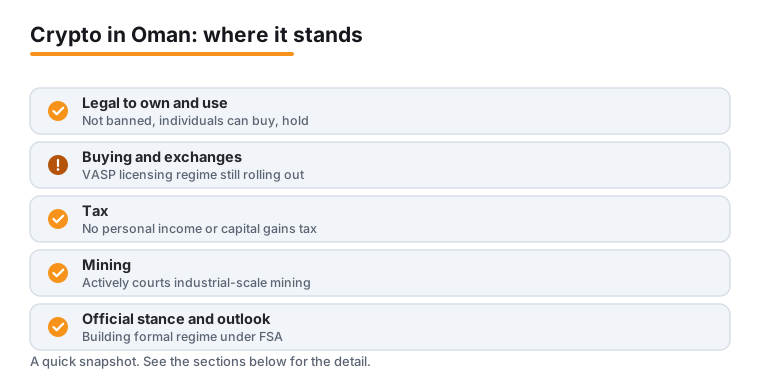
Bitcoin and other cryptocurrencies occupy a legal grey area in Oman. They are not banned, and individuals can generally buy, hold, and sell them. At the same time, they are not legal tender, and no Omani authority guarantees their value. The Central Bank of Oman (CBO) has issued public warnings stating that virtual currencies are not issued or backed by the state and are not protected under the Banking Law (Royal Decree No. 114/2000). In practice this means you may own Bitcoin, but you do so at your own risk and without the consumer protections that apply to bank deposits.
The important distinction is between owning crypto and operating a crypto business. Providing virtual-asset services in or from Oman, such as running an exchange, custody service, or transfer service, is a regulated activity that requires registration with the financial regulator. Using crypto to commit fraud, launder money, or evade sanctions is illegal, as it is everywhere. For ordinary users, the headline is simple: crypto is tolerated and increasingly regulated, not prohibited.
Who regulates crypto in Oman?
The lead regulator for virtual assets is the Financial Services Authority (FSA), the Sultanate's regulator for capital markets, insurance, and the accounting and auditing profession. The FSA was established by Royal Decree No. 20/2024 and came into force on 25 March 2024, taking over the role, assets, and obligations of the former Capital Market Authority (CMA) in their entirety. So when older articles refer to the CMA regulating crypto, that mandate now sits with the FSA. You can confirm current rules on the FSA's official site: fsa.gov.om.
The other key body is the Central Bank of Oman (CBO), which oversees monetary policy, payments, and banking. The CBO does not license virtual-asset firms; instead it has repeatedly cautioned the public that crypto is not legal tender, is not state-backed, and carries financial, legal, operational, and security risks. Its position is available at cbo.gov.om. For matters of tax, the Oman Tax Authority is the relevant body.
Key laws and frameworks
Several pieces fit together to form the picture in 2026:
- VASP registration and AML/CFT rules (2023). The regulator issued a decision commonly cited as Decision No. E/35/2023, setting out instructions for the registration of Virtual Asset Service Providers (VASPs) and their obligations to combat money laundering and terrorism financing. Both legal persons established in Oman and natural persons with a place of business in Oman that offer or conduct virtual-asset services must register.
- The Virtual Assets Regulatory Framework (VARF). Following a public consultation that ran in mid-2023, the regulator (now the FSA) has been developing a comprehensive framework covering virtual-asset activities, a licensing regime for VASP categories, and ongoing supervision. As of 2026 this framework was advancing through rollout rather than being long-settled, so specific licence categories, fees, and timelines should be checked directly with the FSA.
- Establishment of the FSA (2024). Royal Decree No. 20/2024 created the FSA and transferred the CMA's powers to it, which is the legal basis for the FSA's authority over virtual assets today.
Oman's approach is broadly in step with the wider Gulf trend, where jurisdictions such as the UAE and Bahrain already license virtual-asset firms, and with global anti-money-laundering standards including the FATF "travel rule". Because the comprehensive framework is still being finalised, treat exact provisions as subject to change and verify them with the FSA.
Licensing and registration of exchanges and VASPs
Operating a crypto exchange, custodian, or other virtual-asset service in or from Oman is a regulated activity. Under Decision No. E/35/2023, anyone offering VASP services must register with the regulator, and the FSA reviews applications within a defined period after a complete submission. Activities contemplated under the framework include exchanging virtual assets for fiat currency, transferring virtual assets, and providing custody of digital assets, alongside token offerings.
The comprehensive VARF is intended to layer a fuller licensing regime on top of registration, with categories spanning exchanges, custodians, brokers, and token issuers, plus capital, governance, and supervisory requirements. Because the detailed licensing rules, fee schedules, and category definitions were still being rolled out in 2026, any business planning crypto operations in Oman should engage the FSA directly and obtain current guidance before launching. Do not assume that a licence obtained in another jurisdiction permits you to serve Omani customers.
Crypto and Bitcoin tax in Oman
Oman has historically been a low-tax jurisdiction for individuals, with no personal income tax and no individual capital gains tax, which meant personal gains from selling Bitcoin were generally not taxed at the individual level. That position is changing.
In June 2025 Oman issued a Personal Income Tax Law by Royal Decree No. 56/2025, scheduled to take effect on 1 January 2028. It is the first individual income tax in the GCC. As announced by the Oman Tax Authority, it applies a flat 5% rate only to the portion of an individual's annual gross income that exceeds OMR 42,000 (roughly USD 109,000), so an estimated 99% of residents are expected to fall below the threshold. Residence is broadly determined by spending more than 183 days in Oman. How crypto gains will be treated in detail is expected to be clarified in the executive regulations accompanying the law; until those are published and in force, you should not assume a specific rate or treatment for crypto.
Separately, Oman applies Value Added Tax (VAT) at a standard rate of 5% to most goods and services, and businesses above the VAT registration threshold have compliance obligations. Crypto businesses should also account for corporate income tax where applicable. Do not rely on the figures above as settled crypto-tax rules; confirm your obligations with the Oman Tax Authority or a qualified adviser, especially if you trade actively, mine, or run a crypto business. See also our general guide to crypto taxes.
AML, KYC, and compliance obligations
Anti-money-laundering (AML) and counter-terrorism-financing (CFT) controls are the core compliance obligation for crypto activity in Oman. Decision No. E/35/2023 ties VASP registration directly to AML/CFT requirements, consistent with Oman's broader AML law and with international FATF standards.
For registered VASPs, this typically means verifying customer identity (Know Your Customer, or KYC), screening against sanctions lists, monitoring transactions for suspicious activity, keeping records, filing suspicious-transaction reports, and applying the FATF "travel rule" so that originator and beneficiary information accompanies transfers. Firms are generally expected to avoid handling anonymity-enhancing assets such as privacy coins that conceal transaction origins or participants.
For individual users, the practical effect is that reputable platforms serving the region will require identity verification before you can trade or withdraw. Complete KYC honestly, keep your own records, and be prepared to show a legitimate source of funds, particularly for larger amounts.
Buying and using crypto in practice
As of 2026 there is no fully licensed, domestically authorised retail exchange that the public can point to with certainty in Oman, because the FSA's VASP licensing regime is still being rolled out. In practice, Omani residents typically buy crypto through established international exchanges that accept customers from the region and via peer-to-peer (P2P) marketplaces.
Because banks remain cautious, funding methods can be the friction point. Some users fund purchases by card or bank transfer where the exchange and their bank permit it; others use P2P trades settled in Omani rial. Whatever route you choose, the compliance basics are the same:
- Use platforms that enforce KYC identity checks and AML controls. Avoid services that let you trade large sums anonymously, as these carry higher fraud and legal risk.
- Secure your account with a strong password and two-factor authentication, preferably an authenticator app rather than SMS.
- Keep records of every purchase, sale, and transfer, including dates, amounts, counterparties, and the rial value at the time. This matters for future tax compliance and for proving a legitimate source of funds.
- Be alert to scams: fake "investment" platforms, social-media tipsters, and impersonation of officials are common across the Gulf.
Self-custody, meaning holding your own private keys in a hardware or reputable software wallet, is legal and is the safest way to hold significant amounts, since you are not exposed to an exchange failing or freezing withdrawals. Crypto is not legal tender, so no merchant is obliged to accept it for payment.
Bitcoin mining in Oman
Mining is the most distinctive part of Oman's crypto story. Unlike many countries that have restricted mining, Oman has actively courted large-scale, industrial Bitcoin mining as part of its economic diversification and data-centre ambitions. The country offers available land, a strategic location, and access to relatively low-cost energy, and several substantial mining and data-centre investments have been announced in recent years, including operations associated with regions such as Salalah and Sohar.
Two companies have held the early licences for industrial Bitcoin mining in Oman: Exahertz and Green Data City. Green Data City operates near Salalah in the Salalah Free Zone, where total investment in mining and data-centre infrastructure has been reported to exceed USD 700 million, and licensed miners there have been quoted electricity tariffs below USD 0.04 per kWh, which is low by global standards. Both operators have scaled toward hundreds of megawatts of capacity, and by 2025 Oman had publicly targeted a meaningful share of the global Bitcoin hashrate. This activity sits under Oman Vision 2040, the country's economic diversification strategy that includes digital infrastructure, data centres, and blockchain.
This makes Oman one of the more mining-friendly jurisdictions in the Gulf for licensed, large operators. However, this is a regulated industrial activity, not a free-for-all: serious mining ventures secure government approvals, power agreements, and the relevant business licences. The energy and sustainability angle is real, with operators increasingly using efficient cooling, including immersion cooling, and integrating surplus or renewable energy to control costs and environmental impact.
For an individual, home mining of Bitcoin is rarely economic given hardware, electricity, heat, and noise considerations in Oman's climate. Check your electricity terms and any local rules before running mining equipment. The opportunity in Oman is primarily at industrial scale, under formal agreements.
Recent developments (2024 to 2026)
Three developments stand out for anyone tracking Oman:
- A new lead regulator. The Financial Services Authority replaced the Capital Market Authority under Royal Decree No. 20/2024, effective 25 March 2024, inheriting the virtual-asset mandate.
- A landmark tax change. Royal Decree No. 56/2025 introduced a Personal Income Tax Law effective 1 January 2028, a GCC first, with a 5% rate above an OMR 42,000 threshold. Executive regulations clarifying scope, including how asset disposals are treated, are expected before the law takes effect.
- Framework rollout. The comprehensive Virtual Assets Regulatory Framework, first announced in February 2023, continued to develop, with a further consultation reported in 2025 covering VASP licensing categories, digital-asset issuance, and fees, moving toward a fuller licensing and supervisory regime under the FSA.
- A national mining pool. In June 2026 Oman launched a state-supervised Bitcoin mining pool, Omanhash.om, overseen by the Ministry of Transport, Communications and Information Technology and requiring licensed miners in the country to route their hashrate through it. This underlines how Oman is formalising the mining side of its crypto economy while keeping crypto from being legal tender.
Because the regulatory and tax picture is still maturing, treat dates and details as live and confirm them with the FSA and the Oman Tax Authority.
Consumer risks and protection
Crypto in Oman carries the same risks as elsewhere, with a few local nuances. Because crypto is not legal tender and is not covered by the Banking Law's protections, losses from exchange failure, hacks, or scams generally fall on you, with no deposit-guarantee backstop. The Central Bank of Oman has explicitly warned that holders and traders bear full responsibility for any losses.
The main risks are: regulatory uncertainty while the FSA framework is finalised; limited consumer protection; market volatility; scams and fraud, which are widespread across the region; and banking friction when moving money to and from platforms. To protect yourself, use reputable KYC-enabled services, prefer self-custody for meaningful amounts, never share private keys or recovery phrases, be sceptical of guaranteed-return schemes, and only invest money you can afford to lose. If something looks like an official endorsement or a too-good-to-be-true return, verify it independently before acting.
Official sources and how to verify
Because crypto rules in Oman are evolving, always check the primary sources rather than relying on summaries. The most authoritative starting points are:
- Financial Services Authority (FSA), the lead regulator for virtual assets and VASPs, including registration rules and framework updates.
- Central Bank of Oman (CBO), for monetary policy, payments, and its public warnings on cryptocurrencies.
- Oman Tax Authority, for VAT, corporate tax, and the Personal Income Tax Law and its forthcoming executive regulations.
For background and related topics on this site, see our country-by-country regulation index. When in doubt, contact the FSA directly or consult a qualified Omani lawyer or tax adviser. This page is general information as of 2026 and is not legal advice; verify your specific situation with the named official regulator before acting.
Frequently asked questions
Is Bitcoin legal in Oman?
Owning and trading Bitcoin is not illegal in Oman, but it is not legal tender and is not protected by the country's banking laws. The Central Bank of Oman has warned that crypto is not state-backed and that holders bear full responsibility for losses, while the Financial Services Authority (which replaced the Capital Market Authority) regulates virtual-asset businesses. In short, crypto is tolerated and increasingly regulated, not banned.
Who regulates cryptocurrency in Oman?
The Financial Services Authority (FSA) is the lead regulator for virtual assets. It was created by Royal Decree No. 20/2024 and took over the former Capital Market Authority's powers on 25 March 2024. The Central Bank of Oman handles monetary policy and payments and has cautioned the public about crypto, and the Oman Tax Authority handles tax. Confirm current requirements directly with the FSA at fsa.gov.om.
Do I need a licence to run a crypto exchange in Oman?
Yes. Providing virtual-asset services in or from Oman, such as operating an exchange, custodian, or transfer service, requires registration with the regulator under Decision No. E/35/2023, with AML and CFT obligations attached. A fuller licensing regime under the Virtual Assets Regulatory Framework was still being rolled out in 2026, so contact the FSA for the current licence categories, requirements, and fees before launching.
Do I have to pay tax on crypto in Oman?
Historically Oman has had no personal income tax or individual capital gains tax, so personal crypto gains were generally untaxed at the individual level. A Personal Income Tax Law (Royal Decree No. 56/2025) takes effect on 1 January 2028, applying a 5% rate only to income above OMR 42,000 per year; how crypto gains are treated in detail is expected to be clarified in the executive regulations. VAT at 5% also applies broadly. This is not tax advice, so confirm your position with the Oman Tax Authority or a qualified adviser.
Can I mine Bitcoin in Oman?
Yes. Oman has actively encouraged large-scale, industrial Bitcoin mining and data-centre investment, making it one of the more mining-friendly Gulf jurisdictions for licensed operators with proper approvals and power agreements. Home mining is rarely economic given hardware, electricity, and cooling costs in Oman's climate, and you should check your electricity terms and local rules first.
How do I buy Bitcoin in Oman?
Most residents use established international exchanges that accept Omani customers, or peer-to-peer marketplaces, because a fully licensed domestic exchange regime was still being rolled out as of 2026. Choose a platform with strong KYC and AML controls and a good security record, verify your identity, fund the account by a supported method, place your order, and move significant holdings to a wallet you control. Keep records of every transaction for tax and source-of-funds purposes.
Which companies are licensed to mine Bitcoin in Oman?
The early industrial mining licences went to two operators, Exahertz and Green Data City. Green Data City runs near Salalah in the Salalah Free Zone, where reported investment in mining and data-centre infrastructure has passed USD 700 million and licensed miners have been quoted power tariffs below USD 0.04 per kWh. In June 2026 Oman also launched a state-supervised national mining pool, Omanhash.om, overseen by the Ministry of Transport, Communications and Information Technology, which licensed miners are required to join. Home mining remains rarely economic; the opportunity in Oman is at industrial scale under formal agreements.
Does Oman have a specific crypto law yet?
Oman does not yet have a single standalone crypto law. Crypto activity is currently captured by VASP registration and AML and CFT rules under Decision No. E/35/2023, and the Financial Services Authority has been building a comprehensive Virtual Assets Regulatory Framework since February 2023, with a further consultation reported in 2025 on licensing categories, digital-asset issuance, and fees. Until the fuller framework is finalised and published, check current requirements directly with the FSA at fsa.gov.om.
Facts reviewed: 30 June 2026. Page updated: 3 August 2026.