Home › Crypto Regulation › Lithuania
Bitcoin & Cryptocurrency Regulation in Lithuania
Quick answer — Lithuania, 2026
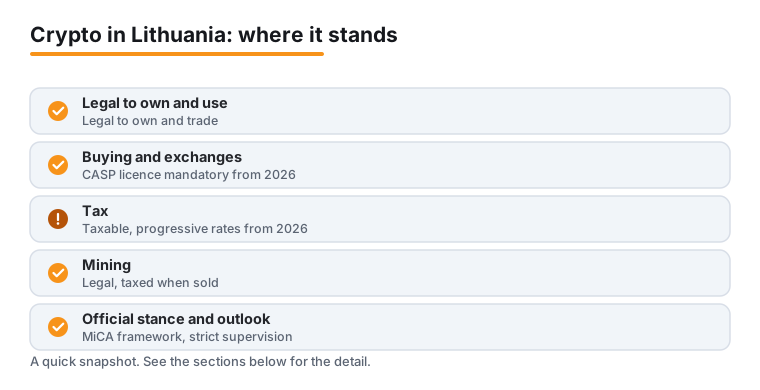
- Legal: Legal to own and trade under EU MiCA, not legal tender
- Tax: Gains taxable, EUR 2,500 allowance; progressive PIT from 2026
- Buying: Via MiCA-authorised CASP exchanges after KYC
Lithuania is one of the European Union's more active jurisdictions for cryptocurrency. It built an early reputation as a fintech-friendly base for crypto start-ups, and it now applies the EU's harmonised crypto rulebook. Holding, buying, selling and trading crypto-assets is legal for individuals and businesses, but Bitcoin is not legal tender and firms that offer crypto services are closely supervised. The EU's Markets in Crypto-Assets Regulation (MiCA) applies directly in Lithuania, and Lithuania set a firm national cut-off: from 1 January 2026, providing crypto-asset services requires a Crypto-Asset Service Provider (CASP) authorisation from the Bank of Lithuania (Lietuvos bankas), replacing the older national virtual-asset registration. This page explains the current legal status, who regulates crypto, how licensing and tax generally work, the AML rules, and the practical realities of buying, using and mining crypto, with links to the official sources you can verify.
This article is general information as of 2026 and is not legal, tax or financial advice. Crypto rules and tax treatment in Lithuania are evolving. Always confirm your situation with the Bank of Lithuania, the State Tax Inspectorate (VMI), the Financial Crime Investigation Service (FNTT/FCIS), or a qualified Lithuanian adviser before acting. See also our guide to crypto regulation and our country regulation hub.
On this page: Legal status · Who regulates it · Taxes · How to buy · Mining
Is Bitcoin and crypto legal in Lithuania?
Yes. Owning, buying, selling and trading Bitcoin and other crypto-assets is legal in Lithuania for both residents and businesses. There is no prohibition on individuals holding crypto in private wallets or transacting peer-to-peer.
What crypto is not is legal tender. The euro is the only official currency in Lithuania, and merchants are under no obligation to accept Bitcoin or any token as payment. Some businesses accept crypto voluntarily, usually through payment processors that settle in euros, but everyday adoption remains limited.
Lithuania is a eurozone member with a freely convertible currency and no general foreign-exchange controls. The real constraints on crypto are regulatory licensing, anti-money-laundering (AML) obligations and tax reporting, not currency restrictions. For background on how rules differ across countries, see our overview of crypto regulation.
Who regulates crypto in Lithuania?
Three official bodies share responsibility, each with a clear role:
- Bank of Lithuania (Lietuvos bankas) is the national competent authority for MiCA. It authorises and supervises crypto-asset service providers (CASPs), oversees conduct and prudential requirements, maintains information on licensed providers, and can take enforcement action against unauthorised operators. Its official CASP page is the primary source for licensing.
- Financial Crime Investigation Service (FNTT, also styled FCIS) is a law-enforcement agency under the Ministry of the Interior. It is Lithuania's financial intelligence unit and AML/counter-terrorist-financing supervisor for obliged entities, including crypto firms. The Bank of Lithuania and the FNTT publicly stepped up cooperation on supervising crypto-asset services.
- State Tax Inspectorate (Valstybine mokesciu inspekcija, VMI) administers the taxation of crypto income and gains and has published guidance on virtual currency.
Official sites: Bank of Lithuania (CASP authorisation), Financial Crime Investigation Service (FNTT/FCIS), and the State Tax Inspectorate (VMI).
Key laws and frameworks
Lithuania's crypto rules now sit primarily within the EU's Markets in Crypto-Assets Regulation (Regulation (EU) 2023/1114, known as MiCA or MiCAR), which applies directly in all member states without needing to be transposed into national law. MiCA created a single, EU-wide rulebook covering crypto-asset service providers, stablecoins (asset-referenced tokens and e-money tokens), market-abuse rules and disclosure obligations for token issuers.
To put MiCA into operation nationally, Lithuania enacted its Law on Markets in Crypto-Assets in 2024, naming the Bank of Lithuania as the competent authority. The CASP authorisation and operating-condition provisions of MiCA (Title V) became applicable in the EU on 30 December 2024.
Separately, Lithuania's AML framework (its Law on the Prevention of Money Laundering and Terrorist Financing) imposes customer due-diligence and reporting duties that crypto firms must follow under FNTT supervision. Crypto taxation is governed by the general Lithuanian tax laws, principally the Law on Personal Income Tax and VAT rules interpreted in line with EU case law.
Licensing and registration of exchanges (the VASP to CASP shift)
Before MiCA, Lithuania allowed virtual-asset service providers (VASPs) to operate under a national registration regime, which made the country popular with crypto companies. To tighten standards ahead of the EU transition, Lithuania had already raised the minimum registered share capital for crypto firms to EUR 125,000 (up from EUR 2,500) from late 2022.
Under MiCA's transitional arrangements, existing firms had to move onto the new CASP authorisation. Lithuania set a firm cut-off: from 1 January 2026, providing crypto-asset services without a valid Bank of Lithuania CASP licence is not permitted. Transitional protection for firms that were operating before 30 December 2024 ended on that date regardless of whether a licence application was still pending.
MiCA-regulated services that need authorisation include operating a crypto exchange (crypto-to-fiat or crypto-to-crypto), custody and administration of crypto for clients, executing orders, transfer services, placement, reception and transmission of orders, advice and portfolio management. Licensing carries minimum-capital, governance, custody-segregation and AML requirements that scale with the services offered. A Lithuanian CASP licence can be passported across the EU.
Enforcement reality: the regime caused a sharp consolidation. Of roughly 300 to 370 previously registered crypto companies, only a small number had been granted full CASP licences by early 2026, and the Bank of Lithuania noted that many firms filed late and underestimated MiCA's complexity. Unlicensed activity can attract serious penalties, including fines, criminal liability and website blocking.
Taxation of crypto in Lithuania
Crypto income and gains are generally taxable and must be reported to the State Tax Inspectorate (VMI). The treatment depends on whether you trade occasionally or as a business, and the rules changed significantly from 2026.
Individuals (occasional disposals)
Under the Personal Income Tax Law, a non-taxable allowance has applied to non-regular disposals: where the taxable profit from non-regular sales of crypto over a 12-month period is below EUR 2,500, personal income tax (PIT) has not applied to that profit. Profit above the allowance is taxable.
Rate changes from 1 January 2026
Historically, crypto gains were taxed at a flat 15 percent PIT (with a 20 percent rate on higher non-employment income above a threshold). From 1 January 2026, Lithuania moved most individual income, including capital gains and individual-activity income, onto progressive PIT rates. The reported bands, which are tied to the national average wage (VDU), are 20 percent on annual income up to about 36 average wages (roughly EUR 82,900), 25 percent on the portion from about 36 to 60 average wages (roughly EUR 82,900 to EUR 138,300), and 32 percent on the portion above about 60 average wages (roughly EUR 138,300). Because these thresholds move with the average wage and are subject to change, confirm the current figures with the VMI before filing.
Mining and business activity
VMI guidance has indicated that mining crypto for your own purposes is not itself taxed at the moment of mining and is outside VAT; tax arises when you sell. Commercial trading or mining carried out as ongoing individual activity or through a company is taxed as business income with the usual accounting and reporting duties.
VAT
Following EU case law, exchanging crypto for fiat (and vice versa) is treated as a VAT-exempt financial service.
This is a simplified summary, not tax advice. See our general guide to crypto taxes and verify your position with the VMI or a qualified Lithuanian tax adviser.
AML and KYC rules
Crypto-asset service providers in Lithuania are obliged entities under the AML framework and are supervised by the Financial Crime Investigation Service (FNTT/FCIS), with the Bank of Lithuania overseeing CASP conduct under MiCA. In practice this means licensed providers must:
- Verify customer identity (KYC) before or during onboarding, and apply enhanced checks and source-of-funds verification for higher-risk or higher-value activity.
- Monitor transactions and report suspicious activity to the FNTT.
- Apply the EU Transfer of Funds (travel rule) requirements for crypto transfers, attaching originator and beneficiary information.
- Keep records and maintain AML/CFT policies, controls and a compliance function.
For users, the visible effect is mandatory identity verification on any compliant exchange, occasional requests for documentation on larger transfers, and the expectation that authorities can access provider data, including under the EU tax-transparency directive DAC8, which from 1 January 2026 requires crypto-asset service providers to collect and report data on EU-resident users' crypto transactions (with the first reports due to tax authorities by 30 September 2027). Lithuanian authorities have publicly pushed to tighten requirements on crypto firms, and have imposed significant fines for AML and sanctions breaches.
Buying and using crypto in practice
Residents can buy crypto through EU-authorised exchanges and brokers. The practical rule is to use platforms authorised to serve EU customers under MiCA; increasingly, exchanges advertise a CASP authorisation obtained in Lithuania or another EU state and passported across the bloc.
When you sign up, expect identity verification (KYC), euro funding by SEPA bank transfer or card, and the need to keep transaction histories for tax reporting. Some Lithuanian banks remain cautious about crypto-related transfers, so payments may occasionally be queried.
A typical compliant route is: choose a regulated platform and check its authorisation; complete KYC; fund with a SEPA transfer (usually the cheapest method) or card; place a market or limit order and review the spread and fees; then decide whether to leave assets with the platform or withdraw to a personal wallet, using a hardware wallet and an offline-stored seed phrase for larger amounts. Avoid unlicensed offshore venues and anyone promising guaranteed returns. Physical Bitcoin ATMs are scarce in Lithuania and tend to charge higher fees and spreads than online exchanges; any operator converting crypto to cash is providing a regulated service and is expected to be authorised and to perform identity checks.
Mining crypto in Lithuania
Bitcoin and other proof-of-work mining is legal in Lithuania. There is no specific national ban, and MiCA did not prohibit mining, although it introduces sustainability-disclosure obligations connected to the consensus mechanisms of crypto-assets.
Mining is treated as an economic activity rather than a special category. According to VMI guidance, crypto mined for your own purposes is not taxed at the point of mining and is not a VATable supply; tax arises when you sell the mined coins. At scale, a miner generally needs to consider business registration and tax, electricity costs and grid-connection terms (the decisive economics), and EU-wide scrutiny of energy sourcing, with renewable power increasingly favoured.
Small-scale hobby mining is not separately licensed, but any resulting income from selling coins can still be taxable. Because classification depends on scale and intent, confirm the current treatment of mining with the VMI or an adviser.
Recent developments (2025 to 2026)
The headline development is the completion of the MiCA transition. Lithuania extended the transitional period for existing VASPs and set 1 January 2026 as the date from which a full CASP licence is mandatory. The Bank of Lithuania required unlicensed entities to wind down by the end of 2025.
This produced a dramatic contraction: of roughly 370 previously registered crypto companies, only around 30 had taken concrete steps toward CASP authorisation by late 2025, and only a small number held full CASP licences by early 2026. The regulator publicly criticised a late surge of applications and weak compliance preparation among many firms. The Bank of Lithuania and the FNTT also announced closer cooperation on supervising crypto-asset services.
On tax, the move to progressive personal income tax rates from 1 January 2026 affects how crypto gains and individual-activity income are taxed. Also from 1 January 2026, the EU DAC8 directive began requiring crypto-asset service providers to collect and report user transaction data to tax authorities, with the first exchange of information due by 30 September 2027, which increases the visibility of crypto holdings to the VMI. Secondary MiCA technical standards continue to develop at EU level, and two dated EU changes are already on the calendar: the EU Anti-Money Laundering Regulation starts applying to crypto-asset service providers on 10 July 2027, and a European Commission package proposed on 4 December 2025 would move supervision of certain significant crypto-asset service providers to ESMA, though it is still in negotiation. For exact current figures and any new rules, rely on the official sources below rather than third-party summaries.
Consumer risks and protection
MiCA improves disclosure, custody and provider standards and brings authorised CASPs under supervision, but it does not guarantee returns, and many crypto-assets sit outside the investor-compensation and deposit-guarantee schemes that cover bank deposits. Key risks to weigh:
- Market volatility: crypto-assets are highly volatile and can lose substantial value quickly. Only consider funds you can afford to lose.
- Fraud and scams: fake exchanges, impersonation and guaranteed-return schemes remain common. Verify any provider's authorisation against the Bank of Lithuania before depositing.
- Unlicensed providers: firms not authorised under MiCA fall outside its consumer-protection and custody safeguards, and from 2026 offering services to Lithuanian users without a licence is illegal.
- Custody and key security: self-custody removes counterparty risk but shifts key security to you; lost keys are usually irreversible.
- Tax missteps: failing to report crypto income or gains can lead to penalties.
Using regulated providers, keeping good records, and confirming current rules with official sources are sensible baseline practices. This is general information, not investment advice.
Official sources and how to verify
Crypto rules and tax figures change, and third-party guides (including this one) can fall out of date. Always confirm the current position against the primary, official sources:
- Bank of Lithuania (Lietuvos bankas) for CASP licensing, supervision and the list of authorised providers: lb.lt CASP authorisation.
- Financial Crime Investigation Service (FNTT/FCIS) for AML/CFT obligations and enforcement: fntt.lrv.lt.
- State Tax Inspectorate (VMI) for crypto and mining taxation and filing: vmi.lt.
Before using any platform, check that it holds a valid CASP authorisation, beware of look-alike or unregulated sites, and keep records of your transactions. This page is general information as of 2026 and is not legal, tax or financial advice; verify your situation with the named official regulators or a qualified Lithuanian adviser. For more, see our regulation hub.
What is changing: the position in August 2026
Nothing in Lithuanian crypto law changed between the last review on 30 June 2026 and early August 2026, and no crypto bill is pending in the Seimas. The change that did land in that window was European. The MiCA grandfathering window, which had let firms authorised under older national regimes keep serving EU clients, expired on 1 July 2026 (ESMA, KPMG, 25 June 2026). Lithuania had already closed its own transition six months earlier, so for firms licensed here this changed nothing. It matters for platforms elsewhere in the EEA that were still relying on a legacy national registration to serve Lithuanian users.
- The law has a number. Crypto services are governed by the Law on Markets in Crypto-Assets No. XIV-2879, adopted by the Seimas on 11 July 2024, published in the Register of Legal Acts on 24 July 2024 as No. 2024-13487, and in force since 25 July 2024, with Articles 7 and 8 from 1 August 2024 (Seimas register).
- The operative text is newer than most guides say. The Seimas register labels the current consolidated version as running from 2 July 2026 to 9 January 2030 (consolidated text). The register does not summarise what changed on that date, so this page does not guess.
- It has been amended. Law No. XV-308 was adopted on 19 June 2025 from bill XVP-416(2), and changed Articles 3, 10, 12, 13, 14 and 15 and the annex listing the EU acts implemented (Seimas bill file). A further act reported as No. XV-185 amended Article 22, the entry into force and implementation article where the transitional deadlines sit (act profile).
- Very few firms are actually licensed here. A public mirror of the ESMA MiCA register listed six CASPs authorised in Lithuania as of 3 August 2026, against 321 across the EEA (CASP register mirror). The Lithuanian entries include Robinhood Europe UAB, Coingate UAB Decentralized, Nuvei Liquidity UAB, Myriad Capital UAB, Newrails UAB and BLUE EMI UAB. CoinGate and Nuvei were authorised on 17 December 2025, each taking a payment institution licence alongside the CASP authorisation (Legasset, 23 December 2025).
- Lithuania chose the strict path on purpose. MiCA allowed member states to run grandfathering to 1 July 2026. Lithuania set 31 May 2025, then extended to 31 December 2025, and did not take the window to its full length (Global Legal Insights, 21 October 2025). Over 370 companies had been registered to offer crypto services, only around 120 were actively operating and filing financial statements, and 30 had applied for CASP authorisation with ten under review; unlicensed providers may face fines, blocked websites, public warnings and imprisonment for up to four years (Crypto Briefing).
- Stablecoin payments need a second licence. Since 1 March 2026 a CASP providing electronic money token services that count as payment services must either hold a payment services authorisation or move that activity to an authorised entity (Global Legal Insights).
- On tax, the bands are settled but the crypto treatment is not spelled out. The 2026 reform was approved on 26 June 2025 and applies from 1 January 2026, taxing aggregated income at 20 percent up to about EUR 82,962 (36 average salaries), 25 percent to about EUR 138,270, and 32 percent above that (KPMG, 20 October 2025, PwC, reviewed 10 March 2026). Published guidance does not state where ordinary crypto disposals sit. KPMG says other non-employment-related income up to 12 times the average salary stays at 15 percent with only the excess at the main rates, while a Lithuanian crypto guide still describes 15 percent with 20 percent above 120 average wages (Lawhill, 20 February 2026). Confirm your rate with the VMI before relying on a figure.
- The EUR 2,500 exemption still does the work for small holders. A combined annual gain at or below EUR 2,500 on personal asset sales is not taxed (Lawhill).
The crypto legislation pipeline and when it takes effect
Lithuania has no crypto bill pending in the Seimas that I could find as of August 2026. Everything still to come is EU law that applies in Lithuania directly or through the Bank of Lithuania. These are the dates worth putting in a calendar.
| Measure | Stage | When it takes effect | What it means in practice |
|---|---|---|---|
| Law on Markets in Crypto-Assets No. XIV-2879, as amended | In force | In force since 25 July 2024; consolidated text runs from 2 July 2026 | Bank of Lithuania authorises and supervises CASPs. Providing crypto services without authorisation is unlawful. |
| MiCA transitional regime, Regulation (EU) 2023/1114 | Closed | Lithuania closed it on 31 December 2025; the EU-wide backstop expired 1 July 2026 | No platform anywhere in the EEA may serve Lithuanian users on an old national registration. Authorisation or a passport is now the only lawful basis. |
| Dual authorisation for electronic money token payment services | In force | 1 March 2026 | Stablecoin payment and settlement services need a payment services authorisation alongside the CASP licence, or must move that activity to an authorised firm. |
| Personal income tax reform, approved 26 June 2025 | In force | Income earned from 1 January 2026, declared in 2027 | Aggregated income is taxed at 20, 25 and 32 percent, with a separate 15 percent for named categories. Published guidance does not state where ordinary crypto disposals fall, so check with the VMI. |
| Regulation (EU) 2024/1624, the EU Anti-Money Laundering Regulation | Adopted, not yet applying | Applies to CASPs from 10 July 2027 | Customer due diligence from EUR 1,000 on occasional transactions, mandatory risk assessment and mitigation for transactions involving self-hosted addresses, enhanced due diligence on cross-border correspondent relationships. Applies directly, so no Lithuanian law is needed for it to bite. (detail) |
| Market Integration and Supervision Package | In the European Parliament and Council | Proposed 4 December 2025, no application date set | Would move direct supervision of certain significant cross-border crypto-asset service providers to the EU level. Licence conditions would not change for customers, but the supervisor and the escalation route would. (ESMA) |
Checking that a platform may legally serve you in Lithuania
Since 1 July 2026 there is one test that works across the whole EU, and it does not depend on where the platform is based.
- ESMA publishes a central register under Articles 109 and 110 of MiCA covering authorised crypto-asset service providers, published white papers, and separately a list of non-compliant entities providing crypto-asset services (ESMA).
- A firm authorised by any EEA regulator can serve you in Lithuania by passporting. It does not need a separate Bank of Lithuania licence, so a foreign entry in the register is not a warning sign in itself.
- A firm that appears in neither the authorised list nor a passport notification is operating outside MiCA when it serves Lithuanian residents, which places you outside MiCA's disclosure, custody segregation and complaints protections.
- ESMA states that white papers listed in its register have not been reviewed or approved by any competent authority, so the presence of a white paper says nothing about whether a token is a sound investment.
Frequently asked questions
Is cryptocurrency legal in Lithuania?
Yes. Buying, holding, selling and trading crypto-assets is legal for individuals and businesses. However, crypto is not legal tender, the euro is the only official currency, and merchants are not required to accept Bitcoin. From 1 January 2026, firms that provide crypto services to Lithuanian users must hold a CASP licence from the Bank of Lithuania under the EU's MiCA framework.
Who regulates crypto in Lithuania?
The Bank of Lithuania (Lietuvos bankas) is the competent authority that licenses and supervises crypto-asset service providers under MiCA. The Financial Crime Investigation Service (FNTT/FCIS), under the Ministry of the Interior, is the AML/CFT supervisor and financial intelligence unit, and the State Tax Inspectorate (VMI) administers crypto taxation.
Do I need a licence to run a crypto exchange in Lithuania?
Yes. Since 1 January 2026, providing crypto-asset services, including running an exchange, custody, transfers or order execution, requires a CASP authorisation from the Bank of Lithuania under MiCA. The older national VASP registration no longer suffices, and operating unlicensed is illegal and can lead to fines, criminal liability and website blocking. A Lithuanian CASP licence can be passported across the EU.
Do I have to pay tax on crypto in Lithuania?
Generally yes. Income and gains from crypto are taxable and must be reported to the VMI. A non-taxable allowance of EUR 2,500 has applied to profit from non-regular disposals over a 12-month period. From 1 January 2026, most individual income, including crypto gains, moved onto progressive personal income tax rates. Mined coins are taxed when you sell them, not when mined. Rates and thresholds change, so confirm current figures with the VMI or a tax adviser. This is not tax advice.
What changed for crypto in Lithuania in 2026?
Two big changes. First, the MiCA transition completed: from 1 January 2026 a full CASP licence from the Bank of Lithuania is mandatory, transitional protection for older VASPs ended, and unlicensed firms had to wind down, which sharply shrank the number of operating crypto companies. Second, Lithuania moved most personal income, including crypto gains, onto progressive tax rates from the start of 2026.
How do I check if a crypto platform is authorised in Lithuania?
Verify it against the Bank of Lithuania, which authorises and lists CASPs at lb.lt. Confirm the firm holds a valid CASP authorisation in Lithuania or another EU state passported into Lithuania, and be wary of look-alike or offshore sites that are not authorised under MiCA, as they fall outside its consumer-protection safeguards. Keep records of your transactions for tax purposes.
How much tax-free crypto profit can I make in Lithuania?
For non-regular (occasional) disposals, a non-taxable allowance of EUR 2,500 applies to the profit from selling crypto over a 12-month period. Only the profit above EUR 2,500 is taxable. From 1 January 2026 that taxable profit falls under progressive personal income tax, starting at 20 percent and rising to 25 and 32 percent for higher income bands tied to the average wage. If your crypto activity counts as ongoing individual activity or a business, different rules apply. Confirm current figures with the VMI, as this is not tax advice.
Will the tax office in Lithuania know about my crypto?
Increasingly, yes. From 1 January 2026 the EU DAC8 directive requires crypto-asset service providers to collect and report data on their EU-resident users' crypto transactions to tax authorities, with the first information exchange due by 30 September 2027. This means the State Tax Inspectorate (VMI) can receive data on holdings and disposals held by exchanges and other providers serving Lithuanian residents. Reporting your crypto income accurately and keeping transaction records is the safe approach.
Which law regulates crypto in Lithuania, and what is its number?
The Law on Markets in Crypto-Assets of the Republic of Lithuania No. XIV-2879. The Seimas adopted it on 11 July 2024, it was published in the Register of Legal Acts on 24 July 2024 as No. 2024-13487, and it entered into force on 25 July 2024, with Articles 7 and 8 from 1 August 2024. It has been amended, including by Law No. XV-308, adopted on 19 June 2025, which changed Articles 3, 10, 12, 13, 14 and 15 and the annex. The Seimas register shows the current consolidated version running from 2 July 2026 to 9 January 2030.
How many crypto firms are actually licensed in Lithuania?
Six. A public mirror of the ESMA MiCA register showed six crypto-asset service providers authorised in Lithuania as of 3 August 2026, out of 321 across the European Economic Area. The Lithuanian entries include Robinhood Europe UAB, Coingate UAB Decentralized, Nuvei Liquidity UAB, Myriad Capital UAB, Newrails UAB and BLUE EMI UAB. For scale, over 370 companies were once registered in Lithuania to offer crypto services and only around 120 were actively operating and filing financial statements before the transition closed on 31 December 2025.
Can I still use an exchange licensed in another EU country?
Yes, if it holds a MiCA authorisation and has passported into Lithuania. It does not need a separate Bank of Lithuania licence. What is no longer possible is relying on an old national registration from any EU or EEA state. The MiCA grandfathering window closed EU-wide on 1 July 2026, and Lithuania closed its own on 31 December 2025.
What crypto rules are coming next, and when?
Two things, both from the EU. Regulation (EU) 2024/1624, the EU Anti-Money Laundering Regulation, starts applying to crypto-asset service providers on 10 July 2027. It brings customer due diligence on occasional transactions of EUR 1,000 or more and requires firms to assess and mitigate risks on transactions involving self-hosted addresses. Separately, the Market Integration and Supervision Package proposed by the European Commission on 4 December 2025 would move direct supervision of certain significant crypto-asset service providers to ESMA. It is still being negotiated by the European Parliament and Council and has no application date.
What tax rate applies to crypto gains in Lithuania in 2026?
The honest answer is that published guidance does not say clearly, so confirm with the State Tax Inspectorate. What is settled: the reform approved on 26 June 2025 applies from 1 January 2026 and taxes aggregated income at 20 percent up to about EUR 82,962 a year, 25 percent to about EUR 138,270, and 32 percent above that, while a separate 15 percent rate remains for named categories such as dividends, certain benefits, and shares acquired more than five years ago outside an investment account. Where ordinary crypto disposals sit is not stated: KPMG describes other non-employment-related income up to 12 times the average salary staying at 15 percent with only the excess at the main rates, while a Lithuanian crypto guide from February 2026 still describes 15 percent with 20 percent above 120 average wages. Small holders are in any case protected by the EUR 2,500 annual exemption on personal asset sales.
Facts reviewed: 3 August 2026. Page updated: 3 August 2026.
Related guides
More countries in the region
Practical guides