Home › Crypto Regulation › Latvia
Bitcoin & Cryptocurrency Regulation in Latvia
Quick answer — Latvia, 2026
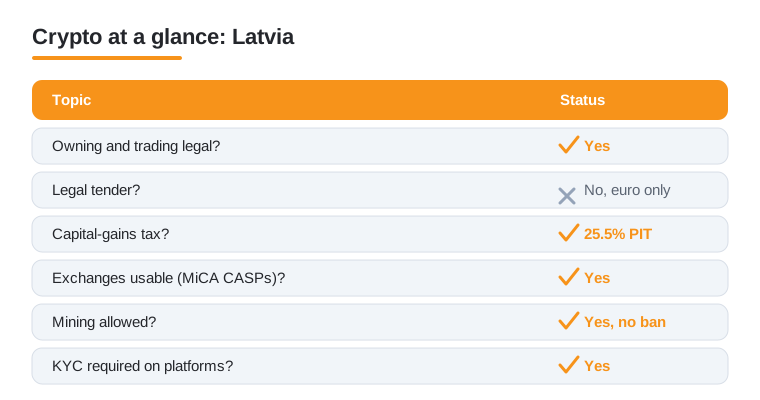
- Owning, buying, selling and trading crypto is legal in Latvia, though it is not legal tender (only the euro is).
- Gains are taxed as a capital asset under personal income tax via the State Revenue Service (VID).
- Residents buy through MiCA-authorised platforms, funding in euro by SEPA transfer or card after completing identity (KYC) checks.
Cryptocurrency is legal to own, buy, sell and hold in Latvia, and the country has positioned itself as an early mover within the European Union's harmonised crypto rulebook. As an EU and euro-area member state, Latvia does not run a bespoke crypto regime in isolation; instead it applies the EU-wide Markets in Crypto-Assets Regulation (MiCA) alongside national implementing legislation. The supervisor is Latvijas Banka (the Bank of Latvia), which has authorised and overseen crypto-asset service providers since the end of 2024 and issued some of the EU's first MiCA licences. This guide explains the current legal status, the regulator and rules, how crypto is taxed, how to register an exchange, how to buy and use crypto in practice, mining, recent 2025 and 2026 developments, consumer risks, and how to verify everything with the official sources.
This article is general information as of 2026 and is not legal, tax or financial advice. Crypto rules and tax treatment change frequently; always confirm your specific situation with the named official regulator, Latvijas Banka, with the State Revenue Service (Valsts ieņēmumu dienests, VID), or with a qualified Latvian professional before acting. See also our overviews of crypto regulation and crypto taxes.
On this page: Legal status · Who regulates it · Taxes · How to buy · Mining
Is Bitcoin and crypto legal in Latvia?
Yes. Owning, buying, selling, trading and holding Bitcoin and other crypto-assets is legal in Latvia. There is no prohibition on individuals using crypto, and businesses may provide crypto-asset services provided they are properly authorised.
What crypto is not is legal tender. The only legal tender in Latvia is the euro, and merchants are under no obligation to accept Bitcoin or any token. Where a business does accept crypto, it does so voluntarily as a commercial choice. Under Latvian tax law, crypto-assets are treated as a form of capital asset rather than as currency.
Because Latvia is part of the EU single market, its crypto framework is shaped primarily by EU law rather than by a standalone national philosophy. That gives users a comparatively clear and predictable environment relative to jurisdictions where the legal status of crypto remains ambiguous.
Who regulates crypto in Latvia? The regulator
The competent authority for crypto-asset services in Latvia is Latvijas Banka (the Bank of Latvia), which is both the central bank and the integrated national financial supervisor. Since 30 December 2024 Latvijas Banka has issued authorisations to crypto-asset service providers (CASPs) and supervised their activities under MiCA. It also acts as the anti-money-laundering and counter-terrorist-financing (AML/CFT) supervisor for the institutions it oversees.
Latvijas Banka maintains a dedicated crypto-assets page, offers free pre-licensing consultations, and publishes a classification scheme explaining which assets fall under MiCA. Tax matters are handled separately by the State Revenue Service (Valsts ieņēmumu dienests, VID). You can confirm the current position with the regulator on its official crypto page: Latvijas Banka crypto-assets.
Crypto laws and frameworks in Latvia
Latvia's crypto rules sit on two layers: EU regulation and national implementing law.
- MiCA (EU level): The Markets in Crypto-Assets Regulation applies across the EU. Its rules for crypto-asset service providers (CASPs) became fully applicable on 30 December 2024, while rules for stablecoin issuers (asset-referenced tokens and e-money tokens) applied earlier in 2024. MiCA sets common requirements for authorisation, governance, disclosures, market-abuse rules and consumer protection.
- National law: Latvia adopted the Law on Crypto-asset Services (Kriptoaktivu pakalpojumu likums) in 2024 to complement MiCA. It designates Latvijas Banka as the competent authority and sets out licensing and supervision fees and the obligations and rights of supervised providers.
- AML/CFT: Crypto providers are obliged entities under Latvia's anti-money-laundering law, which transposes EU directives. The EU's expanding AML regime and the funds-transfer "travel rule" also apply to in-scope providers.
A licensed CASP in Latvia can passport its authorisation to serve customers across the EU under MiCA's cross-border notification mechanism, which is a key reason firms have been attracted to the jurisdiction. The framework is complete rather than pending. MiCA applies directly, the Law on Crypto-asset Services (adopted 13 June 2024, in force 30 June 2024 and still unamended) makes Latvijas Banka the competent authority, and Latvijas Banka Regulation No. 388 of 14 April 2025, in force since 24 April 2025, sets the detailed governance, liquidity, security and client-protection requirements that applicants are assessed against.
Licensing and registration of exchanges (CASPs)
To provide crypto-asset services to Latvian or EU users, a firm must be authorised as a CASP by Latvijas Banka under MiCA. The earlier Virtual Asset Service Provider (VASP) registration model, which focused mainly on AML, has been replaced; existing VASPs were required to transition to a CASP licence, with the transition window in Latvia running to mid-2025.
- Where to apply: Applications are submitted to Latvijas Banka, which assesses the application and supervises the provider afterwards. Free pre-licensing consultations are available.
- Fees: Latvijas Banka charges 2500 euro for reviewing the documents and information submitted to obtain authorisation, plus a supervisory fee of up to 0.6% (inclusive) of the annual gross income from the provision of crypto-asset services, but no less than 3000 euro per year. Always confirm current fees with the regulator.
- Standards: Authorisation involves capital, governance, fit-and-proper, custody, disclosure and consumer-protection requirements set by MiCA and national rules.
- Passporting: A Latvian CASP licence can be passported across all EU member states.
For users, the practical takeaway is to prefer platforms that are authorised to serve EU/Latvian customers and supervised under MiCA. You can check provider status via Latvijas Banka. The exact, current requirements should be verified directly with the regulator before relying on any figure here.
Crypto and Bitcoin tax in Latvia
Under Latvian law a crypto-asset is treated as a capital asset, and gains for individuals fall under the personal income tax (PIT) framework administered by the State Revenue Service (VID). The principles below reflect guidance applied for 2025 and 2026, but rates, thresholds and deadlines change and should be confirmed with VID or a tax adviser.
- Rate: VID states that the personal income tax rate on income from capital gains is 25.5%, and it lists virtual currency within the meaning of the Law on the Prevention of Money Laundering and Terrorist Financing among the capital assets that trigger it. A transitional rate of 20% applies in 2025, 2026 and 2027 to capital-asset transactions that were initiated but not completed by 31 December 2024 where the taxpayer notified the authorities in time.
- What triggers tax: A taxable event typically arises on disposal of crypto for fiat money, goods or services. VID has confirmed that exchanging one crypto-asset for another (for example Bitcoin for Ethereum or a stablecoin) is not itself a taxable event; the gain is effectively deferred until you convert into euro or other fiat. Losses on crypto can generally be set against crypto gains when computing the annual result, so keep detailed euro-denominated records of every acquisition and disposal.
- Declaration cadence: Capital gains are declared electronically through VID's EDS system. Reporting frequency depends on the size of gains: where quarterly gains exceed EUR 1,000, declaration is due by the 15th of the following month; where they do not, an annual declaration applies (around mid-January of the following year). VID sets the filing pattern by size. If income from capital gains in a quarter exceeds EUR 1,000, the declaration is submitted once a quarter before the 15th day of the month following the quarter, and the tax is paid into the single tax account by the 23rd day of the month in which the declaration is submitted. If quarterly income is EUR 1,000 or less, the declaration is due by 15 January of the following year and the tax by 23 January.
- Non-resident incentive: Capital gains a Latvian non-resident receives from the disposal of publicly traded crypto-assets between 1 January 2025 and 31 December 2027 are exempted from the additional 3% PIT, a measure aimed at attracting crypto-asset service providers.
- Mining, staking and business activity: Income from mining, staking or trading carried on as a business may be taxed differently from occasional investment gains and can fall under economic-activity or corporate tax rules.
This is not tax advice. Confirm rates, exemptions and deadlines with the State Revenue Service (VID) or a qualified Latvian accountant. See also our general crypto taxes guide.
AML and KYC rules
Crypto-asset service providers in Latvia are obliged entities under the country's anti-money-laundering and counter-terrorist-financing (AML/CFT) framework, supervised by Latvijas Banka alongside MiCA. In practice this means providers must:
- Verify identity (KYC): Collect and verify customer identification, proof of address and, where relevant, source-of-funds and source-of-wealth information before allowing trading or withdrawals.
- Monitor and report: Conduct risk-based ongoing transaction monitoring, apply EU sanctions measures, and report suspicious activity to the authorities.
- Apply the travel rule: Collect and transmit originator and beneficiary information for in-scope crypto transfers, in line with the EU funds-transfer rules.
- Train and govern: Maintain staff training, internal controls and governance to detect and prevent financial crime.
For ordinary users the most visible effect is mandatory identity verification on any compliant platform. Latvijas Banka publishes AML guidance on its supervision pages: Latvijas Banka AML/CFT.
Buying and using crypto in practice
Residents of Latvia can buy crypto through international exchanges that serve EU customers, EU-based brokers, and increasingly locally authorised CASPs operating under MiCA. The euro and SEPA bank transfers make funding straightforward, and cards are widely supported. A typical compliant route is:
- Choose an authorised platform. Prefer a provider permitted to serve EU/Latvian customers and supervised under MiCA; check Latvijas Banka if in doubt.
- Verify your identity. Complete KYC by submitting identification and any required documents. This is a legal requirement, not optional.
- Fund in euro. Deposit by SEPA transfer (usually cheapest) or debit/credit card (faster, usually pricier).
- Place your order after reviewing the fee and spread.
- Secure your holdings. For meaningful amounts, withdraw to a wallet you control, ideally a hardware wallet, keep your recovery phrase offline, and enable two-factor authentication.
- Keep records of dates, amounts and euro values for future VID declarations.
Using crypto and ATMs. Merchants may accept crypto voluntarily, but it is not legal tender. Physical Bitcoin ATM coverage in Latvia is very limited, with few consistently operational machines; where they exist, expect identity checks and high fees and spreads. For most users a regulated online platform funded by SEPA is cheaper and more reliable. Cross-border remittances are possible with crypto, but within the EU, SEPA Instant transfers already settle in seconds at low cost, so compare the all-in cost (fees plus spread plus any tax) before assuming crypto is cheaper.
Bitcoin mining in Latvia
There is no specific law in Latvia that bans cryptocurrency mining, and individuals or businesses may mine. Mining is shaped less by crypto-specific rules and more by the economics of electricity and by general business, tax and environmental obligations.
- Energy costs and climate: Latvian electricity prices are tied to the regional Nord Pool market and can be volatile. The cool northern climate helps with cooling, and the country has significant hydropower and a growing renewables share, but grid prices usually decide whether mining is viable.
- Tax and business rules: Commercial-scale mining is likely to be treated as economic activity, with registration, accounting and tax consequences. Both mining income and the later disposal of mined coins have tax dimensions to consider with VID.
- Energy and disclosure policy: The EU continues to push energy-efficiency and sustainability expectations, and MiCA includes environmental-disclosure obligations that touch the broader sector. Large operations should expect scrutiny of their consumption.
In short, mining is permissible but is a margin business in Latvia: success depends on access to cheap, ideally renewable, power and disciplined compliance rather than on any crypto-specific incentive scheme.
Recent developments (2025 to 2026)
Latvia has deliberately positioned itself as an early, business-friendly adopter of MiCA, and Latvijas Banka began accepting MiCA licence applications in early 2025.
- First licences issued: Latvijas Banka issued Latvia's first MiCA CASP licence to BlockBen SIA in early December 2025, followed about a week later by a licence to Nexdesk, making them the first and second authorised CASPs in the country.
- Further licences in 2026: In May 2026 Latvijas Banka issued a licence to SIA Paybis Europe (alongside a payment-institution licence), the third firm to obtain a MiCA CASP licence in Latvia. In May 2026 Latvijas Banka also issued licences to Trek Technologies SIA, operating as Backpack EU, reported as the fifth firm licensed by Latvijas Banka under MiCA; its CASP authorisation covers custody, exchange of crypto for funds and other crypto, order execution and transfer services. As of August 2026 the crypto-asset market segment of the Latvijas Banka financial market participant register lists nine Latvian companies: SIA AlphaRoute, Bleap SIA, BlockBen SIA, Hodleris SIA, Neverless SIA, Nexdesk SIA, Nodu Digital SIA, SIA Paybis Europe and Trek Technologies SIA. Latvijas Banka announced a crypto-asset services licence to SIA AlphaRoute on 19 June 2026, licences to Bleap SIA and Hodleris SIA on 26 June 2026, and two licences to Nodu Digital SIA, covering exchange of crypto-assets for funds and transfer services, on 9 July 2026.
- Tax reporting (DAC8 and CARF): Latvia approved legislation aligning its tax rules with the OECD Crypto-Asset Reporting Framework (CARF) and the EU's DAC8 directive, expanding cross-border reporting of crypto holdings, taking effect from 1 January 2026. Under this framework EU crypto-asset service providers report client transactions to VID, with the first such report due by 30 September 2027; VID can then cross-check declared gains against the data it receives from exchanges.
The direction of travel is greater clarity and oversight rather than restriction. The next dated change is tax reporting. Cabinet Regulation No. 751 of 9 December 2025 has applied since 1 January 2026, making 2026 the first reporting year for crypto-asset transaction data, with the first reports due to VID by 30 June 2027. The EU's separate digital-euro project is a central-bank initiative distinct from decentralised crypto-assets like Bitcoin.
Consumer risks and protection
Regulation raises provider standards but does not make crypto safe. The main risks for Latvian users are:
- Market volatility: Crypto prices can fall sharply and quickly. Treat crypto as a small, high-risk slice of a diversified portfolio and never invest money you cannot afford to lose.
- No deposit-style protection: Crypto holdings are not covered by the deposit guarantee scheme that protects bank deposits. If a platform fails or you lose your keys, recovery may be impossible. MiCA improves provider standards but does not eliminate this risk.
- Security threats: Hacks, phishing and lost keys are common ways to lose funds. Use strong security and self-custody for meaningful amounts.
- Fraud: Fake platforms and "guaranteed return" schemes are widespread. Use authorised providers, be sceptical of unsolicited offers, and verify that a provider is licensed before depositing.
- Tax non-compliance: Keep good records and declare gains to VID to avoid avoidable penalties.
This is not investment advice and we do not make price predictions. Do your own research and consider speaking with a licensed financial adviser.
Official sources and how to verify
Crypto rules and tax treatment can change. Verify the current position directly with the official bodies rather than relying solely on third-party summaries:
- Latvijas Banka (the regulator): licensing, supervision and the crypto-asset classification scheme at Latvijas Banka crypto-assets, and AML guidance at Latvijas Banka AML/CFT.
- State Revenue Service (VID): tax rules, the EDS declaration system and guidance at vid.gov.lv.
- EU framework (MiCA): the Markets in Crypto-Assets Regulation applies across the EU and is the backbone of Latvia's rules.
For broader context, see our guides on crypto regulation and crypto taxes, and browse other country pages on our regulation hub. When in doubt, contact Latvijas Banka or VID directly, or consult a qualified Latvian professional. This guide is general information as of 2026 and is not legal advice.
What is changing in 2026 and 2027
Latvia's crypto framework is built, not pending. The remaining moves are dated, and they are mostly about tax reporting and about who supervises whom. This table separates what already binds from what is still only a proposal.
| Measure | Stage | Timing | What it means in practice |
|---|---|---|---|
| End of the MiCA transitional period, ESMA statement published by Latvijas Banka | Done | 1 July 2026 | Grandfathering is over across the EU. Unauthorised providers must cease providing services and wind down in an orderly way while safeguarding client assets. Check that the platform you use appears in an EU regulator's MiCA register. |
| Automatic reporting of crypto transactions to the State Revenue Service, Cabinet Regulation No. 751 of 9 December 2025 | In force since 1 January 2026 | 2026 is the first reporting year; first submissions due by 30 June 2027 | Reporting crypto-asset service providers must identify users, establish tax residence, and report acquisitions, disposals, exchanges, payments and transfers. VID will hold a record of your 2026 activity. |
| DAC8 transposition, amendments to the Law On Taxes and Duties adopted 6 November 2025 | In force since 1 January 2026 | Reporting duty sits in Article 15 | The statutory basis for the above. It defines reportable crypto-assets, extends automatic exchange of information to crypto-assets, electronic money and central bank digital currency, and provides a fine of up to EUR 14 000 for reporting and due diligence failures. |
| Amendments to the AML and counter-terrorism financing law, adopted 5 February 2026 | In force since 6 March 2026 | Applies now, with Article 54 changes from 10 July 2027 | Crypto-asset service providers are defined by reference to Article 3(1)(15) of MiCA and are expressly subjects of the Latvian AML law. Identity checks on Latvian platforms are not optional. |
| EU anti-money laundering package, Regulation (EU) 2024/1624 and Directive (EU) 2024/1640 | Adopted, not yet applicable | The European Commission states it applies, and must be transposed, in 2027. No exact day is given | A single EU AML rulebook. Expect tighter due diligence at Latvian CASPs and banks, and one more round of Latvian AML amendments before the deadline. |
| Commission market integration and supervision package of 4 December 2025 | Commission proposal only | No adoption or application date fixed | Would move supervision of significant cross-border crypto-asset service providers from national regulators to ESMA. Nothing changes unless it is agreed, and no source consulted states how far it has progressed. |
The Latvian laws and regulations by name
Latvia does have crypto-specific law, and it has a name and a number. If you need to cite something, these are the instruments that actually apply.
- Regulation (EU) 2023/1114 (MiCA). Directly applicable. Latvijas Banka states that the requirements for issuing authorisation to provide crypto-asset services apply as of 30 December 2024. See the Latvijas Banka licensing page for crypto-asset service providers.
- Kriptoaktīvu pakalpojumu likums, the Law on Crypto-asset Services. Adopted 13 June 2024, published in Latvijas Vēstnesis No. 120A on 21 June 2024, in force since 30 June 2024 and still unamended as of August 2026. It designates Latvijas Banka as competent authority under Article 93(1) of MiCA and sets penalties reaching up to EUR 15 000 000 or up to 15 per cent of the previous year's total turnover for legal persons in market abuse cases. Its transitional provision allowed providers previously supervised by the State Revenue Service to keep operating until 30 June 2025, and after that only while an application filed by that date was still under examination.
- Latvijas Banka Regulation No. 388. Adopted 14 April 2025, in force since 24 April 2025. Sets governance, liquidity stress testing, recovery and redemption plan, management competence, trading venue security and transfer service client-protection requirements.
- Amendments to the Law On Taxes and Duties. Adopted 6 November 2025, in force since 1 January 2026. Transposes Directive (EU) 2023/2226 (DAC8).
- Cabinet Regulation No. 751. Adopted 9 December 2025, in force since 1 January 2026. The operating rules for crypto tax reporting.
- Amendments to the AML and counter-terrorism and proliferation financing law. Adopted 5 February 2026, in force since 6 March 2026.
- Regulation (EU) 2023/1113, the Transfer of Funds Regulation. The crypto travel rule. The European Commission states it applies as of December 2024 and obliges crypto service providers involved in transfers to collect originator and beneficiary data. Latvijas Banka lists it in its licensing materials.
What the end of the MiCA transitional period means for you
On 1 July 2026 the transitional window under MiCA closed across the European Union. Latvijas Banka published ESMA's statement on 25 June 2026, recording that unauthorised crypto-asset service providers must stop providing services from that date and wind down in an orderly way while safeguarding clients' assets and funds. Latvia's own national grandfathering had already ended a year earlier, on 30 June 2025, under the transitional provisions of the Law on Crypto-asset Services.
- A platform serving you as a Latvian resident should now hold a MiCA authorisation from an EU regulator. If you cannot find it in a national or ESMA register, that is a reason to move.
- Wind-down is not the same as failure, but it does mean the service ends. If a platform you use has announced an EU exit, treat withdrawing your assets as time sensitive.
- Latvijas Banka's financial market participant register lists the Latvian providers and links through to the ESMA registers for crypto-asset service providers, asset-referenced token issuers, e-money token issuers and published white papers.
- Authorisation is a conduct and prudential standard, not a guarantee. Crypto held on a platform is not covered by the deposit guarantee scheme.
Frequently asked questions
Is Bitcoin legal in Latvia?
Yes. Buying, selling, holding and trading Bitcoin and other crypto-assets is legal in Latvia. However, crypto is not legal tender; only the euro is. Businesses are not required to accept crypto, and any that do so voluntarily. This is general information as of 2026, not legal advice; verify with Latvijas Banka.
Who regulates cryptocurrency in Latvia?
Latvijas Banka (the Bank of Latvia) is the competent authority that authorises and supervises crypto-asset service providers under the EU's MiCA Regulation and Latvia's national Law on Crypto-asset Services, and it also acts as the AML/CFT supervisor. Tax matters are handled by the State Revenue Service (VID).
Do I need a licence to run a crypto exchange in Latvia?
Yes. Providing crypto-asset services to EU or Latvian users requires a CASP authorisation from Latvijas Banka under MiCA, which replaced the earlier VASP registration model. Authorisation involves governance, capital, custody and consumer-protection standards, an application fee and an annual supervisory fee, and it can be passported across the EU. Confirm the current requirements and fees directly with Latvijas Banka.
How is crypto taxed in Latvia?
Crypto-assets are treated as capital assets, and individual gains are subject to personal income tax administered by VID, with a capital-gains rate reported at 25.5% (a transitional 20% rate applies in 2025 to 2027 for certain pre-2025 positions). Tax generally arises on disposal for fiat, goods or services; declaration frequency depends on the size of gains. Rates, thresholds and deadlines change, so confirm with VID. This is not tax advice.
Has Latvia issued any MiCA crypto licences yet?
Yes. Latvijas Banka began accepting MiCA applications in early 2025 and issued Latvia's first CASP licences in December 2025 to BlockBen SIA and then Nexdesk. Further licences followed in 2026, including SIA Paybis Europe and Trek Technologies SIA (Backpack EU), with more applications in the pipeline. Check Latvijas Banka for the current list of authorised providers.
Is swapping one cryptocurrency for another taxed in Latvia?
According to VID, exchanging one crypto-asset for another (for example Bitcoin for Ethereum or a stablecoin) is not by itself a taxable event. The gain is effectively deferred until you convert your holdings into euro or other fiat money, at which point the capital-gains rules apply. Keep records of your original acquisition dates and euro costs so the eventual gain can be calculated. This is general information as of 2026, not tax advice; confirm with VID.
Will Latvian exchanges report my crypto to the tax authority?
Yes. Under the EU DAC8 directive and the OECD Crypto-Asset Reporting Framework, taking effect from 1 January 2026, EU crypto-asset service providers report client transaction data to the State Revenue Service (VID), with the first report due by 30 September 2027. VID can cross-check the figures against your own declaration, so accurate record-keeping matters. Confirm current obligations with VID.
Is crypto mining allowed in Latvia?
Yes, there is no specific ban on mining. Its viability depends mainly on electricity costs, which follow regional market prices, and commercial mining is subject to general business, tax and energy/environmental rules. Mined coins and their later sale both have tax implications to consider with VID.
Which Latvian law governs crypto-asset services?
The Kriptoaktivu pakalpojumu likums, the Law on Crypto-asset Services, adopted by the Saeima on 13 June 2024 and in force since 30 June 2024. It supplements Regulation (EU) 2023/1114 (MiCA) and designates Latvijas Banka as the competent supervisory authority. The detailed requirements sit in Latvijas Banka Regulation No. 388 of 14 April 2025, in force since 24 April 2025.
What changed on 1 July 2026?
The MiCA transitional period ended across the European Union. Latvijas Banka published ESMA's statement recording that crypto-asset service providers without authorisation must cease providing services from that date and wind down in an orderly way while safeguarding clients' assets and funds. Latvia's own national grandfathering had already closed on 30 June 2025. In practice, a platform serving Latvian residents should now hold a MiCA authorisation from an EU regulator.
When will my crypto activity start being reported to VID automatically?
It already is. Cabinet Regulation No. 751 of 9 December 2025 took effect on 1 January 2026, so 2026 is the first reporting year. Reporting crypto-asset service providers must identify users and their tax residence and report acquisitions, disposals, exchanges between crypto-assets, payments and transfers. The first submissions to the State Revenue Service are due by 30 June of the year after the reporting period, meaning by 30 June 2027.
When do I have to declare crypto gains in Latvia?
It depends on size. If your income from capital gains in a quarter exceeds EUR 1,000, VID requires the declaration before the 15th day of the month following that quarter, with the tax paid by the 23rd day of the month in which the declaration is submitted. If quarterly income is EUR 1,000 or less, the declaration is due by 15 January of the following year and the tax by 23 January. The rate on income from capital gains is 25.5%.
Facts reviewed: 13 August 2026. Page updated: 13 August 2026.
Related guides
More countries in the region
Practical guides