Home › Crypto Regulation › Estonia
Bitcoin & Cryptocurrency Regulation in Estonia
Quick answer — Estonia, 2026
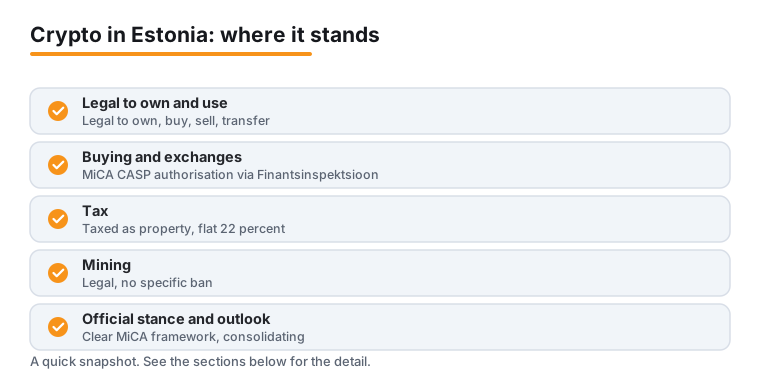
- Legal: Legal to own and use, not legal tender, regulated under MiCA
- Tax: Taxed as property under flat income tax, 22 percent in 2026
- Buying: Via MiCA-authorised CASPs, SEPA or card funding
Estonia is one of Europe's most digitally advanced nations and was an early mover in writing rules for virtual currencies. As of 2026 it regulates crypto under the European Union's Markets in Crypto-Assets Regulation (MiCA), implemented in national law through the Crypto-Assets Market Act (Kruptovarade turu seadus), with Finantsinspektsioon, the Estonian Financial Supervision and Resolution Authority, acting as the lead supervisor. Owning, buying, selling and using Bitcoin and other crypto-assets is legal, but firms that serve users, including exchanges, custodians and transfer providers, must be authorised and meet strict anti-money-laundering, capital, governance and consumer-protection standards.
This guide explains, in plain language, how crypto is treated in Estonia: its legal status, the regulators, the key laws, how exchanges are licensed, how tax generally works, the AML and KYC rules, the practical steps to buy and use crypto, the position on mining, recent developments, consumer risks, and how to verify everything with official sources. This is general information as of 2026 and is NOT legal, tax or financial advice; crypto rules and tax practice change frequently, so always confirm the current position with Finantsinspektsioon or another named Estonian authority, or a qualified local professional, before acting. For background reading see our crypto regulation guide and crypto taxes guide.
On this page: Legal status · Who regulates it · Taxes · How to buy · Mining
Is Bitcoin and crypto legal in Estonia?
Yes. Bitcoin and other cryptocurrencies are legal to own, buy, sell, hold and transfer in Estonia. There is no prohibition on individuals using crypto, and it has long been treated as a legitimate, if regulated, asset class. What Estonia does not do is grant crypto the status of legal tender. The official currency is the euro, and no business is obliged to accept crypto as payment; acceptance is voluntary and a matter of private agreement. Under Estonian and EU definitions a virtual currency is a digital value that can be traded, stored and transferred and that people accept as a means of payment, but which is not the legal tender of any state.
The key distinction is between holding crypto and providing crypto services to the public. Personal use is unrestricted. Anyone operating a business such as a crypto exchange, a wallet or custody service, or a token issuance must comply with Estonia's authorisation and anti-money-laundering regime. Estonia tightened these rules significantly after an earlier, very permissive licensing wave, and the framework is now aligned with EU-wide standards.
Who regulates crypto in Estonia?
The lead supervisor for crypto-asset service providers is Finantsinspektsioon, the Estonian Financial Supervision and Resolution Authority (often shortened to the FSA). Finantsinspektsioon grants, refuses, revokes and supervises authorisations for crypto-asset service providers (CASPs) and for issuers of asset-referenced tokens (ARTs) and e-money tokens (EMTs). You can verify guidance and the register on its official site, Finantsinspektsioon (fi.ee).
This is a significant change from the previous regime, in which crypto service providers were licensed and supervised by the Financial Intelligence Unit (FIU) under anti-money-laundering law. Supervision moved to Finantsinspektsioon when MiCA took effect, while the FIU retains an AML role and remains the recipient of suspicious-activity reports. The central bank, Eesti Pank (Bank of Estonia), is part of the euro-area monetary system and contributes to financial-stability and digital-euro work, but it is not the day-to-day licensing authority for crypto firms.
Key laws and frameworks
Estonia's crypto rulebook in 2026 sits on two pillars:
- MiCA (Markets in Crypto-Assets Regulation, EU 2023/1114): the directly applicable EU framework that sets harmonised rules for crypto-asset service providers (CASPs), for asset-referenced tokens (ARTs) and e-money tokens (EMTs), and for white-paper and disclosure obligations on token offers. MiCA's stablecoin (ART and EMT) rules applied from 30 June 2024, and the full CASP authorisation rules from 30 December 2024.
- The Crypto-Assets Market Act (Kruptovarade turu seadus): Estonia's national law implementing MiCA, in force from 1 July 2024. It designates Finantsinspektsioon as the competent authority and sets out the national supervisory process, bringing crypto firms under financial-sector supervision.
Alongside these, providers are subject to AML and KYC duties, the EU transfer-of-funds and FATF Travel Rule requirements for crypto transfers, governance and capital requirements, client-asset protection rules, and the EU's digital operational resilience (DORA) cybersecurity expectations. Because timelines and detailed thresholds evolve, rely on Finantsinspektsioon's official guidance and the consolidated text of the law in Riigi Teataja, the State Gazette, rather than third-party summaries.
Licensing and registration of exchanges (CASPs)
Platforms that offer exchange, custody, transfer, trading, advice or order-execution services to Estonian or EU customers must hold a MiCA authorisation as a crypto-asset service provider (CASP) from Finantsinspektsioon, or an equivalent CASP authorisation from another EU member state. A licence obtained in one member state can be passported to offer services across the EU.
Practical points reported for the Estonian process:
- The processing fee for a CASP authorisation application is around 3,000 euros, with a completeness check of roughly 25 working days followed by a substantive assessment of about 40 working days (which can be paused if information is missing).
- From 18 March 2026, applications must be submitted through Finantsinspektsioon's online application portal.
- Applicants must show fit-and-proper management, governance and internal controls, ICT and cybersecurity arrangements, custody and client-asset safeguards, and a registered office in Estonia, in practice an Estonian private limited company (OU).
- Under MiCA, minimum capital depends on the service class: 50,000 euros for services such as reception and transmission of orders, execution of orders, advice or placing (class 1), 125,000 euros where the firm also provides custody or exchange services (class 2), and 150,000 euros for operating a trading platform (class 3). Capital must also stay at no less than a quarter of the prior year's fixed overheads.
Older virtual-asset service provider (VASP) authorisations issued by the FIU under the prior framework do not convert automatically. Confirm the exact current fees, forms and timelines on the official Finantsinspektsioon site.
Crypto and Bitcoin tax in Estonia
Estonia does not have a special crypto tax. The Estonian Tax and Customs Board (Maksu- ja Tolliamet, or EMTA) treats cryptocurrency as property, and gains are taxed under the ordinary personal income tax rules. In broad terms:
- Selling crypto for euros or another fiat currency, exchanging one crypto for another, and using crypto to pay for goods or services can each be a taxable disposal that may generate a taxable gain.
- The flat personal income tax rate rose to 22 percent from 1 January 2025 (up from 20 percent). A further rise to 24 percent had been planned for 2026 but was cancelled, so the flat rate remains 22 percent in 2026. Always verify the rate in force for the relevant year with the EMTA.
- Loss treatment depends on the platform. Per EMTA guidance, a loss from transferring crypto-assets held on a MiCA-authorised provider may be set off against gains only where the crypto-asset was acquired through a service provider authorised under MiCA. The Estonian Tax and Customs Board states that a loss from the transfer of such crypto-assets may be deducted during the same period under section 39 of the Income Tax Act, but that crypto-assets not acquired through a MiCA-authorised platform do not qualify as securities, so a loss on their transfer cannot be taken into account for tax purposes at all in the same period, whereas losses on non-MiCA (unregulated) platforms are generally not deductible. This makes accurate, transaction-by-transaction record-keeping important.
- From 1 January 2025 it became possible to hold qualifying regulated crypto-assets through an investment account, which defers tax until money is taken out of the account, and since 1 January 2025 crypto-assets acquired through a MiCA-authorised service provider are treated as financial assets for this purpose under clause 10 of subsection 2 of section 17-1 of the Income Tax Act on reinvested investment income.
- Mining and professional trading can be treated as business income rather than a personal capital gain, with different rules on deductible costs.
Tax outcomes depend heavily on individual circumstances and on whether you act as a private person or a business. This section is informational only. Confirm your obligations directly with the Estonian Tax and Customs Board (emta.ee) or a qualified Estonian tax adviser, and do not rely on any specific figure here as current. See also our general crypto taxes guide.
AML, KYC and the Travel Rule
Anti-money-laundering and counter-terrorist-financing duties are central to Estonia's crypto framework. Licensed providers must:
- Run customer due diligence (KYC), verifying your identity and, where required, your address and source of funds.
- Monitor transactions on an ongoing basis and apply risk-based controls.
- Report suspicious activity to the Financial Intelligence Unit, which retains the AML supervisory and reporting role.
- Comply with the EU transfer-of-funds rules and the FATF Travel Rule. Under the recast Transfer of Funds Regulation, crypto-asset service providers must transmit originator and beneficiary information with every crypto transfer, regardless of the amount, so there is no minimum threshold below which details can be omitted.
For users, the practical effect is that you should expect identity checks when opening an account and when moving larger sums, and you should keep your own records. Using unlicensed or offshore venues that skip these controls increases your counterparty, fraud and compliance risk.
Buying and using crypto in practice
Buying crypto in Estonia is straightforward for residents. Many EU-facing exchanges and brokers serve Estonian users, and the euro makes funding via SEPA bank transfer or card simple. There are no foreign-exchange controls that block ordinary residents from buying or selling crypto; Estonia uses the euro and is part of the EU single market. A typical path looks like this:
- Choose a regulated platform. Prefer an exchange or broker authorised as a CASP under MiCA (in Estonia or another EU state) that is clear about its licensing, fees and custody.
- Open and verify your account. Complete KYC; have an ID document ready and, in some cases, proof of address or source of funds.
- Fund the account. Deposit euros via SEPA bank transfer or, where offered, a card. Bank transfer is usually cheaper.
- Place your order and secure your holdings. For larger amounts, a hardware (cold) wallet improves security; safeguard your recovery phrase.
- Keep records. Save histories for every buy, sell, swap and payment to support accurate tax reporting.
Crypto ATMs exist but are a small niche in Estonia, with limited availability and typically higher fees than online platforms; any ATM operating as a business is a regulated provider subject to the same authorisation and AML duties.
Bitcoin mining in Estonia
Bitcoin mining is legal in Estonia, and there is no specific ban on running mining hardware. In practice, mining at scale is shaped less by crypto-specific rules and more by economics and energy policy. Estonia's relatively cool climate helps with cooling, and the country has been expanding renewable generation, but claims that Estonia has built a dedicated sustainable-mining regime should be treated with caution, as much of that framing comes from promotional content rather than formal policy.
Key considerations for miners:
- Electricity cost and supply: profitability is driven by power prices, which can be volatile across the EU energy market. This is usually the deciding factor.
- Tax: mining rewards are treated by the Estonian Tax and Customs Board as the business income of a natural person, and a sustained operation may be regarded as a business, with corresponding registration, accounting and tax duties. Verify the treatment with the EMTA.
- Business and energy compliance: larger operations must meet ordinary business registration, electrical safety, and any grid-connection or environmental requirements for energy-intensive activity.
Small-scale or hobby mining faces few barriers beyond cost; commercial mining should be planned with professional tax and legal advice.
Recent developments (2025 to 2026)
The headline story is the move from a light-touch, AML-only licensing model to MiCA-aligned, Finantsinspektsioon-supervised authorisation. Key milestones reported:
- MiCA stablecoin rules applied from 30 June 2024 and full CASP rules from 30 December 2024; Estonia's national Crypto-Assets Market Act took effect on 1 July 2024.
- The flat income tax rate rose to 22 percent from 1 January 2025; a further rise to 24 percent planned for 2026 was cancelled, so the flat rate remains 22 percent in 2026.
- An investment-account option for qualifying regulated crypto-assets became available from 1 January 2025.
- From 18 March 2026, CASP applications are filed through Finantsinspektsioon's online portal.
- Legacy FIU-issued VASP licences cease to be valid after 1 July 2026, with no automatic conversion and no grace period after the sunset date; firms must hold a Finantsinspektsioon CASP authorisation, or an equivalent EU CASP authorisation, to keep operating. On 23 March 2026 Finantsinspektsioon publicly reconfirmed that the transition period ends in summer 2026 and that legacy VASP licences stop being valid after 1 July 2026.
The number of CASP authorisations granted in Estonia was still relatively small in 2025 to 2026 compared with the large number of legacy VASP registrations, so the market is consolidating into fewer, more robust providers. Treat specific dates and counts as point-in-time and verify them with the regulator.
Consumer risks and protection
The main risks for crypto users in Estonia fall into a few buckets: market risk (volatile prices and potential for large losses), security risk (hacking, scams, lost keys and platform failures), compliance and tax risk (taxable disposals, limited loss relief for individuals, and record-keeping burdens), and regulatory-change risk as MiCA continues to be implemented and refined.
MiCA strengthens consumer protection through authorisation, governance, transparency, complaint-handling and client-asset rules, and the transition away from legacy VASP licences around mid-2026 should remove weaker operators from the market. None of this removes the underlying volatility of the assets themselves, and crypto-assets are generally not covered by deposit-guarantee or investor-compensation schemes. Sensible practice is to use authorised providers, invest only money you can afford to lose, understand custody and security, and keep thorough records. Consider speaking with a licensed financial adviser before committing significant sums; nothing here is financial advice or a price prediction.
Official sources and how to verify
Crypto rules and tax practice change, so always confirm the current position with a named Estonian authority before acting. The primary official sources are:
- Finantsinspektsioon (Estonian Financial Supervision and Resolution Authority), the lead supervisor for crypto-asset service providers and the source for authorisation guidance and the register: fi.ee.
- Estonian Tax and Customs Board (Maksu- ja Tolliamet, EMTA), for how crypto is taxed and declared: emta.ee.
- Riigi Teataja (State Gazette), for the consolidated text of the Crypto-Assets Market Act and related laws: riigiteataja.ee.
- Eesti Pank (Bank of Estonia), for monetary and financial-stability context and digital-euro information: eestipank.ee.
This guide is general information as of 2026 and is not legal, tax or financial advice; verify your situation with Finantsinspektsioon, the EMTA, or a qualified Estonian professional. For more country guides see our crypto regulation hub.
What changed on 1 July 2026
This page was last fact-checked on 30 June 2026, the day before the most consequential date in Estonian crypto regulation. That date has now passed, so the change described here is done rather than pending.
Finantsinspektsioon and the Financial Intelligence Unit announced jointly on 30 June 2026 that from the following day, crypto-asset services may be provided in Estonia only by companies holding an authorisation under the EU Markets in Crypto-Assets Regulation, granted either by Finantsinspektsioon or by another European Economic Area supervisor. The Financial Intelligence Unit said it would cancel on 1 July the register data for the virtual currency service provider licences. There is no grace period and no automatic conversion of an old licence into a new one.
The scale of the clear-out is worth stating plainly. The Financial Intelligence Unit states that there were 641 valid licences when it started to clean up the virtual currency services sector in the middle of 2021, and 36 valid licences at the start of 2026. On 23 March 2026 Finantsinspektsioon said it was processing 10 applications for licences to provide crypto-asset services, and its management board member Gerd Laub said it was unlikely that a decision to issue or refuse an operating licence would be taken by the end of the transition period for firms that had not yet submitted an application. Firms applying at that stage had to include a plan for winding up their operations.
Firms that did not get authorised had to stop accepting new clients, stop marketing to clients in the European Economic Area, and tell existing clients clearly when services would end and how to withdraw their assets.
Which providers can legally serve you in Estonia now
When the transition closed, the supervisors named three firms able to provide crypto-asset services in Estonia, but by two different legal routes, and the distinction matters when you go to check them.
Finantsinspektsioon's 30 June 2026 notice says that one crypto-asset service provider, Lightspark Payments Europe AS, has received an authorisation from Finantsinspektsioon so far, and that crypto-asset services can also be provided in Estonia by AS LHV Pank and by the investment firm Lightyear Europe AS. Estonian public broadcaster ERR reported on 16 January 2026 that LHV Pank was the second financial intermediary in Estonia authorised to provide crypto-asset services, cleared for crypto-asset custody and management and for receiving and transmitting client orders, after the investment app Lightyear obtained the same permission.
A list of three understates the choice actually available, because MiCA passporting lets a firm authorised in any EEA state serve Estonian customers. Finantsinspektsioon's crypto-asset service provider register lists Estonian and cross-border providers separately, and the cross-border list alone runs to well over a hundred entries.
Before you send money to any platform, do this:
- Search the firm's exact legal name in the Finantsinspektsioon register of supervised entities.
- Do not rely on the Crypto-asset Service Provider category alone. An existing bank or investment firm may be entitled to provide crypto-asset services while appearing in the register under its banking or investment category instead. AS LHV Pank, for example, is listed among credit institutions, not among crypto-asset service providers.
- If the firm is authorised in another EEA country rather than Estonia, that is legitimate under passporting, but check which supervisor authorised it, because that is who handles complaints.
- Treat any firm still advertising an Estonian virtual currency licence as a warning sign. Those licences ceased to have effect on 1 July 2026.
- Remember that authorisation is not deposit insurance. MiCA sets conduct and custody standards; it does not guarantee your holdings.
Your 2026 crypto transactions are being reported to the tax authority
The most significant new obligation for ordinary Estonian holders is not a licensing rule but a reporting one, and it started on 1 January 2026.
Estonia applies Council Directive (EU) 2023/2226, known as DAC8, which builds on the Crypto-Asset Reporting Framework developed by the OECD. Reporting crypto-asset service providers must collect data identifying their users and record their purchases, sales and transfers of crypto-assets, then report those transactions annually to the Estonian Tax and Customs Board on an aggregated basis for each crypto-asset.
The Estonian Tax and Customs Board sets out the timetable:
- 1 January 2026: service providers start collecting user and transaction data.
- January 2027: service providers submit annual data reports for the first time, covering 2026 data.
- 30 June 2027: deadline for that first annual report.
- 30 September 2027: first international exchange of information.
Data are collected on both Estonian and foreign residents. Estonia transmits data on foreign users to the tax authority of their country of residence and receives information about Estonian residents through the same channel. The practical consequence is straightforward: for the 2026 tax year onward, an Estonian resident should assume the tax authority already holds third-party records of their exchange activity.
What is coming next, and roughly when
Estonia has no crypto-specific bill pending in the Riigikogu right now. The pipeline that matters is European, and it is dated.
| What | Stage | When it bites | What it means in practice |
|---|---|---|---|
| DAC8 and CARF reporting | In force since 1 January 2026 | First report due 30 June 2027; first cross-border exchange 30 September 2027 | Your 2026 exchange activity reaches the Estonian Tax and Customs Board, and Estonian residents' activity at foreign providers reaches it too |
| EU anti-money laundering package: Regulation (EU) 2024/1624, Directive (EU) 2024/1640 and the AMLA Regulation (EU) 2024/1620 | Adopted, not yet applicable | The European Commission states the regulation applies from 2027 and that member states must implement the directive from 2027, without naming a day. AMLA took over EU-level anti-money-laundering tasks from the European Banking Authority on 1 January 2026 | Customer due diligence rules for crypto firms move from the Estonian Money Laundering and Terrorist Financing Prevention Act into directly applicable EU law. Expect identity and source-of-funds checks to become more uniform, not lighter |
| Digital euro Regulation, procedure 2023/0212(COD) | Council and Parliament positions agreed, moving into interinstitutional negotiation | Council position December 2025; ECON negotiating mandate recorded as due for announcement at the start of the July 2026 plenary. ECB pilot with 36 payment service providers planned to start in the second half of 2027 and run for 12 months | The ECB says it aims to be ready for a potential first issuance during 2029, assuming the Regulation is adopted in 2026. This is a central bank payment option, not a crypto-asset |
Sources for this table: the European Commission on the anti-money laundering package, the European Banking Authority on the handover to AMLA, the European Parliament legislative train on the digital euro and the ECB digital euro pilot page.
How large the Estonian crypto sector actually is
Eesti Pank publishes statistics on crypto-asset service providers, which give a rare hard measure of a sector usually described only in adjectives. A statistical release of 12 June 2025 reported that clients held 1.8 billion euros in crypto assets at Estonian service providers.
By the first quarter of 2026 the picture had contracted sharply. Reporting on Bank of Estonia data, published 11 June 2026, gives 32 licensed providers at the end of the first quarter of 2026, nine fewer than a year earlier, with client assets down 42 percent over the year: 386 million euros in Bitcoin, down 50 percent; 154 million euros in Ethereum, down 34 percent; and 442 million euros in other crypto assets, down 46 percent. Transaction turnover was 2.16 billion euros in the quarter. The decline is attributed to companies ceasing operations, falling crypto asset prices and asset sales.
One figure explains the character of the Estonian sector better than any other: Estonian clients accounted for only 2 percent of total client assets. Estonia's licensing regime was built for firms serving customers abroad, which is why the clean-up from 2021 to 2026 was so severe and why it barely dented the options available to Estonian residents.
Frequently asked questions
Is cryptocurrency legal in Estonia?
Yes. Buying, holding, selling and transferring Bitcoin and other crypto-assets is legal for individuals in Estonia. Crypto is not legal tender, so no one is required to accept it, but personal use is unrestricted. Businesses that provide crypto services to the public must be authorised and supervised under the MiCA-based framework administered by Finantsinspektsioon.
Who regulates crypto in Estonia?
Finantsinspektsioon, the Estonian Financial Supervision and Resolution Authority, is the lead supervisor for crypto-asset service providers under MiCA and the national Crypto-Assets Market Act. This replaced the earlier system in which the Financial Intelligence Unit (FIU) licensed providers under anti-money-laundering rules; the FIU still handles AML matters and receives suspicious-activity reports. You can verify guidance at fi.ee.
How is crypto taxed in Estonia?
The Estonian Tax and Customs Board treats crypto as property, and gains from selling, swapping or spending it are subject to personal income tax at the flat rate in force, which rose to 22 percent from 2025 and remains 22 percent in 2026. There is no separate crypto tax. Losses on MiCA-authorised platforms may be offset against gains in the same period, but losses on unregulated platforms generally are not deductible. Mining and professional trading may be taxed as business income. Rates and rules change, so confirm the current position with the EMTA or a qualified adviser.
Do crypto exchanges need a licence in Estonia?
Yes. Exchanges, custodians, transfer services and similar providers must hold a MiCA crypto-asset service provider (CASP) authorisation from Finantsinspektsioon, or an equivalent EU CASP authorisation, to serve Estonian or EU customers, and must run KYC and AML controls. The application fee is around 3,000 euros and applications are filed through the regulator's online portal from 18 March 2026. Older FIU-issued VASP licences cease to be valid after 1 July 2026 with no automatic conversion.
What is MiCA and how does it affect Estonia?
MiCA is the EU's Markets in Crypto-Assets Regulation, a directly applicable framework that harmonises rules for crypto-asset service providers and for stablecoin-type tokens across the EU. Its stablecoin rules applied from 30 June 2024 and full CASP rules from 30 December 2024. Estonia implemented it through the Crypto-Assets Market Act (in force 1 July 2024), moving supervision to Finantsinspektsioon and allowing a licence obtained in Estonia to be passported across the EU.
Can I mine Bitcoin in Estonia?
Yes, mining is legal. Small-scale mining faces few barriers beyond electricity cost, while commercial operations must handle business registration, energy and safety compliance, and income tax on rewards. Profitability depends largely on power prices. Get professional advice for any sizeable operation, and verify the tax treatment with the EMTA.
What is the crypto tax rate in Estonia in 2026?
Estonia has no separate crypto tax; gains from selling, swapping or spending crypto are taxed under the flat personal income tax. That flat rate rose to 22 percent from 2025; a further rise to 24 percent planned for 2026 was cancelled, so the flat rate remains 22 percent in 2026. Confirm the rate for your year with the Estonian Tax and Customs Board (EMTA), as rules change.
What do the July 2026 crypto rules mean for exchanges in Estonia?
Legacy VASP licences issued by the Financial Intelligence Unit stop being valid after 1 July 2026, with no automatic conversion and no grace period. To keep serving customers, a provider must hold a MiCA crypto-asset service provider (CASP) authorisation from Finantsinspektsioon, or an equivalent EU CASP authorisation. Applicants generally set up an Estonian private limited company and must meet MiCA minimum capital of 50,000, 125,000 or 150,000 euros depending on the services offered. Finantsinspektsioon reconfirmed this end of the transition period on 23 March 2026.
What happened to Estonian crypto licences on 1 July 2026?
The transition period ended. Finantsinspektsioon and the Financial Intelligence Unit announced on 30 June 2026 that from 1 July, crypto-asset services in Estonia may only be provided by companies that hold an authorisation under MiCA, from Finantsinspektsioon or from another European Economic Area supervisor. The Financial Intelligence Unit cancelled the register data for the virtual currency service provider licences on 1 July. There is no grace period and no automatic conversion.
Is crypto still legal in Estonia in August 2026?
Yes. Owning, buying, selling and holding crypto remains legal for individuals. It is not legal tender. What changed is who may sell it to you: since 1 July 2026 a provider must hold a MiCA authorisation from Finantsinspektsioon or another EEA supervisor. Check any platform in the Finantsinspektsioon register of supervised entities before using it.
Which crypto companies can legally serve customers in Estonia?
In its 30 June 2026 notice Finantsinspektsioon said that one crypto-asset service provider, Lightspark Payments Europe AS, had received an authorisation from it so far, and that crypto-asset services can also be provided in Estonia by AS LHV Pank and by the investment firm Lightyear Europe AS. Many more firms serve Estonian customers under authorisations passported in from other EEA states. Note that a bank or investment firm may appear in the register under its banking or investment category rather than under crypto-asset service providers.
Will the Estonian Tax and Customs Board know about my crypto?
For the 2026 tax year onward, assume yes. Under DAC8, Council Directive (EU) 2023/2226, which builds on the OECD Crypto-Asset Reporting Framework, service providers started collecting user and transaction data on 1 January 2026. The first annual reports are submitted in January 2027 for 2026 data, with a deadline of 30 June 2027, and the first international exchange of information takes place by 30 September 2027. Estonia also receives data on Estonian residents from foreign providers.
Can I deduct crypto losses in Estonia?
Only for crypto-assets acquired through a service provider authorised under MiCA. The Estonian Tax and Customs Board states that a loss from the transfer of such crypto-assets may be deducted during the same period under section 39 of the Income Tax Act. Crypto-assets not acquired through a MiCA-authorised platform do not qualify as securities, so a loss on their transfer cannot be taken into account for tax purposes at all. That is a concrete financial reason to use an authorised platform.
Is there a new crypto law being debated in the Estonian parliament?
No crypto-specific bill is pending in the Riigikogu. The national framework, the Market in Crypto-Assets Act, was passed on 5 June 2024 and published in Riigi Teataja on 29 June 2024. What is still moving is European: the European Commission states that the EU anti-money laundering package applies from 2027, and the digital euro Regulation is moving into interinstitutional negotiation after the Council agreed its position in December 2025 and Parliament's ECON committee adopted a negotiating mandate.
Facts reviewed: 5 August 2026. Page updated: 5 August 2026.
Related guides
More countries in the region
Practical guides