Home › Crypto Regulation › Jamaica
Bitcoin & Cryptocurrency Regulation in Jamaica
Quick answer — Jamaica, 2026
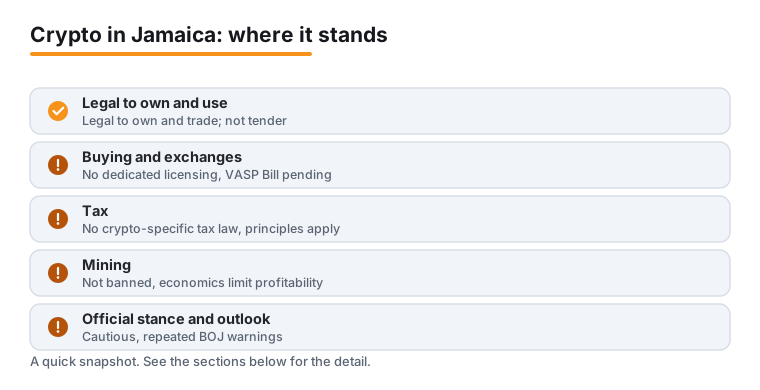
- Legal: Legal to own and trade, not legal tender
- Tax: No crypto-specific law, existing income tax rules can apply
- Buying: Via international exchanges and P2P, no local licensing yet
Jamaica sits in an unusual position on the world crypto map. In June 2022 it became one of the first countries to give a central bank digital currency (CBDC), the Jamaican-dollar JAM-DEX, the status of legal tender. At the same time it has been deliberately cautious about private cryptocurrencies such as Bitcoin and Ether. The result is a market where buying, holding and trading crypto is legal, but where, as of mid-2026, there is still no operational licensing regime in force, limited consumer protection, and repeated public warnings from the Bank of Jamaica. A licensing framework has reached public consultation but has not yet been enacted.
This guide explains where Jamaican law stands on Bitcoin and other crypto assets: their legal status, who the regulators are, the laws that apply, the proposed Virtual Assets Service Provider (VASP) framework, how tax and anti-money-laundering rules work, the practical realities of buying and using crypto, and how to verify everything with official sources. This is general information as of 2026 and is NOT legal, tax or financial advice. Confirm anything that affects you with the Bank of Jamaica, the Financial Services Commission, Tax Administration Jamaica or a qualified Jamaican professional. For broader background, see our guide to crypto regulation and our country regulation hub.
On this page: Legal status · Who regulates it · Taxes · How to buy · Mining
Is Bitcoin and crypto legal in Jamaica?
Yes. Owning, buying, selling and trading cryptocurrency is legal for individuals in Jamaica. No law prohibits residents from acquiring or holding Bitcoin or other crypto assets, and people routinely use international exchanges and peer-to-peer platforms to do so.
What crypto is not is legal tender. The Bank of Jamaica (BOJ) has stated plainly that cryptocurrencies are not legal tender in Jamaica, that the BOJ does not regulate or supervise them, and that it has not authorised any entity to operate a virtual currency platform. Anyone using crypto does so entirely at their own risk, and no merchant or creditor is obliged to accept it as payment.
The key distinction newcomers often miss is that Jamaica embraced a digital version of its own currency (JAM-DEX) while keeping decentralized cryptocurrencies outside the official monetary system. "Legal to use" does not mean "officially endorsed" or "protected."
Who regulates crypto in Jamaica?
There is no single dedicated crypto regulator yet, though the Financial Services Commission is the designated supervisor in waiting: the National Risk Assessment describes the FSC's role as covering "securities and insurance sectors and prospective VASP supervision", and the FSC issued its June 2026 consultation to support what it calls "its forthcoming mandate to regulate and supervise virtual asset service providers". Several bodies share responsibility depending on the activity:
- Bank of Jamaica (BOJ) is the central bank. It issues the currency, oversees payment systems and is the issuer of the JAM-DEX CBDC. It does not license or supervise private crypto businesses, but it has issued repeated public cautions about them.
- Financial Services Commission (FSC) regulates securities, insurance and pensions. Where a crypto token or scheme behaves like a security or collective investment it can fall under FSC jurisdiction, and the FSC has been conducting risk assessment work on virtual-asset service providers.
- Tax Administration Jamaica (TAJ) administers income, corporate and other taxes that can apply to crypto gains and income.
- Financial Investigations Division (FID) leads anti-money-laundering enforcement and handles suspicious-transaction reporting under the Proceeds of Crime Act.
The Government has also signalled a longer-term plan to merge the FSC's regulatory functions with the central bank, a process that is in its early stages. Because the institutional picture is changing, always confirm the current supervisor for your activity directly with the Financial Services Commission and the Bank of Jamaica.
Key laws and frameworks
Jamaica has historically had no statute written specifically for cryptocurrency. Instead, crypto activity is assessed against existing financial legislation depending on what the activity actually involves. The laws most likely to be relevant include:
- The Bank of Jamaica Act and the Banking Services Act, which shape currency, deposit-taking and what counts as regulated money business.
- The Securities Act, where a token or scheme behaves like a security or investment product, bringing it within the FSC's remit.
- The Payment Clearing and Settlement Act, relevant to payment systems and settlement.
- The Proceeds of Crime Act (POCA), 2007 and its amendments, the backbone of the anti-money-laundering framework.
The most important development is the proposed Virtual Assets Service Provider (VASP) Bill (covered in the next two sections), which is intended to create a purpose-built licensing and supervision regime for exchanges, custodians and similar intermediaries. Until that legislation is in force, treat the legal classification of any specific crypto activity as something to confirm with the relevant regulator rather than assume.
The Virtual Assets Service Provider (VASP) Bill
Jamaica's central crypto-policy initiative is the Virtual Assets Service Provider (VASP) Bill. In the 2025/26 Budget Debate on 11 March 2025, Finance Minister Hon. Fayval Williams announced that the Government had programmed the Bill for passage during the 2025/26 fiscal year.
According to the Government, the Bill is designed to establish a legal framework with licensing, supervision and enforcement guidelines for VASP businesses. A primary driver is compliance with Financial Action Task Force (FATF) Recommendations 15 and 16, which require countries to bring virtual assets and virtual-asset service providers within their anti-money-laundering, counter-terrorist-financing and proliferation-financing controls. The Government has also said the Bill will include market-conduct and consumer-protection provisions to safeguard investors.
In mid-2026 the framework moved to public consultation. The Financial Services Commission published its proposed VASP licensing framework for comment, with the consultation window running from 11 June to 10 July 2026. The framework is built on three supporting instruments: AML/CFT/CPF Guidelines, Business Conduct Standards, and Licensing Requirements. The FSC's own draft licensing requirements set out a supervised market with hard entry standards rather than a light-touch register: six licence classes (A trading platform, B advisory, C custody, D broker-dealer, E wallet services, F conversion services), minimum paid-up share capital of J$16,000,000, an application processing fee of J$800,000, annual fees ranging from J$400,000 for custody to J$4,000,000 for a trading platform, Jamaican incorporation as a precondition with foreign-incorporated entities and individuals ineligible, substance requirements including a functioning Jamaica office and a Jamaica-resident director, and quarterly proof of reserves verified by an independent auditor for Class A and Class C licensees. These are consultation proposals, to be effected through regulations on enactment of the Act. The FSC has said these instruments would be finalized and brought into force on enactment of the VASP Act.
The Bill has since been laid before Parliament. The Bank of Jamaica's third National Risk Assessment, published 11 June 2026, states that the Virtual Asset Service Providers Bill "has now been laid before Parliament", and the Gleaner reported the same on 1 July 2026 in a write-up of that assessment. As at early August 2026 it had not been passed, no Act number could be located and no commencement date has been published. The FSC's own documents identify the Financial Services Commission as the intended licensing authority, and the FSC has said it expects the regime to be completed in the fiscal year ending March 2027. Verify the current status with the Jamaica Information Service and the regulators before relying on it.
Licensing and registration of exchanges
Historically Jamaica has not operated a dedicated licensing regime for crypto exchanges, so domestic platforms generally could not obtain local approval and the VASP sector has been effectively unregulated. The practical consequences today are:
- Most Jamaicans access crypto through international exchanges and peer-to-peer (P2P) marketplaces rather than locally licensed venues.
- The consumer protections you would expect from a regulated financial product generally do not apply, because no local body currently supervises these platforms.
- Reputable global exchanges still impose their own Know Your Customer (KYC) and anti-money-laundering checks, so expect to verify your identity with government ID and sometimes proof of address.
The proposed VASP Bill is intended to change this by creating a licensing path for exchanges, custodians and wallet businesses. Until that regime is operational, due diligence falls on you: favour established platforms with a strong security track record, enable two-factor authentication, and be cautious of any service promising guaranteed returns. If a platform claims to be "licensed in Jamaica," verify that claim directly with the FSC before trusting it.
Crypto and Bitcoin tax in Jamaica
Jamaica does not have a tax code written exclusively for cryptocurrency. That does not mean crypto is tax-free. It means existing tax principles administered by Tax Administration Jamaica (TAJ) are applied according to the nature of the activity.
In general terms, profits from trading as a business, or crypto received as payment for goods, services or employment, can be treated as taxable income, and businesses have record-keeping and reporting duties. How a given transaction is characterized, such as investment versus trade or occasional versus regular activity, can change the outcome. Tax Administration Jamaica has published no crypto-specific guidance, so the general rules decide the outcome rather than a bespoke crypto code, and how your activity is characterised is what drives the result.
The one figure that settles most questions is that Jamaica has no capital gains tax at all, so a gain on selling crypto held as a personal investment is not caught by a capital gains charge. Where activity amounts to a trade, or crypto is received as payment, the ordinary rates apply: personal income tax at 25 per cent on chargeable income up to J$6,000,000 a year and 30 per cent above that, against an annual tax-free threshold of J$1,902,360 effective 1 April 2026, and corporate income tax at 25 per cent for unregulated companies or 33 and one third per cent for companies regulated by the Bank of Jamaica, the FSC, the Office of Utilities Regulation or the Ministry of Finance. Rates and thresholds change, so confirm yours before filing. To stay compliant, keep clear records of every acquisition, disposal and conversion together with the Jamaican-dollar value at the time, and seek guidance from Tax Administration Jamaica or a Jamaican tax professional. See also our general crypto tax guide. This section is informational only and is not tax advice.
AML and KYC rules
Anti-money-laundering (AML) and counter-terrorist-financing (CFT) duties are central to how crypto is treated in Jamaica. The principal framework is the Proceeds of Crime Act (POCA), 2007, as amended, supported by related regulations and guidance notes. The Financial Investigations Division (FID) leads enforcement, can impose administrative sanctions on regulated entities, and receives suspicious-transaction reports.
Jamaica's drive to pass the VASP Bill is closely tied to meeting FATF Recommendations 15 and 16, which exist specifically to bring virtual-asset activity under AML and CFT controls. In practice, this means exchanges and other intermediaries serving Jamaican users apply KYC checks: identity verification, and often proof of address and source-of-funds questions for larger transactions.
For everyday users the takeaway is simple. Expect to prove your identity when you sign up to a reputable platform, keep your own records, and be aware that crypto transactions are not anonymous and remain subject to AML scrutiny. You can review the legislation via the Financial Investigations Division.
Buying and using crypto in practice
A typical, careful route for a Jamaican resident looks like this:
- Choose a reputable platform. Select an established international exchange or a trusted P2P marketplace with strong security and a track record of serving Jamaican users.
- Complete verification. Be ready to provide government ID and possibly proof of address to satisfy KYC and AML checks.
- Fund your account. Compare bank transfer, card and P2P options for fees and limits, and use a funding method you control. P2P in particular requires care to avoid fraud, so never release funds before payment is genuinely confirmed.
- Place your order. Start small while you learn the interface, and double-check amounts and fees before confirming.
- Secure your holdings. Enable two-factor authentication and consider moving anything beyond pocket-money amounts into a personal wallet, using a hardware wallet for larger sums.
- Keep records. Log every purchase, sale and conversion with dates and Jamaican-dollar values for tax and personal tracking.
Treat your seed phrase as the master key to your funds: never share it, never enter it into a website, and store a backup offline. No legitimate service will ever ask for it. Crypto is also sometimes used for remittances to Jamaica, but the recipient still has to convert into Jamaican dollars, and volatility plus on and off-ramp costs can offset any savings, so compare the full end-to-end cost against established money-transfer providers.
Bitcoin mining in Jamaica
There is no specific law banning or licensing Bitcoin mining in Jamaica, so small-scale mining is not prohibited. In practice the main constraint is economics rather than regulation.
The decisive factor for mining profitability is the cost of electricity, and Jamaica's grid power has traditionally been relatively expensive by global standards, much of it historically tied to imported fuel. High energy costs make it difficult for proof-of-work mining to compete with operations in low-cost-power jurisdictions. Interest in renewable energy, solar in particular given Jamaica's strong sunshine, is sometimes raised as a way to make mining more viable.
A serious venture would still need to weigh import duties on hardware, business registration, tax obligations under TAJ, and the heat and noise that mining equipment generates. Anyone considering a commercial operation should obtain professional advice on the energy, tax and licensing implications first, and watch for any new requirements introduced under the VASP framework.
JAM-DEX: Jamaica's CBDC
JAM-DEX (Jamaica Digital Exchange) is the Bank of Jamaica's central bank digital currency. It is issued and backed by the BOJ, denominated in Jamaican dollars one-to-one, and was given legal-tender status in 2022, making Jamaica one of the first countries to take that step. It is effectively a digital form of cash.
JAM-DEX is not a cryptocurrency. Unlike Bitcoin, it is centralized, government-backed and not volatile against the local currency. It is designed to lower transaction costs and extend financial access to people who are underbanked.
As of 2026 the Government has reaffirmed its commitment to JAM-DEX and is working to scale it, including upgrading point-of-sale devices and offering merchant incentives. Officials reported that JAM-DEX transaction values rose about 550 percent in 2025 over 2024, and volumes rose about 267 percent, though from a small base and driven largely by existing users transacting more often rather than a surge of new sign-ups. The public accesses JAM-DEX through digital wallets: NCB's Lynk app was the first, and JN Bank launched its JN Pay wallet to the public in July 2025, with further providers expected. The main bottleneck cited by the central bank is the slow retrofitting of point-of-sale machines to accept the currency. Real-world adoption has nonetheless been gradual. You can read the official details on the Bank of Jamaica CBDC page.
Recent developments and outlook
The defining development of 2025 and 2026 is the push to enact the Virtual Assets Service Provider (VASP) Bill. Announced in the March 2025 Budget Debate and programmed for the 2025/26 fiscal year, the Bill is intended to create licensing, supervision, market-conduct and consumer-protection rules for crypto businesses and to satisfy FATF Recommendations 15 and 16. In mid-2026 the Financial Services Commission opened a public consultation, running from 11 June to 10 July 2026, on the proposed licensing framework and its three supporting instruments (AML/CFT/CPF Guidelines, Business Conduct Standards, and Licensing Requirements), which are to be brought into force on enactment of the Act. As of mid-2026 the Bill had not yet been passed by Parliament.
Alongside it, the FSC has been assessing virtual-asset risks, and the Government has signalled a longer-term merger of the FSC's functions into the central bank. On the digital-currency side, JAM-DEX continues to expand. Together these point to cautious modernization: keeping decentralized crypto at arm's length while building an official digital-payments system and a future supervisory regime for crypto intermediaries.
Because the VASP Bill's final wording, the named regulator and its commencement date can still change, treat 2026 as a transitional period and confirm the current position with official sources before acting.
Consumer risks and protection
The biggest risks for crypto users in Jamaica are the ones the Bank of Jamaica has repeatedly highlighted: high price volatility, exposure to cyber-fraud and hacking, the use of crypto in money laundering and terrorist financing, and settlement risk because crypto is not issued or backed by the central bank. Because the sector is largely unregulated, if a platform collapses or you are defrauded you may have little or no official recourse.
Crypto investment scams have actively targeted Jamaica and the wider Caribbean, often promising guaranteed or unusually high returns. Be sceptical of any such promise, never invest more than you can afford to lose, use secure storage for meaningful amounts, and verify that any platform or adviser claiming local authorisation is genuinely recognised by the FSC. The proposed VASP Bill is expected to improve protection over time by adding market-conduct and consumer-protection rules, but until it is in force you should assume the safety net is thin.
Official sources and how to verify
Crypto rules in Jamaica are evolving, so always check the primary sources rather than relying on third-party summaries. The key official references are:
- Bank of Jamaica for the central bank's position, JAM-DEX and its cryptocurrency cautions: boj.org.jm, including its caution on cryptocurrencies.
- Financial Services Commission for securities, investment products and VASP supervision: fscjamaica.org.
- Tax Administration Jamaica for tax obligations: jamaicatax.gov.jm.
- Financial Investigations Division for AML legislation and reporting: fid.gov.jm.
This guide is general information as of 2026 and is NOT legal, tax or financial advice. The legal, tax and licensing position can change, especially as the VASP Bill progresses, so verify anything that affects you with the named official regulators or a qualified Jamaican professional before acting. For more, see our crypto regulation explainer and the regulation hub.
What is changing: status at August 2026
Two things moved between mid June and early August 2026, and both change the answer this page gives.
- The Virtual Asset Service Providers Bill has reached Parliament. Jamaica's third National Risk Assessment, published by the Bank of Jamaica on 11 June 2026, states that the Bill "has now been laid before Parliament", and refers elsewhere to "the VASP legislative framework currently before Parliament" (National Risk Assessment Report, June 2026; index page here). The Gleaner reported the same on 1 July 2026, but its article is a write-up of that same assessment rather than independent confirmation (Gleaner, 1 July 2026). No Bill number, order paper or Bill text could be retrieved, because the Jamaican Parliament website blocks automated access.
- The Financial Services Commission consultation has closed. The consultation period ran from 11 June to 10 July 2026 (FSC consultation paper). As at early August 2026 the FSC had published no feedback statement and no final instrument. The most recent items on its site are dated 27 July 2026 (consultations on corporate governance and on fit and proper standards) and 31 July 2026 (pensions industry statistics), none of them about virtual assets (FSC news).
What has not changed matters just as much. The Bill has not been passed, no Act number could be located, no commencement date has been published, and no licensed virtual asset service provider exists in Jamaica. Until the Act commences, nothing about how a Jamaican resident buys, holds or sells crypto is different from a year ago.
On timing, the Jamaica Observer reported on 8 July 2026 that the FSC expects the regulatory regime to be completed in the fiscal year ending March 2027 and has budgeted to collect $21.25 million from virtual asset service providers in that year (Jamaica Observer, 8 July 2026). That is the clearest public signal of when this becomes real, and it is a budget target rather than a date anyone has committed to.
What the proposed VASP licence would actually require
The FSC's Appendix III sets out the entry conditions in figures. These are consultation proposals, not law: the FSC says the Licensing Requirements are "to be effected through regulations" and that the instruments will be finalised and brought into effect upon enactment of the proposed VASP Act (Appendix III, Proposed Licensing Requirements for VASPs; landing page here).
| Class | Regulated activity | Proposed annual fee |
|---|---|---|
| A | Trading platform (exchanges) | J$4,000,000 |
| B | Advisory services | J$500,000 |
| C | Custody services | J$400,000 |
| D | Broker-dealer | J$1,600,000 |
| E | Wallet services | J$2,400,000 |
| F | Conversion services | J$800,000 |
The other proposed conditions:
- Minimum paid-up share capital of J$16,000,000, with evidence of source of funding and confirmation the funds are not a temporary loan arranged solely to satisfy the requirement.
- An application processing fee of J$800,000. A separate licence is required for each class of activity.
- Only companies incorporated in Jamaica under the Companies Act or the International Business Companies Act may apply. Legal entities incorporated outside Jamaica are not eligible. Individuals are not eligible, and it would be an offence under the proposed Act for a natural person to offer virtual asset services in or from Jamaica without a licence.
- Substance requirements: a functioning office in Jamaica, at least one director resident in Jamaica, qualified local staff, all customer and AML records accessible from the Jamaica office, a Nominated Officer located in Jamaica as required under POCA, and an account with a licensed Jamaican deposit-taking institution.
- Class A and Class C licensees must conduct a proof of reserves exercise no less frequently than quarterly, reconciling client asset holdings against recorded client liabilities, verified by an independent auditor acceptable to the Commission.
- Indicative processing times: completeness review within 10 business days, substantive assessment 60 to 90 business days from acceptance of a complete application, decision notified within 10 business days, licence issued within 5 business days.
- Transition: on enactment, entities already operating in the virtual asset space in Jamaica must notify the FSC within 30 days of the Act coming into force. A prescribed application window will then be announced, and firms filing a complete application within it may be permitted at the Commission's discretion to continue provisionally. Firms that do not apply, or are refused, must cease providing services by a date the Commission specifies.
The FSC explicitly rejects a registration-only model, arguing that such regimes frequently fail on AML risk because ownership and control change after registration without notification, many registrants have little genuine local presence, and governance and compliance deficiencies surface only after the fact.
What the June 2026 National Risk Assessment found about crypto in Jamaica
Jamaica's third National Risk Assessment was published by the Bank of Jamaica on 11 June 2026 and includes a virtual assets and VASP risk assessment. It is the most detailed public picture of crypto use in Jamaica that exists (Bank of Jamaica; full report).
- Jamaica's money laundering, terrorist financing and proliferation financing risk from virtual assets and VASPs is assessed as "LOW (dynamic)". Using the World Bank VA/VASP risk assessment tool, the residual risk score is approximately 11 to 12 per cent for both fiat-to-virtual and virtual-to-fiat channels.
- Jamaica hosted no domestic VASP sector during the assessment period. The assessment found no evidence of domestic virtual asset exchanges facilitating conversion, no custodial wallet providers operating within or interfacing with the regulated financial system, no virtual asset payment gateways integrated into the domestic payments ecosystem, and no locally established broker or administration service.
- Virtual asset related transactions reported through deposit-taking institutions between 2020 and June 2025 amounted to approximately J$8.9 billion across 296,156 transactions, representing less than one per cent of GDP.
- Sample analysis of peer-to-peer platforms indicated annualised transaction values of approximately US$0.98 million, around 0.01 per cent of GDP. The sector appears in the report's sector size table at about 0.01 per cent of GDP for 2024.
- Chainalysis estimated approximately US$2.07 billion in total cryptocurrency transaction value received between October 2023 and September 2024, ranking Jamaica 104th globally on its adoption index and 15th among Latin American economies, split roughly 50.9 per cent centralised exchange flows and 48.8 per cent DeFi. The report treats this as directional only, because it uses a web traffic proxy method.
- Jamaica is not among the jurisdictions FATF identifies as having "materially important VASP activity", a designation applied to countries exceeding 0.25 per cent of global trading volume or hosting more than one million virtual asset users.
- Financial institutions report nil balance sheet exposure to virtual assets and generally avoid relationships with customers engaged in virtual asset business activities. The report is explicit that regulated institutions are the control point: because on-ramps and off-ramps run through them, the flows are observable and mitigated at the point of entry into, or exit from, the domestic financial system.
The practical reading for a Jamaican user is that your bank, not a crypto regulator, is the entity that sees and can question your crypto-related transfers, and de-risking by banks is a realistic obstacle. The report also states that the VASP legislative framework constitutes a direct output of the national risk assessment process.
The tax rates that actually apply while there is no crypto tax law
Jamaica has no crypto-specific tax legislation, and no crypto-specific guidance from Tax Administration Jamaica could be located. That does not make the position unknowable. The general rules decide the outcome, and the most important one is that Jamaica does not levy a capital gains tax at all. The figures below are from PwC Worldwide Tax Summaries, last reviewed 31 December 2025.
| Charge | Rate | Source |
|---|---|---|
| Capital gains tax | None. "There is no tax on capital gains in Jamaica." | PwC Worldwide Tax Summaries |
| Personal income tax (residents) | 25 per cent on chargeable income up to J$6,000,000 a year (J$500,000 a month); 30 per cent above that | PwC Worldwide Tax Summaries |
| Annual tax-free income threshold | J$1,902,360 a year (J$158,530 a month), effective 1 April 2026. Because the increase took effect part-way through the calendar year, the blended figure for the 2026 year of assessment is J$1,876,614 | PwC Worldwide Tax Summaries |
| Corporate income tax | 25 per cent for unregulated companies; 33 and one third per cent for companies regulated by the Bank of Jamaica (other than a building society), the Financial Services Commission (excluding life assurance companies and trust or corporate service providers), the Office of Utilities Regulation (other than a renewable energy independent power producer), or the Ministry of Finance | PwC Worldwide Tax Summaries |
What this means in practice. A one-off gain on selling Bitcoin held as a personal investment is not caught by a capital gains charge, because Jamaica has none. Income tax can still apply where the activity amounts to a trade rather than an investment, or where crypto is received as payment for goods, services or employment, in which case the ordinary personal or corporate rates above apply. Jamaica does levy a transfer tax on the gross consideration for certain assets transferred and stamp duty on the transfer or disposal of shares or real property, neither of which is written to cover virtual assets.
Keep records of every acquisition, disposal and conversion with the Jamaican-dollar value at the time, and confirm your own position with Tax Administration Jamaica or a Jamaican tax professional. This is general information, not tax advice.
Frequently asked questions
Is Bitcoin legal tender in Jamaica?
No. Bitcoin and other private cryptocurrencies are not legal tender in Jamaica, and the Bank of Jamaica does not regulate or supervise them. They are legal to own and trade, but no one is obliged to accept them as payment, and you use them at your own risk. The only digital money with legal-tender status is the official CBDC, JAM-DEX, which is a digital form of the Jamaican dollar, not a cryptocurrency.
Are crypto exchanges licensed or regulated in Jamaica?
As of 2026, not yet under a dedicated regime. Jamaica has historically had no licensing framework for crypto exchanges, so the VASP sector has been effectively unregulated and most users rely on international platforms. The proposed Virtual Assets Service Provider (VASP) Bill, programmed for the 2025/26 fiscal year, is intended to create licensing and supervision rules. Until it is in force, check the current status with the Financial Services Commission and the Bank of Jamaica, and be wary of any platform claiming to be "licensed in Jamaica."
What is the VASP Bill and when will it pass?
The Virtual Assets Service Provider (VASP) Bill is Jamaica's planned framework to license and supervise crypto businesses such as exchanges and custodians, and to meet FATF Recommendations 15 and 16 on anti-money-laundering. It was announced in the March 2025 Budget Debate by Finance Minister Fayval Williams and programmed for passage in the 2025/26 fiscal year. The final form and commencement date can still change, so confirm the latest position with the Jamaica Information Service and the regulators.
Do I have to pay tax on crypto in Jamaica?
Possibly. Jamaica has no crypto-specific tax law, but existing tax rules administered by Tax Administration Jamaica can apply, for example to trading profits or crypto received as income, depending on the circumstances. We do not quote specific rates because they change and depend on your situation. Keep detailed records of dates and Jamaican-dollar values, and consult TAJ or a Jamaican tax professional. This is not tax advice.
What is JAM-DEX and how is it different from Bitcoin?
JAM-DEX is Jamaica's central bank digital currency, issued and backed by the Bank of Jamaica and denominated in Jamaican dollars. Jamaica gave it legal-tender status in 2022, one of the first countries to do so. Unlike Bitcoin, it is centralized, government-backed and not volatile against the local currency, effectively a digital version of cash, whereas Bitcoin is a decentralized, unregulated and price-volatile asset that is not legal tender.
Has Jamaica passed the VASP law yet?
No, not as at early August 2026. The Bill has been laid before Parliament, according to the Bank of Jamaica's National Risk Assessment published 11 June 2026 and reporting by the Gleaner on 1 July 2026, but it has not been passed and no commencement date has been published. The Financial Services Commission's public consultation on the proposed licensing framework ran from 11 June to 10 July 2026 and has now closed, with no feedback statement or final instrument published since. The three supporting instruments (AML/CFT/CPF Guidelines, Business Conduct Standards, and Licensing Requirements) are intended to be finalized and brought into force when the Act is enacted, but the Bill had not yet been passed by Parliament at that point. Check the Jamaica Information Service and the FSC for the latest status.
Which wallets can I use for JAM-DEX?
JAM-DEX is used through approved digital wallets rather than through a crypto exchange. NCB's Lynk app was the first wallet provider, and JN Bank launched its JN Pay wallet to the public in July 2025. The central bank has said it expects further wallet providers to join. Note this only covers JAM-DEX, the official digital Jamaican dollar; it is separate from buying Bitcoin or other cryptocurrencies, which you would do through an international exchange or peer-to-peer platform.
How can I verify the current crypto rules in Jamaica?
Use the primary official sources. Check the Bank of Jamaica (boj.org.jm) for the central bank's position and its cryptocurrency cautions, the Financial Services Commission (fscjamaica.org) for securities and VASP supervision, Tax Administration Jamaica (jamaicatax.gov.jm) for tax, and the Financial Investigations Division (fid.gov.jm) for anti-money-laundering law. Because the rules are evolving, especially with the VASP Bill, confirm anything that affects you with these regulators or a qualified Jamaican professional. This guide is general information as of 2026 and not legal advice.
Is Jamaica's VASP Bill before Parliament?
Yes, according to the Bank of Jamaica. The third National Risk Assessment, published 11 June 2026, states that the Virtual Asset Service Providers Bill has now been laid before Parliament, and the Gleaner reported the same on 1 July 2026 in an article about that report. It had not been passed as at early August 2026, no Act number could be located, and no commencement date has been published. No tabling date or Bill number is available publicly, because the Jamaican Parliament website blocks automated access. The Financial Services Commission has said it expects the regulatory regime to be completed in the fiscal year ending March 2027.
How much would a crypto exchange licence cost in Jamaica?
Under the FSC's June 2026 consultation proposals, an applicant would need minimum paid-up share capital of J$16,000,000, pay a J$800,000 application processing fee, and then pay an annual fee set by class: J$4,000,000 for a Class A trading platform, J$2,400,000 for wallet services, J$1,600,000 for a broker-dealer, J$800,000 for conversion services, J$500,000 for advisory services and J$400,000 for custody. A separate licence is needed for each class of activity. These are consultation proposals, not law, and could change before the VASP Act commences.
Does Jamaica tax capital gains on crypto?
Jamaica has no capital gains tax at all, so a gain on selling crypto held as a personal investment is not caught by a capital gains charge. Income tax can still apply where the activity amounts to trading as a business, or where crypto is received as payment for goods, services or employment. Personal income tax is 25 per cent on chargeable income up to J$6,000,000 a year and 30 per cent above that, with an annual tax-free threshold of J$1,902,360 effective 1 April 2026. Tax Administration Jamaica has published no crypto-specific guidance, so confirm your own position with TAJ or a Jamaican tax professional. This is not tax advice.
Could a foreign exchange be licensed in Jamaica?
Not as a foreign entity under the current proposals. The FSC's draft licensing requirements say applicants must be incorporated in Jamaica under either the Companies Act or the International Business Companies Act, and that legal entities incorporated outside Jamaica are not eligible to apply. Individuals are not eligible either, and it would be an offence under the proposed Act for a natural person to offer virtual asset services in or from Jamaica without a licence. A global platform would need a Jamaican company with a functioning local office, a Jamaica-resident director, a Nominated Officer in Jamaica and a Jamaican bank account.
How much crypto activity is there in Jamaica?
Less than most people assume, at least through the formal system. The June 2026 National Risk Assessment reports approximately J$8.9 billion of virtual asset related transactions through Jamaican deposit-taking institutions between 2020 and June 2025, across 296,156 transactions, which is less than one per cent of GDP. Sampled peer-to-peer platforms indicated annualised transaction values of about US$0.98 million, roughly 0.01 per cent of GDP. Chainalysis separately estimated US$2.07 billion of total crypto transaction value received between October 2023 and September 2024, ranking Jamaica 104th globally, but the Bank of Jamaica treats that figure as directional only because it uses a web traffic proxy method.
Facts reviewed: 13 August 2026. Page updated: 13 August 2026.