Home › Crypto Regulation › Zambia
Bitcoin & Cryptocurrency Regulation in Zambia
Quick answer — Zambia, 2026
- Legal: Legal to own and trade, not legal tender; VASPs directed to register with Bank of Zambia in 2026
- Tax: No crypto specific tax code; general income or business rules may apply
- Buying: Via international exchanges and P2P; providers must register or banks may block payments
Zambia sits in a transitional moment for cryptocurrency. For years the country had no dedicated digital-asset law, leaving Bitcoin and other tokens in a legal grey zone: not banned for individuals, but not formally regulated either. That began to change in early 2026, when the Bank of Zambia moved to bring virtual asset service providers (VASPs) under direct supervision and signalled that a fuller framework is on the way. The result is a market that is still developing, where ordinary holding and trading is tolerated while the rules for businesses tighten quickly.
This guide explains the current legal status of crypto in Zambia, who the regulators are, the laws and directives that apply, how licensing and registration work, and how tax, AML/KYC, buying, mining, and consumer protection play out in practice. It is general information as of 2026 and is NOT legal, tax, or financial advice. Crypto policy in Zambia is changing fast, so always verify the latest position directly with the Bank of Zambia and the other named regulators, and consult a qualified Zambian professional before acting. For wider context, see our overview of crypto regulation and the country guides in our regulation hub.
On this page: Legal status · Who regulates it · Taxes · How to buy · Mining
Legal status: is Bitcoin and crypto legal in Zambia?
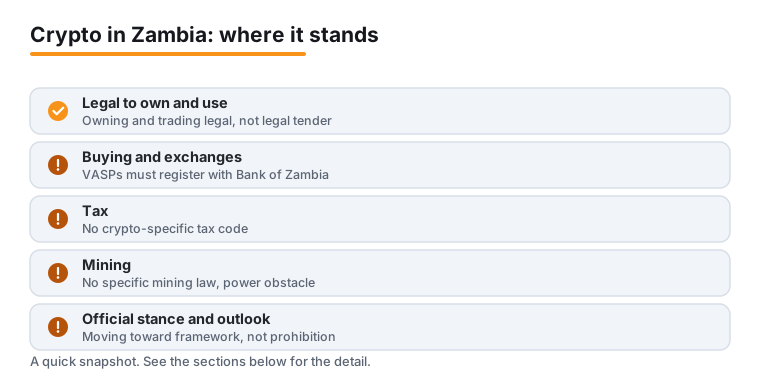
Owning, buying, and selling cryptocurrency is not illegal for individuals in Zambia. No statute criminalises personal possession or peer-to-peer trading of Bitcoin and similar assets. At the same time, crypto is not legal tender. Under the Bank of Zambia Act and the Bank's currency rules, the kwacha and ngwee remain the only currency that must be accepted for domestic obligations, so no merchant is required to accept Bitcoin, and crypto carries none of the legal protections of state-issued money.
This position is long-standing. As far back as its press release of 12 October 2018, the Bank of Zambia stated publicly that cryptocurrencies are not legal tender in Zambia and warned the public about the risks of using them, including fraud, hacking, and money laundering. The 2026 registration directive does not reverse that stance; it builds on it by bringing the businesses that handle crypto into view of the authorities.
The practical takeaway is that crypto in Zambia is permitted but largely unprotected. If you lose access to a wallet, fall victim to a scam, or a platform collapses, there is generally no deposit-insurance scheme or authority that will refund you. That gap is precisely what regulators are now working to close through new rules for the businesses that handle crypto on behalf of the public. This is general information as of 2026 and not legal advice; confirm the current position with the Bank of Zambia before relying on it.
Who regulates crypto in Zambia
Oversight is shared across several public bodies rather than concentrated in one crypto authority:
- Bank of Zambia (BoZ) handles monetary policy, the payment system, and supervision of financial institutions. It is the body that has directed virtual asset service providers to register and that is developing the future framework. Official site: boz.zm.
- Securities and Exchange Commission (SEC) assesses whether a particular token, scheme, or platform amounts to a regulated security or investment product under the Securities Act, and publishes public warnings about unlicensed offerings. Official site: seczambia.org.zm.
- Financial Intelligence Centre (FIC) is Zambia's financial intelligence unit for anti-money-laundering and counter-terrorist-financing (AML/CFT) matters, and applies FATF standards to virtual assets and VASPs. Official site: fic.gov.zm.
- Ministry of Technology and Science has led on innovation policy and, with the BoZ and SEC, on the technology used to test how crypto might be supervised.
- Zambia Revenue Authority (ZRA) administers tax. There is no published crypto-specific tax code, but general tax rules can apply depending on the activity.
Because no single regulator has exclusive authority over the whole sector, the body that matters for a given question depends on what you are doing: payments and provider registration point to the BoZ, securities-like products to the SEC, AML obligations to the FIC, and tax to the ZRA.
Key laws and frameworks
Zambia does not yet have a single, comprehensive cryptocurrency statute. Instead, several instruments combine to govern the space today:
- The Bank of Zambia Act reserves the right to issue legal tender to the central bank and underpins the position that the kwacha is the only domestic currency that must be accepted.
- The Bank of Zambia Currency Directives, 2025 reinforce that the kwacha and ngwee are the sole legal tender for domestic transactions.
- The Securities Act brings any token or scheme that meets the definition of a security within the SEC's remit.
- AML/CFT legislation administered through the Financial Intelligence Centre applies FATF-aligned obligations to virtual asset activity.
- The Bank of Zambia's 2024-2027 Strategic Plan commits to developing a crypto and stablecoin regulatory framework, and a regulatory sandbox has been used with the SEC and the technology ministry to test how such products and rules might work.
The most significant recent instrument is the Bank of Zambia's directive requiring virtual asset service providers to register, described in the next section. The Bank has framed this as an interim measure ahead of a fuller licensing and supervisory framework. Exact scope and obligations can shift, so treat the official BoZ and SEC notices as the controlling source rather than secondary summaries.
Licensing and registration of exchanges and VASPs
In early 2026 the Bank of Zambia directed entities and individuals providing virtual or crypto-asset services to register with the central bank. According to the directive, registration applied to both resident and non-resident providers offering services into Zambia, whether or not they have a physical presence in the country. The reported registration deadline was 27 March 2026, and from around 30 March 2026 BoZ-regulated financial institutions were not to process transactions to or from unregistered providers. The activities covered are broad and include:
- exchanging crypto for kwacha or other fiat, and one crypto asset for another;
- transferring virtual assets on behalf of clients;
- safeguarding, custody, or administration of crypto assets and the keys that control them; and
- providing financial services connected to the issuance or sale of digital assets.
The Bank has been explicit that this registration is preliminary and does not amount to a licence. It is intended to build a database of providers, assess the scale of the sector, and inform a risk-based regulatory framework to be issued after consultation with registered providers. Businesses serving Zambian users should monitor the Bank's notices closely, because today's registration step is expected to be followed by a more demanding licensing regime. Always confirm the live requirements and any deadlines on the official Bank of Zambia website.
Crypto and Bitcoin tax in Zambia
Zambia does not yet have a comprehensive, crypto-specific tax code, and there is no widely published schedule of dedicated crypto tax rates or thresholds. That absence does not mean crypto activity is automatically tax-free. General Zambian tax principles can still apply depending on the facts: profits from a trading business, income earned in crypto, or gains realised on disposals may fall within existing income or business-tax rules administered by the Zambia Revenue Authority (ZRA).
Because the treatment depends heavily on whether you are an occasional holder, an active trader, or a business, and because the framework is evolving alongside the new VASP regime, you should not assume a particular outcome. Keep clear records of acquisition costs, disposals, transfers, and the kwacha value of transactions at the time they occur. Anyone with meaningful activity should obtain advice from a Zambian tax professional or seek guidance directly from the ZRA. We deliberately avoid quoting specific rates or thresholds because they are not reliably established for crypto and could change. For general background, see our explainer on crypto taxes. Nothing in this section is tax advice.
AML, KYC, and the Financial Intelligence Centre
Anti-money-laundering and know-your-customer rules are central to how Zambia is bringing crypto under control. The Financial Intelligence Centre (FIC) is the country's financial intelligence unit and applies the international standards set by the Financial Action Task Force (FATF), which treat virtual asset service providers as obliged entities that must identify customers, monitor transactions, and report suspicious activity.
In practice this means that compliant exchanges and other VASPs serving Zambians are expected to verify user identity, apply transaction monitoring, and cooperate with the FIC and law-enforcement requests. The Bank of Zambia's registration directive reinforces this by requiring providers to come into view of the authorities and, after the deadline, by discouraging regulated banks from dealing with providers that operate outside the framework. For users, the consequence is that legitimate platforms will ask for identity documents and proof of address; a service that allows large, anonymous transfers with no verification is a red flag rather than a convenience. The FIC publishes guidance on virtual assets on its official site, fic.gov.zm.
Buying and using crypto in practice
Most Zambians acquire crypto through international exchanges and peer-to-peer (P2P) marketplaces rather than a large domestic platform. Funding typically uses bank transfers, mobile money, and card payments, with P2P widely used to convert between kwacha and stablecoins or Bitcoin. The new registration requirement is reshaping this landscape: providers dealing with Zambian users are expected to register with the Bank of Zambia, and locally regulated banks may decline to process payments connected to providers that have not done so.
In practice this can mean smoother access through compliant platforms and more friction, or outright blocking, for those outside the framework. Banking access has historically been a pain point, with some institutions cautious about crypto-linked accounts. When choosing where to buy or transact, consider these points:
- favour platforms that are registered with or compliant under the BoZ regime and that apply KYC and AML checks;
- be wary of off-platform deals and "too good to be true" P2P offers, a common vector for fraud;
- understand each platform's fees, withdrawal limits, and dispute handling before depositing funds;
- remember that crypto payments are irreversible, so double-check every wallet address; and
- keep the bulk of long-term holdings in a wallet you control rather than on an exchange.
Crypto is sometimes used for cross-border remittances, where a dollar-pegged stablecoin can settle quickly and reach recipients who rely on mobile money. The trade-offs are price volatility for non-stablecoins, irreversibility, conversion costs back into kwacha, and the need to use providers operating within the BoZ regime.
Bitcoin mining in Zambia
There is no specific Bitcoin-mining law in Zambia, so mining is neither expressly authorised nor banned. The decisive factor for miners is energy. Zambia's electricity supply is dominated by hydropower, and the grid has been under severe strain following one of the worst droughts in decades. Extended load-shedding has been a recurring feature, which is a serious obstacle for an activity that needs cheap, uninterrupted power around the clock.
The outlook is improving but uncertain. The government has pointed to a pipeline of new generation and transmission projects, including expansion of solar capacity, and market reforms have opened the door to more private power producers. For miners, the implications are clear: power cost and reliability make or break profitability, energy-sector and business-licensing requirements may apply, and grid pressure means mining can be politically sensitive when households face outages. Anyone considering a mining operation should engage early with the relevant authorities, plan for reliable or self-generated power, and budget conservatively for downtime and tariff changes.
Regulatory sandbox and testing technology
Before the 2026 registration directive, Zambia spent several years testing how it might supervise crypto rather than moving straight to hard rules. The Bank of Zambia and the Securities and Exchange Commission, working with the Ministry of Technology and Science, ran a programme to trial technology for monitoring and regulating digital-asset activity. Technology and Science Minister Felix Mutati publicly confirmed that the country was testing such technology, with the stated aim of balancing innovation in digital payments against the safety of citizens.
The approach lets the authorities observe how crypto services behave and how supervision might work before a full framework is set. It also helps explain the direction of the 2026 directive: rather than an outright ban, Zambia has moved toward a structured, data-led model in which providers first become visible to regulators and a risk-based framework follows. As with all of this page, treat the regulators' own announcements as the current source, because a sandbox test is not the same as a finished, binding rule.
Recent developments (2025-2026)
The defining development is the Bank of Zambia's early-2026 directive requiring virtual asset service providers to register, with a reported deadline of 27 March 2026 and a follow-on rule that regulated financial institutions should stop processing transactions to or from unregistered providers from around 30 March 2026. The Bank has stressed that registration is a preliminary, data-gathering step rather than a licence, and that a risk-based regulatory framework will follow after consultation with registered providers.
This sits within a longer arc of policy work. The Bank of Zambia's public stance that crypto is not legal tender dates back at least to its press release of 12 October 2018. The Bank's 2024-2027 strategic plan then committed to a crypto and stablecoin framework, and a regulatory sandbox has been run jointly with the SEC and the Ministry of Technology and Science to test products and supervisory tools. The SEC, for its part, has continued to issue public alerts about fraudulent and unlicensed investment schemes, some of them crypto-themed. The overall direction of travel is toward clearer, structured oversight rather than prohibition, but timelines have slipped before, so the dates and details here should be re-checked against the regulators' own announcements.
Consumer risks and protection
The headline risks in Zambia are regulatory uncertainty, weak consumer protection, price volatility, fraud, and operational hazards such as hacking or losing access to wallet keys. Because crypto is not legal tender and there is no deposit-insurance scheme covering it, losses from scams, platform failures, or lost keys are generally not recoverable from any authority. Businesses face the added risk that today's interim registration could become a more demanding licensing regime with new obligations.
The most common consumer harm is fraud. The SEC has repeatedly warned about fake investment groups, unlicensed "advisers," and social-media schemes promising guaranteed or unusually high returns. Protect yourself by using only platforms that follow KYC and AML rules and are registered with or compliant under the Bank of Zambia regime, by never sharing private keys or recovery phrases, by treating guaranteed-return offers as scams, and by checking the SEC's warnings-and-alerts page before sending money to any scheme. Only commit funds you can afford to lose; this guide makes no price predictions and nothing here is financial advice.
Official sources and how to verify
Because the rules are changing quickly, the safest course is always to confirm the current position directly with the official Zambian regulators rather than relying on secondary summaries, including this one. Use these primary sources:
- Bank of Zambia for currency status, the VASP registration directive, and the forthcoming framework: boz.zm.
- Securities and Exchange Commission, Zambia for securities questions and public warnings about scams and unlicensed schemes: seczambia.org.zm.
- Financial Intelligence Centre for AML/CFT obligations and virtual-asset guidance: fic.gov.zm.
- Zambia Revenue Authority for tax questions.
To verify a provider, check whether it appears in or complies with the Bank of Zambia's registration regime and whether the SEC has issued any alert about it. For tax and legal questions specific to your situation, consult a qualified Zambian professional. This article is general information as of 2026 and is NOT legal, tax, or financial advice; the named regulators above are the authoritative source. See also our broader crypto regulation guide.
Frequently asked questions
Is cryptocurrency legal in Zambia?
Yes, in the sense that there is no law banning individuals from owning or trading crypto. However, crypto is not legal tender, the kwacha remains the official currency, and digital assets carry none of the legal protections of money issued by the state. The sector is moving from a grey zone toward formal regulation. This is general information as of 2026, not legal advice; verify with the Bank of Zambia.
Who regulates crypto in Zambia?
Oversight is shared. The Bank of Zambia supervises payments and financial institutions and has directed virtual asset service providers to register with it. The Securities and Exchange Commission addresses whether tokens or schemes are regulated securities and warns the public about unlicensed offerings. The Financial Intelligence Centre handles AML/CFT, and the Zambia Revenue Authority handles tax.
Do crypto exchanges need to register in Zambia?
Yes. In early 2026 the Bank of Zambia directed virtual asset service providers, including non-resident platforms serving Zambians, to register with the central bank, with a reported deadline of 27 March 2026. After the deadline, regulated banks were not to process transactions to or from unregistered providers. Registration is preliminary and is not a licence; a fuller framework is expected to follow. Confirm current requirements at boz.zm.
Do I have to pay tax on crypto in Zambia?
There is no published crypto-specific tax schedule, but that does not make crypto automatically tax-free. Depending on your activity, general income or business rules may apply. We do not quote specific rates because they are not reliably established for crypto. Keep good records and consult a Zambian tax professional or the Zambia Revenue Authority. This is not tax advice.
Can I mine Bitcoin in Zambia?
There is no specific ban on mining, but electricity is the main obstacle. Zambia relies heavily on hydropower and has experienced severe drought-related load-shedding, which makes reliable, low-cost power hard to secure. New generation projects may ease this over time, and energy and licensing requirements can apply, so engage the relevant authorities first.
What is the safest way to buy crypto in Zambia?
Use a reputable platform that applies KYC and AML checks and operates within the Bank of Zambia's registration framework, fund it through a supported method, and move long-term holdings to a wallet you control. Avoid off-platform deals, guaranteed-return schemes, and sharing your private keys, and check the SEC's warnings-and-alerts page before sending money to any scheme.
Has the Bank of Zambia always said crypto is not legal tender?
The stance is long-standing. In a press release dated 12 October 2018, the Bank of Zambia stated that cryptocurrencies are not legal tender in Zambia and warned the public about risks including fraud, hacking, and money laundering. The 2026 registration directive does not change that; it adds supervision of the businesses that provide crypto services. Confirm the latest position at boz.zm.
Did Zambia test technology before regulating crypto?
Yes. The Bank of Zambia and the Securities and Exchange Commission, with the Ministry of Technology and Science, ran a programme to test technology for monitoring and regulating digital-asset activity. The Technology and Science Minister publicly confirmed the testing, with the aim of balancing innovation in digital payments against consumer safety. This testing helped shape the structured, registration-first approach seen in 2026.
Facts reviewed: 30 June 2026. Page updated: 3 August 2026.