Home › Crypto Regulation › Ukraine
Bitcoin & Cryptocurrency Regulation in Ukraine
Quick answer — Ukraine, 2026
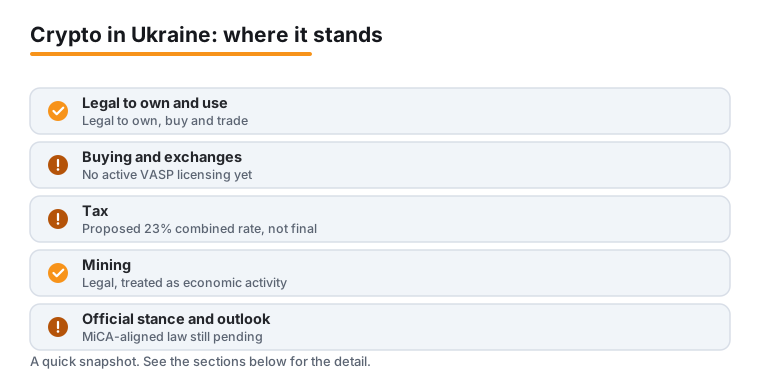
- Legal: Legal to own and trade, not legal tender; dedicated 2022 law passed but not yet in force
- Tax: Crypto to fiat gains taxed as income plus military levy; new 23 percent regime still proposed
- Buying: Via international exchanges, P2P and OTC desks with KYC; no live domestic licensing yet
Ukraine is one of the world's highest-adoption countries for cryptocurrency by grassroots usage, yet it is still in the middle of switching on a full set of crypto-specific rules. Owning, buying, selling, and trading Bitcoin and other digital assets is legal for individuals, but the comprehensive licensing-and-supervision regime that lawmakers passed has not yet entered into force, and a newer reform bill aligning Ukraine with the European Union's Markets in Crypto-Assets (MiCA) regulation is still moving through parliament.
This guide explains the situation as of 2026: the legal status of crypto, who the regulators are, the laws and reform bills in play, what is proposed for taxation and licensing, the anti-money-laundering rules that already apply, and the practical realities of buying and using crypto, mining, and verifying the rules yourself. Ukraine's framework is changing quickly, so treat the details below as a snapshot. This is general information as of 2026 and is NOT legal, tax, or financial advice; always confirm your own position with the named official regulators and a qualified Ukrainian adviser. For broader background see our overview of crypto regulation and our country regulation hub.
On this page: Legal status · Who regulates it · Taxes · How to buy · Mining
Is Bitcoin and crypto legal in Ukraine?
Yes. Owning, buying, selling, and trading Bitcoin and other cryptocurrencies is legal for individuals in Ukraine. There is no prohibition on holding digital assets, and crypto is widely used across the country by savers, freelancers paid in stablecoins, and businesses.
The key nuance is that "legal" does not yet mean "fully regulated." Crypto is not legal tender: the hryvnia (UAH) remains the only official currency, and the National Bank of Ukraine has stated that virtual assets cannot be used as a means of payment. Ukraine passed a dedicated statute, the Law "On Virtual Assets" (No. 2074-IX), back in 2022, but that law has not yet entered into force because its activation was tied to amendments to the Tax Code that have not been finalized. As a result, the dedicated rulebook governing licensed exchanges, custodians, and consumer protections is still pending rather than fully operational.
Who regulates crypto in Ukraine?
Under the planned framework, oversight is split between two bodies, with one ministry driving policy:
- National Securities and Stock Market Commission (NSSMC) is set to be the principal regulator for most virtual assets, responsible for licensing service providers and supervising the market. Its official site is nssmc.gov.ua.
- National Bank of Ukraine (NBU) is expected to oversee assets tied to currency values, such as electronic-money tokens (certain fiat-referencing stablecoins), and to handle related monetary and foreign-exchange questions. Its official site is bank.gov.ua.
- The Ministry of Digital Transformation (Mintsyfra) has been a leading driver of crypto policy and the wider digital-economy agenda, with the Cabinet of Ministers approving plans for crypto legalisation across 2025 to 2026.
Until the reform bill is finally adopted and the main law enters into force, the NSSMC is not yet issuing crypto-specific licences. Treat the regulator roles above as the intended structure that is still being switched on.
Key laws and frameworks
Two pieces of legislation define the picture:
- Law "On Virtual Assets" (No. 2074-IX), 2022. Signed by the President in 2022, this law defines virtual assets and sets up a licensing system, but it was written to take effect only once accompanying Tax Code amendments are passed. Because those amendments have not been finalized, the law's main provisions have not yet been switched on.
- Draft Law No. 10225-d, 2025. Introduced on 24 April 2025, this reform bill revises the earlier approach and aligns it more closely with the EU's MiCA regulation. The Verkhovna Rada (parliament) adopted it in the first reading on 3 September 2025 with 246 votes. It covers definitions of virtual assets, taxation of crypto income, and supervision of the market.
The draft splits virtual assets into categories influenced by MiCA, including asset-referenced tokens, electronic-money tokens (stablecoins), and other virtual assets. As of 3 August 2026 the bill has passed only the first reading, taken on 3 September 2025, and the parliamentary register still records its status as preparing for second reading with no second reading entry; the second reading and final adoption were delayed, so much of the detailed regime remains pending. The official parliamentary record is published by the Verkhovna Rada of Ukraine.
Licensing and registration of exchanges (VASPs)
Ukraine does not yet operate a fully active, bespoke licensing or registration regime for virtual-asset service providers (VASPs). Because Law No. 2074-IX is not in force, the NSSMC is not currently issuing crypto-specific licences, and there is no large pool of formally licensed Ukrainian crypto exchanges in the way you would find under a finished MiCA-style system. Many users therefore rely on well-known global platforms.
Under the planned framework, providers will need to obtain authorisation from the NSSMC (and, for currency-referencing tokens, engage with the NBU), maintain minimum authorised capital, and implement know-your-customer (KYC) and anti-money-laundering (AML) controls. Officials have indicated that a legal domestic market, where Ukrainians can buy and sell crypto through licensed Ukrainian companies, declare income, and pay tax, is expected to come online in the 2026 to 2027 window once the bill is enacted and the main law takes effect. Until then, treat any claim of a Ukrainian crypto "licence" with caution and verify it against the NSSMC site.
Crypto and Bitcoin taxation in Ukraine
Tax is the area most in flux, so be cautious with any specific figure you see online. Historically, gains from converting crypto to fiat have generally been treated as taxable personal income under existing rules, which also carry a separate military levy, and there has been no routine obligation for ordinary individuals to declare holdings.
Draft Law No. 10225-d proposes a clearer, crypto-specific regime. As publicly presented, the main proposal is to tax net gains at the point crypto is converted to fiat (or used to pay for goods and services) at an 18 percent personal income tax plus a 5 percent military levy, a 23 percent combined rate, while crypto-to-crypto exchanges would generally not be taxed. A transitional option has been discussed allowing a preferential 5 percent rate (plus the 5 percent levy) on assets acquired before the law takes effect if they are sold within a limited window. Mining, staking, airdrops, and hard forks have been discussed as taxable when proceeds are realised.
To flesh out the approach, the NSSMC published a proposed "tax matrix" in April 2025. It set out flexible options rather than a single fixed rule: tokens from mining, staking, airdrops, and hard forks could be treated as ordinary income or taxed only when sold; certain foreign-currency-referencing stablecoins could be exempt or taxed at a reduced rate such as 5 or 9 percent; and gifts, donations, and transfers between a person's own wallets would not be taxed. The matrix also floated tax-free thresholds to ease the burden on small holders. The matrix is a policy proposal from the regulator, not enacted law, so the final treatment depends on the adopted bill.
These figures come from the draft bill and may change before final adoption; the precise rates, thresholds, and effective dates depend on the enacted text, so do not treat them as settled law. Practical guidance:
- Keep detailed records of every purchase, sale, and conversion, including dates, amounts, counterparties, and the UAH value at the time.
- Do not assume crypto-to-crypto trades, mining, staking, and fiat conversions are all treated the same.
- Confirm the current rules with the State Tax Service of Ukraine and a qualified Ukrainian tax adviser before filing. See also our general guide to crypto taxes. This section is informational only and not tax advice.
AML and KYC rules
Anti-money-laundering rules already apply in Ukraine even though the dedicated virtual-assets licensing regime is not yet live. The Law "On Preventing and Countering Legalisation (Laundering) of the Proceeds of Crime" (No. 361-IX), adopted in December 2019 and in force from 28 April 2020, names providers of virtual-asset services as reporting (obliged) entities, in line with the EU's 5th AML Directive and FATF Recommendation 15.
In practice this means VASPs are expected to run AML programmes, perform customer due diligence (KYC), monitor transactions, retain records, appoint compliance officers, and report suspicious activity. Reputable exchanges serving Ukrainian users therefore require identity verification. Independent commentary notes that gaps remain in fully operationalising the FATF travel rule and in coordinating supervision, which the new framework is intended to address. Larger or cross-border transfers are the most likely to trigger enhanced checks.
Buying and using crypto in practice
Ukrainians typically buy crypto through international exchanges, peer-to-peer (P2P) marketplaces, and over-the-counter desks. A few practical realities apply today:
- KYC is standard. Reputable platforms require identity verification, and Ukrainian AML rules push providers toward customer due diligence and transaction monitoring.
- Banking and currency controls matter. Wartime and foreign-exchange measures have at times affected card payments, cross-border transfers, and the movement of funds in and out of platforms. Limits can change, so check your bank's and the platform's current terms.
- Stablecoins are popular. Hryvnia volatility and the convenience of dollar-pegged tokens make stablecoins a common on-ramp, store of value, and remittance tool, which is significant given Ukraine's large diaspora and population displacement.
- Bitcoin ATMs exist in larger cities such as Kyiv, operating under general business and AML obligations rather than a crypto-specific kiosk rulebook; fees are usually higher than online exchanges.
A typical buying flow is: choose a reputable platform, complete KYC verification, fund the account (bank transfer, card, or P2P, subject to current banking and FX conditions), place your order, secure holdings with two-factor authentication and ideally a hardware wallet for larger amounts, and keep records for future tax reporting. Always confirm a platform is legitimate and currently available to Ukrainian residents before depositing funds.
Bitcoin and crypto mining in Ukraine
Mining is legal in Ukraine and has historically been attractive thanks to a skilled technical workforce and periods of relatively low electricity costs. Mining is generally treated as an economic activity, so miners are expected to operate as registered businesses and to account for income and energy use under the normal rules.
The war has reshaped the picture significantly. Damage to power infrastructure, electricity shortages, and emergency measures have made grid stability and energy availability the dominant concerns for any large-scale operation. Draft law 10225-d, as passed in first reading, provides that tokens received from mining are not taxed when created and are taxed only when sold or exchanged for fiat and whether specific registration or reporting applies. Anyone considering mining should factor in real current electricity costs and outage risk, business registration and tax accounting, and equipment import, cooling, and power-backup needs. Treat older claims about cheap, abundant energy with caution, because conditions on the ground change frequently.
Recent developments (2025 to 2026)
The most important recent steps are legislative and policy-driven:
- April 2025: Draft Law No. 10225-d on regulating the virtual-asset market and amending the Tax Code was introduced, designed to align Ukraine with EU MiCA standards.
- August 2025: NBU leadership publicly reaffirmed that the legislative framework should follow the European MiCA regulation and related EU rules, while reiterating that crypto should not be legal tender.
- April 2025: The NSSMC published its proposed crypto "tax matrix", outlining how mining, staking, airdrops, stablecoins, and small-holder thresholds could be taxed.
- June 2025: A separate draft law was submitted to the Verkhovna Rada proposing to let the National Bank of Ukraine hold virtual assets, such as Bitcoin, as part of its reserves. The bill is framed as granting an option, not an obligation, and the decision would rest with the NBU.
- September 2025: Parliament adopted bill No. 10225-d in the first reading (246 of 450 lawmakers in favour).
- Into 2026: The second reading and final adoption were delayed, so As of 3 August 2026 the comprehensive regime is still proposed rather than in force. Parliament had aimed to adopt draft law 10225-d in August 2026, but on 31 July 2026 co-author MP Olha Vasylevska-Smahliuk said the second reading had been postponed to autumn, with no date set, because the National Bank and the securities regulator have not agreed how supervisory powers are divided. The Cabinet of Ministers and Ministry of Digital Transformation have continued to list crypto legalisation among their 2025 to 2026 priorities.
The direction of travel is clearly toward a MiCA-aligned system with licensed providers and defined tax treatment, but timelines have repeatedly slipped, so confirm the latest status against official sources before acting.
Consumer risks and protection
The defining feature of Ukraine's crypto landscape is transition, which creates both opportunity and uncertainty. Key risks to keep in mind:
- Limited domestic protections. Because the dedicated licensing-and-supervision regime is not yet live, consumer protections are less developed than in fully regulated markets, and recourse if a platform fails may be limited.
- Regulatory and tax change. Rules on licensing, taxation, and reporting may shift as the reform bill is finalised and enters into force; do not rely on unverified tax rates.
- War-related disruption. Power supply, banking access, and currency controls can all affect access, mining, and transfers.
- Market and security risk. Volatility, scams, fraudulent "licensed" platforms, and operational failures remain ever-present in crypto everywhere.
Practical protection steps: use established, reputable platforms; enable strong security and two-factor authentication; keep money in self-custody for long-term holdings; retain records for future tax obligations; and be sceptical of any offer promising guaranteed returns or claiming a Ukrainian licence that you cannot verify on the regulator's site.
Official sources and how to verify
Because Ukraine's rules are evolving, always check the primary sources rather than relying on secondary summaries. The most authoritative official channels are:
- National Securities and Stock Market Commission (NSSMC), the intended principal regulator for virtual assets, which publishes its plans for licensing and taxation.
- National Bank of Ukraine (NBU), for monetary policy, currency controls, and currency-referencing tokens.
- Verkhovna Rada of Ukraine, the parliament, for the official status and text of bills such as No. 10225-d.
- Cabinet of Ministers of Ukraine, for government policy and Ministry of Digital Transformation plans, and the State Tax Service for tax filing rules.
To verify a claim: check whether the law in question is actually in force (not merely passed in a single reading), confirm any tax figure against the enacted Tax Code, and confirm any provider's authorisation against the NSSMC. This article is general information as of 2026 and is NOT legal or tax advice; verify your specific situation with the named official regulators and a qualified Ukrainian adviser. For more background, see our crypto regulation guide.
What is changing: status as of August 2026
The direction of travel has changed since this page was last reviewed, and not in the way the government intended. On 18 July 2026 Danylo Hetmantsev, chair of the parliamentary Committee on Finance, Tax and Customs Policy, said parliament planned to adopt the virtual assets bill in August 2026. On 31 July 2026 Olha Vasylevska-Smahliuk, one of the bill's co-authors, said the second reading had been pushed back to autumn, that the August discussion was cancelled, and that the working group's next meeting was postponed for an indefinite period.
She named two concrete blockers. The National Bank of Ukraine and the National Securities and Stock Market Commission have not agreed how supervisory functions are divided between them, and a bloc of deputies who hold crypto assets themselves have little incentive to vote for a regime that taxes them. She also warned that further delay puts at risk a commitment Ukraine made to international partners to adopt the law by the end of the year.
Ukraine's own parliamentary register confirms the standstill rather than contradicting it. The card for draft law 10225-d still shows its last recorded action as 3 September 2025, adopted as a basis, with the status "preparing for second reading" and no second reading entry as of 3 August 2026. More than 2,500 amendments were tabled after the first reading, which is a large part of why the text has taken so long.
The regulator is further ahead than parliament. The NSSMC has set up a dedicated virtual assets unit and is preparing to take on the role of principal crypto market regulator. On 31 July 2026 its chairman Oleksii Semeniuk said preparation of the bill is practically complete and in final interagency coordination and review for compliance with EU standards, with the division of powers between the NSSMC and the National Bank, the classification of virtual assets and the key requirements for participants already agreed. On 3 August 2026 he said the Commission has around 18 pieces of secondary legislation in preparation to follow adoption, and that existing operators would get a reasonable transition period.
Realistic timing has slipped by at least a year against what was drafted. The Tax Code changes in the bill were written to take effect on 1 January 2026. Minfin reported on 15 June 2026, after Semeniuk spoke at the Incrypted Conference, that the new crypto market law may only start operating in 2027. That 2027 date is the outlet's assessment: no official is quoted committing to it, and readers should treat it as a forecast rather than a announced schedule.
The legislative pipeline and when each piece moves
Four separate measures are in play. Only one of them is close to becoming law, and none is in force.
| Measure | Stage as of 3 August 2026 | What it would mean | Timing |
|---|---|---|---|
| Law "On Virtual Assets" No. 2074-IX (2022) | Adopted, not in force | Ownership rules and a VASP authorisation framework; confirms crypto is not a means of payment | Commences only when the Tax Code amendments in 10225-d pass. The state register still marks it not entered into force |
| Draft Law No. 10225-d | Passed first reading 3 September 2025; awaiting second reading | The full MiCA-style regime plus the tax rules; exchange licensing; NBU over e-money tokens, NSSMC over the rest | Second reading postponed to autumn 2026; Minfin reports the regime may not operate before 2027 |
| Draft Law No. 13356 (crypto in NBU reserves) | Stalled | Would have let, not required, the National Bank hold crypto in reserves | No timetable. Hetmantsev said parliament will not consider it, citing NBU opposition on volatility grounds |
| DORA analogue and DLT securities bill | Announced only | Operational resilience rules for financial firms; trading of securities issued on distributed ledger technology | NSSMC said in February 2026 it aimed to submit the DORA bill in summer and the DLT bill by year end. Neither is confirmed registered |
Two things determine when the pipeline unblocks. The first is the NBU and NSSMC settling who supervises what. The second is finding the votes: more than 2,500 amendments were tabled to 10225-d after the first reading, and the sponsors say the arithmetic in the chamber is difficult.
The EU accession track sits behind all of it, but it is moving slowly and not yet on the part that matters here. Ukraine opened its first negotiating cluster, Fundamentals, on 15 June 2026, and a second, External Relations, on 14 July 2026. The internal market cluster, which is where financial services alignment sits, is not among the two opened. MiCA alignment is therefore something Ukraine has taken on through 10225-d rather than an obligation under a cluster currently being negotiated.
What actually applies to you today
There is no crypto-specific law in force. That is the honest answer, and it does not mean nothing applies. Four sets of rules are live right now.
- Tax. The State Tax Service set out its position in individual tax consultation No. 4217/ІПК/99-00-24-03-03 of 5 August 2025: because virtual assets have no special legal status, the general Tax Code applies, so income from selling crypto goes into an individual's total annual taxable income at 18 percent personal income tax plus the 5 percent military levy, a combined 23 percent. You declare through the annual return by 1 May and pay by 1 August under Article 179.7 of the Tax Code. Keep purchase dates, prices and fees, because without them you cannot evidence a cost base.
- Payments. You cannot pay for goods or services in crypto in Ukraine, and a sole trader cannot lawfully accept it. The hryvnia is the only legal tender under the Constitution and the Law "On Currency and Currency Operations", and the pending Law on Virtual Assets restates that virtual assets are not a means of payment. Draft law 10225-d keeps that prohibition.
- Buying. Under the martial law currency regime, crypto purchases are in practice treated as quasi-cash operations. That blocks hryvnia card payments to exchanges and restricts cross-border person-to-person card transfers, with practitioners describing a monthly ceiling of about 100,000 hryvnia through official channels. Buying is lawful; funding a foreign exchange directly from a Ukrainian card is not practically available, which is why domestic peer-to-peer remains the common route.
- Licensing. There is none. Because Law 2074-IX has not commenced, no VASP licensing regime exists and no exchange can obtain a Ukrainian crypto licence today. Virtual assets are treated as "digital things" under Article 179-1 of the Civil Code, which gives property protection but no financial-services supervision.
Mining sits in the same gap: lawful, but with no dedicated regime. Under 10225-d, tokens received from mining would not be taxed when created, only when sold or exchanged for fiat.
Frequently asked questions
Is cryptocurrency legal in Ukraine?
Yes. Buying, holding, and trading crypto is legal for individuals, and Ukraine has very high grassroots adoption. However, crypto is not legal tender, and the comprehensive licensing-and-supervision framework is still being finalised. The 2022 Law "On Virtual Assets" (No. 2074-IX) has not yet entered into force because it was tied to pending Tax Code amendments.
Who regulates crypto in Ukraine?
The National Securities and Stock Market Commission (NSSMC) is set to be the principal regulator for most virtual assets, including licensing service providers, with the National Bank of Ukraine (NBU) overseeing currency-referencing tokens such as certain stablecoins. The Ministry of Digital Transformation has driven crypto policy. You can check the NSSMC at nssmc.gov.ua and the NBU at bank.gov.ua. AML rules already apply to service providers under Law No. 361-IX.
How is crypto taxed in Ukraine?
Historically, crypto-to-fiat gains have been treated as taxable personal income plus a military levy. Draft Law No. 10225-d proposes a crypto-specific regime taxing net gains on conversion to fiat at 18 percent personal income tax plus a 5 percent military levy (23 percent combined), with crypto-to-crypto swaps generally untaxed and a possible transitional 5 percent rate. These figures are from the draft bill and are not final, so confirm with the State Tax Service of Ukraine and a qualified adviser. This is not tax advice.
Can a crypto exchange get a licence in Ukraine right now?
Not yet under a fully active regime. Because Law No. 2074-IX is not in force, the NSSMC is not currently issuing crypto-specific licences, so there is no live, bespoke VASP licensing system. A legal domestic market with licensed Ukrainian providers is expected once the reform bill (No. 10225-d) is enacted, with committee chair Danylo Hetmantsev saying on 18 July 2026 that parliament must adopt the bill in August 2026, and co-author MP Olha Vasylevska-Smahliuk saying on 31 July 2026 that the second reading had slipped to autumn with no date fixed. Verify any claimed licence against the NSSMC.
Is Bitcoin mining allowed in Ukraine?
Yes, mining is legal and treated as an economic activity, so miners are expected to register as a business and account for income and energy use. War-related power shortages and infrastructure damage now have a major impact on viability, and future legislation may clarify mining-specific tax and registration rules.
What happened with Ukraine's crypto law in 2025 and 2026?
Parliament adopted reform bill No. 10225-d in the first reading on 3 September 2025 (246 votes), aligning Ukraine with the EU's MiCA regulation. The second reading and final adoption were delayed, so as of early-to-mid 2026 the comprehensive regime remains proposed rather than fully in force. Check the Verkhovna Rada at rada.gov.ua and the NSSMC for the current status before relying on any provision.
Is Ukraine setting up a national Bitcoin reserve?
A draft law submitted to the Verkhovna Rada in June 2025 proposes to let the National Bank of Ukraine hold virtual assets, including Bitcoin, as part of its reserves. It is written as a permission rather than a requirement, so any decision would rest with the NBU, and it had not been enacted as of 3 August 2026, and on 14 August 2025 finance committee chair Danylo Hetmantsev said parliament would not consider it at all. Separately, Ukrainian state bodies have at times held crypto received through wartime donations. Treat reserve plans as proposed, not settled, and verify the current status on official sources.
How are stablecoins and mining income likely to be taxed in Ukraine?
Under the NSSMC's proposed tax matrix from April 2025, certain foreign-currency-referencing stablecoins could be exempt or taxed at a reduced rate such as 5 or 9 percent, and tokens from mining, staking, airdrops, or hard forks could be taxed either as ordinary income or only when sold for fiat. These are policy proposals, not enacted rules, so the final treatment depends on the adopted bill. Confirm with the State Tax Service of Ukraine and a qualified adviser. This is not tax advice.
Has Ukraine passed its crypto law yet, as of August 2026?
No. Draft law 10225-d passed its first reading on 3 September 2025 and has been stuck ever since. Parliament aimed to adopt it in August 2026, but on 31 July 2026 co-author MP Olha Vasylevska-Smahliuk said the second reading was postponed to autumn 2026, with no date fixed. The parliamentary register still shows the bill's last recorded action as 3 September 2025.
Why has the crypto law been delayed again?
Two reasons were named publicly on 31 July 2026. First, the National Bank of Ukraine and the National Securities and Stock Market Commission have not agreed how supervisory functions are split between them, and the working group's next meeting was postponed indefinitely. Second, a number of deputies hold crypto assets themselves and have little incentive to vote for a regime that taxes them, which makes finding the votes difficult. More than 2,500 amendments were also tabled after the first reading.
When will crypto exchanges actually be able to get a Ukrainian licence?
Not before the law passes, and the second reading has been postponed to autumn 2026 with no date set. Minfin reported on 15 June 2026 that the regime may not start operating until 2027, though no official has publicly committed to that date. NSSMC chairman Oleksii Semeniuk said on 3 August 2026 that the Commission has around 18 pieces of secondary legislation in preparation to follow adoption, with a reasonable transition period for firms already operating. Until then no Ukrainian crypto licence exists to apply for.
How is crypto taxed in Ukraine right now, before the new law?
Under the State Tax Service's individual tax consultation No. 4217/IPK/99-00-24-03-03 of 5 August 2025, because virtual assets have no special legal status the general Tax Code applies. Income from selling crypto is included in your total annual taxable income and taxed at 18 percent personal income tax plus the 5 percent military levy, a combined 23 percent. You declare through the annual return by 1 May and pay by 1 August of the following year.
Can I buy crypto with a Ukrainian hryvnia bank card?
Not directly to a foreign exchange. Under the martial law currency regime crypto purchases are in practice treated as quasi-cash operations, which blocks hryvnia card payments to exchanges and restricts cross-border person-to-person card transfers, with practitioners describing a monthly ceiling of about 100,000 hryvnia through official channels. Buying crypto is lawful; the constraint is on the payment rail, which is why domestic peer-to-peer remains the common route.
Is Ukraine going to put Bitcoin in its national reserves?
No, and there is no live legislative route to it. Draft law 13356, registered on 10 June 2025, would have permitted the National Bank to hold virtual assets in Ukraine's gold and foreign exchange reserves. On 14 August 2025 finance committee chair Danylo Hetmantsev said parliament would not consider it, citing a discussion with the National Bank governor and the volatility of crypto assets, and said there were no hints it would be adopted.
Can a Ukrainian business accept payment in cryptocurrency?
No. The hryvnia is the only legal tender under the Constitution and the Law On Currency and Currency Operations, and the Law On Virtual Assets, once it commences, states that virtual assets are not a means of payment. Draft law 10225-d keeps that prohibition, so legalisation will allow buying and selling crypto, not paying with it.
If the law passes, will there be a lower tax rate for crypto I already own?
That is what the bill proposes, but it is not law yet. Under the first-reading text, virtual assets acquired before the law takes effect and sold in the first year would attract a preferential 5 percent personal income tax rate instead of 18 percent. The 5 percent military levy still applies on top, so the effective one-off cost is 10 percent. The bill also exempts crypto-to-crypto swaps and annual disposals up to one minimum monthly wage. With more than 2,500 amendments filed, these parameters can still change.
Facts reviewed: 5 August 2026. Page updated: 5 August 2026.