Home › Crypto Regulation › Suriname
Bitcoin & Cryptocurrency Regulation in Suriname
Quick answer — Suriname, 2026
- Legal: Not banned but not regulated, not legal tender; VASP framework in development
- Tax: No dedicated crypto tax; general tax may apply, no stated rate
- Buying: No licensed local exchanges, use international and P2P platforms
Suriname, a small republic on the northeastern shoulder of South America, has no dedicated cryptocurrency statute and no law that recognises Bitcoin or other digital assets as money. Crypto sits in a legal grey zone: it is neither explicitly authorised nor banned, and the country has not yet built the licensing, consumer-protection or tax machinery seen in larger jurisdictions. The monetary authority, the Centrale Bank van Suriname (CBvS), has publicly stated it is preparing rules for payment service providers and for virtual asset service providers (VASPs) and has begun a sectoral risk analysis as the starting point for that framework, but as of August 2026 the licensing rules are a bill in parliamentary committee rather than law, even though the AML duties in the WMTF already bind virtual asset service providers and are already supervised by the CBvS.
This guide explains the practical and legal landscape for Bitcoin and crypto in Suriname as of 2026, covering legal status, the regulator, the laws that already touch crypto, the planned VASP regime, taxation, AML and KYC, buying and using crypto in practice, mining, recent developments, consumer risks, and how to verify everything against official sources. This article is general information as of 2026, not legal, tax or financial advice; always confirm the current position with the Centrale Bank van Suriname and a qualified Suriname professional before acting. For broader context see our crypto regulation guide.
On this page: Legal status · Who regulates it · Taxes · How to buy · Mining
Is Bitcoin and crypto legal in Suriname?
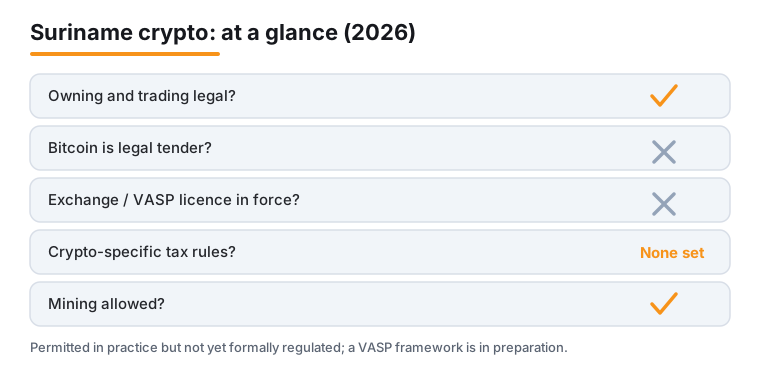
Holding and trading Bitcoin and other cryptocurrencies is not illegal in Suriname. No statute criminalises owning, buying or selling digital assets, and there is no general prohibition on residents using crypto. At the same time, no law positively recognises crypto as money, as a financial instrument, or as a regulated product. The position is best described as permitted in practice but not yet formally regulated.
Key points to keep in mind:
- Not legal tender. The Surinamese dollar (SRD) is the only legal tender. Bitcoin and stablecoins are not official currency, and no merchant is obliged to accept them. Despite political proposals during the 2025 election campaign, Suriname has not adopted Bitcoin as legal tender.
- Not yet specifically regulated. There is no in-force licensing regime for crypto exchanges or custodians. This also means crypto activity sits largely outside formal consumer-protection rules, so local recourse is limited if a platform fails or funds are stolen.
- Permitted in practice. Surinamese users access global platforms and peer-to-peer markets, and interest appears small but growing.
This is a de facto permissive but legally unprotected environment, and it is evolving: the central bank has confirmed it is developing a VASP framework, so the current openness should be treated as provisional rather than guaranteed.
Who regulates crypto in Suriname?
The relevant authority is the Centrale Bank van Suriname (CBvS), the country's monetary authority and the supervisor of the banking and credit system, foreign-exchange houses, money-transfer companies, insurers and pension funds. Its statutory objective is to promote the value and stability of the Surinamese currency. The CBvS is the body that has announced it is preparing legislation and regulation for payment service providers and for virtual asset service providers.
Two further bodies matter for crypto-adjacent financial-crime supervision:
- FIU Suriname (the Financial Intelligence Unit, historically the Meldpunt Ongebruikelijke Transacties or MOT), which receives and analyses reports of unusual transactions. FIU Suriname joined the Egmont Group of financial intelligence units in 2024, with the accession memorandum signed on 5 June 2024, which supports faster cross-border information exchange in money-laundering cases.
- The national AML coordination structure, working with the Caribbean Financial Action Task Force (CFATF), of which Suriname has been a member since 1998.
There is no separate, dedicated crypto regulator. Oversight of any future VASP regime is expected to sit with the CBvS, consistent with its existing supervisory mandate. You can confirm the regulator and its current statements directly at cbvs.sr.
Key laws and frameworks that touch crypto
As of 2026 Suriname has no comprehensive virtual-asset law. However, several existing legal frameworks can reach crypto activity, and an international standard is shaping where the country is heading:
- Money laundering and terrorist financing prevention. The principal AML/CFT statute is the Act on the prevention and combating of money laundering and terrorist financing (Wet ter voorkoming en bestrijding van Money Laundering en Terrorismefinanciering, WMTF), published as S.B. 2022 no. 138 and amended in 2024 (S.B. 2024 no. 99). This is the framework into which crypto-related obligations are expected to be brought.
- Unusual-transaction reporting. The reporting regime administered through FIU Suriname (originating with the MOT / Wet Melding Ongebruikelijke Transacties) requires designated service providers to report unusual transactions.
- FATF / CFATF standards. As a CFATF member, Suriname is expected to implement the FATF standards, including Recommendation 15 on virtual assets and VASPs. A CFATF mutual evaluation flagged VASPs as a sector whose money-laundering and terrorist-financing risks needed to be assessed, which is part of why the CBvS launched its VASP risk analysis.
- Foreign-exchange controls. Suriname has a history of exchange-control measures, which can intersect with crypto used to move value across borders.
Because no single rulebook yet governs crypto specifically, the practical position can change with central-bank circulars and new legislation. Where the law is still being written, the safest course is to rely on the CBvS's own statements rather than third-party summaries.
Licensing and registration of exchanges and VASPs
As of 2026 there is no in-force Suriname licensing or registration regime for crypto exchanges, custodians, wallet providers or other virtual asset service providers. No domestic exchange operates under a Suriname-specific authorisation, because that authorisation does not yet exist.
What the CBvS has stated publicly is that it is building one. According to the central bank, it is in an advanced stage of preparing legislation and regulation for payment service providers, and it has carried out a sectoral risk analysis of the VASP sector, recorded by CFATF as a Sectoral Risk Assessment on virtual assets and VASPs introduced in February 2024. It followed that on 13 October 2025 with a public call for virtual asset service providers to register with its Directorate of Supervision by Monday 17 November 2025, citing article 10 of the Centrale Bankwet 2022 and article 38 of the WMTF. The CBvS frames a VASP as a provider offering services such as exchanging virtual assets for fiat currency and storing, managing or transferring virtual assets in wallets, mirroring the FATF definition.
The direction is now set out in a named bill. The Draft Act containing rules on the supervision of Virtual Asset Service Providers 2026 would make the Centrale Bank van Suriname the statutory supervisor of VASPs, and the CBvS told the parliamentary committee on 22 July 2026 that the proposed definition of a virtual asset service provider applies to all providers serving Surinamese interests, regardless of where they are registered or established. The bill is in committee, not passed. Suriname's next CFATF enhanced follow-up report is due in November 2026, which is the practical deadline the timetable is working to. Until that regime is enacted and in force, businesses should not assume crypto operations are either freely permitted or already authorised, and should obtain current legal advice. Confirm the latest status on the CBvS page describing its payment-services and VASP work: CBvS activities on payment service providers and VASPs.
Crypto and Bitcoin tax in Suriname
Suriname has no crypto-specific tax code and the Belastingdienst publishes no crypto guidance, so the default is the Wet Inkomstenbelasting 1922, a self-assessment income tax under which article 34(1) taxes individuals at nil on the first SRD 108,000 of net income and then at 8, 18, 28 and 38 percent on successive bands, while article 36(1) taxes legal entities at 36 percent. That absence does not mean crypto income is automatically tax-free: general tax principles covering income, business profits and other gains can in principle apply, depending on how an activity is characterised and on the interpretation of the tax authorities.
Situations that may carry tax implications include:
- Selling or trading crypto at a profit.
- Receiving crypto as payment for goods, services or salary.
- Earning crypto through mining, staking or other rewards.
- Operating a crypto-related business.
Because the rules are not crypto-specific and remain unsettled, this guide deliberately states no tax rate, allowance or filing threshold for Suriname. Treatment can hinge on residency and the nature of the activity. Keep clear records of every transaction (dates, amounts, counterparties and the SRD value at the time) and consult a Suriname-qualified tax adviser or the tax authority before filing. For general background see our crypto taxes guide. This section is informational only and is not tax advice.
AML and KYC rules
Anti-money-laundering (AML) and counter-terrorist-financing (CFT) duties in Suriname flow from the WMTF (S.B. 2022 no. 138, amended 2024) and the unusual-transaction reporting regime administered through FIU Suriname. These rules require designated service providers to identify customers, conduct due diligence, keep records, and report unusual or suspicious transactions.
The current AML framework was written primarily around traditional financial institutions and designated non-financial businesses and professions. Bringing virtual asset service providers formally within scope, with full registration and travel-rule style obligations, is part of what the CBvS's VASP work and Suriname's FATF/CFATF commitments are expected to deliver. Until that is enacted, the practical effects on crypto users are indirect but real:
- Banks and money-transfer businesses apply their own AML/KYC checks, which can affect deposits, withdrawals and transfers connected to crypto.
- Global exchanges that accept Surinamese customers run their own KYC (identity verification) regardless of local rules.
- Large or unusual flows can attract scrutiny and reporting through the existing FIU channel.
In short, even before a dedicated VASP regime exists, AML/KYC expectations already touch crypto through the banking system and through the platforms users rely on. Expect these obligations to tighten as the VASP framework is finalised.
Buying and using crypto in practice
With no licensed domestic exchange operating under a Suriname-specific regime, users typically rely on international platforms and peer-to-peer methods. A typical path is to choose a reputable global exchange or a peer-to-peer marketplace that accepts Surinamese customers, complete identity verification (KYC), fund the account with a supported method, place an order, and then move larger holdings to a wallet you control.
Practical cautions specific to Suriname:
- Confirm a platform actually serves Suriname and supports a funding method you can use; availability changes frequently.
- Be mindful of foreign-exchange rules when converting between SRD and foreign currency or crypto.
- Favour established platforms with strong security and two-factor authentication, and assume limited local legal recourse if something goes wrong, because exchanges are not domestically regulated.
- Treat off-market deals from social-media "brokers" or unofficial dealers as high fraud risk, and start with a small test transaction on any new platform or counterparty.
- Keep a record of each purchase (date, amount and SRD value) in case it becomes relevant for tax.
Crypto is sometimes used informally for cross-border value transfer and as a perceived hedge against currency volatility, but because it is not legal tender, no merchant must accept it and conversion back to SRD can be slower or costlier than in jurisdictions with licensed exchanges.
Bitcoin mining in Suriname
There is no crypto-specific mining law in Suriname and no dedicated permitting regime for mining operations. Mining is therefore not prohibited, but it is governed only by general rules, principally those covering electricity supply, business registration, import of equipment and environmental impact.
The factors that matter most are practical and energy-related:
- Electricity cost and reliability. Mining economics depend on power prices and uptime; tariffs, availability and any restrictions on heavy industrial use are decisive.
- Renewable potential. Suriname has significant hydropower and solar potential, which is why renewable-powered mining is sometimes raised as a policy idea.
- Environmental and community considerations. Heat, noise and land use can trigger general environmental and planning rules.
- Import and customs. Mining hardware must be imported, with associated duties and logistics.
Because mining is not separately regulated, the risk is less a specific ban and more the absence of clear rules: a future framework could introduce licensing, energy conditions or environmental obligations. Anyone planning a sizeable operation should confirm electricity terms with the utility and seek legal advice before committing capital.
Recent developments (2024 to 2026)
Several developments shape the current picture:
- VASP framework in preparation. The CBvS has publicly confirmed it is preparing rules for payment service providers and has begun a sectoral risk analysis for the VASP sector, signalling that a crypto framework is coming but is not yet in force.
- AML law amended. The WMTF (S.B. 2022 no. 138) was amended in 2024 (S.B. 2024 no. 99) to better align Suriname with FATF recommendations, and FIU Suriname joined the Egmont Group in 2024, strengthening international cooperation.
- Bitcoin in the 2025 election. A presidential candidate, Maya Parbhoe of the National Party of Suriname, campaigned on making Bitcoin legal tender. That platform did not prevail: she won no seat at the 25 May 2025 general election. Following that election, the National Assembly elected Jennifer Geerlings-Simons as president in July 2025. There is no official policy to adopt Bitcoin as legal tender, and the CBvS has explicitly distanced itself from suggestions that it would convert reserves into Bitcoin.
- Central-bank caution. The CBvS continues to emphasise monetary and financial stability and FATF/AML compliance, stating it will not promote specific risky financial products.
The direction of travel is toward formal oversight rather than away from it. Timing and exact requirements remain uncertain, so monitor the CBvS for the latest position.
Consumer risks and protection
The defining feature of crypto in Suriname is uncertainty, and the consumer-protection gap is wider than in jurisdictions with licensed exchanges. The most material risks are:
- No domestic safety net. Because crypto is not yet regulated locally, users bear the full risk of scams, hacks and platform failures, with limited local legal recourse.
- Regulatory change. The grey-zone status could shift as the VASP framework is enacted, changing how crypto is accessed, taxed or used.
- Market volatility. Crypto prices can move sharply, so using crypto as a store of value carries real risk of loss.
- FX and banking friction. Exchange controls and bank policies can complicate moving money in and out and may affect remittance use.
- Tax ambiguity. The lack of crypto-specific tax guidance creates compliance uncertainty.
Sensible practice is to risk only what you can afford to lose, use reputable platforms with strong security, keep private keys offline, verify counterparties carefully, and retain records. If you encounter fraud connected to the banking system, the existing FIU and law-enforcement channels are the formal avenues, but outcomes for purely peer-to-peer crypto losses are uncertain.
Official sources and how to verify
Because crypto rules in Suriname are evolving, always confirm the current position against primary, official sources rather than relying on summaries. The most authoritative references are:
- Centrale Bank van Suriname (CBvS), the monetary authority and expected supervisor of any VASP regime, including its financial-system and AML/CFT legislation pages.
- CBvS statement on payment service providers and VASPs (gov.sr), the official notice describing the planned framework and the VASP risk analysis.
- FIU Suriname, the financial intelligence unit responsible for unusual-transaction reporting and AML/CFT coordination.
For broader background, see our country crypto regulation hub. This guide is general information as of 2026 and is not legal, tax or financial advice; verify the current rules with the Centrale Bank van Suriname and consult a qualified Suriname professional before acting.
What is changing: the Virtual Asset Service Providers Bill 2026
The most important development since this page was last reviewed is that Suriname's virtual asset framework has moved out of central bank drafting and into parliament. The bill is the Ontwerpwet houdende regels betreffende het toezicht op Virtuele Activa Dienstverleners 2026, in English the Draft Act containing rules on the supervision of Virtual Asset Service Providers 2026. It is being prepared by a Commissie van Rapporteurs (Committee of Rapporteurs) of De Nationale Assemblee, Suriname's parliament, chaired by Rabindre Parmessar. The committee's task is to prepare the bill for handling in the Assembly, so plenary debate and a vote have not yet taken place and the act is not in force.
- 13 October 2025: the Centrale Bank van Suriname publishes a call for virtual asset service providers to register with its Directorate of Supervision by Monday 17 November 2025, citing article 10 of the Centrale Bankwet 2022 and article 38 of the WMTF as amended in 2024, and offering registrants the chance to comment on the draft law (CBvS).
- 17 July 2026: Surinamese press reports that the Committee of Rapporteurs has begun preparing the draft act, has established its working methods and has decided to hear relevant stakeholders, with the CBvS named as the intended supervisor (GFC Nieuws).
- 22 July 2026: the committee is briefed on the bill by Shakuntala Gangadin-Algoe of the CBvS Directorate of Supervision and by officials of the Ministry of Finance and Planning (Suriname Times).
- 31 July 2026: a further committee meeting on the bill, listed on the parliamentary agenda for 11:00 as Commissievergadering CvR Wet Toezicht Virtuele Activa Dienstverleners (De Nationale Assemblee).
On substance, the CBvS told the committee that the proposed definition of a virtual asset service provider applies to all service providers serving Surinamese interests, whether they offer services physically or digitally, regardless of where they are registered or established. That would reach offshore platforms serving Surinamese customers and not only companies incorporated locally. Reporting on the bill describes virtual assets as digital representations of value that can be electronically transferred, stored and traded, used either as a payment instrument or as an investment. Committee members questioned the practical feasibility of supervision and the extent to which the CBvS will be able to perform the supervisory task effectively, and the committee decided to consult further stakeholders. No commencement date, licence fee, capital requirement, transition period or penalty scale from the bill has been made public, and the text of the bill itself has not been published.
What already applies to crypto in Suriname today
It is commonly said that crypto in Suriname is entirely unregulated. That is only half right. There is no licensing regime, but anti-money-laundering duties already bind virtual asset businesses, and the supervisor is already named.
The Wet ter voorkoming en bestrijding van Money Laundering en Terrorismefinanciering (WMTF), State Gazette S.B. 2022 no. 138, defines virtuele activadiensten in article 1(1)(e) and lists five in-scope activities carried out professionally in or from Suriname: exchange between virtual assets and fiat currency; exchange between one or more other forms of convertible virtual assets; transfer of virtual assets by executing a transaction that moves them from one virtual asset address or account to another; custody and administration of virtual assets or of instruments enabling control over them; and participation in and provision of financial services connected with an issuer's offer or sale of a virtual asset (WMTF, S.B. 2022 no. 138).
Two consequences follow. First, article 38(1)(a) charges the Centrale Bank van Suriname with supervising compliance with chapters 1 and 2 insofar as it concerns financial and virtual asset service providers, so the AML supervisor for crypto is already designated and does not depend on the new bill. Second, article 1(3) states that the provision of services relating to virtual assets shall take place exclusively under conditions to be further determined by law. The explanatory memorandum to the act records that rules on virtual assets and the conditions under which such services may be provided are so far lacking in Suriname, and that anticipating rules still to be established by law and a supervisor still to be designated, the provision of virtual asset services has already been placed within the scope of the act. The 2026 bill is the further law that this provision was written to await.
The 2024 amendment, the Law of 2 August 2024 published as S.B. 2024 no. 99, replaced article 38(5) so that the supervisor may impose a fine of up to SRD 1,000,000 (one million Surinamese dollars) on a service provider, and on its directors or other senior management personally, for failing, or failing in time, to meet the obligations in chapters 1 and 2 and paragraph 3.3 of the act, or the directives or instruction issued under article 38. A service provider has 30 working days from notification to object in writing to a supervisory decision under article 41(1) (S.B. 2024 no. 99).
Why November 2026 is the date to watch
Suriname has been in Caribbean Financial Action Task Force enhanced follow-up since its fourth-round mutual evaluation report was adopted in December 2022 at the 55th CFATF Plenary and published on 24 January 2023. On FATF Recommendation 15, which covers new technologies and virtual assets, Suriname was rated Non-Compliant in that mutual evaluation. The rating was not upgraded in the second enhanced follow-up report published on 14 October 2024, whose upgrades covered Recommendations 3, 5, 11, 19, 26, 27, 28 and 30 (second enhanced follow-up report), and it was not upgraded in the third either.
The third enhanced follow-up report, published on 13 October 2025, upgraded Recommendation 6 from Non-Compliant to Largely Compliant, Recommendation 29 from Partially Compliant to Compliant, and Recommendations 1, 10, 23 and 32 from Partially Compliant to Largely Compliant, leaving Suriname Compliant with 10 Recommendations and Largely Compliant on 17 of them (CFATF). Recommendation 15 was not among the re-ratings and its rating table entry remains Non-Compliant. The report states that Suriname has 13 Recommendations rated Non-Compliant or Partially Compliant, that Suriname will remain in enhanced follow-up based on its effectiveness ratings, and that its next enhanced follow-up report is due in November 2026 (third enhanced follow-up report, October 2025).
The same report credits Suriname with introducing a Sectoral Risk Assessment on virtual assets and virtual asset service providers in February 2024, as part of its second National Risk Assessment covering 2021 to 2023. That assessment is the sectoral risk analysis the central bank refers to when it describes its VASP work. Adopting the VASP act is the step aimed most directly at the outstanding Recommendation 15 gap, and the November 2026 follow-up report is the external deadline the parliamentary timetable is working against.
How crypto gains are taxed in practice
There is no crypto-specific tax in Suriname and the Belastingdienst publishes no crypto guidance, so the default is the ordinary income tax. The Belastingdienst states that income tax is governed by the Wet Inkomstenbelasting 1922, that natural persons are subject to a progressive bracket tariff while legal entities pay a fixed rate of the taxable amount, and that income tax is an aangiftebelasting, meaning the taxpayer must declare their own income (Belastingdienst Suriname). That page does not itself list the rates, and directs readers to chapter VI of the act.
Chapter VI, article 34(1) of the act as published by the Belastingdienst sets the individual tariff. The current text is stated to be as last amended by S.B. 2024 no. 3.
| Annual net income (SRD) | Rate |
|---|---|
| First 108,000 | nil |
| Above 108,000 up to and including 150,000 | 8% |
| Above 150,000 up to and including 192,000 | 18% |
| Above 192,000 up to and including 234,000 | 28% |
| Above 234,000 | 38% |
Source: Wet Inkomstenbelasting, article 34(1). A Surinamese tax consultancy reports the same bands as applying for 2024, 2025 and 2026 (Fiscle Consultancy, January 2026). Article 36(1) of the same act sets the rate for legal entities at 36 percent. Be aware that some third-party summaries still quote much older SRD thresholds against the same rate ladder, so check the figures against the act itself.
Under article 1 of the act, natural persons living in Suriname are resident taxpayers, while non-residents are taxed only on domestic income. Suriname has no separate capital gains tax schedule and no crypto-specific charge, so the practical question is characterisation: whether a disposal is a private transaction, income from capital, or profit from a business such as systematic trading or mining. Because no crypto guidance has been published, anyone holding material amounts should seek a position from the Belastingdienst rather than rely on a general summary, and should keep records of acquisition cost, acquisition date and disposal proceeds for every transaction.
Frequently asked questions
Is cryptocurrency legal in Suriname?
Crypto is not banned in Suriname, and no law prohibits owning, buying or selling it. However, it is not legal tender and there is no in-force regulatory regime for it, so it sits in a legal grey area without the consumer protections that apply to banks. The Centrale Bank van Suriname has said it is developing a VASP framework, so treat the current openness as provisional and verify the latest position with the CBvS.
Who regulates crypto in Suriname?
The Centrale Bank van Suriname (CBvS) is the monetary authority and the body preparing rules for payment service providers and virtual asset service providers. FIU Suriname handles unusual-transaction reporting and AML/CFT coordination, working with the Caribbean Financial Action Task Force (CFATF). There is no separate, dedicated crypto regulator as of 2026.
Do crypto exchanges need a licence in Suriname?
As of 2026 there is no in-force Suriname licensing or registration regime for crypto exchanges or other VASPs, so none operate under a Suriname-specific authorisation. The CBvS has announced it is preparing such a framework, informed by FATF Recommendation 15, so registration or licensing and AML obligations are expected in future. Businesses should obtain current legal advice rather than assume crypto operations are freely permitted.
Does Suriname tax Bitcoin and crypto?
Suriname has no dedicated crypto tax code, and no specific rate or threshold can be reliably stated. General tax principles may still apply depending on how the activity is characterised, so crypto income is not automatically tax-free. Keep detailed records and consult a Suriname-qualified tax adviser or the tax authority. This is not tax advice.
Did Suriname make Bitcoin legal tender?
No. Maya Parbhoe campaigned on adopting Bitcoin as legal tender during the 2025 election, but her platform did not prevail and she won no seat; Jennifer Geerlings-Simons was elected president in July 2025. There is no official policy to make Bitcoin legal tender, and the CBvS has distanced itself from suggestions of converting reserves into Bitcoin. The Surinamese dollar remains the only legal tender.
What AML and KYC rules apply to crypto in Suriname?
AML/CFT duties flow from the WMTF (S.B. 2022 no. 138, amended in 2024) and the unusual-transaction reporting regime run through FIU Suriname. These were built mainly around banks and other traditional service providers; formally bringing VASPs into scope is part of the CBvS's planned framework and Suriname's FATF/CFATF commitments. In practice, banks and global exchanges already apply their own KYC to crypto-related activity, and these obligations are expected to tighten.
Can I legally buy Bitcoin in Suriname in 2026?
Yes. There is no law preventing residents from buying, holding or selling crypto, and no domestic licence exists yet, so users generally rely on international exchanges and peer-to-peer platforms that accept Surinamese customers. Because these platforms are not regulated locally, local legal recourse is limited if one fails, so favour established platforms, verify counterparties and be mindful of foreign-exchange rules when converting between SRD and crypto.
Is FIU Suriname a member of the Egmont Group?
Yes. FIU Suriname joined the Egmont Group of financial intelligence units in 2024, with the accession memorandum signed on 5 June 2024. Membership lets FIU Suriname exchange financial-intelligence information with counterparts in other countries, which supports money-laundering and terrorist-financing investigations, including those that may involve crypto flows.
Is there a crypto law in Suriname yet?
Not a licensing law. As of August 2026 the Draft Act containing rules on the supervision of Virtual Asset Service Providers 2026 is before a Committee of Rapporteurs of De Nationale Assemblee. The committee was briefed by the Centrale Bank van Suriname and the Ministry of Finance and Planning on 22 July 2026 and a further committee meeting on the bill was scheduled for 31 July 2026. It has not been voted on and is not in force. Separately, the anti-money-laundering act WMTF (S.B. 2022 no. 138) already applies to virtual asset services.
Do crypto businesses in Suriname have obligations right now, before the new law?
Yes. The WMTF (S.B. 2022 no. 138) defines virtual asset services as five activities carried out professionally in or from Suriname: exchanging virtual assets for fiat, exchanging between convertible virtual assets, transferring virtual assets, custody or administration of virtual assets or the instruments that control them, and providing financial services connected with an issuer's offer or sale of a virtual asset. Providers of those services are subject to customer due diligence, record keeping and unusual transaction reporting. Since S.B. 2024 no. 99, the supervisor can fine a provider, and its directors or senior management personally, up to SRD 1,000,000.
What is the deadline driving Suriname's crypto law?
Suriname is rated Non-Compliant on FATF Recommendation 15, which covers new technologies and virtual assets. That rating was set in the fourth-round mutual evaluation published in January 2023 and was not upgraded in the second enhanced follow-up report of October 2024 or the third of October 2025. The third report states that Suriname's next enhanced follow-up report is due in November 2026.
How much tax do I pay on crypto profits in Suriname?
There is no crypto-specific rate and the Belastingdienst publishes no crypto guidance. The default is the Wet Inkomstenbelasting 1922. Under article 34(1) individuals pay nil on the first SRD 108,000 of net income, then 8 percent up to SRD 150,000, 18 percent up to SRD 192,000, 28 percent up to SRD 234,000 and 38 percent above that. Legal entities pay 36 percent under article 36(1). Whether a gain is taxed depends on characterisation, for example a private disposal versus trading or mining carried on as a business. Keep records of acquisition cost, date and disposal proceeds, and ask the Belastingdienst for a position on material amounts.
Did crypto service providers have to register with the central bank?
Yes. On 13 October 2025 the CBvS published a call for virtual asset service providers to register with its Directorate of Supervision at Waterkant 20, Paramaribo, by Monday 17 November 2025, giving their name, address, contact details and the types of virtual asset services provided. Registrants were also offered the chance to comment on the draft law. The number of providers that registered has not been published.
Facts reviewed: 3 August 2026. Page updated: 3 August 2026.