Home › Crypto Regulation › Sierra Leone
Bitcoin & Cryptocurrency Regulation in Sierra Leone
Quick answer — Sierra Leone, 2026
- Legal: Tolerated for individuals but unregulated, not legal tender; unlicensed deposit-taking barred
- Tax: No crypto-specific guidance; general NRA income and gains rules may apply
- Buying: No licensed local exchange; use global exchanges, P2P or OTC
Sierra Leone is an early-stage, frontier market for Bitcoin and other cryptocurrencies. As of 2026, the country has no dedicated cryptocurrency law: digital assets are neither recognised as legal tender nor specifically banned. Crypto activity instead sits in a legal grey area touched by general banking, financial-services and anti-money-laundering rules administered chiefly by the Bank of Sierra Leone (BSL), the central bank. The Bank has been cautious in practice: in 2019 it publicly confirmed it had not licensed any business to take deposits from the public to invest or trade in crypto-assets such as Bitcoin, and it stopped two firms that were operating without a licence. Interest in crypto is driven mainly by diaspora remittances, uneven access to formal banking, and the growth of mobile money, which has done far more than crypto to broaden financial inclusion.
This guide explains the current status of crypto in Sierra Leone, who the relevant regulators are, the laws that apply, and what residents and visitors should keep in mind around licensing, tax, AML/KYC, buying and using crypto, mining and consumer risk. It is general information as of 2026 and is not legal, tax or financial advice; readers should verify their position with the Bank of Sierra Leone and a qualified local professional before acting. For broader context, see our overview of crypto regulation.
On this page: Legal status · Who regulates it · Taxes · How to buy · Mining
Is Bitcoin and crypto legal in Sierra Leone?
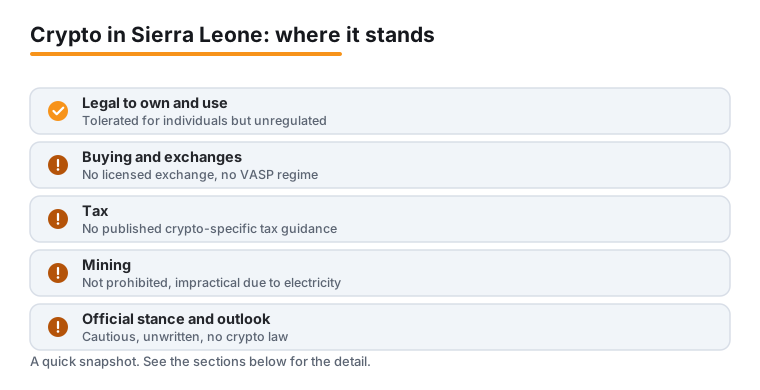
Owning, buying and selling Bitcoin is not prohibited for individuals in Sierra Leone, but it is also not formally regulated or endorsed. No statute makes cryptocurrency illegal, and no statute grants it status as money. In practice you can hold and trade crypto, but you do so without the licensing regime, consumer protections or dispute-resolution channels that exist in more developed markets.
No cryptocurrency is legal tender in Sierra Leone. The only legal tender is the national currency, the Leone (currency code SLE, following the 2022 redenomination), issued by the Bank of Sierra Leone. Businesses are under no obligation to accept Bitcoin or any token, and most everyday commerce runs on cash, bank transfers and mobile money.
The Bank of Sierra Leone has acted against unlicensed crypto deposit-taking. In 2019 it issued a public statement that it had not licensed or permitted any business or financial institution to take deposits from the public for the purpose of investing or trading in crypto-assets, and it halted two companies operating without authorisation. You may see online sources claiming crypto became "fully legal" or "regulated" in Sierra Leone in recent years, sometimes with confident statistics. Treat such claims with caution: there is no documented official crypto-licensing framework, and the accurate summary is that crypto is tolerated for individuals but unregulated, while unlicensed deposit-taking or investment schemes are not permitted.
The regulator: Bank of Sierra Leone (BSL)
The Bank of Sierra Leone is the central bank and the primary financial regulator. It formulates and implements monetary and supervisory policy, issues the Leone, supervises banks and other financial institutions, and oversees payment systems. It is the body whose stance most directly determines how crypto is treated in the country.
To date the BSL has not, to public knowledge, created a crypto-asset exchange, custody or virtual-asset-service-provider (VASP) licence, and it has cautioned the public about the risks of unregulated digital assets. Its supervisory home for non-bank financial innovation is the Other Financial Institutions Supervision Department. The Bank does run a Regulatory Sandbox for fintech (covered below), and it has expanded digital payments infrastructure, but neither of those legalises or specifically regulates private cryptocurrencies. If you need an authoritative answer on a crypto question, the BSL is the correct first point of contact. Related government bodies include the National Revenue Authority (NRA) for tax and the national financial intelligence body for anti-money-laundering matters.
Key laws and frameworks that apply
Because there is no bespoke crypto statute, activity is touched by a patchwork of existing laws rather than a single "crypto act":
- The Banking Act 2019 governs who may carry on banking business and take deposits. Transacting banking business without a valid licence is an offence, and this is the legal basis the BSL relied on when stopping unlicensed crypto deposit-taking. You can read the law via the Banking Act 2019 (sierra-leone.org).
- Anti-money-laundering law establishes Sierra Leone's AML/CFT framework, its financial intelligence body and the customer due-diligence and reporting duties placed on reporting entities. The earlier Anti-Money Laundering and Combating of Financing of Terrorism Act 2012 set up the original framework and Financial Intelligence Unit; it has since been updated by newer legislation aligning the country with international standards. You can read the 2012 Act via sierra-leone.org.
- Foreign-exchange and capital-flow rules can intersect with crypto when value moves across borders, which is relevant to remittances and to converting between crypto, Leones and US dollars.
- General tax law administered by the National Revenue Authority may apply to crypto income even without crypto-specific guidance.
Separately, the central bank has shown interest in studying a possible central bank digital currency (CBDC), and Sierra Leone has experimented with blockchain for record-keeping and identity. A notable example is the Kiva Protocol credit bureau, launched in August 2019 by the non-profit Kiva with the Bank of Sierra Leone and UN agencies (UNCDF and UNDP), which used blockchain and the national digital identity system to build formal credit histories for unbanked citizens. These public-sector initiatives are distinct from private cryptocurrencies such as Bitcoin and do not, by themselves, legalise or regulate them. Sierra Leone is not a member of any bloc with a unified crypto regime such as the EU's MiCA, so no such framework applies here.
Licensing and registration of exchanges and VASPs
There is no licensed, domestically regulated crypto exchange operating under a Sierra Leonean crypto framework, because no such framework has been published. The BSL has not established a virtual-asset-service-provider (VASP) registration or licensing regime, and it has confirmed it does not authorise businesses to take public deposits for crypto investment or trading. A firm that tried to run a crypto deposit-taking or banking-type service without a licence would risk falling foul of the Banking Act 2019.
For now, businesses that want to innovate in regulated financial services can apply to the BSL Regulatory Sandbox Program, which lets selected fintechs test products in a live but supervised environment. The sandbox is open to fintech innovation broadly rather than being crypto-specific, and entry into it is not the same as a general licence to operate a crypto exchange. Anyone planning a crypto-related business in Sierra Leone should engage the BSL directly (the sandbox team can be reached at [email protected]) and obtain written guidance before launching.
Crypto and Bitcoin tax in Sierra Leone
Sierra Leone does not, as of 2026, have published tax rules written specifically for cryptocurrency. The National Revenue Authority (NRA) administers income tax, corporate tax, capital gains tax and goods-and-services tax under the country's general tax laws. In the absence of crypto-specific guidance, the most defensible assumption is that ordinary principles may apply: profits from trading or from business activity could be treated as taxable income, and businesses accepting crypto may have reporting obligations.
Exactly how a given gain is characterised, and whether and at what rate it is taxed, is not settled in public guidance for digital assets, so this guide does not state any specific crypto tax rate or threshold, because none has been reliably verified. Anyone with meaningful crypto income, mining revenue or trading activity should keep detailed records (dates, amounts, counterparties and Leone or US-dollar values) and seek a written opinion from the NRA or a qualified Sierra Leonean tax adviser. For general background see our guide to crypto taxes. This section is informational only and is not tax advice.
AML and KYC rules
Sierra Leone's anti-money-laundering framework was set up by the Anti-Money Laundering and Combating of Financing of Terrorism Act 2012, which created the country's financial intelligence body and imposed customer due-diligence (KYC), record-keeping and suspicious-transaction reporting duties on reporting entities such as banks. That framework has since been updated to align more closely with international standards. Even though these rules were not written with crypto in mind and do not contain detailed crypto-specific provisions, their core principles of identifying customers, monitoring transactions and reporting suspicious activity are expected to extend to anyone dealing in value transfer, including crypto-related dealings.
At the international level, Sierra Leone is assessed against the Financial Action Task Force (FATF) standards, which globally call for virtual-asset service providers to be registered or licensed and to apply AML/CFT controls. Sierra Leone went through a FATF-style mutual evaluation (its 2021 report) and remains in enhanced follow-up, with several technical recommendations re-rated upward in late 2024; it is not, as of this writing, on the FATF list of jurisdictions under increased monitoring (the "grey list"). In practice this means reputable platforms serving Sierra Leonean users will still require identity verification, and users should expect KYC checks rather than anonymity.
Buying crypto and exchange access in practice
Because there is no locally licensed exchange, residents who buy crypto typically use:
- Global centralised exchanges that accept Sierra Leonean users where supported. Availability, deposit methods and verification requirements vary by platform and can change without notice.
- Peer-to-peer (P2P) marketplaces, where buyers and sellers trade directly, often settling in Leones via bank transfer or mobile money. P2P is popular across West Africa because card and bank rails into exchanges can be limited.
- Informal over-the-counter (OTC) arrangements through local communities or brokers.
Each route has trade-offs. Global exchanges offer deeper liquidity but may restrict or off-board users in unregulated jurisdictions, and funding in local currency can be awkward. P2P and OTC deals expose users to counterparty and fraud risk, since there is no local regulator to appeal to if a trade goes wrong. Whatever the method, expect to complete identity verification on reputable platforms, use escrow where available, and be wary of deals that seem too generous. Because there is no statutory consumer protection for crypto here, due diligence falls entirely on the user.
Using crypto, ATMs and remittances
There is no evidence of an established, publicly listed network of Bitcoin ATMs in Sierra Leone. Crypto ATMs are concentrated in higher-income markets with clearer regulation and reliable connectivity. For most users the practical equivalent of an "ATM" is converting crypto to Leones or US dollars through a P2P trade or an OTC contact and then withdrawing via a bank or mobile-money cash-out point. If you ever encounter a machine advertised as a Bitcoin ATM, scrutinise who operates it, what fees and exchange spread it charges, and whether it performs proper identity checks.
On remittances, crypto and stablecoins are sometimes promoted as a cheaper, faster way for the diaspora to send money home, and they can reduce friction for some senders. But they are not a magic solution: recipients still need a reliable way to convert to spendable Leones, volatility can erode value between send and cash-out, and well-run mobile-money and licensed remittance services already serve much of this need with stronger consumer protection. Sierra Leone's broader payments modernisation, including the Salone Payment Switch (SAPS), a national instant payment system launched in February 2025 that links banks and mobile-money operators, is improving everyday digital payments in local currency rather than promoting private crypto.
Bitcoin mining in Sierra Leone
Bitcoin mining is not specifically prohibited in Sierra Leone, but the country is not a practical mining hub. The decisive constraint is electricity: grid power is limited, can be unreliable, and is relatively costly for the kind of continuous, high-consumption load that competitive Bitcoin mining requires. Hardware import costs and cooling in a hot climate add further friction.
Small-scale or hobby mining is conceivable but unlikely to be profitable against large industrial operations elsewhere. Anyone considering mining should also weigh the regulatory ambiguity: revenue from mining could attract tax and AML attention, and the rules are not clearly written for this activity. Treat mining in Sierra Leone as experimental rather than as a reliable income source, and confirm any tax or licensing implications with local professionals before investing in equipment.
Recent developments (2025-2026)
Sierra Leone has focused its energy on modernising regulated digital finance rather than on creating a crypto law. The Bank of Sierra Leone operates a Regulatory Sandbox that lets selected fintechs test products under supervision, and in February 2025 the country launched the Salone Payment Switch (SAPS), a national instant payment system connecting banks and mobile-network operators to speed up domestic transfers. The Bank of Sierra Leone set April 2025 as the deadline for banks, mobile-money operators and payment service providers to integrate their domestic transactions into the switch. This is a regulated local-currency payments upgrade, not a crypto measure. Public-sector and donor-backed work on digital financial inclusion has continued, and the central bank, like many in the region, has shown study-level interest in a possible central bank digital currency.
What has not happened is the publication of a dedicated cryptocurrency or VASP licensing framework. The BSL's underlying caution about unregulated crypto-asset deposit-taking, first made explicit in 2019, still stands. For 2025-2026, expect incremental policy on payments, fintech and financial inclusion rather than a sudden, comprehensive crypto regime. Because the position is evolving and partly unwritten, always confirm the current rules directly with the Bank of Sierra Leone before relying on any crypto arrangement.
How crypto fits alongside mobile money in Sierra Leone
To understand crypto in Sierra Leone it helps to see what it competes with. Formal banking reaches only a minority of adults, so mobile money is the main engine of financial inclusion. Two operators dominate: Orange Money (Orange) and AfriMoney (Africell). These services let people send, receive and store value in Leones through a phone, and they are now linked through the Salone Payment Switch so users can move money between banks and mobile wallets in near real time.
Against that backdrop, private crypto plays a small and mostly informal role. Its main appeal is cross-border: some diaspora senders use Bitcoin or dollar-pegged stablecoins to move value into the country, then cash out to Leones through a peer-to-peer trade or a mobile-money agent. For everyday domestic payments, licensed mobile money is faster, cheaper for the user, denominated in local currency and covered by financial-services supervision, none of which is true of unregulated crypto. Crypto is therefore best understood as a niche remittance and speculative tool in Sierra Leone, not a mainstream payment method.
Consumer risks and protection
The defining risk in Sierra Leone is regulatory uncertainty. Because crypto is unregulated rather than clearly legal or illegal, the rules can shift: the central bank could issue restrictions, tax treatment could be formalised, or AML expectations could tighten. Users carry the full burden of that uncertainty, and there is no local consumer-protection backstop or compensation scheme if a platform fails, freezes withdrawals or turns out to be fraudulent.
Layered on top are the universal crypto risks of price volatility, lost private keys and platform failure, plus local factors such as connectivity gaps and thin liquidity that can make trading and cashing out difficult. Be especially alert to scams: guaranteed-return schemes, impersonation of exchanges or officials, and "investment managers" who promise to trade on your behalf are common and have no legal recourse here. Practical protection comes down to self-discipline: use reputable platforms with proper KYC, never invest borrowed money or funds you cannot afford to lose, move meaningful holdings into a wallet you control, back up your recovery phrase offline, and keep records of every transaction. This section is informational only and is not financial advice.
Official sources and how to verify
Because crypto policy in Sierra Leone is evolving and partly unwritten, you should always confirm the current position against primary sources rather than affiliate or marketing sites. The most authoritative places to check are:
- Bank of Sierra Leone for the regulator's notices, the fintech sandbox and payments policy.
- The Banking Act 2019 and the AML/CFT Act 2012 for the underlying legal framework.
- The National Revenue Authority for any question about how crypto income or gains are taxed.
This guide is general information as of 2026 and is not legal, tax or financial advice. Crypto rules in frontier markets change quickly, so verify your specific situation with the Bank of Sierra Leone and a qualified Sierra Leonean lawyer or tax adviser before acting. You can also compare other jurisdictions through our country regulation hub.
Frequently asked questions
Is cryptocurrency legal in Sierra Leone?
Crypto is not illegal for individuals to own or trade in Sierra Leone, but it is also not formally regulated or recognised as legal tender. It sits in a legal grey area governed by general banking and anti-money-laundering rules rather than a dedicated crypto law, and the Bank of Sierra Leone has stopped firms that took public deposits for crypto without a licence. Because the rules are partly unwritten and can change, confirm the current position with the Bank of Sierra Leone before acting.
Who regulates crypto in Sierra Leone?
The Bank of Sierra Leone is the central bank and main financial regulator, and its stance most directly shapes how crypto is treated. It has not created a crypto-asset or VASP licensing regime, so there is no domestically regulated crypto exchange. The National Revenue Authority handles tax and the national financial intelligence body handles anti-money-laundering matters. You can verify notices at bsl.gov.sl.
Does Sierra Leone license crypto exchanges or VASPs?
No. The Bank of Sierra Leone has not published a virtual-asset-service-provider licensing or registration framework, and it has confirmed it does not authorise businesses to take public deposits for crypto investment or trading. Fintechs can apply to the BSL Regulatory Sandbox to test products under supervision, but that is fintech-wide and is not the same as a licence to run a crypto exchange. Engage the BSL for written guidance before launching any crypto business.
Do I have to pay tax on crypto profits in Sierra Leone?
There is no published, crypto-specific tax guidance, but general tax principles administered by the National Revenue Authority may apply to trading or business income, and Sierra Leone does levy income and capital gains tax. Because no specific crypto rate or threshold has been reliably verified, keep thorough records and seek a written opinion from the NRA or a qualified local tax adviser. This is informational only and not tax advice.
Are there KYC and anti-money-laundering rules for crypto?
Sierra Leone's Anti-Money Laundering and Combating of Financing of Terrorism Act 2012 set up the country's financial intelligence body and imposed customer due-diligence (KYC), record-keeping and suspicious-transaction reporting on reporting entities, and that framework has since been updated to align with international standards. Although these rules were not written with crypto in mind, their principles are expected to extend to crypto dealings, and reputable platforms serving Sierra Leonean users will require identity verification rather than allow anonymity.
Can I use Bitcoin to send remittances to Sierra Leone?
Some members of the diaspora use Bitcoin or stablecoins to send value home, and it can be faster and cheaper than some traditional channels. However, recipients still need a reliable way to convert to Leones, volatility can change the amount received, and licensed mobile-money and remittance services offer stronger protections. Weigh convenience against these risks, and remember there is no local consumer-protection backstop for crypto.
What is the Salone Payment Switch and does it involve crypto?
The Salone Payment Switch (SAPS) is a national instant payment system that the Bank of Sierra Leone launched in February 2025. It lets banks and mobile-money operators such as Orange Money and AfriMoney send money to each other in near real time, and the central bank set April 2025 as the deadline for providers to integrate. It is a regulated local-currency payments upgrade and does not involve or legalise cryptocurrency.
How do most people in Sierra Leone move money, and where does crypto fit?
Most everyday payments run on cash, bank transfers and mobile money, with Orange Money and AfriMoney serving many people who lack a bank account. Private crypto plays a small, mostly informal role, used mainly by some diaspora senders to move value across borders before cashing out to Leones through peer-to-peer trades or mobile-money agents. For domestic payments, licensed mobile money is faster, cheaper and supervised, so crypto stays a niche tool rather than a mainstream payment method.
Facts reviewed: 30 June 2026. Page updated: 3 August 2026.