Home › Crypto Regulation › Romania
Bitcoin & Cryptocurrency Regulation in Romania
Quick answer — Romania, 2026
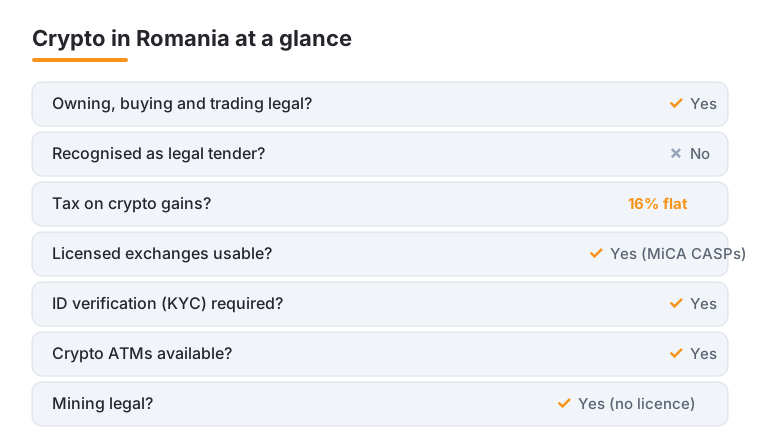
- Yes, owning, buying and trading crypto is legal in Romania; it is not legal tender.
- Gains are taxed at a flat 16% from 1 January 2026 (was 10%), declared on the annual single return (Form 212) to ANAF.
- Residents buy via MiCA-licensed EU or international exchanges with KYC, funding by SEPA transfer or card.
Cryptocurrency is legal to own, buy, sell and hold in Romania. There is no ban on Bitcoin or other crypto-assets, but the activity now sits inside a single, EU-wide rulebook. As an EU member state, Romania applies the bloc's Markets in Crypto-Assets Regulation (MiCA, Regulation (EU) 2023/1114) directly, and in 2025 it passed national legislation, Government Emergency Ordinance (OUG/GEO) 10/2025, to implement that regime and name the domestic supervisors who enforce it.
This guide explains, in plain terms, how crypto is regulated in Romania as of 2026: who supervises the market, how exchanges and crypto ATMs are licensed, how crypto income is taxed, the anti-money-laundering rules, and the practical points around buying, using and mining crypto. This is general information as of 2026 and is not legal, tax or financial advice. The rules are evolving quickly, especially during the MiCA transition that runs to mid-2026, so always verify the current position with the named official regulator, the Financial Supervisory Authority (ASF), or a qualified Romanian professional before acting. See also our general crypto regulation guide and the regulation hub.
On this page: Legal status · Who regulates it · Taxes · How to buy · Mining
Is Bitcoin and crypto legal in Romania?
Yes. Holding, buying, selling and transferring Bitcoin and other crypto-assets is legal in Romania. Crypto is not recognised as legal tender; the Romanian leu (RON) is the only official currency, and the euro is the EU's single currency. Private individuals and businesses are generally free to use crypto, and merchants may choose to accept it.
What is regulated is the service layer around crypto. Businesses that exchange, trade, custody, advise on or otherwise provide crypto-asset services to the public must be licensed and must follow anti-money-laundering rules. In short, the asset is legal to own, but running a crypto business is a licensed, supervised activity. Romania has aligned with the EU rather than pursuing prohibition, so for residents the practical questions are how crypto is regulated and how it is taxed, not whether it is allowed.
Who regulates crypto in Romania?
Romania uses a multi-authority model. The lead crypto supervisor is the Financial Supervisory Authority (Autoritatea de Supraveghere Financiara, ASF). Under OUG 10/2025, the ASF authorises and supervises crypto-asset service providers (CASPs), including exchanges, brokers, custodians, advisers and crypto ATM operators, and oversees the issuance of most crypto-assets other than e-money tokens. The ASF is also Romania's MiCA point of contact with the EU markets authority, ESMA.
The National Bank of Romania (Banca Nationala a Romaniei, BNR) is the competent authority specifically for the issuance of e-money tokens by credit institutions and electronic-money institutions under its supervision, and is the guardian of monetary stability.
Two further bodies matter in practice: the National Office for the Prevention and Combating of Money Laundering (ONPCSB), Romania's financial intelligence unit, which receives suspicious-transaction reports; and the National Agency for Fiscal Administration (ANAF), which handles crypto taxation. You can verify the supervisors' roles on their official sites: ASF, National Bank of Romania and ONPCSB.
Key laws and frameworks
Romania's crypto rules rest on a small number of clear pillars:
- MiCA (Regulation (EU) 2023/1114): The EU's Markets in Crypto-Assets Regulation applies directly in Romania. It creates a single authorisation regime for CASPs that can be passported across the EU, and sets dedicated rules for asset-referenced tokens and e-money tokens (stablecoin-type assets). MiCA's rules for service providers have been phasing in across the EU through 2024 and 2025.
- OUG/GEO 10/2025: Romania's national implementing measure, in force from 13 March 2025. It designates the ASF and BNR as the competent authorities, sets the transitional regime for existing firms, and amends Romania's AML law (Law No. 129/2019) to bring crypto activity into line with the EU transfer-of-funds and travel-rule requirements.
- AML law (Law No. 129/2019, as amended): Imposes know-your-customer, monitoring and reporting obligations, transposing EU anti-money-laundering directives.
Because OUG 10/2025 was issued as an emergency ordinance and implementing details continue to be published, confirm the current text and any later amendments with the ASF before relying on a specific provision. For background on how MiCA fits the wider EU picture, see ESMA's official MiCA page.
Licensing and registration of exchanges (CASPs)
Any business providing crypto-asset services to Romanian or EU customers must hold, or be in the process of obtaining, a MiCA authorisation as a CASP. In Romania the ASF grants and supervises these licences under OUG 10/2025. Reported features of the Romanian regime include minimum capital requirements that start at EUR 50,000 for the lowest MiCA tier and rise to EUR 125,000 or EUR 150,000 depending on the services offered, governance and fit-and-proper checks, and full EU passporting once authorised.
Existing firms had a transitional path. Reporting indicates that a provider registered under Romania's AML regime by 30 December 2024 could keep operating if it filed its ASF authorisation dossier by 31 December 2025, with the grandfathering window closing on 1 July 2026.
A distinctive Romanian step is a technical pre-approval from the Authority for the Digitisation of Romania (ADR), which reviews a CASP's IT systems, cybersecurity and operational-resilience arrangements (aligned with the EU's DORA framework) before the main application goes to the ASF.
For consumers, the practical takeaway is to favour platforms that are MiCA-licensed or clearly progressing through authorisation, and that name the EU regulator supervising them. The EU markets authority ESMA maintains an interim MiCA register of authorised providers; you can reach it from the official ESMA MiCA page, and Romanian authorisations can be checked with the ASF.
Crypto and Bitcoin tax in Romania
Crypto gains are taxable in Romania, and the tax treatment changed at the start of 2026. The headline points reported for 2026 are:
- Flat income-tax rate of 16% on crypto gains from 1 January 2026, up from 10% that applied to gains realised in 2025. Gains realised during 2025 are reported as still taxed at the old 10% rate when declared in 2026; the 16% rate applies to gains realised from 1 January 2026 onward. The taxable gain is generally the positive difference between sale price and acquisition cost, including direct transaction fees, and applies to crypto-to-fiat and crypto-to-crypto disposals.
- Small-gain relief: gains under 200 RON per transaction are reported as not taxed, provided total annual gains do not exceed 600 RON.
- Health contribution (CASS): a 10% health-insurance contribution can apply once annual income from such sources passes set thresholds (linked to multiples of the minimum wage).
- Self-declaration: individuals generally report crypto income on the annual single return (Declaratia Unica, Form 212), filed via the ANAF portal, with the usual deadline around 25 May of the following year.
Reporting is tightening: Romania transposed the EU's DAC8 crypto-reporting directive (Directive (EU) 2023/2226) through Government Emergency Ordinance No 71/2025, which amends the Fiscal Procedure Code. Under it, crypto service providers must collect user identification data and report user transaction data to ANAF each year. The first reporting cycle covers 2026 transactions, with the report due to ANAF by 15 March 2027, so under-declaring is increasingly risky. Because rates, thresholds and contribution rules can change between tax years and detailed ANAF guidance is still developing, confirm current figures directly with ANAF or a Romanian tax adviser. See also our general crypto taxes guide. This is informational only, not tax advice.
AML and KYC rules
Anti-money-laundering and counter-terrorist-financing controls are a core part of Romania's crypto regime. CASPs are obligated persons under Law No. 129/2019, as amended by OUG 10/2025, and must perform customer due diligence (KYC), verify identities, monitor transactions and file suspicious-transaction reports with the ONPCSB, Romania's financial intelligence unit.
Crypto-specific obligations follow the EU transfer-of-funds rules and the FATF travel rule: providers must collect and pass on information about the sender and recipient of crypto transfers, and must assess and manage the risk of transfers to or from self-hosted (unhosted) wallets and untrusted addresses. In practice this means fully anonymous services are being phased out: a compliant exchange or crypto ATM will always ask you to verify your identity. The ONPCSB publishes guidance and sector risk assessments on its official site, onpcsb.ro.
Buying and using crypto in practice
Romanians can buy crypto through EU-based and international exchanges, brokers and peer-to-peer platforms; there is no rule forcing residents onto a domestic-only service. Most people use established platforms that support RON or EUR funding via SEPA bank transfer or card.
A typical compliant route is: choose a MiCA-licensed (or clearly authorising) platform; complete identity verification (KYC) with an ID document and any required proof of address; fund the account by SEPA transfer or card (transfers usually carry lower fees); place your buy order; then decide whether to keep assets on the exchange or withdraw to a personal wallet. Self-custody, holding your own private keys in a software or hardware wallet, remains legal and widely used, although moving funds to or from a regulated exchange can trigger KYC and record-keeping on the platform side.
Crypto ATMs exist in Romania, mainly in larger cities such as Bucharest. Their operators are CASPs under the ASF and must apply identity and transaction-monitoring controls; expect verification, and treat any machine that asks for no identification at all with caution. Keep records of every transaction (dates, amounts, RON value, fees) for your tax return.
Bitcoin mining in Romania
Crypto mining is not banned in Romania and there is no dedicated mining licence. Miners operate within the country's general legal, energy and tax framework, which shapes whether mining is viable:
- Electricity cost and supply: mining is energy-intensive, so profitability depends heavily on power prices. Romania's generation mix includes significant hydro, nuclear and other sources, but tariffs, grid-connection rules and any energy levies all affect the economics.
- Energy and environmental rules: larger operations may need to engage with energy-market regulation, grid operators and permitting like any sizeable electricity consumer, and the EU is increasing scrutiny and disclosure requirements around crypto energy use.
- Tax and business registration: mining rewards generally have tax consequences, and running mining as a business brings standard company obligations.
There is no prohibition aimed at miners, but anyone scaling beyond hobby level should plan around electricity contracts, permitting and tax treatment, and confirm current requirements with the relevant authorities.
Recent developments (2025-2026)
The defining change is Romania's move onto the single EU rulebook and the closing of the MiCA transition:
- OUG 10/2025 entered into force on 13 March 2025, naming the ASF and BNR as competent authorities and tightening AML rules for crypto firms.
- Transitional (grandfathering) regime: firms already active were given a limited window to keep operating under prior arrangements while they apply for full MiCA authorisation. Reporting indicates that firms registered under Romania's AML regime by 30 December 2024 were eligible to keep operating provided they submitted their ASF authorisation dossier by 31 December 2025, with the transitional window running to 1 July 2026.
- 1 July 2026 cut-off: reporting indicates that from around 1 July 2026 only fully MiCA-licensed CASPs may serve EU customers, and transitional registrations expire; providing crypto-asset services without authorisation is reported to become a criminal offence from that date. Exact dates can shift, so confirm the current cut-off with the ASF.
- DAC8 reporting (OUG 71/2025): in December 2025 Romania transposed the EU's DAC8 crypto tax-reporting directive through Government Emergency Ordinance No 71/2025. CASPs must report user transaction data to ANAF each year, the first cycle covering 2026 data and due by 15 March 2027, with reported fines for non-compliance ranging from 20,000 to 150,000 RON.
- Tax increase: the crypto income-tax rate rose to 16% from 1 January 2026 (gains realised in 2025 stay at 10%).
Separately, Romania participates, through the BNR and the European Central Bank, in the EU's preparatory work on a possible digital euro. That is a state-backed project distinct from decentralised crypto and, if it proceeds, would coexist with cash rather than replace private crypto-assets.
Consumer risks and protection
The direction of travel under MiCA is clearer licensing, stronger consumer-protection and disclosure rules, and more comprehensive tax reporting, all of which favour established, compliant providers. Even so, real risks remain:
- Market volatility: crypto prices swing sharply and you can lose part or all of your capital. Crypto is not covered by deposit-guarantee or investor-compensation schemes the way bank deposits are.
- Platform and transition risk: during the MiCA transition some providers may restrict services, change terms or exit the market; check that your platform completes full authorisation. Even licensed providers are not risk-free, and unlicensed ones are far riskier.
- Fraud: crypto is a frequent target for scams. Be wary of guaranteed-return schemes, social-media giveaways, fake support staff and unsolicited investment offers.
Sensible protections are to use regulated platforms, enable strong security, consider self-custody for larger holdings, invest only what you can afford to lose, and keep complete records. If a service or offer seems suspect, you can raise concerns with the ASF's consumer-protection function.
Official sources and how to verify
Because crypto rules in Romania are still settling and details can change between updates, always confirm specifics with a primary official source rather than secondary articles. The authorities to check are:
- Financial Supervisory Authority (ASF), the lead crypto regulator and MiCA licensing authority: asfromania.ro.
- National Bank of Romania (BNR), for e-money tokens and monetary matters: bnr.ro.
- ONPCSB, the financial intelligence unit, for AML and travel-rule guidance: onpcsb.ro.
- ESMA, for the EU-wide MiCA framework and the interim register of authorised CASPs: esma.europa.eu.
To verify an exchange, look it up in the ESMA MiCA register or confirm its authorisation with the ASF. For tax, rely on ANAF and the Declaratia Unica instructions, or a Romanian tax adviser. This guide is general information as of 2026 and is not legal, tax or financial advice; verify any specific point with the named official regulator before acting. You can also explore our regulation hub for other countries.
Frequently asked questions
Is cryptocurrency legal in Romania?
Yes. Owning, buying, selling and transferring crypto is legal. It is not legal tender, but there is no ban. Businesses that provide crypto services to the public must be licensed and must follow the EU's MiCA rules and Romania's anti-money-laundering law.
Who regulates crypto in Romania?
The Financial Supervisory Authority (ASF) is the lead regulator and licenses crypto-asset service providers under MiCA and OUG 10/2025. The National Bank of Romania (BNR) is competent for e-money tokens, the ONPCSB handles anti-money-laundering reporting, and ANAF deals with taxation. Confirm current responsibilities on the ASF website, asfromania.ro.
How is crypto taxed in Romania in 2026?
Crypto gains are reported as taxable at a flat 16% from 1 January 2026 (up from 10% for 2025 gains), with a small-gain relief reported for transactions under 200 RON where annual gains stay under 600 RON, and a possible 10% health contribution (CASS) above set thresholds. You usually declare on the single annual return (Declaratia Unica, Form 212) via ANAF by about 25 May. Confirm current figures with ANAF; this is not tax advice.
Do crypto exchanges need a licence in Romania?
Yes. Exchanges and other crypto-asset service providers serving Romanian or EU customers need a MiCA authorisation as a CASP, granted and supervised in Romania by the ASF under OUG 10/2025. During the transition some firms operate under prior registrations while applying; reporting indicates only fully MiCA-licensed providers may serve EU customers from around mid-2026. Check the ASF or the ESMA MiCA register.
Do I have to verify my identity to use crypto in Romania?
On regulated platforms, yes. Exchanges and crypto ATMs are obligated persons under Romania's AML law and must perform KYC identity checks, monitor transactions and report suspicious activity to the ONPCSB. Self-custody of your own wallet is legal, but a compliant service will always ask for identification, so be cautious of any that does not.
Is Bitcoin mining legal in Romania?
Yes. There is no ban and no special mining licence. Miners operate under general energy, environmental, business and tax rules, and profitability depends heavily on electricity costs. Larger operations should check grid-connection, permitting and tax obligations with the relevant authorities.
Do crypto exchanges report my transactions to ANAF?
Increasingly, yes. Romania transposed the EU's DAC8 directive through Government Emergency Ordinance No 71/2025 in December 2025. Under it, crypto-asset service providers must collect user identification data and report user transaction data to ANAF each year. The first cycle covers 2026 transactions and is reported as due to ANAF by 15 March 2027, so it is sensible to keep your own records and declare accurately.
Can my current crypto platform keep operating in Romania after 1 July 2026?
Only if it holds a full MiCA authorisation. Reporting indicates the transitional (grandfathering) window closes on 1 July 2026, after which only fully MiCA-licensed CASPs may serve customers, and providing services without authorisation is reported to become a criminal offence. Firms that were AML-registered by 30 December 2024 had to file their ASF dossier by 31 December 2025 to use the transition. Check a platform's status with the ASF or the ESMA MiCA register.
Facts reviewed: 30 June 2026. Page updated: 3 August 2026.