Home › Crypto Regulation › Philippines
Bitcoin & Cryptocurrency Regulation in Philippines
Quick answer — Philippines, 2026
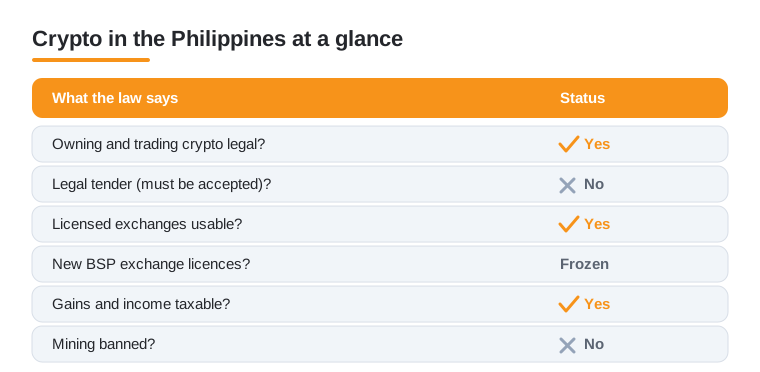
- Yes, owning and trading crypto is legal for residents, but crypto is not legal tender (only the peso is).
- Crypto gains and income are taxable; declare them in your annual BIR return.
- Buy through a BSP-licensed exchange or e-wallet (verify its status first), complete ID checks, and fund in pesos.
The Philippines is one of Southeast Asia's most active cryptocurrency markets, with high retail adoption, a large remittance and play-to-earn community, and a regulatory framework that matured significantly in 2025. Buying, holding, selling and using cryptocurrencies such as Bitcoin is legal for residents, but the sector is supervised: the central bank (the Bangko Sentral ng Pilipinas) licenses crypto exchanges as Virtual Asset Service Providers, the Securities and Exchange Commission now regulates Crypto-Asset Service Providers under rules that took effect in July 2025, and the tax authority expects crypto gains and income to be declared.
This guide explains the current state of Philippines crypto regulation as of 2026 in plain language: who regulates what, how crypto is treated for tax, the licensing rules for exchanges, how anti-money-laundering rules apply, and the practical steps to buy and use crypto safely. It is general information only, current as of 2026, and is not legal, tax or financial advice. Philippine crypto rules are evolving quickly, so always confirm the latest position with the Bangko Sentral ng Pilipinas (BSP), the Securities and Exchange Commission (SEC), the Bureau of Internal Revenue (BIR), or a qualified Philippine professional before acting. For background, see our guide to crypto regulation and the wider country regulation hub.
On this page: Legal status · Who regulates it · Taxes · How to buy · Mining
Is Bitcoin and crypto legal in the Philippines?
Yes. No Philippine law prohibits individuals or businesses from buying, holding, selling or transferring Bitcoin and other cryptocurrencies. Crypto is treated as a regulated financial activity rather than a banned one, and regulators have publicly confirmed that trading itself is not prohibited.
An important distinction applies: cryptocurrency is not legal tender in the Philippines. The Philippine peso (PHP), issued by the Bangko Sentral ng Pilipinas, is the only legal tender, and no merchant is obliged to accept crypto. What the law requires is that any business providing crypto services to the public, such as exchanges and platforms that convert between crypto and pesos, operate under the appropriate licence or registration and follow anti-money-laundering rules. In short, using crypto as an individual is legal; running a crypto business serving the Philippine public is legal only if you are properly authorised and supervised.
Who regulates crypto in the Philippines?
Crypto oversight in the Philippines is shared between two principal regulators, working alongside the tax authority and the anti-money-laundering body.
Bangko Sentral ng Pilipinas (BSP)
The central bank supervises Virtual Asset Service Providers (VASPs), which broadly covers businesses that exchange crypto for fiat (or one crypto for another), transfer virtual assets, or hold and administer them for customers. The BSP regulates VASPs principally under BSP Circular No. 1108 (2021). VASPs must register with the BSP, meet capital and governance standards, and follow Know Your Customer (KYC) and Anti-Money Laundering (AML) obligations. See the central bank's official site, the Bangko Sentral ng Pilipinas.
Securities and Exchange Commission (SEC)
In 2025 the SEC introduced a dedicated regime for Crypto-Asset Service Providers (CASPs) through Memorandum Circular No. 4 and No. 5, Series of 2025, which were issued on 30 May 2025 and took effect on 5 July 2025. These rules establish registration, capital, disclosure and conduct requirements for firms that offer crypto-asset services or market crypto tokens to the Philippine public, and they cover public offerings of crypto-assets. The official regulator is the Securities and Exchange Commission of the Philippines.
BIR and AMLC
The Bureau of Internal Revenue (BIR) handles taxation of crypto gains and income, while the Anti-Money Laundering Council (AMLC) enforces AML duties. The practical takeaway is that the rulebook is split: the BSP focuses on money-transmission and custody, while the SEC focuses on offerings and investment-type services. Reputable platforms hold the relevant authorisation from one or both, depending on what they do.
Key crypto laws and frameworks
The Philippines does not have a single, standalone "crypto act." Instead, several existing laws and regulator-issued rules combine to govern the sector:
- BSP Circular No. 1108 (2021) sets out the VASP licensing and supervision framework administered by the central bank.
- SEC Memorandum Circular No. 4 and No. 5, Series of 2025 (the CASP Rules), effective 5 July 2025, create the registration and conduct regime for crypto-asset service providers and for the marketing and public offering of crypto-assets.
- The Anti-Money Laundering Act (Republic Act No. 9160, as amended) brings VASPs and CASPs within scope as covered persons, with reporting and customer-due-diligence duties to the AMLC.
- The National Internal Revenue Code (Tax Code) is the basis for taxing crypto gains and income, since the BIR applies general tax law rather than a dedicated crypto statute.
Other general laws on securities, consumer protection and electronic commerce can also apply depending on the activity. Because this framework is built from multiple instruments and is still developing, you should always verify the current text and any new issuances directly with the relevant regulator.
Licensing and registration of exchanges (VASPs and CASPs)
Any platform offering crypto services to Philippine residents is expected to be authorised, as a BSP VASP and, where its activity touches offerings or investment-type services, under the SEC's CASP regime.
Under the SEC's 2025 CASP Rules, widely reported requirements include that a CASP must be a corporation registered with the SEC, maintain a physical office in the Philippines, hold a minimum paid-up capital of PHP 100 million (excluding crypto-assets), segregate customer funds, disclose risks clearly, and run an AML/CFT programme. Public offerings of crypto-assets generally require a disclosure document filed with the SEC and published at least 30 days before marketing or the offering begins. Registered CASPs face extensive ongoing reporting obligations.
A significant development for the VASP side is that the BSP has suspended the issuance of new VASP licences. A three-year moratorium imposed in September 2022 was, effective 1 September 2025, extended indefinitely, citing heightened risks in the sector; the BSP says it will periodically review the policy. Reporting at that time indicated only around a dozen BSP-licensed VASPs, with fewer than that actively operating. The practical effect is that the pool of newly licensed local exchanges is frozen, while existing licensees continue to operate. Always confirm a platform's current status against the BSP's official list of registered VASPs and the SEC's CASP records before depositing funds.
Crypto and Bitcoin tax in the Philippines
The Bureau of Internal Revenue (BIR) treats cryptocurrency gains and income as taxable. There is no "crypto exemption." The BIR has not issued a dedicated crypto tax regulation; instead it applies the general National Internal Revenue Code, under which income from whatever source, including digital assets, is taxable.
The widely cited professional view is that gains from selling or trading crypto, and income received in crypto (for example from mining, staking, freelancing or play-to-earn rewards), are generally treated as ordinary income taxed at regular income-tax rates, rather than under the separate capital-gains-tax regime that applies to certain other assets. Because the Philippines has no crypto-specific tax statute, the rate you pay is the ordinary one for your situation: the graduated schedule under Republic Act No. 10963, running from 0 percent to 35 percent, or, for qualified self-employed individuals and professionals whose gross sales stay within the PHP 3,000,000 VAT threshold, an optional flat 8 percent on gross sales or receipts and other non-operating income above PHP 250,000 in place of the graduated rates. No enacted Philippine provision sets a crypto-specific capital-gains rate, so any single headline percentage quoted online is not law. The rates that do apply are the ordinary income-tax rates under Republic Act No. 10963, which start at zero on the first PHP 250,000 of annual taxable income and reach 35 percent above PHP 8,000,000. See our crypto taxes overview for general background.
Reliable practical points:
- Crypto income and gains are generally taxable and should be included in your annual income-tax return filed with the BIR.
- Keep detailed records: dates, amounts, peso values at the time of each transaction, fees and the purpose.
- Penalties, interest and back taxes can apply to undeclared income.
- Record-keeping is becoming more important: the Department of Finance has said the Philippines will adopt the OECD Crypto-Asset Reporting Framework (CARF), which supports automatic exchange of crypto-account data between tax authorities, with implementation targeted by 2028.
This is not tax advice. For the current rates, forms and deadlines that apply to you, consult the Bureau of Internal Revenue or a licensed Philippine accountant or tax lawyer.
AML, KYC and the Travel Rule
Both BSP-licensed VASPs and SEC-registered CASPs are covered persons under the Anti-Money Laundering Act, supervised by the Anti-Money Laundering Council (AMLC). Registration as a covered person with the AMLC is mandatory, not optional, and these businesses must run a full AML/CFT compliance programme.
What this means in practice:
- KYC and customer due diligence. Licensed platforms must verify customer identities using reliable documentation, typically a government ID and selfie or document checks, before you can fund, trade or withdraw.
- The FATF Travel Rule applies. VASPs must collect and pass on originator and beneficiary information for qualifying transfers. BSP Circular No. 1108, in force since 5 February 2021, sets the Travel Rule threshold at PHP 50,000 or its foreign-currency equivalent. At or above that figure the originating institution must obtain, retain and transmit the originator's name and account number plus one further identifier (physical address, national identity number, unique identification number, or date and place of birth), together with the beneficiary's name and account number. All virtual asset transfers, domestic or cross-border, are treated as cross-border wire transfers. The BSP said on 10 July 2026 that it plans to expose proposed amendments to Circular No. 1108 for public comment, with no draft or timeline yet published.
- Reporting. Providers file Covered Transaction Reports for transactions above the statutory threshold and Suspicious Transaction Reports for red-flag activity regardless of amount.
For users, this means more identity checks and information requests than in an unregulated market, but also a cleaner path for funds into the banking and e-wallet system. The official body is the Anti-Money Laundering Council.
Buying and using crypto in practice
Filipinos can buy crypto through BSP-licensed exchanges and e-wallets, peer-to-peer marketplaces, and some international platforms. The defining rule is that any platform offering crypto-to-peso services to residents should be properly registered. What this means for users:
- Identity verification is standard. Licensed platforms require KYC before you can fund an account or withdraw to pesos.
- Use registered providers. Regulators have repeatedly cautioned against unregistered platforms and have moved to block access to illegal trading sites. Check whether an operator appears on the BSP's list of registered VASPs or holds SEC CASP authorisation before depositing.
- Funding methods commonly include bank transfers, the InstaPay and PESONet rails, debit cards and e-wallet top-ups.
A typical, compliance-friendly path to buy Bitcoin: choose a licensed platform and confirm its status with the regulator; complete KYC; fund your account in pesos; place a market or limit order after reviewing the price, spread and fees; for meaningful amounts, move coins to a wallet you control (a hardware wallet offers strong protection) and back up your recovery phrase offline; and keep records for tax. Remittances are a major real-world use case: a sender abroad converts to crypto or a stablecoin, transfers it, and the recipient cashes out to pesos through a licensed local exchange or e-wallet, subject to AML checks and conversion costs. Beware of unsolicited "investment managers," guaranteed-return offers and platforms that discourage withdrawals, which are classic scam signals Philippine regulators repeatedly flag.
Bitcoin ATMs and mining
Bitcoin ATMs have a limited footprint in the Philippines compared with markets like the United States, and where they exist they are mostly in larger cities. An ATM operator that converts cash to crypto for the public performs a virtual-asset service and would be expected to fall under the BSP's VASP framework, including KYC and AML duties. Given the BSP's cautious licensing stance and the popularity of mobile e-wallets, most Filipinos buy crypto through apps rather than kiosks. If you use a crypto ATM, expect identity checks beyond very small amounts and compare the quoted rate and fees against an online exchange, as kiosk margins are often high.
Bitcoin mining is not banned, but it is not a major industry locally, and the main constraint is economics rather than a specific prohibition. Electricity prices in the Philippines are among the higher ones in the region, making large-scale proof-of-work mining hard to run profitably. Mined coins and mining income are generally treated as taxable income by the BIR, so keep records of the peso value of rewards when received, and standard business, electrical-safety and customs rules apply to any sizeable operation. For most participants, buying crypto on a licensed exchange is far more practical than mining it.
Recent developments (2025 to 2026)
The period from 2025 into 2026 brought the most significant regulatory changes the Philippine crypto sector has seen:
- SEC CASP Rules took effect on 5 July 2025 (Memorandum Circular No. 4 and No. 5, Series of 2025), creating the country's most comprehensive framework yet for crypto-asset service providers, including registration, a PHP 100 million capital requirement and disclosure obligations.
- The BSP extended its VASP licensing moratorium indefinitely from 1 September 2025, freezing new local exchange licences while citing heightened risks.
- Enforcement against unregistered platforms intensified. In an advisory dated 1 August 2025 the SEC publicly warned against and moved to block access to around ten offshore exchanges operating without local registration, including names such as OKX, Bybit, KuCoin and Kraken; internet providers displayed block pages citing local rules, and in late December 2025 the National Telecommunications Commission ordered internet service providers to block 50 unlicensed platforms at the BSP's request, citing Section 902-N of the Manual of Regulations for Non-Bank Financial Institutions, BSP Circular No. 1206 (Series of 2024) and Republic Act No. 11211; the full list of 50 was not released, so no published roster of named exchanges exists. The SEC has stressed that this is not a ban on crypto trading but a requirement for platforms to be registered.
- Tax transparency commitment. The Department of Finance said the Philippines will adopt the OECD Crypto-Asset Reporting Framework (CARF), which provides for automatic exchange of crypto-account information between tax authorities. The commitment, made in June 2025, targets implementation by 2028, alongside dozens of other jurisdictions.
Because policy, tax guidance and enforcement are all still moving, treat any specific figure or list as a snapshot and confirm the current position with the official regulators.
Consumer risks and protection
The Philippines has moved toward a clearer, supervised regime, but crypto remains high-risk. Key risks to understand:
- Market volatility. Crypto prices can move sharply in either direction, and you can lose a substantial part, or all, of your money.
- Scams and unlicensed platforms. Investment fraud is a persistent problem; authorities frequently warn the public and have blocked illegal trading sites. Unregistered platforms offer no local legal recourse if things go wrong.
- No legal-tender status or deposit-style protection. Crypto holdings are not covered by deposit insurance, and merchants are not obliged to accept crypto.
- Custody and platform risk. Funds held on a third-party platform depend on that platform's solvency and security.
Sensible risk management: invest only money you can afford to lose, keep crypto a small part of a diversified portfolio, avoid leverage and "guaranteed return" offers, verify a platform's licensing directly with the regulator, and for larger holdings self-custody with a hardware wallet and an offline backup of your recovery phrase. The SEC warns that unauthorised platforms expose users to total loss, fraud, market manipulation and misuse for money laundering.
Official sources and how to verify
Crypto rules in the Philippines change frequently, so always check primary sources before acting. The authoritative regulators and their official websites are:
- Bangko Sentral ng Pilipinas (BSP), the central bank, for VASP licensing, the list of registered VASPs and advisories.
- Securities and Exchange Commission (SEC) for the CASP Rules (Memorandum Circular No. 4 and No. 5, Series of 2025), public offering rules and investor alerts.
- Bureau of Internal Revenue (BIR) for tax obligations, forms and deadlines.
- Anti-Money Laundering Council (AMLC) for AML and Travel Rule requirements.
To verify a platform, look for its name on the BSP's registered-VASP list and check whether the SEC has issued any advisory against it. This page is general information current as of 2026 and is not legal, tax or financial advice; readers should confirm their specific situation with the named official regulators or a qualified Philippine professional. For more, see our crypto regulation guide.
August 2026 status: what is true right now
Crypto is legal to own and trade in the Philippines, it is not legal tender, and there is still no crypto-specific statute. Everything binding is regulator-made: BSP circulars and memoranda, the SEC's 2025 Crypto-Asset Service Provider circulars, the Anti-Money Laundering Act, and the ordinary Tax Code. Congress has passed no crypto law.
What moved in the twelve months to August 2026 is enforcement reach and product scope, not legal status:
- Enforcement went from advisories to network-level blocking. In late December 2025 the National Telecommunications Commission ordered internet service providers to block 50 unlicensed platforms at the BSP's request, citing Section 902-N of the Manual of Regulations for Non-Bank Financial Institutions, BSP Circular No. 1206 (Series of 2024), and Republic Act No. 11211, which amended the New Central Bank Act (Fintech News Philippines, BitPinas). Neither the NTC nor the BSP released the full list of 50, so treat any named roster of blocked exchanges with caution.
- The BSP began policing which coins may be listed at all, through Memorandum No. M-2026-023, signed on 5 June 2026.
- Binance re-entered through the SEC's Strategic Sandbox rather than through a licence, and on 11 June 2026 the BSP said publicly that neither Binance nor its local partner holds a VASP licence (CoinDesk).
One development post-dates most write-ups of this topic. On 10 July 2026 the BSP told BitPinas it plans to expose proposed amendments to Circular No. 1108 for public comment, and that speculative or investment-focused crypto-to-crypto trading through a trading venue fits under the SEC's perimeter rather than the BSP's (BitPinas). No draft and no timeline have been published, so nothing has changed for users yet, but the boundary between BSP and SEC oversight is the thing most likely to move next.
The practical checkpoint for a reader has not changed: the BSP publishes its own list of licensed virtual asset service providers, and that list, not a platform's marketing page, is what decides whether a service is legal here.
Crypto legislation in Congress: what is pending and where it stands
The page above describes what regulators have done. Congress has done nothing yet. No crypto bill has become law in the Philippines. Three measures in the 20th Congress would change that, and all three are stuck at committee stage.
| Bill | Author and filing date | What it would do | Stage |
|---|---|---|---|
| Senate Bill No. 433, Digital Assets Act | Sen. Imee Marcos, filed 10 July 2025 (a refiling of SB 1041 from 2019) | Statutory licensing for e-money issuers, virtual token offerings and virtual asset businesses, with the BSP as lead agency for e-money and the SEC over virtual asset offerings; AML, due diligence and cybersecurity duties, and penalties for violations | Pending with the Senate Committee on Banks, Financial Institutions and Currencies since 13 August 2025. No committee report. |
| House Bill No. 4792, Philippine Tokenization and Crypto Adoption Act of 2025 | Rep. Edgar R. Erice, filed 23 September 2025 | Creates a National Council on Digital Assets and Tokenized Investments to develop frameworks for real-world asset tokenization, stablecoin use, exchange development, decentralised finance and retail crypto payments | Pending with the House Committee on Banks and Financial Intermediaries since 25 September 2025. No committee report. |
| House Bill No. 421, Strategic Bitcoin Reserve Act | Rep. Miguel Luis Villafuerte, filed 30 June 2025 | Directs the BSP to buy 2,000 BTC a year for five years, 10,000 BTC in total, held in trust at least 20 years, in a network of Philippine cold storage facilities with quarterly public audits and cryptographic attestations | Pending with the House Committee on Banks and Financial Intermediaries since 29 July 2025. |
What that means concretely: none of the three has a committee report, a second reading, or an approved counterpart in the other chamber, so none imposes any obligation on you, your exchange, your bank or your tax return today (BitPinas bill tracker, updated 8 June 2026). Bill detail: SB 433, HB 4792, HB 421.
One caution against a common confusion. The blockchain bills that are actually moving in Congress are budget transparency measures, not crypto regulation. The Senate passed the CADENA Act (Senate Bill No. 1506, Sen. Paolo Benigno Aquino IV, filed 12 November 2025) on third reading on 15 December 2025, and in May 2026 House Bill No. 6235 was selected as the working draft consolidating more than 30 blockchain measures. Those put government spending records on a ledger. They do not change how you buy, hold, or pay tax on crypto.
New since June 2026: what a licensed exchange may list, and what it must remove
The most consequential change for ordinary users in 2026 is BSP Memorandum No. M-2026-023, the Coin/Token Listing Guidelines, signed on 5 June 2026 by Deputy Governor Lyn I. Javier of the Financial Supervision Sector. It moves the BSP from supervising exchanges to supervising what those exchanges may sell.
- Before listing any token, a licensed VASP must establish a robust due diligence and accreditation process. The memorandum organises the factors into six pillars: Issuer's Background, Market Maturity, Use Cases, Transparency Traceability and Security, Redemption Liquidity and Reserves, and Legal and Compliance. The detailed considerations and documentary requirements sit in Annex A.
- VASPs must conduct ongoing monitoring of the criteria applied at listing and define thresholds for deviations that act as triggers for delisting. Reporting on the guidelines describes triggers including loss of liquidity, issuer insolvency, de-pegging, security breaches and misleading disclosures (Fintech News Philippines, BitPinas).
- The offering of anonymity-enhancing virtual assets, described in the memorandum as privacy VAs, is prohibited from being listed or supported by VASPs. The memorandum does not name individual coins; commentary has read the prohibition as removing assets such as Monero and Zcash from compliant Philippine platforms (Decrypt).
- The memorandum states that its list of factors is not exhaustive, and that VASPs may develop their own listing frameworks and weigh additional factors with due consideration of the guidelines.
The official text is published by the central bank as Memorandum No. M-2026-023. No transition deadline for existing privacy coin listings appears in the memorandum or in any reporting, so treat delisting timing as a matter for each platform to announce.
What this means for a holder: if you keep privacy coins on a BSP-licensed Philippine exchange, plan for withdrawal rather than assuming continued trading, and expect shorter, more curated token menus on local platforms.
Binance's supervised return, and the licence it still does not have
Binance was blocked in the Philippines in 2024. It is back in 2026, but through a route worth understanding before you use it.
- BlockShoals Technologies Inc., a Philippine-incorporated fintech, received in-principle approval from the SEC en banc on 21 November 2025 and a Notice to Proceed dated 14 April 2026, authorising it to operate as a Crypto Asset Intermediary under SEC Memorandum Circular No. 9, Series of 2024. BlockShoals holds full responsibility for local regulatory compliance and user-facing operations; Binance provides backend technology infrastructure and strategic support (The Manila Times).
- The supervised pilot runs under the SEC's Strategic Sandbox, known as StratBox, for 24 months in a phased rollout, with additional products released in stages subject to SEC approval. BlockShoals must apply know-your-customer procedures, compliance checks and product suitability assessments, with knowledge tests for more sophisticated offerings (Daily Tribune, 28 July 2026).
- Peso conversion is not in the initial phase. It waits on integration with a BSP-regulated virtual asset service provider.
- On 11 June 2026 the BSP said neither Binance nor BlockShoals holds a VASP licence, and that sandbox participation does not substitute for central bank licensing: the two frameworks must be satisfied independently (CoinDesk).
The takeaway is that "admitted to the SEC sandbox" and "licensed by the BSP" are different statuses, and only the second lets a platform move pesos. When you check a platform, check which of the two it actually holds.
The tax rates that actually apply
There is no crypto-specific tax statute and no crypto-specific capital gains rate in Philippine law. That is the honest position, and it does not mean crypto is untaxed. It means crypto falls to the ordinary income tax schedule in the National Internal Revenue Code as amended by Republic Act No. 10963. From 1 January 2023, for resident individuals:
| Annual taxable income | Tax |
|---|---|
| Up to PHP 250,000 | 0 percent |
| Over PHP 250,000 to PHP 400,000 | 15 percent of the excess over PHP 250,000 |
| Over PHP 400,000 to PHP 800,000 | PHP 22,500 plus 20 percent of the excess over PHP 400,000 |
| Over PHP 800,000 to PHP 2,000,000 | PHP 102,500 plus 25 percent of the excess over PHP 800,000 |
| Over PHP 2,000,000 to PHP 8,000,000 | PHP 402,500 plus 30 percent of the excess over PHP 2,000,000 |
| Over PHP 8,000,000 | PHP 2,202,500 plus 35 percent of the excess over PHP 8,000,000 |
Qualified self-employed individuals and professionals whose gross sales do not exceed the VAT threshold in Section 109(BB) of the Tax Code, namely PHP 3,000,000, may elect a flat 8 percent on gross sales or gross receipts and other non-operating income in excess of PHP 250,000, in place of the graduated rates.
Two forward-looking points. First, the Philippines committed on 17 June 2025 to implement the OECD Crypto-Asset Reporting Framework, targeting 2028, announced by DOF Undersecretary Charlito Martin R. Mendoza at the 8th Asia Initiative Meeting in Male, Maldives, alongside 67 other committed jurisdictions (Department of Finance). Second, the BIR said on 28 April 2026 that it is exploring data and blockchain analytics with the PAOCC, the Bureau of Customs, the AMLC and the Department of Trade and Industry to close enforcement gaps (BitPinas). Neither is yet an implementing regulation, but both point the same way: declared crypto is the safer position well before 2028.
Treat any article quoting a single headline crypto tax percentage with suspicion. As of August 2026 no enacted Philippine provision sets one. This is general information, not tax advice.
Frequently asked questions
Is cryptocurrency legal in the Philippines?
Yes. Buying, holding, selling and transferring cryptocurrency is legal for individuals and businesses, and regulators have confirmed there is no ban on crypto trading. However, crypto is not legal tender (only the Philippine peso is), and businesses providing crypto services to the public must be authorised, by the BSP as Virtual Asset Service Providers and, where applicable, registered under the SEC's 2025 Crypto-Asset Service Provider rules.
Who regulates crypto in the Philippines?
Two main regulators. The Bangko Sentral ng Pilipinas (BSP) supervises virtual-asset service providers such as exchanges and custodians under BSP Circular No. 1108, while the Securities and Exchange Commission (SEC) regulates crypto-asset service providers and offerings under Memorandum Circular No. 4 and No. 5, Series of 2025 (effective 5 July 2025). The Anti-Money Laundering Council (AMLC) enforces AML duties, and the Bureau of Internal Revenue (BIR) handles tax.
Can a new crypto exchange get a licence in the Philippines right now?
Not from the BSP for now. The central bank imposed a moratorium on new VASP licences in September 2022 and, effective 1 September 2025, extended it indefinitely, citing heightened risks. The freeze began with BSP Memorandum No. M-2022-035, which closed the regular application window on 1 September 2022, and was extended indefinitely from 1 September 2025 subject to periodic review. Existing licensed VASPs continue to operate, and one route stays open: BSP-supervised institutions such as banks, quasi-banks and e-money issuers can apply to add VASP services to their existing authority. Everyone else must go through the SEC as a Crypto-Asset Service Provider. Separately, firms can register with the SEC under the CASP Rules, which require a corporation with a physical Philippine office and a minimum paid-up capital of PHP 100 million.
Do I have to pay tax on crypto in the Philippines?
Generally yes. The Bureau of Internal Revenue (BIR) has not issued a dedicated crypto regulation but applies the general Tax Code, under which crypto gains and income (including from trading, mining, staking and payments) are taxable, and professional consensus is that they are generally treated as ordinary income at regular rates. Declare them in your annual income-tax return and keep records. Because exact rates and treatment depend on your situation and evolving guidance, confirm with the BIR or a licensed Philippine tax professional. This is not tax advice.
Why are some global exchanges blocked in the Philippines?
Because they were operating without local registration. After the SEC's CASP Rules took effect on 5 July 2025, the regulator warned the public against, and moved to block access to, several offshore exchanges that offered crypto-asset services to Filipinos without being registered. The SEC has emphasised this is not a ban on crypto trading itself but an enforcement of the requirement that platforms serving the Philippine public be properly registered.
How do I buy Bitcoin safely in the Philippines?
Use a BSP-licensed exchange or e-wallet (and, where relevant, an SEC-registered CASP), and verify its status directly with the regulator before depositing. Complete identity verification, fund your account in pesos via bank transfer, InstaPay/PESONet, debit card or an e-wallet, then place your order after reviewing price, spread and fees. For larger holdings, move coins to a wallet you control, ideally a hardware wallet, and back up your recovery phrase offline. Avoid any service promising guaranteed returns or discouraging withdrawals.
How much paid-up capital does a crypto platform need under the SEC CASP Rules?
Under the SEC's 2025 Crypto-Asset Service Provider (CASP) Rules, an applicant must be a corporation registered with the SEC with CASP operations in its primary purpose, maintain a physical office in the Philippines, and hold a minimum paid-up capital of PHP 100 million in cash or property, excluding crypto-assets. The rules also require segregation of customer funds, clear risk disclosures and an AML/CFT programme, and they apply to both local and foreign firms serving Filipinos.
Will crypto transactions be automatically reported to tax authorities in the Philippines?
Not yet, but this is planned. In June 2025 the Department of Finance said the Philippines will adopt the OECD Crypto-Asset Reporting Framework (CARF), which provides for automatic exchange of crypto-account information between tax authorities to reduce cross-border tax evasion. Implementation is targeted by 2028. In the meantime, crypto gains and income are already taxable and should be declared, so keep full records of your transactions.
Is a crypto law being debated in the Philippine Congress right now?
Yes, but none of it is close to passing. Three measures in the 20th Congress deal directly with crypto: Senate Bill No. 433, the Digital Assets Act, filed by Senator Imee Marcos on 10 July 2025 and pending with the Senate Committee on Banks, Financial Institutions and Currencies since 13 August 2025; House Bill No. 4792, the Philippine Tokenization and Crypto Adoption Act of 2025, filed by Rep. Edgar Erice on 23 September 2025 and pending with the House Committee on Banks and Financial Intermediaries since 25 September 2025; and House Bill No. 421, the Strategic Bitcoin Reserve Act, filed by Rep. Miguel Luis Villafuerte on 30 June 2025, which would have the BSP buy 2,000 bitcoin a year for five years. None has a committee report, a second reading or an approved counterpart in the other chamber, so none of them changes anything for holders today. The blockchain bills that have actually moved in Congress, such as the CADENA Act, are about publishing the national budget on a ledger, not about crypto ownership.
What tax rate do I actually pay on crypto profits in the Philippines?
There is no crypto-specific rate. Gains and crypto-denominated income are declared on your annual return and taxed at the ordinary graduated rates under Republic Act No. 10963, applying from 1 January 2023: nothing on the first PHP 250,000 of taxable income; 15 percent of the excess over PHP 250,000 up to PHP 400,000; PHP 22,500 plus 20 percent up to PHP 800,000; PHP 102,500 plus 25 percent up to PHP 2,000,000; PHP 402,500 plus 30 percent up to PHP 8,000,000; and PHP 2,202,500 plus 35 percent above PHP 8,000,000. Qualified self-employed individuals and professionals whose gross sales stay within the PHP 3,000,000 VAT threshold may instead elect a flat 8 percent on gross sales or receipts above PHP 250,000. Articles quoting a single crypto capital-gains percentage are not describing enacted Philippine law. This is general information, not tax advice.
Can I still trade Monero or Zcash on a Philippine exchange?
Not on a BSP-licensed one. Memorandum No. M-2026-023, the Coin/Token Listing Guidelines signed on 5 June 2026 by Deputy Governor Lyn I. Javier, prohibits licensed virtual asset service providers from listing or supporting anonymity-enhancing virtual assets, which the BSP calls privacy VAs. The memorandum does not name individual coins, but the prohibition is generally read as covering assets such as Monero and Zcash. The same memorandum requires exchanges to run a documented due diligence process across six pillars before listing any token and to define thresholds that trigger delisting. No transition deadline was published, so watch your platform's own announcements.
Is Binance legal in the Philippines again?
Partly, and the distinction matters. Binance products are offered through BlockShoals Technologies Inc., which the SEC en banc granted in-principle approval on 21 November 2025 and a Notice to Proceed dated 14 April 2026, authorising it to act as a Crypto Asset Intermediary under SEC Memorandum Circular No. 9, Series of 2024 within the Strategic Sandbox, StratBox. The supervised pilot runs 24 months in phases, with KYC, compliance checks, suitability assessments and knowledge tests required. But on 11 June 2026 the BSP said neither Binance nor BlockShoals holds a virtual asset service provider licence, and that sandbox admission does not substitute for one. Peso conversion is not part of the initial phase; it waits on integration with a BSP-regulated VASP.
Why can no new crypto exchange get a Philippine licence?
The BSP closed the regular VASP application window on 1 September 2022 under Memorandum No. M-2022-035 and extended the freeze indefinitely from 1 September 2025, subject to periodic review. BSP-supervised institutions such as banks, quasi-banks and e-money issuers can still apply to add VASP services to their existing authority, which is why recent local entrants tend to be banks and wallets rather than standalone exchanges. Anyone else must register with the SEC as a Crypto-Asset Service Provider under Memorandum Circular No. 4, Series of 2025, which requires a Philippine corporation with CASP operations in its primary purpose, a physical office in the country, and PHP 100 million in paid-up capital in cash or property excluding crypto-assets.
Facts reviewed: 5 August 2026. Page updated: 5 August 2026.