Home › Crypto Regulation › Palestine
Bitcoin & Cryptocurrency Regulation in Palestine
Quick answer — Palestine, 2026
- Legal: Not specifically banned but no legal status, not legal tender, banks avoid crypto
- Tax: No crypto-specific tax law, treatment uncertain, general rules may apply
- Buying: No licensed local exchange, use international platforms, P2P and stablecoins
Cryptocurrency occupies an unusual position in the Palestinian territories. As of 2026 there is no dedicated statute that makes Bitcoin legal or illegal, no licensed local exchange industry, and the territory does not issue a national currency of its own. Yet ordinary Palestinians, businesses and aid recipients use crypto in practice, often to move value across borders when conventional banking is slow, costly or restricted. This guide explains the current legal and practical landscape in plain terms: who regulates money, how crypto is treated, what the main laws say, and the risks to weigh. The central-bank-style regulator is the Palestine Monetary Authority (PMA), and its official website is pma.ps. This is general information as of 2026 and is NOT legal, tax or financial advice; verify your position with the PMA or a qualified Palestinian lawyer before acting. For wider context, see our crypto regulation guide and our country regulation hub.
On this page: Legal status · Who regulates it · Taxes · How to buy · Mining
Is Bitcoin and crypto legal in Palestine?
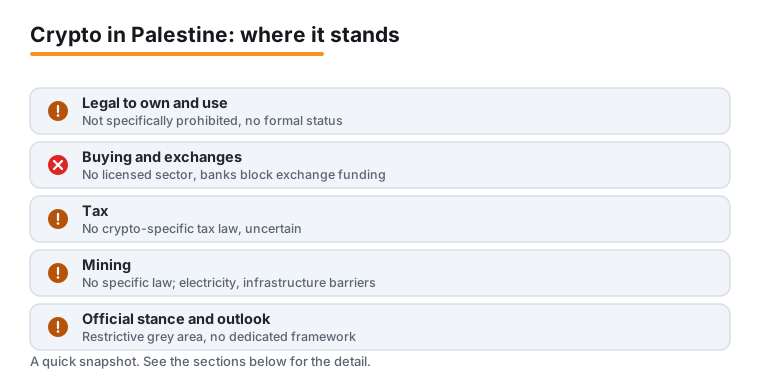
Holding, buying or sending Bitcoin and other cryptocurrencies is not specifically prohibited in the Palestinian territories. At the same time, no law recognises crypto as legal tender or grants it formal legal status. The practical result is a legal grey area: crypto activity is neither expressly banned nor formally licensed and protected. As of 2026 the Palestine Monetary Authority (PMA) has not issued a dedicated framework that legalises, licenses or fully prohibits private cryptocurrencies.
In practice the environment is restrictive rather than open. Local banks, following PMA directives, generally do not support cryptocurrency transactions, and reporting indicates the PMA blocks attempts to fund crypto exchanges from local bank accounts. So while you are unlikely to break a specific anti-crypto law by holding Bitcoin, the official banking system is not designed to accommodate it, and there is no consumer-protection regime, deposit insurance or dispute-resolution process covering digital assets.
Read the position as "not specifically prohibited" rather than "protected and regulated." Laws and official guidance can change; confirm the current position with the PMA or a qualified local lawyer before acting.
Who regulates money and crypto in Palestine?
The Palestine Monetary Authority (PMA) is the territory's central-bank-style regulator. Established in 1994 following the Paris Protocol, it describes itself as an independent public institution responsible for regulating and supervising the banking sector, formulating monetary policy, and protecting depositors. It supervises the banks operating across the West Bank and Gaza. Yahya Shunnar has served as PMA Governor since January 2025.
A defining constraint is that the PMA does not issue a national Palestinian currency. Under the 1994 Paris Protocol, monetary arrangements are tied to Israel, and several foreign currencies circulate in daily life: the Israeli new shekel, the Jordanian dinar (common in the West Bank) and the US dollar, with the Egyptian pound also seen in Gaza. This shapes everything about crypto, because there is no domestic monetary anchor and cross-border value transfer is a constant practical concern.
On the anti-money-laundering side, the Financial Follow-up Unit (FFU) operates as Palestine's financial intelligence unit and works alongside the PMA. There is no separate, dedicated crypto or virtual-asset regulator at this time.
Crypto laws and frameworks in Palestine
As of 2026, the Palestinian territories have no comprehensive statute governing cryptocurrency, virtual-asset service providers (VASPs), token issuance or crypto custody. There is no MiCA-style licensing regime, no public registry of approved exchanges, and no tax-code section written specifically for digital assets.
The laws that most plausibly touch crypto are the anti-money-laundering and counter-terrorism-financing (AML/CFT) framework. The core instrument was Decree-Law No. 20 of 2015 on Anti-Money Laundering and Terrorism Financing, amended by Decree-Law No. 13 of 2016, and later replaced or updated by the AML/CFT Decree-Law No. 39 of 2022. These laws are published by the PMA and the FFU. They are the most likely route through which obligations such as customer identification and suspicious-transaction reporting could be applied to anyone dealing in crypto through a regulated financial channel, even though they are not crypto-specific.
A separate, recent measure is Decree-Law No. 4 of 2026 on the Reduction of Cash Use, issued on 17 February 2026 and published in the official gazette on 25 February 2026. It prohibits cash settlement of transactions above ILS 30,000 (or the equivalent in other currencies) and pushes payments toward bank transfers, cards and electronic wallets. Notably, this law does not mention cryptocurrency or virtual assets; its "non-cash" definitions point to regulated, traditional digital payments rather than decentralised crypto. Because the rulebook is thin and evolving, assume future regulation could arrive with little notice; follow PMA communications and verify before acting.
Licensing and registration of exchanges (VASPs)
There is no licensed domestic crypto-exchange sector in Palestine and no local approval or registration process for trading platforms or VASPs as of 2026. The PMA has not published a virtual-asset licensing regime, so there is no list of locally authorised exchanges to choose from.
In practice, Palestinians who buy or sell crypto rely on international exchanges, peer-to-peer (P2P) marketplaces, or over-the-counter dealers. When you use a foreign platform you are relying on that platform's home-country rules and oversight, not on Palestinian licensing or protection. If funds are frozen, an account is closed, or a platform fails, there is no local regulator to appeal to.
Globally, the standard-setter for this area is the Financial Action Task Force (FATF), whose Recommendation 15 expects jurisdictions to register or license VASPs and apply AML/CFT rules to them. Palestinian AML/CFT law sits within the broader regional framework, but a specific, operational VASP licensing regime has not been established locally. Treat the absence of licensing as a gap in protection, not as official endorsement.
Crypto and Bitcoin tax in Palestine
There is no crypto-specific tax law in the Palestinian territories and no officially published rate, threshold or allowance dedicated to digital-asset gains. That does not automatically mean crypto activity is tax-free. General tax principles, such as income or business taxation, could in some circumstances apply to crypto-related profits or to a business that accepts crypto, depending on how the activity is characterised and how the authorities interpret existing rules.
Because nothing is codified specifically for crypto, the treatment of an individual investor's gains is genuinely uncertain. This guide does not state a percentage or a tax-free figure, because no verified crypto-specific number exists to cite. Anyone earning, trading or being paid in crypto should keep detailed records (dates, amounts, counterparties, and the local-currency value at the time) and obtain advice from a qualified Palestinian tax professional. Obligations may also depend on residency and on where an exchange or counterparty is based. For general background see our crypto taxes guide. This section is informational only and is not tax advice; confirm your position with a licensed accountant or the relevant tax authority before filing.
AML and KYC rules
Palestine has an established anti-money-laundering and counter-terrorism-financing (AML/CFT) regime, built on Decree-Law No. 20 of 2015 (amended by No. 13 of 2016) and the AML/CFT Decree-Law No. 39 of 2022, with the Financial Follow-up Unit (FFU) acting as the financial intelligence unit and the PMA supervising banks. These rules require regulated financial institutions to identify customers, monitor transactions and report suspicious activity.
There is, however, no crypto-specific AML licensing regime locally. In practice, the AML/KYC checks most Palestinians will encounter come from the international exchanges they use, which apply their own know-your-customer (identity verification) and anti-money-laundering procedures under their home jurisdictions and the FATF standards. Reporting has also described informal expectations that local crypto dealers record client identity details for each conversion, reflecting the general AML environment even outside a formal crypto rulebook.
If you transact in crypto, expect identity verification on reputable platforms, keep your own records, and be aware that cross-border transfers can trigger AML obligations on the platforms involved. The official AML/CFT legislation is published by the PMA and the FFU; verify the current text there.
Buying and using crypto in practice
Because there is no licensed local exchange, buying crypto in Palestine usually means using an established international exchange, a reputable P2P marketplace, or a trusted over-the-counter dealer. Several practical frictions shape how this works:
- Banking access. Local banks generally steer clear of crypto and the PMA reportedly blocks exchange funding from local accounts, so ordinary bank transfers to platforms can be difficult or unreliable.
- Currency mix. With the shekel, dinar and dollar all circulating, pricing and conversion add an extra step compared with a single-currency market.
- Identity checks. Reputable global exchanges apply KYC and AML checks, and verification can be harder where documentation, addresses or supported-country lists are restrictive.
- P2P and stablecoins. Peer-to-peer trades and dollar-pegged stablecoins such as USDT are widely used precisely because they route around some banking constraints; reporting suggests USDT in particular sees significant local use.
- Self-custody. For anything you are not actively trading, move funds to a wallet you control and back up your recovery phrase offline. There is no local regulator to reverse a scam or recover lost keys.
Cross-border payments and remittances are where crypto has the clearest real-world relevance here: when conventional transfers are slow, costly or disrupted, Bitcoin and stablecoins can move value quickly. The trade-offs are price volatility, friction converting back into spendable shekels, dinars or dollars (usually via P2P or informal dealers), and the absence of local legal protection. Used carefully it can be a practical tool; it is not a risk-free or fully sanctioned one.
Bitcoin mining in Palestine
There is no specific law that authorises or bans cryptocurrency mining in the Palestinian territories. In practice mining is uncommon and difficult, and the obstacles are largely physical and economic rather than legal.
The biggest barriers are electricity and infrastructure. Power supply in parts of the West Bank and Gaza can be limited, costly or intermittent, and mining is energy-intensive and only profitable where electricity is cheap and stable. Importing and maintaining specialised hardware is also harder under the territory's logistical and economic conditions. On top of that, mining revenue could attract tax or business-licensing questions under general rules, even though no crypto-mining-specific regime exists. Anyone considering mining should weigh electricity cost and reliability first, confirm they are not breaching utility or import rules, and get local advice on whether mining income would be treated as taxable business activity.
Recent developments (2025-2026)
Two developments stand out. First, the PMA continues to modernise the payments system rather than open crypto markets. Decree-Law No. 4 of 2026 on the Reduction of Cash Use, issued on 17 February 2026, pushes high-value transactions (above ILS 30,000) onto bank transfers, cards and electronic wallets. Supervision of the law is assigned under Article 9 to the PMA, working with the Ministry of Finance, the Ministry of National Economy, the Financial Follow-up Unit, the Customs Police and other bodies, and Article 10 grants a rectification period of up to six months from publication for affected parties to adjust. It does not mention cryptocurrency, but it signals an official direction toward regulated, traceable digital payments rather than decentralised assets.
Second, in February 2026 a dollar-backed stablecoin proposal for Gaza drew wide attention. Reporting, first published by the Financial Times on 23 February 2026 and later confirmed by the body itself, described the "Board of Peace" exploring a US-dollar-pegged stablecoin as part of a post-war reconstruction plan for Gaza. The proposal is presented as a digital payments tool, not a new Palestinian currency and not a replacement for the shekel, and is reported to be led by technology entrepreneur Liran Tancman as an unpaid adviser. As of mid-2026 it remains a proposal under discussion, not a launched or approved system, and critics have raised concerns about separating Gaza's economy from the West Bank and about the governance of digital financial control. This is separate from the PMA and from any official Palestinian framework; treat it as an announced idea to watch, not a live regulated product.
The wider backdrop is a banking crisis in Gaza. Reporting through 2025 and into 2026 described most bank branches as damaged or destroyed and only a handful of ATMs still working, with fresh shekel cash deliveries restricted. That breakdown of ordinary banking is a large part of why crypto, and dollar-pegged stablecoins in particular, are used informally on the ground.
Third, the long-discussed idea of a Palestinian digital currency remains aspirational. Since at least 2017 to 2021 the PMA has explored issuing a state digital currency to reduce dependence on the shekel, but the Paris Protocol gives Israel an effective veto over a Palestinian currency, and no such currency has launched. A central-bank-style digital currency, if ever issued, would be a state-controlled instrument and is conceptually different from decentralised assets like Bitcoin. As of 2026 there is no confirmed launch date, and private crypto use remains unformalised. Yahya Shunnar took over as PMA Governor in January 2025. Treat any current freedom as provisional and watch official PMA communications for change.
Consumer risks and protection
The central risk in Palestine is the absence of a clear legal and protective framework for crypto. Without crypto-specific regulation, users carry the full weight of platform failure, fraud, lost keys and price swings, with little local recourse. There is no deposit insurance and no dispute-resolution body covering digital assets, and reliance on foreign platforms plus informal off-ramps adds counterparty risk. Crypto is a high-volatility asset class everywhere, and stablecoins reduce but do not remove risk, since they depend on the issuer holding adequate reserves.
Scams are a particular concern. Fraudulent "humanitarian aid to Palestinians" crypto-donation schemes have been documented, exploiting goodwill to steal funds. Be sceptical of unsolicited investment offers, "guaranteed return" schemes and donation appeals that demand crypto. Practical safeguards: never invest money you cannot afford to lose, use reputable security-focused platforms, enable strong account protection, verify a counterparty's reputation before P2P trades, double-check wallet addresses, and self-custody anything you are not actively trading. Because there is no local regulator to reverse a loss, prevention is your main protection.
Official sources and how to verify
Because the legal position is evolving and unsettled, always confirm the current rules against primary official sources before acting:
- Palestine Monetary Authority (PMA): the central-bank-style regulator; its site publishes banking regulation, monetary policy and AML/CFT legislation.
- FATF country page for the Palestinian Authority: international AML/CFT context and standards (including Recommendation 15 on virtual assets).
- WAFA (official Palestinian news agency): official statements and gazette announcements, such as new decree-laws.
For broader background, see our crypto regulation guide and the regulation hub. This guide is general information as of 2026 and is NOT legal, tax or financial advice; verify your situation with the Palestine Monetary Authority or a qualified Palestinian professional before relying on any treatment.
Frequently asked questions
Is Bitcoin legal in Palestine?
Bitcoin is not specifically banned, but it has no formal legal status and is not legal tender. It sits in a grey area: not prohibited, but not regulated or protected. Local banks, following Palestine Monetary Authority directives, generally do not support crypto transactions, and there is no licensed local exchange sector or consumer-protection regime for digital assets. Verify the current position with the PMA or a local lawyer before acting.
Who regulates crypto in Palestine?
The Palestine Monetary Authority (PMA, pma.ps) is the central-bank-style regulator, supported by the Financial Follow-up Unit (FFU) for anti-money-laundering matters. Under the 1994 Paris Protocol the PMA does not issue a national currency, so the Israeli shekel, Jordanian dinar and US dollar circulate instead. As of 2026 the PMA has not created a dedicated crypto or VASP licensing framework.
Does Palestine tax cryptocurrency?
There is no crypto-specific tax law and no published rate or allowance dedicated to digital assets. That does not necessarily mean crypto is tax-free; general income or business tax rules could apply depending on the activity. Because the treatment is uncertain, keep detailed records and consult a qualified local tax professional. This is not tax advice.
Are crypto exchanges licensed in Palestine?
No. As of 2026 there is no local licensing or registration regime for crypto exchanges or virtual-asset service providers, and no list of locally authorised platforms. Palestinians typically use international exchanges or peer-to-peer marketplaces, which means relying on those platforms' home-country rules rather than local Palestinian protection. There is no local regulator to appeal to if funds are frozen or lost.
What does Decree-Law No. 4 of 2026 mean for crypto?
Decree-Law No. 4 of 2026 on the Reduction of Cash Use, issued on 17 February 2026, prohibits cash settlement of transactions above ILS 30,000 and pushes payments toward bank transfers, cards and electronic wallets. It does not mention cryptocurrency or virtual assets, and its definitions point to regulated traditional digital payments rather than decentralised crypto. It signals an official direction toward traceable electronic payments.
Can I send remittances to Palestine using Bitcoin?
In practice, yes, and it is one of the most common real uses of crypto there. Bitcoin and dollar-pegged stablecoins like USDT are used informally to move value across borders when conventional transfers are slow, costly or restricted. The trade-offs are price volatility, friction converting back into local cash, and a lack of local legal protection, so use reputable tools and trusted counterparties.
Is there a Gaza stablecoin, and is it official?
Not as a live product. In February 2026, reporting first published by the Financial Times, and later confirmed by the body, described the "Board of Peace" exploring a US-dollar-backed stablecoin for Gaza as part of a post-war reconstruction plan. It is presented as a digital payments tool, not a new Palestinian currency and not a replacement for the shekel, and is reported to be led by technology entrepreneur Liran Tancman as an unpaid adviser. As of mid-2026 it is a proposal under discussion, not an approved or launched system, and it is separate from the Palestine Monetary Authority. Treat it as news to watch, not something to buy into.
Why do people in Gaza use crypto and stablecoins?
Mainly because ordinary banking has broken down. Reporting through 2025 and into 2026 described most bank branches as damaged or destroyed, only a handful of working ATMs, and restricted deliveries of shekel cash. With services like PayPal and Western Union limited, dollar-pegged stablecoins such as USDT are used informally to receive remittances and aid and to pay suppliers. This is out of necessity, not because crypto is officially sanctioned; there is still no local licensing or consumer protection, so the volatility and counterparty risks described above apply.
Facts reviewed: 30 June 2026. Page updated: 3 August 2026.