Home › Crypto Regulation › Gabon
Bitcoin & Cryptocurrency Regulation in Gabon
Quick answer — Gabon, 2026
- Legal: Owning not criminalised, not legal tender, banks barred under CEMAC rules
- Tax: No crypto-specific tax, general rules may apply
- Buying: No domestic licensed exchange, use international platforms and P2P
Gabon is a Central African oil producer and a member of the Economic and Monetary Community of Central Africa (CEMAC), so its approach to Bitcoin and cryptocurrency is shaped far more by regional rules than by any single national crypto law. Gabon uses the Central African CFA franc (XAF), issued by the Bank of Central African States (BEAC), and its banking and financial-market activity is supervised by regional institutions rather than a standalone Gabonese crypto regulator. For anyone in Gabon trying to understand whether they can legally hold, buy, mine, or send crypto, the practical answer turns on a key distinction: what private individuals may do versus what licensed financial institutions are permitted to do.
This page explains the legal status of crypto in Gabon as of 2026, identifies the relevant regulators and their official websites, and sets out the realities of tax, buying, mining, AML/KYC and consumer protection. It is general information as of 2026 and is NOT legal, tax, or financial advice. CEMAC crypto rules are actively evolving, so verify any specific point with the named official regulators (BEAC, COBAC and COSUMAF) or a qualified local professional before acting. See also our overview of crypto regulation.
On this page: Legal status · Who regulates it · Taxes · How to buy · Mining
Is Bitcoin and crypto legal in Gabon?
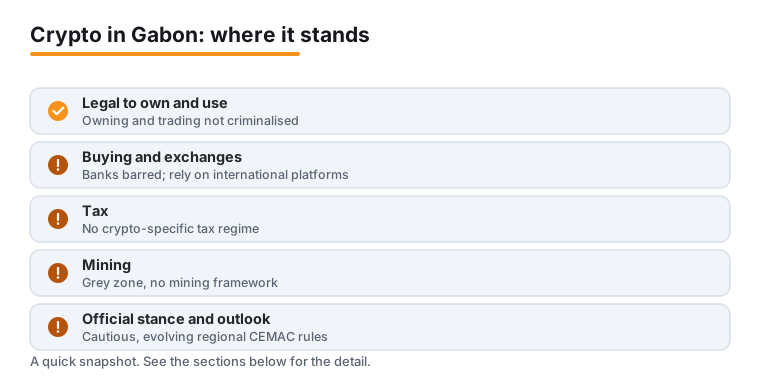
There is no Gabonese law that criminalises private individuals for owning or trading cryptocurrency, and no law recognises Bitcoin as legal tender. In practice, holding crypto in a personal wallet and trading on international platforms is not illegal for individuals, but it is not formally protected by a dedicated national consumer-protection regime either.
The decisive restriction sits at the institutional level. Because Gabon belongs to CEMAC, it is subject to the regional banking supervisor, the Central African Banking Commission (COBAC). Decision COBAC D-2022/071 of 6 May 2022 bars the institutions COBAC supervises, meaning credit institutions, microfinance institutions and payment service providers, from acquiring, holding, transferring or converting crypto-assets for their own account or for clients, bars them from keeping accounts in cryptocurrencies or carrying them on the balance sheet, and requires internal controls to detect such operations and inform COBAC and BEAC. It is addressed to supervised institutions and does not directly bind private citizens. The result is a two-tier reality: an individual may legally own Bitcoin, but the regulated banking system is largely barred from acting as an on-ramp or off-ramp for it.
Some low-quality articles claim Gabon has "formally adopted Bitcoin" or built a complete national crypto framework. That overstates the situation. Gabon has not made Bitcoin legal tender (unlike, briefly, the neighbouring Central African Republic, which later reversed course), and treatment of crypto remains cautious and largely regional. Always confirm the current position with the official sources listed at the end of this page.
Who regulates crypto in Gabon
There is no standalone Gabonese crypto regulator. Oversight comes from three regional CEMAC institutions, plus Gabon's national tax authority for fiscal questions:
- BEAC (Bank of Central African States) is the regional central bank. It issues the CFA franc, sets monetary policy and manages the shared foreign reserves. BEAC has not recognised any cryptocurrency as legal tender and has publicly voiced caution, including at the January 2024 Douala fintech forum, where it argued that buying crypto with converted CFA francs drains the zone's foreign-exchange reserves. It has since pushed a one-to-one digital CFA franc rather than open crypto as its preferred direction. Official site: beac.int.
- COBAC (Central African Banking Commission) is the regional banking supervisor. Its May 2022 decision restricts banks, microfinance institutions and payment service providers from facilitating crypto transactions and imposes monitoring and reporting duties on them.
- COSUMAF (Commission de Surveillance du Marche Financier de l'Afrique Centrale) is the regional financial-market and securities regulator. Its updated rulebook opened a pathway for crypto-asset platforms to seek approval as licensed market intermediaries. Official site: cosumaf.org.
For tax matters, the relevant national body is Gabon's tax authority, the Direction Generale des Impots (DGI): dgi.ga. Because the regional texts are being debated and amended, treat the details here as a starting point and check the latest BEAC, COBAC and COSUMAF publications.
Key laws and frameworks
Crypto in Gabon is governed by regional CEMAC instruments rather than a single Gabonese statute. Two pillars matter most, and they pull in different directions:
- COBAC May 2022 decision prohibiting reporting entities (banks, microfinance institutions, payment service providers and their technical partners) from subscribing to, holding, exchanging, converting, settling or hedging crypto-asset transactions for their own account or on behalf of clients, with monthly reporting obligations on any flagged transactions.
- COSUMAF Reglement General on the organisation and functioning of the Central African financial market (Reglement n 01/22/CEMAC/UMAC/CM/COSUMAF, adopted 21 July 2022). This text brings digital tokens within the scope of admitted financial instruments and treats "virtual asset service providers" as a category of market intermediary that can be approved by COSUMAF. As of a legal review published on 18 June 2026, no PSAN implementing instruction had been published and no PSAN approval had been granted anywhere in CEMAC, so the regime remains on paper.
The net effect is an evolving, partly contradictory framework: COBAC keeps crypto out of the regulated banking channel, while COSUMAF has created a route to license crypto-asset service providers at the capital-market level. There is no comprehensive Gabon-specific national act that codifies consumer protection, exchange licensing or custody rules. Because these regional texts continue to change, verify any detail directly with the regulators before relying on it. For background, see our guide to crypto regulation.
Licensing and registration of exchanges and VASPs
Gabon has no domestic crypto-exchange licensing regime of its own. At the regional level, COSUMAF's updated rulebook defines virtual asset services to include custody of virtual assets for others, exchange between virtual assets and fiat or other tokens, operating trading platforms, transmitting orders for third parties, portfolio management and related advisory and investment activity. A provider wishing to offer these services as a "virtual asset service provider" would seek approval as a market intermediary from COSUMAF.
In practice, this pathway is still maturing. No PSAN-specific implementing instruction had been published as of June 2026, and the Reglement General itself sets no minimum capital and no exact filing requirements, so there is nothing usable to apply against. BEAC was still drafting a sub-regional crypto-asset framework with the IMF, which Governor Yvon Sana Bangui said in Dakar on 9 May 2026 is expected to be published during the current financial year. Until those implementing texts are in force, the licensing route should be treated as emerging rather than settled. There is no public register indicating that a Gabon-based, COSUMAF-approved crypto exchange is operating at scale, so most users continue to rely on international platforms. Anyone planning to operate a VASP touching Gabon should obtain specialist CEMAC legal advice and confirm the current status with COSUMAF directly.
Crypto and Bitcoin tax in Gabon
Gabon has no crypto-specific tax rule and the Direction Generale des Impots has published no crypto guidance. Gabon does have published general rates that a disposal would fall under: a tax on capital gains at 20%, payable before 30 April of the year following the gain, IRPP rising to 35%, corporate income tax at 30% and VAT at 18%. None of these is a crypto rate. There is no widely documented "Bitcoin tax" rule, and you should be sceptical of sources that quote precise crypto capital-gains rates or thresholds for Gabon, because such figures are generally not verifiable against official tax legislation.
In the absence of crypto-specific rules, gains or income connected to digital assets would typically be considered under Gabon's general tax principles for personal income, business profits and capital gains. How a transaction is characterised, whether personal investment, frequent trading, business revenue or mining income, can change the treatment significantly, so keep dated records of every acquisition, disposal and transfer along with the XAF value at the time of each event. Gabon's tax authority has also been digitising filing through an online e-tax portal.
Because tax outcomes depend on your specific facts and on rules that can change, consult the Direction Generale des Impots, dgi.ga, or a qualified local accountant. See our general explainer on crypto taxes. This section is informational only and is not tax advice.
AML, KYC and reporting rules
Anti-money-laundering obligations in Gabon flow from Reglement n 02/24/CEMAC/UMAC/CM of 20 December 2024, which replaced the earlier CEMAC AML regulation, runs to 186 articles and for the first time defines virtual assets and virtual asset service providers and brings them expressly inside the reporting perimeter, alongside a ban on cash payments above XAF 5,000,000 and a duty to declare transactions above that threshold. The COBAC May 2022 decision does more than restrict banks from handling crypto: it also requires reporting entities to identify and track transactions connected to cryptocurrencies and to file detailed monthly reports covering the ordering client, beneficiaries, amounts, transaction currency, any crypto consideration and the purpose of the transaction. CEMAC's broader AML/CFT regime, supervised regionally, continues to apply to the formal financial sector.
On the capital-market side, COSUMAF has been strengthening its own AML/CFT requirements as it builds out the market-intermediary regime, so any future licensed crypto-asset service provider would be expected to apply customer due diligence, identity verification and suspicious-transaction reporting consistent with those standards. For individuals, the practical effect is that reputable international platforms serving Gabonese users will require KYC (a government ID and sometimes proof of address); avoid services that skip verification entirely, as they are more likely to be used for fraud and may expose you to legal and counterparty risk.
Buying and using crypto in practice
Because local banks and payment providers are restricted from facilitating crypto, buying Bitcoin in Gabon usually happens through international platforms and peer-to-peer (P2P) methods rather than a domestic exchange. A typical path:
- Choose a platform. Many global exchanges and P2P marketplaces serve African users. Check whether the platform accepts Gabonese users, which payment methods work locally (often mobile money or P2P transfers) and what its security and withdrawal policies are.
- Complete identity verification. Reputable platforms require KYC. Avoid services that skip verification entirely.
- Fund and trade. Use mobile-money or P2P rails where direct bank transfers are impractical, then place your order and confirm the all-in cost, including spreads and fees, before committing.
- Secure your coins. For anything beyond small amounts, move funds to a wallet you control and back up your recovery phrase offline. Self-custody removes platform-failure risk but makes you fully responsible for security.
Crypto is also sometimes promoted as a faster, cheaper way to send remittances than traditional channels, settling in minutes regardless of banking hours. The appeal is genuine for tech-comfortable users, but the same on/off-ramp friction, price volatility, all-in fees and connectivity barriers apply, and informal channels carry legal and counterparty risk. Compare the real all-in cost and risk against licensed money-transfer providers before relying on crypto for meaningful sums. None of this is an endorsement of any specific service; do your own due diligence.
Bitcoin mining in Gabon
There is no specific Gabonese law that authorises or prohibits Bitcoin mining, so mining sits in a grey zone: not explicitly banned, but not supported by a clear licensing regime either. Anyone considering it would still be subject to general rules on business registration, electricity-supply contracts, import duties on hardware and the regional banking restrictions if mining proceeds are routed through banks.
Gabon's most interesting mining angle is energy. The country has significant hydroelectric potential and abundant rainfall, exactly the kind of renewable or stranded energy that large-scale miners look for to lower costs and emissions. In theory, hydro-rich regions could host efficient operations. In practice the obstacles are real: grid reliability and capacity constraints, limited high-bandwidth connectivity in remote areas, hardware import logistics and regulatory uncertainty about how mining income would be taxed. None of the "green mining" potential changes the fact that there is currently no formal Gabonese mining framework, so anyone exploring it should seek local legal and energy-sector advice first.
Recent developments (2025-2026)
The most important trend is a regional push toward a single, harmonised crypto-asset framework. In February 2025, BEAC held a capacity-building workshop bringing together COBAC, COSUMAF and GABAC (the Central African anti-money-laundering task force) to prepare region-wide crypto-asset rules, and BEAC has been working with the International Monetary Fund on a sub-regional framework. This effort aims to reconcile the tension between COBAC's banking-channel prohibition and COSUMAF's market-intermediary pathway. The CEMAC Conference of Heads of State has instructed BEAC, the CEMAC Commission, COBAC and COSUMAF to put a harmonised crypto-asset framework in place, BEAC and the IMF held a preparatory seminar in Yaounde from 23 to 27 February 2026 with COBAC, COSUMAF and GABAC, and BEAC said on 9 May 2026 that publication is expected during the current financial year. That is a stated expectation rather than a legal deadline, and no draft text had been published as of August 2026.
BEAC's public stance has stayed cautious. At the first CEMAC fintech forum in Douala (29 to 31 January 2024), BEAC officials pushed back on fintech calls to regulate open cryptocurrencies, arguing that converting the CFA franc into dollars or euros to buy crypto spends the zone's shared foreign-exchange reserves and weakens the currency. In parallel, BEAC has signalled that its preferred answer is a sovereign digital CFA franc. Governor Yvon Sana Bangui has framed this around a single parity, one CFA franc to one digital CFA franc, describing it as a question of monetary sovereignty, and BEAC has said any stablecoin allowed in the zone would need to be pegged one-to-one to the CFA franc rather than to the dollar. This is a stated direction rather than a launched product, and details remain to be confirmed. Because this area is moving quickly, the safest course is to verify the current position with BEAC, COBAC and COSUMAF before acting. See also this report.
Consumer risks and protection
The defining risk in Gabon is regulatory uncertainty layered on top of the universal hazards of crypto. CEMAC's stance has swung between restriction and cautious openness: COBAC keeps crypto out of the banking channel, COSUMAF has created a licensing pathway that is still being operationalised, and BEAC remains wary of broad adoption. Rules could tighten or formalise further, and what is tolerated today may be regulated tomorrow.
Because there is no comprehensive national consumer-protection regime for crypto and most activity happens through international or informal channels, you have limited formal recourse if a platform fails, a P2P counterparty defaults or you are defrauded. On top of that come price volatility, scams, exchange or counterparty failure and the irreversibility of mistaken or stolen transfers. Protect yourself: only commit money you can afford to lose, prefer reputable platforms with strong security and KYC, use built-in escrow for P2P trades and never settle outside it, be alert to "guaranteed return" schemes and unsolicited offers, keep clear dated records, and secure self-custodied funds with an offline backup of your recovery phrase. COSUMAF has acted in Gabon itself. By a communique of 9 November 2023 it found that BMI INVESTISSEMENT GABON had circulated prospectuses inviting the public to subscribe to cryptocurrency titles promising substantial gains, held the operation to be in breach of the public offering rules because the company was not among its approved bodies, ordered the breaches to stop without delay and referred the matter to the competent judicial authorities.
Official sources and how to verify
Crypto rules in Gabon are evolving, so always confirm the current position against primary, official sources rather than secondary articles. The authoritative starting points are:
- BEAC (Bank of Central African States), the regional central bank issuing the CFA franc: beac.int.
- COSUMAF, the Central African financial-market regulator that publishes the market regulation and instructions covering virtual asset service providers: cosumaf.org.
- Direction Generale des Impots (Gabon), the national tax authority for any tax question: dgi.ga.
For COBAC's banking decision, look for its text via BEAC's site, as COBAC operates within the BEAC framework. You can compare with our broader regulation hub for other countries. This page is general information as of 2026 and is NOT legal advice; verify your specific situation with the named official regulators or a qualified Gabonese professional before acting.
What is changing, and roughly when
Nothing crypto-specific has been adopted for Gabon or for CEMAC since this page was last reviewed. What exists is a mandate, a drafting process and a stated expectation. The CEMAC Conference of Heads of State has instructed BEAC, the CEMAC Commission, COBAC and COSUMAF to put a harmonised crypto-asset framework in place, a point BEAC restated at a central bank governors' round table in Kigali on 11 March 2026. BEAC and the IMF then ran a preparatory seminar in Yaounde from 23 to 27 February 2026 with COBAC, COSUMAF, GABAC and Financial Stability Board specialists.
| Item | Stage in August 2026 | Timing stated by officials |
|---|---|---|
| Harmonised CEMAC crypto-asset framework, drafted by BEAC with the IMF | Being drafted. No text or draft published | BEAC said in Dakar on 9 May 2026 that publication is expected during the current financial year. That is an expectation, not a legal deadline |
| COSUMAF implementing instructions for digital asset service providers | Not published, as recorded by a legal review of 18 June 2026 | No date announced |
| First digital asset service provider approval anywhere in CEMAC | None granted | No date announced |
| Revision of the CEMAC payment services framework covering fintechs and payment aggregators | Consultations with the participants concerned under way. Not a crypto text | Consultations close in September 2026, texts then submitted for adoption, per the UMAC Ministerial Committee of 22 July 2026 |
| BEAC digital CFA franc (e-CFA) | Under study. BEAC has never officially launched a digital currency project | No circulation date announced |
| A Gabonese national crypto bill | None. The National Assembly examined 33 bills and adopted 23 in the first ordinary session of the 6th legislature, none on crypto-assets | Not on the published legislative programme |
The practical reading for a holder in Gabon: expect no change to your legal position during 2026 unless BEAC publishes the sub-regional framework. Even then, a published framework would still need COSUMAF instructions before any exchange could actually be licensed to serve you locally.
The named rules that actually apply
Gabon has no crypto statute of its own, so a handful of community texts do the work. Naming them lets you check the position yourself rather than rely on secondary summaries.
- Decision COBAC D-2022/071 of 6 May 2022 on the holding, use, exchange and conversion of cryptocurrencies by institutions supervised by COBAC. It bars credit institutions, microfinance institutions and payment service providers from acquiring, holding, transferring or converting crypto-assets for their own account or for clients, bars them from keeping accounts in cryptocurrencies or carrying them on the balance sheet, and requires internal controls to detect such operations and inform COBAC and BEAC. As a published legal commentary notes, it is a decision addressed to supervised institutions rather than a general regulation, so it does not directly bind private citizens.
- Reglement n 01/22/CEMAC/UMAC/CM/COSUMAF of 21 July 2022, which organises the Central African financial market. Breaches of its public offering rules carry pecuniary sanctions at articles 264 and following, and COSUMAF has used it against a crypto scheme in Gabon.
- The COSUMAF Reglement General, adopted 23 May 2023, the first binding CEMAC text requiring approval for digital asset service providers. Article 336 defines a digital token as any intangible good representing, in digital form, one or more rights. Article 92 requires a written AML/CFT commitment from any applicant and article 93 requires procedures matched to a risk assessment specific to the activity. Approval covers buying and selling digital assets against legal tender, custody for third parties, operating a trading platform, receiving and transmitting orders, portfolio management, advice and placement. A review published on 18 June 2026 records that the text sets no minimum capital and no exact filing requirements, and that no approval has been granted.
- Reglement n 02/24/CEMAC/UMAC/CM of 20 December 2024 on money laundering and terrorist financing, in force from signature. It replaced the earlier CEMAC AML regulation, runs to 186 articles against 166 before, and for the first time defines virtual assets and virtual asset service providers and extends its scope expressly to them. It also restates the ban on cash payments above XAF 5,000,000 and the duty on reporting entities to declare transactions above XAF 5,000,000, plus any suspicious transaction whatever the amount. Compliance deadlines are left to the sectoral regulators. A parallel text, Reglement COBAC R-2023/01 of 19 December 2023, sets AML due diligence duties for supervised institutions and entered into force on 1 July 2024.
Read together: a Gabonese bank cannot touch crypto, a platform serving Gabonese users needs a COSUMAF approval it cannot yet obtain, and the AML regulation already names virtual asset service providers as reporting entities even though none has been approved in the zone.
Tax: no crypto rule, but real Gabonese rates
Gabon has no crypto-specific tax provision and the Direction Generale des Impots has published no crypto guidance. The 2026 budget law, Loi n 041/2025 du 29 decembre 2025, contains no digital asset measure. None of the rates below is a crypto rate. They are the general Gabonese rates a disposal would fall under, and they are published, which is more than the page currently offers.
- Capital gains tax: 20%. Gabon applies a tax on capital gains at 20%, payable by the taxpayer who made the gain before 30 April of the year following the year in which it was made (PwC Worldwide Tax Summaries, last reviewed 6 August 2026). Capital gains are not generally subject to IRPP but may be subject to this tax.
- Personal income tax: progressive to 35%. IRPP runs from 0% on the first XAF 1,500,000 of income per share to 35% above XAF 11,000,000 per share, plus a 5% complementary tax on salaries, with the first XAF 150,000 a month exempt (PwC).
- Corporate income tax: 30%, or 35% for companies in the oil and mining sectors, with a minimum tax of 1% of global turnover and a floor of XAF 500,000 even in the absence of profit (PwC). For companies, capital gains feed into taxable profit, with a deferral where an amount equal to the gain and the sale price is reinvested in fixed assets within three years (PwC).
- VAT: 18% standard rate.
- Non-resident share transfers: the liberatory levy on the gain where a non-resident partner transfers rights in a Gabonese company rises from 20% to 25% under the 2026 budget law.
An occasional personal disposal plausibly sits with the 20% capital gains tax, while regular trading or mining that looks like a business would be pulled toward income tax or corporate tax on profits. Which one applies to your facts is exactly the question the DGI has not answered publicly, so treat any source quoting a specific Gabonese crypto tax rate as unverified, keep dated records of every acquisition and disposal with the XAF value at the time, and take local advice before filing. This is information, not tax advice.
What has actually happened in Gabon
Two Gabon-specific facts are worth more than a page of regional summary.
- The regulator has already acted in Gabon. By a communique of 9 November 2023 signed by COSUMAF president Jacqueline Adiaba Nkembe, COSUMAF found that BMI INVESTISSEMENT GABON had published and circulated prospectuses inviting the public to subscribe to cryptocurrency titles promising substantial gains. COSUMAF stated the company did not appear among its approved bodies, that the operation breached the public offering provisions of Reglement n 01/22/CEMAC/UMAC/CM/COSUMAF of 21 July 2022 and the COSUMAF general regulation, issued an injunction to stop the breaches without delay, and referred the matter to the competent judicial authorities (Droit Medias Finance). If a scheme in Gabon offers you crypto returns, the first check is whether it appears on COSUMAF's approved list.
- The state is not hostile at the promotion level. On Saturday 27 June 2026 the headquarters of ANPI-Gabon, the national investment promotion agency, hosted Gabon Crypto Day, opened by deputy director general Hashir Mabignath Sall Joumas, with sessions on careers in digital finance and on the place of Bitcoin in francophone Africa (Gabon Media Time, 29 June 2026). A state agency hosting a crypto day sits oddly beside COBAC's banking prohibition, and that gap is the honest picture of where Gabon currently stands.
On AML standing, Gabon is not among the 22 jurisdictions under FATF increased monitoring following the plenary of 17 to 19 June 2026, unlike neighbouring Cameroon and the Democratic Republic of the Congo (ComplyAdvantage, Checklynx). Gabon is assessed through GABAC, the FATF-style regional body for Central Africa.
Frequently asked questions
Is Bitcoin legal in Gabon?
Owning and trading Bitcoin as an individual is not criminalised in Gabon, but Bitcoin is not legal tender and is not formally endorsed. Under CEMAC-wide rules, the regional banking supervisor (COBAC) restricts banks, microfinance institutions and payment providers from facilitating crypto transactions, so crypto sits largely outside the regulated banking system. This is general information, not legal advice; verify with the official regulators.
Who regulates cryptocurrency in Gabon?
There is no standalone Gabonese crypto regulator. Oversight comes from three regional CEMAC bodies: BEAC (the central bank, beac.int, which issues the CFA franc and has not recognised crypto as legal tender), COBAC (the banking supervisor behind the institutional restrictions), and COSUMAF (the financial-market regulator, cosumaf.org, which has introduced a licensing pathway for virtual asset service providers). For tax, the national body is the Direction Generale des Impots (dgi.ga).
Do I have to pay tax on crypto in Gabon?
Gabon has no documented crypto-specific tax regime, so gains or income would generally fall under existing personal income, business-profit and capital-gains principles depending on the facts. Be wary of articles quoting exact crypto tax rates for Gabon, as these are usually not verifiable. Consult the Direction Generale des Impots (dgi.ga) or a qualified accountant. This is not tax advice.
Can a crypto exchange get a licence in Gabon?
Not through a national Gabonese regime, but COSUMAF's updated CEMAC market rulebook lets a virtual asset service provider seek approval as a market intermediary. That pathway is still being operationalised through implementing instructions, and a harmonised CEMAC-wide crypto-asset framework was being prepared with BEAC, COBAC and the IMF. Anyone planning to operate should confirm the current status directly with COSUMAF (cosumaf.org).
How can I buy Bitcoin in Gabon if banks restrict crypto?
Most users rely on international exchanges and peer-to-peer marketplaces, often funded via mobile money or P2P transfers rather than direct bank channels. Use platforms that accept Gabonese users and require identity verification (KYC), keep funds in a wallet you control, and use built-in escrow for P2P trades to reduce counterparty risk. Be alert to scams and never settle a P2P trade outside the platform's escrow.
Is the CEMAC crypto framework changing?
Yes. In February 2025, BEAC held a workshop with COBAC, COSUMAF and the GABAC anti-money-laundering task force to prepare a harmonised CEMAC crypto-asset framework, working with IMF support to reconcile COBAC's banking-channel ban with COSUMAF's market-intermediary route. BEAC has also signalled interest in a digital CFA franc to counter dollar stablecoins. Because the picture is shifting, verify the latest position on the official BEAC and COSUMAF sites before acting.
Does BEAC want to ban crypto in Gabon?
BEAC, the regional central bank, has been openly cautious rather than issuing an outright ban on private ownership. At the January 2024 CEMAC fintech forum in Douala it resisted calls to regulate open cryptocurrencies, arguing that converting CFA francs into dollars or euros to buy crypto spends the zone's shared reserves and weakens the currency. Its preferred route is a sovereign digital CFA franc pegged one-to-one to the existing franc. The banking-channel restrictions come from COBAC, not a criminal ban on individuals.
Can I use a stablecoin like USDT in Gabon?
There is no Gabonese law criminalising an individual for holding a dollar-pegged stablecoin, but the regulated banking system is restricted from facilitating crypto, so on and off ramps run through international platforms or peer-to-peer channels. BEAC has publicly opposed dollar-backed stablecoins circulating in the CEMAC zone and has said any stablecoin it would permit must be pegged one-to-one to the CFA franc. Treat this as an evolving area and verify the current position with the official regulators before relying on it.
Is a crypto law coming to Gabon, and when?
Not a Gabonese one. The CEMAC Conference of Heads of State has instructed BEAC, the CEMAC Commission, COBAC and COSUMAF to put a harmonised crypto-asset framework in place, and BEAC is drafting it with the IMF. BEAC Governor Yvon Sana Bangui said at a Dakar conference on 9 May 2026 that publication is expected during the current financial year, which is an expectation rather than a legal deadline. No draft text has been published. Gabon's own National Assembly examined 33 bills in the first ordinary session of the 6th legislature and adopted 23, none of them on crypto-assets.
What tax would I pay if I sell crypto at a profit in Gabon?
There is no crypto-specific rule and the Direction Generale des Impots has issued no crypto guidance, so the answer depends on how your activity is characterised. Gabon applies a tax on capital gains at 20%, payable before 30 April of the year following the year the gain was made. Personal income tax is progressive up to 35%, corporate income tax is 30% and 35% for oil and mining, and VAT is 18%. None of those is a crypto rate. An occasional personal disposal plausibly sits with the capital gains tax, while frequent trading or mining that looks like a business would tend toward income or corporate tax on profits. Keep dated records of every acquisition and disposal with the XAF value at the time, and confirm your position with the DGI or a local accountant. This is not tax advice.
Has any exchange been licensed to serve Gabon under the CEMAC rules?
No. The COSUMAF Reglement General adopted on 23 May 2023 requires approval for digital asset service providers, but as of June 2026 no approval had been granted anywhere in CEMAC and no PSAN-specific implementing instruction had been published. The regulation itself sets no minimum capital and no exact filing requirements, so there is nothing usable to apply against. In practice international platforms continue to serve Gabonese users from outside the zone, which means no local licence and no local legal recourse if something goes wrong.
Does the CEMAC anti-money-laundering regulation mention crypto?
Yes, since 20 December 2024. Reglement n 02/24/CEMAC/UMAC/CM replaced the earlier CEMAC AML regulation, runs to 186 articles against 166 before, and for the first time defines virtual assets and virtual asset service providers and extends the reporting perimeter expressly to them. It also restates a ban on cash payments above XAF 5,000,000 and a duty on reporting entities to declare transactions above XAF 5,000,000 and any suspicious transaction whatever the amount. It entered into force on the date of signature and is directly applicable in Gabon, with compliance deadlines left to the sectoral regulators.
Is Gabon on the FATF grey list?
No. Gabon is not among the 22 jurisdictions under FATF increased monitoring following the plenary of 17 to 19 June 2026, unlike neighbouring Cameroon and the Democratic Republic of the Congo. Gabon is assessed through GABAC, the FATF-style regional body for Central Africa.
Facts reviewed: 13 August 2026. Page updated: 13 August 2026.