Home › Crypto Regulation › Samoa
Bitcoin & Cryptocurrency Regulation in Samoa
Quick answer — Samoa, 2026
- Legal: Personal ownership tolerated, not legal tender; dealers and promoters regulated under AML law
- Tax: No verified crypto-specific tax; general income and business rules may apply
- Buying: No local licensed exchange; use international exchanges and P2P
Samoa takes a cautious, compliance-first approach to cryptocurrency. Bitcoin and other digital assets are not recognised as legal tender, and Samoa has no dedicated, comprehensive crypto law that licenses exchanges or sets out a bespoke digital-asset tax regime. Instead, the activity of dealing in or promoting cryptocurrency is captured by Samoa's anti-money-laundering framework, and the Central Bank of Samoa (CBS), the country's monetary authority and primary AML supervisor, has publicly warned that crypto is speculative and is not a regulated means of payment. This page explains what that means in practice as of 2026, covering legal status, the regulators, the relevant laws, licensing, tax, AML/KYC duties, buying and using crypto, mining, recent developments, consumer protection, and how to verify the position with official sources.
This article is general information as of 2026 and is not legal, tax, or financial advice. Crypto rules in small jurisdictions can change with little notice; always confirm the current position directly with the Central Bank of Samoa and a qualified Samoan professional before acting. See also our guide to crypto regulation.
On this page: Legal status · Who regulates it · Taxes · How to buy · Mining
Is Bitcoin and crypto legal in Samoa?
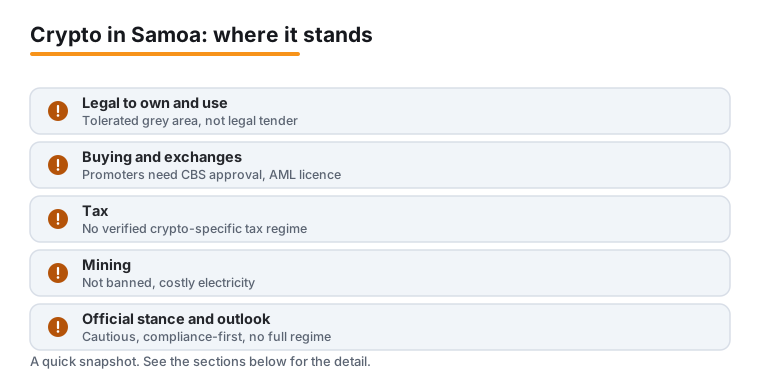
Owning, buying, and holding Bitcoin is not prohibited for individuals in Samoa, but it is important to be precise about what "legal" means here. The Central Bank of Samoa has stated that cryptocurrencies such as Bitcoin and Ethereum are not issued or regulated by the Central Bank and do not have legal-tender status. The Samoan tala (WST) remains the only legal tender, and no merchant or institution is obliged to accept crypto as payment.
At the same time, crypto is not a free-for-all. Anyone who promotes, markets, or runs a business dealing in cryptocurrency falls within Samoa's money-laundering rules and is treated as a regulated financial institution, so licensing and reporting obligations apply. In a public notice first issued on 21 February 2019, the CBS said promoters who wish to carry out crypto promotions or presentations in Samoa must first obtain the Central Bank's approval, and that breaches can carry a fine, an imprisonment term, or both.
The practical summary for 2026: personal ownership sits in a tolerated, largely unregulated grey area; commercial crypto activity is regulated through the AML framework; and crypto is explicitly not money in the legal sense. Because policy can shift, verify the live position with the CBS before relying on any of this. For background, see our overview of crypto regulation.
Who regulates crypto in Samoa
There is no single dedicated crypto regulator in Samoa. Oversight is shared across a small number of bodies:
- Central Bank of Samoa (CBS) is the country's monetary authority and the lead institution on crypto. It is responsible for currency, supervision of licensed financial institutions, AML/CFT supervision, and the public warnings and approvals that apply to crypto promoters. Its official website is cbs.gov.ws.
- Financial Intelligence Unit (FIU), which operates within the Central Bank's financial-stability function, receives and analyses suspicious-transaction and threshold reports under the AML regime.
- Money Laundering Prevention Authority, established under the Money Laundering Prevention Act, oversees compliance by reporting entities, including those dealing in or promoting virtual currency.
- Ministry of Customs and Revenue administers taxation generally; there is no crypto-specific tax authority.
Samoa is also a member of the Asia/Pacific Group on Money Laundering (APG), so its framework is shaped by FATF-aligned international standards. The CBS is the authoritative first stop for any question about the status of crypto in Samoa.
Key laws and frameworks
Samoa does not yet have a single, purpose-built "digital assets act." The most relevant rules come from its anti-money-laundering and counter-terrorism-financing (AML/CFT) regime and from central-bank guidance.
- Money Laundering Prevention Act 2007 is the core AML statute. It designates the Central Bank of Samoa as the primary supervisor for money-laundering prevention and sets out customer due-diligence and reporting duties for financial institutions.
- Money Laundering Prevention Amendment Act 2018 extended the definition of "financial institution" to capture dealers and promoters of virtual or digital currency and activity related to blockchain technology. This is the key provision that brings crypto businesses inside the regulated perimeter.
- Central Bank of Samoa Act 2015 establishes the CBS, its mandate over currency and monetary stability, and its supervisory powers.
- Financial Institutions Act 1996 governs the licensing and supervision of financial institutions, which now includes crypto dealers and promoters via the 2018 amendment.
- Related instruments include the Money Laundering Prevention Regulations 2009, the Counter Terrorism Act 2014, and the Proceeds of Crime Act 2007.
You can confirm the legislation administered by the regulator on the Central Bank's official site. Expect incremental tightening of AML obligations rather than a sudden, crypto-friendly licensing regime.
Licensing and registration of exchanges and VASPs
Samoa has no bespoke virtual-asset-service-provider (VASP) licence. Instead, under the Money Laundering Prevention Amendment Act 2018, a person who deals in or wishes to promote cryptocurrency or digital currency is treated as a financial institution. That classification carries real obligations:
- Holding a valid Samoan business licence.
- Conducting customer due diligence (KYC) and ongoing monitoring.
- Meeting the Central Bank's reporting requirements for financial institutions, including suspicious-transaction reporting to the FIU.
- Obtaining CBS approval before promoting crypto in Samoa.
There is, in practice, no Samoa-domiciled, CBS-licensed cryptocurrency exchange that we can point to. International AML reviewers (including FATF-aligned mutual evaluations of Samoa) have noted that while the law captures virtual-currency activity, the practical mechanism for identifying and registering VASPs has been limited. Any offshore platform actively marketing into Samoa would, on the face of the law, be expected to be licensed and to hold CBS approval, which most will not. Always verify a provider's status before transacting.
Crypto and Bitcoin tax in Samoa
Samoa has not published a dedicated cryptocurrency tax code, and we could not verify any crypto-specific rates, exemptions, or thresholds from official sources. For that reason this section deliberately avoids quoting numbers.
In general terms, where a country lacks bespoke crypto tax rules, existing income and business-tax principles tend to apply by analogy. Depending on the facts, that can mean:
- Profits from crypto trading as a business or regular activity may be treated as taxable income.
- Receiving crypto as payment for goods, services, or work may be taxable like other income, valued in tala.
- Businesses dealing in crypto may also face record-keeping and reporting duties tied to their financial-institution status under the AML rules.
None of this should be read as a definitive statement of Samoan tax law. Crypto users and businesses should obtain written advice or a ruling from the Ministry of Customs and Revenue and a qualified local accountant, keep detailed transaction records in tala, and confirm how gains, income, and business revenue are assessed before filing. Our general crypto tax guide explains the principles, but it is not a substitute for Samoa-specific advice.
AML and KYC rules
Anti-money-laundering compliance is the backbone of how Samoa regulates crypto. Because the 2018 amendment classifies virtual-currency dealers and promoters as financial institutions, they fall under the same AML/CFT obligations as banks and other reporting entities.
Core duties under the Money Laundering Prevention Act 2007 and its regulations include:
- Customer due diligence (verifying customer identity) and enhanced checks for higher-risk situations.
- Record-keeping of transactions and customer information for the statutory retention period.
- Suspicious-transaction reporting to the Financial Intelligence Unit within the Central Bank.
- Threshold and currency reporting as required by the framework.
For ordinary users, the practical consequence is that any compliant platform will require identity verification (KYC). Treat a platform that lets you transact significant value with no identity checks as a serious red flag, both for fraud risk and for potential legal exposure. Samoa's AML approach is aligned with FATF standards through its APG membership and is periodically assessed in mutual-evaluation follow-up reports.
Buying and using crypto in practice
There is no Samoa-domiciled, CBS-licensed cryptocurrency exchange. In practice, Samoans who buy crypto generally do so through international exchanges and peer-to-peer platforms rather than a local venue. Several factors make access harder than in larger markets:
- Banking and payment access. Samoa has experienced "de-risking," where international correspondent banks have scaled back relationships with Pacific institutions. That can complicate card payments, bank transfers, and the on/off ramps that global exchanges rely on.
- Promoter rules. Any platform actively marketing crypto into Samoa is, under the 2018 amendment, expected to be licensed and CBS-approved, which most offshore exchanges will not be.
- Verification and availability. Reputable global exchanges require KYC, and whether a specific platform accepts Samoan residents varies and changes over time.
If you intend to buy, prioritise well-established, security-conscious platforms, confirm they accept Samoan residents, understand deposit and withdrawal limits, enable two-factor authentication, consider a self-custody wallet for larger amounts, and never share your recovery phrase. Start with a small test transaction and confirm you can withdraw before committing more. None of this is a recommendation of any specific provider; do your own due diligence.
Remittances. Because remittances are central to Samoa's economy, crypto and stablecoins are sometimes proposed to lower transfer costs. In practice, recipients still need to convert crypto into spendable tala, local cash-out points are limited, volatility is a risk, and any service moving value into Samoa would be expected to meet financial-institution obligations. For most families, regulated money transfer operators remain the practical choice today.
Bitcoin mining in Samoa
No specific Samoan law bans cryptocurrency mining, and no dedicated regime explicitly authorises it either. The main constraints are practical and economic rather than purely legal.
- Electricity cost and supply. Like many Pacific nations, Samoa has historically relied heavily on imported fuel for power, making electricity relatively expensive, which is a major problem for energy-hungry proof-of-work mining. Renewable generation is expanding, but grid capacity remains a real consideration for any large operation.
- Climate and logistics. A tropical climate raises cooling costs, and importing and maintaining specialised hardware on a remote island adds expense and lead time.
- Regulatory overlay. A mining business that also sells or promotes the resulting crypto could be drawn into the financial-institution obligations under the AML framework, in addition to the usual business-licensing and tax requirements.
In short, hobby-scale mining is not specifically prohibited, but Samoa is not an obviously competitive location for commercial mining given its energy economics. Anyone planning a venture should check electricity tariffs locally and confirm licensing and tax treatment with the relevant authorities.
Recent developments (2024 to 2026)
The most notable recent development is on the innovation side rather than a new crypto-specific law. On 25 November 2024 the Central Bank of Samoa launched a Regulatory Sandbox, developed with support from the Alliance for Financial Inclusion and based on Pacific Islands Regional Initiative guidelines. The sandbox lets eligible entities test innovative financial products in a controlled, supervised environment before a wider launch.
Under that framework, the CBS approved FreedomPacific Samoa Limited to test PacWallex, a mobile digital wallet for electronic money, and the linked TickTap contactless payment card. The nine-month sandbox test period runs from 4 May 2026 to 3 February 2027, with defined user limits, transaction caps, fund-safeguarding, data-security, and complaint-handling requirements. These are regulated electronic-money and payments products operating under CBS supervision, not unregulated cryptocurrencies, but they signal the central bank's interest in modern digital payments and financial inclusion.
Beyond this, Samoa's posture on private cryptocurrencies has remained cautious and consistent: crypto is not legal tender, dealers and promoters are regulated as financial institutions, and the CBS continues to issue scam and risk warnings. We did not find a confirmed, official Samoa-specific crypto tax statute or a dedicated VASP licensing regime in force as of 2026. Some crypto-company-formation websites advertise a Samoa "Virtual Assets Act" or a CBS VASP licence with a set minimum capital; we could not confirm any such statute or licence from the Central Bank of Samoa or Samoan news sources, so treat those marketing claims with caution and verify any claim of major new crypto legislation against official CBS communications.
Consumer risks and protection
The Central Bank of Samoa has explicitly described crypto investment as very risky and speculative, with no guarantee that cryptocurrencies will be accepted as a medium of exchange or hold their value. It has issued public advisories warning residents about cryptocurrency investment scams and promoted-coin schemes.
Key risks for Samoan users include:
- No legal-tender status or local protection. Crypto need not be accepted anywhere in Samoa, and there is no domestic deposit protection or compensation scheme if a platform collapses.
- Limited recourse. Most platforms used by Samoans are offshore, so local enforcement and dispute resolution options are thin.
- Access and de-risking. Banking and payment frictions make buying, selling, and cashing out to tala harder than in larger markets.
- Scams and volatility. Guaranteed-return promises and recruitment-based programmes are classic warning signs; the CBS has specifically cautioned about promoted coins, and prices can swing severely.
Protect yourself by treating crypto as a high-risk, speculative holding rather than savings, using only money you can afford to lose entirely, verifying any platform's licensing status, securing your accounts and keys, keeping full records, and seeking independent advice suited to your circumstances. Report suspected scams to the Central Bank of Samoa.
Official sources and how to verify
Because crypto rules in small jurisdictions can change quickly, always confirm the current position with primary sources before acting. The authoritative starting points for Samoa are:
- Central Bank of Samoa for currency status, financial-institution supervision, AML/FIU guidance, sandbox approvals, and crypto and scam advisories: cbs.gov.ws and its legislation page at cbs.gov.ws/our-legislation.
- Money Laundering Prevention Amendment Act 2018 (official text), which classifies virtual-currency dealers and promoters as financial institutions: Government of Samoa.
- FATF / Asia-Pacific Group mutual evaluation follow-up on Samoa, for how AML standards are assessed and where VASP gaps have been identified: fatf-gafi.org.
For general background, see our crypto regulation hub and our country regulation directory. Remember this page is general information as of 2026 and not legal advice; verify with the named official regulator, the Central Bank of Samoa, and a qualified Samoan professional before relying on any of it.
Frequently asked questions
Is Bitcoin legal tender in Samoa?
No. The Central Bank of Samoa has stated that cryptocurrencies are not issued or regulated by the bank and do not have legal-tender status. The Samoan tala remains the only legal tender, and no business is obliged to accept crypto as payment.
Can I legally buy and hold Bitcoin in Samoa?
Owning and buying Bitcoin as an individual is not specifically prohibited, but it sits in a largely unregulated grey area. Businesses that deal in or promote cryptocurrency are treated as financial institutions under the Money Laundering Prevention Amendment Act 2018 and must hold a Samoan business licence, perform KYC, and meet Central Bank reporting requirements. Always confirm the current rules with the Central Bank of Samoa.
Do crypto exchanges need a licence in Samoa?
There is no separate VASP licence, but under the 2018 amendment anyone dealing in or promoting crypto is classified as a financial institution. That means a valid business licence, customer due diligence, reporting to the Financial Intelligence Unit, and Central Bank approval before promoting crypto in Samoa. There is no Samoa-domiciled, CBS-licensed crypto exchange that we can point to.
Are there cryptocurrency taxes in Samoa?
Samoa has no verified, dedicated crypto tax regime, so we do not quote rates here. Existing income and business-tax principles may apply by analogy depending on your activity. Seek guidance from the Ministry of Customs and Revenue and a qualified local accountant, and keep full records of your transactions valued in tala.
What AML rules apply to crypto in Samoa?
Crypto dealers and promoters are subject to the Money Laundering Prevention Act 2007 and its 2018 amendment. That includes customer identity verification (KYC), transaction record-keeping, and suspicious-transaction reporting to the Central Bank's Financial Intelligence Unit. A platform that lets you transact significant value with no identity checks should be treated as a red flag.
Where can I check the official position on crypto in Samoa?
Start with the Central Bank of Samoa at cbs.gov.ws, which publishes currency, AML, sandbox, and scam advisories, and its legislation page. The official text of the Money Laundering Prevention Amendment Act 2018 is on the Government of Samoa site. This page is general information as of 2026, not legal advice, so verify with the Central Bank of Samoa before acting.
Did the Central Bank of Samoa launch a crypto or fintech sandbox?
Yes, but it is a payments and fintech sandbox, not a crypto licensing scheme. The Central Bank of Samoa launched a Regulatory Sandbox on 25 November 2024. Under it, the CBS approved FreedomPacific Samoa Limited to test the PacWallex digital wallet and the linked TickTap contactless card, with a nine-month test period running from 4 May 2026 to 3 February 2027. These are regulated electronic-money products under CBS supervision, not private cryptocurrencies.
Does Samoa have a Virtual Assets Act or a CBS crypto licence?
Not that we could verify. Some company-formation websites advertise a Samoa "Virtual Assets Act" or a Central Bank VASP licence with a fixed minimum capital, but we found no confirmation of such a statute or licence from the Central Bank of Samoa or Samoan news sources as of 2026. The verified position is that crypto dealers and promoters are treated as financial institutions under the Money Laundering Prevention Amendment Act 2018. Confirm the current position with the Central Bank of Samoa before relying on any licence claim.
Facts reviewed: 30 June 2026. Page updated: 3 August 2026.