What Is Wrapped Bitcoin (WBTC)?
Wrapped Bitcoin, or WBTC, is an Ethereum token that stands in for real Bitcoin. Each one is meant to be backed by one actual BTC held by a custodian, so you can use Bitcoin's value inside Ethereum apps without selling your coins. It is useful, but it is not the same thing as holding Bitcoin yourself, and that difference matters more than most guides admit.
What WBTC actually is
Bitcoin and Ethereum are separate networks. Bitcoin's chain does not run the smart contracts that power lending markets, decentralized exchanges, and other DeFi apps. Those almost all live on Ethereum and chains like it. So if you hold BTC and want to use it inside those apps, you hit a wall. Your Bitcoin cannot natively show up on Ethereum.
WBTC is the workaround. It is an ERC-20 token, the standard format for assets on Ethereum, and each WBTC is supposed to represent one Bitcoin sitting in custody. The idea is simple: lock up real BTC, get a matching token on Ethereum that you can move around, and that token tracks the price of Bitcoin one to one. When you want your Bitcoin back, you hand in the token and the real coins are released.
It launched in 2019 and has stayed the largest version of "Bitcoin on Ethereum" by a wide margin. In mid 2026 its market value sits in the range of several billion dollars, which tells you a lot of people use it. But size does not erase the tradeoffs, and we will get to those.
How the mint and burn flow works
WBTC runs on a two-party model. There is a custodian who holds the actual Bitcoin, and there are merchants who deal with users. For years the custodian was BitGo alone. After a custody change in 2024, the Bitcoin is now held under a multi-jurisdiction setup, with keys split between BitGo in the United States, BiT Global in Hong Kong, and BitGo Singapore. More on why that happened later.
Creating new WBTC is called minting. The short version:
- You request WBTC through a merchant, which usually means passing identity checks (KYC and AML).
- You send your real BTC to the custodian's address.
- After the Bitcoin network confirms the transfer, the custodian issues the matching amount of WBTC to your Ethereum wallet.
Burning is the reverse. You send WBTC back, the smart contract destroys those tokens on Ethereum, and the custodian releases the same amount of native BTC to your Bitcoin address. Destroying the tokens is what keeps the count honest, so the number of WBTC in circulation should always match the Bitcoin held in reserve.
One thing worth saying plainly: almost nobody mints or burns directly. That process is built for merchants and large players. As a normal user you will buy WBTC on an exchange or swap into it on a decentralized exchange, and sell or swap out the same way. The mint and burn machinery runs in the background to keep supply backed.
Why people use it
The whole point is to put Bitcoin to work without giving up your Bitcoin exposure. If you think BTC will rise over time, you may not want to sell. But selling is not the only way to use it. With WBTC you can keep price exposure to Bitcoin while doing other things with the same value.
Common uses:
- Lending and borrowing. You can supply WBTC to a lending market like Aave or Compound to earn yield, or post it as collateral and borrow stablecoins against it. That lets you raise cash without a taxable sale, though borrowing brings its own liquidation risk.
- Liquidity provision. WBTC is paired against ETH or stablecoins in pools on exchanges like Uniswap, and providers earn a cut of trading fees.
- Collateral and structured products. Plenty of DeFi apps accept WBTC as backing for various positions.
Because WBTC has been around the longest and has the deepest liquidity, it tends to be accepted in more places than newer wrapped versions. That network effect is a real reason people stick with it.
The honest tradeoff: it is a claim, not your Bitcoin
Here is the part too many guides skip. WBTC is not Bitcoin. It is a token that promises a Bitcoin is being held for you. You are trading away two of Bitcoin's best features, self-custody and a single well-tested network, in exchange for usability on Ethereum. That trade brings two real risks.
First, custodial risk. Someone else holds the actual BTC. If that custodian is hacked, mismanages the keys, freezes redemptions, or runs into legal trouble, the token in your wallet could stop being worth a clean Bitcoin. You are trusting an institution, full stop. The not-your-keys warning that applies to coins on an exchange applies to WBTC too, just one layer removed.
Second, smart-contract risk. WBTC lives in code on Ethereum, and so do the DeFi apps you use it in. Bugs, exploits, and bad upgrades happen. A flaw in the wrapped token contract or in a lending market can cost you funds even if the underlying Bitcoin is perfectly safe in custody.
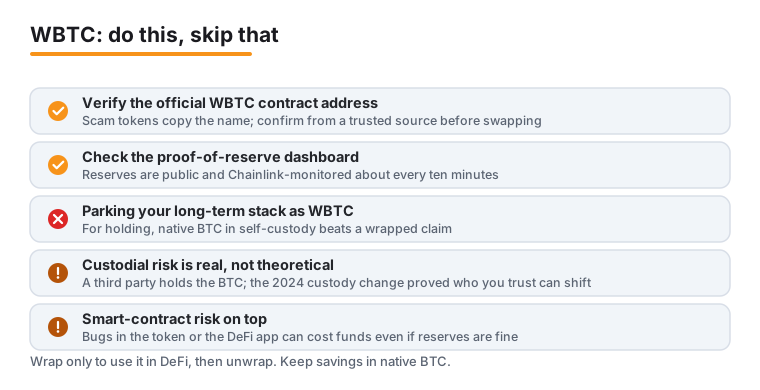
So the blunt guidance: if your goal is simply to hold Bitcoin for the long run, plain BTC in your own self-custody wallet beats a wrapped claim every time. Fewer parties to trust, fewer things to break. Only wrap your Bitcoin when you have a specific reason to use it in DeFi, and treat that wrapped balance as money that is exposed to extra risk while it is wrapped.
How the 1:1 backing is checked
The promise that every WBTC is matched by a real Bitcoin only means something if you can verify it. WBTC publishes the Bitcoin addresses that hold its reserves, and uses a Chainlink Proof of Reserve feed that checks the balances of the custody wallets roughly every ten minutes, which is about how often a new Bitcoin block appears. You can view the reserve dashboard on the official wbtc.network site.
This is better than nothing, and it is more transparency than many wrapped assets offer. But understand what it does and does not prove. It shows that the Bitcoin sitting at the published addresses matches the WBTC supply at a moment in time. It does not protect you from the custodian's keys being stolen, from legal seizure, or from a freeze on redemptions. Proof of reserves is a check on the math, not a guarantee you can always get your coins out.
The 2024 custody shakeup, and why it still matters
In 2024 BitGo announced it would move WBTC custody into a joint venture spanning multiple countries, bringing in BiT Global and tying the arrangement to people connected with the Tron ecosystem, including Justin Sun. That set off real alarm in DeFi. Risk teams at major protocols, including those behind the DAI and USDS stablecoins, opened discussions about dropping WBTC as collateral because they were not comfortable with the new parties involved.
After the pushback, BitGo settled on a three-key model where BitGo in the US, BiT Global in Hong Kong, and BitGo Singapore each hold one key, with the transition completing in October 2024. Around the same time, Coinbase delisted WBTC trading on December 19, 2024, and pushed its own wrapped Bitcoin, cbBTC.
Why bring this up in a how-to guide? Because it is the clearest example of the custodial risk being real, not theoretical. The token did not break, but the question of who you trust changed overnight, and the people who held WBTC had no say in it. When you hold a wrapped asset, you inherit whatever decisions the issuer makes.
Alternatives worth knowing
WBTC is no longer the only option, and the differences come down to who you trust and how.
- cbBTC is Coinbase's wrapped Bitcoin, fully managed by Coinbase and issued across Ethereum, Base, and Solana. It grew fast after launch. The tradeoff is plain: you are trusting one large company instead of a multi-party custody setup.
- tBTC from the Threshold Network takes a different path. Instead of one custodian holding the keys, it spreads the job across a rotating group of independent stakers using threshold cryptography, aiming to remove the single point of failure. It is smaller and less liquid than WBTC, and its model brings its own complexity, but it is the main option for people who want less reliance on one institution.
There is no version that erases the core fact. Every wrapped Bitcoin replaces self-custody of native BTC with trust in some system, whether that is a company, a joint venture, or a network of signers. You are picking which trust assumption you can live with.
Practical tips if you decide to use WBTC
If you have a real reason to wrap, a few habits keep you out of trouble:
- Buy and sell on liquid venues. For most people the simplest path is swapping into WBTC on a major decentralized exchange like Uniswap or buying it on an exchange that still lists it, then doing the reverse when you are done. You do not need to touch the mint and burn process yourself.
- Check the token contract address. Scam tokens copy the WBTC name. Verify the official contract address from a trusted source before swapping, especially on a chain you do not use often.
- Mind the gas and slippage. Ethereum fees and price slippage on a swap eat into your value. On a small amount those costs can outweigh whatever you planned to earn.
- Do not park large amounts long term. Wrap what you intend to use, use it, then unwrap or sell back to native BTC. The longer you hold a wrapped claim, the longer you carry custodial and contract risk for no extra benefit.
- Keep your long-term stack in self-custody. The coins you are saving and not actively using belong in your own wallet as plain Bitcoin, not as a token on someone else's books.
Frequently asked questions
Is WBTC the same as Bitcoin?
No. WBTC is an Ethereum token that represents a Bitcoin held by a custodian. It tracks Bitcoin's price one to one, but it is a claim on Bitcoin, not the coin itself. Holding WBTC means trusting the custodian and the smart contract, which is a different risk than holding real BTC in your own wallet.
Is WBTC safe?
It works as designed and is the most established wrapped Bitcoin, with published reserves and a Chainlink proof-of-reserve feed. But safe is relative. You take on custodial risk, since a third party holds the actual BTC, and smart-contract risk from the token and any DeFi app you use it in. For plain long-term holding, self-custodied Bitcoin is safer.
How do I convert WBTC back to Bitcoin?
Most people do not unwrap directly. The simplest route is to swap WBTC for BTC on an exchange, or use a swap service that sends native Bitcoin to your wallet. Direct burning, where the token is destroyed and the custodian releases real BTC, runs mainly through authorized merchants and is built for larger or institutional users.
Who holds the Bitcoin that backs WBTC?
Since the 2024 custody change, the reserves sit under a multi-jurisdiction arrangement with one key each held by BitGo in the US, BiT Global in Hong Kong, and BitGo Singapore. The backing Bitcoin addresses are public and monitored by a Chainlink proof-of-reserve feed roughly every ten minutes.
What is the difference between WBTC, cbBTC, and tBTC?
All three put Bitcoin's value onto other chains, but the trust model differs. WBTC uses a multi-party custody setup. cbBTC is fully run by Coinbase across Ethereum, Base, and Solana. tBTC spreads custody across a rotating network of independent stakers to avoid a single custodian. WBTC has the deepest liquidity, while tBTC leans toward less institutional reliance.
Should I wrap my Bitcoin?
Only if you have a specific reason to use it in DeFi, such as earning yield, borrowing against it, or providing liquidity. If you just want to hold Bitcoin for the long run, do not wrap it. Keep it as native BTC in self-custody, where you carry the fewest counterparties and the least that can go wrong.
Last updated: 2026-06-24.