Home › Crypto Regulation › Vietnam
Bitcoin & Cryptocurrency Regulation in Vietnam
Quick answer — Vietnam, 2026
- Legal: Legal as property since 2026, not legal tender; payment use prohibited
- Tax: 0.1% personal income tax per transaction via licensed providers, VAT exempt
- Buying: Licensed local platforms still being set up; many use international and P2P venues
Vietnam has moved from being one of Asia's largest grassroots crypto markets with almost no formal rules to having a clear, if tightly controlled, legal framework. For years Bitcoin and other digital assets sat in a grey zone: not banned, but not formally recognised, and explicitly off-limits as a means of payment. That changed when the National Assembly passed the Law on Digital Technology Industry on 14 June 2025, which took effect on 1 January 2026 and, for the first time, recognises crypto assets as a form of property under Vietnamese law. Vietnam is one of the world's most active grassroots crypto markets, placing fourth in the Chainalysis 2025 Global Crypto Adoption Index. The Government then issued Resolution 05/2025/NQ-CP on 9 September 2025, launching a five-year pilot for licensed crypto-asset trading.
This page explains, in plain terms, where crypto stands in Vietnam as of 2026: whether it is legal, who regulates it, the key laws, how exchanges are licensed, how crypto is taxed, the AML and KYC rules, the practical realities of buying and using it, mining, recent developments, consumer risks, and how to verify the current position with official sources. This is general information as of 2026, not legal, tax or financial advice, and you should verify your situation with the named official regulators or a qualified Vietnamese professional. For more background see our guide to crypto regulation.
On this page: Legal status · Who regulates it · Taxes · How to buy · Mining
Is Bitcoin and crypto legal in Vietnam?
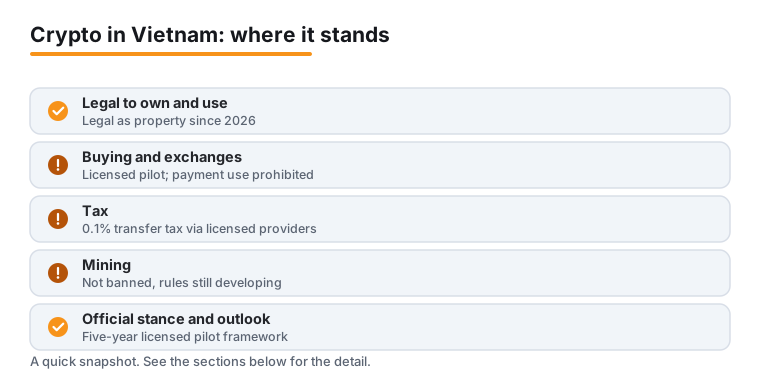
Yes, with one important distinction. As of 2026, owning, buying, selling and holding crypto assets is legal in Vietnam. The Law on Digital Technology Industry, effective 1 January 2026, formally recognises crypto assets as a type of property, ending years of legal ambiguity for an estimated 17 million Vietnamese holders.
What remains prohibited is using crypto as a means of payment. Vietnam does not recognise Bitcoin or any cryptocurrency as legal tender, and only the Vietnamese dong (VND) is valid for settling payments domestically. Using crypto to pay for goods and services has long been treated as the use of an illegal means of payment and can attract administrative fines under Decree 88/2019/ND-CP. In short, you can legally treat crypto as an investable, tradeable asset, but you cannot lawfully use it like cash at the till.
The law defines a crypto asset as a type of digital asset that uses cryptographic technology (or equivalent digital technology) for authentication during its creation, issuance, storage and transfer. It explicitly excludes securities, digital forms of fiat currency, and other financial instruments already regulated under civil and financial laws.
Who regulates crypto in Vietnam
Oversight is shared across several bodies, with the Ministry of Finance acting as the lead authority:
- Ministry of Finance (MOF) leads the crypto pilot, issues licences to crypto-asset service providers, and sets tax rules. Official site: mof.gov.vn.
- State Bank of Vietnam (SBV) is the central bank. It governs monetary policy, payment systems and foreign exchange, and it is the body that has repeatedly confirmed crypto is not legal tender. Official site: sbv.gov.vn.
- State Securities Commission (SSC) coordinates on market supervision and on assessing applicants under the Ministry of Finance.
- Ministry of Public Security (MPS) handles security vetting, cybersecurity standards and the criminal-enforcement side of AML.
Decision 96/QD-BTC of 20 January 2026 fixed the division of labour for licensing: applicants file with the State Securities Commission, which is the receiving, coordinating and procedural focal point, and the Ministry of Finance reviews and decides after consulting the Ministry of Public Security and the State Bank of Vietnam on anti-money-laundering, cybersecurity, system safety and risk control. The State Bank of Vietnam remains the authority on payment and currency questions, while the Ministry of Finance is the gatekeeper for the new licensed trading market.
Key laws and frameworks
Three layers of regulation define the current landscape:
- The Law on Digital Technology Industry (passed by the National Assembly on 14 June 2025, effective 1 January 2026) is the foundational law. Widely described as the first dedicated digital technology industry law of its kind, it recognises digital and crypto assets as property and requires sector activity to meet anti-money-laundering and cybersecurity standards.
- Resolution 05/2025/NQ-CP (issued by the Government on 9 September 2025) establishes a controlled five-year pilot (running through 2030) for the issuance, trading, custody and supervision of crypto assets, and creates Vietnam's first licensing regime for crypto trading platforms.
- Tax circulars from the Ministry of Finance, namely Circular 32/2026/TT-BTC (dated 27 March 2026) and Circular 41/2026/TT-BTC (dated 6 April 2026), set out how corporate income tax, value-added tax and personal income tax apply to crypto-asset transactions, along with tax declaration, withholding, payment and finalisation rules.
Two older instruments still matter for context: the State Bank's position that Bitcoin is not a lawful means of payment (reaffirmed in Official Letter 5747/NHNN-PC of 2017) and Decree 88/2019/ND-CP, which sets administrative fines for using illegal payment instruments. The official text of Resolution 05/2025/NQ-CP is available on Vietnam's law portal: LuatVietnam (English).
Licensing and registration of crypto exchanges
Vietnam's pilot introduces one of the stricter exchange-licensing regimes in the region. Under Resolution 05/2025/NQ-CP, a licensed crypto-asset service provider must be a Vietnamese-incorporated company (a limited liability or joint-stock company) and meet demanding thresholds:
- Minimum charter capital of VND 10 trillion (roughly USD 378 million), fully contributed in Vietnamese dong.
- At least 65% of charter capital held by institutional investors, of which a portion must come from commercial banks, securities firms, fund managers, insurers or technology companies that have been profitable for the past two years.
- Foreign ownership capped at 49%.
- All offering, issuance, trading and settlement conducted in Vietnamese dong, with only Ministry of Finance-licensed organisations permitted to provide market services.
The resolution also sets personnel requirements. Reporting on the rules describes a chief executive with at least two years of finance and management experience, a chief technology officer with at least five years in IT or fintech, at least 10 certified IT-security specialists, at least 10 licensed securities professionals, and dedicated compliance, legal and operations staff.
Licensed providers may organise the trading market, execute trades, custody crypto assets and host issuance platforms. Enterprises file the initial application dossier with the State Securities Commission (SSC), which assesses applicants alongside the Ministry of Finance, the Ministry of Public Security and the State Bank. Seven applications were filed and the Ministry of Finance found five valid: VIX Digital Asset Exchange JSC (VIXEX), Loc Phat Vietnam Crypto Asset Exchange JSC (LPEX), Vietnam Prosperity Crypto Asset Exchange JSC (CAEX), Techcom Digital Asset Exchange JSC (TCEX) and Vietnam Digital Assets JSC. Two, Dolphinex Encrypted Asset Services JSC and SSI Digital Technology JSC, were found not valid because their charter and personnel documentation was incomplete. The Ministry of Finance began accepting applications on 20 January 2026, and major Vietnamese banks and securities firms have signalled they are preparing to apply, but as of 3 August 2026 no licence had been issued. Under Decision 96/QD-BTC of 20 January 2026 the State Securities Commission is the receiving and procedural focal point, the Ministry of Finance grants or refuses within 30 working days of a complete file, and no state fees apply during the pilot.
Crypto and Bitcoin tax in Vietnam
For years Vietnam had no clear crypto tax rules because the assets had no defined legal status. With the 2026 framework in place, the Ministry of Finance has issued tax circulars covering crypto-asset transactions, broadly mirroring the treatment of securities.
Reporting on the pilot tax framework (Circular 32/2026/TT-BTC and Circular 41/2026/TT-BTC) describes a 0.1% personal income tax on the transfer value of each transaction made through a licensed service provider, a 20% corporate income tax on net taxable income for domestic businesses, and a value-added tax exemption for crypto-asset trading. The circulars also set out declaration, withholding and finalisation obligations.
The circulars put collection on the platform rather than the taxpayer: licensed crypto-asset service providers withhold and remit the tax on each completed transfer, declare and remit monthly, and issue annual withholding certificates. Foreign corporate sellers pay 0.1% of gross transfer value rather than tax on net income, while Vietnamese companies are taxed on proceeds less purchase cost and expenses. Because withholding runs through licensed providers and none exists yet, the mechanism is not yet operating in practice. Treatment can depend on whether you are an individual or a business, your residency, the nature of the transaction and the platform used, and details may be refined by further guidance. Before filing, confirm the current rates and obligations directly with the Ministry of Finance or a Vietnamese tax professional. See our general crypto tax guide for background. This section is informational only and is not tax advice.
AML and KYC rules
Anti-money-laundering (AML) and know-your-customer (KYC) controls are central to Vietnam's new framework. The Law on Digital Technology Industry requires sector activity to meet AML and cybersecurity standards, and Resolution 05/2025/NQ-CP makes licensed providers responsible for verifying customer identity, monitoring transactions and reporting suspicious activity.
In practice this means anonymity is not the norm on compliant services: expect identity verification when you open an account, and expect transactions to be traceable. AML obligations sit within Vietnam's broader anti-money-laundering regime, and the Ministry of Public Security plays a role in enforcement and security vetting. Using unlicensed or anonymous services can expose users to compliance and legal risk, particularly where funds are later converted into dong.
Because the implementing rules are still maturing, the exact reporting thresholds and procedures for crypto providers may continue to be clarified. Verify current AML and KYC requirements with the licensed platform and the relevant authorities before transacting.
Buying and using crypto in practice
What the framework means for ordinary users:
- No domestic platform is licensed yet. Applications opened on 20 January 2026 under Decision 96/QD-BTC, five of seven applicants were found valid, and in May 2026 Deputy Finance Minister Nguyen Duc Chi said the exchange could begin official operations as early as the third quarter of 2026. As of 3 August 2026 there is still no lawful domestic exchange to use.
- Many Vietnamese have historically used international exchanges and peer-to-peer (P2P) services. Vietnam placed fourth in the Chainalysis 2025 Global Crypto Adoption Index, and Chainalysis put the country's crypto market value at around USD 220 billion for the year to mid-2025. Reporting on user behaviour points to Binance, including its P2P service, as the most used venue, followed by platforms such as Bybit and OKX. As the licensed framework matures, expect more scrutiny of how residents access offshore platforms.
- Settlement is in dong. Licensed platforms must conduct trading and settlement in VND, typically funded by bank transfer.
- You cannot pay with crypto. Holding and trading are legal, but using crypto to pay merchants is not.
A sensible workflow: choose a platform operating lawfully under the current framework with clear KYC/AML procedures, complete identity verification, fund in dong, start with small orders, secure holdings with strong passwords and two-factor authentication (and a hardware wallet for larger amounts), and keep records for tax. Re-check which platforms are authorised before you commit funds, and be cautious with anonymous or unlicensed venues. Note that Bitcoin ATMs are effectively non-existent in Vietnam, since cash-to-crypto kiosks sit awkwardly against the payment ban and foreign-exchange controls.
Bitcoin mining in Vietnam
There is no specific law that outright bans owning mining hardware or running mining operations in Vietnam, and the country has seen genuine mining activity over the years. However, mining sits at the intersection of several pressure points.
- Electricity and the grid. Vietnam's power system can come under strain in high-demand periods. Large-scale mining is energy-intensive, and policymakers are conscious of the load it adds.
- Import and business considerations. Importing mining rigs, running a commercial operation, and the tax treatment of mined coins can all attract official attention as the broader framework formalises.
- Taxation. With crypto now recognised as property and tax rules emerging, the treatment of mined coins and mining-business income should be checked against current guidance.
If you are considering mining beyond a hobby, check the current position on equipment imports, business registration, electricity use and taxation, and bear in mind that mining-specific rules are still developing.
Recent developments (2025 to 2026)
The pace of change has been rapid:
- 14 June 2025: the National Assembly passed the Law on Digital Technology Industry, the foundation for recognising crypto assets as property.
- 9 September 2025: the Government issued Resolution 05/2025/NQ-CP, launching the five-year crypto-asset market pilot with its licensing regime.
- 1 January 2026: the Law on Digital Technology Industry took effect.
- 20 January 2026: the Ministry of Finance began accepting licence applications from Vietnamese enterprises, with major banks and securities firms signalling they were preparing to apply.
- 27 March 2026: the Ministry of Finance issued Circular 32/2026/TT-BTC on corporate income tax, value-added tax and personal income tax for crypto-asset transactions.
- 6 April 2026: the Ministry of Finance issued Circular 41/2026/TT-BTC on tax declaration, withholding, payment and finalisation for the crypto-asset market.
Two further items landed in July 2026. On 16 July 2026 the Government signed Decree 284/2026/ND-CP, the administrative penalty decree for the crypto-asset market, published in Official Gazette No. 449 on 28 July 2026 and in force from 1 September 2026. On 27 July 2026 Decision 1413/QD-TTg approved the financial market reform plan to 2045, which tasks the Ministry of Finance with researching and enacting a Law on Digital Assets and Crypto Assets in 2028 to 2029 and with researching a central bank digital currency pilot in 2029 to 2030. Always confirm the latest position with the named regulators.
Consumer risks and protection
The headline risks in Vietnam are familiar but locally flavoured: price volatility, scams and fraudulent investment schemes, the use of unlicensed or offshore platforms, and the fact that crypto still cannot be used for payment. The legal recognition of crypto as property does improve ownership and dispute-resolution footing, but it does not guarantee the safety of any particular platform or investment.
Practical protection steps: use only services operating lawfully under the current framework, complete KYC honestly, keep good records for tax, avoid leverage and any scheme promising guaranteed returns, secure your own keys for larger holdings, and treat any unsolicited investment pitch with strong scepticism. Converting crypto to dong through informal or unlicensed channels can carry compliance and foreign-exchange risk, so prefer licensed on- and off-ramps as they become available.
Crypto investing carries real risk of loss, and no article can promise returns. Invest only what you can afford to lose, and seek independent financial advice for your own situation.
Official sources and how to verify
Crypto rules in Vietnam are evolving quickly, so always confirm the current position against primary sources rather than secondary commentary. The most authoritative starting points are:
- State Bank of Vietnam for payment, currency and foreign-exchange matters: sbv.gov.vn.
- Ministry of Finance for the crypto pilot, licensing and tax: mof.gov.vn.
- Official text of Resolution 05/2025/NQ-CP on Vietnam's law portal: LuatVietnam (English).
For broader context, see our regulation hub. This page is general information as of 2026 and is not legal, tax or financial advice; for decisions that matter, verify with the named official regulators or a qualified Vietnamese professional.
Where things stand in August 2026
Reviewed 3 August 2026. Two things moved after this page was last checked at the end of June 2026, and one thing many readers expect to have happened still has not.
- No crypto exchange has been licensed yet. The application window opened on 20 January 2026 under Decision 96/QD-BTC. Seven applications were filed and five were found valid: VIX Digital Asset Exchange JSC (VIXEX), Loc Phat Vietnam Crypto Asset Exchange JSC (LPEX), Vietnam Prosperity Crypto Asset Exchange JSC (CAEX), Techcom Digital Asset Exchange JSC (TCEX) and Vietnam Digital Assets JSC. Two, Dolphinex Encrypted Asset Services JSC and SSI Digital Technology JSC, were found not valid because their charter and personnel documentation was incomplete. In May 2026 Deputy Finance Minister Nguyen Duc Chi said the exchange could begin official operations as early as the third quarter of 2026.
- Penalties now have a decree behind them. The Government signed Decree 284/2026/ND-CP on 16 July 2026, published in Official Gazette No. 449 on 28 July 2026. It takes effect on 1 September 2026 and sets money fines for trading through unlicensed providers and for unlicensed service provision and advertising.
- A longer legislative plan is now on paper. Decision 1413/QD-TTg of 27 July 2026, the financial market reform plan to 2045, tasks the Ministry of Finance with researching and building a Law on Digital Assets and Crypto Assets in 2028 to 2029, and with researching a central bank digital currency pilot in 2029 to 2030.
- Vietnam is still on the FATF grey list. After the plenary of 17 to 19 June 2026 it remained one of 22 jurisdictions under increased monitoring. Compliance analysts describe Vietnam's virtual asset service provider regulation as still nascent, though that wording is theirs rather than FATF's.
Fines for unlicensed crypto activity from 1 September 2026
Decree 284/2026/ND-CP, signed on 16 July 2026 and in force from 1 September 2026, is the first Vietnamese instrument to attach specific money penalties to crypto-asset conduct. The published fine bands are as follows.
| Conduct | Fine |
|---|---|
| Providing crypto-asset services, or advertising them, without a Ministry of Finance licence | VND 180 million to VND 200 million |
| Domestic investor trading crypto assets outside a licensed service provider | VND 30 million to VND 50 million (about USD 1,140 to USD 1,900) |
| Domestic investor trading crypto assets designated for foreign investors | VND 70 million to VND 100 million (about USD 2,650 to USD 3,800) |
| Breach of foreign ownership limits on issuance | VND 70 million to VND 100 million |
| Inaccurate or incomplete disclosure by an issuer | VND 100 million to VND 150 million |
| Improper offering, or failure to meet issuance conditions | VND 150 million to VND 200 million |
| Unlawful collection, storage, exchange, sale or disclosure of crypto-asset account data | VND 150 million to VND 200 million |
| Licensed provider failing to verify the identity of an investor opening an account | VND 50 million to VND 70 million |
The ceiling is VND 200 million for organisations and VND 100 million for individuals, with individual fines set at half the rate applied to organisations. Source: the Government news portal and the Official Gazette entry. Beyond fines, law firm analysis of the decree describes temporary suspension of activities, disgorgement of unlawful gains, confiscation of assets connected to violations, orders to remove or rectify non-compliant platforms, and mandatory corrective disclosures, and reads the decree as creating compliance exposure for offshore exchanges that serve Vietnamese users and cannot realistically obtain a Vietnamese licence.
Timing is genuinely unsettled and it is worth being plain about that. Resolution 05/2025/NQ-CP gives domestic investors a six-month transition that runs from the licensing of the first provider, after which all domestic trading must go through licensed platforms. No licence had been issued as of 3 August 2026, so on that reading the clock has not started. Vietnamese state media has separately reported that from 1 September investors will be required to transact through exchanges licensed in Vietnam. No source checked here reconciles the two, so treat 1 September 2026 as the date the penalty regime exists and the six-month window as the transition mechanism, and confirm your own position with the Ministry of Finance before relying on either reading.
What is coming next, and roughly when
Vietnam has published a sequence rather than a single deadline. Only some steps carry published dates.
- 1 September 2026: Decree 284/2026/ND-CP takes effect, putting the penalty regime in place. It applies for the duration of the pilot.
- Third quarter of 2026: the earliest the first regulated market activity could begin, according to Deputy Finance Minister Nguyen Duc Chi in May 2026. This is an expectation, not a commitment, and it had not happened by 3 August 2026.
- 30 days after a licence is granted: the licensed organisation must go into operation.
- Six months after the first licence: the transition window for domestic investors on unlicensed and offshore platforms closes under Resolution 05/2025/NQ-CP.
- 2028 to 2029: research and enactment of a Law on Digital Assets and Crypto Assets, classifying assets into payment-oriented crypto assets, utility tokens, and security tokens or tokenised real-world assets.
- 2029 to 2030: research and piloting of a central bank digital currency.
- September 2030: the five-year pilot under Resolution 05/2025/NQ-CP expires.
The 2028 to 2030 items come from Decision 1413/QD-TTg of 27 July 2026 and are targets in an approved plan, not enacted law. That plan also sets a market development roadmap beginning with a controlled sandbox and then extending to tokenised securities, tokenisation of real assets, digital bonds, digital investment funds and custody and settlement services on distributed ledger technology, but it does not publish year ranges for those later steps. No draft Law on Digital Assets has been published and no National Assembly session has been scheduled for it.
What a licensed Vietnamese platform can and cannot list
The pilot is narrower than most readers expect, and the exclusions matter more than the inclusions.
- Fiat-backed stablecoins are out. Resolution 05/2025/NQ-CP excludes central bank digital currencies and stablecoins that function as currency substitutes, and all transactions must be settled in Vietnamese dong, so the stablecoin-denominated P2P trading most Vietnamese users rely on today has no equivalent on a licensed platform.
- Securities and security tokens are out. The pilot covers cryptocurrencies, utility tokens and non-fungible tokens, and excludes security tokens and other instruments classified as securities.
- Foreign-issued mainstream assets are in, by deposit. Crypto assets issued and offered by foreign entities before Resolution 05 took effect may be deposited with a licensed crypto-asset service provider.
- Vietnamese-issued tokens face a different rule. Only Vietnamese entities may issue crypto assets, those assets must be backed by real underlying assets, and they may be issued only to foreign investors.
- Custody is prescribed. Client assets must be held in segregated accounts at authorised banks, with cold storage for crypto holdings.
Frequently asked questions
Is cryptocurrency legal in Vietnam in 2026?
Yes. Following the Law on Digital Technology Industry, which took effect on 1 January 2026, crypto assets are legally recognised as a form of property that can be owned, transferred and traded. However, crypto is not legal tender and cannot be used to pay for goods and services, where only the Vietnamese dong is valid.
Who regulates crypto in Vietnam?
The Ministry of Finance (mof.gov.vn) is the lead authority for the crypto pilot, licensing and tax. It works with the State Bank of Vietnam (sbv.gov.vn), which governs payment and currency matters, the State Securities Commission, and the Ministry of Public Security, which handles security vetting and AML enforcement.
Can I use Bitcoin to pay for things in Vietnam?
No. Using cryptocurrency as a means of payment is not permitted in Vietnam, and only the dong is recognised for settling payments. Using crypto as payment can attract administrative fines under Decree 88/2019/ND-CP. You can legally hold and trade crypto as an asset, but you cannot lawfully use it to pay merchants.
How is crypto taxed in Vietnam?
Under the pilot tax framework reported in the Ministry of Finance's 2026 circulars (Circular 32/2026/TT-BTC and Circular 41/2026/TT-BTC), individuals face a 0.1% personal income tax on the transfer value per transaction through licensed providers, businesses face a 20% corporate income tax on net income, and crypto trading is exempt from value-added tax. These rules are new and may be refined, so confirm with the Ministry of Finance or a tax professional. This is informational only and not tax advice.
What does it take to license a crypto exchange in Vietnam?
Under Resolution 05/2025/NQ-CP, a licensed crypto-asset service provider must be a Vietnamese-incorporated company with minimum charter capital of VND 10 trillion (around USD 378 million), at least 65% institutional ownership, foreign ownership capped at 49%, and all trading and settlement in Vietnamese dong. The Ministry of Finance issues licences and began accepting applications on 20 January 2026, with only a small number expected during the pilot.
Where can I legally buy Bitcoin in Vietnam?
Vietnam is establishing a licensed exchange framework under its five-year pilot, and the menu of fully authorised domestic platforms is still taking shape as the market ramps up through 2026. Many residents have historically used international exchanges and peer-to-peer services. Use platforms operating lawfully under the current framework, complete identity verification, keep records for tax, and re-check which venues are authorised before depositing funds.
How big is crypto adoption in Vietnam?
Vietnam is one of the most active grassroots crypto markets in the world. It placed fourth in the Chainalysis 2025 Global Crypto Adoption Index, and Chainalysis put the country's crypto market value at around USD 220 billion for the year to mid-2025. Much of this activity has run through international exchanges and peer-to-peer services rather than licensed domestic platforms.
When did Vietnam's crypto tax rules take effect?
The Ministry of Finance issued Circular 32/2026/TT-BTC (dated 27 March 2026), covering corporate income tax, value-added tax and personal income tax on crypto-asset transactions, and Circular 41/2026/TT-BTC (dated 6 April 2026), covering tax declaration, withholding, payment and finalisation. These rules apply mainly to activity routed through licensed providers during the pilot. Confirm current rates with the Ministry of Finance or a tax professional. This is informational only and not tax advice.
Can I be fined for using Binance or OKX in Vietnam?
Yes, once the rules bite. Decree 284/2026/ND-CP, signed on 16 July 2026 and in force from 1 September 2026, sets fines of VND 30 million to VND 50 million (roughly USD 1,140 to USD 1,900) for domestic investors who trade crypto assets outside a Ministry of Finance licensed provider, and VND 70 million to VND 100 million for trading crypto assets designated for foreign investors. The start date is reported inconsistently. Resolution 05/2025/NQ-CP gives domestic investors a six-month transition running from the date the first service provider is licensed, and no licence had been issued as of 3 August 2026, so on that reading the clock has not started. Vietnamese state media has separately reported that from 1 September investors must transact through exchanges licensed in Vietnam. Confirm your position with the Ministry of Finance rather than relying on either reading.
Has Vietnam licensed any crypto exchange yet?
No. As of 3 August 2026 no crypto-asset exchange has been licensed. Applications opened on 20 January 2026 under Decision 96/QD-BTC. Seven were filed and five were found valid: VIXEX, LPEX, CAEX, TCEX and Vietnam Digital Assets JSC. Two, Dolphinex Encrypted Asset Services JSC and SSI Digital Technology JSC, were found not valid because their charter and personnel documentation was incomplete. In May 2026 Deputy Finance Minister Nguyen Duc Chi said the exchange could begin official operations as early as the third quarter of 2026.
Can I trade USDT or USDC on a licensed Vietnamese platform?
No. Resolution 05/2025/NQ-CP excludes central bank digital currencies and stablecoins that function as currency substitutes from the pilot, and requires transactions to be settled in Vietnamese dong. Fiat-backed stablecoins such as USDT and USDC therefore cannot be traded inside the licensed framework. Security tokens and other instruments classified as securities are also excluded; cryptocurrencies, utility tokens and non-fungible tokens are inside it.
Is Vietnam going to pass a full crypto law after the pilot?
That is the stated plan. Decision 1413/QD-TTg, approved on 27 July 2026, tasks the Ministry of Finance with researching and building a Law on Digital Assets and Crypto Assets in 2028 to 2029, classifying assets into payment-oriented crypto assets, utility tokens, and security tokens or tokenised real-world assets. The same plan schedules research on a central bank digital currency pilot for 2029 to 2030. No draft bill has been published and no National Assembly session has been scheduled. The current five-year pilot under Resolution 05/2025/NQ-CP runs to September 2030.
Who pays and collects crypto tax in Vietnam?
Under Circular 32/2026/TT-BTC and Circular 41/2026/TT-BTC, the licensed crypto-asset service provider withholds and remits the tax rather than the investor filing it. Individual sellers, resident and non-resident, are charged 0.1% personal income tax on the gross transfer price of each transaction. Vietnamese corporate sellers pay 20% corporate income tax on proceeds less purchase cost and expenses, with preferential rates of 15% to 17% available where annual revenue thresholds are met, while foreign corporate sellers pay 0.1% of gross transfer value. Crypto-asset transfers and trading are not subject to VAT. Providers declare and remit monthly and issue annual withholding certificates. Because no provider is licensed yet, this mechanism is not yet operating. This is informational only and not tax advice.
Is Vietnam still on the FATF grey list?
Yes. Following the FATF plenary of 17 to 19 June 2026, Vietnam remained one of 22 jurisdictions under increased monitoring. Bosnia and Herzegovina and Iraq were added at that plenary, and Algeria and Namibia were removed. Compliance analysts describe Vietnam's virtual asset service provider regulation as still nascent, though that characterisation is theirs rather than FATF's own wording.
Facts reviewed: 3 August 2026. Page updated: 3 August 2026.