Home › Crypto Regulation › Tonga
Bitcoin & Cryptocurrency Regulation in Tonga
Quick answer — Tonga, 2026
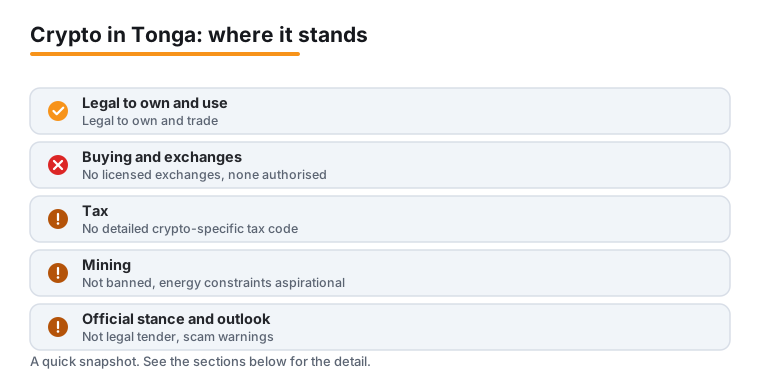
- Legal: Legal to own and trade, not legal tender; no crypto business licensed
- Tax: No detailed crypto tax rules; assessed under general tax law
- Buying: No licensed local exchange, use international platforms, P2P, or diaspora
Tonga is a small Pacific Island kingdom whose economy depends heavily on remittances from relatives living overseas, which is exactly why Bitcoin and other cryptocurrencies have drawn local interest. In 2021 and 2022 the kingdom was discussed internationally as a possible follower of El Salvador's Bitcoin legal-tender experiment after a former member of parliament championed the idea. That plan was never enacted into law.
As of 2026, cryptocurrency is legal to own and trade in Tonga but it is not legal tender, it is not issued or backed by the central bank, and there is no comprehensive crypto-specific statute. The National Reserve Bank of Tonga (NRBT) is the monetary authority that has set the official position: only the NRBT can issue legal tender, no business has been licensed to offer crypto-assets, and the public is warned repeatedly about scams. This guide covers the legal status, the regulator, the laws that apply, licensing, tax, AML/KYC, buying and using crypto, mining, recent 2025 to 2026 developments, consumer risks, and how to verify everything with official sources.
This article is general information as of 2026 and is not legal, tax, or financial advice. Crypto rules change quickly. Verify anything important directly with the National Reserve Bank of Tonga before acting.
On this page: Legal status · Who regulates it · Taxes · How to buy · Mining
Is Bitcoin and crypto legal in Tonga?
Owning, buying, and trading Bitcoin and other cryptocurrencies is not prohibited in Tonga. No law makes holding digital assets a criminal offence, and Tongans regularly send and receive crypto, often in connection with remittances from family abroad.
Two distinctions matter. First, not illegal is not the same as regulated: Tonga has not enacted a dedicated cryptocurrency framework, so most activity sits in a lightly supervised grey area rather than under a clear, purpose-built regime. Second, crypto is not legal tender. The National Reserve Bank of Tonga has publicly stated that the sole authority to issue currency or legal tender in the kingdom rests with the NRBT under section 22 of the National Reserve Bank of Tonga Act. The Tongan pa'anga (TOP) remains the only official currency, and no business is obliged to accept Bitcoin.
The widely reported proposal by a former parliamentarian, the late Lord Fusitu'a, to make Bitcoin legal tender drew heavy international coverage in 2021 and 2022 but was never passed into law, and the central bank publicly distanced itself from it. Lord Fusitu'a died in February 2024, and public momentum behind the legal-tender idea has faded since. Treat older articles suggesting Tonga was about to adopt Bitcoin nationally as unrealised plans. For broader context on how different countries approach digital assets, see our overview of crypto regulation.
Who regulates crypto in Tonga?
The lead authority is the National Reserve Bank of Tonga (NRBT), the country's central bank and monetary authority. It is responsible for issuing currency, maintaining financial stability, supervising banks and financial institutions, managing the country's external reserves, and hosting the financial intelligence function. The NRBT has issued public awareness statements making clear that cryptocurrencies are not legal tender, are not issued or backed by the bank, and carry significant volatility and fraud risk.
Within the NRBT, the Transactions Reporting Authority (TRA) serves as Tonga's financial intelligence unit, receiving suspicious-transaction and currency-transaction reports under the country's anti-money-laundering law. The Ministry of Revenue and Customs administers tax, and the Attorney General's Office and police handle fraud and criminal matters. Because there is no bespoke crypto regulator, oversight is spread across these existing bodies rather than concentrated in one digital-asset authority.
Crypto laws and frameworks in Tonga
Tonga does not have a single, comprehensive cryptocurrency statute. Crypto activity is instead shaped by general financial, banking, and anti-money-laundering law, plus public guidance from the central bank. The main instruments that apply are:
- National Reserve Bank of Tonga Act. Establishes the NRBT's exclusive right to issue legal tender (section 22) and governs how the country's external reserves must be held in high-quality, low-credit-risk assets (sections 30(1) and 30(2)). On this basis the NRBT has said investing national reserves in cryptocurrency is highly unlikely.
- Money Laundering and Proceeds of Crime Act 2000 and the Money Laundering and Proceeds of Crime Regulations 2010. Impose customer identification, record-keeping, and reporting duties on financial institutions and cash dealers, enforced through the Transactions Reporting Authority.
- General consumer-protection and fraud law, under which crypto scams can be pursued even without a crypto-specific statute.
Unlike European Union member states, Tonga is not subject to the EU's MiCA regulation or any regional crypto framework. With no bespoke licensing regime for exchanges, there is no Tongan crypto exchange licence to look for, which makes independent due diligence on any provider especially important. Confirm the current legal position directly with the NRBT, as guidance evolves.
Exchange and VASP licensing in Tonga
There is no dedicated licensing or registration regime for cryptocurrency exchanges or virtual-asset service providers (VASPs) in Tonga, and there are no Tonga-based, domestically licensed exchanges of any scale. The NRBT has stated plainly that no business licence has been issued to any business in Tonga to offer crypto-assets such as Bitcoin, and that offering crypto-asset investments would require a licence. Investment-type activities are regulated under section 4A(k) of the National Reserve Bank of Tonga Act.
In 2025 the NRBT launched a FinTech Regulatory Sandbox Framework, supported by the Alliance for Financial Inclusion, which lets fintech companies test innovative digital financial solutions in a controlled live environment with defined safeguards and duration. The sandbox is aimed broadly at digital payments, remittances, and financial inclusion rather than crypto specifically, but it is the main avenue through which a digital-finance business could engage the regulator. Because no general crypto licence exists, most Tongans who buy digital assets use international platforms or peer-to-peer arrangements instead.
Crypto and Bitcoin tax in Tonga
Tonga has not published a detailed, crypto-specific tax code, so digital assets generally fall back on existing tax law administered by the Ministry of Revenue and Customs, most likely assessed under general principles rather than a special regime.
In broad terms, profits from trading or disposing of crypto could be taxable income, especially where the activity resembles a business rather than occasional personal use; crypto received as payment may need to be valued in pa'anga and reported as business income; and consumption tax could apply to goods and services bought with crypto. We deliberately avoid quoting specific rates or thresholds, because Tonga has not issued clear, verified crypto-tax guidance and any figure could be wrong or out of date.
Treat crypto gains as potentially taxable, keep records of transactions and their pa'anga value at the time, and confirm your obligations with the Ministry of Revenue and Customs or a local accountant. Positions for individuals, businesses, and miners can differ. For general background on how crypto is taxed in other jurisdictions, see our guide to crypto taxes.
AML and KYC rules in Tonga
Tonga's anti-money-laundering and counter-terrorist-financing rules come from the Money Laundering and Proceeds of Crime Act 2000 and the Money Laundering and Proceeds of Crime Regulations 2010. These require financial institutions and cash dealers to verify customer identity, keep records, maintain internal reporting procedures, and file suspicious-transaction reports with the Transactions Reporting Authority under section 14(1) of the Act, as well as currency-transaction reports under the regulations. Tonga is a member of the Asia/Pacific Group on Money Laundering, which assesses the country against the global FATF standards.
These obligations are written for traditional financial institutions and money-transfer businesses rather than crypto firms specifically. In practice that means a Tongan business converting crypto to cash, or a bank or money operator touching crypto-linked funds, can be expected to apply know-your-customer checks. When you use any reputable international exchange you will also face that platform's own KYC, typically ID verification and sometimes proof of address. Expect identity checks whenever you move between crypto and pa'anga.
Buying and using crypto in Tonga in practice
With no domestic licensing regime, most Tongans who buy crypto do so through international platforms, peer-to-peer arrangements, or relatives abroad. Common routes include:
- Global exchanges accessed online. Availability depends on each platform's own country policies and whether it supports Tongan users, identity documents, and payment methods.
- Peer-to-peer (P2P) trading. Buyers and sellers match directly, often settling in cash or via mobile money. P2P is flexible but carries higher counterparty and fraud risk with little recourse.
- Help from the diaspora. Relatives in New Zealand, Australia, or the United States may buy on regulated exchanges there and transfer value home, which is one of the strongest practical use cases given how much of Tonga's income arrives as remittances.
Practical frictions are real: limited banking integration, card-acceptance issues, thin local liquidity, and a small market. Crypto donations did feature in relief efforts after the 2022 Hunga Tonga-Hunga Ha'apai eruption, showing how digital assets can move funds quickly in a crisis. Prioritise platforms with strong security records and clear fees, confirm a service genuinely supports Tongan residents before depositing, start small to test the full round trip including cashing out, and expect AML checks when converting between crypto and pa'anga. Bitcoin ATMs are not established in Tonga, so do not count on finding one.
Bitcoin mining in Tonga
Bitcoin mining in Tonga has been discussed enthusiastically, often tied to the country's geothermal and renewable-energy potential as a foundation for environmentally conscious mining. In practice, large-scale mining faces serious obstacles.
- Energy constraints. The electricity system is small and, in many areas, dependent on imported diesel, with renewable capacity still being built out. Reliable, low-cost power at mining scale is not readily available, and grid-connected mining could compete with essential local demand.
- Cost and logistics. Importing and maintaining specialised hardware on a remote island chain is expensive, and high ambient temperatures add cooling challenges.
- Disruption risk. Tonga is exposed to cyclones, volcanic activity, and undersea-cable outages, all of which threaten continuous operation.
- Regulatory uncertainty. There is no dedicated mining licence or tax framework, so miners would operate under general business, electricity, import, and tax rules.
The vision of sustainable, volcano-powered mining is appealing in theory, but as of 2026 it remains largely aspirational rather than a developed industry. Anyone considering it should investigate power agreements, import duties, and tax treatment, and confirm current rules with local authorities.
Recent developments (2025 to 2026)
Several concrete developments have shaped the picture in the last two years:
- FinTech Regulatory Sandbox (June 2025). The NRBT launched its sandbox framework at the Pacific Central Bankers' Meeting in Nuku'alofa on 3 June 2025, with support from the Alliance for Financial Inclusion, creating a controlled way for digital-finance innovators to test products.
- Reaffirmed legal-tender position. The NRBT's public awareness statements continue to stress that crypto is not legal tender, that no crypto-asset business licence has been issued, and that investing in crypto is an individual decision taken at your own risk.
- Scam enforcement (late 2025 into 2026). The NRBT issued a press release in December 2025 warning about the BG Wealth Sharing / DSJEX cryptocurrency investment scam spreading through Facebook and targeting Tongans at home and in the diaspora. It described a Ponzi-style scheme using multi-level-marketing recruitment. In early 2026 the warning was echoed by regulators in several countries, including New Zealand's Financial Markets Authority, Australia's ASIC, and the Central Bank of Samoa, as the scheme spread through Tongan family networks, church groups, and social media across multiple countries.
- Fading legal-tender push. Lord Fusitu'a, the former parliamentarian who championed making Bitcoin legal tender, died in February 2024. Since then there has been little public effort to revive the idea, and the practical direction has stayed with digital payments and financial inclusion rather than national Bitcoin adoption.
- CBDC exploration. A central bank digital currency remains at a very early exploratory phase, with no decision to issue one.
The direction of travel is incremental: clearer AML application, consumer warnings, and controlled fintech testing, rather than the dramatic legal-tender move once floated.
Consumer risks and protection
The central risk in Tonga is the gap between activity and oversight. People can use crypto, but without a dedicated regulatory framework, deposit protection, or clear dispute resolution. That magnifies the usual risks: volatility, scams, hacking, lost private keys, and thin local liquidity that can make cashing out slow or expensive.
The NRBT has been blunt about this. In its scam warnings it states that cryptocurrency payments have no legal protections and that the bank cannot step in to help recover lost funds, that transactions are irreversible, and that any promise of free money or guaranteed returns is a red flag. The BG Wealth Sharing / DSJEX case shows the typical pattern: fake platforms displaying fabricated profits, pressure to invest more, and blocked withdrawals followed by demands for extra taxes or fees.
Practical protection is mostly self-protection: use reputable services with strong security records, be wary of social-media investment managers and guaranteed-return schemes, never share recovery phrases, move holdings beyond small amounts into a wallet you control, keep transaction records, and assume recourse will be limited if something goes wrong. Treat any headline claim about Tonga adopting Bitcoin sceptically unless confirmed by the NRBT.
Official sources and how to verify
Because the rules are evolving and lightly codified, always check the primary sources rather than relying on secondary reporting. The most useful official references are:
- National Reserve Bank of Tonga - the central bank and lead authority, publishing legal-tender statements, scam warnings, and fintech-sandbox news.
- NRBT cryptocurrency investment scam press release - the bank's consumer warning on fraudulent crypto schemes.
- NRBT Transactions Reporting Authority - Tonga's financial intelligence unit and AML reporting body.
- Money Laundering and Proceeds of Crime Act 2000 - the AML statute hosted by the Attorney General's Office.
For tax, contact the Ministry of Revenue and Customs directly. You can also compare Tonga's approach against other countries through our wider crypto regulation hub. This article is general information as of 2026 and is not legal advice; verify your situation with the National Reserve Bank of Tonga or a qualified local professional.
Frequently asked questions
Is Bitcoin legal tender in Tonga?
No. The Tongan pa'anga is the only legal tender, and no business is required to accept Bitcoin. Under section 22 of the National Reserve Bank of Tonga Act, only the NRBT can issue legal tender. A former member of parliament proposed making Bitcoin legal tender in the early 2020s, but that plan was never enacted and the central bank did not endorse it.
Is it legal to own and trade crypto in Tonga?
Yes. There is no ban on owning, buying, or trading cryptocurrency in Tonga. However, the activity is largely unregulated, there is no dedicated crypto framework, and the NRBT has not licensed any business to offer crypto-assets. Few formal consumer protections exist, so platform choice and security are your own responsibility. Confirm the latest position with the National Reserve Bank of Tonga.
Are crypto exchanges licensed in Tonga?
No. Tonga has no dedicated licensing or registration regime for crypto exchanges or virtual-asset service providers, and the NRBT has stated that no business licence has been issued to any business in Tonga to offer crypto-assets such as Bitcoin. In 2025 the NRBT launched a FinTech Regulatory Sandbox for testing digital-finance products, but it is not a general crypto licence. Most users rely on international platforms instead.
Do I have to pay tax on crypto in Tonga?
Tonga has not published detailed crypto-specific tax rules, so digital assets are generally assessed under existing tax law administered by the Ministry of Revenue and Customs. Crypto gains and crypto received as payment may be taxable. Keep records of transactions and their pa'anga value, and confirm your obligations with the Ministry or a local accountant. This is not tax advice.
What are the AML and KYC rules for crypto in Tonga?
Tonga's anti-money-laundering rules come from the Money Laundering and Proceeds of Crime Act 2000 and the 2010 Regulations, which require financial institutions and cash dealers to verify customer identity, keep records, and report suspicious and large transactions to the Transactions Reporting Authority. These rules are not crypto-specific, but businesses converting crypto to cash can be expected to apply them, and reputable international exchanges run their own KYC checks.
How does Tonga protect crypto consumers from scams?
Protection is limited. The NRBT warns that crypto payments have no legal protections and that it cannot recover lost funds, and it has issued specific alerts such as the December 2025 warning about the BG Wealth Sharing / DSJEX scam targeting Tongans and the diaspora. There is no deposit insurance or dedicated crypto dispute body, so caution and verification with the National Reserve Bank of Tonga are essential.
Is Tonga still planning to adopt Bitcoin as legal tender?
No. The proposal championed by former parliamentarian Lord Fusitu'a in 2021 and 2022 was never passed into law, and the National Reserve Bank of Tonga distanced itself from it at the time. Lord Fusitu'a died in February 2024, and public momentum behind the idea has faded. The Tongan pa'anga remains the only legal tender, and the central bank's focus has moved toward digital payments and financial inclusion rather than national Bitcoin adoption.
What is the NRBT FinTech Regulatory Sandbox?
It is a framework the National Reserve Bank of Tonga launched on 3 June 2025, with support from the Alliance for Financial Inclusion, that lets fintech companies test digital financial products in a controlled live environment with defined safeguards and duration. It is aimed at digital payments, remittances, account ownership, and financial literacy rather than crypto specifically, and it is not a general crypto exchange licence. It is, however, the main route for a digital-finance business to engage the regulator directly.
Facts reviewed: 30 June 2026. Page updated: 3 August 2026.