Home › Crypto Regulation › Sri Lanka
Bitcoin & Cryptocurrency Regulation in Sri Lanka
Quick answer — Sri Lanka, 2026
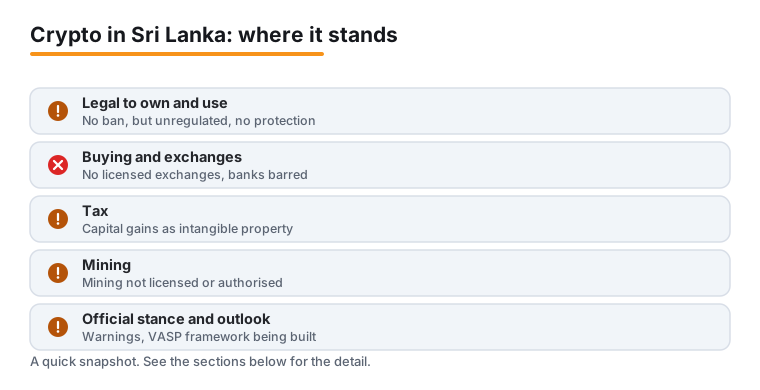
- Legal: Legal to own and invest, not legal tender, cannot be used for payment
- Tax: Treated as intangible property, capital gains and income tax apply
- Buying: No licensed exchange, banks and cards blocked, use international and P2P
Cryptocurrency in Sri Lanka sits in a well-defined grey zone: there is no law that bans owning or investing in Bitcoin and other crypto assets, but crypto is not legal tender, no exchange is licensed, and banks and payment cards are barred from processing crypto transactions. The Central Bank of Sri Lanka (CBSL) has issued repeated public warnings about the risks, and through 2025 and 2026 the government has been actively building a Virtual Asset Service Provider (VASP) regulatory framework, with the Securities and Exchange Commission of Sri Lanka (SEC) named as the proposed lead regulator. This page explains where the law stands, who regulates what, how people actually buy and use crypto, how it is taxed, and the practical risks. It is general information as of 2026 and is NOT legal, tax, or financial advice; this area is evolving quickly, so always verify the current position with the CBSL and the other named regulators before acting.
On this page: Legal status · Who regulates it · Taxes · How to buy · Mining
Is Bitcoin and crypto legal in Sri Lanka?
There is no law in Sri Lanka that bans owning or investing in Bitcoin and other cryptocurrencies. In September 2025, the CBSL Governor publicly confirmed that, in the absence of specific laws or regulations, there is no legal impediment to a Sri Lankan investing in cryptocurrency or virtual currency. At the same time, crypto is not recognised as legal tender, and the Governor made equally clear that it cannot be used as a means of payment within the country. The Sri Lankan rupee remains the only currency recognised for domestic payments.
This produces a two-sided picture. Buying and holding crypto as an investment is tolerated, but it carries no consumer or investor protection: if a platform fails, an exchange is hacked, or you fall victim to a scam, no Sri Lankan regulator stands behind your funds. The CBSL has stated it has not licensed or authorised any entity to operate crypto exchanges, initial coin offerings (ICOs), mining schemes, or virtual-currency businesses. Treat the entire space as unregulated and use it at your own risk. For background on how this compares globally, see our overview of crypto regulation.
Who regulates crypto in Sri Lanka?
Sri Lanka does not yet have a single, comprehensive crypto law, so several authorities apply existing rules and a new framework is being assembled:
- Central Bank of Sri Lanka (CBSL): the monetary authority responsible for monetary policy, payments, and foreign exchange. It has issued the public warnings on virtual currencies and confirms no crypto business is licensed. Official site: cbsl.gov.lk.
- Securities and Exchange Commission of Sri Lanka (SEC): under the proposed VASP framework discussed during 2026, the SEC is designated as the lead regulator for virtual assets. Official site: sec.gov.lk.
- Financial Intelligence Unit (FIU) of Sri Lanka: handles anti-money-laundering (AML) and counter-terrorist-financing (CFT) supervision under the Financial Transactions Reporting Act, No. 6 of 2006, and operates as an independent unit within the CBSL.
- Inland Revenue Department (IRD): administers taxation, including capital gains and business-income tax that can apply to crypto.
Policy is being coordinated through a VASP Sub-Committee under the national AML/CFT coordinating structure, involving the CBSL, the SEC, the FIU, and the Ministry of Digital Economy. Because the SEC's role as lead regulator is part of a proposed framework not yet fully enacted, treat the institutional picture as transitional and confirm responsibilities with the regulators directly.
Key laws and frameworks
The current rules come mainly from foreign-exchange and AML legislation, not a bespoke crypto statute:
- Foreign Exchange Act, No. 12 of 2017: the CBSL's April 2021 public notice confirmed that virtual currencies are not a recognised investment category under this Act and that no crypto business has been authorised under it.
- Directions No. 03 of 2021 (Department of Foreign Exchange): issued under the Foreign Exchange Act, these prohibit the use of Electronic Fund Transfer Cards (EFTCs), including debit and credit cards, for payments related to virtual-currency transactions.
- Financial Transactions Reporting Act, No. 6 of 2006: the basis for the FIU's AML/CFT mandate; proposed amendments to bring VASPs clearly within its scope have been under discussion in 2026.
- Inland Revenue Act, No. 24 of 2017: the general tax law under which crypto gains are treated (see the taxation section below).
A dedicated VASP framework is being drafted to align Sri Lanka with Financial Action Task Force (FATF) standards. As of 2026 it had not been finalised into enacted, gazetted legislation, so the legal landscape should be treated as evolving. Verify the latest position with the CBSL and SEC.
Licensing and registration of exchanges (VASPs)
No cryptocurrency exchange is currently licensed or authorised to operate in Sri Lanka, and the CBSL has repeatedly stated it has not given any licence or authorisation to any entity to run virtual-currency schemes, exchanges, ICOs, or mining operations. Banks are also prohibited from processing crypto transactions, and cards cannot be used for crypto-related payments under the 2021 Directions.
That is set to change if the proposed VASP framework is enacted. Through 2025 and 2026, a VASP Sub-Committee, whose fourth meeting was held at the Central Bank on 25 May 2026, has been developing a formal, internationally compliant regime. The reported direction includes designating the SEC as lead regulator, registering and supervising VASPs, requiring registration with the FIU for AML/CFT purposes, classifying virtual assets as a distinct legal category, and formalising the policy through a Cabinet Memorandum and concept paper. Until such law is enacted and a licensing window opens, anyone offering exchange or custody services to the Sri Lankan public is doing so outside any authorised regime, and users have no regulatory recourse.
How crypto is taxed in Sri Lanka
Sri Lanka has no dedicated cryptocurrency tax code, but that does not make crypto gains tax-free. The Inland Revenue Department treats cryptocurrencies as intangible property, so they fall under the existing rules in the Inland Revenue Act, No. 24 of 2017. In practice this means gains from selling or exchanging crypto can be subject to Capital Gains Tax, with the taxable gain calculated as the difference between the disposal price and the acquisition cost. Crypto received as business income or from activities such as trading or mining may instead be taxed as income.
Rates and reporting rules are changing. The capital gains tax rate for individuals had been 10 percent, and the Inland Revenue (Amendment) Bill published on 24 February 2026 proposed raising the capital gains tax rate for individuals and partnerships from 10 percent to 15 percent, with the rate for trusts, unit trusts, mutual funds and similar bodies increased to 30 percent. These changes take effect on enactment of the Amendment Act. Separately, an 18 percent Value Added Tax on digital services provided by non-resident suppliers, which can include overseas crypto platforms serving Sri Lankan users, is being introduced, with the effective date for non-resident digital service providers reported to have been deferred to 1 July 2026 subject to final IRD guidance. Because the figures are evolving and depend on your personal circumstances, do not rely on a single headline number: confirm your obligations directly with the IRD or a qualified Sri Lankan tax adviser. For general background, see our guide to crypto taxes. This page does not provide tax advice.
AML, KYC and FATF compliance
Anti-money-laundering and know-your-customer obligations sit at the centre of Sri Lanka's emerging approach to crypto. The Financial Intelligence Unit, operating under the Financial Transactions Reporting Act, No. 6 of 2006, is responsible for AML/CFT supervision and has been working to bring virtual asset service providers within its reporting and due-diligence regime. As a first concrete step, in late 2025 the FIU launched a mandatory survey to collect information on persons and entities providing virtual asset services as a business, so it can identify who is operating in the sector.
Much of the urgency is driven by Sri Lanka's participation in the FATF Mutual Evaluation process, which assesses how effectively a country counters money laundering and terrorist financing, including risks from virtual assets. The proposed VASP framework is expected to require registered providers to perform customer due diligence (KYC), monitor and report suspicious transactions, and implement international measures such as the FATF travel rule for transfers. For users, the practical takeaway is to expect identity verification on any reputable platform and to be wary of any service that asks for none. Until the framework is law, AML coverage of crypto remains incomplete, which is part of why the CBSL flags money-laundering and terrorist-financing risks in its warnings.
Buying and using crypto in practice
Because no exchange is licensed and banks block crypto transactions, buying crypto in Sri Lanka is possible but comes with real friction. The general steps people follow are:
- Educate yourself first. Understand wallets, private keys, and exchanges, and read the CBSL's warnings so you go in with eyes open.
- Choose a platform. Most users turn to established international exchanges or reputable peer-to-peer (P2P) services; research each platform's security history, fees, and treatment of Sri Lankan users.
- Complete identity verification. Reputable platforms require KYC checks; be wary of anything that does not.
- Fund carefully. Local card and bank funding for crypto is restricted, so settlement is often via P2P. Make sure any movement of funds is consistent with foreign-exchange rules.
- Secure your assets. Move holdings to a wallet you control, enable two-factor authentication, and never share your seed phrase. For larger amounts, consider a hardware wallet.
- Keep records. Save dates, amounts, and prices for every transaction for possible tax reporting.
Crypto cannot be used for domestic payments, and using overseas platforms or P2P channels can raise foreign-exchange compliance questions and offers no recourse through a Sri Lankan regulator. Proceed cautiously and assume you bear the full risk of any loss.
Bitcoin mining in Sri Lanka
Cryptocurrency mining is not licensed or authorised in Sri Lanka. The CBSL has explicitly stated it has not approved any mining operations or virtual-currency schemes, and there is no dedicated framework that permits, regulates, or incentivises commercial Bitcoin mining.
Practical factors also weigh against mining locally. Sri Lanka has experienced periods of electricity-supply pressure and tariff increases, and proof-of-work mining is highly energy-intensive, so power cost and reliability are real constraints. Anyone considering mining should recognise that mining income could be treated as a taxable activity by the IRD, that hardware imports and electricity use carry their own costs, and that the absence of authorisation leaves the activity legally uncertain. Verify the current position with the CBSL, the IRD, and a qualified local adviser before committing capital.
Recent developments (2025 to 2026)
The most significant shift is the move from blanket warnings toward an organised framework. In September 2025 the CBSL Governor publicly clarified that investing in crypto faces no legal barrier while reiterating that it cannot be used for payments, and signalled that laws would be developed to require virtual asset service providers to register with the FIU and to guard against money laundering.
Late in 2025 the Financial Intelligence Unit, part of the CBSL, launched a mandatory survey to obtain information on individuals and entities engaged in virtual asset service providing as a business, a first step toward formally identifying the sector ahead of Sri Lanka's AML/CFT evaluation. A related public notice was issued on 1 March 2026. Through 2026, a VASP Sub-Committee, with its fourth meeting held at the Central Bank on 25 May 2026 under Deputy Minister of Digital Economy Eranga Weeraratne, advanced a draft framework. Reported outcomes include designating the Securities and Exchange Commission of Sri Lanka as the lead regulator for virtual assets, discussing amendments to the Financial Transactions Reporting Act, and tracking Sri Lanka's FATF Mutual Evaluation, with the next step being a Cabinet Memorandum and concept paper. On tax, the Inland Revenue (Amendment) Bill published on 24 February 2026 proposed raising the capital gains tax rate for individuals from 10 percent to 15 percent. None of the VASP framework is finalised law as of 2026, and timelines can slip, so treat these as developing proposals and confirm the current status with the official sources.
Consumer risks and protection
The central risk in Sri Lanka is the lack of regulation and protection. Without licensed exchanges or a complete legal framework, users are exposed to platform failures, hacks, scams, illiquidity when cashing out, and uncertainty over how foreign-exchange and tax rules apply. The CBSL has described virtual currencies as unregulated financial instruments with no regulatory oversight or safeguards in Sri Lanka, warning that investors have no specific legal or regulatory recourse in the event of a dispute, and that crypto carries financial, operational, legal, customer-protection, and security risks. The Central Bank has also issued specific notices about protecting the public from crypto investment scams.
If you choose to participate, treat it as high-risk capital you can afford to lose, use reputable platforms with strong security, keep detailed records, and never act on promises of guaranteed or unusually high returns. Consider speaking with a qualified, independent financial adviser first. Until a VASP framework is enacted, assume there is no safety net.
Official sources and how to verify
Because the rules are evolving, always confirm the current position with the named official regulators rather than relying on secondary commentary. The primary official sources are:
- Central Bank of Sri Lanka (CBSL), for public notices on virtual currencies, the Foreign Exchange Act position, and payment rules.
- Securities and Exchange Commission of Sri Lanka (SEC), the proposed lead regulator for virtual assets under the VASP framework.
- Inland Revenue Department (IRD), for capital gains and income tax treatment of crypto.
- Financial Intelligence Unit of Sri Lanka (FIU), for AML/CFT rules and VASP reporting.
You can also compare other jurisdictions through our regulation hub. This page is general information as of 2026 and is not legal, tax, or financial advice; verify your specific situation with the CBSL and the other named regulators or a qualified Sri Lankan professional before acting.
Frequently asked questions
Is cryptocurrency legal in Sri Lanka?
Yes, in the sense that there is no law banning the ownership or investment of cryptocurrency, and in September 2025 the CBSL Governor confirmed there is no legal impediment to investing in crypto. However, crypto is not legal tender, cannot be used for payments, and is not yet regulated. No exchanges are licensed, banks cannot process crypto transactions, and the Central Bank warns there is no investor protection. In short, it is tolerated but unregulated, and you use it at your own risk.
Who is the main crypto regulator in Sri Lanka?
The Central Bank of Sri Lanka (CBSL) has been the lead authority issuing warnings and applying foreign-exchange rules. Under the proposed VASP framework developed in 2026, the Securities and Exchange Commission of Sri Lanka (SEC) is designated as the lead regulator for virtual assets, working alongside the Financial Intelligence Unit on AML/CFT and the Inland Revenue Department on tax. Because the framework is not yet fully enacted, confirm responsibilities directly with the CBSL and SEC.
Can I use my Sri Lankan bank account or card to buy crypto?
Generally no. Under Directions No. 03 of 2021 issued by the CBSL's Department of Foreign Exchange under the Foreign Exchange Act, No. 12 of 2017, Electronic Fund Transfer Cards such as debit and credit cards may not be used for payments related to virtual-currency transactions, and banks are kept away from crypto. People typically rely on international platforms or peer-to-peer trading, both of which carry additional risk and may raise foreign-exchange compliance questions. Confirm the current rules before moving any money.
Do I have to pay tax on crypto in Sri Lanka?
Likely yes if you make gains. Sri Lanka has no dedicated crypto tax law, but the Inland Revenue Department treats cryptocurrency as intangible property, so gains can fall under Capital Gains Tax in the Inland Revenue Act, No. 24 of 2017, and crypto-related income can be taxed as income. Rates and rules are changing, including an Inland Revenue (Amendment) Bill published in February 2026, so confirm your obligations directly with the IRD or a qualified tax adviser. This page does not provide tax advice.
Are crypto exchanges or Bitcoin ATMs licensed in Sri Lanka?
No. The CBSL has not licensed or authorised any entity to operate a crypto exchange, ICO, mining scheme, or related service, and there is no regulated network of Bitcoin ATMs. Any platform or kiosk operating locally does so outside a clear legal framework and without oversight, so caution is essential. This may change if the proposed VASP licensing regime is enacted.
Is Sri Lanka going to regulate cryptocurrency?
Yes, work is well underway. A VASP Sub-Committee under the national AML/CFT structure has been developing a framework, with its fourth meeting held at the Central Bank on 25 May 2026. Reported plans include naming the SEC as lead regulator for virtual assets, registering VASPs with the FIU, amending the Financial Transactions Reporting Act, and aligning with FATF standards, with a Cabinet Memorandum as the next step. As of 2026 this was not yet enacted law, so check the CBSL and SEC for the latest position.
What is the capital gains tax rate on crypto in Sri Lanka?
The capital gains tax rate for individuals had been 10 percent. The Inland Revenue (Amendment) Bill published on 24 February 2026 proposed raising the rate for individuals and partnerships from 10 percent to 15 percent, taking effect on enactment of the Amendment Act, with a higher rate for trusts and similar bodies. Crypto gains are treated under the general Inland Revenue Act rather than a dedicated crypto tax code, so your actual liability depends on your circumstances. Confirm the current rate and rules with the Inland Revenue Department or a qualified tax adviser. This page does not provide tax advice.
Did Sri Lanka start collecting information on crypto businesses?
Yes. In late 2025 the Financial Intelligence Unit, part of the Central Bank of Sri Lanka, launched a mandatory survey to collect information on individuals and entities providing virtual asset services as a business, with a related public notice issued on 1 March 2026. It is an information-gathering step ahead of a formal registration and supervision regime and Sri Lanka's AML/CFT evaluation, not a licensing scheme in itself. No virtual asset service provider is licensed yet.
Facts reviewed: 30 June 2026. Page updated: 3 August 2026.