Home › Crypto Regulation › South Sudan
Bitcoin & Cryptocurrency Regulation in South Sudan
Quick answer — South Sudan, 2026
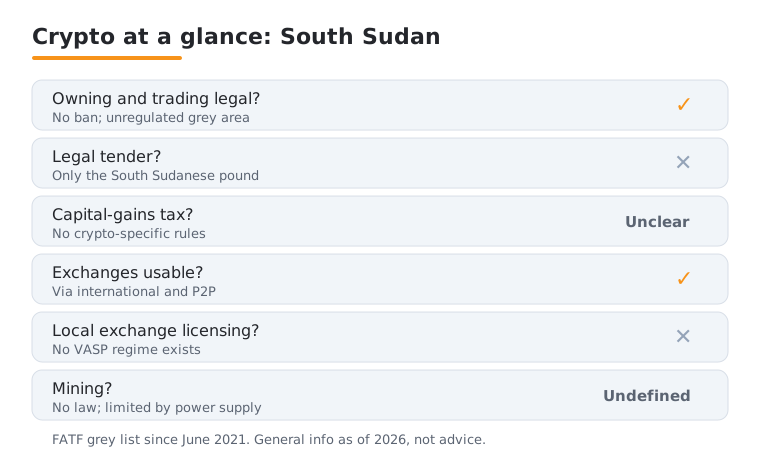
- Owning and trading crypto is not banned, but it is not regulated or protected either; it is not legal tender (only the South Sudanese pound is).
- No dedicated crypto tax exists, yet general tax principles could still apply, so keep records.
- There is no licensed local exchange; residents typically buy via international and peer-to-peer platforms with ID checks.
South Sudan is one of the least mapped jurisdictions in the world for cryptocurrency. As of 2026 it has no dedicated law addressing Bitcoin or other digital assets, no licensing regime for crypto businesses, and no published central-bank framework that either authorises or prohibits them. The result is not a clear green light but a genuine legal vacuum: using crypto is not a defined crime, yet it is not recognised, regulated, or protected either. For a young nation rebuilding its institutions, contending with a volatile currency, and relying heavily on money sent home from abroad, that uncertainty shapes how digital assets are actually used.
This guide explains how Bitcoin and cryptocurrencies are treated in South Sudan heading into 2026: their legal status, the relevant authorities (chiefly the Bank of South Sudan and the National Revenue Authority), how tax might apply, anti-money-laundering context, the practical reality of buying and using crypto, mining, remittances, and consumer risks. It is general information as of 2026 and is NOT legal, tax, or financial advice. Because there is little settled law and the situation can change quickly, verify the current position with the official regulator, the Bank of South Sudan, and a qualified local lawyer or tax professional before acting. For broader context see our guide to crypto regulation and our country regulation hub.
On this page: Legal status · Who regulates it · Taxes · How to buy · Mining
Is Bitcoin and crypto legal in South Sudan?
No South Sudanese law bans owning, buying, or trading Bitcoin and other cryptocurrencies, and equally none formally permits or recognises them. In practice, crypto sits in an unregulated grey area: neither prohibited nor protected. Holding or transacting is not by itself a defined offence, but you also do not get the consumer safeguards, dispute resolution, or deposit protections that come with regulated financial products.
What is clear is that cryptocurrencies are not legal tender. The only official currency is the South Sudanese pound (SSP), issued by the Bank of South Sudan under the Bank of South Sudan Act, 2011. No merchant or institution is obliged to accept Bitcoin; any acceptance is purely voluntary. Because the framework is effectively silent, much of your risk comes from that silence: there is no specialised authority to turn to if a platform fails, a counterparty disappears, or a transaction goes wrong.
Note that South Sudan is a distinct country from its northern neighbour, Sudan, which has its own central bank (the Central Bank of Sudan) and its own, more explicit public warnings on crypto. Statements from Sudanese authorities do not apply in South Sudan. This is general information as of 2026, not legal advice. Verify the current status with the Bank of South Sudan or a qualified local lawyer.
The regulator: Bank of South Sudan
The Bank of South Sudan (BoSS) is the central bank and monetary authority. It was established under the Bank of South Sudan Act, 2011, following independence in July 2011, and holds the exclusive right to issue the South Sudanese pound. Its core mandate is price stability, a sound and efficient market-based financial system, a secure national payment system, and the licensing and supervision of commercial banks and other financial institutions.
As the body most likely to lead any future crypto policy, BoSS is the right place to check the official position. As of 2026, its public regulations page lists rules on matters such as banking licences, foreign exchange, exchange rates, electronic money, and anti-money-laundering policy, but contains no dedicated cryptocurrency or virtual-asset framework. Do not assume any particular treatment of crypto; confirm directly with the bank.
For tax matters, the relevant authority is the National Revenue Authority (NRA), which administers and collects national taxes and duties. Neither BoSS nor the NRA currently publishes crypto-specific guidance, so treat any informal claim about official policy with caution and check the primary sources.
Crypto laws and frameworks in South Sudan
South Sudan's defining feature is the near-total absence of crypto-specific regulation: there is no virtual-asset act, no exchange-licensing system, and no published central-bank rulebook for digital assets. Unlike European Union members governed by the EU's Markets in Crypto-Assets (MiCA) regulation, South Sudan has no comparable comprehensive framework and no regional equivalent in force.
Laws that can still apply
The lack of crypto-specific rules does not place crypto beyond all law. General legal obligations can still bear on how crypto is used, especially for anyone operating commercially or moving large sums. These include the Bank of South Sudan Act, 2011 and its banking and foreign-exchange regulations; the country's Anti-Money Laundering and Counter-Terrorist Financing Act; tax law under the annual Financial Act; and general laws on fraud and financial crime.
What this means in practice
Treat the environment as undefined rather than safe: the absence of a rule today does not guarantee one will not appear tomorrow. As the country rebuilds its institutions, enforcement capacity and how existing rules are applied to new technology can be unpredictable. Do not rely on summaries, including this one, for compliance decisions. General information only, not legal advice. Confirm the scope of any applicable law with the Bank of South Sudan or a qualified South Sudanese lawyer. See also our overview of how crypto regulation works.
Licensing and registration of exchanges and VASPs
There is no domestic licensing or registration regime for crypto exchanges or virtual-asset service providers (VASPs) in South Sudan as of 2026. BoSS licenses banks, electronic-money operators, and foreign-exchange bureaus, but it has not published a dedicated authorisation pathway for crypto businesses, and no local crypto-exchange industry has been formally established.
This matters for two reasons. First, anyone running a crypto-related business cannot obtain a clear local licence to point to, which creates legal uncertainty; general financial-services, foreign-exchange, and anti-money-laundering obligations may still be relevant, so qualified legal advice is essential before operating commercially. Second, ordinary users typically rely on international exchanges and peer-to-peer (P2P) marketplaces rather than domestically regulated platforms, which means the consumer protections that come with a licensed local provider are absent.
Because there is no registry to consult, you cannot verify a crypto business's standing with a South Sudanese regulator the way you could a licensed bank. Prefer established global platforms with a strong track record and proper identity checks, and confirm the current position with BoSS before assuming any business is authorised. General information only.
Crypto and Bitcoin tax in South Sudan
South Sudan does not have a clear, dedicated crypto tax regime aimed at everyday investors. The country's tax rules are set out in an annual Financial Act administered by the National Revenue Authority, and the most recent versions (the Financial Act 2023/2024 and Financial Act 2024/2025) amend conventional taxes such as business profit tax, personal income tax, and sales tax. They do not contain crypto-specific provisions.
The uncertainty is itself the key point: the absence of specific crypto rules does not automatically make crypto activity tax-free. Depending on the facts, general tax principles could apply; for example, income from a trade or business, or profits from commercial activity, may fall within broader obligations administered by the NRA. How a transaction is characterised can depend on whether you are an occasional individual user or operating as a business.
Because the position is unsettled and fact-specific, this guide deliberately does not state any crypto tax rates, thresholds, or filing requirements; doing so would risk being inaccurate or out of date. Keep thorough records of every transaction (dates, amounts, SSP value at the time, counterparties, fees, platforms) so you can report accurately if required. General information only, not tax advice. Confirm any obligations with the National Revenue Authority or a qualified local tax professional, and see our introduction to crypto taxes.
AML, KYC, and financial-crime context
While there are no crypto-specific anti-money-laundering rules, South Sudan does have a general AML/CFT framework. The country has enacted an Anti-Money Laundering and Counter-Terrorist Financing Act, which requires reporting institutions to verify customer identity, keep records, and report suspicious transactions, and it provides for a Financial Intelligence Unit (FIU).
Importantly, South Sudan has been on the Financial Action Task Force (FATF) list of jurisdictions under increased monitoring, commonly called the "grey list," since June 2021. FATF reviews through 2025 and into 2026 noted limited progress on its action plan, with priorities including building AML/CFT supervisory capacity, beneficial-ownership transparency, and operationalising a fully functioning, independent FIU. This grey-list status is one reason some international platforms apply heightened scrutiny to, or restrict, users connected to South Sudan.
In practice, the KYC you will encounter comes from the exchanges themselves: reputable international platforms require a government-issued ID before trading or withdrawing, as a standard AML measure. Avoid services that skip identity checks. General information only. Confirm current obligations with the Bank of South Sudan or a qualified local adviser.
Buying and using crypto in practice
There is no established, domestically licensed crypto-exchange industry in South Sudan. People who buy crypto generally use international exchanges and P2P marketplaces, and the obstacles are as much about infrastructure as law.
- Connectivity and power: internet and reliable electricity are limited, especially outside main towns, which constrains who can realistically use online platforms; a stable connection and a device are prerequisites.
- Identity verification (KYC): reputable exchanges require a government-issued ID before trading or withdrawing. Access can still depend on whether a platform supports South Sudanese users and documents, and grey-list status can mean extra checks.
- Funding and the pound: moving value between the SSP and crypto is often the hardest step. P2P trading, settling in local currency by bank transfer or mobile money while the platform holds crypto in escrow, is the common workaround. Use the escrow rather than settling off-platform, and verify counterparties.
- Foreign-exchange context: South Sudan has seen significant currency instability and applies FX rules, so converting or moving value can intersect with them. Confirm current requirements before transacting at scale.
Prefer established providers with strong security, clear fees, and proper KYC. Self-custody removes counterparty risk but makes security your responsibility: beyond small amounts, withdraw to a personal wallet (a hardware wallet for larger holdings), back up your recovery phrase offline, and never share it. General information only. Currency and cross-border rules are country-specific; verify them with the Bank of South Sudan.
Bitcoin mining in South Sudan
No specific law in South Sudan bans or regulates cryptocurrency mining, so, like crypto generally, it sits in an undefined grey area rather than being clearly permitted. The bigger constraints here are practical rather than legal.
Proof-of-work mining is extremely energy-intensive and needs cheap, abundant, reliable electricity. South Sudan's national power supply is limited and inconsistent, with much of the country dependent on generators rather than a stable grid, making large-scale mining costly and hard to sustain. Internet reliability, equipment-import logistics, and a challenging operating environment add further hurdles.
The takeaway is that mining here is hampered far more by infrastructure than by any explicit prohibition, but "unregulated" is not "approved." Connecting energy-intensive operations to constrained public infrastructure can attract scrutiny, and policy could change. Anyone considering mining should monitor the legal landscape and seek qualified local legal advice before committing capital. General information only, not legal advice.
Recent developments and outlook
As of 2026, there have been no confirmed crypto-specific legislative or central-bank developments in South Sudan: no virtual-asset act, no VASP licensing, and no published BoSS crypto framework. The most relevant moving parts are indirect.
- FATF monitoring: South Sudan remained on the FATF grey list through the October 2025 review and was reviewed again in the February 2026 cycle, with work still outstanding on its AML/CFT action plan; FATF has noted that the plan's deadlines have expired and progress has been limited. Named priorities include building risk-based AML/CFT supervision, a legal framework for beneficial-ownership information, operationalising a fully functioning and independent Financial Intelligence Unit, implementing targeted financial sanctions in line with United Nations Security Council resolutions, and supervising non-profit organisations at risk of terrorist-financing abuse. Progress here could eventually push the authorities toward clearer rules on financial flows, including virtual assets.
- Tax law: the Financial Act is updated annually (most recently the 2024/2025 edition), so the tax baseline can shift each fiscal year even without crypto-specific provisions.
- Regional context: several African jurisdictions have moved toward formal crypto frameworks. South Sudan could in time follow regional peers, but the pace is uncertain, and stability, currency, and basic financial infrastructure are likely to take priority.
Be cautious of secondhand claims that South Sudan has "banned" or "legalised" crypto; neither is supported by a published instrument. For the current position, rely on the official sources below rather than aggregator sites. General information only.
Regional context: crypto use across sub-Saharan Africa
South Sudan itself has little published data on crypto use, but it sits within a wider sub-Saharan African market where digital assets are used mainly for cross-border transfers and as a hedge against local-currency instability, rather than for speculation. Industry trackers report that crypto activity in the region kept growing through 2025, with peer-to-peer transfers and mobile-money funding widely cited as the entry points for everyday users.
This regional pattern helps explain the practical reality on the ground in South Sudan: with no local licensed exchange, most access runs through international platforms and P2P marketplaces, often funded through mobile money, and remittances from the diaspora are a common motivation. Treat this as context, not a country-specific statistic; robust standalone figures for South Sudan are not published, and adoption here is constrained by the connectivity and power limits described above. See Chainalysis on 2025 global adoption for the wider regional picture. General information only.
Consumer risks and protection
Crypto in South Sudan carries the usual market and security risks, amplified by a frontier environment with little legal protection and significant infrastructure constraints. The biggest user risks are volatility, fraud, the absence of any regulatory safety net, and reliance on power and connectivity that may be unreliable. Crypto holdings are not protected like bank deposits, and a lost private key or compromised account can mean permanent loss.
Scams to watch for
Fraud follows adoption, and newer, less-served markets are heavily targeted. Common schemes include fake or cloned exchange sites; "investment" offers promising guaranteed or unusually high returns, including Ponzi structures and bogus token sales; phishing that captures your login or recovery phrase; and "pig butchering" or romance scams that build trust before pushing a fake platform. Protect yourself by using only reputable providers, double-checking website addresses, enabling two-factor authentication, never sharing your seed phrase, and treating any unsolicited "opportunity" with suspicion.
Because there is no specialised crypto regulator or compensation scheme, there is usually no domestic recourse if a platform fails or a scam succeeds. A common conservative principle is to invest only money you can afford to lose, avoid leverage, and treat any "guaranteed" return as a red flag. This is not financial advice and contains no price predictions.
Official sources and how to verify
Because crypto rules in South Sudan are sparse and evolving, always confirm the current position against primary, official sources rather than relying on summaries, aggregator sites, or this guide alone:
- Bank of South Sudan (central bank and monetary authority): boss.gov.ss, including its regulations page for current rules and any new circulars.
- National Revenue Authority (national tax authority): nra.gov.ss for tax law, the latest Financial Act, and filing guidance.
- Financial Action Task Force (FATF) country page for South Sudan: fatf-gafi.org for the country's AML/CFT monitoring status and action plan.
For a qualified, situation-specific answer, consult a South Sudanese lawyer or licensed tax professional. You can also compare other jurisdictions on our crypto regulation hub. This page is general information as of 2026 and is not legal, tax, or financial advice; verify the current rules with the Bank of South Sudan and the National Revenue Authority before acting.
Frequently asked questions
Is Bitcoin legal in South Sudan?
There is no law that bans owning or trading Bitcoin in South Sudan, and no law that formally recognises it either, so crypto sits in an unregulated grey area. It is not legal tender; only the South Sudanese pound is. Because the framework is effectively silent, you do not get the protections of a regulated product. This is general information as of 2026, not legal advice; confirm the current position with the Bank of South Sudan or a local lawyer.
Who regulates cryptocurrency in South Sudan?
No authority specifically regulates cryptocurrency in South Sudan as of 2026, and there is no published crypto-licensing regime. The Bank of South Sudan (BoSS), established under the Bank of South Sudan Act, 2011, is the central bank and monetary authority and would most likely lead any future crypto policy. The National Revenue Authority (NRA) handles taxation. General laws on AML, foreign exchange, fraud, and financial crime can still be relevant.
Are crypto exchanges licensed in South Sudan?
No. South Sudan has no licensing or registration regime for crypto exchanges or virtual-asset service providers (VASPs), and no domestic crypto-exchange industry has been formally established. Users typically rely on international exchanges and peer-to-peer marketplaces, which means there is no local regulator to verify a platform's standing or to turn to if something goes wrong. Prefer established global providers with strong security and proper identity checks.
Do I have to pay tax on crypto in South Sudan?
South Sudan does not have a clear, dedicated crypto tax regime for everyday investors, and the annual Financial Act administered by the National Revenue Authority contains no crypto-specific provisions. However, the absence of specific rules does not automatically make crypto activity tax-free; general tax principles could apply depending on the facts. We do not state any rates here because the position is uncertain. Keep detailed records and confirm any obligations with the NRA or a qualified local tax professional. Not tax advice.
Is crypto mining allowed in South Sudan?
There is no specific law banning or regulating crypto mining in South Sudan, so it is undefined rather than clearly permitted. In practice the main barriers are infrastructure: limited and unreliable electricity, patchy internet, and a difficult operating environment make large-scale mining costly. "Unregulated" is not the same as "approved," and policy could change, so seek local legal advice before committing capital. General information only, not legal advice.
Where can I verify the official rules?
Use primary sources: the Bank of South Sudan at boss.gov.ss (and its regulations page) for monetary and financial rules, the National Revenue Authority at nra.gov.ss for tax matters, and the FATF South Sudan country page for the AML/CFT monitoring status. South Sudan has been on the FATF grey list since 2021. For a situation-specific answer, consult a qualified South Sudanese lawyer or licensed tax professional.
Is South Sudan still on the FATF grey list in 2026?
Yes. South Sudan has been on the FATF list of jurisdictions under increased monitoring, the "grey list," since June 2021, and it remained on that list through the October 2025 review and the February 2026 review cycle. FATF has noted that its action-plan deadlines have expired with limited progress, citing priorities such as risk-based AML/CFT supervision, beneficial-ownership transparency, and a fully functioning, independent Financial Intelligence Unit. This status is one reason some international platforms apply extra checks to users connected to South Sudan. Check the FATF South Sudan country page for the latest position.
How do people in South Sudan actually buy crypto?
Because there is no local licensed exchange, residents generally use international exchanges and peer-to-peer (P2P) marketplaces. A common route is P2P trading funded by bank transfer or mobile money, with the platform holding crypto in escrow until payment clears. This mirrors the wider sub-Saharan African pattern, where crypto is used mainly for transfers and as a currency hedge rather than speculation, though robust standalone figures for South Sudan are not published. Access still depends on connectivity, electricity, whether a platform supports South Sudanese users and ID documents, and the extra checks that can come with grey-list status. General information only.
Facts reviewed: 30 June 2026. Page updated: 3 August 2026.