Home › Crypto Regulation › Slovakia
Bitcoin & Cryptocurrency Regulation in Slovakia
Quick answer — Slovakia, 2026
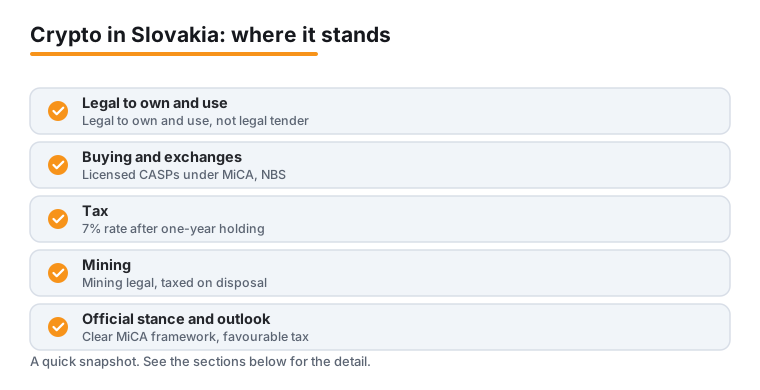
- Legal: Legal to own and use, not legal tender; EU MiCA applies, CASPs need NBS licence
- Tax: 7% on gains held over a year, 19-25% if under a year; swaps not taxed
- Buying: Via MiCA-authorised EU exchanges with KYC, or Bitcoin ATMs
Slovakia treats Bitcoin and other crypto-assets as legal to own, buy, sell and use, while regulating the businesses that provide crypto services to the public. As a European Union member state that uses the euro, Slovakia applies the EU's Markets in Crypto-Assets Regulation (MiCA) directly, alongside its own anti-money-laundering and income-tax rules. The National Bank of Slovakia (Narodna banka Slovenska, or NBS) is the competent authority that authorises and supervises crypto-asset service providers (CASPs), and crypto income is taxed under the Slovak Income Tax Act administered by the Financial Administration of the Slovak Republic. For 2026 the headline points are that the MiCA transition window for legacy providers closed at the end of December 2025, that Slovakia offers a notably favourable income-tax treatment for crypto held more than a year, and that new EU tax-reporting obligations (DAC8) for crypto platforms apply from 1 January 2026.
This article is general information as of 2026 and is not legal, tax or financial advice. Crypto rules, tax rates and thresholds change; always verify the current position with the National Bank of Slovakia, the Slovak Financial Administration and a qualified Slovak adviser before acting. For broader background see our guide to crypto regulation.
On this page: Legal status · Who regulates it · Taxes · How to buy · Mining
Is Bitcoin and crypto legal in Slovakia?
Yes. Owning, buying, selling, holding and transferring Bitcoin and other crypto-assets is legal in Slovakia. There is no ban on individuals using cryptocurrency, and residents can freely hold crypto in self-custody wallets or with regulated providers. The National Bank of Slovakia states plainly on its official guidance that consumers do not need any authorisation from the NBS to buy, sell or hold crypto-assets for private purposes.
What Bitcoin is not is legal tender. The euro is Slovakia's official currency, and no business is obliged to accept crypto as payment, though merchants may choose to accept it voluntarily. For tax and regulatory purposes, crypto-assets are treated as a form of property rather than as money.
The key distinction is between using crypto and providing crypto services to the public. Individuals face no licensing hurdle, but companies that exchange, custody, transfer or otherwise deal in crypto-assets on behalf of customers must be authorised. That is where MiCA and the NBS come in, and it is the part of Slovak crypto law that changed most in 2024 and 2025.
Who regulates crypto in Slovakia?
Several authorities share responsibility, each over a different aspect:
- National Bank of Slovakia (Narodna banka Slovenska, NBS): the single competent authority for crypto-asset supervision under MiCA. It authorises and supervises crypto-asset service providers and issuers of asset-referenced tokens, and maintains the official register of licensed entities. See the NBS crypto-assets supervision pages; questions can be directed to its dedicated crypto contact.
- Financial Administration of the Slovak Republic (Financna sprava): administers income tax and VAT, including the taxation of crypto gains and the new DAC8 crypto reporting.
- Financial Intelligence Unit (FIU), part of the National Crime Agency: the body that receives anti-money-laundering reports under the Slovak AML Act.
- Ministry of Finance: sets tax and financial-market policy and transposes EU directives into Slovak law.
For the European dimension, the European Securities and Markets Authority (ESMA) coordinates MiCA across the EU and publishes EU-wide registers of authorised firms. Always cross-check a provider against the NBS register and the ESMA registers before depositing funds.
Crypto laws and frameworks in Slovakia
Slovakia's crypto framework now sits primarily on directly applicable EU law, with national legislation handling AML and tax. The core pieces are:
- Markets in Crypto-Assets Regulation (MiCA): the EU-wide regime that has applied to the provision of crypto-asset services since 30 December 2024. It governs CASP authorisation, stablecoins (asset-referenced and e-money tokens), issuer white papers and conduct rules.
- Transfer of Funds Regulation (TFR): extends the financial "travel rule" to crypto transfers, requiring originator and beneficiary information to accompany transactions.
- Digital Operational Resilience Act (DORA): sets IT and cyber-resilience requirements for financial firms, including CASPs.
- Slovak AML Act, Act No. 297/2008 Coll. (as amended): the national anti-money-laundering law that applies to providers of services related to virtual currencies, including exchanges and wallet custodians.
- Income Tax Act, Act No. 595/2003 Coll. (as amended): the national law under which crypto income is taxed; it was amended to introduce the favourable long-term holding regime.
Because the precise transition arrangements and the list of authorised firms evolve, rely on the official NBS registers and EU/ESMA registers for a provider's current status rather than older "VASP" listings. For a general primer, see our crypto regulation explainer.
Licensing and registration of exchanges (CASPs)
Under MiCA, any firm that professionally provides crypto-asset services to customers in Slovakia needs a crypto-asset service provider (CASP) authorisation from the NBS, or a licence from another EU regulator that is "passported" into Slovakia. Covered activities include operating a trading platform, custody and administration of crypto-assets, exchanging crypto for fiat or other crypto, executing or placing orders, reception and transmission of orders, and providing advice or portfolio management.
Practical points reported for the Slovak CASP regime include:
- Single competent authority: the NBS reviews applications for governance, financial soundness and compliance systems, then decides within MiCA's statutory periods.
- Capital requirements: minimum own funds generally range from around 50,000 to 150,000 euro depending on the services offered, in line with MiCA's prudential tiers. Confirm the exact figure for a given activity with the NBS.
- EU passporting: a single Slovak CASP authorisation can be passported to serve customers across all EU member states.
- End of the transition window: legacy virtual-asset service providers that had operated under earlier Slovak trade licences could continue only until 30 December 2025. From then on, ongoing CASP activity requires MiCA authorisation or valid passporting.
If you operate or plan to operate a crypto business, treat the figures above as orientation and confirm current requirements directly with the NBS, because application detail and capital tiers depend on the precise service mix.
How crypto is taxed in Slovakia
Crypto income is taxed under the Slovak Income Tax Act and administered by the Financial Administration. Slovakia substantially reformed this area, and the regime is now relatively favourable for patient holders. Widely reported features include:
- Long-term holding (over one year): gains on crypto-assets held for more than one year before sale, where not held as business assets, are reported in a special tax base under section 51e of the Income Tax Act (the same base used for dividends) at a reduced rate of 7 percent. This regime took effect from 1 January 2024 and replaced earlier treatment that could reach a combined burden of up to 39 percent.
- Short-term holding (under one year): gains are taxed at the ordinary progressive personal income-tax rates. The lowest rate is 19 percent, rising to 25 percent and, following the 2026 changes to the Income Tax Act, higher rates above further thresholds. Check the current brackets and thresholds with the Financial Administration, as they are indexed and were revised for 2026.
- Crypto-to-crypto swaps: exchanging one crypto-asset for another is reportedly not treated as a taxable event; tax generally arises on exchange into fiat, stablecoins, goods or services.
- Small-payment relief: income from paying with crypto is reportedly exempt up to 2,400 euro per year, with only the excess taxed.
- Health-insurance levy: reported as abolished on crypto sale income from 2024.
- VAT: exchanging crypto-assets for legal tender (or vice versa) is exempt from VAT, consistent with EU case law.
These rates, thresholds and conditions carry exceptions and can change. Do not rely on a single figure from any article, including this one. Confirm the current treatment with the Financial Administration of the Slovak Republic or a qualified tax adviser, and see our general crypto taxes guide.
AML and KYC rules
Anti-money-laundering obligations apply both through directly applicable EU rules and through the Slovak AML Act (Act No. 297/2008 Coll., as amended), which has covered providers of services related to virtual currencies since the implementation of the EU's Fifth Anti-Money-Laundering Directive. In practice this means crypto-asset service providers operating in Slovakia must:
- Verify customer identity (KYC): collect and check identity documents before providing services, and apply enhanced due diligence to higher-risk situations.
- Monitor transactions: screen activity for suspicious patterns and keep records.
- Report to the FIU: file suspicious-transaction reports with the Slovak Financial Intelligence Unit, the part of the National Crime Agency that receives AML reports.
- Apply the travel rule: attach originator and beneficiary information to crypto transfers under the EU Transfer of Funds Regulation.
For users, the visible effect is that regulated exchanges, brokers and Bitcoin ATMs will ask you to verify your identity before you can trade or withdraw beyond minimal amounts.
Buying and using crypto in practice
Slovaks have a wide choice of ways to buy crypto. EU-based exchanges, brokers and apps serve the market, typically under a MiCA CASP licence held with the NBS or another EU regulator and passported across the bloc, and there are local crypto businesses and OTC desks as well. A typical path looks like this:
- 1. Choose a provider: prefer a MiCA-authorised exchange or app and cross-check its status in the NBS register at the central bank's site or in the ESMA registers.
- 2. Open and verify an account: complete KYC by providing identity documents, as required by AML rules.
- 3. Fund the account: SEPA euro bank transfers and cards are the common methods.
- 4. Place an order: compare trading fees and spreads first, as they vary widely.
- 5. Decide on custody: leave assets with the regulated provider, or withdraw to your own wallet (a hardware wallet for larger amounts) and safeguard your recovery phrase.
- 6. Keep records: save dates, amounts and euro values, which matter for tax and for tracking the one-year holding period.
Cash buyers can also use Bitcoin ATMs, which are established in larger cities such as Bratislava and Kosice; expect identity checks for anything beyond small amounts and higher fees than online platforms. Using a regulated, MiCA-authorised provider generally offers the strongest consumer protections.
Bitcoin mining in Slovakia
Bitcoin mining is legal in Slovakia. There is no specific prohibition on running mining hardware, and miners operate within the country's general legal, tax, energy and environmental frameworks rather than under a bespoke mining law.
The main practical constraint is electricity cost. Slovak power prices are relatively high by global standards, which makes large-scale proof-of-work mining economically challenging compared with low-cost-energy jurisdictions. On the other hand, a substantial share of Slovak electricity comes from low-carbon sources, including nuclear and hydro, so mining drawing on that mix can have a lower carbon footprint. Energy consumption and the electronic waste from obsolete hardware remain the wider concerns any serious operator must manage.
On tax, newly mined crypto is reportedly not taxed at the moment it is created; the tax liability instead arises when the mined assets are later sold, exchanged or otherwise transferred for consideration. Anyone mining at scale should also weigh business-registration, accounting and energy-compliance issues and consult a professional, and should record the euro value of disposals for tax purposes.
Recent developments (2025 to 2026)
Two themes dominate the current outlook: a maturing licensing regime and far greater tax transparency.
On licensing, MiCA is now fully in force. The transition window that let legacy virtual-asset service providers operate under older Slovak trade licences closed on 30 December 2025, so ongoing crypto-asset services now require full NBS CASP authorisation or valid EU passporting. The broad direction is more regulation and stronger consumer protection, not prohibition.
On transparency, the EU's DAC8 directive extends automatic exchange of tax information to crypto. All EU member states had to transpose DAC8 by 31 December 2025 and apply it from 1 January 2026, and Slovakia was among the group of states that transposed it on time. Slovak crypto-asset service providers now face new registration and reporting duties, with the first annual reports covering 2026 transactions due in early 2027, plus fines for failing to register or report. In practice your crypto activity is becoming much more visible to tax authorities, so accurate record-keeping is essential. Treat the specific dates and act numbers here as orientation and verify them against official sources.
Consumer risks and protection
MiCA brings a more standardised, supervised market, but it does not remove the underlying risks of holding crypto. Keep in mind:
- Volatility: crypto prices can move sharply and suffer steep, lasting drawdowns. Only commit money you can afford to lose.
- Platform and stablecoin failure: exchanges can be hacked, freeze withdrawals or fail; even regulated providers are not risk-free.
- Lost keys and irreversible transfers: self-custody means full responsibility for your recovery phrase, and on-chain transfers cannot be reversed.
- Scams: be sceptical of guaranteed-return, "get rich quick" or impersonation schemes; the NBS and EU regulators repeatedly warn about crypto fraud.
Your main protections are to use MiCA-authorised providers verified in the official registers, to secure your keys, to diversify, and to check the NBS consumer guidance and warnings. The NBS distinguishes clearly between regulated business activity and your own private use, so check whether a provider is actually supervised before trusting it. None of this is financial advice; consider speaking to a licensed Slovak adviser.
Official sources and how to verify
Because crypto rules and tax thresholds change, verify the current position yourself using primary sources rather than relying on summaries:
- National Bank of Slovakia, crypto-asset supervision: licensing, the register of authorised CASPs, FAQs and consumer guidance, at the NBS crypto-assets pages.
- Financial Administration of the Slovak Republic: income-tax and VAT treatment of crypto, at the Financial Administration portal.
- European Securities and Markets Authority (ESMA): the EU-wide MiCA framework and registers of authorised firms, at the ESMA MiCA page.
Before using any provider, confirm it appears in the NBS or ESMA registers. For more country guides, see our regulation hub. This guide is general information as of 2026, not legal advice; verify any specific question with the National Bank of Slovakia, the Financial Administration and a qualified Slovak professional.
Frequently asked questions
Is Bitcoin legal in Slovakia?
Yes. Buying, holding, selling and transferring Bitcoin and other crypto-assets is legal in Slovakia. Crypto is not legal tender, however (the euro is), so no one is required to accept it as payment. Businesses that provide crypto services to the public must be authorised as crypto-asset service providers under the EU's MiCA rules, but private individuals need no authorisation from the National Bank of Slovakia to buy, hold or sell crypto.
Who regulates cryptocurrency in Slovakia?
The National Bank of Slovakia (Narodna banka Slovenska, NBS) is the single competent authority for crypto-asset service providers under the EU's MiCA regulation, handling CASP authorisation, the official register and supervision. Crypto taxation is administered by the Financial Administration of the Slovak Republic, and anti-money-laundering reports go to the Slovak Financial Intelligence Unit. Always check a provider's current status in the NBS or EU/ESMA registers.
How is crypto taxed in Slovakia?
Crypto is taxed as income under the Slovak Income Tax Act. Slovakia introduced a favourable regime from 1 January 2024 in which gains on crypto held for more than one year are reported in a special tax base at a reduced 7 percent rate, while gains on crypto held under a year are taxed at ordinary progressive rates of 19 or 25 percent depending on income. Crypto-to-crypto swaps are reportedly not a taxable event, and there is a reported exemption for crypto payments up to 2,400 euro per year. Rates and thresholds change, so confirm the current treatment with the Slovak Financial Administration or a tax adviser.
Do I need a licence to use crypto in Slovakia?
No. Individuals do not need any licence to buy, hold, sell or send crypto for private purposes. Licensing applies only to businesses that provide crypto-asset services to the public, which must hold a MiCA CASP authorisation from the National Bank of Slovakia or another EU regulator passporting into Slovakia.
What changed for crypto in Slovakia in 2025 and 2026?
The EU's MiCA transition window for legacy virtual-asset service providers closed on 30 December 2025, so ongoing crypto-asset services now require full MiCA authorisation from the NBS or valid EU passporting. Separately, Slovakia transposed the EU's DAC8 directive on time by amending its act on the automatic exchange of financial-account information, so crypto-asset service providers must report transaction information from 1 January 2026, making crypto activity far more transparent to tax authorities. Keep accurate records and verify current obligations with official sources.
Are crypto exchanges legal and regulated in Slovakia?
Yes. Crypto exchanges are legal but regulated. To serve Slovak customers they must hold a MiCA crypto-asset service provider (CASP) authorisation from the National Bank of Slovakia or be passported in from another EU regulator. Reported minimum own funds run from roughly 50,000 to 150,000 euro depending on the services offered. Before depositing money, verify that an exchange appears in the NBS register or the EU/ESMA registers.
Is holding crypto for more than a year worth it for tax in Slovakia?
For many private holders, yes. Gains on crypto held for more than one year before sale, where the assets are not business assets, are taxed in a special tax base at 7 percent rather than at the ordinary personal income-tax rates of 19 or 25 percent that apply to holdings sold within a year. This is why keeping accurate acquisition dates and euro values matters. The 7 percent long-term regime applies from 1 January 2024. Confirm your own situation with the Slovak Financial Administration or a tax adviser, because rates and conditions can change and business assets are treated differently.
Does DAC8 mean the Slovak tax office will see my crypto trades?
Increasingly, yes. Slovakia transposed the EU's DAC8 directive, which from 1 January 2026 requires crypto-asset service providers to collect and report customer and transaction information to tax authorities, with the first annual reports covering 2026 transactions due in early 2027. The information is then exchanged automatically between EU tax administrations. In practice this makes crypto activity far more visible, so keep your own records of dates, amounts and euro values and report income accurately.
Facts reviewed: 30 June 2026. Page updated: 3 August 2026.