Home › Crypto Regulation › Senegal
Bitcoin & Cryptocurrency Regulation in Senegal
Quick answer — Senegal, 2026
- Legal: Not banned, not legal tender; WAEMU rules now cover VASPs under AML law
- Tax: No crypto-specific tax code; general DGID income rules may apply
- Buying: Via international exchanges and P2P, funded by mobile money in CFA francs
Senegal sits inside one of Africa's most dynamic mobile-money markets, yet it has no standalone cryptocurrency statute. As a member of the West African Economic and Monetary Union (WAEMU, or UEMOA in French), Senegal shares a single currency, the West African CFA franc (XOF), and a single central bank, the Banque Centrale des Etats de l'Afrique de l'Ouest (BCEAO), with seven other states. That regional structure is the key to understanding crypto here: the rules that matter most are decided at the WAEMU level by the BCEAO, not in Dakar alone, while a handful of national bodies handle anti-money-laundering supervision and taxation.
Importantly, this is no longer a pure legal vacuum. Since 2023 the WAEMU framework has begun naming virtual assets and virtual asset service providers (VASPs) directly, and Senegal transposed an updated anti-money-laundering law in 2024 that brings VASPs into its supervised perimeter. This guide explains where things stand for 2026: the legal status of crypto, who regulates it, the laws now on the books, how registration, tax, and foreign-exchange rules may apply, and the realities of buying, sending, and mining Bitcoin in Senegal.
This article is general information as of 2026 and is not legal, tax, or financial advice. Crypto rules in the WAEMU zone are evolving; verify current requirements with the BCEAO and the named Senegalese authorities before acting. See also our overviews of crypto regulation and country regulation guides.
On this page: Legal status · Who regulates it · Taxes · How to buy · Mining
Is Bitcoin and crypto legal in Senegal?
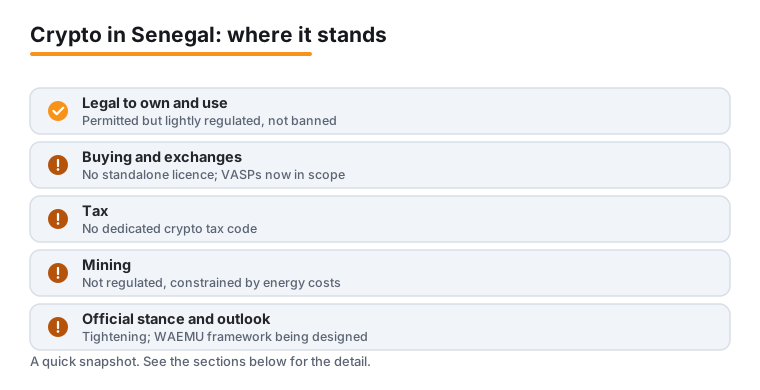
Owning, buying, and selling Bitcoin is not prohibited in Senegal. There is no law that bans cryptocurrency, and residents routinely hold and trade digital assets through international exchanges and peer-to-peer (P2P) marketplaces. At the same time, crypto is not legal tender. The only legal tender is the West African CFA franc, issued under BCEAO authority. No merchant is obliged to accept Bitcoin, and any payment made in crypto is a private arrangement between the parties.
The honest summary is that crypto is permitted but lightly regulated, and the regulatory perimeter is tightening. Since the WAEMU adopted a uniform anti-money-laundering law in 2023 that defines virtual assets and virtual asset service providers, and Senegal transposed updated rules in 2024, businesses that provide crypto services are increasingly expected to fall under registration and AML obligations rather than operate entirely informally. For an ordinary user, holding crypto remains a personal, at-your-own-risk activity without the deposit guarantees and dispute mechanisms that apply to licensed banks. For a business, the message is the opposite of a free pass: do not assume the absence of a dedicated crypto code means no rules apply.
Who regulates crypto in Senegal?
There is no single national crypto regulator. Authority is shared between a regional central bank and several Senegalese institutions:
- BCEAO (Banque Centrale des Etats de l'Afrique de l'Ouest) is the regional central bank for the eight WAEMU states. It controls monetary policy, the CFA franc, foreign-exchange regulation, and the licensing of payment and electronic-money providers. It is the primary authority shaping any crypto regime, and it has publicly committed to building a harmonised WAEMU framework for crypto-assets.
- CENTIF-Senegal (Cellule Nationale de Traitement des Informations Financieres) is Senegal's financial intelligence unit, operating under the Ministry of Finance. It receives suspicious-transaction reports and enforces anti-money-laundering and counter-terrorist-financing (AML/CFT) obligations, which now extend to virtual asset service providers.
- DGID (Direction Generale des Impots et des Domaines) is the national tax administration that applies general tax rules to income and business activity, including crypto-related gains and businesses.
Senegal is also a member of GIABA, the regional FATF-style body for West Africa, whose evaluations drive much of the AML reform agenda. Because monetary and payment policy is set regionally, the most consequential crypto decisions are expected to come from the BCEAO and the WAEMU Council of Ministers rather than from a purely national law.
Crypto laws and frameworks that apply in Senegal
Senegal has no crypto-specific investment or markets law on the model of the EU's MiCA. Instead, crypto is governed by a layered set of WAEMU and national instruments:
- WAEMU AML/CFT directive (adopted 31 March 2023). The WAEMU Council of Ministers adopted Directive No. 01/2023 and an accompanying uniform law that, for the first time, introduced definitions of virtual assets and virtual asset service providers and subjected VASPs to prior authorisation or registration, bringing them within the perimeter of obligated entities in line with FATF Recommendation 15.
- Senegal Law No. 2024-08 of 14 February 2024. Adopted by the National Assembly on 2 February 2024, this AML/CFT/proliferation-financing law transposes WAEMU Directive No. 01/2023 and expands the list of reporting entities to include fintechs, payment service providers, and virtual asset service providers. It replaces the prior national AML/CFT act (Law No. 2018-03 of 23 February 2018).
- WAEMU foreign-exchange regulation (adopted 20 December 2024). A new exchange-control regulation replaced the 2010 rules and gave the BCEAO greater control over cross-border financial flows; the BCEAO published a series of implementing instructions on 1 August 2025.
- BCEAO Instruction No. 008-05-2015 governs electronic-money issuers across the WAEMU and underpins the region's AML/CFT expectations for payment activity.
Standard commercial, banking, and tax laws apply on top of these. The direction of travel is clear: VASPs are being pulled into a registration and AML regime, even though a full conduct-and-prudential crypto framework is still being designed at the regional level.
Exchange and VASP registration in Senegal
There is no Senegal-specific exchange licence comparable to a securities or e-money licence dedicated to crypto. However, the regulatory situation has shifted from "unaddressed" to "in scope." Under the 2023 WAEMU uniform AML/CFT law and Senegal's Law No. 2024-08, virtual asset service providers (which can include exchanges, brokers, custodians, and transfer services) are defined obligated entities and are, in principle, subject to prior authorisation or registration and to AML/CFT duties.
In practice, this framework is still maturing: as of 2026 the WAEMU is working through how VASPs are authorised and supervised, and detailed operational rules and a public register of approved providers are still developing. For users, the consequence is that most access to crypto continues through international exchanges and P2P platforms that are not locally licensed, which means little local recourse if a platform fails. For anyone planning to operate a crypto business in or from Senegal, the prudent assumption is that registration with the relevant authorities and full AML/CFT compliance will be required, and that requirements should be confirmed directly with the BCEAO and CENTIF before launching.
A separate but related development is the BCEAO's tightening of payment-provider rules, which crypto on-ramps and off-ramps often touch. Under BCEAO Instruction No. 001-01-2024 (issued 23 January 2024), any provider of payment services in the WAEMU must hold either a Payment Institution licence or an Electronic Money Institution licence from the central bank. After a transition period that the BCEAO extended to 31 August 2025, only licensed entities may offer payment services in the Union from 1 September 2025. Senegal hosts more than 100 fintechs, and only a small number had received authorisation in the first months of enforcement, which caused service disruptions for others. This is not a crypto licence, but it shapes the mobile-money and payment rails that most local crypto buyers rely on.
Crypto and Bitcoin tax in Senegal
Senegal does not publish a dedicated cryptocurrency tax code, and there is no officially published crypto-specific rate or threshold. That does not mean crypto is tax-free. General tax principles administered by the DGID can apply: profits from trading or from running a crypto-related business may fall under income or business taxation, and goods or services paid for in crypto can carry the same indirect-tax treatment as any other transaction.
The DGID has not classified crypto disposals or issued dedicated guidance on digital-asset taxation, and there is no crypto-specific rate. Where crypto income is treated as taxable, it would fall under the general provisions of Senegal's Code General des Impots, including the progressive personal income tax (Impot sur le Revenu), which rises in bands up to a top rate for higher incomes. Because no crypto-specific figures are officially published, this guide deliberately states no crypto rate. How a gain or activity is taxed can depend on whether you are an occasional investor or a professional trader, and on your overall circumstances. Sensible practice:
- Keep clear records of every purchase, sale, transfer, and conversion to CFA francs, with dates and values.
- Track cost and disposal value so any gain or loss can be calculated if required.
- Distinguish personal investment from business activity, which may be treated differently.
Confirm your obligations with the DGID or a qualified local tax professional before filing. For background, see our general guide to crypto taxes. This is not tax advice.
AML and KYC rules for crypto in Senegal
Anti-money-laundering and know-your-customer obligations are the most concrete and fastest-moving part of Senegal's crypto rules. Senegal's financial intelligence unit, CENTIF-Senegal, receives suspicious-transaction reports and supervises obligated entities, and the perimeter of those entities now expressly includes virtual asset service providers, fintechs, and payment service providers under Law No. 2024-08.
For licensed and registered service providers, expect standard FATF-aligned duties: customer identification and verification, ongoing monitoring, record-keeping, suspicious-transaction reporting, and application of the FATF "travel rule" for transfers, which requires originator and beneficiary information to accompany virtual-asset transfers above set thresholds. Senegal exited the FATF grey list in October 2024 after strengthening its AML/CFT regime, and a further GIABA mutual evaluation cycle is ongoing, which tends to push standards higher rather than lower.
For ordinary users, the practical effect is that reputable exchanges and P2P platforms will ask you to complete identity verification (KYC). Complete it accurately. Attempts to evade verification, or use of unregulated intermediaries, increase both legal exposure and fraud risk.
Buying and using crypto in practice
Because there is no locally licensed exchange regime yet, most residents access crypto through international platforms and P2P marketplaces, settling in CFA francs via mobile money. Senegal has very high mobile-money penetration, with Wave, Orange Money, and Free Money widely used, and P2P trading commonly bridges between those wallets and crypto. A typical flow:
- Choose a platform: an established international exchange that accepts users in the region, or a reputable P2P marketplace popular in West Africa.
- Verify your identity (KYC): legitimate services require it; complete it honestly.
- Fund in CFA francs: often via mobile money or bank transfer, frequently through P2P offers matched to local payment methods.
- Place your order and check the all-in price, including fees and P2P spreads.
- Secure holdings: enable two-factor authentication, and move long-term savings to a wallet you control rather than leaving them on an exchange.
Two regional realities matter. First, WAEMU foreign-exchange controls, tightened by the December 2024 regulation, govern how value crosses borders; moving larger sums in or out of the zone may attract scrutiny, and banks apply their own policies toward crypto-linked transfers. Second, because platforms are not locally licensed, you carry the full risk if one fails, freezes funds, or is compromised. Watch for P2P payment-reversal scams, fake apps, and phishing, and start with a small test transaction on any new platform or counterparty.
Crypto remittances to Senegal
Remittances are central to Senegal's economy. Many Senegalese work abroad and send money home, and the cost and speed of those transfers matter to recipient families, which is where crypto's appeal is strongest. Sending value as Bitcoin or stablecoins can in principle be faster and cheaper than some traditional channels, and it can reach recipients who use mobile money rather than a bank account. A common flow is a sender abroad transferring crypto to a relative in Senegal, who converts it to CFA francs through a P2P platform and cashes out via mobile money.
The trade-offs are real. Price volatility means the CFA value received can move between sending and cashing out unless a stablecoin is used. Conversion still depends on exchanges or P2P counterparties that carry fraud and liquidity risk. Advertised "low" fees often understate on-ramp and off-ramp spreads. And cross-border movements remain subject to WAEMU foreign-exchange rules. Crypto remittances can work well, but recipients should use trusted counterparties and convert promptly to limit exposure.
Bitcoin mining in Senegal
Bitcoin mining is not specifically regulated, banned, or licensed in Senegal, but it faces real practical hurdles. Mining is energy-intensive, and the main constraints are the cost and reliability of electricity: power can be relatively expensive and supply is not always stable, both of which undermine the economics of large-scale mining. Hardware import costs and cooling in a hot climate add further pressure.
Senegal's energy strategy has emphasised expanding generation and raising the share of renewables, including solar, alongside new gas resources, which could in time make cheaper or greener power available. For now there is no targeted incentive scheme for crypto mining. Anyone considering it should also account for general business-registration, electricity-supply, and tax obligations, and should not assume that the absence of mining-specific rules means no rules at all.
Recent developments (2024 to 2026)
The defining trend is a steady move from grey zone toward structure:
- 2023: The WAEMU adopted its AML/CFT directive (Directive No. 01/2023, 31 March 2023) defining virtual assets and VASPs and requiring their authorisation or registration; a new uniform banking law later that year widened supervision to include fintechs and electronic-money institutions.
- February 2024: Senegal adopted Law No. 2024-08, transposing the updated AML/CFT/proliferation framework and explicitly adding VASPs, fintechs, and payment providers to its reporting entities.
- 23 January 2024: The BCEAO issued Instruction No. 001-01-2024 requiring payment service providers across the WAEMU to hold a Payment Institution or Electronic Money Institution licence; after an extension to 31 August 2025, only licensed entities may operate from 1 September 2025.
- October 2024: Senegal exited the FATF grey list after strengthening its AML/CFT regime.
- 20 December 2024: A new WAEMU foreign-exchange regulation replaced the 2010 rules, tightening cross-border controls; the BCEAO published implementing instructions on 1 August 2025.
- 8 May 2026: The BCEAO convened an international conference in Dakar on "Crypto-assets and digital innovations: opportunities and challenges for monetary and financial stability," aimed at producing recommendations toward a harmonised WAEMU regulatory framework that balances innovation and financial inclusion with stability. The central bank has weighed the opportunities of crypto-assets against financial-stability risks and has cautioned about those risks while stopping short of a ban.
Expect binding crypto rules to continue arriving at the regional level. Monitor BCEAO announcements rather than waiting for a purely national crypto act.
Consumer risks and protection
Because most crypto activity in Senegal happens through platforms that are not yet locally licensed, consumer protection is limited. Key risks:
- Limited recourse: if an exchange fails, freezes funds, or is hacked, there is little formal local protection or compensation scheme.
- Fraud and scams: P2P payment-reversal scams, fake apps, phishing, and "guaranteed return" schemes are common; recovery is often impossible.
- Volatility: sharp price swings can erase value quickly.
- Regulatory change: a maturing WAEMU framework could introduce licensing, restrictions, or reporting duties that affect how crypto can be bought, held, or transferred.
- Foreign-exchange friction: moving larger sums in or out of the zone is constrained by tightened WAEMU controls.
Practical defences: use established platforms, complete KYC honestly, enable two-factor authentication, self-custody long-term holdings, treat unusually high P2P spreads or returns as warning signs, and invest only what you can afford to lose. None of this is investment advice.
Official sources and how to verify
Crypto rules in the WAEMU zone are evolving, so always confirm the current position with primary sources rather than third-party summaries (including this one). The most authoritative starting points for Senegal are:
- BCEAO (Banque Centrale des Etats de l'Afrique de l'Ouest) for monetary policy, foreign-exchange regulation, payment and e-money licensing, and crypto-asset framework announcements.
- CENTIF-Senegal for AML/CFT obligations and reporting, including those affecting virtual asset service providers.
- Ministere des Finances et du Budget du Senegal for national financial laws, the tax administration (DGID), and official publications.
For wider context, see our guide to crypto regulation and our other country regulation guides. This article is general information as of 2026 and is not legal, tax, or financial advice; verify your specific situation with the BCEAO and the named Senegalese authorities or a qualified local professional before acting.
Frequently asked questions
Is Bitcoin legal in Senegal?
Yes, owning and trading Bitcoin is not banned in Senegal. However, it is not legal tender; the West African CFA franc remains the only legal tender. There is no dedicated crypto investment law, but since 2023 the WAEMU framework defines virtual assets and virtual asset service providers, and Senegal's Law No. 2024-08 brings VASPs into its anti-money-laundering perimeter. Ordinary users hold crypto at their own risk, with limited consumer protection.
Who regulates cryptocurrency in Senegal?
There is no single national crypto regulator. As a WAEMU member, Senegal relies on the regional central bank, the BCEAO, for monetary policy, foreign-exchange rules, and payment-provider licensing, and the BCEAO is leading work on a harmonised crypto framework. Nationally, CENTIF-Senegal handles AML/CFT supervision (including for VASPs) and the DGID administers tax. GIABA, the regional FATF-style body, drives much of the reform agenda.
Do crypto exchanges need a licence in Senegal?
There is no standalone crypto-exchange licence yet, but the situation has shifted from unaddressed to in-scope. Under the 2023 WAEMU uniform AML/CFT law and Senegal's Law No. 2024-08, virtual asset service providers are defined obligated entities subject in principle to prior authorisation or registration and to AML/CFT duties. Operational rules are still maturing, so anyone running a crypto business should confirm requirements directly with the BCEAO and CENTIF before launching.
Do I have to pay tax on crypto in Senegal?
Senegal has no dedicated crypto tax code and publishes no crypto-specific rates, but general tax rules administered by the DGID can still apply to trading profits or crypto-related business income. Because no figures are officially published, keep detailed records and confirm your obligations with the DGID or a qualified local professional before filing. This is not tax advice.
What KYC and AML rules apply to crypto in Senegal?
Virtual asset service providers, fintechs, and payment providers are now obligated entities under Senegal's Law No. 2024-08, supervised by CENTIF-Senegal. Registered providers face FATF-aligned duties: customer identity verification, monitoring, record-keeping, suspicious-transaction reporting, and the FATF travel rule for transfers. In practice, reputable exchanges and P2P platforms will require you to complete identity verification (KYC). Senegal exited the FATF grey list in October 2024.
How do most people buy crypto in Senegal?
Most residents use international exchanges or peer-to-peer (P2P) platforms, frequently funding purchases with mobile money in CFA francs through services like Wave, Orange Money, and Free Money. Dedicated Bitcoin ATMs are scarce, so phone-based mobile money plus P2P trading is the common on-ramp and off-ramp. Cross-border movements remain subject to WAEMU foreign-exchange rules tightened in late 2024.
Does Senegal have a crypto licence yet?
Not a dedicated one. As of 2026 there is no standalone crypto-exchange or crypto-asset licence in Senegal or the wider WAEMU zone; the BCEAO is still working toward a harmonised regional framework. A related change is BCEAO Instruction No. 001-01-2024, which requires payment service providers to hold a Payment Institution or Electronic Money Institution licence, with only licensed entities allowed to operate from 1 September 2025. That governs payment rails rather than crypto itself, but it affects the mobile-money services many crypto buyers use.
Has the BCEAO banned crypto in Senegal?
No. The BCEAO has cautioned about the financial-stability and consumer risks of crypto-assets, but it has not banned them, and owning or trading crypto is not illegal in Senegal. Banks in the zone generally do not offer crypto services, so activity happens through international exchanges and peer-to-peer platforms. In May 2026 the BCEAO hosted a Dakar conference to help shape a harmonised WAEMU approach, so rules may tighten over time; monitor BCEAO announcements for changes.
Facts reviewed: 30 June 2026. Page updated: 3 August 2026.