Home › Crypto Regulation › Papua New Guinea
Bitcoin & Cryptocurrency Regulation in Papua New Guinea
Quick answer — Papua New Guinea, 2026
- Legal: Legal to use but unregulated, not legal tender, no VASP licensing
- Tax: No crypto-specific tax, general rules may apply, not tax-free
- Buying: No licensed local exchange, use international platforms or P2P with KYC
Papua New Guinea (PNG) is at an early, largely undefined stage of cryptocurrency regulation. Owning and trading Bitcoin or other digital assets is not illegal, but crypto is not legal tender and is not yet covered by any dedicated licensing or consumer-protection framework. The country's central bank, the Bank of Papua New Guinea (BPNG), has stated plainly that it does not license or supervise crypto platforms, and in April 2026 it repeated public warnings about crypto and so-called fast-money schemes. At the same time, BPNG has explored blockchain and completed a central bank digital currency (CBDC) proof of concept. This page explains the landscape as it stands in 2026: who the regulators are, how laws and tax may apply, and what to check before you buy, mine or move value in crypto. It is general information as of 2026 and is NOT legal, tax or financial advice; always verify your situation with the named official regulators and a qualified PNG professional. For background, see our guide to crypto regulation.
On this page: Legal status · Who regulates it · Taxes · How to buy · Mining
Is Bitcoin and crypto legal in Papua New Guinea?
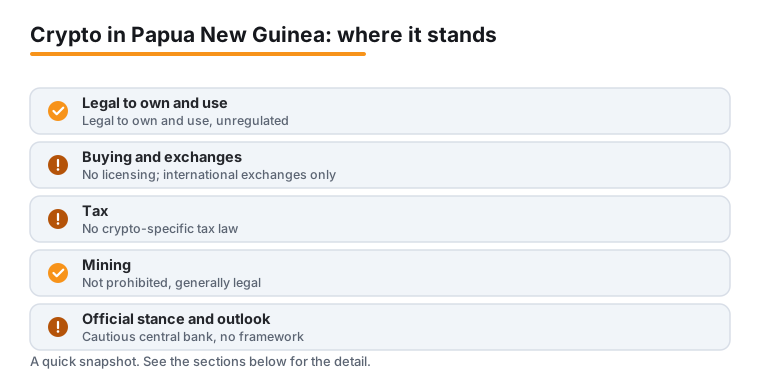
Holding, buying, selling and using Bitcoin and other cryptocurrencies is not prohibited in Papua New Guinea. No law bans cryptocurrency, and no law grants it legal-tender status. In practice this places crypto in a legal grey area: it is neither officially endorsed nor outlawed.
The key point for newcomers is that crypto is not legal tender. The kina (PGK) remains the only recognised currency, and no business is obliged to accept Bitcoin as payment. The Bank of Papua New Guinea has stated that it does not recognise or regulate entities offering digital-asset investments, and that it does not license crypto platforms operating in the country.
Because there is no bespoke regime, users do not get the protections that licensed financial products carry. If a platform fails, freezes withdrawals or turns out to be fraudulent, recourse is limited. The most accurate way to understand the current position is: legal to use, but unregulated.
Who regulates crypto in Papua New Guinea?
There is no single dedicated crypto regulator in PNG. Instead, several official bodies touch crypto-related activity under existing mandates:
- Bank of Papua New Guinea (BPNG): the central bank and primary monetary authority. It issues the kina, oversees the payments system, and houses the country's financial-intelligence function. BPNG has publicly stated it does not license Virtual Asset Service Providers (VASPs) or crypto investment platforms. Its website is bankpng.gov.pg.
- Securities Commission of Papua New Guinea (SCPNG): the independent statutory regulator of capital markets, established under the Securities Commission Act 2015 and enforcing the Capital Market Act 2015. SCPNG licenses and supervises securities and derivatives market participants and regularly warns the public about unregistered investment and fast-money schemes. Its website is scpng.gov.pg.
- Internal Revenue Commission (IRC): administers PNG's tax system and would assess any crypto income or gains under general tax law.
If you deal with crypto in PNG, treat BPNG and SCPNG announcements as the authoritative public sources and seek local legal advice rather than assuming a fixed rulebook exists.
Crypto laws and regulatory framework
Papua New Guinea has no dedicated cryptocurrency or virtual-asset statute. Crypto activity instead intersects with several existing frameworks and the stated position of the authorities.
- No crypto-specific licensing law: there is no statute creating a VASP or exchange licence. BPNG has confirmed it does not license such providers, so they operate without local oversight.
- Capital markets law: the Securities Commission Act 2015 and Capital Market Act 2015 govern securities, derivatives and investment schemes. Crypto products marketed as investments could fall foul of these laws if they are not registered with SCPNG.
- Anti-money-laundering law: the Anti-Money Laundering and Counter Terrorist Financing Act 2015 underpins PNG's AML/CTF regime (see the dedicated section below).
- General financial and consumer law: fraud, misrepresentation and unlicensed-scheme rules can apply to crypto-related conduct even without crypto-specific legislation.
Regulation may evolve quickly. PNG produced a Sector Risk Assessment on money laundering and terrorist financing through virtual assets, signalling that authorities are studying the sector even though no full licensing regime has been enacted. Anyone running or relying on a crypto service should monitor official announcements and take local legal advice.
Exchange and VASP registration or licensing
There is currently no licensing or registration regime in Papua New Guinea for cryptocurrency exchanges or Virtual Asset Service Providers. The central bank has explicitly said it does not license such platforms. As a result, most residents who buy crypto do so through international exchanges or peer-to-peer arrangements rather than through a domestically regulated provider.
Practical realities for users include:
- No local safety net: platforms are not supervised by PNG authorities, so protections such as guaranteed withdrawals or compensation schemes generally do not apply.
- Banking and payment friction: card payments, bank transfers and foreign-exchange limits can affect whether and how you can fund an account; PNG's foreign-currency environment can add delays.
- Identity checks anyway: reputable global exchanges still require identity verification under their own AML policies, even though PNG does not license them.
Because no PNG-licensed option exists, due diligence on the provider is your main protection. Confirm a service accepts PNG users, understand its fees and withdrawal terms, and prefer well-established platforms with strong security records.
Crypto and Bitcoin tax in Papua New Guinea
Papua New Guinea has no tax legislation written specifically for cryptocurrency. Tax is administered by the Internal Revenue Commission (IRC), and crypto is most likely to be assessed under existing general principles rather than a dedicated crypto code. A few points should be verified before you rely on them:
- Where crypto activity looks like a business or a profit-making venture (for example regular trading, or mining run as an enterprise), proceeds could fall within ordinary income-tax provisions.
- PNG has historically not operated a broad general capital gains tax. A narrow 15 percent capital gains tax took effect in January 2026, but it applies to the sale of interests in extractive (mining and petroleum) assets, not to cryptocurrency. Do not assume it covers crypto.
- The absence of a crypto-specific reporting or enforcement framework is not the same as crypto being tax-free.
Because the rules are general and untested for crypto, this page states no specific crypto rates or thresholds. Confirm your obligations directly with the IRC or a qualified PNG tax adviser. For a wider explainer, see our crypto tax guide. This is general information, not tax advice.
AML and KYC rules
Papua New Guinea operates an anti-money-laundering and counter-terrorist-financing (AML/CTF) regime built on the Anti-Money Laundering and Counter Terrorist Financing Act 2015. The Financial Analysis and Supervision Unit (FASU), which sits within the Bank of Papua New Guinea, is the country's financial-intelligence unit; it detects, analyses and supervises efforts against illicit financial flows, operating with functional independence and reporting to the BPNG Governor.
Two developments matter for anyone using crypto:
- FATF grey list: in February 2026 the Financial Action Task Force (FATF) added Papua New Guinea to its list of jurisdictions under increased monitoring (the grey list). PNG made a high-level political commitment to work with the FATF and the Asia/Pacific Group to strengthen its AML/CTF regime. This typically leads to tighter controls over time.
- Virtual-asset focus: FASU has produced a sector risk assessment on money laundering and terrorist financing through virtual assets, showing the regulator is tracking crypto risk in line with FATF standards.
In practice, while PNG does not license crypto platforms, reputable international exchanges still apply their own know-your-customer (KYC) and AML checks, so expect to verify your identity when you open an account. Read more in our crypto regulation hub.
Buying and using crypto in practice
There is no PNG-licensed exchange, so residents typically use international platforms or peer-to-peer (P2P) marketplaces to buy Bitcoin with kina (PGK). Common funding methods on global services include card payments and P2P trades that settle in local currency. Access has been helped by rising mobile coverage, though internet reliability and foreign-exchange limits still vary by location. None of these routes carry PNG regulatory protection, so provider due diligence remains your responsibility.
For residents who decide to proceed, the typical route looks like this. Treat each step as a checklist, not a recommendation of any specific provider.
- Choose a reputable exchange: select a well-established international platform that accepts PNG users, has a strong security track record and clear fee disclosure.
- Complete identity verification: expect to provide ID and personal details to satisfy the platform's KYC and AML checks.
- Fund your account: confirm which payment methods work for PNG users and check any foreign-exchange or bank limits that may apply.
- Place your order: buy the amount you intend, paying attention to spreads and fees.
- Secure your assets: enable two-factor authentication and consider moving larger holdings to a personal wallet, including a hardware wallet for long-term storage, rather than leaving them on an exchange.
- Keep records: retain transaction history for potential tax reporting.
On everyday use, remember that no business is required to accept crypto and the kina remains the only legal tender. Never share private keys or recovery phrases, and treat unsolicited "investment manager" offers or guaranteed-return promises as red flags.
Bitcoin mining in Papua New Guinea
Cryptocurrency mining is not specifically prohibited in Papua New Guinea, so it is generally treated as legal under the current absence of dedicated rules. Legal does not mean frictionless, however, and several practical factors matter:
- Electricity: mining is energy-intensive, and reliable, low-cost power is the single biggest constraint. Grid reliability and electricity costs in PNG can make large-scale mining difficult to operate profitably.
- Equipment and connectivity: importing specialised hardware and securing stable internet add cost and complexity.
- Tax and business treatment: mining run as a business may attract income-tax obligations under general principles; clarify your position with the IRC.
- Future rules: the regulatory picture could tighten over time as authorities study the sector.
Anyone considering mining should evaluate power economics first and confirm there are no local permitting or tax issues before investing in hardware.
Remittances and the digital kina
Remittances are one of the most discussed potential use cases for crypto in PNG, where cross-border transfers can be slow and costly and many people in remote areas have limited banking access. In principle, Bitcoin and stablecoins can move value internationally quickly and cheaply. The practical hurdles are significant, though: converting crypto to and from kina locally is the weakest link, prices can move sharply between sending and cashing out, transactions are irreversible, and providers are unregulated.
Notably, PNG's own central bank is exploring a public alternative. On 28 January 2025, BPNG presented the results of a central bank digital currency (CBDC) proof of concept, the "digital kina," run with Japan's Soramitsu, Mitsubishi, METI and the Japan International Cooperation Agency (JICA). The pilot demonstrated real-time payments and peer-to-peer remittances via a mobile app, with a focus on financial inclusion. A CBDC is a state-issued digital form of the kina and is distinct from private cryptocurrencies such as Bitcoin.
BPNG's stance on blockchain versus private crypto
It is worth separating two things the central bank treats very differently. On one hand, BPNG has run a Blockchain Technology Project to study the technology itself and has invested in the digital-kina CBDC work described above, so it is not hostile to blockchain as a tool. On the other hand, it has been consistently cautious about private cryptocurrencies and the platforms that market them.
The practical takeaway for users is that state-led experiments with blockchain do not signal any endorsement of Bitcoin or of unlicensed investment platforms. BPNG has repeated that it does not license VASPs or crypto investment schemes and that participants carry the risk themselves. Read announcements from BPNG and SCPNG as the authoritative position rather than inferring approval from the CBDC programme.
Recent developments (2025 to 2026)
Several developments shape the picture as of 2026:
- January 2025: BPNG unveiled the results of its digital-kina CBDC proof of concept in Port Moresby, signalling genuine interest in digital-payment innovation.
- February 2026: the FATF placed Papua New Guinea on its grey list of jurisdictions under increased monitoring, prompting a commitment to strengthen AML/CTF controls. This is likely to influence how crypto businesses and cross-border flows are treated.
- April 2026: on 22 April 2026, BPNG Governor Elizabeth Genia issued a public warning that the bank does not license any VASPs, crypto-based investment platforms or fast-money schemes, and that participants in such schemes have no recourse if they lose money. The warning highlighted scams promising returns such as turning K30,000 into K270,000 in 28 hours, or offering 400 percent returns, and noted these operations often use new investors' money to pay earlier ones before collapsing.
Together these point to a cautious central bank that is wary of private crypto while open to state-led digital-payment innovation. Rules could be introduced or tightened with limited notice, so verify the current position against official sources.
Consumer risks and protection
The defining risk in Papua New Guinea is the lack of regulation. With no dedicated crypto law and no licensing of platforms, users operate without the protections of a supervised market. If a platform fails or a scheme collapses, there is generally no compensation fund and limited recourse.
Specific risks to weigh include:
- Fraud and fast-money schemes: BPNG and SCPNG have repeatedly warned about scams that promise unrealistically high returns, sometimes using forged documents and the central bank's letterhead. Guaranteed or unusually high returns are a red flag.
- Volatility: crypto prices can swing sharply; only commit money you can afford to lose.
- Limited liquidity and conversion: turning crypto into kina locally can be difficult.
- Irreversibility: crypto transactions cannot be reversed, so errors and scams can mean permanent loss.
Protect yourself by using reputable, well-secured platforms, enabling two-factor authentication, keeping records, and checking whether any investment scheme is registered with SCPNG before you put money in. See more in our regulation hub.
Official sources and how to verify
This page is general information as of 2026 and is NOT legal, tax or financial advice. Crypto rules in Papua New Guinea are limited and evolving, so always confirm the current position with the official regulators before acting. The authoritative sources are:
- Bank of Papua New Guinea (BPNG) for monetary policy, AML/CTF, FASU, public warnings and the CBDC programme.
- Securities Commission of Papua New Guinea (SCPNG) for capital-markets rules and warnings about unregistered investment and fast-money schemes.
- FATF country page for Papua New Guinea for the latest AML/CTF monitoring status.
For the central bank's own account of its CBDC work, see Governor Genia's speech as published by the Bank for International Settlements. When in doubt, contact BPNG or SCPNG directly and consult a qualified PNG lawyer or tax adviser.
Frequently asked questions
Is Bitcoin legal in Papua New Guinea?
Yes, owning and trading Bitcoin is not prohibited, but it is not legal tender and is not covered by a dedicated regulatory or licensing framework. The Bank of Papua New Guinea does not recognise, license or regulate cryptocurrencies, so crypto sits in a legal grey area where users lack the protections of a supervised market.
Who regulates cryptocurrency in Papua New Guinea?
There is no single dedicated crypto regulator. The Bank of Papua New Guinea (BPNG) is the central monetary authority and has publicly stated it does not license crypto platforms or Virtual Asset Service Providers. The Securities Commission of Papua New Guinea (SCPNG) regulates capital markets and warns about unregistered investment schemes, and the Internal Revenue Commission (IRC) handles tax. AML oversight runs through FASU within BPNG.
Do I have to pay tax on crypto in Papua New Guinea?
PNG has no crypto-specific tax law, but that does not mean crypto is tax-free. Gains or income from crypto could be assessed under general tax principles, especially where activity resembles a business. A 15 percent capital gains tax took effect in January 2026, but it applies to extractive (mining and petroleum) assets, not crypto. Confirm your obligations with the Internal Revenue Commission or a qualified PNG tax adviser. This is not tax advice.
Does Papua New Guinea license crypto exchanges or VASPs?
No. The Bank of Papua New Guinea has stated it does not license any Virtual Asset Service Providers, cryptocurrency investment platforms or fast-money schemes. There is no exchange or VASP licensing regime in PNG, so platforms operate without local oversight and users have no local compensation scheme if something goes wrong.
Is crypto mining allowed in Papua New Guinea?
Mining is not specifically prohibited and is generally treated as legal under current rules. The main constraints are practical, especially the cost and reliability of electricity, plus potential income-tax obligations if you mine as a business. Confirm there are no local permitting or tax issues before investing in hardware.
What recent crypto-related developments should I know about?
Three stand out: in January 2025 BPNG completed a digital-kina CBDC proof of concept with Japanese partners; in February 2026 the FATF placed PNG on its grey list, prompting a commitment to strengthen AML/CTF controls; and in April 2026 BPNG Governor Elizabeth Genia warned the public that the bank does not license crypto platforms or fast-money schemes and that participants have no recourse if they lose money. Verify the latest position with BPNG and SCPNG.
How do people in Papua New Guinea buy Bitcoin if there is no licensed exchange?
Because no PNG-licensed exchange or VASP exists, residents generally use international platforms or peer-to-peer (P2P) marketplaces to buy Bitcoin with kina, funding accounts by card or local-currency P2P trades. Rising mobile coverage has made access easier, but internet reliability and foreign-exchange limits vary, and none of these routes carry PNG regulatory protection. Check that a service accepts PNG users and do your own due diligence on fees, security and withdrawal terms.
Is Papua New Guinea on the FATF grey list, and does it affect crypto?
Yes. In February 2026 the Financial Action Task Force added Papua New Guinea to its list of jurisdictions under increased monitoring, known as the grey list, after a 2024 mutual evaluation found AML/CTF weaknesses. PNG committed to an action plan to strengthen its regime. Grey-listing usually leads to tighter checks over time, including on cross-border flows and virtual assets, so expect more scrutiny and identity verification rather than fewer controls.
Facts reviewed: 30 June 2026. Page updated: 3 August 2026.