Home › Crypto Regulation › Panama
Bitcoin & Cryptocurrency Regulation in Panama
Quick answer — Panama, 2026
- Legal: Legal to own and use, not legal tender, no comprehensive crypto law yet
- Tax: Territorial system, no crypto-specific code, foreign-source gains may be untaxed
- Buying: Via international exchanges, P2P and OTC desks, expect KYC
Panama is one of Latin America's most open financial and trade hubs, and that openness extends to cryptocurrency. Bitcoin and other digital assets circulate freely among individuals, merchants and service providers, but as of 2026 the country still has no single, comprehensive law written specifically to govern them. The result is a permissive but lightly defined environment: holding, buying, selling and spending crypto is legal, yet there is no dedicated crypto regulator, no purpose-built licensing regime and no tax code written for digital assets.
Instead, crypto activity in Panama is touched by a patchwork of general rules covering anti-money laundering, securities and banking, while a dedicated framework remains under debate in the National Assembly. This guide explains how crypto fits into Panamanian law today, which official bodies are involved, how the country's territorial tax system tends to treat digital-asset income, and what changed in 2025 and 2026. It is general information as of 2026 and is NOT legal, tax or financial advice; because the rules are evolving, verify anything that affects you with the official authorities named below or a qualified Panamanian professional before acting. For broader context see our overview of crypto regulation.
On this page: Legal status · Who regulates it · Taxes · How to buy · Mining
Legal status of Bitcoin and crypto in Panama
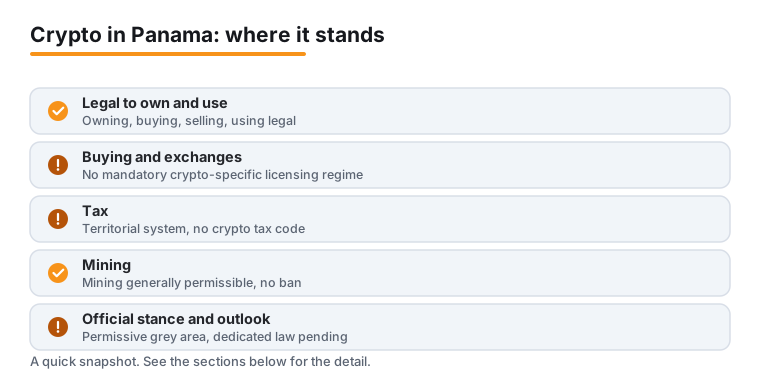
Owning, buying, selling and using Bitcoin and other cryptocurrencies is legal in Panama. No law bans digital assets, and individuals can hold and transact in them without special permission.
What does not exist is a purpose-built legal framework. Most analysts describe Panama as a legal gray area for crypto: it is permitted, but it is not comprehensively classified across every use case. Crypto is NOT legal tender. Panama is a dollarized economy, using the US dollar alongside the Panamanian balboa, which is pegged one to one to the dollar, and the country has never had a central bank issuing monetary policy. No person or business is required to accept crypto as payment; where two parties agree to use it, they generally may, but acceptance is voluntary and token values can change quickly. In short, crypto is legal to use but operates largely outside a specific statutory regime, which makes due diligence on platforms, counterparties and tax treatment especially important. For a primer on how this compares globally, see our crypto regulation guide.
Who regulates crypto in Panama
There is no single dedicated crypto regulator in Panama and, because the country is dollarized, no central bank conducting monetary policy. Instead, several existing authorities touch crypto-related activity depending on what is being done:
- Unidad de Analisis Financiero (UAF), the Financial Analysis Unit, is the financial-intelligence body central to anti-money-laundering (AML) and counter-terrorist-financing reporting. Entities meeting the definition of a virtual-asset service provider can fall within its registration and reporting expectations.
- Superintendencia de Bancos de Panama (SBP), the banking superintendency, supervises banks and governs how regulated institutions interact with crypto businesses. The SBP has historically warned the public about the risks of crypto.
- Superintendencia del Mercado de Valores (SMV), the securities-market superintendency, becomes relevant when a token has the characteristics of a security or investment offering.
- Direccion General de Ingresos (DGI), within the Ministry of Economy and Finance, administers taxes.
Because no single statute consolidates these roles for crypto, the practical compliance picture is assembled from general AML, securities, banking and tax rules. The official sites are listed in the final section below.
Key laws and frameworks
Panama has tried, and so far failed, to pass a dedicated crypto law. A bill widely referred to as the "crypto law" (Bill No. 697) was approved by the National Assembly in 2022 but was partially vetoed by then-President Laurentino Cortizo, who cited the need to align with Financial Action Task Force (FATF) anti-money-laundering standards and raised constitutional concerns. It never took effect at all. After the Assembly insisted on the bill, the Corte Suprema de Justicia declared it inexequible, meaning unconstitutional, in full, in a ruling published in edicto 835 on 14 July 2023. The Executive had objected on substantive grounds against articles 34 and 36 and on formal grounds against the whole text. Bill 697 is dead and cannot be revived in that form, so any source presenting it as pending law is out of date.
The principal law that already applies to crypto businesses is Law 23 of 2015, Panama's main AML and counter-financing-of-terrorism statute. It defines a list of regulated "sujetos obligados" (obligated subjects) that must register with the supervising authority, conduct customer due diligence, keep records and report suspicious activity. Entities that meet a virtual-asset-service-provider profile are commonly expected to register with the UAF and run a documented AML program under this regime, even though Law 23 was not written specifically for crypto. Public reporting and legal commentary describe Law 23 and related AML laws as the practical baseline today; treat the precise scope as something to confirm with a Panamanian lawyer, because interpretation is evolving.
Pending crypto legislation (Bill 247)
Since 2025, lawmakers have sought a clearer, dedicated regime. A bill widely reported as No. 247 was introduced in March 2025 by an alternate deputy and aims to create a legal framework for crypto-asset transactions and to position Panama as a regional digital-asset hub. As described in public reporting, the bill would define key terms, recognize certain digital assets (such as Bitcoin, Ethereum and stablecoins) as valid means of payment where parties agree, require virtual-asset service providers such as exchanges and wallet operators to register or be licensed with AML and know-your-customer obligations, and create a National Council of Digital Assets (reported as CONAD) to coordinate oversight.
As of 2026 these proposals remain under legislative discussion and have NOT been enacted; reporting indicates the bill was referred to a subcommittee for further analysis on 30 September 2025, and no further movement has been found in the public record since. The clearest dated pressure on the timetable is Panama's fifth-round GAFILAT mutual evaluation, scheduled for 2027, whose coordinator has named effective supervision of virtual assets as one of the things Panama still has to demonstrate. Treat any specific provision of Bill 247 as a proposal, not current law, until it is officially adopted, and check the National Assembly's official site for the latest status.
Bill 247 is no longer the only proposal. In January 2026 the National Assembly received a separate, more comprehensive draft reported as Anteproyecto de Ley No. 314, a proposed "Ley Marco Integral de Tecnologias Financieras" (comprehensive fintech framework law), presented on 13 January 2026. According to public reporting and legal commentary, it would introduce dedicated licensing for virtual-asset service providers alongside payment service providers and electronic-money issuers, with formal VASP definitions, AML/CTF programs, minimum capital and governance requirements, a local compliance officer, and supervision by the SBP and UAF. It too remained a proposal, not enacted law, as of mid-2026. The two drafts sit at different stages and are not equivalent. Bill 247 was presented in March 2025 by alternate deputy Gabriel Solis and adopted by the Comision de Comercio y Asuntos Economicos on 10 April 2025; alongside the CONAD it would subject crypto-asset transactions to a special tax regime under the Direccion General de Ingresos. Anteproyecto 314 was presented on 13 January 2026 by deputy Ernesto Cedeno Alvarado and is still an anteproyecto, the earliest stage in Panama's process. Neither has a scheduled vote, so verify the latest status directly with the National Assembly before relying on either.
Licensing and registration of exchanges and VASPs
As of 2026 there is no mandatory, crypto-specific licensing regime for exchanges in Panama. A crypto business can generally be operated through an ordinary Panamanian company without a dedicated VASP license, which is part of why Panama is often described as a low-friction jurisdiction for digital-asset firms.
That said, "no dedicated license" does not mean "no rules." Platforms operating in or serving Panama are generally treated as virtual-asset service providers and are expected to follow AML and KYC practices consistent with Law 23 of 2015 and FATF guidance. In practice the recognized compliant pathway is to register with the UAF as an obligated subject and implement a documented AML and counter-financing-of-terrorism program. Most reputable services therefore verify customer identity, monitor transactions and keep records. If a dedicated framework is enacted, formal VASP licensing and reporting duties could become mandatory. Two proposals point in that direction: Bill 247 (introduced March 2025) and the more detailed Anteproyecto de Ley No. 314 (received by the National Assembly on 13 January 2026), which would create explicit VASP licensing, minimum-capital and AML obligations under SBP and UAF supervision. Neither had taken effect as of mid-2026, so no such license is required today, but a firm setting up now should plan for the possibility of a future licensing regime. Anyone running a crypto business in Panama should obtain local legal advice on which existing obligations apply to their specific activity.
Crypto and Bitcoin taxation in Panama
Panama uses a territorial tax system. As a general principle, income from sources outside Panama is not subject to Panamanian income tax, while income from Panamanian sources is taxable. There is no tax code written specifically for cryptocurrency, so digital-asset income is generally analyzed under these existing principles rather than under a bespoke "crypto tax."
This makes the source and nature of a transaction important: where the activity occurs, who the counterparties are, and whether gains are treated as foreign-source or local-source can all affect the outcome. Commentary frequently notes that genuinely foreign-source crypto gains, such as trading on international exchanges, may fall outside Panamanian income tax under the territorial principle, while activity carried out within Panama may be taxable; the treatment of an occasional personal sale can differ from that of a business that trades or provides crypto services locally. Where crypto income is treated as Panamanian-source, it is generally analyzed under the ordinary income-tax rules that already apply to individuals and companies rather than a special crypto rate, and legal commentators note it could be characterized either as regular income or as a capital gain depending on the facts. There is no crypto rate, but the ordinary rates that would apply to a Panamanian-source gain are published. Individual income tax runs at 0% on the first USD 11,000, 15% from USD 11,000 to USD 50,000, and 25% above USD 50,000. Corporate income tax is 25%, with an alternative minimum calculation of 4.67% of gross taxable income for companies whose taxable income exceeds USD 1.5 million. Capital gains on the transfer of securities are taxed at 10% with 5% withheld by the buyer, though that rate applies only where a token qualifies as a security, which crypto is not by default. ITBMS, Panama's VAT, is 7%. None of these was written for digital assets, and the decisive question is usually whether a gain is foreign-source or Panamanian-source rather than which rate applies. Confirm your obligations with Panama's tax authority (the Direccion General de Ingresos, DGI) or a qualified Panamanian tax advisor, and see our general notes on crypto taxes. Nothing here is tax advice.
AML and KYC rules
Anti-money-laundering compliance is the most concrete area of crypto regulation in Panama today. Law 23 of 2015 and related AML and counter-financing-of-terrorism legislation set out the obligations for regulated entities, including registration as an obligated subject, customer due diligence (KYC), ongoing transaction monitoring, record-keeping and reporting of suspicious activity to the UAF. Crypto businesses that fall within the virtual-asset-service-provider concept are generally expected to apply these measures.
This focus on AML reflects Panama's wider international standing. Panama was placed on the FATF "grey list" of jurisdictions under increased monitoring, then removed from that list in October 2023 after completing its action plan; it has since strengthened its AML framework. The practical takeaway for users is that reputable platforms serving Panama will ask for identity verification and may decline anonymous or unusually structured transactions, and that this expectation is likely to increase rather than relax if a dedicated VASP law is enacted.
Buying and using crypto in practice
Residents and visitors can buy and sell crypto through international exchanges, peer-to-peer marketplaces and over-the-counter desks. Panama's heavy use of the US dollar makes funding and pricing straightforward, since major platforms quote in dollars. A typical purchase involves choosing a reputable platform that serves Panama, completing identity verification (usually a passport or national ID), funding the account, placing an order after reviewing fees and the quoted spread, and then securing meaningful holdings in a wallet you control, ideally a hardware (cold) wallet with the recovery phrase backed up offline and never shared.
A few Panama-specific practicalities matter. Banks apply their own policies to crypto-related transfers, and reporting suggests some banks and prosecutors have scrutinized peer-to-peer crypto activity. That friction now has a named source: Acuerdo No. 1-2026 of 16 January 2026, which under its Article 52 begins to govern six months after promulgation and so applies from around July 2026, resetting anti-money-laundering due diligence, beneficial-ownership identification and source-of-funds documentation for banks and trust companies. It says nothing about crypto specifically, but it applies at account opening and in transaction monitoring, so expect more questions on bank rails rather than a new registration duty. Bitcoin ATMs exist, concentrated mainly in Panama City, but the network is small and changes over time, and machine fees and spreads are usually higher than online exchanges; check a live ATM locator before relying on one. Crypto can also be used for cross-border remittances, where Bitcoin and dollar-pegged stablecoins can move value quickly and sometimes more cheaply than traditional wires, though volatility (for Bitcoin), on- and off-ramp conversion costs, and AML/KYC checks all apply. Prefer established services with transparent fees, keep your own records for tax and banking purposes, and be wary of anything that promises to skip identity checks. This is general information, not an endorsement of any platform.
Bitcoin mining in Panama
No law specifically bans or licenses cryptocurrency mining in Panama, so mining is generally permissible. It sits within ordinary rules that were not written for it, including electricity supply and tariffs, company registration, import requirements for hardware, and any applicable environmental and zoning considerations.
Energy is the decisive factor. Panama has significant hydroelectric generation plus growing solar and wind capacity, which in principle could support lower-carbon mining, but electricity pricing, grid access and the availability of suitable industrial sites determine whether an operation is economically viable. There is no special crypto-mining electricity tariff or incentive enshrined in law as of 2026; commentary about encouraging renewable-powered mining remains aspirational rather than codified. Anyone considering a commercial operation should model power costs carefully, confirm the legal basis for their electricity arrangement, and seek advice on business, customs and environmental obligations before committing capital.
Recent developments (2025 to 2026)
The most visible 2025 development was at the municipal level. In April 2025 Panama City announced it would accept Bitcoin, Ether and the stablecoins USDC and USDT for taxes, fees, tickets and permits, making the capital one of the first public institutions in the country to take crypto for government payments. Crucially, the city implemented this WITHOUT new national legislation: under an agreement with a local bank (reported as Towerbank), a partner bank instantly converts the received crypto into US dollars so the municipality still receives dollars, satisfying the legal requirement that public payments be made in the national currency.
At the national level, Bill 247 was introduced in March 2025 and, per reporting, was referred to a subcommittee for further analysis on 30 September 2025; it remains pending and unenacted as of 2026. In January 2026 the National Assembly received a separate and more detailed draft, reported as Anteproyecto de Ley No. 314 (a proposed "Ley Marco Integral de Tecnologias Financieras", or comprehensive fintech framework law), presented on 13 January 2026. As described in public reporting and legal commentary, it would for the first time set out formal definitions and dedicated licensing for virtual-asset service providers, payment service providers and electronic-money issuers, with AML/CTF programs, minimum capital and governance standards, a local compliance officer, and supervision by the SBP and UAF. Like Bill 247, it is a proposal and had NOT been enacted as of mid-2026. In parallel, Panama's AML framework was rewritten at the banking level. The Superintendencia de Bancos issued Acuerdo No. 1-2026 on 16 January 2026, which repeals Acuerdo No. 10-2015 and its amendments along with Acuerdo No. 1-2013, Acuerdo 8-2000 and Acuerdo 10-2000, and applies to general-licence banks, international-licence banks, trust companies and banking groups. Under Article 52 it begins to govern six months after promulgation, placing it in force from around July 2026, with adaptation deadlines of 31 January 2027 and 30 June 2027. It does not mention virtual assets or crypto anywhere, but it raises the documentation and source-of-funds standard at account opening, which is where crypto activity meets the banking system. The overall direction is gradual, AML-conscious formalization rather than prohibition, but no comprehensive crypto statute has yet taken effect, so always confirm the current status against the official sources below.
Consumer risks and protection
The central theme for Panama is regulatory uncertainty. Because there is no consolidated crypto statute in force, users rely heavily on platform-level protections and general financial rules, and the legal treatment of specific activities can be unclear. Key risks to keep in mind:
- Limited consumer recourse: without crypto-specific protections, losses from fraud, hacks or platform failure may be hard to recover, and there is no deposit-insurance-style backstop for crypto holdings.
- Legal change: new legislation could alter how crypto is taxed, who must be licensed, and what disclosures are required.
- Market volatility: token prices can swing dramatically, so treat any allocation as high-risk capital you can afford to lose.
- Banking friction: financial institutions may restrict or scrutinize crypto-related transfers.
- Fraud: beware guaranteed-return schemes, unsolicited investment offers and platforms that discourage withdrawals; these are common signs of a scam.
The SBP and SMV have publicly cautioned that crypto activities have historically fallen outside their direct supervision, which underscores the importance of self-protection: use reputable services, secure your own custody, document your activity, and consult licensed professionals. See our regulation hub for related country guides.
Official sources and how to verify
Crypto rules in Panama are actively evolving, so always confirm the current position with primary, official sources rather than secondary summaries. The most relevant official bodies and their websites are:
- Unidad de Analisis Financiero (UAF), for AML registration and reporting obligations.
- Superintendencia de Bancos de Panama (SBP), for banking supervision and public risk warnings.
- Superintendencia del Mercado de Valores (SMV), for securities and investment-offering matters.
- Direccion General de Ingresos (DGI), for tax administration.
- Asamblea Nacional de Panama, to track the status of Bill 247 and other legislation.
This article is general information as of 2026 and is NOT legal, tax or financial advice. Laws and proposals may have changed since publication; verify your specific situation with the named official regulator (for AML matters, the UAF; for tax, the DGI) or a qualified Panamanian professional before acting.
What is changing: Panama crypto rules as of August 2026
Between this page's last fact review on 30 June 2026 and 3 August 2026, no crypto law was enacted in Panama and no crypto-specific rule entered into force. That answer is stable. One non-crypto instrument did take effect inside that window, and one item already on this page needs correcting.
The correction first. Panama's 2022 crypto law is not waiting in a queue: the Corte Suprema de Justicia declared Proyecto de Ley 697 of 2021 inexequible, meaning unconstitutional, in full, in a ruling published in edicto 835 on 14 July 2023. It was struck down, not merely vetoed.
Here is the pipeline as published, with what each item is and where it stands.
| Instrument | Stage | Key dates | What it means in practice |
|---|---|---|---|
| Acuerdo No. 1-2026 (Superintendencia de Bancos) | In force | Issued 16 January 2026. Article 52: governs from six months after promulgation, so from around July 2026. Article 53 adaptation deadlines 31 January 2027 and 30 June 2027 | The only new instrument to take effect in the review window. Rewrites bank and trust AML onboarding and repeals Acuerdo 10-2015. Its text contains no reference to virtual assets or crypto, but it governs the bank rails crypto users rely on |
| CARF Multilateral Competent Authority Agreement | Signed, not operative | Signed 2 December 2025 | Panama has agreed to exchange crypto-asset transaction data with foreign tax authorities. No domestic implementing rule exists yet, so it imposes nothing today |
| Anteproyecto de Ley No. 314, Ley Marco Integral de las Tecnologias Financieras | Draft, earliest stage | Presented 13 January 2026 | Would create fintech licensing supervised by the Superintendencia de Bancos, with a simplified licence for micro and small firms, a regulatory sandbox, and fines up to B/.2,000,000 |
| Proyecto de Ley No. 247 | In committee | Presented March 2025, adopted by the Comision de Comercio y Asuntos Economicos on 10 April 2025 | Would create a Consejo Nacional de Activos Digitales and subject crypto transactions to a special tax regime under the Direccion General de Ingresos. No further movement confirmed in the public record |
| Proyecto de Ley No. 697 of 2021 | Dead | Struck down 14 July 2023 | Cannot be revived in this form. Ignore any source that presents it as forthcoming law |
One dated external pressure explains the likely timing better than any predicted vote. Panama faces its fifth-round GAFILAT mutual evaluation in 2027, and the evaluation coordinator has named effective supervision of virtual assets as one of the things Panama still has to demonstrate. Having exited the FATF grey list in October 2023, Panama has a direct incentive to have a supervisory regime working before assessors arrive. No official date for a crypto law exists.
The tax numbers that actually apply
Panama has no crypto-specific tax code and no crypto tax rate. That is the honest headline, and the page states it correctly. But saying only that leaves readers with nothing. The general regime a Panamanian-source crypto gain would be analysed under is published and has numbers, so here they are.
Panama taxes on a territorial basis. Citizens and residents are taxed on income from Panamanian sources, and non-residents only on Panamanian-source income. Genuinely foreign-source income sits outside the base. The rates below are the ordinary published rates, reviewed 18 January 2026.
| Tax | Rate | Relevance to crypto |
|---|---|---|
| Individual income tax | 0% on the first USD 11,000; 15% on USD 11,000 to USD 50,000; 25% above USD 50,000 | The default schedule if a gain is Panamanian-source and treated as ordinary income |
| Corporate income tax | 25% | Applies to a Panamanian company trading crypto or providing crypto services locally |
| Alternative minimum calculation (CAIR) | 4.67% of gross taxable income, for companies with taxable income above USD 1.5 million | The tax base is the greater of net taxable income or the CAIR figure |
| Capital gains on transfer of securities | 10%, with 5% withheld by the buyer | Only relevant if a token qualifies as a security. Crypto is not a security by default |
| ITBMS (VAT) | 7% general rate | Applies to Panamanian-source supplies of goods and services, not to holding crypto |
Two cautions that are not hedging. First, none of these rates was written for digital assets, and whether a specific gain is ordinary income or a capital gain is fact-dependent. Second, the source question does most of the work: whether trading on an international exchange from Panama produces foreign-source or Panamanian-source income is the point on which liability usually turns, and it is not settled by a published rule. Confirm your own position with the Direccion General de Ingresos or a Panamanian tax adviser. This is general information, not tax advice.
Panama has agreed to share crypto data with foreign tax authorities
The most consequential development for holders is not a Panamanian law at all. On 2 December 2025, at the 18th Plenary of the OECD Global Forum on Transparency and Exchange of Information for Tax Purposes in New Delhi, Panama signed the Multilateral Competent Authority Agreement on the Crypto-Asset Reporting Framework (CARF MCAA), together with an Addendum to the Common Reporting Standard MCAA. The OECD signatory list, status 3 March 2026, records Panama at entry 43 with signature date 02-12-2025.
What this does and does not mean:
- It commits Panama to the annual automatic exchange of information on crypto-asset transactions with partner tax authorities.
- It changes nothing for anyone today. Panama has no internal regulation in force covering the reporting and supervision of crypto-assets, so there is currently no reporting obligation and no data to exchange.
- Panama's existing exchange machinery for bank accounts runs under Law 51 of 2016, the Common Reporting Standard framework. Crypto held with a service provider is not yet within it.
- No first-exchange year for Panama exists in the published record. The OECD signatory list has no exchange-year column, the 2025 Global Forum Statement of Outcomes names Panama only as an attendee, and the 2025 CARF monitoring update does not mention Panama at all. Panama is also not among the jurisdictions in the CARF joint statement that target exchanges commencing by 2027. Treat any specific year you see quoted for Panama as unsourced.
The practical read is directional: the assumption that crypto activity routed through Panama sits outside the reach of foreign tax authorities has a defined end point, even though the date itself has not been published.
Why banking is the real friction point, and what changed in July 2026
The page correctly notes that banks apply their own policies to crypto transfers. That friction now has a named source. On 16 January 2026 the Superintendencia de Bancos de Panama issued Acuerdo No. 1-2026, a full replacement of the bank and trust anti-money-laundering rulebook.
- Article 1 applies it to general-licence banks, international-licence banks, trust companies and banking groups.
- Article 54 repeals Acuerdo No. 10-2015 and all its amendments, plus Acuerdo No. 1-2013, Acuerdo 8-2000 and Acuerdo 10-2000.
- Article 52 states it begins to govern six months after promulgation. The Acuerdo does not state its own Gaceta Oficial promulgation date, so entry into force lands around July 2026 rather than on a confirmed day.
- Article 53 gives banks until 31 January 2027 to comply with Article 25 paragraph 1, and until 30 June 2027 for Article 14, the rule on digital and remote account opening.
- It requires risk-based due diligence, beneficial-ownership identification and transaction monitoring, and Article 3 requires the AML manual to be sent annually to the Superintendency.
One thing it does not do: the 38-page text contains no reference to activos virtuales, criptoactivos or virtual-asset service providers. Its only use of the word virtuales is redes privadas virtuales, meaning VPNs, in the geolocation rule. This is not a crypto rule and it creates no crypto licence. Its relevance is indirect and practical. It resets the documentation and source-of-funds standard at the exact point where crypto meets the banking system, which is where Panamanian users and crypto businesses actually encounter resistance. Expect more questions at account opening and on inbound transfers, not a new registration duty.
Frequently asked questions
Is cryptocurrency legal in Panama?
Yes. Buying, holding, selling and using cryptocurrency is legal in Panama. However, crypto is NOT legal tender, and as of 2026 there is no comprehensive law dedicated to digital assets, so it operates in a permissive but lightly regulated gray area. No business is required to accept it as payment. This is general information, not legal advice; verify with the official authorities such as the UAF.
Does Panama have a crypto law or a single crypto regulator?
Not a comprehensive one in force, and no single dedicated crypto regulator. A 2022 bill (No. 697) was partially vetoed and never took effect as drafted, and a newer proposal reported as Bill 247, introduced in March 2025, remains under discussion in the National Assembly and was sent to a subcommittee in late 2025. Today, general rules apply instead: the UAF for AML, the SBP for banking, the SMV for securities and the DGI for tax. Confirm the current status on the Asamblea Nacional and regulator websites.
How is crypto taxed in Panama?
Panama uses a territorial tax system, so income from foreign sources is generally not subject to Panamanian income tax, while Panamanian-source income is taxable. There is no crypto-specific tax code, and treatment can be fact-specific depending on residency and where the activity occurs. This guide does not state specific rates or thresholds; confirm your obligations with Panama's tax authority, the Direccion General de Ingresos (DGI), or a qualified tax advisor. This is not tax advice.
Do crypto exchanges need a license in Panama?
As of 2026 there is no mandatory, crypto-specific exchange license; a crypto business can generally operate through an ordinary Panamanian company. However, virtual-asset service providers are expected to follow AML and KYC rules under Law 23 of 2015, and the recognized compliant pathway is to register with the UAF as an obligated subject and run a documented AML program. If Bill 247 is enacted, formal VASP licensing could become mandatory. Seek local legal advice for your specific activity.
Can I pay taxes in Panama with Bitcoin?
In Panama City, yes for certain payments. In April 2025 the capital began accepting Bitcoin, Ether and the stablecoins USDC and USDT for municipal taxes, fees, tickets and permits. A partner bank instantly converts the crypto into US dollars, so the city still receives dollars and no new national law was needed. This is a municipal initiative, not a nationwide rule, so confirm current availability with the relevant authority.
What is Panama's Anteproyecto de Ley 314?
It is a draft law, reported as Anteproyecto de Ley No. 314 and titled as a comprehensive fintech framework (Ley Marco Integral de Tecnologias Financieras), that the National Assembly received on 13 January 2026. Public reporting says it would create dedicated licensing for virtual-asset service providers, payment service providers and electronic-money issuers, with AML and know-your-customer duties, minimum capital, a local compliance officer, and supervision by the SBP and UAF. It is a proposal and had not been enacted as of mid-2026, so it does not yet impose obligations. Check the Asamblea Nacional website for the current status.
Do I have to pay tax when I sell crypto in Panama?
It depends on the source and nature of the transaction. Under Panama's territorial tax system, genuinely foreign-source gains (for example, trading on international exchanges) are generally outside Panamanian income tax, while Panamanian-source or business activity may be taxable under the ordinary income-tax rules rather than a special crypto rate. Whether a gain is treated as regular income or a capital gain is fact-specific. This guide does not state a rate or threshold for your situation; confirm with the Direccion General de Ingresos (DGI) or a qualified Panamanian tax advisor. This is not tax advice.
Is Panama still on the FATF grey list?
No. Panama was placed on the FATF grey list of jurisdictions under increased monitoring but was removed in October 2023 after completing its action plan. It has since continued to strengthen its anti-money-laundering framework, including the AML obligations under Law 23 of 2015 that apply to crypto-related businesses. Verify the latest standing through official AML sources such as the UAF.
Has Panama passed a crypto law yet, as of August 2026?
No. As of 3 August 2026 Panama has no crypto-specific statute in force, and nothing was enacted between 30 June and 3 August 2026. Two bills are unenacted and neither has a scheduled vote: Proyecto de Ley 247, adopted by the commerce committee on 10 April 2025 with no further movement confirmed in the public record, and Anteproyecto de Ley No. 314, presented on 13 January 2026 and still at the earliest draft stage. What does apply is the general AML regime under Law 23 of 2015, ordinary tax rules, and, for banks and trust companies, the new Acuerdo No. 1-2026.
What actually happened to Panama's 2022 Bitcoin law?
It was struck down. Proyecto de Ley 697 of 2021 was presented by deputy Gabriel Silva in September 2021, approved by the National Assembly in April 2022, partially objected to by then-President Laurentino Cortizo, and after the Assembly insisted, the Corte Suprema de Justicia declared it inexequible, meaning unconstitutional, in full. The ruling was published in edicto 835 on 14 July 2023. It is not pending or awaiting signature. Any source describing it as forthcoming law is out of date by three years.
Will Panama report my crypto to my home country's tax authority?
Not yet, but it has agreed to. Panama signed the OECD Crypto-Asset Reporting Framework Multilateral Competent Authority Agreement on 2 December 2025, committing to automatic annual exchange of crypto-asset transaction data. However, Panama has no domestic regulation in force covering crypto-asset reporting, so there is currently no reporting obligation and no data being exchanged. No first-exchange year for Panama appears in the published OECD documents, and Panama is not among the jurisdictions that signed the CARF joint statement targeting exchanges by 2027, so treat any specific year you see quoted as unsourced.
If my crypto gain is Panamanian-source, what rate applies?
There is no crypto-specific rate. The gain would be analysed under the ordinary regime: individual income tax at 0% on the first USD 11,000, 15% from USD 11,000 to USD 50,000, and 25% above USD 50,000, or corporate income tax at 25% if held through a Panamanian company. The 10% capital gains rate on securities transfers applies only if a token qualifies as a security, which crypto is not by default. The harder question is usually whether the gain is foreign-source or Panamanian-source at all. Confirm with the Direccion General de Ingresos or a Panamanian tax adviser. This is not tax advice.
When is Panama likely to actually regulate crypto?
No official date exists and no bill has a scheduled vote. The clearest dated pressure on the timetable is Panama's fifth-round GAFILAT mutual evaluation, scheduled for 2027, whose coordinator has named effective supervision of virtual assets as one of the things Panama still has to demonstrate. Having exited the FATF grey list in October 2023, Panama has an incentive to have a working supervisory regime in place before assessors arrive. Anyone quoting a specific month or year for the passage of a Panamanian crypto law is going beyond the public record.
Facts reviewed: 3 August 2026. Page updated: 3 August 2026.
Related guides
More countries in the region
Practical guides