Home › Crypto Regulation › Mauritania
Bitcoin & Cryptocurrency Regulation in Mauritania
Quick answer — Mauritania, 2026
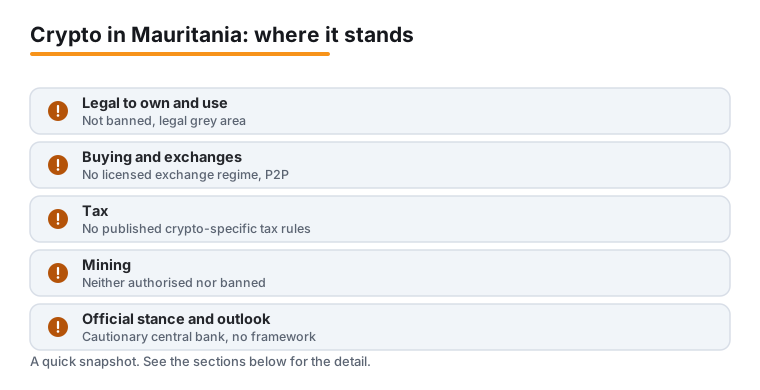
- Legal: No specific law, not banned and not legal tender, legal grey area
- Tax: No crypto-specific tax rules, gains may fall under general categories
- Buying: No licensed local exchanges, use international platforms or P2P
Mauritania has no dedicated cryptocurrency law. Bitcoin and other digital assets are neither recognised as legal tender nor explicitly banned, so residents, traders and businesses operate in a legal grey area shaped by general monetary, foreign-exchange and anti-money-laundering rules rather than crypto-specific statutes. The country's monetary authority is the Banque Centrale de Mauritanie (BCM), and the only legal tender is the Mauritanian ouguiya (MRU). This guide explains what is actually known about Mauritania crypto regulation as of 2026, covering legality, the regulator, applicable frameworks, exchanges, tax, AML and KYC, practical buying, mining, recent developments such as the exploratory Digital Ouguiya project, consumer risk and how to verify the position with official sources.
This page is general information as of 2026 and is not legal, tax or financial advice. The position can change quickly and is often shaped by guidance or enforcement rather than headline laws, so verify the current rules with the Banque Centrale de Mauritanie and a qualified local professional before acting. See also our crypto regulation overview.
On this page: Legal status · Who regulates it · Taxes · How to buy · Mining
Is Bitcoin and crypto legal in Mauritania?
There is currently no law in Mauritania that specifically legalises or prohibits Bitcoin or other cryptocurrencies. In practice, owning, buying and trading crypto is not a defined criminal offence, but it is also not a regulated or protected activity. Digital assets are not legal tender, since the only legal tender is the Mauritanian ouguiya (MRU), so no merchant or institution is obliged to accept crypto and disputes are unlikely to enjoy the protections that apply to regulated financial products.
Because the framework is silent rather than permissive, several things follow. Banks and payment providers may decline crypto-related transactions at their discretion. Activities that touch regulated areas, such as operating an exchange, handling client funds, offering investment services or moving money across borders, can still fall under existing licensing, foreign-exchange and anti-money-laundering obligations even though no crypto-specific licence exists. Mauritania has not adopted a blanket ban like some other African states, but the absence of a ban should be treated as legal uncertainty rather than a green light. For broader context, see our guide to crypto regulation.
The regulator: Banque Centrale de Mauritanie
The Banque Centrale de Mauritanie (BCM), created in 1973 and based in Nouakchott, is the country's central bank and the authority closest to anything crypto-related. Its stated missions are maintaining monetary stability, ensuring financial stability and supporting the country's economic development. It issues the ouguiya, oversees the banking and payment system, and administers foreign-exchange arrangements.
No authority in Mauritania has been given an explicit, crypto-specific mandate, and the BCM has not published a licensing regime for crypto businesses. The BCM itself now operates under Law 2024-042/PR, which revised the statutes created by Law 73-118 of 30 May 1973; the Council of Ministers approved the reform bill on 21 August 2024 in a context the Ministry of Economy and Finance described as the evolution of mobile and other digital payment technologies. Securities and capital-market supervision has since been carved out to a separate body, the Autorite de Regulation des Marches Financiers, created by Law 2024-044/PR of 10 December 2024. Consistent with the stance of many regional central banks, the BCM's public posture toward cryptocurrencies has been cautionary, flagging risks such as volatility, fraud and illicit use rather than creating or prohibiting anything. The official source to consult is the BCM directly at Banque Centrale de Mauritanie (bcm.mr).
Key laws and frameworks that apply
Mauritania has not enacted a comprehensive virtual-asset framework comparable to the EU's Markets in Crypto-Assets Regulation (MiCA). As a non-EU African state, MiCA does not apply to Mauritania, so any comparison to European licensing regimes is illustrative only. Instead, crypto sits at the intersection of older, general-purpose rules:
- Monetary and banking law administered by the BCM: Law 2024-042/PR, the current statutes of the central bank; Loi n° 2018-036 bis of 16 August 2018 regulating credit institutions, which covers banks, financial institutions and microfinance bodies; and Loi n° 2021-014 on electronic payment services and means, whose Article 65 requires prior BCM authorisation for anyone other than a bank to carry on the activity of a payment institution. The bill approved by the National Assembly on 12 November 2024 repealed and replaced Law 2018-034 of 8 August 2018.
- Foreign-exchange arrangements, which govern how value moves in and out of the country and can be relevant when converting between crypto and foreign currency.
- Anti-money-laundering and counter-terrorist-financing law, specifically Loi n° 2019-017 of 20 February 2019, whose Article 60 repeals Loi n° 2005-048 of 27 July 2005. It binds financial institutions and designated non-financial businesses and professions, listed in Article premier as real estate agents, dealers in precious stones and metals, lawyers, notaries and accountants carrying out financial operations for a client, and company and trust service providers, and it names the unite mauritanienne d'enquetes financieres as the reporting body. The statute never uses the words actifs virtuels or crypto, so any reach over a firm facilitating crypto-to-fiat conversion has to be argued from the general definition of funds rather than read off the text.
No published guidance currently sets registration, capital or conduct requirements specifically for crypto businesses. Because nothing here is crypto-specific or settled, confirm the present position directly with the BCM rather than relying on third-party summaries.
Licensing and registration of exchanges and VASPs
There is no locally licensed crypto exchange regime in Mauritania and no published register of authorised virtual-asset service providers (VASPs). No crypto-specific licence currently exists, so a business cannot obtain one even if it wanted to operate compliantly under a dedicated category.
That does not mean such activity is risk-free. A firm that handles client funds, exchanges crypto for fiat or offers investment-type services can still fall within existing financial-services licensing, foreign-exchange and AML obligations enforced by the BCM and other authorities. Internationally, the Financial Action Task Force (FATF) Recommendation 15 calls on jurisdictions to license or register VASPs and subject them to AML/CFT supervision, and regional bodies have pressed members in this direction. AML-driven registration is one possible route, but the institutional picture changed in December 2024: Law 2024-044/PR created the Autorite de Regulation des Marches Financiers (ARMF) as an independent public authority to regulate and supervise the Mauritanian capital market. As of 11 August 2026 the ARMF was still establishing its legal and regulatory framework, its governance and its teams, and had been admitted as an associate member of IOSCO. Neither the BCM nor the ARMF has announced a crypto or digital-asset regime, but the ARMF is now the body with the mandate to write one for investment-type products. A separate perimeter already exists for the payments side: under Loi n° 2021-014, carrying on the activity of a payment institution requires prior BCM authorisation. Anyone planning a crypto business should seek written legal advice and confirm requirements with the BCM. See also our country regulation hub.
Crypto and Bitcoin tax in Mauritania
Mauritania does not publish crypto-specific tax rules, and we will not state a crypto rate that cannot be verified. What changed for 2026 is the taxation of the payment rails crypto buyers use locally. A new Chapter 8 of the General Tax Code, created by the 2026 Finance Law, levies a Taxe sur les Transactions Electroniques of 0.1 percent on payments and transfers made through wallets and digital banking services whose operator is established in Mauritania, plus 10 percent on approved agents' commissions on related cash deposits. Operations below 5,000 MRU are exempt, the tax is withheld by the operator but borne by the payer, and the rectifying finance law adopted on 29 July 2026 capped it at 200 MRU per transaction. That is a cost on the ouguiya leg of a peer-to-peer trade, not a tax on the crypto gain itself. As a general principle in jurisdictions without dedicated guidance, gains or income from crypto are typically assessed under existing categories such as income, business profits or capital gains depending on the nature and frequency of the activity, but how Mauritania's tax authority would treat a given transaction is not formally codified.
Practical implications:
- Keep detailed records of every acquisition, disposal, transfer and conversion, including dates, amounts in MRU, counterparties and fees.
- Do not assume crypto is automatically tax-free simply because there is no specific statute; an absence of crypto rules is not the same as an exemption.
- Cross-border transactions can carry additional reporting or foreign-exchange implications.
Because the position is genuinely unclear, obtain a written opinion from a qualified Mauritanian tax adviser and confirm current obligations with the relevant tax authority before filing. See our general crypto tax guide for background. This section is informational only and not tax advice.
AML and KYC obligations
Mauritania is a member of MENAFATF, the Middle East and North Africa Financial Action Task Force, the FATF-style regional body that assessed the country's AML/CFT regime. Its mutual evaluation report is dated 18 November 2018, and MENAFATF has since published three enhanced follow-up reports for Mauritania, dated 9 June 2019, 19 December 2020 and 28 November 2021. No later Mauritania follow-up report appears in the MENAFATF list, so the November 2021 report is the most recent published assessment. These assessments cover the broader financial system rather than a dedicated crypto regime. As of the FATF plenary of 19 June 2026, which added Iraq and Bosnia and Herzegovina to the grey list and removed Algeria and Namibia, leaving 22 jurisdictions under increased monitoring, Mauritania is not on the FATF list of jurisdictions under increased monitoring (the grey list), and it is not on the FATF blacklist. That status can change at future plenary meetings, so check the FATF country page for the current position.
For users, the practical effect of AML and KYC rules shows up mainly through the platforms they use. International exchanges that accept residents typically require identity verification (KYC), and banks may scrutinise or decline transfers they associate with crypto. Firms that convert crypto to fiat could fall within AML obligations even without a crypto-specific law. The FATF has, through Recommendation 15, pushed jurisdictions to extend AML/CFT duties to virtual assets and VASPs, so tighter expectations over time are realistic. Authoritative references include the FATF country page for Mauritania.
Buying and using crypto in practice
Because no local exchange regime exists, Mauritanians who hold crypto generally rely on:
- International exchanges that accept users from the region, subject to those platforms' own KYC checks and country availability, which can change without notice.
- Peer-to-peer (P2P) marketplaces, where buyers and sellers transact directly, often settling the fiat leg via local bank transfer or mobile money.
The frictions are real. Getting ouguiya in and out of global platforms can be difficult, banks may scrutinise or block crypto-linked transfers, and P2P trading exposes you to counterparty fraud. Crypto can also be discussed as a way to move remittances, which are economically important to Mauritania, but the recipient still needs a reliable, lawful way to convert into spendable ouguiya, and that off-ramp is often the hardest part. Mitigate risk by favouring escrow-based P2P, verifying counterparties, withdrawing to wallets you control, comparing all-in costs against established remittance providers, and respecting foreign-exchange rules when converting between MRU and foreign currency. Confirm that any platform you use lawfully serves Mauritanian residents.
Bitcoin mining in Mauritania
No law specifically authorises or bans cryptocurrency mining in Mauritania, so the activity inherits the same legal uncertainty as trading. Claims circulating on some crypto sites that mining was formally legalised in a particular year or contributes a specific share of GDP are not supported by any official source we could verify, and we do not repeat them as fact. Those figures appear only on promotional crypto blogs, not in any Mauritanian government or central-bank publication, so treat them as unverified. The more decisive constraints for miners are practical: reliable, low-cost electricity and supporting infrastructure. Mauritania has notable renewable-energy potential, particularly solar and wind, and has pursued green-hydrogen ambitions, factors sometimes cited as theoretically attractive for energy-intensive computing.
Anyone considering mining should weigh several issues:
- Power access and cost: securing a stable, affordable supply at scale typically requires direct arrangements and is not guaranteed.
- Regulatory exposure: with no mining-specific rules, operators must still respect general business-licensing, hardware-import, tax and environmental requirements, and watch for new rules.
- Compliance posture: keep transparent records and be prepared to engage with authorities if a framework emerges.
Confirm electricity terms, import duties on equipment and any permits with the relevant Mauritanian authorities before committing capital.
Recent developments: the Digital Ouguiya (CBDC)
The most notable recent development is not about private crypto but about a central bank digital currency. In April 2024, during the IMF and World Bank Spring Meetings, the Banque Centrale de Mauritanie signed an agreement with the German technology company Giesecke+Devrient (G+D) to explore designing a digital version of the ouguiya. Under the agreement, G+D supports the BCM in defining requirements and delivering a technical solution for initial testing of defined use cases.
Importantly, this is exploratory work, not a commitment to launch. The project's stated aim is to understand how a digital ouguiya could benefit society and the economy, complement cash and support financial inclusion. A central bank digital currency is a state-issued form of national money and is distinct from decentralised cryptocurrencies such as Bitcoin, so this initiative does not, by itself, legalise or regulate private crypto. As of August 2026 the project remains in the exploratory and testing phase. No pilot result, launch date or decision to issue the digital ouguiya has been announced since the April 2024 agreement, the BCM's own website carries no page mentioning the project, and press coverage of the BCM's 2025 annual report, published on 31 July 2026, described it in terms of growth, inflation, external accounts, the banking sector and financial inclusion, with the rate of access to financial services put at 55 percent at end-2025 against 45.25 percent a year earlier, without reference to any digital ouguiya milestone. Reporting at the time of the 2024 agreement also noted that a final design might not necessarily use a blockchain, underlining that the technical approach was still open. The official announcement is the G+D press release on the Mauritania CBDC project. For the current status, monitor the BCM directly.
Consumer risks and protection
The principal risks in Mauritania flow from the regulatory vacuum. Because crypto is unregulated, there is little formal recourse if a platform fails or a counterparty defrauds you. Converting between crypto and ouguiya can be difficult and depends on third-party platforms that may change their policies without notice, and prices can move sharply, so you could lose some or all of your capital. Limited local merchant acceptance and thin liquidity add friction, and any cross-border activity must respect foreign-exchange and AML obligations.
To protect yourself: only commit money you can afford to lose; prefer escrow-based P2P and verify counterparties; use self-custody (a wallet you control, ideally hardware for larger balances) and keep your recovery phrase offline; retain full records for tax purposes; and be sceptical of guaranteed returns or deals that seem too good to be true. Stay alert to any change in the legal or tax position. This is informational only and not legal, tax or financial advice.
Official sources and how to verify
Because Mauritania's position is evolving and not codified in a single crypto statute, always verify the current rules with primary sources rather than secondary summaries. The most authoritative references are:
- Banque Centrale de Mauritanie, the central bank and monetary authority, for monetary, payment, foreign-exchange and any crypto-related communications: bcm.mr.
- FATF country page for Mauritania, for the AML/CFT framework and standards relevant to virtual assets: fatf-gafi.org.
- MENAFATF, the regional FATF-style body that evaluates Mauritania's AML/CFT regime, for mutual evaluation and follow-up reports: menafatf.org.
- Giesecke+Devrient press release, the primary announcement of the Digital Ouguiya CBDC exploration: gi-de.com.
This page is general information as of 2026 and is not legal advice. For your specific situation, confirm the current position with the Banque Centrale de Mauritanie and a qualified Mauritanian legal or tax professional. Explore more country guides on our regulation hub.
August 2026 status: what has changed and what has not
Since this page was last reviewed on 30 June 2026, the core answer is unchanged. Mauritania still has no crypto-specific law, no virtual-asset service provider licence, no published register of crypto businesses, and no crypto bill that can be identified in parliament, in a ministry consultation or in a central bank publication. Anyone telling you a Mauritanian crypto framework is imminent cannot point to a text.
That absence is now checkable rather than assumed. Neither the 2026 Finance Law nor the rectifying finance law adopted on 29 July 2026 contains the words crypto, virtual assets, tokens or blockchain, and the same is true of the 2019 anti-money-laundering statute and the 2021 electronic payments law.
What has changed is the architecture around crypto, and three developments matter:
- Mauritania has a dedicated capital markets regulator. The Autorite de Regulation des Marches Financiers (ARMF) states that it was created by Law 2024-044/PR of 10 December 2024 as an independent public authority to regulate and supervise the Mauritanian capital market. On 11 August 2026 its president was still describing the build-out of its legal and regulatory framework, governance and teams.
- The central bank's statutes were rewritten. The BCM states that it operates under Law 2024-042/PR, which revised the statutes created by Law 73-118 of 30 May 1973. The Council of Ministers approved the reform bill on 21 August 2024, in a context the Ministry of Economy and Finance described as the evolution of mobile and other digital payment technologies (ministry record), and the National Assembly approved it on 12 November 2024 as bill 2024-035, repealing Law 2018-034 of 8 August 2018.
- Electronic payments are taxed, and the rules tightened in July 2026. A 0.1 percent tax has applied to electronic payments and transfers since the 2026 budget year, and the rectifying law of 29 July 2026 capped it at 200 MRU per transaction while adding a reporting and enforcement regime aimed at non-resident digital platforms.
On AML there is no change of status. At the FATF plenary of 19 June 2026, Mauritania was absent from both the list of jurisdictions under increased monitoring and the blacklist. That plenary added Iraq and Bosnia and Herzegovina and removed Algeria and Namibia, leaving 22 jurisdictions on the grey list.
Named laws that actually apply
There is no crypto statute, so the rules that bind you are general ones. These are the instruments by name and number, all currently in force.
| Instrument | Status | Why it matters for crypto |
|---|---|---|
| Loi n° 2019-017 of 20 February 2019 on combating money laundering and terrorist financing | In force. Article 60 repeals Loi n° 2005-048 of 27 July 2005, as amended in 2016 | The operative AML statute. It never uses the words actifs virtuels or crypto. Obliged parties are financial institutions and designated non-financial businesses and professions, listed in Article premier as real estate agents, dealers in precious stones and metals, lawyers, notaries and accountants carrying out financial operations for a client, and company and trust service providers. The reporting body is the unite mauritanienne d'enquetes financieres. |
| Loi n° 2021-014 on electronic payment services and means | In force. Adopted June 2021 according to the BCM | The licence perimeter most likely to catch a crypto off-ramp. Article 65 provides that, banks excepted, no one may habitually carry on the activity of a payment institution without prior BCM authorisation, and Article 66 lets the BCM set the conditions including minimum capital. It also covers electronic money issuers. |
| Loi n° 2018-036 bis of 16 August 2018 regulating credit institutions | In force | Article premier regulates the conditions for carrying on the activity, the supervision and the control of credit institutions, for the protection of public deposits. Its definitions cover banks, financial institutions and microfinance institutions. A crypto business holding client ouguiya balances can fall inside this perimeter without any crypto rule existing. |
| Law 2024-042/PR, statutes of the Banque Centrale de Mauritanie | In force. Revised the statutes created by Law 73-118 of 30 May 1973 | Sets the BCM's organisation, missions, instruments and operations. It creates no crypto licensing category, and the ouguiya remains the sole legal tender. |
| Law 2024-044/PR of 10 December 2024 on the modernisation of financial markets | In force. The regulator is still being stood up | Creates the ARMF to regulate and supervise the Mauritanian capital market. Any future rules on token offerings or crypto investment products would most plausibly sit here rather than at the BCM. |
One practical constraint sits below statute level. The BCM states on its own site that in March 2024 it set caps on electronic transactions of 50,000 MRU per day for loading and transfers, 40,000 MRU for payments and 10,000 MRU for cash withdrawals, with a monthly ceiling of 200,000 MRU for withdrawals, payments and transfers, and that customers must hold valid identity documents to keep transacting through certain electronic services (BCM). These caps, not any crypto rule, are what most often limits the size of a peer-to-peer settlement.
The ARMF, and why it is the regulator to watch
Until December 2024 the Banque Centrale de Mauritanie was the only plausible home for crypto rules, which is why this page has always pointed there. That is no longer the full picture. The ARMF states that Law 2024-044/PR of 10 December 2024 created it as an independent public authority charged with regulating and supervising the Mauritanian capital market, with the aim of a secure and transparent financial framework. The National Assembly approved the capital markets modernisation bill on 12 November 2024, in the same session as the central bank statutes reform.
The ARMF is not yet a mature regulator. On 11 August 2026 its president, Sidi Mohamed Biya, received the World Bank Vice President for West and Central Africa, Ousmane Diagana, in Nouakchott and set out the main advances since the Authority was created, specifically the establishment of its legal and regulatory framework, its governance and its teams. Diagana welcomed the ARMF's progress over one year and noted its admission as an associate member of IOSCO. The director general of the Bourse de Nouakchott, Djoulou Camara, attended, and the discussion covered World Bank support for developing and modernising Mauritanian financial markets.
What this means practically:
- No timetable for a Mauritanian digital-asset regime has been published, by the ARMF or by the BCM. Nothing on token offerings, stablecoins or tokenisation has been announced, and the ARMF's public site carries no digital-asset content at all.
- The ARMF already appears in tax law. The fourth exemption from the electronic transaction tax turns on whether a payment runs through a provider, depositary, intermediary, platform or infrastructure authorised by the BCM or by the ARMF, so authorisation status is already doing legal work.
- If you plan to offer a token or a crypto investment product to Mauritanian investors, the risk is no longer purely theoretical. Public-offering and market-conduct authorisation now has an institutional owner, and the ARMF's first general regulation is the document to read when it appears.
How the 2026 tax rules touch the fiat leg of a crypto trade
Mauritania still has no crypto-specific tax and publishes no crypto rate. What it does have, from the 2026 budget year, is a tax on the electronic payment rails used to settle peer-to-peer trades in ouguiya, set out in a new Chapter 8 of the General Tax Code created by the 2026 Finance Law and amended by the rectifying finance law adopted on 29 July 2026.
- Scope (Article 293 octies). The Taxe sur les Transactions Electroniques applies to payment or transfer operations carried out via wallets and digital banking services whose operator is established in Mauritania, and to commissions received by approved agents on related cash deposits. Mobile Money, electronic wallets and payment applications, and approved electronic transfer platforms are named.
- Rate and ceiling (Article 293 decies). 0.1 percent of the gross amount before any deduction of fees, commissions or withholdings, capped at 200 MRU per transaction since the July 2026 amendment, plus 10 percent on approved agents' commissions. The cap is only reached on a single transaction of 200,000 MRU or more, which is above the BCM's own published wallet ceilings.
- Exemptions (Article 293 nonies). Operations for or debited to the Treasury, the CNSS or other public bodies; humanitarian, social or public aid transfers; operations whose unit amount is below 5,000 MRU; and securities and investment-related payments made through a provider authorised by the BCM or by the ARMF. That last exemption cannot help a crypto trade, because no crypto provider holds either authorisation.
- Who pays (Article 293 duodecies). The operator withholds at source as collector for the Treasury and remits by the 15th of the following month, but the real taxpayer is the user initiating the payment or transfer, that is the payer or buyer.
- Reporting (Article 293 terdecies). Monthly returns to the Direction Generale des Impots state the number, value and nature of taxable operations and, separately, the total of exempt transactions.
- Related change. Amended Article 278 sets the Taxe sur les Operations Financieres at a normal rate of 16 percent and 20 percent on commissions charged for transfers, cash withdrawals and payments made through electronic wallets.
The rectifying law also changed the position of foreign platforms, and this is the part most likely to be missed. New Article 221-bis makes a digital platform liable for Mauritanian VAT whether or not it is established in Mauritania, on its commission in all cases and on the underlying supply where it collects the price, sets essential transaction terms or acts as the contractual interface. New Article 249 bis requires banks and payment and electronic money institutions established in Mauritania to report to the tax administration each month the payment operations made to non-resident digital platforms, with the beneficiaries identified. New Article 249 ter lets the tax administration, after an unanswered formal notice, request suspension or restriction of access to the services concerned, require blocking of the related payment flows, and seek their delisting nationally.
None of this makes a crypto gain taxable or exempt, and none of these articles mentions crypto or virtual assets. No enforcement action against a crypto platform has been reported. The point is narrower: routing a trade through an offshore platform no longer keeps the ouguiya leg invisible, and the State now has an express power to have payment flows to a non-compliant foreign platform blocked. The question of how a crypto gain itself is taxed remains uncodified, and the advice in the tax section above still stands.
Frequently asked questions
Is cryptocurrency banned in Mauritania?
No. There is no law that specifically bans cryptocurrency in Mauritania, but there is also no law that regulates or protects it. Crypto is not legal tender and operates in a legal grey area, so treat the lack of a ban as uncertainty rather than approval, and verify the current position with the Banque Centrale de Mauritanie.
Who regulates crypto in Mauritania?
No authority has an explicit, crypto-specific mandate. The Banque Centrale de Mauritanie (BCM) is the central bank and the closest regulator; it oversees the financial system and the ouguiya and has been cautionary about crypto risks. General foreign-exchange and AML/CFT rules can also apply. There is currently no published licensing regime for crypto businesses.
Do crypto exchanges need a licence in Mauritania?
There is no crypto-specific licence or VASP register in Mauritania, so a dedicated crypto licence cannot be obtained. However, a business that handles client funds, converts crypto to fiat or offers investment services may still fall within existing financial-services, foreign-exchange and AML obligations. Seek written legal advice and confirm requirements with the BCM before operating.
Do I have to pay tax on crypto in Mauritania?
Mauritania has no published crypto-specific tax rules, so the treatment of gains or income is not clearly codified. An absence of specific rules does not mean crypto is tax-free. Keep detailed records and seek a written opinion from a qualified Mauritanian tax adviser before filing. This is informational only and not tax advice.
Is Mauritania launching a digital currency?
The Banque Centrale de Mauritanie signed an agreement in April 2024 with Giesecke+Devrient to explore a Digital Ouguiya central bank digital currency. Officials have described it as exploratory work, not a commitment to launch. A CBDC is state-issued money and is different from decentralised cryptocurrencies such as Bitcoin, so it does not legalise or regulate private crypto.
What currency does Mauritania use?
Mauritania's national currency and only legal tender is the Mauritanian ouguiya (currency code MRU, symbol UM), issued by the Banque Centrale de Mauritanie. The currency was redenominated at a rate of 1:10 in 2017 to 2018. Cryptocurrencies are not legal tender.
Is Mauritania on the FATF grey list?
No. As of the FATF statement of February 2026, Mauritania is not on the FATF list of jurisdictions under increased monitoring (the grey list), and it is not on the FATF blacklist. It is a member of MENAFATF, the regional FATF-style body, which assessed its anti-money-laundering regime. This status can change at future FATF plenary meetings, so confirm the current position on the FATF country page.
Is crypto mining legal in Mauritania?
No Mauritanian law specifically authorises or bans cryptocurrency mining, so it inherits the same legal uncertainty as trading. Claims on some crypto blogs that mining was formally legalised in a set year or contributes a specific share of GDP are not supported by any official Mauritanian source we could verify. Miners still face general business-licensing, equipment-import, tax and electricity constraints, so confirm terms with the relevant authorities before committing capital.
Has Mauritania launched a digital ouguiya yet?
No. The Banque Centrale de Mauritanie's digital ouguiya project, agreed with Giesecke+Devrient in April 2024, remained in an exploratory and testing phase as of mid-2026, with no announced public launch date or firm decision to issue it. A central bank digital currency is state-issued money and is separate from decentralised cryptocurrencies such as Bitcoin.
Is a crypto law coming in Mauritania?
No crypto bill has been identified in the Mauritanian parliament, in a ministry consultation or in a central bank publication as of August 2026, so nothing specific is scheduled. The institution to watch is the Autorite de Regulation des Marches Financiers (ARMF), created by Law 2024-044/PR of 10 December 2024 to regulate the capital market. As of 11 August 2026 it was still establishing its legal and regulatory framework, governance and teams, and had been admitted as an associate member of IOSCO. If Mauritania regulates token offerings or crypto investment products, that is now the most likely venue, but no timetable has been published.
Which law would be used against crypto-related money laundering in Mauritania?
Loi n° 2019-017 of 20 February 2019 on combating money laundering and terrorist financing, whose Article 60 repeals the earlier Loi n° 2005-048 of 27 July 2005. It never mentions virtual assets or crypto. Its Article premier defines funds broadly enough that an argument can be made for covering crypto, but the wording about electronic or digital form attaches to the documents and titles evidencing ownership, so the point is arguable rather than settled. Obliged parties are financial institutions and designated non-financial businesses and professions, and reports go to the unite mauritanienne d'enquetes financieres.
Is there a tax on mobile money transfers in Mauritania?
Yes, from the 2026 budget year. A new Chapter 8 of the General Tax Code created a Taxe sur les Transactions Electroniques of 0.1 percent on the gross amount of payments and transfers made through wallets and digital banking services whose operator is established in Mauritania, plus 10 percent on commissions approved agents receive on related cash deposits. The rectifying finance law adopted on 29 July 2026 capped the 0.1 percent charge at 200 MRU per transaction. Operations whose unit amount is below 5,000 MRU are exempt, as are transactions involving public bodies and humanitarian or social transfers. The operator withholds the tax and files a monthly return, but the person who bears it is the payer. It is not a crypto tax, but it applies to the ouguiya leg of a peer-to-peer crypto trade settled locally.
Does Mauritania have a securities or capital markets regulator?
Yes, since December 2024. The Autorite de Regulation des Marches Financiers (ARMF) states that it is an independent public authority created by Law 2024-044/PR of 10 December 2024 on the modernisation of financial markets, charged with regulating and supervising the Mauritanian capital market. It is still being built out. This matters for crypto because investment-type digital asset products would fall under a securities regulator rather than the central bank in most jurisdictions, and because Mauritanian tax law already treats ARMF authorisation as a condition for one of the exemptions from the electronic transaction tax.
Can Mauritania block payments to a foreign crypto exchange?
There is no crypto-specific power, but a general one now exists. The rectifying finance law adopted on 29 July 2026 added Article 249 ter to the General Tax Code, which lets the tax administration, after an unanswered formal notice for breach of digital services tax obligations, request suspension or restriction of access to the services concerned, require blocking of the payment flows linked to taxable operations, and seek their delisting nationally, with telecommunications and financial authorities obliged to cooperate. The same law added Article 249 bis, requiring banks and payment and electronic money institutions in Mauritania to report monthly to the tax administration on payments made to non-resident digital platforms, with beneficiaries identified. Neither article mentions crypto and no action against a crypto platform has been reported, so treat this as exposure rather than announced policy.
Facts reviewed: 13 August 2026. Page updated: 13 August 2026.