Home › Crypto Regulation › Mali
Bitcoin & Cryptocurrency Regulation in Mali
Quick answer — Mali, 2026
- Legal: Not banned but largely unregulated, not legal tender; CFA franc only
- Tax: No verifiable crypto-specific tax, general rules may apply
- Buying: No licensed local exchange, via international platforms and P2P
Mali is a landlocked West African country and a member of the West African Economic and Monetary Union (WAEMU, known in French as UEMOA). It shares the CFA franc (XOF) with seven other member states, and its monetary policy and banking supervision are handled regionally by the Central Bank of West African States (BCEAO, the Banque Centrale des Etats de l'Afrique de l'Ouest) rather than by a purely national central bank. This regional setup is the single most important thing to understand about Mali crypto regulation: there is no detailed, crypto-specific law written in Bamako, and the rules that touch digital assets come mainly from BCEAO instructions and WAEMU-wide regulations that apply across all member states.
One point of confusion is worth clearing up early. In 2025 Mali, together with Burkina Faso and Niger, completed its withdrawal from the Economic Community of West African States (ECOWAS) and deepened the Alliance of Sahel States (Alliance des Etats du Sahel, AES). That political shift did not change Mali's membership of WAEMU: as of 2026 Mali still uses the CFA franc and the BCEAO remains its central bank and financial-sector supervisor. For crypto, this means the relevant rules are still the regional WAEMU and BCEAO frameworks.
As of 2026, holding and trading Bitcoin and other cryptocurrencies is not prohibited in Mali, but the activity sits in a legal grey zone. There is no licensing regime purpose-built and operational for crypto exchanges, no recognition of any cryptocurrency as legal tender, and limited official guidance for users. This guide explains the current status, the regulators involved, tax and foreign-exchange considerations, and the practical realities of buying crypto, mining, and sending remittances. It is general information as of 2026 and is not legal, tax, or financial advice; always confirm specifics with a qualified Malian professional and with the BCEAO before acting. For wider context, see our crypto regulation guide.
On this page: Legal status · Who regulates it · Taxes · How to buy · Mining
Is Bitcoin and crypto legal in Mali?
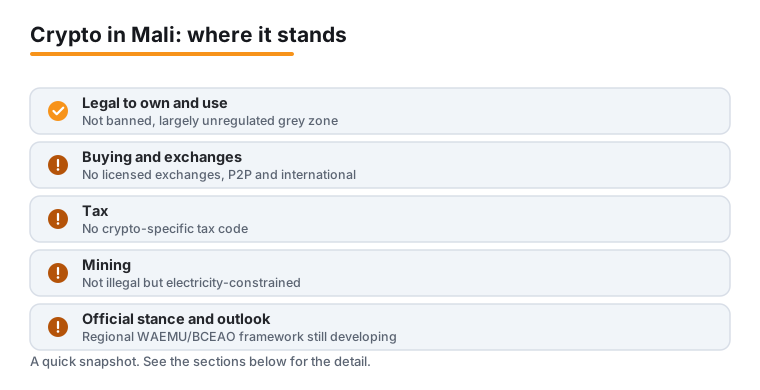
There is no Malian law that bans owning, buying, or selling cryptocurrency, and there is no law that grants it official legal-tender status. In practice this means residents are generally free to hold and trade Bitcoin and other assets, but they do so without the consumer protections, dispute-resolution channels, or deposit guarantees that apply to licensed banks and regulated financial products.
The only currency that is legal tender in Mali is the CFA franc, which the BCEAO has the exclusive right to issue across the WAEMU zone and which is pegged to the euro. No merchant or institution is obliged to accept Bitcoin, and crypto is not recognised as a means of settling official obligations such as taxes. Claims you may see online that shops and markets across Mali widely accept Bitcoin should be treated with caution; everyday commerce overwhelmingly runs on cash and on mobile-money services rather than on crypto.
Because the framework is permissive-by-default rather than affirmatively regulated, the situation can change as the BCEAO and WAEMU move toward more formal virtual-asset rules. Treat the current status as not banned, but largely unregulated, and re-check official sources periodically.
Who regulates crypto in Mali: the BCEAO and WAEMU
Mali does not have a standalone national crypto regulator. Oversight of money, payment systems, and the financial sector comes from the regional Central Bank of West African States (BCEAO), which serves all eight WAEMU member states from its headquarters in Dakar. The WAEMU Council of Ministers and the UEMOA Commission set the wider legal framework that BCEAO implements.
The BCEAO has the exclusive right to issue the CFA franc, supervises banks and electronic-money institutions, and has publicly weighed the opportunities and the financial-stability risks of crypto-assets. It has not authorised any cryptocurrency as money. On 8 May 2026 the BCEAO hosted an international conference in Dakar on crypto-assets and digital innovations, bringing together central-bank governors and partners such as the IMF and World Bank, and Governor Jean-Claude Kassi Brou said at that conference that the BCEAO had set up a committee, named C-CRYPTO, charged with drawing up the regulatory framework for crypto-assets in the UMOA. As of 24 July 2026 no text had been published and the BCEAO had not said when it would be, and the UMOA Council of Ministers session of 3 July 2026, the only ordinary session held since the announcement, adopted no crypto-asset instrument.
You can confirm the regulator and its communications directly at the BCEAO official website and at the UEMOA Commission.
Crypto laws and regulatory framework in Mali
Mali does not have a dedicated cryptocurrency statute. Instead, several layers of regional rules apply:
- WAEMU AML/CFT law (2023). On 31 March 2023 the WAEMU Council of Ministers adopted a uniform anti-money-laundering and counter-terrorist-financing law (WAEMU Directive No. 01/2023) that, for the first time, introduced definitions of virtual assets and virtual-asset service providers (VASPs) and subjected VASPs to prior authorisation or registration, in line with FATF Recommendation 15. This is the closest the region has come to recognising crypto businesses in law. A WAEMU directive is not self-executing: each member state must transpose it into national law before it fully takes effect. Some states moved early, for example Senegal (Law No. 2024-08 of 14 February 2024) and Benin (Law No. 2024-01 of 20 February 2024). Mali transposed it in 2024. Ordonnance n°2024-011/PT-RM of 30 August 2024, published in the Journal officiel special issue n°17 of 2 September 2024 and ratified by Loi n°2024-022 of 11 December 2024, states at Article 1er that it transposes the UMOA uniform law and defines virtual assets and virtual-asset service providers, while Article 206 repeals prior contrary provisions, in particular those of Loi n°2016-008 of 17 March 2016.
- Electronic-money rules. BCEAO Instruction No. 008-05-2015 sets the conditions for issuers of electronic money across WAEMU. It was written for regulated e-money and mobile money rather than for decentralised crypto, but it shapes how digital-value businesses must operate.
- Payment-services framework. UEMOA Instruction No. 001-01-2024 on payment services, which entered into force in early 2024, requires payment institutions to be authorised or registered with the BCEAO. Businesses that touch payment flows in the region must consider whether their activity falls within this regime.
- Foreign-exchange regulation. Regulation No. 06/2024/CM/UEMOA on foreign exchange, adopted in December 2024 to replace the 2010 rules, tightens BCEAO oversight of cross-border financial flows.
In Mali the gap is specific and can be read in the text itself. Article 58 of Ordonnance n°2024-011/PT-RM provides that nobody may carry on the professional activity of a virtual-asset service provider without having obtained the agrément or prior authorisation of the competent authority, but the ordinance never names which body that is for VASPs, and Article 59 leaves the specific requirements and the applicable AML/CFT sanctions to be specified later by the competent authorities. Those texts have not been issued, and a title search of Mali's Journal officiel database returns no Malian law, ordinance or decree on virtual assets. There is, as of 2026, no fully operational crypto-asset licence comparable to the EU's MiCA. Treat the legal picture as defined in principle but not yet built out in practice, and verify the current status with the BCEAO.
Licensing and registration of crypto exchanges (VASPs)
The 2023 WAEMU AML/CFT law brings virtual-asset service providers, such as exchanges and custodial wallet providers, within the perimeter of obligated entities and, on paper, subjects them to prior authorisation or registration. In other words, the legal hook for licensing crypto businesses exists across the union, including in Mali.
In practice the machinery is incomplete in a way you can pin down. Mali has transposed the regional law: Article 3 point c of Ordonnance n°2024-011/PT-RM lists virtual-asset service providers among the persons subject to it, and Article 2 point 51 defines them by five activities covering fiat and crypto exchange, transfers, custody and administration, and financial services connected to an issuer's offer or sale of virtual assets. What is missing is everything downstream of Article 58: no competent authority has been designated for VASPs, no licence conditions have been published, and no application route or public register exists. As of 2026 there is no widely documented, BCEAO-licensed domestic crypto exchange operating in Mali under a crypto-specific permit.
If you intend to run or use a crypto business connected to Mali, the prudent course is to assume AML/CFT registration duties may apply, to check whether your activity also falls under the payment-services or e-money regimes, and to confirm the latest requirements directly with the BCEAO before launching. Do not assume an absence of a clear licence means an absence of obligations.
Crypto and Bitcoin tax in Mali
Mali has a general tax system covering income, business profits, and value-added tax, administered by the Direction Generale des Impots (DGI). It does not, however, publish a clear, crypto-specific tax code, and there is no reliably verifiable rate or threshold that applies specifically to gains from Bitcoin or other digital assets. Be wary of websites that quote an exact Mali crypto tax percentage or describe detailed crypto reporting rules; such figures are frequently fabricated or AI-generated and are not supported by an official Malian source.
What can be said precisely is what the code contains. The words crypto, actifs numériques, monnaie virtuelle and actif virtuel appear nowhere in the consolidated Code Général des Impôts the DGI publishes. The individual capital-gains charge, the taxe sur les plus-values de cession des particuliers, is stated broadly at Article 121 but enumerated at Article 122 as applying to immovable property, real rights over property, shares in property-rich companies, and jewellery, art, collectors' items, antiques and securities; crypto-assets are not a listed category. The rates at Article 129 are 7 percent on shares and corporate interests, 5 percent on bonds, 15 percent on short-term gains other than on securities and 5 percent on long-term gains other than on securities. If activity is habitual and organised it is more likely to be treated as a business, where Articles 85 and 86 set profits tax at 30 percent with a minimum of 1 percent of turnover excluding tax, and VAT at Article 229 is 18 percent standard and 5 percent reduced. Because crypto is not codified, the outcome turns on characterisation, and the code is not neutral about it. Article 83 of the Livre de procédures fiscales requires the capital-gains tax to be declared and paid at the competent bureau des domaines, under the same conditions and sanctions as the registration duties on property transactions, a process built for conveyancing rather than for a token disposal. That is one reason business characterisation under Articles 85 and 86 is the more likely landing point for anyone trading regularly.
If you trade, mine, or accept crypto in Mali, keep detailed records of acquisitions, disposals, and CFA-franc values at the time of each transaction, and consult a qualified Malian tax adviser. You can reach the tax authority through the Mali DGI official website. This article does not state any crypto tax rate or threshold for Mali because none is reliably verifiable, and nothing here is tax advice. For general principles, see our crypto taxes guide.
AML, KYC, and foreign-exchange rules
Anti-money-laundering and counter-terrorist-financing (AML/CFT) duties are the most concrete crypto-relevant obligations in the WAEMU zone. The 2023 uniform AML/CFT law extends customer-identification (KYC), record-keeping, and suspicious-transaction-reporting duties to obligated entities, and it explicitly brings virtual-asset service providers within scope. Financial institutions and intermediaries that interact with crypto can therefore be drawn into these requirements.
On top of this sits the foreign-exchange regime. Regulation No. 06/2024/CM/UEMOA, adopted in December 2024 and applying directly across all WAEMU states including Mali, gives the BCEAO tighter control over cross-border financial flows. Among other things it strengthens rules on the repatriation of foreign-currency earnings and on holding funds abroad, as part of the region's AML/CFT drive. Moving value across borders, including via crypto, can intersect with these controls, and using crypto specifically to evade foreign-exchange rules or capital controls can carry legal risk.
For ordinary users, the practical takeaway is that reputable platforms will require identity verification, and that large or cross-border movements may attract scrutiny. Expect KYC, keep documentation, and be cautious of services that ask for no identification at all, as that often signals higher risk.
Buying and using crypto in practice in Mali
There is no BCEAO-licensed domestic crypto exchange operating under a crypto-specific permit in Mali. Malians who buy crypto typically rely on:
- International exchanges that accept users from the region, funded via cards or bank transfers where available.
- Peer-to-peer (P2P) platforms and informal trading, often settled through mobile money or cash, which is common across West Africa.
- Mobile-money rails as an on-ramp, given that mobile money is far more widespread than traditional bank accounts. Orange Money is one of the main mobile-money services operating in Mali and across Francophone West Africa, and it is commonly used to settle P2P trades.
For wider context, crypto use has been rising across the region even without local licensing. Industry data from Chainalysis reported that Sub-Saharan Africa received more than 205 billion US dollars in on-chain value between July 2024 and June 2025, a year-on-year increase of about 52 percent, with dollar-pegged stablecoins such as USDT and USDC used heavily for remittances and as a store of value. Mali is a small part of that regional picture, and these figures describe the region rather than Mali specifically.
General steps look like this, and they are educational rather than an endorsement of any platform: choose a method (a reputable international exchange or a P2P marketplace); complete identity verification, since most legitimate platforms require KYC documents; fund the purchase, usually via mobile money, or via bank transfer or card where supported; place the trade and review the fees and exchange spread before confirming; move anything beyond small short-term amounts to a self-custody wallet and back up the recovery phrase securely offline; and keep records of dates, amounts, and CFA-franc values for potential tax reporting.
Remember that recourse is limited if an unregulated platform fails or freezes funds, and that WAEMU foreign-exchange rules apply to cross-border activity. Be alert to common scams such as fake investment managers, social-media giveaways, and platforms promising guaranteed profits. None of this is a recommendation to use any particular service.
Crypto for remittances to Mali
Remittances are economically important to Mali, with money sent home by the diaspora supporting many households. Traditional transfer channels can be slow and carry meaningful fees, which is why crypto and stablecoins attract interest as a potentially faster, cheaper way to move value across borders.
Crypto can, in principle, allow a sender abroad to transfer value to a recipient in Mali quickly, with the recipient converting to CFA francs through a P2P trade or local off-ramp. Stablecoins pegged to the dollar or euro are often preferred because they avoid Bitcoin's short-term price swings during the transfer window. Because the CFA franc is itself pegged to the euro, the main appeal of crypto remittances here is cost and speed rather than escaping currency volatility.
The practical caveats are significant: exchange-rate spreads and off-ramp fees can erode the savings, liquidity for converting back to CFA francs can be limited, price volatility affects non-stablecoin transfers, and the WAEMU foreign-exchange and AML/CFT rules apply to cross-border flows. Recipients also bear the technical burden of managing wallets safely. Crypto remittances can work, but they are not automatically cheaper or simpler than established providers; compare the all-in cost and confirm the legal position before relying on them.
Bitcoin mining in Mali
There is no specific Malian law that authorises or bans Bitcoin mining, and no dedicated mining-licence regime. In principle, mining is not prohibited, but it runs into a more fundamental obstacle: energy. Mali has historically faced significant electricity-supply constraints, including limited generating capacity, grid-reliability problems, and periods of load-shedding. Proof-of-work mining is extremely power-hungry, so the economics and practicality of large-scale mining in Mali are challenging.
Anyone considering mining would need to think about access to reliable, affordable electricity (potentially off-grid or renewable), the general business, import, and tax rules that apply to any commercial operation, and the AML/CFT considerations that arise when mined coins are converted into CFA francs. Energy is supplied through regulated utilities, and diverting subsidised power for mining could create legal and contractual issues.
In short, mining in Mali is not specifically illegal, but the country is not a natural mining hub, and the binding constraint is electricity rather than crypto-specific regulation. Verify energy-supply terms and business obligations before committing capital.
Recent developments (2025-2026)
Two strands of change stand out. First, on the regional regulatory front, the BCEAO has been steadily tightening the rules around digital value: the payment-services framework (UEMOA Instruction No. 001-01-2024) took effect in early 2024, the new foreign-exchange Regulation No. 06/2024/CM/UEMOA was adopted in December 2024, and on 8 May 2026 the BCEAO convened an international conference in Dakar on crypto-assets and digital innovations. The central bank has indicated it is developing a harmonised regional framework for crypto-assets, although as of 2026 that framework is still in preparation rather than in force.
Second, on the political front, Mali completed its withdrawal from ECOWAS in 2025 (the exit transition period ran to 29 July 2025) and continued building the Alliance of Sahel States with Burkina Faso and Niger. In December 2025 the AES established a Confederal Investment and Development Bank (Banque Confederale d'Investissement et de Developpement, BCID-AES), headquartered in Bamako, with an initial capital reported at 500 billion CFA francs, to finance infrastructure across the three states. AES leaders have also discussed, as of 2025, the idea of a common currency to replace the CFA franc, but as of mid-2026 no such currency exists and no timeline is confirmed. Importantly for crypto, none of this has changed Mali's WAEMU membership, its use of the CFA franc, or the BCEAO's role as supervisor, so the regional crypto rules described in this guide continue to apply. If a currency transition ever happens it could reshape the monetary backdrop, but that is speculative for now.
The likely path ahead is regional, and it is worth being concrete about where it stands: the BCEAO's C-CRYPTO drafting committee was announced on 8 May 2026, no draft has been published, no consultation has opened, and no publication date has been given. The UMOA Council of Ministers has held two ordinary sessions in 2026, on 27 March and 3 July, and neither adopted anything on crypto-assets. That Council is the forum any binding regional text would have to pass through. Because this is an evolving area, treat the position as provisional and check official communications for updates.
Consumer risks and protection
The defining feature of crypto in Mali is the absence of a fully built-out, crypto-specific regulatory framework. That brings concrete risks: there is no local consumer-protection backstop tailored to crypto, limited legal recourse if a platform collapses or freezes funds, exposure to scams and operational failures, an unsettled tax position, and foreign-exchange rules that can complicate cross-border activity. Security risks fall heavily on the individual, because self-custody mistakes are usually irreversible.
If you choose to participate, basic risk discipline matters more than usual. Only commit money you can afford to lose. Prefer self-custody with secure, offline backups over leaving funds on unregulated platforms. Be sceptical of guaranteed-return schemes, fake investment managers, and social-media giveaways. Use platforms with clear KYC practices and a strong security track record, understand fees and exchange spreads before trading, and keep records for tax purposes.
This article does not give investment recommendations or price predictions; whether crypto rises or falls is unknowable. For more on the wider landscape, see our country regulation hub. None of this is financial advice; consider speaking with a qualified adviser about your own situation.
Official sources and how to verify
Because crypto rules in Mali are evolving and are set regionally, you should verify the current position directly with the authorities rather than relying on third-party summaries, including this one. The most authoritative starting points are:
- The BCEAO (Central Bank of West African States), the regional central bank and financial supervisor, for monetary, payment, e-money, and crypto-related communications.
- The BCEAO page on electronic-money issuing institutions, which lists licensed e-money providers and reflects Instruction No. 008-05-2015.
- The UEMOA Commission, for WAEMU-wide regulations such as the AML/CFT law and the foreign-exchange regulation.
- The Mali Direction Generale des Impots (DGI), the national tax authority, for the General Tax Code and any official guidance on how activities are taxed.
This guide is general information as of 2026 and is not legal, tax, or financial advice. Laws and BCEAO instructions can change, and crypto-specific rules in the region are actively being developed, so confirm the latest position with the BCEAO and a qualified Malian professional before acting.
Status in August 2026: what has moved and what has not
Three things are settled, and one is not. The page below already covers the 8 May 2026 Dakar conference; what follows is what came of it and what was already on Mali's own books.
- Mali already has a national law covering virtual assets. Ordonnance n°2024-011/PT-RM of 30 August 2024, ratified and amended by Loi n°2024-022 of 11 December 2024, transposes the UMOA uniform anti-money-laundering law and brings virtual-asset service providers inside Malian law. It has been in force since its publication in the Journal officiel on 2 September 2024.
- The union-wide crypto framework is still only a drafting exercise. At the Dakar conference on 8 May 2026, BCEAO Governor Jean-Claude Kassi Brou said the central bank had set up a committee to draw up the crypto-asset regulatory framework for the UMOA, a committee the BCEAO's own conference page names C-CRYPTO. No draft text has been published and none is in public consultation.
- Nothing has been adopted since. The UMOA Council of Ministers has held two ordinary sessions in 2026, on 27 March and 3 July. Only the July session fell after the committee was announced, and neither communiqué contains a crypto-asset text. The July session adopted a decision operationalising the UMOA Financial Stability Fund and a recommendation on 2027 economic policy guidance, and examined but deferred a public-debt reference framework.
- No timetable exists. As of 24 July 2026 the BCEAO had not said when the framework will be published. The Governor's public message to users is a warning rather than a protection: "It is not a currency. It is not regulated. So be careful." The same reporting notes continuing discussion of a possible central bank digital currency for the zone, the e-CFA.
The practical consequence: the rule that binds a business in Mali today is the Malian ordinance, not a future BCEAO text. For an ordinary holder, nothing has changed and nothing is scheduled to change on any announced date.
Mali's own virtual-asset law: what Ordonnance 2024-011 actually requires
The page elsewhere says Mali's transposition of the 2023 regional law needs to be confirmed. It does not: Mali transposed it in 2024. Ordonnance n°2024-011/PT-RM of 30 August 2024 was published in the Journal officiel special issue n°17 of 2 September 2024 and ratified by Loi n°2024-022 of 11 December 2024, which the Conseil national de Transition adopted on 4 November 2024. Article 1er states expressly that the ordinance transposes the UMOA uniform law, and Article 206 repeals prior contrary provisions, in particular those of Loi n°2016-008 of 17 March 2016.
| Provision | What it says |
|---|---|
| Article 2, point 2 | Defines an actif virtuel as a digital representation of value that can be exchanged or transferred by a digital process, excluding digital representations of fiat currency, securities and other financial assets already subject to their own regulation. |
| Article 2, point 51 | Defines a prestataire de services d'actifs virtuels (PSAV) as any natural or legal person carrying on commercially, for or on behalf of a client, any of five activities: virtual asset to fiat exchange, exchange between forms of virtual assets, transfer of virtual assets, custody or administration of virtual assets or of the instruments that control them, and participation in or provision of financial services connected to an issuer's offer or sale of virtual assets. |
| Article 3, point c | Lists PSAVs among the persons subject to the law, alongside financial institutions and designated non-financial businesses and professions. |
| Article 58 | Nobody may carry on the professional activity of a PSAV without having obtained the agrément or prior authorisation of the competent authority. |
| Article 59 | PSAVs operating in Mali must apply the relevant provisions of the ordinance, in particular the preventive measures. The specific requirements and the AML/CFT sanctions applicable to PSAVs are to be specified by the competent authorities. |
| Article 94 | The competent authority for the national risk assessment is designated by decree. That assessment, carried out with CENTIF, must cover risks arising from virtual-asset activity and from PSAV operations, and its conclusions go in a report updated every two years. |
| Articles 184 and 197 | Money laundering by a natural person carries three to seven years imprisonment plus a fine equal to three times the value of the funds or property involved, and attempts carry the same penalties. Intentional breach of the preventive duties by directors or staff of a subject person carries six months to two years and a fine of 100,000 to 1,500,000 FCFA, or only one of those two penalties, rising to twelve months to four years and 200,000 to 3,000,000 FCFA where terrorist or proliferation financing is involved. Unintentional failures carry a fine of 50,000 to 700,000 FCFA in money-laundering cases and 100,000 to 1,500,000 FCFA in terrorist or proliferation financing cases. |
The gap is specific and worth stating plainly. Article 58 creates a prohibition on unauthorised activity, but the ordinance never names which body is the competent authority for PSAVs, and the requirements and sanctions promised by Article 59 have not been issued. So the authorisation duty exists in law while no authorisation can be applied for. A title search of Mali's Journal officiel database at the Secrétariat Général du Gouvernement returns no result at all for actif virtuel or actifs virtuels, and the only Malian texts whose titles contain crypto concern cryptologie, that is encryption, not crypto-assets: Loi n°2016-011 of 6 May 2016 on cryptology and the decrees of 27 March and 26 August 2019 made under it. Those are not crypto-asset laws and should not be read as such.
Suspicious transactions are reported to CENTIF, Mali's financial intelligence unit, under Article 60, on a model set by order of the Minister of Finance. Article 97 sets its composition at six to eight members appointed by decree, chaired by a senior official seconded from Customs, the Treasury or the tax administration, with a BCEAO official seconded to run its secretariat.
What Mali's tax code actually says about crypto disposals
The honest headline is unchanged: there is no crypto-specific tax rule in Mali and no DGI ruling on how crypto gains are characterised. The words crypto, actifs numériques, monnaie virtuelle and actif virtuel appear nowhere in the consolidated Code Général des Impôts published by the Direction Générale des Impôts. But the page can tell readers what the default framework contains, which is more useful than saying nothing.
The relevant regime for an individual selling an asset is the taxe sur les plus-values de cession réalisées par les particuliers. Article 121 states the general principle broadly, covering gains made by individuals on the disposal for consideration of biens ou droits, and it opens by reserving the separate rules that apply to professional gains. Article 122 then enumerates the categories it applies to: immovable property, real rights over immovable property, shares and corporate interests in companies whose assets are principally property, and jewellery, works of art, collectors' items, antiques and securities. Crypto-assets are not among the listed categories, which is the source of the uncertainty. Article 128 provides that for movable property the base is the net gain, that is the sale price less the costs borne to conserve the asset and the costs incurred on disposal.
| Charge | Rate as published | Reference |
|---|---|---|
| Gains on shares and corporate interests | 7 percent | CGI Article 129 |
| Gains on bonds | 5 percent | CGI Article 129 |
| Short-term gains other than on securities | 15 percent | CGI Article 129 |
| Long-term gains other than on securities | 5 percent | CGI Article 129 |
| Business and corporate profits | 30 percent, with a minimum of 1 percent of turnover excluding tax | CGI Articles 85 and 86 |
| VAT | 18 percent standard, 5 percent reduced | CGI Article 229 |
| Gains on shares in Mali-registered companies realised by non-residents | 15 percent, rising to 30 percent where the seller is resident in a non-cooperative or privileged-tax jurisdiction | CGI Article 129-C |
Two practical points follow. First, if trading is habitual and organised it is far more likely to be treated as a business, in which case the 30 percent charge with its 1 percent minimum on turnover is the relevant figure rather than any capital-gains rate. Second, the capital-gains tax is administratively built around property: Article 83 of the Livre de procédures fiscales requires it to be declared and paid at the competent bureau des domaines, under the same conditions and sanctions as the registration duties on property transactions, which is not a process designed for a crypto disposal.
These rates come from the consolidated code the DGI publishes, whose file is marked as updated to 2 August 2017; annual finance laws can amend them, and Mali's budget documents are posted by the Ministry of Economy and Finance at finances.ml, where a Projet de loi de finances rectificative 2026 was posted on 22 July 2026. None of this is a DGI position on crypto. It is the default framework a Malian tax adviser would be reasoning from in the absence of one.
Frequently asked questions
Is cryptocurrency legal in Mali?
There is no law that bans owning or trading cryptocurrency in Mali, so it is generally permitted, but it is also not recognised as legal tender and remains largely unregulated. The CFA franc, issued by the BCEAO, is the only legal tender. Treat the status as not banned, but without the protections that apply to regulated financial products, and verify the current position with the BCEAO.
Who regulates crypto in Mali?
Mali is part of the West African Economic and Monetary Union (WAEMU), so monetary and financial-sector oversight comes mainly from the regional Central Bank of West African States (BCEAO) rather than from a national-only regulator. Mali has transposed the regional AML/CFT law nationally through Ordonnance n°2024-011/PT-RM of 30 August 2024, ratified by Loi n°2024-022 of 11 December 2024, which defines virtual assets and virtual-asset service providers and requires prior authorisation to operate as one under Article 58. No competent authority has been designated for that authorisation and no licence conditions have been published, so there is no operational crypto-specific licence. The electronic-money and payment-services instructions and the 2024 foreign-exchange regulation apply alongside it.
Did Mali leaving ECOWAS change its crypto rules?
No. Mali completed its withdrawal from ECOWAS in 2025 and deepened the Alliance of Sahel States, but it remains a member of WAEMU, still uses the CFA franc, and the BCEAO is still its central bank and supervisor. The regional WAEMU and BCEAO frameworks that govern digital assets continue to apply in Mali.
Do I have to pay tax on crypto in Mali?
Mali does not publish a clear, crypto-specific tax code, and there is no reliably verifiable rate or threshold that applies to crypto specifically. General income and business-tax rules administered by the DGI may apply depending on how an activity is characterised. Be wary of websites quoting exact Mali crypto tax percentages, as these are often fabricated. Keep detailed records and consult a qualified Malian tax adviser. This is not tax advice.
Do crypto exchanges need a licence in Mali?
The 2023 WAEMU AML/CFT law subjects virtual-asset service providers, such as exchanges, to prior authorisation or registration on paper, but key implementing texts (who issues licences and on what terms) are not yet fully in place across the union. As of 2026 there is no widely documented, BCEAO-licensed domestic crypto exchange operating in Mali under a crypto-specific permit. Anyone running such a business should assume AML/CFT duties may apply and confirm requirements with the BCEAO.
Can I use Bitcoin for remittances to Mali?
It is technically possible to send value via crypto and have the recipient convert to CFA francs through a peer-to-peer trade or local off-ramp, and stablecoins are often used to avoid price swings during transfer. However, exchange spreads, off-ramp fees, limited liquidity, and the WAEMU foreign-exchange and AML/CFT rules can reduce or complicate the benefit. Compare the all-in cost against established transfer providers before relying on it.
Will the Alliance of Sahel States or a new currency change crypto rules in Mali?
Not so far. In December 2025 the AES set up a Confederal Investment and Development Bank (BCID-AES) based in Bamako, and its leaders have discussed the idea of a common currency to replace the CFA franc. As of mid-2026 no such currency exists, no timeline is confirmed, and Mali still uses the CFA franc under the BCEAO. The regional WAEMU and BCEAO rules on digital assets continue to apply. Treat any talk of a currency switch as a proposal, not a rule you can plan around.
Do shops in Mali accept Bitcoin?
Generally no. The CFA franc is the only legal tender, and no merchant is obliged to accept crypto. Everyday commerce runs on cash and on mobile-money services such as Orange Money rather than on Bitcoin. Be sceptical of claims that shops and markets across Mali widely accept crypto; such claims are usually not supported by evidence.
Has Mali transposed the 2023 WAEMU virtual-asset rules into national law?
Yes. Ordonnance n°2024-011/PT-RM of 30 August 2024, published in the Journal officiel special issue n°17 of 2 September 2024 and ratified by Loi n°2024-022 of 11 December 2024, transposes the UMOA uniform anti-money-laundering law. It defines actifs virtuels at Article 2 point 2, defines prestataires de services d'actifs virtuels at Article 2 point 51, lists them among subject persons at Article 3 point c, and at Article 206 repeals prior contrary provisions including those of Loi n°2016-008 of 17 March 2016.
Which Malian authority licenses a crypto exchange?
None has been designated. Article 58 of Ordonnance n°2024-011/PT-RM says nobody may carry on the professional activity of a virtual-asset service provider without the agrément or prior authorisation of the competent authority, but the ordinance does not name that authority for VASPs, and Article 59 leaves the specific requirements and AML/CFT sanctions to be specified later by the competent authorities. No such text has been published. The duty to be authorised exists while no authorisation can be applied for.
When will the BCEAO publish crypto rules for the WAEMU zone?
No date has been announced. Governor Jean-Claude Kassi Brou said at the BCEAO conference in Dakar on 8 May 2026 that a committee, C-CRYPTO, had been set up to draw up the crypto-asset framework for the UMOA. As of 24 July 2026 no draft had been published, no consultation had opened, and the central bank had not said when the framework would appear. The UMOA Council of Ministers session of 3 July 2026, the only ordinary session held since the announcement, adopted no crypto-asset text.
What penalties apply to crypto-related money laundering in Mali?
Under Ordonnance n°2024-011/PT-RM, Article 184 punishes money laundering by a natural person with three to seven years imprisonment plus a fine equal to three times the value of the funds or property involved, and attempts carry the same penalties. Article 197 punishes intentional breaches of the preventive duties by directors or staff of a subject person with six months to two years imprisonment and a fine of 100,000 to 1,500,000 FCFA, or only one of those two penalties, rising to twelve months to four years and 200,000 to 3,000,000 FCFA where terrorist or proliferation financing is involved. Unintentional failures carry a fine of 50,000 to 700,000 FCFA in money-laundering cases and 100,000 to 1,500,000 FCFA in terrorist or proliferation financing cases. The requirements and sanctions specific to virtual-asset service providers are left to Article 59 and have not been issued.
Is there a Mali capital gains tax rate for selling crypto?
There is no crypto-specific rate and no DGI ruling. The consolidated Code Général des Impôts published by the DGI contains no reference to crypto, actifs numériques, monnaie virtuelle or actif virtuel. The individual capital-gains charge is stated broadly at Article 121 but enumerated at Article 122 by asset class, and crypto is not one of the listed classes. The published rates at Article 129 are 7 percent on shares and corporate interests, 5 percent on bonds, 15 percent on short-term gains other than on securities and 5 percent on long-term gains other than on securities, while business profits are taxed at 30 percent under Article 85 with a minimum of 1 percent of turnover under Article 86. Which of these a Malian adviser would apply depends on characterisation, and annual finance laws can change rates.
Do Mali's cryptology laws regulate cryptocurrency?
No. Searching Mali's Journal officiel for crypto returns Loi n°2016-011 of 6 May 2016 on cryptology and the decrees made under it of 27 March 2019 and 26 August 2019, which set licensing and declaration rules for suppliers of encryption tools and services. They concern cryptography, not crypto-assets, and do not apply to holding or trading cryptocurrency. Searching the same database for actif virtuel or actifs virtuels returns no result.
Facts reviewed: 13 August 2026. Page updated: 13 August 2026.