Home › Crypto Regulation › Liberia
Bitcoin & Cryptocurrency Regulation in Liberia
Quick answer — Liberia, 2026
- Legal: Personal use tolerated grey area, unlicensed crypto business illegal
- Tax: No crypto-specific tax, income may fall under general rules
- Buying: No licensed local exchange, via global apps and P2P
Liberia is a small, dollarised West African economy where the US dollar, the Liberian dollar and mobile money circulate side by side. Interest in Bitcoin and other cryptocurrencies is rising, driven mainly by remittances, dollar access and a young, mobile-first population. The legal picture, however, is not settled. As of 2026 Liberia has no dedicated cryptocurrency statute, the Central Bank of Liberia (CBL) has publicly warned that launching an unlicensed digital financial product is illegal, and anti-money-laundering duties sit with the Financial Intelligence Agency (FIA). This guide explains, in plain language, what is and is not known about crypto regulation in Liberia today: legal status, the regulators, the laws that actually apply, licensing, tax, AML and KYC, practical use, mining, recent developments, consumer risk, and how to verify everything against official sources. This is general information as of 2026 and is not legal, tax or financial advice; always confirm your situation with the Central Bank of Liberia and a qualified Liberian professional before acting. See also our overview of crypto regulation.
On this page: Legal status · Who regulates it · Taxes · How to buy · Mining
Is Bitcoin and crypto legal in Liberia?
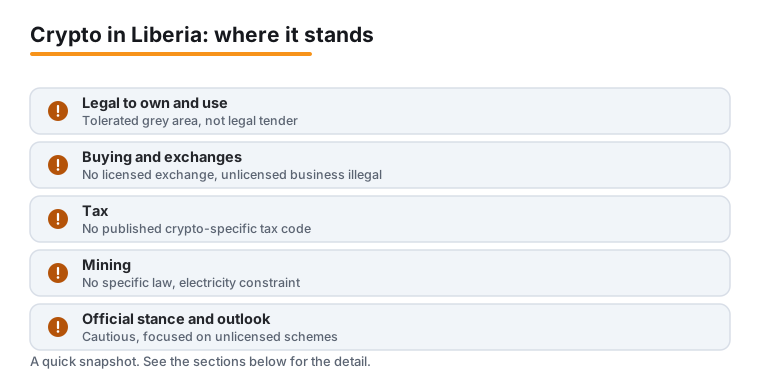
Holding, buying or sending Bitcoin is not specifically banned for individuals in Liberia, but it is also not formally authorised or recognised. The country sits in a regulatory grey zone: no statute legalises crypto as a means of payment, and no statute criminalises ordinary personal use of it.
Two distinctions matter:
- Crypto is not legal tender. The money the state recognises for settling debts is the Liberian dollar and, in practice, the widely circulating US dollar. No cryptocurrency has legal-tender status in Liberia.
- Running an unlicensed crypto business can be treated as illegal. The Central Bank of Liberia has stated that launching a digital financial product without the required licence breaches Liberia's financial-institutions law. That is very different from an individual quietly holding Bitcoin.
In short, personal use exists in a tolerated grey area, while operating an exchange, issuing a coin or soliciting the public for a crypto scheme without authorisation carries real legal exposure. Because no dedicated framework exists, treat the position as evolving and verify it with the CBL before relying on it.
Who regulates crypto in Liberia?
There is no dedicated crypto regulator. Several existing authorities have overlapping relevance:
- Central Bank of Liberia (CBL) is the primary authority over money, payments and financial institutions. It licenses banks and financial businesses and has been the main official voice on crypto. Its website is cbl.org.lr.
- Financial Intelligence Agency (FIA) is Liberia's central agency for receiving and analysing suspicious-transaction reports and leading the anti-money-laundering and counter-terrorist-financing (AML/CFT) regime. It was established on 29 July 2022, replacing the earlier Financial Intelligence Unit. Its website is fialiberia.gov.lr.
- Liberia Revenue Authority (LRA) administers taxation, including income and business taxes that can apply to economic gains, whatever their form.
No Liberian regulator currently runs a licensing window specifically for crypto exchanges or custodians. Where activity touches regulated financial business or money laundering, the CBL and FIA frameworks are the ones that bite.
Crypto laws and frameworks that actually apply
Liberia has no comprehensive, crypto-specific law. Crypto activity is judged instead against named financial, payments and AML instruments, several of which address virtual assets directly. The ones that matter most are:
- The New Financial Institutions Act. This is Liberia's core banking and financial-business law. The CBL relied on its Section 3(1) when it declared that an unlicensed digital-asset launch was not permitted, because conducting financial business in Liberia requires CBL authorisation.
- The AML/CFT Act, 2021 and the Financial Intelligence Agency Act, 2021. These set Liberia's anti-money-laundering and counter-terrorist-financing duties and establish the FIA. They define reporting obligations for financial institutions and can reach businesses whose activity touches crypto.
Beware of online articles claiming Liberia passed a detailed crypto licensing code in 2024. We could not verify any such enacted law in official CBL, FIA or government sources, and it conflicts with the regulators' own published position that no comprehensive crypto framework yet exists. Treat any rule you read about, including in this article, as a starting point to confirm against the official sources, not a final answer. For background, see our guide to how crypto regulation works.
The Central Bank of Liberia's known position
The clearest official signal is the CBL's public notice dated 13 May 2021 concerning The Abundance Community Coin (TACC). In it the CBL stated that it had not approved any licence for the company to transact any financial business in Liberia, citing Section 3(1) of the New Financial Institutions Act. It described introducing a digital financial product without proper authorisation as illegal and intended to undermine the country's financial system, directed the promoter to halt all publicity and financial activity, warned of legal action, and urged the public to exercise caution.
The pattern is consistency rather than novelty. The bank's concern is unlicensed solicitation of the public and threats to financial stability, not the underlying technology. You can read the notice directly on the CBL site: Public Notice on The Abundance Community Coin (TACC).
Licensing and registration of exchanges and VASPs
As of August 2026 there is still no published CBL licensing regime for crypto exchanges, custodians or other virtual-asset service providers (VASPs). The position is sharper than a simple absence. Liberia's second round mutual evaluation records at criterion 15.4 that VASPs are required to be licensed or registered, but that implementing legislation has not been adopted to define the parameters of the licensing process, so the obligation exists with no route to comply. Criterion 15.7 records that there were no licensed VASPs operating in the country, and none has become possible since. The report also records that the CBL issued a circular to financial institutions prohibiting dealings with VASPs and virtual assets. The practical consequences:
- No locally licensed crypto exchange. No business operates openly as a CBL-authorised crypto platform under a dedicated rulebook.
- Conducting financial business still needs authorisation. Under the New Financial Institutions Act, transacting financial business in Liberia requires a CBL licence. Offering crypto services to the public without one is the activity most likely to draw enforcement, as the TACC notice showed.
- AML duties can still apply. VASPs are expressly within the FIA's supervisory perimeter. Criterion 15.6 of Liberia's mutual evaluation records that the Financial Intelligence Agency Act confers broad supervisory responsibility on the FIA over all reporting entities, including VASPs, citing sections 67.3(13) and (14), together with powers to conduct inspections and compel the production of information. Customer due diligence, record-keeping and suspicious-transaction reporting duties therefore apply to a crypto business in Liberia now, even though no bespoke crypto licence exists for it to hold.
Anyone planning to operate a crypto-related business in Liberia should obtain written guidance from the CBL before launching rather than assuming the grey area equals permission.
Crypto and Bitcoin tax in Liberia
Liberia does not have a published, crypto-specific tax code and the Liberia Revenue Authority has issued no ruling on digital assets. That does not leave you without an answer, because the general Liberia Revenue Code rates apply by default:
- Income is generally taxable in Liberia regardless of its form. If you earn money through crypto, for example as business income, trading profit or payment for services, that gain may fall within existing income or business-tax rules administered by the Liberia Revenue Authority (LRA).
- There is no separate crypto tax rate or digital-asset capital-gains schedule. The default applies instead: gains on the disposition of property are included in an individual's gross income and taxed at ordinary rates. For resident individuals that means nil on the first LRD 70,000, 5 percent from 70,001 to 200,000, LRD 6,500 plus 15 percent from 200,001 to 800,000, and LRD 96,500 plus 25 percent above 800,000. Non-residents pay a flat 20 percent, and companies pay 25 percent generally.
- Record-keeping matters. Keep clear records of what you bought, sold or received and at what value, in US dollars or Liberian dollars, so any future assessment is straightforward and disputes are less likely.
Because crypto taxation here is unsettled and fact-specific, do not rely on rules of thumb. Confirm your obligations with the LRA or a qualified Liberian tax adviser before filing. For general background, see how crypto is taxed. Nothing here is tax advice.
AML and KYC rules
Even without a dedicated crypto law, anti-money-laundering and know-your-customer duties are real and enforceable through Liberia's AML/CFT framework.
- The AML/CFT Act, 2021 sets out customer due diligence, record-keeping and suspicious-transaction reporting obligations for financial institutions and other reporting entities.
- The Financial Intelligence Agency (FIA) receives and analyses those reports and coordinates Liberia's AML/CFT regime.
- For individuals, the most visible effect is that reputable exchanges and platforms require identity verification (KYC). A service that asks for no verification at all is a serious red flag and may itself be operating outside the law.
If you run any business that handles customer funds or facilitates crypto trades, assume AML and KYC duties may apply and check your status with the FIA. You can review its published material at fialiberia.gov.lr.
Buying and using crypto in practice
With no CBL-licensed local exchange, Liberians who buy crypto generally use:
- Global exchanges and apps that accept users from the region, funded by card, bank transfer or supported methods where available.
- Peer-to-peer (P2P) marketplaces, where buyers and sellers trade directly and settle with mobile money, cash or US dollars. P2P is popular because formal on-ramps are limited, but it concentrates the risk of scams.
Practical points to keep in mind:
- Access to international platforms can be inconsistent, and some services restrict users in smaller markets. Availability can change without notice.
- Expect identity verification on reputable platforms; be wary of any that ask for none.
- Prices are usually quoted in US dollars, which fits Liberia's dual-currency reality but adds exchange-rate considerations when you cash out in Liberian dollars.
- Remittances are a genuine use case: crypto and stablecoins can move value across borders quickly, but the last mile, converting to spendable local cash, still relies on P2P traders and reintroduces fees, spreads and counterparty risk.
Because there is no crypto-specific consumer-protection regime, you bear most of the platform and counterparty risk yourself. Start with a small test amount, secure your own wallet, and never share your seed phrase or private keys.
Bitcoin mining in Liberia
No specific Liberian law authorises or prohibits Bitcoin mining, but several practical realities make large-scale mining difficult.
- Electricity is the binding constraint. Liberia has one of the lower electrification rates in the region, grid capacity is limited, and power can be expensive or unreliable. Industrial proof-of-work mining depends on cheap, abundant, stable electricity, which is hard to secure here.
- Energy and sustainability. Some regional discussion focuses on pairing mining with renewable sources such as hydro or solar so it does not strain communities or the grid. In Liberia this remains largely aspirational rather than an established industry.
- Regulatory uncertainty. Even where mining is not banned, the absence of clear rules means an operation could later face licensing, energy-use or tax questions.
For most individuals, hobby-scale activity is more realistic than a domestic mining farm, and even then the economics are challenging given local power costs.
Recent developments and outlook
The most authoritative recent signal remains the CBL's stance that unlicensed digital financial products are not permitted under existing financial-institutions law, reinforced by the establishment of the FIA in 2022 and the AML/CFT Act, 2021. We found no verifiable evidence in official CBL, FIA or government sources that Liberia enacted a comprehensive crypto licensing law in 2024, 2025 or 2026, despite some third-party articles asserting otherwise.
What has moved recently is the AML/CFT machinery, not crypto-specific rules. Liberia adopted a National AML/CFT Action Plan (2024-2028) on 5 August 2024, established an Office of Asset Recovery through Executive Orders No. 126 (2024) and No. 145 (2025), and was admitted into the Egmont Group of financial intelligence units. On 30 June 2026 the FIA unveiled its Strategic Plan (2026-2031) to strengthen the AML/CFT regime in line with FATF standards. Liberia also carried out a survey of virtual-asset service providers (VASPs) covering the banking and insurance sectors, which improved the country's understanding of money-laundering and terrorist-financing risks tied to virtual assets. None of this creates a crypto licensing regime, but it signals that virtual assets are now on the authorities' AML radar.
Direction of travel: the sequence the CBL has itself set out is a risk assessment first, then a licensing framework. The FIA announced digital data collection training for the second round National Risk Assessment on 16 July 2026, with collection set to begin across key sectors and no completion date published, so a VASP framework is unlikely to arrive before that assessment reports. The CBL's focus has been financial stability and stopping unlicensed schemes rather than embracing or banning crypto outright, while broader African and FATF-aligned AML work continues to shape the region. Expect gradual clarification rather than sudden, sweeping legalisation. Because the picture can change, always check the CBL and FIA sites for the latest notices before acting.
Regional AML context: GIABA and FATF
Liberia does not sit outside the international anti-money-laundering system. It is a member of the Inter-Governmental Action Group against Money Laundering in West Africa (GIABA), the FATF-style regional body for the region, and its AML/CFT framework is assessed against FATF standards.
- Enhanced Follow-Up. After its second-round Mutual Evaluation, Liberia was placed on Enhanced Follow-Up by GIABA, meaning it reports back on fixing identified weaknesses. Its next (third-round) Mutual Evaluation is scheduled for adoption in November 2031.
- Active engagement. A GIABA high-level delegation visited Liberia in August 2025, and Monrovia hosted the 44th GIABA Plenary in November 2025, reflecting continued regional pressure to tighten AML/CFT compliance.
- Why it matters for crypto. FATF standards expect countries to bring virtual-asset service providers into their AML frameworks. Liberia's VASP survey and action-plan work fit that trend, so any future crypto rules are likely to arrive first through the AML/CFT channel rather than a standalone crypto statute.
For the regulator's own material, see the Financial Intelligence Agency of Liberia and the GIABA site.
Consumer risks and protection
The risks of using crypto in Liberia are structural, not just market-related:
- No local safety net. There is no crypto-specific consumer protection, deposit insurance or compensation scheme. If a platform fails or you are defrauded, recourse is limited.
- Fraud and unlicensed schemes. Scams, phishing and unlicensed investment programmes are a serious threat. Be deeply sceptical of anything promising guaranteed or high returns, especially locally promoted coins; the CBL has already warned about exactly this.
- Self-custody risk. If you hold crypto, you are responsible for securing it. Use strong unique passwords, enable two-factor authentication, and consider a hardware wallet with offline backups for larger amounts. Lost keys mean lost funds.
- Volatility and liquidity. Prices swing sharply, and converting back to spendable local currency can be slow or costly.
Sensible principle: never invest money you cannot afford to lose entirely. None of this is investment advice or a recommendation to buy or sell any asset.
Official sources and how to verify
Because the rules are evolving and often misreported online, verify everything against primary, official sources rather than blogs or exchange marketing. The most useful starting points are:
- Central Bank of Liberia for the regulator's notices, press releases and the financial-institutions framework.
- CBL Public Notice on The Abundance Community Coin (TACC) for the clearest statement of the bank's position on unlicensed digital assets.
- Financial Intelligence Agency of Liberia for AML/CFT laws, regulations and guidance.
For tax questions, contact the Liberia Revenue Authority directly, and for anything affecting your specific situation consult a qualified Liberian lawyer or tax adviser. This article is general information as of 2026, not legal advice; the named regulators are the authoritative source. You can also browse our wider country regulation guides.
Status at August 2026: what is actually true now
Nothing crypto-specific has been enacted in Liberia, and no virtual asset bill is before the legislature. That much the rest of this guide already says. What it has understated is that Liberia is not simply a blank space. Three concrete things are on the record in Liberia's second round mutual evaluation.
- The Central Bank of Liberia issued a circular on cryptocurrency to all financial institutions in August 2021, directing them not to provide services to facilitate any person or entity in dealing with or settling virtual currencies. The same report records that the CBL issued a circular to financial institutions prohibiting dealings with VASPs and virtual assets, and that after noting some illegal VASP activity it issued a press release recalling that no VASP had been licensed. See the Mutual Evaluation Report of Liberia, paragraphs 416 and 425 and criterion 15.3.
- VASPs are already required to be licensed or registered in Liberia. The implementing legislation that would define the parameters of the licensing process has never been adopted, so the requirement exists with no way to comply with it. That is criterion 15.4 of the same report.
- Liberia was rated Non-Compliant on FATF Recommendation 15, which covers new technologies, virtual assets and VASPs. Criterion 15.7 records that there were no licensed VASPs operating in the country, and no licensing framework has been created since.
So the accurate description is not a permissive grey area. It is a closed door with no handle: personal holding is not criminalised, the banking system is directed not to touch virtual currencies, and the one lawful route for a business has been mandated but never built.
Since this page was last reviewed on 30 June 2026, every movement has been in anti-money-laundering plumbing rather than crypto rules. The FIA and the CBL held a national validation meeting on a draft AML/CFT and PF Regulation on 23 June 2026. On 16 July 2026 the FIA announced digital data collection training for the second round National Risk Assessment, with collection set to begin across key sectors. UK HM Treasury delivered a four-day technical assistance workshop at CBL headquarters in Monrovia from 28 to 31 July 2026.
What is coming, at what stage, and roughly when
Liberia has published no target date for a crypto law. What it has published is a sequence, and the order matters: the central bank has said a licensing framework depends on a risk assessment that is only now getting under way.
| What is moving | Stage on 3 August 2026 | Timing | What it would mean in practice |
|---|---|---|---|
| CBL licensing framework for VASPs | Stated intention only. No draft, no consultation, no reference number. | No date. Paragraph 416 of the mutual evaluation ties it to the CBL's completed study of the sector's preparedness plus a subsequent risk assessment of the sector. | Would create the first lawful way to run an exchange or custodian in Liberia and would presumably lift or narrow the circular that currently blocks bank dealings. |
| Draft AML/CFT and PF Regulation of Liberia | Drafted. National validation meeting held 23 June 2026 with reporting entities and national stakeholders. | No adoption date published. | Would refresh due diligence, record keeping and reporting duties for reporting entities. Because VASPs are already reporting entities, a crypto business would be caught. The published notice does not mention virtual assets. |
| Second round National ML/TF/PF Risk Assessment | Under way. Digital data collection training announced 16 July 2026, with collection set to begin across key sectors nationwide. | No completion date published. It runs ahead of the third round mutual evaluation. | This is the assessment the CBL said must come before a VASP framework. The previous evaluation found Liberia had carried out no assessment of virtual asset risk, so this is the gating step. |
| GIABA third round mutual evaluation | Round has opened. Ghana was assessed first, on-site 26 January to 6 February 2026. | GIABA's announcement of the third round does not name Liberia or give a Liberian date. | Will re-score Liberia on Recommendation 15. A second Non-Compliant rating is the kind of pressure that historically produces a regulation. |
The realistic reading is that any crypto rule in Liberia arrives as an anti-money-laundering instrument issued by the CBL or FIA, not as a standalone crypto statute passed by the legislature, and that it follows the risk assessment rather than leading it. Anyone told a Liberian crypto licence is available today is being misinformed.
The named rules that already bind crypto activity
Liberia has no crypto statute. Said once, that is the whole of it. These are the instruments that do apply, with the provisions that actually mention virtual assets.
| Instrument | Status | Why it matters for crypto |
|---|---|---|
| CBL circular on cryptocurrency to all financial institutions, August 2021 | In force | Directs financial institutions not to provide services facilitating any person or entity dealing in or settling virtual currencies. The most practical constraint on funding an exchange account from a Liberian bank. |
| Financial Intelligence Agency Act, 2021, section 67.3(13) and (14) | In force | Makes VASPs reporting entities under FIA supervision, with inspection and information-gathering powers, even though no VASP is licensed. |
| AML/CFT Act, 2021, sections 15.3.1 and 15.3.10, with CBL AML/CFT Regulation sections 2.9.1 and 2.9.2 | In force | Requires risk assessment of new and developing technologies before launch, and requires VASPs to identify, assess, manage and mitigate their own money laundering and terrorist financing risk. |
| New Financial Institutions Act, 2019, section 3(1) | In force | Operating a financial service business in Liberia without a licence is illegal, with a fine of not less than L$500,000 and power for the CBL to close the business down. |
| The Payment Systems Act (2014) | In force | Part of the statutory basis on which the CBL regulates payment, clearing and settlement. A likely legal basis for any future digital payment rule. |
| Regulations Concerning Licensing and Operations of Electronic Payment (e-Payment) Services in Liberia, No. CBL/RSD/003/2020 | In force | The only published, priced payment licensing route. A full text search returns no mention of virtual assets, cryptocurrency, digital currency, bitcoin or blockchain. |
If you are planning a payment or on-ramp business, the e-payment regulations, issued on 8 January 2020, set out what lawful payment activity actually costs in Liberia:
- Application fee of US$500, non-refundable, payable with the application.
- Licence fee of US$5,000, due no later than 30 days after receiving notice of approval.
- Annual operating levy of US$3,000, due on or before 15 January each year.
- Minimum paid up capital of US$100,000, deposited in an escrow account at any licensed bank in Liberia and maintained at all times.
- Administrative monetary penalties of up to L$200,000, alongside full or partial suspension and permanent revocation of licence.
Note what this is not. It is a payment services licence, and it does not authorise dealing in virtual assets. The CBL has set a price for payment activity and has set no price for crypto activity, because there is nothing to buy.
Crypto tax in Liberia: the default rates that apply
There is no crypto-specific tax code in Liberia and no published Liberia Revenue Authority ruling on digital assets. That does not mean there is no answer. Gains on the disposition of property are included in the gross income of an individual and taxed at ordinary rates, so a crypto disposal falls to the general schedule below unless and until the LRA says otherwise.
| Resident individual annual taxable income (LRD) | Tax |
|---|---|
| 0 to 70,000 | Nil |
| 70,001 to 200,000 | 5 percent of the excess over 70,000 |
| 200,001 to 800,000 | 6,500 plus 15 percent of the excess over 200,000 |
| 800,001 and above | 96,500 plus 25 percent of the excess over 800,000 |
Alongside that:
- Non-resident individuals are taxed at a flat rate of 20 percent.
- The general corporate income tax rate is 25 percent, with specialised sectors assessed on rates ranging from 15 to 30 percent. Trading through a company puts gains here rather than on the individual scale.
- Gains on the sale of personal-use property are excluded from income unless the amount derived from the sale is equal to or more than LRD 1.6 million. Whether a given crypto holding counts as personal-use property has not been ruled on by the LRA, so do not assume the exclusion applies.
These are the general Revenue Code positions as published in PwC's Worldwide Tax Summaries for Liberia, last reviewed 14 January 2026, covering taxes on personal income, income determination and corporate income tax. They are the default treatment, not a crypto ruling. Confirm your own position with the Liberia Revenue Authority or a qualified Liberian tax adviser before filing.
What Liberia built instead of a crypto framework
The reason crypto rules have not moved is not indifference to digital money. The CBL has spent the period building state-run payment rails instead.
- The Liberian Inclusive Instant Payments System, a real-time interoperable platform built on Mojaloop with the Mojaloop Foundation, ThitsaWorks and the AfricaNenda Foundation, was launched in December 2025 and is branded Pay Na-Na. It connects Lone Star Cell MTN and Orange Liberia, ending the separation between the two mobile money networks. The CBL's director of payment systems, Miatta Kutteh, described implementing it as the first major step toward establishing a national electronic switch that integrates all market participants.
- The CBL already operates a Real Time Gross Settlement system, a Scripless Securities Settlement system, an Automated Clearing House and a National Electronic Payment Switch, under a modernisation programme launched in December 2010.
- In July 2026 the Minister of Finance and Development Planning, Augustine Kpehe Ngafuan, presented the instant payment system and mobile money expansion as the government's route to financial inclusion, saying that with transaction costs capped below one percent and a regulatory framework that encourages local participation, Liberia is building the foundation for sustainable economic transformation.
For a reader weighing crypto for remittances, this is the relevant comparison. The cheap, fast, legally supported way to move money inside Liberia is now the mobile money and instant payment system the central bank runs and endorses. Crypto remains the route with no local licence, no consumer protection scheme and a circular telling banks not to facilitate it.
Frequently asked questions
Is Bitcoin legal in Liberia?
There is no law that specifically legalises or bans personal use of Bitcoin in Liberia, so individual holding and use exists in a tolerated grey area. Bitcoin is not legal tender, and running an unlicensed crypto business or promoting a coin to the public can be treated as illegal under the New Financial Institutions Act, as the Central Bank of Liberia made clear in its 2021 notice on The Abundance Community Coin. Confirm the current position with the CBL.
Who regulates cryptocurrency in Liberia?
There is no dedicated crypto regulator. The Central Bank of Liberia (CBL) is the main authority over money, payments and financial institutions and has issued warnings about unlicensed crypto schemes. Anti-money-laundering duties sit with the Financial Intelligence Agency (FIA), established in 2022 under the AML/CFT and FIA Acts of 2021. Tax falls to the Liberia Revenue Authority (LRA). No comprehensive crypto law exists as of 2026.
Do I need a licence to run a crypto exchange in Liberia?
There is no dedicated crypto-exchange licence, but conducting financial business in Liberia requires Central Bank of Liberia authorisation under Section 3(1) of the New Financial Institutions Act. Offering crypto services to the public without that authorisation is the activity most likely to draw enforcement. If a business is a reporting entity, AML and KYC duties under the AML/CFT Act, 2021 also apply through the FIA. Seek written guidance from the CBL before launching.
Do I have to pay tax on crypto in Liberia?
Liberia has no published crypto-specific tax code, so this guide will not state any rate. As a general principle, income earned through crypto may fall under existing income or business-tax rules administered by the Liberia Revenue Authority. Keep clear records of dates, amounts and values, and confirm your obligations with the LRA or a qualified local tax adviser. This is not tax advice.
Did Liberia pass a crypto licensing law in 2024?
We could not verify any such enacted law in official Central Bank of Liberia, Financial Intelligence Agency or government sources, despite some third-party articles claiming it. The verifiable official position is that no comprehensive crypto framework yet exists and that unlicensed digital financial products breach the New Financial Institutions Act. Treat unverified claims with caution and check the CBL and FIA websites for the latest official notices.
Can I send money to Liberia using Bitcoin?
Technically yes. Crypto and stablecoins can move value across borders quickly and reach recipients via a smartphone. The challenge is the last mile: converting crypto into spendable Liberian or US dollars usually relies on peer-to-peer traders, which adds fees, exchange-rate spreads and counterparty risk, with no crypto-specific consumer protection if something goes wrong. Many Liberians still rely on established money-transfer and mobile-money services.
Is Liberia part of any international anti-money-laundering group?
Yes. Liberia is a member of GIABA, the FATF-style regional body for West Africa, and its AML/CFT framework is assessed against FATF standards. After its second-round Mutual Evaluation, Liberia was placed on Enhanced Follow-Up by GIABA, and Monrovia hosted the 44th GIABA Plenary in November 2025. Because FATF standards expect virtual-asset service providers to fall under AML rules, future crypto obligations in Liberia are likely to come through this channel.
What has changed for crypto and AML in Liberia in 2024 to 2026?
There has been no new crypto-specific law, but the anti-money-laundering framework has advanced. Liberia adopted a National AML/CFT Action Plan (2024-2028) on 5 August 2024, set up an Office of Asset Recovery through Executive Orders in 2024 and 2025, joined the Egmont Group of financial intelligence units, and the FIA unveiled a Strategic Plan (2026-2031) on 30 June 2026. Liberia also ran a survey of virtual-asset service providers covering banking and insurance. These steps put virtual assets on the authorities' AML radar without creating a crypto licence.
Can Liberian banks process crypto payments?
They are directed not to. Liberia's second round mutual evaluation records at paragraph 425 that the Central Bank of Liberia issued a circular on cryptocurrency to all financial institutions in August 2021, directing them not to provide services to facilitate any person or entity in dealing with or settling virtual currencies. Paragraph 416 records a circular prohibiting dealings with VASPs and virtual assets, and criterion 15.3 records a press release calling on financial institutions not to facilitate any virtual asset related business and transactions. In practice that is why funding a crypto account from a Liberian bank or card is unreliable and why most activity settles peer to peer. It does not make personal holding of Bitcoin a crime.
Is there a VASP or crypto exchange licence in Liberia?
No, and the position is unusual. Criterion 15.4 of Liberia's mutual evaluation records that virtual asset service providers are required to be licensed or registered, but that implementing legislation has not been adopted to define the parameters of the licensing process, so no application route exists. Criterion 15.7 records that there were no licensed VASPs operating in the country. Paragraph 416 records that the CBL does not deliver licences for virtual asset financial business and intends to develop a licensing framework adapted to the Liberian environment after a study of sector preparedness and a subsequent risk assessment, but it has published no draft and no date.
What tax rate applies to crypto gains in Liberia?
There is no crypto-specific rate and no Liberia Revenue Authority ruling on digital assets, so the Liberia Revenue Code default applies: gains on the disposition of property are included in gross income and taxed at ordinary rates. For residents that is nil up to LRD 70,000, 5 percent to LRD 200,000, LRD 6,500 plus 15 percent to LRD 800,000, and LRD 96,500 plus 25 percent above that. Non-residents pay a flat 20 percent and companies 25 percent generally, with specialised sectors from 15 to 30 percent. Gains on personal-use property are excluded unless the amount derived from the sale is LRD 1.6 million or more, but whether crypto counts as personal-use property has not been ruled on. Confirm with the LRA before filing.
How did Liberia score on the FATF standard for crypto?
Liberia was rated Non-Compliant on FATF Recommendation 15, which covers new technologies, virtual assets and VASPs, in its second round mutual evaluation adopted by GIABA in 2023. The assessors found Liberia had not carried out any assessment of risks posed by virtual assets or VASPs, that no mechanism was in place to identify unlicensed operations of VASPs in the country, and that the licensing framework had yet to be established so Liberia had not effectively allowed market entry. Liberia was subsequently placed on the Enhanced Follow-Up process, requiring annual reports to the GIABA Plenary.
When will Liberia get a crypto law?
No date has been published and no virtual asset bill is before the legislature. The order of events the authorities have set out is that the second round National Risk Assessment, whose data collection training was announced in July 2026, comes before the CBL builds a VASP licensing framework. A third round GIABA mutual evaluation is also coming, the round having opened with Ghana on-site from 26 January to 6 February 2026, and GIABA's announcement of that round does not give a Liberian date. The realistic expectation is a central bank or FIA regulation issued through the anti-money-laundering channel rather than a standalone crypto statute.
What does a payment licence actually cost in Liberia?
Under the CBL's Regulations Concerning Licensing and Operations of Electronic Payment Services, No. CBL/RSD/003/2020, issued on 8 January 2020, an applicant pays a non-refundable application fee of US$500 with the application, a licence fee of US$5,000 no later than 30 days after receiving notice of approval, and an annual operating levy of US$3,000 on or before 15 January each year, and must deposit minimum paid up capital of US$100,000 in an escrow account at a licensed bank in Liberia and maintain it at all times. Penalties reach L$200,000 plus suspension or permanent revocation. Note that this licence covers electronic payment services only. The regulation contains no mention of virtual assets or cryptocurrency, so it does not authorise crypto business.
Facts reviewed: 3 August 2026. Page updated: 3 August 2026.