Home › Crypto Regulation › Guyana
Bitcoin & Cryptocurrency Regulation in Guyana
Quick answer — Guyana, 2026
- Legal: Personal use not criminalised, not legal tender; running a crypto business is a criminal offence under section 72 of the Guyana Compliance Commission Act No. 14 of 2023
- Tax: No crypto-specific tax; capital gains tax is 20 per cent, gains received within 12 months of a change of ownership are taxed as income at 28 or 40 per cent
- Buying: Via international platforms and P2P; no licensed domestic exchange
Guyana sits in one of the more cautious and undefined corners of the global crypto map. The country has seen rapid economic growth on the back of offshore oil, a fast-modernizing financial sector, and a large overseas diaspora that sends money home regularly. Cryptocurrency touches all three of those threads, yet as of 2026 Guyana has no dedicated crypto law, no licensing regime for exchanges, and no tax guidance written specifically for digital assets. The result is a guarded grey area: personal use of Bitcoin is not criminalized, but crypto is not recognized as money, and the official posture leans toward restriction rather than welcome.
Importantly, the authorities have gone further than mere silence. A 2023 national risk assessment led by Guyana's Financial Intelligence Unit (FIU) rated the money-laundering and terrorist-financing risk of virtual assets as High and recommended that virtual asset service providers (VASPs) be prohibited for now, while the Anti-Money Laundering and Countering the Financing of Terrorism (AML/CFT) Act was amended in 2023 to bring virtual asset activity within the scope of AML/CFT supervision. This guide explains, in plain terms, where things stand in 2026 for anyone in Guyana who wants to buy, hold, send, or mine cryptocurrency, and points you to the real official sources so you can verify the current position yourself. This is general information as of 2026, not legal, tax, or financial advice, and you should confirm anything important with the Bank of Guyana, the FIU, or the Guyana Revenue Authority before acting. See also our broader guide to crypto regulation.
On this page: Legal status · Who regulates it · Taxes · How to buy · Mining
Is Bitcoin and crypto legal in Guyana?
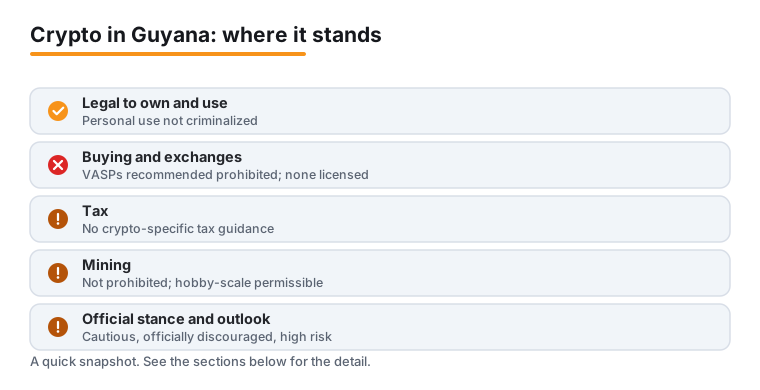
Owning and trading cryptocurrency as an individual is not specifically criminalized in Guyana. There is no statute that prohibits a private person from buying Bitcoin, holding it in a wallet, or trading it on an overseas platform. At the same time, crypto is not legal tender and has no official monetary status. Under Guyana's currency rules, only banknotes and coins issued by the Bank of Guyana are recognized as legal tender, so no business or person is obliged to accept Bitcoin in settlement of a debt.
The position is more restrictive when it comes to running a crypto business. A 2023 national risk assessment of virtual assets and VASPs, coordinated by Guyana's AML/CFT National Coordination Committee and the Financial Intelligence Unit, concluded that virtual assets and VASPs are not currently regulated in Guyana and recommended that such activities be prohibited until the country develops adequate technological infrastructure and supervisory mechanisms. That recommendation was then enacted. Section 72(1) of the Guyana Compliance Commission Act No. 14 of 2023 makes it an offence to conduct, as a business and on behalf of any other person, except where licensed under that Act, exchange between virtual assets and fiat currencies, exchange between forms of virtual assets, transfer of virtual assets, custody or administration of virtual assets, or financial services related to the issue or sale of a virtual asset. There is therefore no legal pathway today for a licensed domestic crypto exchange or custodian, even though casual personal use is not itself an offence. Treat crypto in Guyana as unregulated and officially discouraged, rather than freely permitted.
Who regulates crypto in Guyana?
No single agency holds a dedicated crypto mandate. Instead, several bodies share oversight of the financial system and have engaged with virtual assets:
- Bank of Guyana is the central bank. It has the sole right to issue notes and coins, which are the only legal tender in Guyana, and it supervises banks and payment systems.
- Financial Intelligence Unit (FIU) of Guyana leads anti-money-laundering and counter-terrorist-financing work and coordinated the 2023 virtual-assets risk assessment.
- Guyana Securities Council regulates securities and took part in the inter-agency working group on virtual assets.
- Guyana Revenue Authority (GRA) administers tax and customs.
The 2023 risk-assessment working group also drew in the Attorney General's Chambers, the Guyana Police Force's Special Organised Crime Unit, the Gaming Authority, and the Commercial and Deed Registry. Because oversight is spread across these bodies and no crypto-specific regulator exists, the safest course is to verify the current position directly with the Bank of Guyana and the Financial Intelligence Unit (Guyana).
Key laws and frameworks
Guyana has not passed a standalone cryptocurrency act. The most relevant legal anchor is the country's AML/CFT regime:
- Anti-Money Laundering and Countering the Financing of Terrorism (AML/CFT) Act, No. 13 of 2009, which replaced the earlier Money Laundering (Prevention) Act and has been amended several times.
- AML/CFT (Amendment) Acts of 2022 and 2023, which the FIU describes as bringing the framework into line with international standards. The 2023 amendment (Act No. 15 of 2023, published in the Official Gazette) designated virtual asset and VASP activity as activities subject to AML/CFT supervision.
- Bank of Guyana Act (Act No. 19 of 1998, Chapter 85:02), under which only Bank of Guyana notes and coins are legal tender.
Guyana is also a member of the Caribbean Financial Action Task Force (CFATF), the regional body that applies Financial Action Task Force (FATF) standards, including FATF Recommendation 15 on virtual assets. There is no equivalent of the EU's MiCA regulation in Guyana; the framework here is built on AML/CFT law and central-bank powers rather than a bespoke digital-asset regime. Because this area is evolving, confirm the current text of the law via the FIU's legislation pages before relying on it.
Licensing and registration of exchanges and VASPs
There is currently no licensing or registration regime that allows a virtual asset service provider, exchange, or custodian to be authorized to operate in Guyana. The 2023 national risk assessment explicitly recommended that VASPs be prohibited at this time, citing gaps in technological infrastructure and supervisory capacity, and rated the money-laundering and terrorist-financing risk of the virtual-asset sector as High. Drug trafficking and fraud were identified as the main predicate offences associated with the virtual-asset ecosystem in the local context. The assessment noted that no domestic virtual-asset business had been detected at the time, though it cited open-source reports of a Guyanese-linked crypto token project as a sign the sector was starting to touch the country.
The practical consequences are significant:
- No domestic exchange can be formally licensed, so platforms serving Guyanese users are based abroad and governed by foreign rules, not Guyanese ones.
- Because VASP activity is now within the scope of AML/CFT supervision, any entity that did offer such services would face customer due diligence, record-keeping, and suspicious-transaction reporting obligations under the AML/CFT Act.
- The prohibition is statutory rather than advisory, and it has a timeline attached. Section 72(3) of the Guyana Compliance Commission Act No. 14 of 2023 provided that no licence shall be issued under the Act for those activities on or before 31 December 2025, and Guyana told the 61st CFATF Plenary in November 2025 that the prohibition had been extended, although the amending instrument has not been published. A Virtual Assets Bill was named in the government's 2026 legislative programme on 6 February 2026 but does not appear on the Parliament of Guyana bill status list as at August 2026.
Crypto and Bitcoin tax in Guyana
Guyana has not published tax rules written specifically for cryptocurrency, and the Guyana Revenue Authority (GRA) has not issued dedicated crypto guidance. That does not mean crypto activity is automatically tax-free. Guyana taxes income derived from Guyana or elsewhere, and the general principles that apply to income, business profits, and gains can in principle extend to crypto-related earnings depending on the facts.
In practice, activities such as trading as a business, mining for profit, accepting crypto as payment for goods or services, or otherwise earning crypto income could create a tax obligation under existing law even though no crypto-specific category exists. There is no crypto-specific rate or return, but the default rates are published. Capital gains tax is charged at 20 per cent under section 12 of the Capital Gains Tax Act, Chapter 81:20. Gains not exceeding G$500,000 are exempt, as are gains on transactions carried out more than twenty five years after the asset was acquired. A gain received within twelve months after a change of ownership is deemed part of chargeable income for income tax instead, which for year of income 2024 was 28 per cent on the first G$2,400,000 and 40 per cent on the balance. Capital gains returns are submitted on or before April 30 each year. Keep clear records of every transaction (dates, amounts, counterparties, and values in Guyanese dollars), and confirm how your situation is treated with the Guyana Revenue Authority or a qualified local tax adviser. For background on how crypto is taxed in general, see our crypto taxes guide. This section is informational only and is not tax advice.
AML and KYC rules
Anti-money-laundering and know-your-customer obligations are the most concrete part of Guyana's approach to virtual assets. Under the AML/CFT Act, regulated reporting entities such as banks and money-transfer agents must verify customer identity, monitor transactions, keep records, and file suspicious-transaction reports and threshold transaction reports with the Financial Intelligence Unit. The 2023 amendment brought virtual asset and VASP activity within this supervisory perimeter.
For everyday users, the practical effect is felt at two points: the international exchanges and peer-to-peer platforms they use will apply their own KYC checks (typically a government ID and proof of address), and any local bank transfers connected to crypto can attract compliance questions, particularly for larger or frequent flows. Because the FIU rated the virtual-asset sector's laundering risk as High, scrutiny of crypto-linked transactions is more likely rather than less. The FIU publishes AML/CFT handbooks and guidelines for reporting entities on its website, which are the authoritative reference for these obligations.
Buying and using crypto in practice
Because no exchange is licensed domestically, Guyanese users generally rely on international platforms and peer-to-peer (P2P) marketplaces, and they do so at their own risk and under each platform's foreign rules. There is no Guyana-specific exchange rulebook, so users are bound by each platform's terms, identity-verification requirements, and supported funding methods.
A few realities shape the experience:
- Limited direct GYD support. The Guyanese dollar is rarely offered as a trading pair on major exchanges, so users often route through US dollars, stablecoins, bank cards, or P2P deals priced in local currency.
- Foreign-exchange and banking friction. Moving funds in and out via local banks can be subject to currency and compliance checks, which is part of why P2P trading has gained traction.
- Counterparty risk in P2P. Direct trades place more responsibility on the user to vet counterparties, use escrow where available, and avoid scams.
- No domestic recourse. If an overseas platform fails or funds are stolen, there is no Guyanese regulator or compensation scheme to turn to.
If you choose to participate, prioritize platforms with strong security and a credible track record, enable two-factor authentication, double-check wallet addresses because transfers are irreversible, and start with small amounts.
Mining crypto in Guyana
There is no Guyanese law that specifically prohibits cryptocurrency mining, so hobby-scale mining is generally treated as permissible by default. The absence of a dedicated rule is not the same as formal authorization, however, and anyone mining at scale should weigh several practical and regulatory factors:
- Electricity supply and cost. Mining is energy-intensive, and grid reliability and tariffs are major considerations; large operations could attract scrutiny over power consumption.
- Equipment importation. Bringing in mining hardware can involve customs duties and import procedures administered by the GRA.
- Business and tax obligations. Mining as a commercial venture may fall under general business, licensing, and tax rules even without crypto-specific legislation.
- AML and proceeds questions. Selling mined coins through exchanges will involve the same KYC and AML scrutiny as any other crypto activity.
Because the rules are not crypto-specific, anyone planning more than hobby-scale mining should seek guidance on electricity, import, and business-registration requirements before investing in equipment.
Recent developments (2023 to 2026)
The most consequential recent step was the 2023 national risk assessment of virtual assets and VASPs, published via the Financial Intelligence Unit, which rated the sector's money-laundering and terrorist-financing risk as High and recommended prohibiting VASPs until Guyana builds adequate infrastructure and supervision. In parallel, the AML/CFT (Amendment) Act 2023 designated virtual asset activity as subject to AML/CFT supervision, and the FIU has continued to publish updated AML/CFT handbooks and guidelines for reporting entities (including a March 2024 handbook) and its 2024 annual report.
Guyana also remains engaged with the Caribbean Financial Action Task Force (CFATF) follow-up process, which keeps pressure on the country to align with FATF standards on virtual assets over time. As at August 2026 there is still no licensing framework for crypto exchanges in Guyana. CFATF recorded that the Guyana Compliance Commission was not constituted at the time of the mutual evaluation and that no authority had been designated to monitor virtual asset activity. The Commission now has a board headed by Anil Beharry and eight approved staff, and the Attorney General said on 16 July 2026 that it should be fully operational before the CFATF conference in November 2026, adding that the government planned to establish an appropriate supervisory framework for virtual assets and virtual asset service providers. Because the picture can change, treat the prohibition as the current position rather than a permanent one, and check the FIU and Bank of Guyana sites for updates before acting.
The government has also spoken publicly. In February 2025, at the Guyana Energy Conference and Supply Chain Expo, Vice President Bharrat Jagdeo said the country is not ready to facilitate or regulate cryptocurrency and that the financial sector must first grow in complexity. Asked whether the government was considering crypto regulations, he answered, in his words, no, not at this time, while adding that crypto could be layered on in future once the appropriate safeguards are in place. In December 2025, in the context of a review of gold-sector smuggling, the FIU Director, Matthew Langevine, indicated the unit had not received specific reports of cryptocurrency being used in that trade for 2024, a reminder that domestic virtual-asset activity detected by authorities has so far been limited.
Consumer risks and protection
The defining feature for crypto users in Guyana is the lack of a safety net. With no dedicated crypto law, no licensed domestic platforms, and no crypto-specific consumer-protection regime, users operate without the recourse available in more developed regulatory environments. Specific risks include:
- Market volatility. Crypto assets can lose value rapidly, and there is no local cushion if they do.
- Scams and fraud. The FIU identified fraud as a leading offence in the virtual-asset space; guaranteed-return and investment schemes are common warning signs.
- Irreversibility. Crypto transfers cannot be reversed, so an error or a scam payment is typically unrecoverable.
- Platform and custody risk. If an overseas exchange fails or is hacked, there is no Guyanese authority to compensate you.
- Legal uncertainty. Because VASP activity is officially discouraged, future rules could change how crypto may be used, taxed, or accessed.
If you choose to hold crypto, treat it as high-risk, never invest money you cannot afford to lose, use strong security including a hardware wallet for larger holdings, and keep good records.
Official sources and how to verify
Because Guyana's position is set by general law, official statements, and an inter-agency risk assessment rather than a single crypto act, always verify the current rules at the primary sources before acting. The most authoritative references are:
- Bank of Guyana, the central bank, for legal tender, banking, and payments.
- Financial Intelligence Unit (Guyana), for AML/CFT law, guidelines, and the virtual-assets risk assessment.
- Guyana Revenue Authority, for tax and customs questions.
- Caribbean Financial Action Task Force (CFATF), for regional AML standards and Guyana's mutual-evaluation reports.
For wider context, see our crypto regulation overview and our regulation hub for other countries. This article is general information as of 2026 and is not legal, tax, or financial advice; rules can change and are often applied case by case, so confirm anything important with the named official regulators or a qualified Guyanese professional before acting.
August 2026 status update
This page was last reviewed on 30 June 2026. No Guyanese crypto statute changed between then and August 2026, but the underlying legal position needs restating more precisely than the page currently puts it, and three things moved during 2026.
- The ban on crypto businesses is a statute, not a recommendation. It is section 72 of the Guyana Compliance Commission Act No. 14 of 2023 and it carries criminal penalties. The provision is reproduced in the AML/CFT/PF National Coordination Committee public notice appended to the FIU virtual assets risk assessment and analysed at Recommendation 15 of the CFATF 4th Round Mutual Evaluation Report of Guyana.
- A Virtual Assets Bill entered the government's legislative programme. The Attorney General named it on Friday 6 February 2026 during the Budget 2026 debates, among more than 40 bills, per Kaieteur News and the Department of Public Information. It does not appear on the Parliament of Guyana bill status list, whose most recent entries are bills of 2025.
- The Guyana Compliance Commission began being stood up. CFATF recorded that it was not constituted at the time of the mutual evaluation. It now has a board headed by Anil Beharry, former director of the New Building Society, and eight approved staff, and the Attorney General said on 16 July 2026 that it should be fully operational before the CFATF conference in November 2026, per Demerara Waves.
- The Bank of Guyana has still issued no crypto circular or public warning. Its circulars page carries nothing on virtual assets and its most recent listed circulars date from 2017, and its legislation page lists no virtual asset instrument. The FIU circulars for 2025 and 2026 likewise carry nothing on virtual assets. The prohibition lives in the Compliance Commission Act, not in a central bank notice.
The law that actually bans crypto businesses: section 72
Guyana's 2023 virtual assets risk assessment did recommend prohibition, and Parliament enacted it. Section 72(1) of the Guyana Compliance Commission Act No. 14 of 2023 provides that no person shall, as a business, except where licensed under that Act, conduct in or from within Guyana on behalf of any other person any of the following.
- Negotiation, brokerage or exchange between virtual assets and fiat currencies, whether the legal tender of Guyana or any other country.
- Negotiation, brokerage or exchange between one or more forms of virtual assets.
- Transfer of virtual assets.
- Loan, deposit, custody, safekeeping, management or administration of virtual assets, or of instruments enabling control over virtual assets.
- Participation in and provision of financial services related to the issuance, or an issuer's offer or sale, of a virtual asset.
Section 72(3) provided that no licence shall be issued under the Act for any of those activities on or before the 31st day of December 2025. Anyone already carrying on such a business when the Act commenced had to notify within one month and cease within three months. The penalties recorded in the CFATF Mutual Evaluation Report are as follows.
| Breach | Penalty on indictment |
|---|---|
| Failure to notify pre-existing virtual asset activity, section 72(4) to (6) | Fine not exceeding GY$25,000,000, or 5 years imprisonment, or both |
| Failure to cease virtual asset activity within three months of commencement, section 72(4) to (6) | Fine of GY$50,000,000, or 5 years imprisonment, or both |
| A reporting entity engaging in virtual asset or VASP activity, section 45 | Fine of GY$10,000,000 to GY$50,000,000, or 5 years imprisonment, or both |
Two points matter for an ordinary user. First, the prohibition is written around conducting the activity as a business on behalf of another person, which is why personal buying, holding and trading on an overseas platform is not caught by it. Second, CFATF rated Guyana Partially Compliant with FATF Recommendation 15, recording that the Guyana Compliance Commission was not constituted by the end of the onsite visit, that no authority had been designated to monitor, and that there is no clear offence or sanction for a person found carrying out VASP activity without a licence beyond three months after commencement. The gap in enforcement machinery is real, but it is not permission.
What is coming, and roughly when
Guyana has an announced bill, a regulator being stood up, and two fixed international review dates. It does not yet have published draft legislative text.
| Item | Stage as at August 2026 | Timing |
|---|---|---|
| Virtual Assets Bill | Announced only, named by the Attorney General in the Budget 2026 debates on 6 February 2026. No draft text published, not on the Parliament of Guyana bill status list. | No date stated by government |
| Guyana Compliance Commission | Board appointed, headed by Anil Beharry; eight staff approved; being operationalised first for designated non-financial businesses and professions | Attorney General said on 16 July 2026 it should be fully operational before November 2026 |
| Strategy for the Implementation of the Recommendations of the VA/VASP Risk Assessment for Guyana | Developed September 2023 following the risk assessment, with three strategic objectives: protecting the public; preparation of the legislative and policy framework; and practical evolution of the AML/CFT systems to encapsulate virtual assets and VASPs | Runs 2023 to 2028 |
| CFATF follow-up report on Guyana | Scheduled | November 2026 |
| CFATF re-rating assessment of Guyana | Scheduled | November 2027 |
The CFATF dates are stated by the Ministry of Legal Affairs following the 62nd CFATF Plenary held in Port of Spain from 24 to 28 May 2026. In practice the November 2026 follow-up report is the next moment at which Guyana has to say on the record what it has done about virtual assets, which is also why the Compliance Commission is being pushed to be operational before it.
The tax that applies when there is no crypto tax rule
The Guyana Revenue Authority has published no crypto guidance, so the default asset and income rules apply. Those rules do have published rates.
- Capital gains tax is charged at 20 per cent. Section 12 of the Capital Gains Tax Act, Chapter 81:20 provides that, subject to section 8, capital gains tax shall be charged upon the net chargeable capital gain of any person for each year of assessment at the rate of twenty per cent.
- Gains not exceeding G$500,000 are exempt, and so are gains on transactions carried out more than twenty five years after the asset was acquired, per the GRA capital gains page.
- A gain received within twelve months after a change of ownership is not capital gains tax at all. The GRA states it is deemed part of chargeable income for income tax purposes and would not be subject to capital gains tax. Short holding periods therefore fall on the income side, which is where most active crypto trading would sit.
- Income tax rates, for the most recent year the GRA publishes, being year of income 2024 and year of assessment 2025, are 28 per cent on the first G$2,400,000 of chargeable income and 40 per cent on the balance, with a personal allowance of G$1,200,000. See the GRA rates and thresholds table.
- Capital gains returns are submitted on or before April 30 of each year.
Guyana's own tax authority told the 2023 risk assessment working group that it is not equipped to adequately recover taxes related to crypto currency, but that based on the Income Tax Act such activities would be taxable in the framework of the law in Guyana. The same assessment records the GRA saying current tax laws do not specifically address virtual assets and will need to be updated in future. In other words the liability exists even though the collection machinery does not. Keep records in Guyanese dollars and confirm your position with the GRA or a qualified local adviser. This is information, not tax advice.
Frequently asked questions
Is cryptocurrency legal in Guyana?
Personal use of cryptocurrency is not specifically criminalized in Guyana, but crypto is not legal tender and has no formal legal status; only banknotes and coins issued by the Bank of Guyana are legal tender. Running a crypto business is more restricted: a 2023 national risk assessment led by the Financial Intelligence Unit recommended prohibiting virtual asset service providers for now, so there is no licensed domestic exchange. Verify the current position with the Bank of Guyana and the FIU before acting.
Who regulates cryptocurrency in Guyana?
No single agency has a dedicated crypto mandate. Oversight is shared among the Bank of Guyana (the central bank), the Financial Intelligence Unit (which leads AML/CFT work and produced the 2023 virtual-assets risk assessment), the Guyana Securities Council, and the Guyana Revenue Authority for tax. The 2023 inter-agency working group also included the Attorney General's Chambers and the police's Special Organised Crime Unit.
Can crypto exchanges be licensed in Guyana?
No. As of 2026 there is no licensing or registration regime allowing a virtual asset service provider, exchange, or custodian to operate in Guyana, and the 2023 national risk assessment recommended prohibiting VASPs until the country develops adequate infrastructure and supervision. Platforms serving Guyanese users are based abroad and governed by foreign rules. This stance was framed as temporary, so confirm the current status with the FIU before assuming any service is permitted.
Do I have to pay tax on crypto in Guyana?
Guyana has no crypto-specific tax rules, and the Guyana Revenue Authority has not published dedicated crypto guidance. However, general principles for income, business profits, and gains can in principle apply to crypto-related earnings depending on the circumstances, so trading as a business, mining for profit, or being paid in crypto could create a tax obligation. Keep detailed records and consult the GRA or a qualified local tax adviser. This is not tax advice.
What AML and KYC rules apply to crypto in Guyana?
Guyana's AML/CFT Act requires regulated entities such as banks and money-transfer agents to verify customer identity, monitor transactions, keep records, and report suspicious and threshold transactions to the Financial Intelligence Unit. The 2023 amendment brought virtual asset activity within this supervisory scope. In practice, international exchanges apply their own KYC checks and local bank transfers linked to crypto can attract compliance scrutiny, since the FIU rated the sector's laundering risk as High.
Is Bitcoin mining allowed in Guyana?
There is no law specifically prohibiting crypto mining, so hobby-scale mining is generally treated as permissible. Larger operations should weigh electricity reliability and cost, customs procedures for importing hardware, general business and tax obligations, and the AML and KYC scrutiny that applies when selling mined coins through exchanges. Seek guidance on electricity, import, and business-registration requirements before investing in equipment.
Has the Guyana government said anything about crypto recently?
Yes. In February 2025, at the Guyana Energy Conference and Supply Chain Expo, Vice President Bharrat Jagdeo said Guyana is not ready to facilitate or regulate cryptocurrency at this time and that the financial sector must first grow in complexity, though he did not rule out crypto in future if the right safeguards are put in place. The official position through 2026 remains cautious, and the VASP prohibition recommended in the 2023 risk assessment still stands. Check the FIU and Bank of Guyana sites for any update before acting.
How do people in Guyana buy crypto if no exchange is licensed?
Because no exchange is licensed to operate domestically, Guyanese users rely on international platforms and peer-to-peer (P2P) marketplaces governed by foreign rules rather than Guyanese ones. The Guyanese dollar is rarely offered as a direct trading pair, so people often route through US dollars, stablecoins, bank cards, or P2P deals priced in local currency. Local bank transfers linked to crypto can attract compliance questions, and there is no Guyanese regulator or compensation scheme to turn to if a platform fails or funds are stolen, so treat this as high-risk and confirm the current rules with the FIU before acting.
Is it a crime to run a crypto exchange in Guyana?
Yes. Section 72(1) of the Guyana Compliance Commission Act No. 14 of 2023 makes it an offence to conduct, as a business and on behalf of any other person, crypto to fiat exchange, crypto to crypto exchange, transfer of virtual assets, custody or administration of virtual assets, or financial services related to issuing or selling a virtual asset, except where licensed under that Act. Section 72(3) provided that no licence would be issued under the Act for those activities on or before 31 December 2025. Penalties recorded by CFATF run to fines of GY$25,000,000 for failing to notify pre-existing activity and GY$50,000,000 for failing to cease it, each with up to 5 years imprisonment, and a reporting entity such as a bank that engages in virtual asset activity faces GY$10,000,000 to GY$50,000,000 or 5 years. Buying and holding crypto for yourself is not what this section addresses.
Is a crypto law coming in Guyana, and when?
A Virtual Assets Bill was named by Attorney General Anil Nandlall on Friday 6 February 2026 during the Budget 2026 debates, as one of more than 40 bills in the 2026 legislative programme. No draft text has been published, no timetable has been stated, and the bill does not appear on the Parliament of Guyana bill status list, whose most recent entries are bills of 2025. Separately, on 16 July 2026 the Attorney General said the government planned to establish a supervisory framework for virtual assets and virtual asset service providers. The next fixed milestone is Guyana's CFATF follow-up report in November 2026, with re-ratings expected in November 2027.
What tax rate applies if I sell crypto at a profit in Guyana?
There is no crypto-specific rule, so the general rules apply. Capital gains tax is 20 per cent under section 12 of the Capital Gains Tax Act, Chapter 81:20. Gains not exceeding G$500,000 are exempt, and so are gains on transactions carried out more than twenty five years after the asset was acquired. If the gain is received within twelve months after a change of ownership, the Guyana Revenue Authority deems it part of chargeable income for income tax instead, which for year of income 2024 was 28 per cent on the first G$2,400,000 of chargeable income and 40 per cent on the balance. Capital gains returns are submitted on or before April 30 each year. The GRA told Guyana's 2023 virtual assets risk assessment that it is not equipped to adequately recover taxes related to crypto currency, but that based on the Income Tax Act such activities would be taxable in the framework of the law in Guyana.
Who would license crypto firms in Guyana if the rules change?
Section 72 of the Guyana Compliance Commission Act No. 14 of 2023 frames the prohibition around not being licensed under that Act, and CFATF records that persons already carrying on virtual asset activity had to notify the Guyana Compliance Commission, so the Commission is the body under whose Act any licence would issue. No supervisor has actually been designated, however. CFATF found that the Commission was not constituted by the end of its onsite visit and that no authority had been designated to monitor, which is one reason Guyana was rated only Partially Compliant with FATF Recommendation 15. The FIU risk assessment itself records that respondents were of the opinion that either the Guyana Securities Council or the Bank of Guyana could be the best AML/CFT supervisory authority for virtual asset activity. The Commission's board was appointed during 2026, headed by Anil Beharry, with eight staff approved, and it is being operationalised first for designated non-financial businesses and professions such as lawyers, accountants, auto dealers and pawnbrokers.
Facts reviewed: 13 August 2026. Page updated: 13 August 2026.