Home › Crypto Regulation › Equatorial Guinea
Bitcoin & Cryptocurrency Regulation in Equatorial Guinea
Quick answer — Equatorial Guinea, 2026
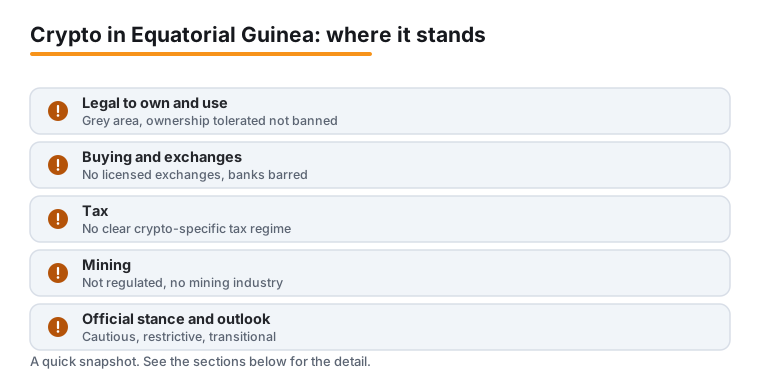
- Legal: Owning not illegal, not legal tender, institutions barred, grey area
- Tax: No crypto-specific tax; general rules apply, company tax 25%, personal income up to 25%
- Buying: No local licensed exchange, use international platforms and P2P
Equatorial Guinea is a small, oil-rich Central African nation whose monetary and financial rules are mostly set at the regional level rather than in Malabo alone. As a member of the Economic and Monetary Community of Central Africa (CEMAC), it shares the Central African CFA franc (XAF) and answers to common institutions: the Bank of Central African States (BEAC) for monetary policy, the Central African Banking Commission (COBAC) for bank supervision, and the Central African Financial Market Supervisory Commission (COSUMAF) for capital-market and virtual-asset oversight. As a result, the question "is crypto legal in Equatorial Guinea?" is largely answered at the CEMAC level.
As of 2026, there is no published Equatorial Guinean law that makes simply owning Bitcoin a crime for an individual, but there is also no framework that treats crypto as money or as a protected financial product locally. CEMAC rules bar banks and licensed payment providers from handling crypto, and the regional securities regulator has warned the public that crypto-asset offerings are not authorised. A separate regional regulation, Regulation No. 01/22/CEMAC/UMAC/CM/COSUMAF of 21 July 2022, sets out a licensing path for crypto platforms through COSUMAF, and the COSUMAF General Regulation of 23 May 2023 fills in the application procedure at Articles 336 to 343. The result is a cautious, transitional environment. This page explains the current legal status, who regulates what, taxation, AML/KYC, how people buy and move crypto in practice, and the main risks. It is general information as of 2026 and is NOT legal, tax, or financial advice; always verify specifics with the named official regulators (BEAC, COBAC, COSUMAF) and a qualified local professional before acting. For broader context see our guide to crypto regulation.
On this page: Legal status · Who regulates it · Taxes · How to buy · Mining
Is Bitcoin and crypto legal in Equatorial Guinea?
There is no published Equatorial Guinean statute that explicitly bans individuals from buying, holding, or using Bitcoin and other cryptocurrencies. In that narrow sense, personal ownership is not illegal. However, crypto is not legal tender, is not recognised as official money, and is not a regulated investment product inside the country. The only legal tender is the Central African CFA franc (XAF), issued by the BEAC.
The more important constraint comes from CEMAC-wide rules. The Central African Banking Commission (COBAC) prohibits banks, microfinance institutions, and licensed payment service providers from facilitating cryptocurrency transactions, holding crypto for their own account, or converting crypto on behalf of clients. Separately, COSUMAF has publicly warned that crypto-asset offerings to the public are not authorised in the CEMAC region. So while a private individual is not committing an offence simply by owning Bitcoin, the formal financial system in Equatorial Guinea is largely walled off from crypto, which pushes activity toward peer-to-peer trades, foreign platforms, and informal channels.
The net picture for 2026 is best described as a legal grey area: tolerated at the individual level, restricted at the institutional level, and still evolving. Anyone treating crypto as a settled, fully legal financial instrument in Equatorial Guinea is overstating the situation. Verify the current position with the regulators listed below.
Who regulates crypto in Equatorial Guinea?
Because Equatorial Guinea belongs to CEMAC, oversight comes mainly from regional bodies rather than a single national crypto agency. The three institutions that matter are:
- BEAC (Bank of Central African States) is the regional central bank that issues the CFA franc and sets monetary and foreign-exchange policy across the six CEMAC states. It has consistently prioritised protecting the CFA franc and monetary sovereignty over accommodating private digital currencies, and is headquartered in Yaounde, Cameroon. Official site: BEAC.
- COBAC (Central African Banking Commission) supervises banks and microfinance institutions and issued the directive barring those institutions from dealing in crypto. It is based in Libreville, Gabon, and operates under the BEAC umbrella.
- COSUMAF (Central African Financial Market Supervisory Commission) is the regional securities-style regulator that oversees the unified capital market and virtual assets, also based in Libreville. It publishes the public warnings on crypto-asset offerings and the regulation defining Virtual Asset Service Providers. Official site: COSUMAF.
Equatorial Guinea does not have a separate, standalone national crypto regulator. Domestic ministries (such as the finance ministry) apply national tax and company rules, but the substantive crypto rules flow from these CEMAC institutions. When you need an authoritative answer, the BEAC and COSUMAF are the primary references.
Key laws and regulatory frameworks
Equatorial Guinea has no standalone national crypto act; the controlling rules are CEMAC instruments. The most relevant are:
- COBAC Decision D-2022/071 of 6 May 2022, recorded as still in force in the November 2024 GABAC mutual evaluation, prohibits banks, microfinance institutions, and payment service providers from subscribing to or holding cryptocurrencies for themselves or third parties, and from exchanging, converting, or settling crypto-related transactions. Institutions must refuse such transactions and report rejected ones.
- COSUMAF Regulation No. 01/22/CEMAC/UMAC/COSUMAF is the updated financial-market regulation that introduced provisions on blockchain, token offerings (ICOs), virtual assets, and Virtual Asset Service Providers (VASPs). It defines a token as an intangible asset representing rights in digital form, transferable via blockchain, and sets out, in principle, an approval pathway for VASPs through COSUMAF.
- COSUMAF public warnings on crypto-asset offerings state that crypto-asset activity in the CEMAC space is not currently subject to regulatory authorisation, that no provider may lawfully offer such services to the public, and that public solicitation can expose promoters to legal proceedings.
This creates a two-track reality: traditional financial institutions are kept away from crypto, while a licensing path for dedicated platforms exists on paper but is not yet a developed, openly operating regime in Equatorial Guinea. The GABAC mutual evaluation adopted on 22 November 2024 found this framework virtually inoperative in the absence of COSUMAF implementing instructions, and rated Equatorial Guinea Non-Compliant with FATF Recommendation 15 on new technologies and virtual assets. The first implementing text to bite on crypto firms arrived on 15 December 2025 as COSUMAF Instruction No. 46-25, circulated on 19 February 2026, which requires prior COSUMAF approval of the directors of digital asset service providers and gave existing management until 19 May 2026 to comply.
Licensing and registration of exchanges and VASPs
There is no large, locally licensed crypto exchange headquartered in Equatorial Guinea that operates the way regulated exchanges do in major markets. At the regional level, COSUMAF Regulation No. 01/22 contemplates that an entity wishing to operate as a Virtual Asset Service Provider, such as a platform buying and selling virtual assets, providing custody, or running a trading venue, would need approval from COSUMAF, COSUMAF adopted ten Instructions on 5 December 2023 setting out the terms and conditions for the approval of financial market intermediaries, and Articles 341 to 343 of its General Regulation of 23 May 2023 set the application procedure, giving COSUMAF sixty working days from receipt of a complete file to process a digital asset service provider application.
In practice, however, COSUMAF has simultaneously warned that crypto-asset offerings to the public are not currently authorised, and COBAC bars the banking system from facilitating crypto. So the licensing pathway is best understood as a framework on paper rather than a fully active register of approved local crypto exchanges. As of 2026 there is no public, well-documented roster of COSUMAF-licensed crypto exchanges operating openly to retail users in Equatorial Guinea.
If you are a business considering offering crypto services in or into Equatorial Guinea, do not assume you can operate freely. Confirm the current authorisation requirements and whether any approvals have actually been granted directly with COSUMAF before launching, and seek qualified local legal counsel. For how licensing fits into the wider picture, see our crypto regulation hub.
Crypto taxation in Equatorial Guinea
There is no clear, publicly documented crypto-specific tax regime for Equatorial Guinea, and this page does not state any crypto tax rate or threshold because none is reliably verified. That absence does not mean activity is automatically tax-free: the general national rules are the starting point. Corporate income tax is 25% and capital gains are subject to it, with a minimum income tax of 1.5% of turnover payable on 15 July and 15 January. Personal income tax is progressive from 0% on the first XAF 1,400,000 to 25% above XAF 15,000,000, and value added tax is 15% standard with a 5% reduced rate. These rates are published by PwC Worldwide Tax Summaries and were last reviewed on 21 November 2025.
Because the position is unsettled and crypto is not formally recognised, the safest approach is to keep complete records of every transaction (dates, amounts, counterparties, and CFA-franc values at the time) and to obtain advice from a qualified local tax professional and the relevant tax authority before assuming any treatment. Do not rely on generic international crypto tax articles, which do not reflect Equatorial Guinea or the CEMAC zone. For general concepts, see our crypto taxes guide, then confirm specifics locally.
AML and KYC rules
Anti-money-laundering (AML) and know-your-customer (KYC) obligations in Equatorial Guinea come from Regulation No. 02/24/CEMAC/UMAC/CM, adopted at Libreville on 20 December 2024 and in force on signature, which repealed the Regulation No. 01/CEMAC/UMAC/CM of 11 April 2016. Article 6(e) lists virtual or digital asset service providers among the reporting entities, and Article 42 forbids engaging in the professional activity of a virtual asset service provider without prior approval from the competent authority of the state concerned, requires enhanced vigilance where the threshold for occasional transactions exceeds 500,000 CFA francs, and makes originator and beneficiary information travel with virtual asset transfers. The COBAC directive that bars banks and payment providers from crypto activity is itself partly an AML and financial-stability measure: institutions must refuse crypto-related transactions and report attempts.
For individuals, the most practical AML/KYC touchpoint is the foreign platform you use. Reputable international exchanges enforce identity verification and AML screening regardless of local ambiguity, so expect to provide identity documents and proof of address. Using crypto does not exempt anyone from CEMAC foreign-exchange controls or AML rules: moving value across the CEMAC border can engage reporting and exchange-control requirements, and structuring transactions to evade those rules carries legal risk.
Because crypto sits in a grey area locally, informal P2P and unlicensed intermediaries are common, and these often lack proper AML controls, which raises both fraud and compliance risk. Favour platforms with strong, documented compliance, keep records, and avoid counterparties who ask you to bypass identity checks.
Buying and using crypto in practice
There is no large, locally licensed crypto exchange in Equatorial Guinea, so most residents who buy crypto rely on international platforms and peer-to-peer (P2P) methods, where buyers and sellers match directly and settle through mobile money, cash, or transfers. The practical realities to keep in mind:
- Banks are restricted. Domestic banks and licensed payment providers are barred from facilitating crypto transactions, so funding a purchase through a local bank card or account can be unreliable or blocked.
- Foreign-exchange controls apply. CEMAC operates relatively strict rules on moving CFA francs and foreign currency in and out of the zone, and crypto purchases that effectively move value across borders can intersect with these rules.
- KYC still matters. Reputable international exchanges enforce identity verification regardless of local ambiguity.
- The last mile is hard. Converting crypto back into spendable CFA francs typically happens through P2P trades or informal channels, since the banking system is restricted.
A typical cautious approach: choose a reputable platform with a strong security record, complete identity verification, decide between exchange custody and self-custody, fund via P2P escrow where available, and always test small amounts first before committing larger sums. Use strong passwords and two-factor authentication, back up recovery phrases offline, and keep transaction records. None of this is a recommendation to transact; it is a general description of how the process tends to work in a market with restricted banking access.
Crypto mining in Equatorial Guinea
Cryptocurrency mining is not a significant or specifically regulated activity in Equatorial Guinea, and there is no published national mining-specific law. There is no indication of a meaningful domestic mining industry, and the country lacks the cheap surplus power, cooling, and data-centre infrastructure that drive mining hubs elsewhere. The economy is heavily oriented toward oil and gas rather than digital-asset infrastructure.
In principle, the same constraints that affect other crypto activity would apply to anyone mining: crypto is not legal tender, banks are restricted from converting it, and converting any mined coins into CFA francs would face the same banking and foreign-exchange frictions described above. Anyone considering mining should also account for electricity availability and cost, import rules for hardware, and the unsettled legal status. Because there is no clear local framework, confirm the position with the relevant authorities before investing in equipment.
Recent developments (2024 to 2026)
The most concrete regional signals are institutional rather than retail. At the first CEMAC fintech forum in Douala in late January 2024, BEAC officials reaffirmed opposition to regulating private cryptocurrencies, citing the risk that crypto purchases drain the zone's foreign-exchange reserves and weaken the CFA franc. BEAC has instead signalled a preference for a sovereign, CFA-franc-pegged digital currency (a central bank digital currency, or CBDC) for the CEMAC zone, and has worked with international partners, including the IMF, on a sub-regional approach aimed at preserving monetary sovereignty over private stablecoins.
In May 2026, at an international conference on crypto-assets organised by the West African central bank (BCEAO), BEAC Governor Yvon Sana Bangui restated this position, framing a digital CFA franc pegged one-to-one to the CFA franc as a matter of monetary sovereignty and a response to the risk that dollar-backed private stablecoins could pull hard currency out of the zone. Officials have linked this concern to the region's reserves position: CEMAC's foreign-exchange reserves stood at an estimated 11.3 billion US dollars at the end of 2024, equal to about 4.2 months of imports, below the roughly five-month level the IMF generally recommends.
At the same time, the BEAC, COBAC, and COSUMAF have held capacity-building work to prepare a harmonised crypto-asset regulatory framework for the region, culminating in a seminar in Yaounde from 23 to 27 February 2026 organised by BEAC with the IMF, attended by COBAC, COSUMAF and GABAC and joined by Financial Stability Board specialists, which covered crypto-asset typologies and risks, central bank digital currency design, stablecoins, financial stability and AML/CFT integrity, and was described as preparing the adaptation of the sub-regional legal corpus. No timetable was announced. As of August 2026 no harmonised CEMAC crypto-asset regulation has been published, and the practical status for Equatorial Guinea remained the restrictive, transitional regime described above. Earlier reports of a standalone Equatorial Guinean national digital currency should be read in this regional context: any official digital currency affecting the country is far more likely to emerge through BEAC at the CEMAC level than as an independent national project. Treat any specific date or framework name as provisional until confirmed against official BEAC and COSUMAF publications.
Consumer risks and protection
The defining risks in Equatorial Guinea are regulatory and infrastructural rather than purely market-based, and there is very little domestic protection if something goes wrong:
- No local investor protection. Crypto is not a regulated investment product, so there is no domestic compensation scheme or supervisory recourse if a platform fails or a counterparty disappears.
- No authorised local providers. COSUMAF has warned that crypto-asset offerings to the public are not authorised, so anyone marketing a local crypto investment or guaranteed-return scheme is operating outside the recognised framework and may be acting unlawfully.
- Fraud is a real hazard. Fake exchanges, bogus investment managers promising fixed returns, impersonation scams, and fake Bitcoin ATM or cash-out services are common where formal infrastructure is thin. There is no established Bitcoin ATM network in the country.
- Universal crypto risks apply. Price volatility, irreversible transactions, and custody errors can all cause permanent loss.
Protect yourself by treating any guaranteed return as a red flag, verifying providers independently, never sending funds to counterparties who ask you to skip identity checks, using self-custody best practices, and never committing money you cannot afford to lose. Consult a qualified professional about your own situation.
Official sources and how to verify
Because the rules are regional and still evolving, always confirm the current position against primary sources rather than third-party summaries. The authoritative references for Equatorial Guinea are the CEMAC institutions:
- Bank of Central African States (BEAC) for monetary policy, the CFA franc, foreign-exchange rules, and digital-currency plans.
- COSUMAF (Central African Financial Market Supervisory Commission) for the financial-market regulation, VASP provisions, and public warnings on crypto-asset offerings.
- CEMAC (Economic and Monetary Community of Central Africa) for the regional legal and institutional framework, including COBAC.
When verifying, look for the specific regulation or decision text (for example COBAC's 2022 decision and COSUMAF Regulation No. 01/22) and check the publication date, since the framework is being harmonised. For domestic tax and company questions, contact Equatorial Guinea's tax authority and a qualified local professional. This page is general information as of 2026 and is NOT legal, tax, or financial advice; verify with the named official regulators before acting. You can also browse our country regulation overviews for comparison.
What is changing (August 2026)
The position for an individual holder is unchanged. The legal scaffolding around it has moved, and every moving piece is a CEMAC instrument rather than an Equatorial Guinean one.
- A new regional anti-money-laundering regulation is in force. Regulation No. 02/24/CEMAC/UMAC/CM was adopted in extraordinary session at Libreville on 20 December 2024, enters into force on the date of signature under Article 184, and repeals the Regulation No. 01/CEMAC/UMAC/CM of 11 April 2016 that previously governed this area. It names virtual or digital asset service providers as reporting entities and sets specific duties for them.
- COSUMAF has begun issuing implementing rules that bind crypto firms directly. Instruction No. 46-25 of 15 December 2025, circulated by Lettre circulaire No. 001-2026 of 19 February 2026, requires prior approval of directors and senior managers of supervised entities and names digital asset service providers expressly among them. Existing directors had to be regularised within three months, by 19 May 2026, and the processing fee is 250,000 CFA francs (4M Legal and Tax; Droit, Medias et Finance).
- There is still no harmonised CEMAC crypto-asset regulation. BEAC and the IMF held a seminar in Yaounde from 23 to 27 February 2026, attended by COBAC, COSUMAF and GABAC and joined by Financial Stability Board specialists, to prepare the adaptation of the sub-regional legal corpus. No timetable was announced (GABAC; report of the seminar).
- Equatorial Guinea is not on the FATF grey list. It does not appear anywhere in the FATF statement on jurisdictions under increased monitoring of 19 June 2026, although its CEMAC neighbours Cameroon and the Democratic Republic of the Congo are listed.
What the CEMAC anti-money-laundering rules now say about crypto
Regulation No. 02/24/CEMAC/UMAC/CM of 20 December 2024 is the first place where crypto obligations applying in Equatorial Guinea are written out in an instrument that applies directly, rather than inferred from a banking prohibition.
- Article 6(e) lists virtual or digital asset service providers among the persons subject to anti-money-laundering and counter-terrorist-financing obligations. The same list covers financial authorities, the BEAC, financial institutions, trust and company service providers, money and value transfer companies, and casinos and gaming establishments.
- Article 42, headed Specific measures for virtual asset service providers, provides that no one may engage in the professional activity of a virtual asset service provider unless they have obtained prior approval or authorisation from the competent authority of the State in whose territory they are to carry out their activity. The same rule applies to anyone acting as an agent on the territory of a CEMAC member state.
- Enhanced due diligence threshold. Article 42 provides that where the threshold for occasional transactions exceeds 500,000 CFA francs, providers must take enhanced vigilance measures.
- Transfer information duties. For virtual asset transfers, the originator's provider must obtain and keep accurate information on the originator and the required information on the beneficiary and pass it to the beneficiary's provider, which has the mirror obligation. The same duties apply to financial institutions sending or receiving a virtual asset transfer for a customer.
- Who the competent authority is. The mutual evaluation states that Equatorial Guinea has entrusted COSUMAF with responsibility for virtual assets, and that COSUMAF is responsible for controlling and monitoring any VASPs (mutual evaluation report).
Two things follow for a reader. An unlicensed operator soliciting business in Equatorial Guinea is now in breach of a named provision, not just outside a framework. And the foreign exchange regime is expressly preserved: Regulation 02/24 states that foreign exchange transactions, capital movements and settlements of any kind between a resident and a non-resident must be carried out in strict compliance with the foreign exchange regulations in force, which are set by Regulation No. 02/18/CEMAC/UMAC/CM of 21 December 2018.
The licensing pipeline: what a crypto business actually faces
The route to a lawful crypto business serving Equatorial Guinea runs through COSUMAF in Libreville. The steps are documented.
- Legal basis. Regulation No. 01/22/CEMAC/UMAC/CM/COSUMAF, adopted 21 July 2022 and effective 1 August 2022, defines a token at Article 76, requires COSUMAF approval to act as a digital asset service provider at Article 144, and lists the permitted services at Article 160: custody for third parties, purchase against legal tender or other digital assets, operating a trading platform, order transmission, portfolio management, advice and placement (analysis of the regulation).
- Application mechanics. Articles 336 to 343 of the COSUMAF General Regulation of 23 May 2023 set the operating conditions and the procedure. Article 341 requires a written application with the file described in Article 338, Article 342 requires COSUMAF first to take the opinion of an independent expert in digital asset operations, and Article 343 gives COSUMAF sixty working days from receipt of a complete file to process it.
- Director approval. Since Instruction No. 46-25 of 15 December 2025, senior managers must themselves be approved before taking office: a clean criminal record in every country of residence over the last ten years, at least a Master's degree in law, finance or economics or equivalent recognised certification, at least ten years of professional experience including five on financial markets, and a 250,000 CFA franc processing fee. An appointment made without approval is legally inoperative.
- Who is in the queue. COSUMAF met market participants at its Libreville headquarters on 25 July 2025 and launched a census of digital asset service providers operating in the CEMAC zone, saying the first licence applications were already under examination and would be assessed on the competence and integrity of directors, AML/CFT compliance, client asset protection, personal data protection, information system security and risk control mechanisms (COSUMAF consultation, July 2025). Yellow Card had begun talks with COSUMAF and was registering a dedicated subsidiary in Libreville to cover all six member states, with no official approval calendar communicated (EcoMatin, 26 June 2025).
- Licences granted. As of 27 June 2025, no digital asset licence had been issued anywhere in CEMAC despite the May 2023 general regulation (ActuCameroun). This page could not verify the position after that date. Treat any platform claiming CEMAC authorisation as unverified until COSUMAF confirms it, and note that COSUMAF publishes approval and withdrawal decisions on its website and in legal gazettes.
What tax actually applies to a crypto gain
There is no crypto-specific tax rule in Equatorial Guinea and no published crypto rate. That does not mean a gain is untaxed: the default rules for company profits and personal income are the ones a tax adviser would start from. The figures below are the general rates published by PwC Worldwide Tax Summaries, last reviewed 21 November 2025.
| Tax | Rate | What it applies to |
|---|---|---|
| Corporate income tax | 25% | Taxable profits. Capital gains are subject to corporate income tax (income determination) |
| Minimum income tax | 1.5% of turnover | An advance payment of corporate income tax, due 15 July and 15 January (corporate income tax) |
| Personal income tax | 0% up to XAF 1,400,000; 10% to XAF 5,000,000; 15% to XAF 10,000,000; 20% to XAF 15,000,000; 25% above XAF 15,000,000 | Residents on worldwide income, non-residents on Equatorial Guinea source income (personal income tax) |
| Value added tax | 15% standard, 5% reduced, 0% on a listed set | Supplies of goods and services. The 5% rate covers a limited list of basic consumables and books (other taxes) |
| Withholding tax | 10% on services, 15% on dividends and interest | Paid to non-residents. The withholding tax paid by non-residents is a final tax (withholding taxes) |
Filing dates matter as much as rates: corporate returns must be filed within the first six months of the year following the taxable fiscal year, and payment is due within 15 days following the filing date (tax administration). The published summary for individuals sets out employment income and does not state a capital gains rule for private individuals, so an individual selling crypto at a profit has no published rate to point to and should get local advice rather than assume either taxation or exemption.
How Equatorial Guinea rates on the international AML review
Equatorial Guinea's anti-money-laundering system was assessed by GABAC, the FATF-style regional body for Central Africa. The report was adopted during an extraordinary plenary session of the GABAC Technical Committee in Libreville on 22 November 2024 (full report; GABAC evaluation reports). Its crypto findings are unusually direct.
- Rated Non-Compliant with Recommendation 15, the FATF standard on new technologies and virtual assets. The evaluators concluded that the framework for supervising VASPs, in particular the COSUMAF General Regulation of 23 May 2023, was virtually inoperative in the absence of a more precise framework, notably COSUMAF instructions setting out implementing measures.
- The country has not legislated on virtual assets. The report states that the country has not legislated on the use of virtual assets and VASP operations, and that the team noted there are no formal virtual asset service providers.
- Weighted as a low-materiality sector. In weighting its assessment of supervision, the evaluation placed virtual asset service providers in the low weighting group, alongside insurance, real estate agents, precious metals and stones companies, microfinance institutions and notaries.
- Fraud is the observed harm. The report records reports of scams and thefts from the country's citizens through a virtual asset platform based outside Equatorial Guinea, and notes that there seems to be some mistrust of online VASPs as a result. It is the one crypto experience the evaluators documented in the country.
- Read the date carefully. The evaluation assessed Equatorial Guinea against the CEMAC regulation of 11 April 2016. It was adopted on 22 November 2024, four weeks before Regulation No. 02/24 replaced that text, so the Recommendation 15 rating does not take the new Article 42 into account.
- Grey list status. Equatorial Guinea does not appear on the FATF list of jurisdictions under increased monitoring published on 19 June 2026. Cameroon and the Democratic Republic of the Congo, both in the region, are listed.
Frequently asked questions
Is owning Bitcoin illegal in Equatorial Guinea?
No published law makes personal ownership of Bitcoin a crime, so holding crypto as an individual is not illegal. However, crypto is not legal tender or a regulated product, CEMAC rules bar banks and licensed payment providers from facilitating crypto transactions, and COSUMAF warns that crypto-asset offerings to the public are not authorised. The practical status is a grey area: tolerated for individuals, restricted for institutions. Confirm current rules with the BEAC and COSUMAF before acting.
Who regulates cryptocurrency in Equatorial Guinea?
Oversight comes mainly from CEMAC regional bodies rather than a single national agency: the Bank of Central African States (BEAC) for monetary policy and the CFA franc, the Central African Banking Commission (COBAC) for banks and microfinance, and the Central African Financial Market Supervisory Commission (COSUMAF) for the capital market and Virtual Asset Service Providers. COSUMAF's regional regulation sets out the licensing path for crypto platforms, and its public warnings cover crypto-asset offerings.
Are crypto exchanges licensed in Equatorial Guinea?
There is no large, locally licensed crypto exchange in the country. COSUMAF Regulation No. 01/22 contemplates approval for Virtual Asset Service Providers, but COSUMAF has also warned that crypto-asset offerings to the public are not currently authorised, and banks are barred from facilitating crypto. So the licensing pathway exists mainly on paper, and there is no public roster of openly operating COSUMAF-licensed crypto exchanges. Businesses should confirm requirements directly with COSUMAF before operating.
How is crypto taxed in Equatorial Guinea?
There is no crypto-specific tax regime and no published crypto tax rate for Equatorial Guinea. The general rules are the starting point: corporate income tax is 25% and capital gains are subject to it, the minimum income tax is 1.5% of turnover, personal income tax runs from 0% on the first XAF 1,400,000 to 25% above XAF 15,000,000, and value added tax is 15%. The published tax summaries set out employment income for individuals and do not state a capital gains rule for private individuals. Because the position is unclear, keep full records and consult a qualified local tax professional and the tax authority to understand your obligations.
Can banks in Equatorial Guinea handle cryptocurrency?
No. Under the CEMAC framework, the Central African Banking Commission (COBAC) prohibits banks, microfinance institutions, and licensed payment service providers from holding, exchanging, converting, or settling cryptocurrency transactions for themselves or clients, and requires them to refuse and report such transactions. In practice this means you generally cannot fund or cash out crypto through the formal local banking system, which pushes activity toward peer-to-peer and foreign platforms.
Are there Bitcoin ATMs in Equatorial Guinea?
No. There is no established Bitcoin ATM network in Equatorial Guinea, and public trackers do not list active machines there. Residents generally use international exchange apps and peer-to-peer trades instead. Be cautious of any service claiming to offer a local crypto ATM or guaranteed cash-out kiosk, and verify it independently before sending funds, as misrepresented or fraudulent operations are a known risk.
Is Equatorial Guinea getting a digital currency or crypto framework soon?
Any official digital currency affecting Equatorial Guinea is most likely to come through the BEAC at the CEMAC level rather than as a national project. The BEAC is working on a sovereign digital CFA franc pegged one-to-one to the CFA franc, and in May 2026 its governor, Yvon Sana Bangui, restated this as a monetary-sovereignty priority and a response to dollar-backed private stablecoins. Separately, BEAC and the IMF brought COBAC, COSUMAF and GABAC together in Yaounde from 23 to 27 February 2026 to prepare the adaptation of the sub-regional legal corpus to digital currencies and crypto-assets. No timetable was announced, and as of August 2026 no harmonised CEMAC crypto-asset regulation has been published. What has actually been adopted is narrower: Regulation No. 02/24/CEMAC/UMAC/CM of 20 December 2024 on money laundering, which requires prior approval to act as a virtual asset service provider, and COSUMAF Instruction No. 46-25 of 15 December 2025 on the approval of directors, with a 19 May 2026 compliance deadline.
Does the new CEMAC anti-money-laundering regulation cover cryptocurrency?
Yes. Regulation No. 02/24/CEMAC/UMAC/CM, adopted at Libreville on 20 December 2024 and in force from the date of signature, replaced the regulation of 11 April 2016. Article 6(e) lists virtual or digital asset service providers among the businesses subject to anti-money-laundering obligations, and Article 42 says no one may engage in that activity without prior approval or authorisation from the competent authority of the state where the activity is carried out. Where the threshold for occasional transactions exceeds 500,000 CFA francs, enhanced vigilance applies, and providers must pass originator and beneficiary information along with virtual asset transfers. It applies directly in Equatorial Guinea.
Do I need a licence to run a crypto exchange serving Equatorial Guinea?
Yes, and you apply to COSUMAF in Libreville, not to any authority in Malabo. Article 144 of the CEMAC regulation of 21 July 2022 requires COSUMAF approval to act as a digital asset service provider, and Articles 336 to 343 of the COSUMAF General Regulation of 23 May 2023 set the conditions and procedure, with sixty working days for COSUMAF to process a complete file. Since Instruction No. 46-25 of 15 December 2025 your directors must be separately approved before taking office, with a processing fee of 250,000 CFA francs and a deadline of 19 May 2026 for regularising existing management. Reporting from June 2025 said no such licence had been issued anywhere in CEMAC, and this page could not verify the position after that date.
Is Equatorial Guinea on the FATF grey list?
No. Equatorial Guinea does not appear on the FATF list of jurisdictions under increased monitoring published on 19 June 2026, although Cameroon and the Democratic Republic of the Congo, both in the region, are on it. That said, its GABAC mutual evaluation adopted on 22 November 2024 rated the country Non-Compliant with FATF Recommendation 15, the standard covering new technologies and virtual assets, because the supervision framework had no implementing rules at that time.
What tax would I pay on a crypto profit in Equatorial Guinea?
There is no crypto-specific rate. For a company, corporate income tax is 25% and capital gains are subject to it, with a minimum income tax of 1.5% of turnover paid on 15 July and 15 January. For an individual, personal income tax is progressive from 0% on the first XAF 1,400,000 up to 25% above XAF 15,000,000, and residents are taxed on worldwide income. The published tax summaries do not state a capital gains rule for private individuals, so take local advice rather than assuming either that a gain is taxed or that it is exempt. These rates were last reviewed on 21 November 2025.
Has any crypto platform been authorised in the CEMAC zone?
No approval had been publicly announced when this page was last checked. COSUMAF met market participants in Libreville on 25 July 2025 and launched a census of digital asset service providers operating in the zone, saying the first applications were already under examination and would be judged on the competence and integrity of directors, anti-money-laundering compliance, client asset protection, personal data protection, information system security and risk controls. Yellow Card had begun talks with COSUMAF and was registering a Libreville subsidiary to serve all six member states, with no approval calendar communicated. Treat any platform claiming CEMAC authorisation as unverified until COSUMAF confirms it.
Facts reviewed: 13 August 2026. Page updated: 13 August 2026.