Home › Crypto Regulation › Micronesia
Bitcoin & Cryptocurrency Regulation in Micronesia
Quick answer — Micronesia, 2026
- Legal: Legal to hold but unregulated, not legal tender
- Tax: No crypto-specific guidance, wages paid in crypto are taxed under Title 54 section 121 (6 percent on the first $11,000, 10 percent above it) and business trading revenue under section 141 ($80 on the first $10,000 plus 3 percent of the excess), with no capital gains tax on a private sale
- Buying: No local exchange, use international platforms via KYC
The Federated States of Micronesia (FSM) is a small Pacific island nation of four states (Yap, Chuuk, Pohnpei and Kosrae) with a population of roughly 100,000 spread across hundreds of islands. It uses the US dollar as its official currency, a legacy of its close relationship with the United States under the Compact of Free Association. As of 2026, the FSM has no cryptocurrency-specific legislation. Bitcoin and other digital assets are neither formally banned nor formally regulated as money, which leaves them governed by four named statutes: the FSM Bank Act of 1980 at Title 29 of the FSM Code, the money laundering and proceeds of crime provisions at Title 11 Chapter 9, the wages, salaries and gross revenue taxes at Title 54 Chapter 1, and the Foreign Investment Act of 1997 at 32 FSMC Chapter 2.
This page explains what is currently known about owning, buying, using and earning crypto in Micronesia, who regulates the financial sector, and the practical realities of a remote, dollarized economy. It is general information as of 2026 and is NOT legal, tax or financial advice; the FSM framework can change, and anyone transacting should verify the current position with the named official regulator (the Banking Board of the FSM) or a qualified local professional. For wider context see our guide to crypto regulation and the full country regulation index.
On this page: Legal status · Who regulates it · Taxes · How to buy · Mining
Is Bitcoin and crypto legal in Micronesia?
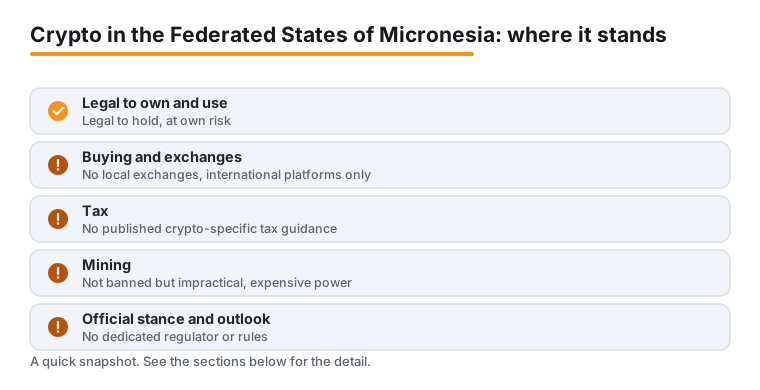
There is no law in the Federated States of Micronesia that prohibits individuals from owning, buying or selling Bitcoin or other cryptocurrencies. At the same time, there is no statute that recognizes crypto as legal tender or as a regulated financial instrument. In practice this means digital assets occupy an unregulated space: holding or trading them is not illegal, but it also carries none of the consumer protections that apply to bank deposits or licensed financial products.
The official and only legal tender in the FSM is the US dollar. Crypto cannot be used to settle taxes or government obligations and is not guaranteed by any authority. Because no FSM-specific crypto framework has been enacted, activity still runs into section 104(1) of the Bank Act of 1980, which bars any person from engaging in the business of accepting deposits or using the term bank without a Banking Board licence, and into Title 11 Chapter 9, which requires identity verification, records of every transaction exceeding $10,000, and suspicious transaction reports to the FSM Department of Justice no later than three working days after forming the suspicion. The absence of a dedicated framework was restated in the US State Department 2025 Investment Climate Statement for the FSM, which noted that as of May 2025 the country did not have any digital-focused laws or regulations. Treat crypto in Micronesia as legal to hold but entirely at your own risk, and verify the position before transacting in any commercial context.
Who regulates crypto in Micronesia?
No FSM authority regulates cryptocurrency specifically. The institutions most relevant to any crypto-related activity are the general financial-sector and fiscal bodies:
- Banking Board of the FSM is the national body that licenses and supervises banks, protects depositors, and promotes the soundness and stability of the banking system. It operates under the Bank Act of 1980 (as amended), codified in Title 29 of the FSM Code, and is headquartered in Kolonia, Pohnpei. A Banking Commissioner, appointed by the President and required to have recognized experience in banking and financial matters, acts as its chief executive. See the Banking Board of the FSM.
- FSM Department of Finance and Administration (DoFA) handles tax administration and broader fiscal policy through its Division of Customs and Tax Administration. See the FSM Department of Finance and Administration.
Because the FSM has both national and state-level legislation, rules can differ between Yap, Chuuk, Pohnpei and Kosrae. None of these bodies currently issues crypto-specific licences or guidance, so the absence of a dedicated regulator is itself one of the most important facts for anyone using crypto here. The FSM should not be confused with neighbouring Pacific nations such as the Marshall Islands or Palau, which are separate countries that have pursued their own distinct digital-asset initiatives that do not apply in the FSM.
Key laws and frameworks
The FSM does not have a dedicated digital-asset law, a licensing regime for exchanges or wallet providers, or a virtual-asset-service-provider (VASP) framework. Instead, several general statutes form the backdrop against which crypto activity is assessed:
- Bank Act of 1980 (Title 29 of the FSM Code) governs the licensing and supervision of banks and underpins the Banking Board.
- Title 54 of the FSM Code (Taxation and Customs) sets out the income, wages-and-salary and gross-revenue taxes administered by DoFA.
- Title 11, Chapter 9 of the FSM Code (Money Laundering and Proceeds of Crime) provides the criminal anti-money-laundering framework and confiscation powers.
You can read the statutes themselves on the FSM Code at fsmlaw.org. Internationally, the FSM takes part in the Asia/Pacific Group on Money Laundering (APG) as an observer, the regional body that promotes implementation of Financial Action Task Force (FATF) standards. The FATF standard known as Recommendation 15 extends AML/CFT obligations to virtual assets and VASPs, so any such rules would still have to be enacted by the FSM Congress, and as of August 2026 no bill of either kind has been introduced: the 24th Congress bill index runs to CB 24-193 and the public law series reached PL 24-111, with nothing on digital assets, virtual assets, blockchain or tokens. As of 2026 no such crypto-specific implementing law has been enacted, and the US State Department's 2025 review of the FSM likewise found no digital-focused laws or regulations in place.
Licensing and registration of exchanges
There is no domestically licensed cryptocurrency exchange in the FSM and no statutory regime that authorizes, registers or prohibits crypto exchanges, brokers or custodians. Unlike jurisdictions with a VASP registration requirement, the FSM has not created one, so operating or using an exchange is neither licensed nor expressly forbidden.
Residents who buy crypto therefore rely on international platforms accessed online. Those platforms apply their own know-your-customer (KYC) checks and geographic-availability rules, and some may not accept FSM-based customers at all. Anyone using an exchange should confirm that it genuinely serves FSM users, understand its withdrawal and custody arrangements, and recognize that no local regulator will license, audit or assist if the platform fails or funds are lost. A business in the FSM that handles crypto-to-cash flows could still fall within general banking, money-transmission or AML expectations even without a crypto-specific licence, so legal advice is sensible before launching such a service.
Crypto and Bitcoin tax in Micronesia
The FSM levies taxes under Title 54 of the FSM Code, administered through DoFA's Division of Customs and Tax Administration. The national tax system centres on a wages-and-salary tax on employees and a gross-revenue tax on businesses, rather than the broad capital-gains regime seen in larger economies. There is no published guidance that specifically addresses the taxation of cryptocurrency gains, mining income or crypto received as payment.
The absence of explicit guidance does not necessarily mean crypto activity is tax-free. Income earned in connection with a business, or wages paid in crypto, falls within the gross revenue tax at Title 54 section 141 when it is earned through trade or business, and within the wages and salaries tax at section 121 when it is paid as compensation for personal services. Neither reaches a private individual's gain on selling an asset, because Title 54 Chapter 1 contains no capital gains tax. No crypto-specific rate or threshold exists, so the figures above are the general Title 54 rates for wages and for business gross revenue rather than crypto rules. Anyone with material crypto income or gains in the FSM should obtain advice from DoFA or a qualified local tax professional rather than assuming a position. For general background see our crypto tax guide. This is not tax advice.
AML and KYC rules
The FSM has a general anti-money-laundering and counter-terrorist-financing (AML/CFT) framework grounded in Title 11, Chapter 9 of the FSM Code (Money Laundering and Proceeds of Crime), and it takes part as an observer in the Asia/Pacific Group on Money Laundering. These obligations apply to the formal financial sector, principally banks supervised by the Banking Board. There is, however, no crypto-specific AML rule, no FSM VASP registration, and no requirement directed at crypto businesses as such, because none has been enacted.
In practice, KYC and identity checks reach FSM crypto users mainly through the international exchanges they use, which verify identity and may file their own suspicious-activity reports under the laws of their home jurisdictions. Any FSM business converting crypto to or from cash will meet the FSM's actual anti-money-laundering rules through its bank, which must verify customer identity under section 913 of Title 11 Chapter 9, keep records of every transaction exceeding $10,000 under section 914(1)(a), and report suspicious transactions to the FSM Department of Justice no later than three working days after forming the suspicion under section 915(1) even though no crypto-specific obligation has been spelled out. Because de-risking has reduced Pacific banks' correspondent relationships, financial institutions in the region tend to be cautious about crypto-linked flows.
Buying and using crypto in practice
Because the FSM is dollarized, there is no local-currency conversion step, which removes one common friction point. In practice, though, the barriers are significant. The commercial banks operating in the FSM, including the Bank of Guam and the Bank of the Federated States of Micronesia, are conservative institutions, and card- or transfer-based funding of crypto purchases may be limited or declined. International platforms apply their own KYC and availability checks and may not serve FSM residents.
A typical cautious approach for someone who has confirmed the legal and tax position: choose a reputable international exchange that explicitly accepts FSM customers and read its terms on availability and withdrawals; complete identity verification, which normally requires a government-issued ID and proof of address; fund the account in US dollars where permitted and be prepared for a local bank to decline crypto-related transactions; buy a small amount first to confirm the full process works end to end, including selling and withdrawing; secure holdings with a strong unique password, two-factor authentication, and, for larger amounts, a self-custody hardware or software wallet so you control your private keys; and keep records of purchases, sales and transfers for any future tax or compliance need. Plan the cash-out path before you buy, because converting crypto back into spendable US dollars is the weakest link given the FSM's limited local infrastructure. There is no public evidence of any Bitcoin ATMs operating in the FSM, and major crypto-ATM tracking services do not list machines there.
Bitcoin mining in Micronesia
Bitcoin mining is not specifically regulated or banned in the FSM, but the practical barriers are substantial. Electricity in the islands is largely generated from imported diesel fuel, which makes power both expensive and carbon-intensive, the opposite of the cheap, abundant energy that large-scale mining requires. Grid capacity is limited, and reliability varies between and within the four states.
Some commentary highlights renewable microgrids (localized solar or hybrid systems that can run independently of a central grid) as a theoretical way to power small mining operations more sustainably. While microgrids are a genuine and useful technology for improving energy resilience on remote islands, dedicating scarce local renewable capacity to crypto mining remains speculative for the FSM and would compete directly with the more pressing goal of electrifying communities. Geographic remoteness, hardware import costs, cooling needs in a tropical climate and a shortage of specialized technical labour all weigh against mining as a realistic activity here. Anyone considering it should also check whether commercial electricity use of this kind would trigger business, customs or environmental obligations.
Crypto remittances in Micronesia
Remittances matter in the FSM: many citizens work in the United States, Guam and elsewhere and send money home, while foreign workers in the FSM remit funds abroad. Today this flow is dominated by traditional money-transfer operators such as Western Union and MoneyGram, alongside bank channels. These services are familiar and widely accessible but can be slow and carry meaningful fees, especially for smaller transfers. A regional concern is the decline in correspondent banking relationships across the Pacific, which the Pacific Islands Forum and the World Bank have been addressing through a Pacific correspondent-banking project that became effective in 2025.
In principle, Bitcoin and stablecoins can move value across borders quickly and at low network cost, which is why crypto remittances are often discussed for dollarized Pacific economies. In reality, the model only works if both sender and recipient can reliably convert between crypto and usable US dollars. In the FSM that final step is the weak link: limited exchange access, sparse cash-out options and patchy connectivity on outer islands mean crypto is not yet a practical mainstream remittance tool. It may suit technically comfortable individuals on a person-to-person basis, but most families will find established operators more dependable. Anyone using crypto should account for exchange spreads, network fees and price volatility between sending and cashing out.
Recent developments (2025-2026)
As of 2026, there has been no enactment of a crypto-specific law, exchange-licensing regime or VASP framework in the FSM, and the Banking Board and DoFA have not published dedicated crypto guidance. The US State Department's 2025 Investment Climate Statement for the FSM reinforced this picture, noting that as of May 2025 the country had no digital-focused laws or regulations, and observing that the weak digital regulatory environment leaves few legal protections against cybercrime. The most relevant recent activity is indirect rather than crypto-focused. Across the Pacific, correspondent banking relationships have fallen sharply since 2011, and in response the Pacific Islands Forum, the World Bank and development partners launched a multi-country Strengthening Correspondent Banking Relationships Project. That project, funded at about US$77 million and covering several Pacific countries, was approved by the World Bank Board in late August 2024 and became effective in April 2025, with a project management unit operating from Suva.
For the FSM specifically, near-term policy priorities centre on financial inclusion, banking access and resilient infrastructure rather than building a bespoke crypto regime. Any future movement on digital assets would have to start as a bill in Congress, and none has been introduced through CB 24-193 as of August 2026. The only revenue reform actually moving is the Net Profits Tax and Value Added Tax package, which finished nationwide consultations on 23 December 2025 and has not yet reached Congress. The realistic outlook for now is continued informal tolerance without formal endorsement. Because this can change, confirm the current position with the official sources named below before acting.
Consumer risks and protection
The central risk in the FSM is the regulatory vacuum. Operating in an unregulated space means no licensing standards, no investor-compensation scheme, no local consumer protection and no local dispute resolution, plus the constant possibility that new rules could change the landscape with little notice. Layered on top are the usual crypto risks (price volatility, scams and phishing, exchange failure and irreversible transactions) amplified by remoteness, limited connectivity, low local crypto literacy and reliance on foreign platforms over which no FSM regulator has authority. The US State Department has also flagged that the FSM's limited digital regulation leaves few legal protections against cybercrime, which is a relevant backdrop for anyone holding assets online.
Crypto assets are highly volatile, can lose value rapidly and are not protected by any FSM authority. The general principles that apply everywhere apply here: only use funds you can afford to lose, understand the technology and custody risks, treat crypto as a speculative holding rather than a savings substitute, and be especially wary of anyone promising guaranteed returns. If a dispute arises with an overseas platform, recourse will depend on that platform's home-country rules, not on any FSM body. This page is informational only and is not financial advice; consider speaking to a qualified adviser before committing money.
Official sources and how to verify
Because the FSM has no crypto-specific regulator or law, the most reliable way to confirm the current position is to go to the primary government sources rather than secondary summaries:
- Banking Board of the FSM for banking supervision, the Bank Act of 1980 and any financial-sector guidance.
- FSM Department of Finance and Administration for tax administration and Title 54 customs and tax matters.
- FSM Code at fsmlaw.org for the actual statutory text, including Title 11 (Money Laundering and Proceeds of Crime), Title 29 (banking) and Title 54 (taxation).
For comparison across jurisdictions, see our country regulation index and our guide to crypto regulation. This page is general information as of 2026 and is NOT legal advice; verify the current rules with the Banking Board of the FSM, DoFA or a qualified local professional before acting.
Micronesia crypto status, August 2026
Nothing about the legal position has changed since this page was last reviewed on 30 June 2026. The Federated States of Micronesia still has no crypto-specific law. The published bill index of the 24th Congress, which runs to CB 24-193, contains no measure on digital assets, virtual assets, blockchain or tokens, and the public law index shows none either. In an announcement published on 7 August 2026, the FSM government reported that President Simina had completed action on legislation transmitted by the Twenty-Fourth Congress following its Third Special Session, taking the public law series to PL 24-111. The measures listed were supplemental appropriations, fund reallocations and amendments to previously enacted public laws. None concerned digital assets.
So the answer to the question most readers arrive with is yes, crypto is legal in Micronesia, by default rather than by design. Buying, holding and selling are not prohibited, and crypto is not legal tender. The national currency is the US dollar, and the Banking Board licenses exactly two commercial banks: the Bank of Guam, a foreign bank domiciled or incorporated in Guam, and the Bank of the Federated States of Micronesia. Both are insured by the US FDIC. Money transfer services, credit unions, insurance companies and the FSM Development Bank fall outside Banking Board supervision because they do not meet the Title 29 definition of banking business.
Two dated facts set the context. In the Banking Board's published system update, deposits stood at $491.4 million as of 31 March 2026, lending to the commercial private sector was 9.16 percent of the deposit base, and over $398.4 million of surplus liquidity was invested offshore in low-yielding assets. Separately, the nearest thing to official engagement with digital finance this year was the national finance conference Vice President Aren B. Palik opened in Kosrae on 24 July 2026, whose agenda listed emerging financial technologies alongside budget planning, fiscal policy and audit and compliance. No policy, paper or announcement on digital assets came out of it.
The named laws that apply instead of a crypto law
There is no crypto-specific statute in the FSM. Said once, that is the whole of it. Here is what governs crypto activity instead, by name and section.
| Law | What it requires | Where crypto sits |
|---|---|---|
| FSM Bank Act of 1980, Title 29 FSM Code, from PL 1-94 (chapter 1, chapter 2) | Section 104(1) bars any person from engaging in the business of accepting deposits, or using the terms bank or savings and loan association, without a licence. Section 104(2) bars a licensee from any business other than banking business. Section 201, in chapter 2, establishes a Banking Board of three members appointed by the President with the advice and consent of Congress. | No mention of digital assets or virtual currency anywhere in the Act. The Board licenses no crypto business and has published no crypto guidance, circular or warning. |
| Money laundering and proceeds of crime, Title 11 Chapter 9 FSM Code (text) | Section 912 gives the FSM Department of Justice primary enforcement authority. Section 913 requires customer identity verification against an official record. Section 914(1)(a) requires records of all transactions exceeding $10,000. Section 915(1) requires suspicious transaction reports to the Department of Justice no later than three working days after forming the suspicion. | Section 903 defines currency as coin and paper money designated as legal tender, so crypto is not currency here. There is no virtual asset service provider category. The cash dealer list covers insurers, securities dealers, futures brokers, bullion dealers, money order issuers, casinos and unit trust managers, and stops there. |
| Taxation of wages, salaries and gross revenues, Title 54 Chapter 1 FSM Code (text) | Section 121 taxes wages and salaries. Section 141 taxes gross revenue. Section 143 sets quarterly filing. | The chapter contains no capital gains tax and no general income tax on investment gains. Rates are set out in the next section. |
| Foreign Investment Act of 1997, 32 FSMC Chapter 2, from PL 10-49 (text) | Section 204 requires a valid Foreign Investment Permit before a noncitizen engages in business in the FSM. Section 207 places national permits with the Secretary of the Department of Resources and Development. Section 220 sets the penalties. | Applies to a foreign owned exchange, ATM operator, custodian or mining venture exactly as it applies to any other foreign business. |
The named regulator is the Banking Board of the FSM, whose Banking Commissioner and chief executive officer is Mr. Jesse Giltamag, per the Board's own page. The Board's published list of the statutes it works from names only the Banking Act, the Consumer Protection Act, the Anti-Money Laundering Act, the Secured Transaction Act and the Bankruptcy and Insolvency Act. No FSM body publishes a mandate to license or supervise a crypto exchange.
Crypto tax in Micronesia, and the reform that could change it
Title 54, Chapter 1 of the FSM Code taxes two things and only two things: wages and salaries, and gross revenue. There is no capital gains tax and no provision taxing a gain on the disposal of an asset.
- Wages and salaries, section 121: six percent upon the first $11,000 and ten percent upon the amount over the first $11,000. If you are paid in crypto for employment, that compensation sits inside the section 112(11) definition, which reaches commissions, fees, bonuses and every other kind of compensation paid for personal services performed as an employee.
- Gross revenue, section 141: $80 per year where gross revenue does not exceed $10,000, plus three percent per year on the amount above $10,000. Businesses earning gross revenues of not more than $2,000 per year are exempt. Section 112(5) defines gross revenue as gross receipts, cash or accrued, derived from trade, business, commerce or sales, so a business trading crypto is taxed on turnover rather than profit.
- Filing, section 143: gross revenue returns are quarterly, due on or before 30 April, 31 July, 31 October and 31 January.
- A private individual who buys crypto and later sells it at a gain is reached by neither tax on the face of the statute, because the gain is neither wages nor gross receipts from trade or business. Treat that as the statutory default and not as a confirmed position: the FSM has published no crypto tax ruling or guidance of any kind.
The one reform that would change this picture is the National Tax Reform Task Force, chaired by Vice President Aren B. Palik, which proposes a Net Profits Tax and a Value Added Tax to replace a number of existing taxes. The Task Force wrapped up consultations across Kosrae, Chuuk, Pohnpei and Yap on 23 December 2025 and said feedback would be reviewed and used to shape final recommendations. No implementation date or timeline has been published, and no Net Profits Tax or Value Added Tax bill appears in the 24th Congress bill index as of August 2026, so nothing is yet before legislators. If it is enacted as described, the practical effect for anyone trading crypto commercially is that tax would attach to profit instead of gross receipts.
Running a crypto business from Micronesia
- A noncitizen needs a Foreign Investment Permit under section 204 of the Foreign Investment Act of 1997 before conducting any activity that amounts to engaging in business in the FSM. The Secretary of the Department of Resources and Development issues the national permit under section 207, and section 208 provides for State Foreign Investment Permits under state legislation.
- Under section 220, breach carries a monetary fine of up to $10,000 or imprisonment of up to 12 months, or both, for an individual, and a fine of up to $50,000 for a legal entity, along with possible forfeiture of assets or property rights.
- There is no licence to apply for as a crypto exchange, custodian or ATM operator. The Banking Board's licensing power under section 104 of the Bank Act covers deposit taking, and the Board's published list of the statutes it works from is the Banking Act (29 FSMC), the Consumer Protection Act (34 FSMC), the Anti-Money Laundering Act (11 FSMC), the Secured Transaction Act (Chapter 10, 33 FSMC) and the Bankruptcy and Insolvency Act (31 FSMC). None of them mentions digital assets.
- AML exposure still reaches an FSM based operator through its bank. Financial institutions and cash dealers must verify identity, keep records of every transaction exceeding $10,000, and report suspicious transactions to the FSM Department of Justice no later than three working days after forming the suspicion, under sections 913 to 915 of Title 11 Chapter 9.
Frequently asked questions
Is Bitcoin legal in the Federated States of Micronesia?
Yes, in the sense that no law bans owning or trading it. However, crypto is not legal tender and is not specifically regulated, so it carries no official protections. The only legal currency in the FSM is the US dollar.
Who regulates cryptocurrency in Micronesia?
No authority regulates crypto specifically. The Banking Board of the FSM oversees banks under the Bank Act of 1980 (Title 29 of the FSM Code), and the Department of Finance and Administration handles tax. General financial and anti-money-laundering rules under Title 11 of the FSM Code may apply to crypto-related activity.
Do I need a licence to run a crypto exchange in Micronesia?
There is no FSM crypto-exchange or virtual-asset-service-provider licensing regime, so there is no crypto-specific licence to obtain. That said, a business handling crypto-to-cash flows could still fall within general banking, money-transmission or AML expectations, so seek legal advice from a qualified local professional before launching such a service.
Do I have to pay tax on crypto in Micronesia?
There is no published crypto-specific tax guidance. Depending on the circumstances, crypto income could fall under the existing wages-and-salary or gross-revenue tax categories under Title 54 of the FSM Code. No verified rates exist, so confirm your position with the Department of Finance and Administration or a qualified local tax adviser.
Are there Bitcoin ATMs in Micronesia?
There is no public evidence of any crypto ATMs operating in the FSM, and major tracking services do not list machines there. Bank ATMs dispense US dollars, and cash access can be limited on outer islands, so buying or selling crypto generally requires an online exchange and a supporting bank account.
Can I send remittances to Micronesia using Bitcoin?
It is technically possible, but limited local cash-out options, exchange access and connectivity make it impractical for most people. Traditional services such as Western Union and MoneyGram still handle the majority of remittances to and from the FSM.
Does the FSM have any crypto or digital-asset laws in 2026?
No. As of 2026 the FSM has not enacted a cryptocurrency law, an exchange-licensing regime or a virtual-asset-service-provider framework. The US State Department's 2025 Investment Climate Statement for the FSM likewise noted that the country had no digital-focused laws or regulations as of May 2025.
Is crypto safe to use in Micronesia given the lack of regulation?
There is no local consumer protection, compensation scheme or dispute-resolution body for crypto in the FSM, so any loss from an exchange failure, scam or mistaken transfer would fall on you. The State Department has also noted that limited digital regulation leaves few legal protections against cybercrime. Use only funds you can afford to lose and keep strong security on any online accounts.
Is crypto legal in Micronesia in August 2026?
Yes, by default. Nothing in FSM law prohibits buying, holding or selling cryptocurrency, and as of August 2026 the 24th Congress has passed no crypto law: the published bill index runs to CB 24-193 and the public law series reached PL 24-111, reported in a government announcement published on 7 August 2026, without a single measure on digital assets, virtual assets, blockchain or tokens. Crypto is not legal tender. The national currency is the US dollar.
Do I pay tax on crypto gains in Micronesia?
Title 54, Chapter 1 of the FSM Code taxes only two things: wages and salaries at six percent on the first $11,000 and ten percent above it (section 121), and gross revenue at $80 where revenue does not exceed $10,000 plus three percent of the excess, with businesses earning not more than $2,000 exempt (section 141). There is no capital gains tax and no general income tax on investment gains, so on the face of the statute a private individual's sale is not taxed. If you trade as a business you are taxed on gross receipts rather than profit, and returns are quarterly, due on or before 30 April, 31 July, 31 October and 31 January. The FSM has published no crypto tax guidance, so treat this as the statutory default rather than a confirmed official position.
Who regulates crypto in Micronesia?
No one does. The Banking Board of the FSM, whose Banking Commissioner and chief executive officer is Mr. Jesse Giltamag, licenses banks only under section 104 of the Bank Act of 1980, and it supervises two: the Bank of Guam and the Bank of the Federated States of Micronesia. The Board's published list of the statutes it works from covers banking, consumer protection, anti-money laundering, secured transactions and bankruptcy, and none of them mentions digital assets. The Banking Board has published no crypto guidance, circular or warning.
Is a crypto law coming to Micronesia, and when?
Not as of August 2026. No digital asset bill has been introduced in the 24th Congress. The only revenue reform in the national pipeline is the National Tax Reform Task Force's proposal for a Net Profits Tax and a Value Added Tax to replace a number of existing taxes. It is chaired by Vice President Aren B. Palik and wrapped up consultations across all four states on 23 December 2025. No implementation date or timeline has been published and no NPT or VAT bill has reached Congress yet.
Does Micronesia's anti-money laundering law cover crypto?
Not by name. Title 11, Chapter 9 of the FSM Code defines currency as the coin and paper money of the FSM or a foreign country designated as legal tender, so crypto is not currency for its purposes, and the chapter creates no virtual asset service provider category. Its cash dealer list covers insurers, securities dealers, futures brokers, bullion dealers, money order issuers, casinos and unit trust managers. FSM banks must still verify customer identity (section 913), keep records of transactions exceeding $10,000 (section 914(1)(a)) and report suspicious transactions to the FSM Department of Justice no later than three working days after forming the suspicion (section 915(1)), which is where a crypto user's transfers are actually screened.
Can a foreigner set up a crypto exchange or mining operation in Micronesia?
There is no crypto licence to obtain, but the Foreign Investment Act of 1997 (32 FSMC Chapter 2, from PL 10-49) applies. Section 204 bars a noncitizen from conducting any activity amounting to engaging in business in the FSM without a valid Foreign Investment Permit; the Secretary of the Department of Resources and Development issues national permits under section 207, and section 208 provides for state permits. Section 220 sets a fine of up to $10,000 or up to 12 months imprisonment, or both, for an individual, or up to $50,000 for a legal entity, plus possible forfeiture of assets.
Facts reviewed: 13 August 2026. Page updated: 13 August 2026.