Home › Crypto Regulation › Solomon Islands
Bitcoin & Cryptocurrency Regulation in Solomon Islands
Quick answer — Solomon Islands, 2026
- Legal: Legal but unregulated, no legal-tender status
- Tax: No crypto-specific tax, general income and business rules may apply
- Buying: No licensed local exchanges, international platforms or P2P
The Solomon Islands has no dedicated cryptocurrency law. Buying, holding and trading Bitcoin and other digital assets is not illegal, but it sits in a regulatory grey area: crypto is not issued, regulated or backed by the authorities, and it carries no legal-tender status. The Central Bank of Solomon Islands (CBSI) has publicly warned that cryptocurrencies are unregulated, risky and speculative, while at the same time piloting its own digital version of the national currency, Bokolo Cash. This guide explains the current 2026 legal status, the regulators involved, the laws that touch crypto, how tax and anti-money-laundering rules apply in practice, and what to know about buying, mining and using crypto. It is general information as of 2026 and is not legal, tax or financial advice; always verify your situation with the named official regulator, the CBSI, and a qualified local professional. For background, see our guide to crypto regulation.
On this page: Legal status · Who regulates it · Taxes · How to buy · Mining
Legal status of Bitcoin and crypto in the Solomon Islands
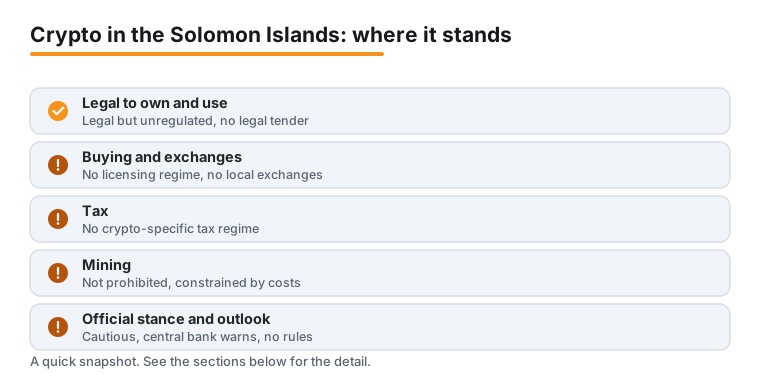
Owning and using Bitcoin and other cryptocurrencies is legal in the Solomon Islands in the sense that no statute bans it. There is equally no law that recognises crypto as money or grants it legal-tender status. The result is a permissive but unregulated environment: individuals and businesses may transact in digital assets, but they do so at their own risk and without the consumer protections that apply to licensed banks and financial services.
The only legal tender in the country is the Solomon Islands Dollar (SBD). Under the Central Bank of Solomon Islands Act 2012, the CBSI has the sole authority to issue currency, and that currency is the only legal tender; no merchant is obliged to accept Bitcoin or any other token as payment. The CBSI has made its stance explicit in a public notice on its position on cryptocurrencies, stating that virtual currencies such as Bitcoin, Ethereum and Ripple are not issued or regulated by the central bank and have no legal-tender status. In short: legal to use, but unrecognised and unprotected.
The regulators: CBSI and SIFIU
No single agency has been given a mandate to license or supervise crypto specifically. Two institutions are nonetheless the most relevant points of reference.
- Central Bank of Solomon Islands (CBSI) is the monetary authority. It issues the SBD, supervises licensed banks and financial institutions, and has published warnings on cryptocurrencies. It is also the body running the country's digital-currency experiment. Its official website is cbsi.com.sb.
- Solomon Islands Financial Intelligence Unit (SIFIU) is the national financial intelligence unit, hosted within the CBSI. It administers anti-money-laundering and counter-terrorism-financing (AML/CFT) reporting and is the focal point for suspicious-transaction analysis.
The national tax authority, the Inland Revenue Division (IRD) of the Ministry of Finance and Treasury, is the relevant body for any tax questions. None of these agencies has issued crypto-specific licensing rules as of August 2026. The only crypto-specific instrument any Solomon Islands regulator has ever published is CBSI Public Notice 03/2019 of 31 October 2019, which is a warning rather than a rule, and it is no longer hosted on the CBSI website. SIFIU remains one of CBSI's eleven departments and was established under the Money Laundering and Proceeds of Crime Amendment Act 2010, with the Anti-Money Laundering Commission established under section 11(1) of that Act and chaired by the Attorney General.
Key laws and frameworks
There is currently no bespoke statute that licenses crypto exchanges, custodians or token issuers in the Solomon Islands. Instead, activity is touched by a handful of general laws:
- Central Bank of Solomon Islands Act 2012 (No. 6 of 2012) establishes the CBSI, makes the SBD the sole legal tender, and gives the central bank exclusive authority to issue currency.
- Money Laundering and Proceeds of Crime Act 2002, as amended by the Money Laundering and Proceeds of Crime (Amendment) Act 2010, is the core AML/CFT statute. It imposes customer due diligence and suspicious-transaction reporting obligations on financial institutions and other reporting entities.
- General criminal, contract and consumer law applies to fraud, theft and disputes involving crypto, even though crypto itself is not separately defined in law.
The country's AML/CFT framework is periodically assessed by the Asia/Pacific Group on Money Laundering (APG) against the Financial Action Task Force (FATF) standards; its most recent mutual evaluation was published in 2019. Note that these laws were not written specifically for crypto, and the Solomon Islands has not yet enacted the FATF "travel rule" or a dedicated virtual-asset-service-provider (VASP) regime. See our overview of how crypto regulation works for context.
Licensing and registration of exchanges and VASPs
As of 2026 there is no crypto-specific licensing or registration regime in the Solomon Islands. A business cannot obtain a local "crypto exchange licence" or a virtual-asset-service-provider (VASP) registration, because no such category exists in law. There are no locally licensed cryptocurrency exchanges operating in the country.
That does not mean crypto businesses are entirely outside the law. A company dealing in crypto would still need ordinary business registration, and to the extent it touches the regulated banking system or qualifies as a reporting entity, the AML/CFT obligations under the Money Laundering and Proceeds of Crime Act can apply. The lack of a tailored regime should not be read as a green light. The CBSI Regulatory Sandbox is the only formal channel for live-testing a financial product that existing law does not cover, and paragraph 7.1(e) of the CBSI Regulatory Sandbox Framework bars any product or service that entails the use, promotion, distribution, exchange, issuance, trading or provision of cryptocurrencies in any form. So there is not merely no licence to apply for; the one supervised route into the perimeter is closed to crypto on its face. Anyone planning a crypto business should seek legal advice and confirm the current position directly with the CBSI before launching.
Crypto and Bitcoin taxation in the Solomon Islands
The Solomon Islands does not have a tax regime written specifically for cryptocurrency, and the IRD has not published crypto-specific guidance. That does not automatically make crypto tax-free. The country operates a broadly territorial income-tax system and does not levy a general capital-gains tax, but general income and business tax principles can still apply depending on the facts. For example, profits from trading crypto as a business, or crypto received as payment for goods, services or employment, may fall within existing income or business tax rules administered by the IRD.
No crypto-specific guidance has been issued, so the treatment of any given transaction turns on the facts. What can be stated precisely are the rates that would apply if crypto activity counts as income. The Inland Revenue Division publishes a personal exemption threshold of SBD 30,080, then 11% on income to SBD 15,000, SBD 1,650 plus 23% of the excess from SBD 15,001 to 30,000, SBD 5,100 plus 35% of the excess from SBD 30,001 to 60,000, and SBD 15,600 plus 40% of the excess above SBD 60,000. Registration, assessment, record keeping and penalties sit under the Tax Administration Act 2022 (No. 3 of 2022), in force since 1 January 2023. Practical steps:
- Keep clear records of every acquisition, disposal, conversion and any crypto income, including dates and SBD values.
- Treat crypto received in the course of business or work as potentially taxable income unless advised otherwise.
- Confirm your obligations with the IRD and a qualified local accountant before filing.
This is general information, not tax advice. See our crypto tax basics for general concepts, and always verify the current local position with official sources.
AML and KYC rules
The Solomon Islands' AML/CFT regime is built around the Money Laundering and Proceeds of Crime Act 2002 (as amended in 2010) and is overseen by the SIFIU within the CBSI. While these laws were not written for crypto, banks and reporting entities must still apply customer due diligence (know-your-customer, or KYC), monitor transactions and file suspicious-transaction reports.
In practice this means that if you move crypto on or off a regulated bank account, or use a service that touches the local banking system or cross-border payment rails, identity checks and reporting can apply. Reputable international exchanges that accept regional customers will also run their own KYC. The country has not yet implemented a crypto-specific FATF travel-rule obligation, but the general AML duties on financial institutions are real and enforceable, so the absence of crypto-specific rules should not be mistaken for an absence of obligations.
Buying and using crypto in practice
With no locally licensed exchanges, residents who buy crypto typically do so through one of two routes:
- International exchanges that accept customers from the region, where available. Access can be limited and depends on each platform's own country list and verification requirements.
- Peer-to-peer (P2P) marketplaces, where buyers and sellers trade directly using local payment methods. P2P is common where banking rails to global exchanges are restricted, but it carries higher counterparty and scam risk.
Whatever the route, expect identity verification on reputable platforms, and be aware that moving SBD to and from overseas services interacts with foreign-exchange and AML rules. There is no public network of Bitcoin ATMs in the Solomon Islands; global ATM trackers do not list established machines, so online exchanges and P2P trades are the realistic on and off ramps. Use established platforms, confirm a counterparty's track record on P2P, store funds in a wallet you control, and never send money based on unsolicited offers or promises of guaranteed returns. Because there is no local consumer-protection backstop for crypto, due diligence is your main line of defence.
Bitcoin mining in the Solomon Islands
Bitcoin mining is neither specifically prohibited nor specifically licensed. In practice, the main constraints are economic and infrastructural rather than legal. Electricity in the Solomon Islands is relatively expensive and has historically relied heavily on imported diesel generation, which undermines the profitability of energy-hungry proof-of-work mining. Grid reliability and limited high-capacity internet outside the capital, Honiara, add further hurdles.
No Solomon Islands law licenses, taxes or restricts mining specifically, and no regulator has published a position on it. There is also no supervised route to test a mining-linked financial product, because the CBSI Regulatory Sandbox Framework excludes cryptocurrency in any form at paragraph 7.1(e). If mining is carried on as a business, ordinary income and business tax rules and the Tax Administration Act 2022 apply to the proceeds. But anyone considering mining today should treat power cost, hardware import logistics, cooling in a tropical climate, and Bitcoin price volatility as the decisive factors. Before investing, check whether any business-registration, import-duty, electricity-tariff or environmental requirements apply to your specific setup, and budget conservatively.
Recent developments: the Bokolo Cash CBDC
Even as it warns against private crypto, the CBSI has explored a central bank digital currency (CBDC). In November 2023 it launched Bokolo Cash, a proof-of-concept digital form of the Solomon Islands Dollar developed with the Japanese blockchain firm Soramitsu and supported by the Japanese government. It is built on Hyperledger Iroha technology, connected to the Sora network, and accessed through QR codes and a mobile wallet, with each Bokolo pegged one-to-one to the SBD. The pilot has tested retail payments and person-to-person transfers in Honiara, with wholesale interbank transfers and simulated cross-border remittances also in scope.
Bokolo Cash is a state-backed pilot, a digital SBD, not a private cryptocurrency, and is distinct from Bitcoin in both its legal status and its centralised design. Through 2024 and 2025 the work continued under the Iroha 2 platform, with Soramitsu and Japanese government support aimed at broadening participants and moving toward production-grade operation; the Solomon Islands case has also been featured among Hyperledger Iroha CBDC deployments in industry write-ups. As of August 2026 it is not a national rollout, and CBSI has stopped reporting on it. Bokolo Cash is not mentioned anywhere in the CBSI 2025 Annual Report, whose only Bokolo references are to the unrelated Bokolo Bills security and the Bokolo Quarterly Projection Model, and the CBSI Central Bank Digital Currency page carries only a placeholder. CBSI's published payments priorities are instead the national payment system SOLATS, which launched in 2024 and was in full operation through 2025, and a unified QR code standard developed with the Australian Government whose Phase 2 commenced on 30 June 2026. The project signals official interest in digital payments while reinforcing the message that genuine legal tender comes only from the central bank. No dedicated private-crypto legislation has been enacted alongside it. Two live reform tracks could eventually reach crypto, and both are named and dated. SIFIU and the Ministry of Justice and Legal Affairs have prepared a draft Bill amending the Money Laundering and Proceeds of Crime Act; Cabinet endorsed the review in August 2023, stakeholder meetings were held by the end of 2025, the next step is submission to Cabinet, and broader consultations were expected to commence in the second half of 2026. Separately, Cabinet has approved drafting instructions for a new Financial Institutions Bill that CBSI says expands the regulatory perimeter to emerging financial service providers and fintech-type models, with enactment expected in 2026. Treat any claim of a brand-new "crypto law" with scepticism unless you can confirm it through the CBSI or the government gazette.
Consumer risks and protection
The defining risk in the Solomon Islands is the lack of a legal framework. Without licensing, disclosure or consumer-protection rules for crypto, users carry the full weight of platform, custody and fraud risk themselves. The CBSI has warned the public both about cryptocurrencies generally and about specific fake-currency schemes, such as the "Sol York" scam, that have surfaced in the country, underlining how fraudsters exploit gaps in awareness. More recently, the CBSI has repeated public alerts about online investment scams that reach Solomon Islanders through Telegram, social media and messaging apps, often promising quick or guaranteed returns; treat any such offer, especially anything using crypto branding, as a likely scam and verify it directly with the central bank before sending money. There is no formal, crypto-specific dispute-resolution channel, so contractual clarity and dealing only with reputable counterparties matter a great deal.
On the practical side, expect friction: limited local on-ramps, dependence on P2P trading, foreign-exchange considerations when moving value across borders, and the inherent volatility of crypto assets. Remittances are a real Pacific use case, and crypto is sometimes promoted as a cheaper cross-border channel; in reality, on and off-ramp costs, AML checks and counterparty risk can erode that advantage, so compare it honestly against established remittance services. Only commit money you can afford to lose, use secure self-custody, enable two-factor authentication, and keep detailed records.
Official sources and how to verify
Crypto policy can change, and online summaries (including this one) can fall out of date. Always confirm the current position against primary official sources before acting:
- CBSI press releases, where the central bank publishes its public notices and warnings, including on cryptocurrencies.
- Central Bank of Solomon Islands, which hosts the Solomon Islands Financial Intelligence Unit (SIFIU), for the AML/CFT framework and reporting obligations.
- Central Bank of Solomon Islands Act 2012, the statute making the SBD sole legal tender.
- Inland Revenue Division (IRD), the national tax authority, for tax questions.
This article is general information as of 2026 and is not legal, tax or financial advice; readers should verify their own situation with the named official regulator, the Central Bank of Solomon Islands, and a qualified local professional. For more, browse our country regulation hub.
What is changing: the Solomon Islands legislative pipeline, August 2026
Nothing crypto-specific has been enacted, drafted or put out for consultation. But three reform tracks are live, all of them documented in the CBSI 2025 Annual Report, and none of them names cryptocurrency. They matter because they are the only realistic vehicles through which a virtual-asset rule would arrive.
| Measure | Stage as at August 2026 | Timing | Why it matters for crypto |
|---|---|---|---|
| Draft Bill amending the Money Laundering and Proceeds of Crime Act (MLPCA) | Draft Bill prepared by SIFIU with the Ministry of Justice and Legal Affairs. Cabinet endorsed the review in August 2023. Stakeholder meetings held by the end of 2025. Next step is submission to Cabinet. | Broader stakeholder consultations were expected to commence in the second half of 2026. No introduction date announced. | The MLPCA is the statute that would carry any FATF-aligned virtual-asset, VASP or travel-rule obligation. CBSI does not say whether the current draft touches virtual assets. |
| New Financial Institutions Bill, replacing the Financial Institutions Act 1998 | Cabinet approved the drafting instructions during 2025. Developed with Asian Development Bank Private Sector Development Initiative support. Not yet tabled; no text public. | CBSI states the reforms are expected to be enacted in 2026. | CBSI says the new FIA expands the regulatory perimeter to include emerging financial service providers and fintech-type models, with tiered supervision scaled to size and risk. This is the likeliest route to crypto businesses being licensed. |
| Proposed Targeted Financial Sanctions (TFS) regime | Proposed. Australian Attorney-General's Department advisors held bilateral consultations and a workshop in Honiara in May 2025. | Not stated. | Sanctions screening duties would fall on every reporting entity handling transfers of value, the category any future virtual asset service provider would sit in. |
The pacing is set by remediation of the 2019 Mutual Evaluation Report and the 2017 National Risk Assessment. SIFIU has developed a Solomon Islands National AML Strategic Plan to guide key priorities and implementation timelines over four years, leading up to the country's next mutual evaluation in 2030. That is the realistic outer horizon for any virtual-asset regime. Reporting volumes are rising in the meantime: suspicious transaction reports received by SIFIU went from 96 in 2024 to 196 in 2025, and border currency reports from 69 to 125.
There is no crypto licence, and the CBSI sandbox is expressly closed to crypto
The CBSI runs a Regulatory Sandbox. It is the only formal route in the Solomon Islands for testing a financial product or service that existing law does not cover, and it is closed to crypto. Paragraph 7.1(e) of the CBSI Regulatory Sandbox Framework states that a product or service shall not entail the use, promotion, distribution, exchange, issuance, trading or provision of cryptocurrencies (in any form).
That single line answers the licensing question more directly than the absence of a statute does. There is no crypto or VASP licence category to apply for, and the one supervised channel CBSI has built for regulating by testing rules crypto out on its face.
Other terms of the framework, for anyone weighing a fintech application:
- Testing shall not last longer than 18 months, and can be extended by up to a further 12 months by decision of the CBSI Working Group.
- Preliminary review of an application does not exceed 20 business days; in-depth analysis does not exceed 40 business days.
- Only legal entities may apply. Applicants may be incorporated in the Solomon Islands or in another jurisdiction, and may or may not already be licensed by CBSI.
- Proposals must contribute to financial inclusion and serve the public interest, with special focus on vulnerable groups such as the youth, the elderly, women and those living on remote islands.
- Enquiries and applications go to the Financial Systems and Regulations Department; see the CBSI sandbox page.
The sandbox is genuinely in use, which is why the exclusion carries weight. CBSI reported three applicants in the testing phase during 2025, with sandbox solutions spanning digital remittance, digital nano loan and parametric insurance. One of them, IumiCash, was granted money transfer licences in 2025 to provide digital foreign remittances.
What tax actually applies, and at what rates
There is still no crypto-specific tax guidance from the Inland Revenue Division, so the practical question is which general rules bite. Two named instruments do the work. The Tax Administration Act 2022 (No. 3 of 2022) was brought into force on 1 January 2023 by Legal Notice No. 256, signed by the Minister for Finance and Treasury on 26 October 2022 and published in Extra-Ordinary Gazette No. 304 of 1 November 2022. It governs registration, assessment, record keeping and penalties across all tax types, including a penalty of 10,000 penalty units for a false or misleading statement, or the amount of the tax shortfall if that is higher. The Income Tax Act (Cap 123) supplies the charge on income.
The individual rates the IRD currently publishes are:
- Personal exemption threshold of SBD 30,080. Individuals, both employees and self-employed, will not pay tax on the first SBD 30,080 they earn.
- SBD 1 to 15,000: 11%
- SBD 15,001 to 30,000: SBD 1,650 plus 23% of the excess
- SBD 30,001 to 60,000: SBD 5,100 plus 35% of the excess
- SBD 60,000 and over: SBD 15,600 plus 40% of the excess
These are the rates that would apply if crypto activity is treated as income, for example trading as a business, mining as a business, or crypto taken as payment for work, goods or services. There is no general capital gains tax, so a one-off disposal by a private holder has no obvious charging provision, but that is the effect of a gap rather than a published exemption, and the Tax Administration Act 2022 still governs how any assessment and any penalty would be handled.
One thing that has not changed: the Solomon Islands has not moved to VAT. The IRD's live filing calendar still runs on Goods Tax and Sales Tax with monthly returns due on the 30th, and the IRD legislation page lists the Goods Tax Act (Cap 122) and the Sales Tax Act (Cap 125) with no VAT Act, even though a Value Added Tax Bill 2023 appears in Parliament's 2023 bill list.
Exchange control is the real constraint on buying from abroad
Buying from an overseas exchange is not only a question of which platforms accept Solomon Islands customers. CBSI states that exchange control in Solomon Islands is administered by the Central Bank on behalf of the Solomon Islands Government under the Exchange Control (Foreign Exchange) Regulations 1977, made under section 3 of the Exchange Control Act 1976, and that it covers financial transactions between residents of Solomon Islands and residents of other countries.
By virtue of regulation 20, CBSI has appointed the commercial banks operating in Solomon Islands as authorised dealers, which administer the controls day to day. In practice that means your bank is the gatekeeper on the fiat leg. Applications for overseas payments are made on Form A1 and applications for overseas travel on Form A2. Details are on the CBSI exchange control page.
This is the concrete reason local access is thin, and it is worth stating plainly: the binding constraint is the cross-border payment, not a crypto prohibition. It does not affect crypto you already hold, nor peer-to-peer trades settled locally in Solomon Islands Dollars.
Where Bokolo Cash actually stands
Bokolo Cash, the proof-of-concept digital Solomon Islands Dollar, has gone quiet in CBSI's own reporting. It is not mentioned anywhere in the CBSI 2025 Annual Report, which was launched on 30 April 2026. The only Bokolo references in that report are to Bokolo Bills, an unrelated short-term discount security issued and backed by CBSI for monetary operations, and to the Bokolo Quarterly Projection Model, a macroeconomic forecasting tool. CBSI's dedicated Central Bank Digital Currency page carried no content as of August 2026, displaying only a "New Content Coming Soon" placeholder.
None of that is a formal announcement that the project has ended, and it should not be read as one. What it does show is where CBSI's published payments priorities now sit, and they are conventional rather than CBDC. The national payment system, SOLATS, launched in 2024 and was in full operation through 2025, and the 2025 report said Instant Fund Transfer was expected to go live in the first quarter of 2026 to enable real-time settlement of retail payments. CBSI has not since published confirmation that it did. And on 30 June 2026 CBSI announced the commencement of Phase 2 of a unified QR code standard project with the Australian Government, involving co-development of technical standards and business rules with commercial banks, mobile money operators and payment service providers.
Treat any claim that a Solomon Islands CBDC has launched nationally as unverified, and check the CBSI CBDC page or its press releases before relying on it.
The CBSI position on crypto, named and dated
CBSI's position has a name and a date: Public Notice 03/2019, issued on Thursday 31 October 2019 and headed "CBSI's Position on Cryptocurrencies". It warns the general public that cryptocurrencies, meaning virtual or digital currencies such as bitcoin, etherium and ripple, are not currencies issued or regulated by the Central Bank; that these cryptocurrencies do not have any legal tender status to be accepted as a currency in Solomon Islands; that investment in such digital currencies is considered very risky and speculative in nature; that people who invest in any of the cryptocurrencies do so at their own risk; that there is no guarantee cryptocurrencies will be accepted as a medium of exchange or will hold their value; and that the Central Bank does not currently endorse unregulated cryptocurrencies and therefore does not encourage anyone to invest in any digital cryptocurrencies.
The notice is no longer published on the CBSI website. Its former addresses now return 404, and an archived copy is the only reachable version. Nothing indicates the position has been withdrawn or replaced, and it is consistent with the crypto exclusion CBSI still applies in its sandbox framework. But readers should know that the only crypto-specific statement any Solomon Islands regulator has issued is now nearly seven years old and is not currently hosted by the regulator itself.
Two points of precision on the surrounding law. The Central Bank of Solomon Islands Act 2012 (No. 6 of 2012), passed by the National Parliament on 19 November 2012 and assented to on 18 December 2012, provides at section 19 that currency issued by the Central Bank shall be legal tender in Solomon Islands and that only banknotes and coins issued by the Central Bank that have not been withdrawn from circulation shall be legal tender. And SIFIU remains one of CBSI's eleven departments, confirmed on the CBSI departments page; it was established under the Money Laundering and Proceeds of Crime Amendment Act 2010, and the Anti-Money Laundering Commission, to which it refers policy issues, has its establishment and mandate set out in section 11(1) of that Act and is chaired by the Attorney General.
Frequently asked questions
Is cryptocurrency legal in the Solomon Islands?
Yes. As of 2026 there is no law banning Bitcoin or other cryptocurrencies, so owning and trading them is legal. However, crypto is unregulated and has no legal-tender status; only the Solomon Islands Dollar is legal tender, and the Central Bank of Solomon Islands has warned that crypto is risky and speculative. This is general information, not legal advice.
Who regulates cryptocurrency in the Solomon Islands?
No agency has a dedicated crypto mandate. The most relevant body is the Central Bank of Solomon Islands (CBSI), which issues the currency and has published its position on cryptocurrencies, while the Solomon Islands Financial Intelligence Unit (SIFIU) handles anti-money-laundering reporting. The Inland Revenue Division handles tax. Verify any question directly with the CBSI.
Do I have to pay tax on crypto in the Solomon Islands?
There is no crypto-specific tax regime and the country has no general capital-gains tax, but ordinary income and business tax rules may still apply, for example to crypto received as business income or payment for work. Because no specific guidance has been published, keep detailed records and confirm your obligations with the Inland Revenue Division and a qualified local accountant. This is not tax advice.
Are crypto exchanges licensed in the Solomon Islands?
No. There is no crypto-specific licensing or VASP-registration regime, and there are no locally licensed exchanges. Residents typically use international exchanges that accept regional customers or peer-to-peer marketplaces. A crypto business would still need ordinary business registration and may face AML/CFT obligations under the Money Laundering and Proceeds of Crime Act.
What is Bokolo Cash and is it the same as Bitcoin?
Bokolo Cash is a proof-of-concept central bank digital currency (CBDC) launched by the CBSI in November 2023 with the Japanese firm Soramitsu. It is a digital form of the Solomon Islands Dollar, pegged one-to-one and state-backed, and is not a private cryptocurrency like Bitcoin. As of 2026 it remains a pilot rather than a full national rollout.
Are there Bitcoin ATMs in the Solomon Islands?
There is no evidence of an established Bitcoin ATM network in the Solomon Islands. The practical options for converting between SBD and crypto are online exchanges (where accessible) and peer-to-peer trades. Verify any advertised machine or operator carefully before use, and treat unusually generous rates as a warning sign of a scam.
Can I use crypto to send remittances to the Solomon Islands?
There is no rule banning it, and crypto is sometimes promoted as a cheaper cross-border channel across the Pacific. In practice, on and off-ramp fees, foreign-exchange conversion, AML checks and counterparty risk can erode the saving, and there is no local consumer-protection backstop if something goes wrong. Compare the true all-in cost against established remittance services before relying on crypto, and keep records of every transfer.
Has the Solomon Islands warned about crypto scams?
Yes. The Central Bank of Solomon Islands has issued public warnings about cryptocurrencies being unregulated and speculative, about the fake "Sol York" currency scheme, and more recently about online investment scams spread through Telegram, social media and messaging apps. Treat any offer of quick or guaranteed returns as a likely scam and confirm with the CBSI before sending money.
Is a crypto law coming to the Solomon Islands?
Nothing crypto-specific is drafted or announced. Two general reform tracks could eventually reach crypto. SIFIU and the Ministry of Justice and Legal Affairs have prepared a draft Bill amending the Money Laundering and Proceeds of Crime Act; Cabinet endorsed the review in August 2023, stakeholder meetings were held by the end of 2025, the next step is submission to Cabinet, and broader consultations were expected to commence in the second half of 2026. Separately, Cabinet has approved drafting instructions for a new Financial Institutions Bill which CBSI says expands the regulatory perimeter to emerging financial service providers and fintech-type models, with enactment expected in 2026. Neither names cryptocurrency and no draft text is public. The country's next FATF-style mutual evaluation is scheduled for 2030.
Can I get a crypto licence or test a crypto product with the Central Bank of Solomon Islands?
No. There is no crypto or virtual asset service provider licence category in Solomon Islands law, and the CBSI Regulatory Sandbox, which is the only formal route for testing a financial product the law does not yet cover, expressly excludes crypto. Paragraph 7.1(e) of the CBSI Regulatory Sandbox Framework states that a product or service shall not entail the use, promotion, distribution, exchange, issuance, trading or provision of cryptocurrencies in any form. The three sandbox applicants CBSI reported in testing during 2025 covered digital remittance, digital nano loan and parametric insurance.
What tax rate would I pay on crypto profits in the Solomon Islands?
There is no crypto-specific rate and no general capital gains tax. If crypto activity counts as income, for example trading or mining as a business or crypto received as payment for work or goods, the ordinary individual rates published by the Inland Revenue Division apply: no tax on the first SBD 30,080, then 11% on income to SBD 15,000, SBD 1,650 plus 23% of the excess from SBD 15,001 to 30,000, SBD 5,100 plus 35% of the excess from SBD 30,001 to 60,000, and SBD 15,600 plus 40% of the excess above SBD 60,000. Administration, record keeping and penalties sit under the Tax Administration Act 2022, in force since 1 January 2023. Confirm your own position with the IRD and a qualified local accountant. This is not tax advice.
Do I need approval to send money abroad to buy crypto?
Possibly, and you should ask your bank first. CBSI states that exchange control covers financial transactions between residents of Solomon Islands and residents of other countries, administered by CBSI under the Exchange Control (Foreign Exchange) Regulations 1977 made under section 3 of the Exchange Control Act 1976. By virtue of regulation 20 the commercial banks are appointed authorised dealers and administer the controls day to day, and overseas payments are applied for on Form A1. This fiat leg, not any crypto prohibition, is the main legal constraint on buying from an overseas exchange. It does not affect crypto you already hold or peer-to-peer trades settled locally.
Has the Central Bank of Solomon Islands published anything specifically about crypto?
Once. CBSI Public Notice 03/2019, issued on 31 October 2019, warns that cryptocurrencies such as bitcoin, etherium and ripple are not issued or regulated by the Central Bank, have no legal tender status in Solomon Islands, and are very risky and speculative, and states that CBSI does not endorse unregulated cryptocurrencies and does not encourage anyone to invest in them. It is a warning, not a rule: it creates no offence and no licensing duty. The notice is no longer published on the CBSI website, so only an archived copy is reachable. Nothing indicates it has been withdrawn or replaced.
Facts reviewed: 3 August 2026. Page updated: 12 August 2026.