Home › Crypto Regulation › Palau
Bitcoin & Cryptocurrency Regulation in Palau
Quick answer — Palau, 2026
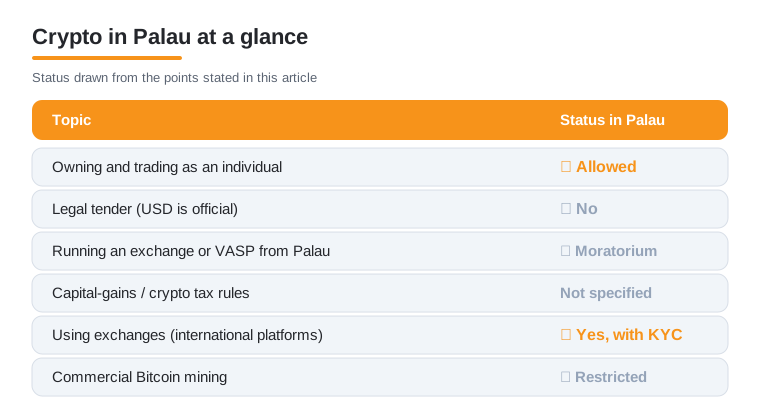
- Owning, buying, and using crypto as an individual is not banned in Palau, but it is not legal tender (the US dollar is).
- Running a crypto business is restricted: a 2019 moratorium on new crypto/VASP firms has not been formally lifted.
- There is no clear crypto-specific tax; ignore "0 percent" claims and confirm with the Bureau of Revenue and Taxation.
- Residents typically buy via international platforms, with full KYC, funded in US dollars.
Palau, a small Pacific island republic of roughly 18,000 people, has drawn outsized attention in the cryptocurrency world. It uses the US dollar as its official currency, runs a territorial tax system, and has experimented with government-linked blockchain projects, most notably a Ripple-supported US dollar stablecoin pilot and a widely marketed digital residency ID. Despite that profile, Palau does not yet have a comprehensive standalone cryptocurrency statute. The single most important fact for anyone planning a crypto business here is that Palau's Financial Institutions Commission imposed a moratorium on new commercial crypto and virtual-asset activity in March 2019, and that moratorium has not been formally lifted. At the same time, the Financial Intelligence Unit has begun publishing proposed 2026 AML/CFT regulations aimed specifically at virtual asset service providers, signalling that a formal framework is being built. This guide explains the current legal status of crypto in Palau, the authorities involved, taxation, AML/KYC rules, and how buying, holding, and mining fit into that picture.
This is general information as of 2026 and is not legal, tax, or financial advice. Crypto rules in Palau are evolving; always confirm current requirements with the named official regulators (in particular the Financial Intelligence Unit and the Financial Institutions Commission) or a qualified local professional before acting. See our overview of how crypto regulation works for background.
On this page: Legal status · Who regulates it · Taxes · How to buy · Mining
Is Bitcoin and crypto legal in Palau?
There is no public law in Palau that bans an individual from owning, buying, holding, or using Bitcoin and other cryptocurrencies, and the country has positioned itself as open to blockchain experimentation rather than hostile to it. Personal ownership of crypto is best understood as permitted.
However, "not banned for individuals" is very different from "freely allowed as a business." Since March 2019, Palau's Financial Institutions Commission (FIC) has maintained a moratorium that blocks new commercial virtual-asset and crypto-service businesses from being licensed or operated in Palau, pending a suitable legal framework. So while you may personally hold crypto, running a crypto exchange, brokerage, or similar service from within Palau is restricted.
Crypto is also not legal tender in Palau: the US dollar is the official currency, and no cryptocurrency carries mandatory acceptance status. The clearest regulatory touchpoint for any crypto activity is anti-money-laundering and counter-terrorist-financing (AML/CFT) law, which now expressly reaches virtual-asset activity.
The regulators: who governs crypto in Palau
Palau's crypto-relevant oversight is shared among several bodies rather than a single crypto regulator:
- Financial Intelligence Unit (FIU) is Palau's dedicated AML/CFT authority, established by the Money Laundering and Proceeds of Crime Act of 2001 and made a fully independent agency in 2014. It supervises financial institutions and Designated Non-Financial Businesses and Professions, and it now has a dedicated VASP compliance officer overseeing virtual asset service providers. Its official site is palaufiu.org.
- Financial Institutions Commission (FIC) is the supervisor of banks and financial institutions and the body that imposed the 2019 crypto moratorium.
- Ministry of Finance, and within it the Bureau of Revenue and Taxation, handles tax administration and has been the government arm behind state-linked blockchain initiatives such as the stablecoin pilot. Government tax and ministry information is published at palaugov.pw.
- Office of the Public Auditor (OPA) independently audits government projects, including the 2025 review of the stablecoin pilot.
Palau is a member of the Asia/Pacific Group on Money Laundering (APG), a FATF-style regional body, and works toward the FATF 40 Recommendations. That alignment is why VASPs face customer-due-diligence, record-keeping, and travel-rule expectations.
Key laws and frameworks
Palau does not have a single dedicated digital-asset act. Instead, crypto sits within a small set of existing laws and policy actions:
- Money Laundering and Proceeds of Crime Act (2001, amended 2014). This is the backbone AML/CFT law, the statute that established the FIU and under which virtual asset service providers are required to comply. In 2023 the FIU publicly stated that VASPs are required to comply with this Act.
- The 2019 FIC moratorium. Adopted by FIC resolution on 19 March 2019, it halts new commercial crypto/virtual-asset business licensing until Palau has a suitable legal framework and the capacity to monitor, supervise, and regulate such firms. It was triggered after a firm ("Palau Coin") falsely claimed government backing.
- Tax law (Title 40 of the Palau National Code). Administered by the Bureau of Revenue and Taxation under the Ministry of Finance, with the 2023 introduction of the Palau Goods and Services Tax and Business Profits Tax.
The direction of travel is toward a formal VASP regime: in March 2026 the FIU published proposed regulations for consultation, including "FIU AML/CFT Regulation 03 - Other Reporting Entities: VASPs and MVTS" and "Regulation 04 - AML/CFT Reporting Entity Registry." Until such rules are finalized, much remains in transition, so verify the current status directly with the FIU.
Licensing and registration of exchanges and VASPs
This is where Palau differs sharply from many "crypto-friendly" reputations. Because of the 2019 FIC moratorium, Palau has not been issuing licenses for new commercial crypto businesses, including exchanges and virtual-asset service providers, and a 2019 joint statement by the Bureau of Revenue and Taxation and the FIC warned that using existing or voided business licenses to conduct crypto transactions is unlawful. There is therefore no open, functioning exchange-licensing regime that approves platforms to operate from Palau today.
What is emerging is the AML/CFT registration side. The FIU's proposed 2026 regulations would establish a reporting-entity registry and set out obligations specifically for VASPs and money or value transfer services (MVTS). The clear signal is that any future VASP activity will require registration with the FIU and full AML/CFT compliance.
Practical takeaway: do not assume you can legally launch a crypto exchange, ATM operation, or token service from Palau. Confirm the moratorium's current status and any registration requirements with the FIC and FIU before committing. For wider context on how exchange rules work, see our crypto regulation guide.
Crypto and Bitcoin tax in Palau
Palau operates a territorial tax system, meaning tax generally attaches to income sourced within Palau rather than to worldwide income. Following a 2023 reform administered by the Bureau of Revenue and Taxation, the main relevant taxes are a Business Profits Tax (BPT) and the Palau Goods and Services Tax (PGST), a broad-based tax of 10 percent on most goods and services consumed in Palau. The BPT replaced the older gross revenue tax for PGST-registered businesses.
Palau has not published a clear, crypto-specific tax code spelling out how individual gains on Bitcoin or other tokens are treated. Whether and how disposals, crypto received as payment, or crypto business revenue are taxed are best resolved with official guidance rather than assumptions. Some third-party sites advertise a flat "0 percent crypto tax" in Palau; that framing oversimplifies the territorial principle and product-specific residency marketing and should not be relied on.
Do not rely on any specific rate or threshold you read online. Confirm your situation with the Bureau of Revenue and Taxation or a qualified professional, and remember that if you are tax-resident in another country, its crypto rules may still apply to you. Our general crypto tax explainer covers the principles, not Palau-specific figures.
AML and KYC rules
Anti-money-laundering and counter-terrorist-financing rules are the most concrete part of Palau's crypto picture. Under the Money Laundering and Proceeds of Crime Act, the FIU supervises compliance, and it has publicly confirmed that virtual asset service providers fall within scope. Palau's membership of the APG and its work toward the FATF Recommendations mean the standard expectations apply: customer due diligence (identity verification), record-keeping, suspicious-activity reporting, and the FATF "travel rule" for transfers between VASPs.
For ordinary users, the practical effect is that any reputable platform serving you will require full know-your-customer (KYC) verification; anonymous large-scale buying is not realistic. For businesses, the FIU's proposed 2026 registry and VASP regulations are designed to make these obligations explicit and enforceable. Anyone operating a crypto-related business in or from Palau should assume AML/CFT duties apply and engage with the FIU early.
Buying and using crypto in practice
Palau does not host a meaningful domestic exchange industry, so residents and visitors who buy crypto generally use international platforms rather than a local Palau-licensed exchange. Because of the moratorium, there is no public licensing regime approving specific exchanges to serve Palau, but AML/CFT expectations mean any compliant service will require KYC.
One reason Palau appears frequently in crypto-onboarding discussions is its government-backed digital resident ID, issued through the RNS.ID program (launched in 2022). It is a real, machine-readable government identity document that is promoted as accepted KYC documentation at various exchanges and fintech services. That makes Palau relevant as an identity and residency option, which is separate from where you actually buy or hold coins. Promotional claims about which exchanges accept it, and about associated banking or stablecoin products, vary in reliability, so verify any "Palau supported" or "accepted for KYC" claim directly with the provider before relying on it.
Practical points: expect full KYC, fund in US dollars (convenient given Palau's currency), observe cross-border banking rules, and keep clear records of every transaction.
Bitcoin mining in Palau
For mining, the central issue in Palau is practicality and environmental impact rather than a specific prohibition. Palau is a small island nation with limited generation capacity, heavy reliance on imported fuel, and relatively high electricity costs, conditions that make large-scale proof-of-work mining commercially difficult. Its economy and national identity are also tied to a pristine marine environment, and conservation is a strong policy priority, so energy-intensive mining sits uneasily against those goals.
There is no indication of a dedicated mining-licensing regime in Palau. Importantly, a commercial mining operation would likely be treated as a crypto/virtual-asset business and therefore caught by the FIC moratorium on new crypto businesses, in addition to general business, energy, and environmental rules. Anyone considering mining should confirm the position with the FIC and FIU before proceeding.
Recent developments (2025-2026)
Two strands of activity define Palau's recent crypto story. First, the state-linked Palau Stablecoin (PSC) pilot, run with Ripple Services on the XRP Ledger, tested a US-dollar-backed token with government-employee volunteers using it at select local merchants. The Office of the Public Auditor's 2025 performance audit (report AR-2025-005) set out the specifics: the pilot ran from 26 October 2021 to 27 November 2023, involved 154 volunteer government employees who each received 100 PSC (one-to-one with the US dollar), and was funded by a single $25,000 payment from Ripple Services, of which the Ministry of Finance disbursed about $14,035, mainly to reimburse three participating merchants (Surangel and Sons, Penthouse Hotel, and King's Minute Mart). The auditors concluded the Ministry acted within its broad authority but flagged legal-process gaps: neither the October 2021 memorandum of understanding nor the December 2022 Ripple hosted-services agreement was certified for form and legality by the Attorney General as required, and fund availability was not certified when the services agreement was signed. The audit stated that any expansion into a full circulating national stablecoin would be unlawful without explicit legislation by the Olbiil Era Kelulau (Palau's Congress).
Second, on 3 March 2026 the FIU moved to formalize VASP oversight, publishing (in English and Palauan) proposed AML/CFT regulations for virtual asset service providers and money/value transfer services, plus a reporting-entity registry, for public consultation. Read together, these developments suggest Palau is incrementally building an AML-led framework rather than throwing the doors open. Because this is a live, changing area, treat any single news report cautiously and rely on the FIU and OPA for the authoritative position.
Consumer risks and protection
The main risks for crypto users connected to Palau are regulatory and structural rather than the result of an outright ban on ownership. Because there is no comprehensive crypto statute and exchange licensing is restricted by the moratorium, there are fewer formal investor protections, custody rules, and complaint mechanisms than in heavily regulated markets. That places more responsibility on the individual to choose reputable platforms, secure their own private keys, and understand counterparty risk.
Be especially wary of marketing that overstates Palau's openness: claims of guaranteed returns, "zero tax" certainty, or government endorsement deserve scepticism, as the original "Palau Coin" episode that triggered the 2019 moratorium showed. Only commit funds you can afford to lose, diversify sensibly, keep records, and remember that past performance does not predict future results. This guide gives no investment advice. For broader context, see the wikicrypto regulation hub.
Official sources and how to verify
Because Palau's framework is still developing, always check primary sources rather than secondary summaries. The most authoritative starting points are:
- Palau Financial Intelligence Unit for AML/CFT rules, VASP obligations, and the proposed 2026 regulations and registry.
- Republic of Palau National Government, including the Ministry of Finance and the Bureau of Revenue and Taxation tax-reform pages, for tax questions.
- Office of the Public Auditor for independent audit reports such as the stablecoin pilot review (AR-2025-005).
The Republic of Palau also maintains an entry with the Financial Action Task Force (FATF) describing its AML/CFT standing. To confirm the current status of the crypto moratorium or any licensing question, contact the Financial Institutions Commission and the FIU directly. Remember: this article is general information as of 2026, not legal advice, and you should verify your specific situation with these named official regulators.
Frequently asked questions
Is cryptocurrency legal in Palau?
Owning, buying, and using cryptocurrency as an individual is not banned in Palau, but running a commercial crypto business is restricted: the Financial Institutions Commission imposed a moratorium on new crypto and virtual-asset businesses in March 2019, and it has not been formally lifted. Crypto is not legal tender (the US dollar is the official currency), and there is no comprehensive standalone crypto law yet. AML/CFT rules administered by the Financial Intelligence Unit reach virtual-asset activity.
Who regulates crypto in Palau?
There is no single crypto regulator. The Financial Intelligence Unit (palaufiu.org) handles AML/CFT and VASP oversight under the Money Laundering and Proceeds of Crime Act; the Financial Institutions Commission supervises financial institutions and imposed the 2019 crypto moratorium; and the Ministry of Finance, through the Bureau of Revenue and Taxation, handles tax. The Office of the Public Auditor audits government projects.
Can I run a crypto exchange or VASP from Palau?
Not freely. Because of the 2019 FIC moratorium, Palau has not been licensing new commercial crypto businesses, and authorities warned in 2019 that using existing or voided business licenses for crypto is unlawful. The FIU's proposed 2026 regulations would set up a VASP/MVTS registry and AML/CFT obligations, signalling a future framework. Confirm the current status with the FIC and FIU before attempting any VASP activity.
Does Palau tax crypto gains?
Palau uses a territorial tax system and has not published clear crypto-specific tax rules, so no definitive rate can be stated here. Since 2023 the main taxes are a Business Profits Tax and a 10 percent Palau Goods and Services Tax administered by the Bureau of Revenue and Taxation. Ignore third-party claims of a guaranteed 0 percent crypto tax; confirm your position with the Bureau or a qualified professional, and note that tax residency elsewhere may still create obligations.
Did Palau launch its own cryptocurrency?
Palau ran a US-dollar-backed stablecoin pilot (the Palau Stablecoin, or PSC) with Ripple Services on the XRP Ledger. Per the 2025 Office of the Public Auditor report (AR-2025-005), it ran from 26 October 2021 to 27 November 2023, involved 154 government-employee volunteers who each received 100 PSC, and was funded by a single $25,000 payment from Ripple. The audit flagged missing legal certifications (including from the Attorney General) and stated that a full circulating national stablecoin would be unlawful without explicit legislation by Palau's Congress. It was a limited experiment, not a fully rolled-out national digital currency.
Is the Palau digital residency (RNS.ID) ID accepted for crypto KYC?
Palau's digital resident ID, issued through the RNS.ID program since 2022, is a genuine government-issued, machine-readable identity document that is widely promoted as accepted KYC documentation at various crypto and fintech services. However, acceptance varies by platform and changes over time, and the ID does not by itself grant tax exemptions or override the moratorium on crypto businesses. Verify acceptance directly with each provider and confirm details with official Palau sources.
Does the 2019 moratorium stop me from buying crypto in Palau?
No. The Financial Institutions Commission's 2019 moratorium restricts new commercial crypto and virtual-asset businesses, such as exchanges and VASPs, from being licensed or operated in Palau. It does not ban an individual from personally buying, holding, or using crypto. In practice, residents buy through international platforms with full KYC, funded in US dollars, rather than through a Palau-licensed local exchange.
When will Palau have formal crypto rules for VASPs?
No firm date has been set. On 3 March 2026 the Financial Intelligence Unit published proposed AML/CFT regulations for virtual asset service providers and money or value transfer services, along with a reporting-entity registry, for public consultation. These were proposals open for comment, not finalized law, so check the FIU (palaufiu.org) for the current status before relying on any specific requirement.
Facts reviewed: 30 June 2026. Page updated: 3 August 2026.