Home › Crypto Regulation › Niger
Bitcoin & Cryptocurrency Regulation in Niger
Quick answer — Niger, 2026
- Legal: Not banned but not protected, not legal tender, no dedicated crypto law
- Tax: No dedicated crypto tax, general rules may apply, no verified rate
- Buying: No local licensed exchange, use international platforms or P2P
Niger sits in a regulatory grey zone for Bitcoin and other cryptocurrencies. There is no Niger-specific statute that bans owning or trading crypto, but there is also no national framework that licenses, supervises or protects it. As a member of the West African Economic and Monetary Union (WAEMU, or UEMOA in French), Niger shares a single currency, the West African CFA franc, and a single central bank with seven neighbouring countries. Crypto policy in Niger is therefore shaped far more by that regional structure, led by the Central Bank of West African States (BCEAO), than by anything written in Niamey. Note that Niger formally left the Economic Community of West African States (ECOWAS) on 29 January 2025, alongside Mali and Burkina Faso, but it remains a member of WAEMU/UEMOA and still uses the CFA franc, so the BCEAO-led monetary framework described here continues to apply. This page explains, in plain terms, what that means for residents, businesses and visitors: legal status, the authorities involved, the key frameworks, exchange access, tax, anti-money-laundering rules, mining, remittances and the 2025 to 2026 outlook.
This article is general information as of 2026 and is not legal, tax or financial advice. Because the rules are unsettled and largely inferred from regional financial regulation rather than a dedicated crypto law, anyone with a real situation should verify the current position directly with the named official regulator, the BCEAO, and with Niger's tax and financial-intelligence authorities or a qualified local professional before acting. See also our broader crypto regulation guide and our country regulation index.
On this page: Legal status · Who regulates it · Taxes · How to buy · Mining
Is Bitcoin and crypto legal in Niger?
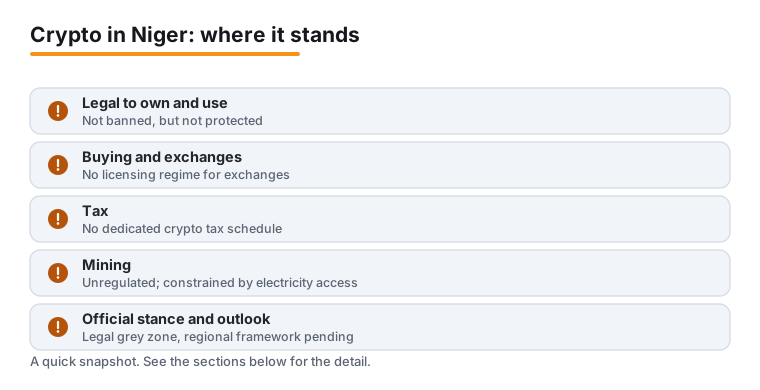
Owning and trading Bitcoin is not specifically illegal in Niger, but it is not officially recognised or protected either. No national law criminalises holding crypto, and none grants it legal-tender status or treats it as a regulated financial instrument. The honest summary is that crypto exists in a legal grey zone: tolerated in practice, but outside any formal consumer-protection or licensing regime.
The decisive context is regional. Niger uses the West African CFA franc and is a WAEMU/UEMOA member, whose monetary policy is run by the Central Bank of West African States (Banque Centrale des Etats de l'Afrique de l'Ouest, BCEAO). The BCEAO has consistently made clear that crypto-assets are not legal tender across the union and are not recognised as currency in the legal sense. Only the CFA franc is legal tender. Regulators in the zone have also cautioned about volatility, the potential for fraud and illicit finance, and the absence of any guarantee or recourse if something goes wrong.
So while you are unlikely to break a specific crypto law simply by holding Bitcoin in Niger, you are also not covered by one. Crypto is not money a merchant must accept, it is not a supervised product, and disputes will not be resolved by a financial regulator the way a bank complaint might be. Treat the status as not banned, but not protected, and verify the current position through official BCEAO and Nigerien government channels, because regional policy is actively evolving in 2025 and 2026.
Who regulates crypto in Niger: the BCEAO and national bodies
There is no single dedicated crypto regulator in Niger today. Oversight is shared between a regional authority and national bodies.
- BCEAO (Central Bank of West African States). The regional central bank, headquartered in Dakar, issues the CFA franc, supervises banks and licensed payment institutions, and sets monetary policy for all eight WAEMU members, including Niger. It is the primary authority whose position governs how crypto is treated across the zone. Its official site is bceao.int.
- CENTIF-Niger (financial-intelligence unit). Niger's Cellule Nationale de Traitement des Informations Financieres receives suspicious-transaction reports and handles money-laundering intelligence under the regional AML/CFT framework.
- Niger's Ministry of Finance and tax administration. These handle fiscal matters, including how general tax rules might apply to income or gains.
- GIABA. The Inter-Governmental Action Group against Money Laundering in West Africa, historically an ECOWAS body, conducts mutual evaluations of Niger's AML/CFT system. Niger left ECOWAS in January 2025 but has indicated it intends to remain within GIABA under the group's statutes, and GIABA adopted Niger's third follow-up report in November 2024. See giaba.org.
Because no Nigerien agency currently licenses or supervises crypto businesses, the practical regulator that matters most is the BCEAO at the regional level. Confirm any current position through these official channels rather than third-party summaries.
Key laws and frameworks that apply
Niger does not have a comprehensive, standalone cryptocurrency statute. The relevant rules instead come from regional monetary regulation, banking and payments law, and AML/CFT obligations that apply across the WAEMU zone and are transposed into Nigerien law.
- WAEMU monetary and payments regulation. The BCEAO frameworks for electronic money and payment services, including BCEAO Instruction No. 008-05-2015 on electronic-money issuers, define what counts as money and a licensed payment activity in the union. These rules are aimed partly at preventing money laundering and terrorist financing. Crypto-assets fall outside legal-tender status under them.
- WAEMU foreign-exchange regulation. A new union foreign-exchange regulation adopted by the WAEMU Council of Ministers in December 2024 tightened control of cross-border financial flows and strengthened AML/CFT priorities, which is part of the environment any cross-border crypto activity sits within.
- Regional AML/CFT framework. WAEMU operates harmonised anti-money-laundering and counter-terrorist-financing rules implemented nationally through CENTIF-Niger. Though not written specifically for crypto, they capture suspicious transactions and impose customer-identification duties on regulated institutions.
- Regional instant-payment infrastructure. In September 2025 the BCEAO launched PI-SPI, an interoperable instant-payment platform for the union that connects banks, electronic-money institutions, microfinance institutions and payment providers. It is a national-currency payment rail rather than a crypto framework, but it is part of the BCEAO's wider push to modernise digital payments in the zone, and connection deadlines for institutions run into 2026 and 2027.
This amounts to regulation by general principle rather than by bespoke crypto law: crypto is neither carved out and banned nor given a tailored legal home. Where this guide describes how a rule applies to crypto specifically, treat it as an interpretation of general regulation, not as a quotation of a dedicated crypto act. Confirm the current wording through official BCEAO publications or a qualified local lawyer before relying on any summary.
Licensing and registration of exchanges and VASPs
As of 2026, Niger has no national licensing or registration regime for crypto exchanges or virtual asset service providers (VASPs). There is no Nigerien crypto-exchange licence to apply for, and no dedicated supervisory desk that authorises or monitors such businesses. This mirrors the position in other WAEMU members such as Senegal and Cote d'Ivoire, where exchanges operate in a legal grey zone without a formal licensing process.
In practice this means a crypto platform serving people in Niger is not authorised, supervised or guaranteed by any Nigerien or BCEAO licence covering crypto activity specifically. Banks and licensed payment institutions in the zone, by contrast, are supervised by the BCEAO and tend to be cautious about facilitating crypto-related transfers. The absence of a licensing regime is not the same as a ban: it means there is no domestic authority standing behind any exchange and no formal recourse through a regulator if a platform fails. The WAEMU-level work described in the recent developments section below could change this in future.
Crypto taxation in Niger
Niger does not publish a dedicated crypto tax schedule, so there is no verified, crypto-specific rate to quote, and this guide will not invent one. General tax principles may still apply to gains or income depending on the nature of the activity, for example whether crypto is held privately, traded as a business, or received as payment, but exactly how that applies to an individual in Niger is a question for Niger's tax administration or a qualified Nigerien tax adviser.
Regardless of the rules, keeping clear records of every transaction, including dates, amounts, counterparties and the CFA-franc value at the time, is sensible because it supports accurate reporting and provides a transparent trail if a bank or authority queries a transfer. For background on how crypto tax tends to work elsewhere, see our crypto taxes guide, but note that it is general and not specific to Niger. This section is informational only and is not tax advice; confirm your obligations with Niger's Ministry of Finance, the tax administration, or a licensed professional.
AML and KYC rules
Niger applies the WAEMU harmonised anti-money-laundering and counter-terrorist-financing (AML/CFT) framework, transposed into national law and supervised through CENTIF-Niger and, for licensed institutions, the BCEAO. The Inter-Governmental Action Group against Money Laundering in West Africa (GIABA) periodically evaluates Niger's compliance. Niger's mutual evaluation report was adopted in 2021, and GIABA adopted the country's third follow-up report in November 2024. Niger has remained under an enhanced-monitoring regime because of gaps identified in that process, and GIABA has been preparing a third round of mutual evaluations for its member states. Public assessments, including a 2025 IMF report, have noted that Niger's financial-intelligence unit, CENTIF, faces financial and capacity constraints.
These rules are not written specifically for crypto, but they shape it in two ways. First, banks, money-transfer operators and other regulated entities must identify customers and report suspicious transactions, which is why transfers linked to crypto can attract extra scrutiny. Second, the same expectations are why any reputable exchange serving the region asks for identity verification (KYC) before letting you trade or withdraw. KYC on a serious platform is therefore a sign that the service takes compliance seriously, not an obstacle to avoid. A platform that lets you transact large amounts with no identity checks should be treated as a red flag rather than a convenience.
Buying and using crypto in practice
Because there is no Nigerien-licensed exchange, people in Niger who buy Bitcoin typically use established international platforms or peer-to-peer (P2P) marketplaces. Since crypto is unregulated rather than banned, this is broadly tolerated, but the risk sits with you: there is no domestic regulator to complain to if a platform fails, freezes funds or turns out to be fraudulent. Where access is available, the general process looks like this:
- Choose a reputable platform. Prefer established international exchanges or well-known P2P marketplaces that apply proper KYC and have a track record. Avoid anonymous offers that look too good to be true, a common vector for fraud.
- Complete identity verification. Serious platforms will ask for ID, reflecting the AML/CFT expectations described above.
- Fund the purchase. Funding in the region often centres on mobile money, bank transfer or P2P cash, since direct card support can be limited and local banks may be cautious about crypto-linked transfers.
- Move crypto to a wallet you control. Leaving assets on an exchange means trusting that platform's security. A personal wallet, ideally a hardware wallet for larger amounts, with the recovery phrase stored offline, gives you control of your own keys.
A few habits reduce risk: enable two-factor authentication on every account, never share your recovery phrase, verify platforms independently, and keep clear records of what you bought, sold, sent and received. Note also that Niger does not have an established, regulated Bitcoin ATM network, so any machine advertising crypto-cash services would operate without a licensing framework or consumer protection behind it. This section is informational only and is not financial advice.
Crypto mining in Niger
Bitcoin and crypto mining is not specifically regulated in Niger; there is no mining-specific licence or prohibition. In practice, the binding constraints are not legal but physical: reliable electricity access and energy cost matter far more to whether a mining operation is viable than any rule. Niger faces significant electricity-access challenges, and large-scale, energy-intensive mining is difficult to run economically and reliably in much of the country.
Anyone considering mining should also remember that the wider regulatory stance can change, and that income from mining could fall under general tax principles, which is a matter for a qualified Nigerien tax adviser. As with everything on this page, treat mining as unregulated rather than endorsed, and confirm the current position with official sources.
Recent developments (2025 to 2026)
The most important recent development is at the regional WAEMU level rather than in Niger specifically. The BCEAO has set up a dedicated committee, referred to as C-CRYPTO, tasked with developing crypto-asset regulation for the West African Monetary Union, alongside wider work on payment-system modernisation and reflection on a possible central-bank digital currency (CBDC) version of the CFA franc. The BCEAO has framed its approach as controlled and orderly integration of digital innovation rather than a blanket ban, with the goal of a harmonised regional framework that preserves financial stability.
As part of this, the BCEAO has been convening regional discussion, including an international conference on crypto-assets and digital innovations held in Dakar on 8 May 2026 under the theme of opportunities and challenges for monetary and financial stability. At that event the BCEAO restated a position of regulating crypto-assets rather than banning them and called for a balanced approach between innovation and financial stability. In parallel, the BCEAO launched its PI-SPI interoperable instant-payment platform for the union in September 2025, and the December 2024 WAEMU foreign-exchange reform tightened control of cross-border flows. The clear direction across West Africa is toward clearer crypto-asset frameworks rather than outright bans, but as of 2026 no finalised WAEMU crypto regulation is in force, and Niger still has no dedicated national regime. Treat any claim that the rules have already changed, in either direction, with caution and confirm it through the BCEAO directly.
Consumer risks and protection
The defining risk in Niger is the absence of protection rather than the presence of a ban. Because crypto sits outside the regulated perimeter, there is no domestic regulator to pursue if an exchange collapses, a transfer goes wrong, or you fall victim to a scam. The burden of due diligence sits entirely with the user.
- No recourse and no guarantee. Crypto-assets carry no official guarantee in the WAEMU zone. If funds are lost to fraud or platform failure, there is unlikely to be a formal compensation route.
- Market volatility. Crypto prices can move sharply in both directions. Treat any promise of guaranteed returns as a red flag, because such promises are a hallmark of scams.
- Fraud and social engineering. Unregulated markets attract fake exchanges, impostor support agents and recovery-phrase phishing. Never share your seed phrase, and verify platforms independently.
- Banking friction and policy change. Banks in the zone may be cautious about crypto-linked transfers, and the regulatory stance can shift. A change in BCEAO or Nigerien policy could tighten or formalise the rules with relatively little notice.
Remittances deserve a specific note. Some guides promote Bitcoin as a faster, cheaper way to send money to Niger. Crypto can move value quickly, but prices are volatile, there is no dispute-resolution mechanism if a transfer is mis-sent, and cross-border crypto activity intersects with AML/CFT rules and the union's foreign-exchange environment. For dependable remittances, compare regulated banks, licensed money-transfer operators and mobile-money services.
Official sources and how to verify
Crypto rules in and around Niger are evolving, so always confirm the current position against primary sources rather than relying on any single summary, including this one. The authorities and official references that matter most are:
- BCEAO, Central Bank of West African States, the regional regulator whose stance governs crypto across WAEMU, including Niger: bceao.int. Look here for statements on crypto-assets, payment-system rules and the C-CRYPTO regional work.
- GIABA, the ECOWAS anti-money-laundering body that evaluates Niger's AML/CFT system: giaba.org.
- Niger's Ministry of Finance and tax administration, for any question about how general tax rules apply to crypto income or gains.
- A qualified Nigerien lawyer or licensed tax adviser, for advice on a specific situation.
This page is general information as of 2026 and is not legal, tax or financial advice. Verify anything that matters to you directly with the BCEAO and Niger's relevant authorities before acting. For wider context, see our crypto regulation guide and country regulation index.
Frequently asked questions
Is Bitcoin legal in Niger?
There is no Niger-specific law banning Bitcoin, so owning and trading it is not specifically illegal. However, crypto is not legal tender and is not a regulated, protected product. The regional central bank, the BCEAO, treats crypto-assets as not legal tender and they carry no official guarantee in the WAEMU zone. Treat the status as not banned, but not protected, and verify the current position with the BCEAO. This is general information, not legal advice.
Who regulates cryptocurrency in Niger?
There is no dedicated national crypto regulator. The most important authority is the regional Central Bank of West African States (BCEAO), which governs monetary policy and licensed financial institutions across the WAEMU zone that Niger belongs to. Nationally, CENTIF-Niger handles money-laundering intelligence and the Ministry of Finance handles tax. You can verify positions at bceao.int. This is general information as of 2026 and not legal advice.
Do I have to pay tax on crypto in Niger?
Niger does not publish a dedicated crypto tax schedule, so there is no verified crypto-specific rate to quote, and this guide will not invent one. General tax principles may still apply to gains or income depending on the activity, but how that affects you is a question for Niger's tax administration or a qualified local adviser. Keep clear records of your transactions to support accurate reporting. This is informational only and not tax advice.
Are crypto exchanges licensed in Niger?
No. As of 2026 Niger has no licensing or registration regime for crypto exchanges or virtual asset service providers, so there is no Nigerien crypto licence to apply for and no domestic authority supervising such platforms. People typically use international exchanges or peer-to-peer marketplaces, with the risk sitting on the user. The BCEAO is developing a regional framework, but no finalised WAEMU crypto licensing regime is in force yet. This is not financial advice.
Is it safe to buy Bitcoin in Niger?
Buying is broadly tolerated because crypto is unregulated rather than banned, but it is not protected: if a platform fails or you are scammed, there is no domestic regulator to turn to. Use reputable platforms that apply identity verification, enable two-factor authentication, never share your recovery phrase, and move larger holdings to a wallet you control. Note that Niger has no regulated Bitcoin ATM network. This is general information, not financial advice.
Will crypto rules in Niger change soon?
Possibly. The BCEAO has created a regional committee, referred to as C-CRYPTO, to develop crypto-asset regulation for the WAEMU zone, and has convened regional discussion including a conference in Dakar on 8 May 2026. At that conference the BCEAO said it intends to regulate crypto-assets rather than ban them. As of 2026 no finalised WAEMU crypto regulation is in force and Niger has no dedicated national regime. Confirm any change directly with the BCEAO at bceao.int.
Does Niger leaving ECOWAS change crypto rules there?
Not in a direct way. Niger formally left the Economic Community of West African States (ECOWAS) on 29 January 2025, together with Mali and Burkina Faso, but it has stayed in the West African Economic and Monetary Union (WAEMU/UEMOA) and still uses the CFA franc under the BCEAO. Because crypto in Niger is shaped by that BCEAO-led monetary framework, the practical position described on this page still applies. On money-laundering oversight, Niger has indicated it intends to remain within GIABA. This is general information as of 2026, not legal advice.
What currency is legal tender in Niger, and is crypto accepted?
The West African CFA franc is the only legal tender in Niger, issued by the BCEAO. Crypto-assets are not legal tender in the WAEMU zone and carry no official guarantee, so no merchant is required to accept Bitcoin or any other crypto as payment. In September 2025 the BCEAO also launched PI-SPI, an instant-payment platform for national-currency transfers, which is separate from any crypto framework. Verify the current position with the BCEAO. This is general information, not financial advice.
Facts reviewed: 30 June 2026. Page updated: 3 August 2026.