Home › Crypto Regulation › Guinea Bissau
Bitcoin & Cryptocurrency Regulation in Guinea-Bissau
Quick answer — Guinea Bissau, 2026
- Legal: Not banned but unregulated, not legal tender
- Tax: No crypto-specific tax; position unsettled
- Buying: Via international or pan-African platforms and P2P; no licensed local exchanges
Guinea-Bissau has no dedicated national cryptocurrency law. Owning, buying and using Bitcoin or other crypto-assets is not prohibited, but crypto is not legal tender, is not formally regulated, and enjoys no specific legal protection. The country's financial rules are set mainly at the regional level because Guinea-Bissau belongs to the West African Economic and Monetary Union (WAEMU, known in French as UEMOA), shares the West African CFA franc (XOF), and falls under the monetary authority of the Central Bank of West African States (BCEAO). That regional context matters more than any local statute when it comes to crypto.
This guide explains the current legal status of crypto in Guinea-Bissau as of 2026, the regulators involved, the key regional frameworks, and how licensing, tax, anti-money-laundering rules, buying, mining and consumer protection fit in. It is general information only and is not legal, tax or financial advice. The regional position is actively evolving, so always confirm the latest rules directly with the BCEAO and a qualified local professional before acting. For wider context see our overview of crypto regulation.
On this page: Legal status · Who regulates it · Taxes · How to buy · Mining
Is Bitcoin & crypto legal in Guinea-Bissau?
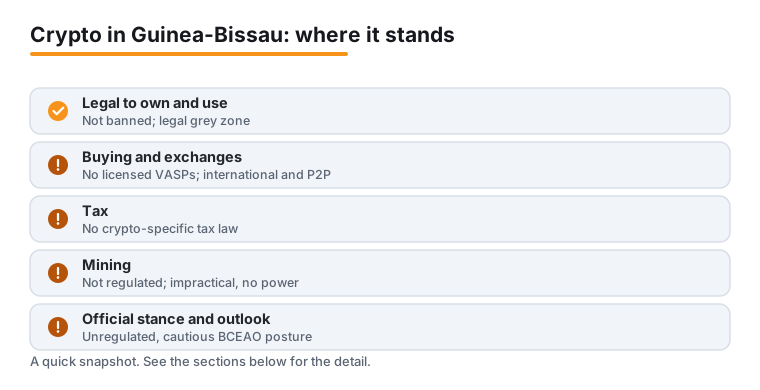
Yes, in the narrow sense that no law specifically bans it. As of 2026 there is no national statute in Guinea-Bissau that prohibits owning, buying, holding or using Bitcoin and other cryptocurrencies. At the same time, crypto is not recognised as legal tender and is not formally regulated, which places it in a legal grey zone: not banned, but not endorsed or protected either.
The only legal-tender currency is the West African CFA franc (XOF), issued exclusively by the BCEAO across the eight WAEMU member states. No cryptocurrency has the status of money in the legal sense, and merchants are not obliged to accept it. The BCEAO has repeatedly signalled caution toward crypto-assets, citing price volatility, weak consumer protection, and the risk of misuse for money laundering and terrorism financing. In practice a resident can use an international exchange or wallet without breaking a specific prohibition, but does so without the safeguards (deposit protection, licensed dispute channels, supervised custodians) that apply to banks. The absence of a ban should not be read as approval.
Who regulates crypto in Guinea-Bissau?
There is no dedicated national crypto regulator in Guinea-Bissau. Because the country is a member of the WAEMU, monetary policy, currency issuance and foreign-exchange matters are handled at the regional level by the Central Bank of West African States (BCEAO), headquartered in Dakar, Senegal. The BCEAO serves the eight WAEMU states (Benin, Burkina Faso, Cote d'Ivoire, Guinea-Bissau, Mali, Niger, Senegal and Togo) and issues the West African CFA franc.
The BCEAO has not created a licensing or supervisory regime for crypto-asset businesses, but it is the institution whose communications and any future regional framework will determine how crypto is treated. Anti-money-laundering supervision in the region is reinforced through GIABA, the Inter-Governmental Action Group against Money Laundering in West Africa, of which Guinea-Bissau is a member. National authorities such as the Ministry of Finance and the national tax administration apply general financial and tax law, but none of them currently runs a crypto-specific framework. You can verify the regulator's identity and statements on the official BCEAO website.
Key laws & regional frameworks
Guinea-Bissau has not enacted a standalone framework licensing crypto exchanges, custodians, token issuers or wallet providers. Instead, several layers of regional rules apply indirectly:
- WAEMU monetary law. The BCEAO holds exclusive authority over currency issuance and monetary policy for the union. Crypto-assets sit outside this framework and carry no monetary status.
- Electronic-money rules. BCEAO Instruction No. 008-05-2015 sets the conditions for issuing electronic money across WAEMU member states. It governs licensed e-money and mobile-money providers rather than crypto specifically, but it is the closest existing regional regime to digital payments.
- Foreign-exchange regulation. Regulation No. 06/2024/CM/UEMOA on foreign exchange, adopted by the WAEMU Council of Ministers on 20 December 2024, replaced the 2010 rules. It tightens cross-border controls, strengthens export-earning repatriation, and channels transactions through approved intermediaries. Though not aimed at crypto, these controls can affect residents' ability to fund and withdraw from international platforms.
- AML/CFT. The region keeps reinforcing anti-money-laundering and counter-terrorism-financing obligations, increasingly reaching the on- and off-ramps between crypto and the CFA franc.
There is no national crypto law and no domestic registration process for crypto businesses. This is general information as of 2026 and not legal advice; readers should verify the current position with the BCEAO.
Licensing & registration of exchanges (VASPs)
No cryptocurrency exchange or virtual-asset service provider (VASP) is licensed or supervised inside Guinea-Bissau, because no licensing regime exists at either the national or, so far, the WAEMU level. This is a known gap: regional authorities and the FATF-style body GIABA have flagged that most West African states are only partially compliant or non-compliant with FATF Recommendation 15, which calls for the licensing or registration and risk-based supervision of VASPs.
Residents who buy crypto therefore typically use international platforms online or informal peer-to-peer (P2P) trades. Some pan-African and global exchanges serve West Africa and support the CFA franc indirectly via mobile-money or card rails, but availability and payment methods change frequently. Until a formal framework arrives, there is no local authority that licenses, audits or backstops an exchange operating with Guinea-Bissau users, and there is little practical recourse under Bissau-Guinean law if an offshore platform freezes funds or fails. Choosing an established platform with a track record, strong security and clear withdrawal terms matters more here than in markets with formal consumer protection.
Crypto taxation in Guinea-Bissau
There is no crypto-specific tax law in Guinea-Bissau, and the treatment of crypto gains, trading or business activity is unsettled. The tax administration is the Direccao Geral das Contribuicoes e Impostos (DGCI), inside the Ministry of Finance, and as of August 2026 it has published no crypto guidance at dgci.mef.gw. General income and business rules apply to taxable activity: a company earning fees from crypto services falls under the same regime as any other business, including value added tax (IVA), whose legal framework is Law No. 4/2022 and which the DGCI applied from 1 January 2025 under Circular n.º 20/GDGCI/2024 of 2 December 2024. There is still no published rate, threshold or reporting rule for an individual holding or selling coins. Because no statute defines a crypto rate, threshold or reporting rule, this guide quotes no specific figure.
Anyone with potentially taxable crypto activity should keep complete records of purchases, sales, conversions and transfers, and should consult a qualified Bissau-Guinean tax adviser and confirm obligations directly with the national tax administration. For background on how crypto is taxed elsewhere, see our guide to crypto taxes. Treat that as general context only; the Guinea-Bissau position must be verified locally.
AML / KYC rules
Although crypto itself is unregulated, the financial system around it is increasingly subject to anti-money-laundering (AML) and know-your-customer (KYC) obligations. Guinea-Bissau is a member of GIABA, the regional AML/CFT body affiliated with the FATF global network, and the WAEMU framework requires banks, payment providers and authorised intermediaries to verify customer identity, monitor transactions and report suspicious activity.
The 2024 foreign-exchange regulation strengthened these duties: authorised intermediaries must now thoroughly verify cross-border financial flows, demand supporting documentation and report suspicious transactions, with heavier penalties for non-compliance. In practice this means reputable exchanges serving the region require identity verification (typically a government-issued ID, and sometimes proof of address), and that large or recurring transfers used to fund or withdraw from crypto platforms can attract scrutiny from banks and regulators. At the regional level, GIABA forums in 2025 specifically addressed the supervision of virtual assets and VASPs, signalling that AML/CFT expectations for crypto on- and off-ramps are tightening.
Buying and using crypto in practice
For residents who decide to proceed and accept the risks, a typical process looks like this:
- 1. Choose a reputable platform. Favour established international or pan-African exchanges with strong security, transparent fees and clear withdrawal terms, and confirm the platform serves Guinea-Bissau users.
- 2. Complete identity verification (KYC). Prepare a government-issued ID and any other documents required.
- 3. Fund the account. Use a supported method, commonly mobile money, a card or a P2P trade in CFA francs, mindful of the WAEMU foreign-exchange rules on cross-border transfers.
- 4. Buy and review fees. Place the order and check the total cost, including spread and network fees.
- 5. Secure your holdings. Beyond small amounts, move funds to a wallet you control and keep your recovery phrase offline. Never share private keys or seed phrases.
- 6. Keep records of your transaction history for any future tax or compliance needs.
Practical frictions are real here: direct XOF bank transfers are uncommon on many exchanges, and there is no local recourse if something goes wrong. Internet access is limited: DataReportal put internet use at about 32.5 percent of the population (roughly 723,000 users) at the start of 2025, while mobile-money services have grown quickly and are the main digital payment method for many residents. Start small to test the full cycle (buying, holding and cashing out) before committing larger sums. Crypto is also sometimes used for diaspora remittances, but the recipient still needs a reliable way to convert back into CFA francs, usually via P2P or a mobile-money-enabled exchange, so compare the all-in cost against established transfer operators.
Bitcoin mining in Guinea-Bissau
Bitcoin mining is not specifically regulated, banned or licensed in Guinea-Bissau, but several structural factors make large-scale mining impractical:
- Electricity supply. The country has one of the region's lowest electrification rates, with limited grid coverage, frequent outages and heavy reliance on diesel generation. Mining is electricity-intensive and depends on cheap, reliable power that is largely unavailable here.
- Cost and sustainability. Where power comes from imported fuel, the cost per kilowatt-hour is high and the carbon footprint significant, undermining both profitability and sustainability.
- Infrastructure. Stable internet, cooling, hardware imports and technical support, all prerequisites for competitive mining, are constrained.
Small hobby setups are conceivable but unlikely to be economical. Any future mining sector would raise the same questions seen across the region, including sourcing reliable energy and how regulators might tax or supervise it, none of which Guinea-Bissau addresses today.
Recent developments (2025-2026)
The most important recent signal is regional rather than national. On 8 May 2026 the BCEAO hosted an international conference in Dakar titled "Crypto-assets and digital innovations: opportunities and challenges for monetary and financial stability," bringing together central bank governors, regulators, banks and digital-finance stakeholders. The stated aim was to formulate strategic and operational recommendations supporting the development of a harmonised regulatory framework within the WAEMU, balancing innovation and financial inclusion against financial stability and consumer protection.
Alongside this, the 2024 WAEMU foreign-exchange regulation took effect and tightened cross-border controls, and GIABA continued to push member states (including Guinea-Bissau) toward FATF Recommendation 15 compliance on supervising virtual assets and VASPs. Taken together, these point to a region preparing a future crypto framework rather than one that already exists. No dedicated WAEMU crypto-asset framework had been adopted as of August 2026, and neither the UEMOA Council of Ministers session of 27 March 2026 nor that of 3 July 2026 adopted a crypto instrument. One regional AML instrument does already reach crypto firms: Directive n°01/2023/CM/UEMOA of 31 March 2023 and the uniform law adopted the same day by Decision n°04/2023/CM/UEMOA add virtual asset service providers to the reporting entities and require prior approval or registration, although Guinea-Bissau's transposition could not be confirmed. Follow official BCEAO communications for changes.
Consumer risks & protection
The absence of regulation cuts both ways: there is no ban, but there is also no safety net. The main risks for crypto users in Guinea-Bissau are the lack of local consumer protection, price volatility, fraud, regulatory uncertainty, and operational hurdles such as patchy internet and limited cash-out options. There is no licensed exchange to complain to, no deposit guarantee, and limited recourse if a platform fails or an investment turns out to be a scam. Guinea-Bissau's financial intelligence unit, CENTIF-GB (Celula Nacional de Tratamento de Informacoes Financeiras), does operate a channel for reporting suspicious operations at centif-gb.gw, but it publishes no virtual asset guidance and it is not a consumer redress body.
This guide gives no investment advice and makes no price predictions. Crypto-assets are highly volatile and can lose value quickly, and in an under-regulated market schemes promising fixed or high returns are a common hallmark of fraud. Anyone considering crypto should commit only money they can afford to lose, use reputable platforms, secure their own keys, and be sceptical of guaranteed-return offers. Clarify any tax consequences with a local professional before realising gains. For more on staying safe and the broader regulatory picture, see our regulation hub.
Official sources & how to verify
Because crypto rules in this region are evolving and set largely at the WAEMU level, always confirm the current position against primary sources rather than relying on secondary summaries. The most authoritative references are:
- Central Bank of West African States (BCEAO) for monetary policy, electronic-money rules, foreign-exchange regulation and any future crypto framework affecting Guinea-Bissau.
- GIABA, the regional AML/CFT body, for anti-money-laundering standards and the supervision of virtual assets and VASPs in West Africa.
- FATF guidance on virtual assets for the international standards (notably Recommendation 15) that GIABA and WAEMU members are working toward.
For the national position on tax and any future legislation, contact the Guinea-Bissau Ministry of Finance and national tax administration directly, and consult a qualified local lawyer or tax adviser. This page is general information as of 2026, not legal advice, and the legal and tax status of crypto should be verified with the BCEAO and a local professional before you act.
What is changing, checked August 2026
Checked in August 2026: nothing in Guinea-Bissau's own statute book changed on crypto since the last review. Every moving part is either regional, at the BCEAO and the UEMOA Council of Ministers, or political, in the transition that replaced the National People's Assembly. The table below is where each one stands.
| What | Where it stands in August 2026 |
|---|---|
| UMOA crypto-asset framework | At the BCEAO's international conference on crypto-assets and digital innovations, held in Dakar on 8 May 2026, Governor Jean-Claude Kassi Brou confirmed that the central bank has set up a committee charged with developing the crypto-asset regulatory framework for the UMOA. No draft text, consultation or timetable has been published, and the bank's press release index carries no crypto framework release through 6 August 2026 (BCEAO conference report, press release index). |
| UEMOA Council of Ministers | Met on 27 March 2026 and again on 3 July 2026 in Ouagadougou. Neither communique lists a crypto-asset regulation, directive or decision among those adopted (27 March 2026, 3 July 2026). |
| Financial stability review | The 29th ordinary session of the UMOA Financial Stability Committee met in Ouagadougou on 30 June 2026. It flags cyberattacks among emerging risks and does not mention crypto-assets at all (CSF-UMOA communique). |
| Fiat payment rails | The BCEAO's interoperable instant payment platform (PI-SPI) went live on 30 September 2025. On 25 June 2026 the bank extended the connection deadline to 30 September 2026 for banks and electronic money and payment institutions, and to 30 June 2027 for microfinance institutions supervised by the UMOA Banking Commission, reporting 80 participants connected and 74 institutions in live testing as at 24 June 2026 (BCEAO). This is the rail most local buyers meet, and it is not a crypto measure. |
| National tax guidance | The Direccao Geral das Contribuicoes e Impostos (DGCI) publishes no guidance on crypto-assets, virtual assets or digital assets (dgci.mef.gw). Nor does the Ministry of Finance (mef.gw). |
| National AML guidance | CENTIF-GB, the financial intelligence unit, operates a channel for reporting suspicious operations but publishes no virtual asset guidance (centif-gb.gw). |
The WAEMU rule that already covers crypto businesses
There is one adopted regional instrument that already names crypto businesses, and it is an anti-money-laundering instrument rather than a market one. On 31 March 2023 the UEMOA Council of Ministers adopted Directive n°01/2023/CM/UEMOA on the fight against money laundering, terrorist financing and the financing of the proliferation of weapons of mass destruction, together with Decision n°04/2023/CM/UEMOA adopting the matching uniform law, and recommended that member states internalise the uniform law within six months (reporting on the adoption and Benin's transposition).
The uniform law widens the list of reporting entities to include virtual asset service providers. They must obtain approval from or register with the competent authority before operating (analysis of the transposed text), and Article 58 of the chapter setting out those specific provisions states that no one may carry on the professional activity of a virtual asset service provider without having obtained approval (article by article text of the VASP chapter). Senegal transposed the directive by Law 2024-08 of 2 February 2024. That is the concrete shape of the first crypto rule most WAEMU states get: a registration duty backed by AML obligations, not a licensing market and not investor protection. It is worth noting that transposition does not by itself make the route usable, since Senegalese reporting recorded that the competent authority for approving providers had not yet been designated.
For Guinea-Bissau the honest position is that transposition could not be confirmed either way. GIABA's country page still describes the anti-money-laundering uniform law adopted by National Assembly Resolution Nr. 4/2004 of 2 November 2004, records a mutual evaluation on-site visit from 18 January to 5 February 2021 with the report published in June 2023, and makes no mention of virtual assets or of virtual asset service providers (GIABA). The legislation section of the National People's Assembly site could not settle the question either, because it publishes category links only and no document listings (Assembleia Nacional Popular). If you run an exchange, broker or custody service touching Guinea-Bissau, this directive, rather than any future BCEAO crypto framework, is the rule most likely to bind you first, and the Boletim Oficial is where a definitive answer on transposition would appear.
Why a national crypto law is unlikely before 2027
Guinea-Bissau has no ordinary legislature at present. A National Transitional Council sits in place of the National People's Assembly. That council approved a revised constitution of 164 articles against 162 in the previous text, described by its spokesperson as a targeted rather than a comprehensive revision, and a national referendum on bringing it into force was set for 30 August 2026 (Agencia de Noticias da Guine-Bissau, 7 July 2026). Presidential Decree No. 02/2026 fixed 6 December 2026 for combined presidential and legislative elections, set after separate hearings with the National Transitional Council, the high military command for the restoration of constitutional order, the transitional prime minister and the national elections commission (ANG, 21 January 2026).
The practical reading for anyone waiting on a Bissau-Guinean crypto statute: the body that would pass one does not sit in its ordinary form, its replacement is occupied with the constitution and the electoral calendar, and a newly elected National People's Assembly would not take office until after 6 December 2026. Expect no national crypto law in 2026. The likelier sequence is that the BCEAO publishes a UMOA-wide framework and Guinea-Bissau applies it as a member state, rather than legislating on its own first.
Tax: the authority that would decide, and what it has published
The authority has a name and an address. It is the Direccao Geral das Contribuicoes e Impostos (DGCI), the tax administration under the Ministry of Finance, at dgci.mef.gw, Av. Osvaldo Vieira, Bissau. It describes itself as the organ of public administration responsible for applying tax policy and legislation, and it is the office that would issue any crypto tax ruling. As of August 2026 it has issued none. Its published material covers taxpayer obligations, tax legislation, declaration forms and the tax calendar, with no reference to criptomoedas, ativos virtuais or ativos digitais.
What the DGCI has done recently is run a general tax reform that any locally established crypto business will meet. Value added tax (IVA), whose legal framework is Law No. 4/2022, has applied since 1 January 2025 across the national territory under DGCI Circular n.º 20/GDGCI/2024 of 2 December 2024, signed by Director General Uffe Vieira Gomes da Silva and giving effect to Despacho n.º 130/GMF/2024 (DGCI circular). Entities in scope must file a start of activity declaration (DIRASCA) with the DGCI, request standardised invoices under Despacho n.º 1/2023, and meet IVA filing and payment obligations. Non-compliance exposes them to fines, penalties and suspension of activity under the RGIT. Budget, debt and public finance documents are published by the Ministry of Finance at mef.gw, which likewise says nothing about crypto.
None of this names crypto. It matters because a Bissau-Guinean company earning fees from crypto services is assessed under these general rules, not under a crypto regime. For an individual holding or selling coins there is still no published rate, threshold or reporting rule, and this guide will not invent one. The circular itself does not state the IVA rate, so no rate is quoted here. Contact the DGCI directly and keep complete records of every purchase, sale, conversion and transfer.
Frequently asked questions
Is cryptocurrency legal in Guinea-Bissau?
There is no law that bans owning or using cryptocurrency in Guinea-Bissau, but crypto is also not legal tender and is not formally regulated, so it sits in a legal grey zone. The only legal-tender currency is the West African CFA franc, issued by the BCEAO, which has expressed caution about crypto-assets. The absence of a ban is not the same as approval, and there is no local consumer protection.
Who regulates crypto in Guinea-Bissau?
There is no dedicated national crypto regulator. Guinea-Bissau is part of the West African Economic and Monetary Union, so monetary and foreign-exchange matters fall to the regional Central Bank of West African States (BCEAO). Anti-money-laundering supervision runs through GIABA. No domestic licensing regime for crypto businesses currently exists, and any future framework is expected to come from the WAEMU level.
Do I have to pay tax on crypto in Guinea-Bissau?
There is no crypto-specific tax law in Guinea-Bissau, and the treatment of crypto gains or business activity is unsettled. General income, business or capital rules could apply in some cases, but the position is unclear. Because this guide cannot confirm any specific rate or threshold, keep full records and consult a qualified local tax adviser and the national tax administration before assuming your obligations.
Are crypto exchanges licensed in Guinea-Bissau?
No. There is no licensing or registration regime for cryptocurrency exchanges or virtual-asset service providers (VASPs) in Guinea-Bissau, and none yet at the WAEMU level. Residents typically use international platforms or peer-to-peer trades, with no local authority supervising them and little legal recourse if a platform fails. The region is working toward FATF Recommendation 15 standards, but a binding framework was not in force as of 2026.
What are the main crypto rules I should know about?
The relevant rules are regional, not national. They include BCEAO Instruction No. 008-05-2015 on electronic money, Regulation No. 06/2024/CM/UEMOA on foreign exchange (adopted 20 December 2024), and AML/CFT obligations reinforced through GIABA. None targets crypto directly, but together they shape how money moves to and from crypto platforms. Verify the current rules with the BCEAO.
Is a WAEMU crypto regulation coming?
Probably, but there is no text and no date. At the BCEAO's international conference on crypto-assets and digital innovations, held in Dakar on 8 May 2026, Governor Jean-Claude Kassi Brou confirmed that the central bank has established a committee charged with developing the crypto-asset regulatory framework for the UMOA. No draft, consultation paper or timetable had been published as of August 2026 for the WAEMU region, and GIABA continues to press member states on supervising virtual assets. As of mid-2026 no binding regional crypto law had been adopted, so crypto remains unregulated in practice in Guinea-Bissau. Follow official BCEAO communications for updates.
How do people in Guinea-Bissau usually buy crypto?
Because no exchange is licensed locally, residents generally use international or pan-African platforms and informal peer-to-peer trades rather than a domestic exchange. Funding often runs through mobile money, which has grown into the main digital payment method in the country, or a card or P2P trade in CFA francs. Internet access is a practical constraint: DataReportal put internet use at about 32.5 percent of the population at the start of 2025, so reach is uneven. There is no local supervisor and little legal recourse if an offshore platform fails.
Is Guinea-Bissau assessed on crypto anti-money-laundering rules?
Yes, indirectly. Guinea-Bissau is a member of GIABA, the FATF-style regional body for West Africa, and its anti-money-laundering and counter-terrorism-financing measures are assessed through GIABA mutual evaluations. FATF Recommendation 15 requires countries to license or register and supervise virtual-asset service providers, and most jurisdictions assessed so far are only partly compliant. Guinea-Bissau does not yet run a crypto-specific licensing regime, so this remains a known gap the region is working to close.
Has Guinea-Bissau adopted the WAEMU anti-money-laundering rules that cover crypto firms?
Not confirmed. The UEMOA Council of Ministers adopted Directive n°01/2023/CM/UEMOA and the matching uniform law by Decision n°04/2023/CM/UEMOA on 31 March 2023, and recommended that member states internalise the uniform law within six months. That uniform law adds virtual asset service providers to the list of reporting entities and requires them to be approved by or registered with the competent authority before operating. Senegal transposed the directive by Law 2024-08 of 2 February 2024. For Guinea-Bissau no transposing statute could be found as of August 2026: GIABA's country page still lists the older uniform law adopted by National Assembly Resolution Nr. 4/2004 of 2 November 2004, and the National People's Assembly site publishes category links rather than document listings, so neither source can confirm or exclude transposition. The Boletim Oficial would settle it.
Could Guinea-Bissau pass its own crypto law in 2026?
Realistically no. A National Transitional Council currently sits in place of the National People's Assembly. The transitional authorities set a constitutional referendum for 30 August 2026 and, by Presidential Decree No. 02/2026, presidential and legislative elections for 6 December 2026. A newly elected National People's Assembly would only take office after that vote, so the earliest realistic window for a national crypto statute is 2027. The more likely route is a UMOA-wide framework from the BCEAO that Guinea-Bissau applies as a member state without legislating first.
Who would regulate crypto exchanges in Guinea-Bissau if rules arrive?
On present signals, the BCEAO. The central bank has set up a committee to develop the crypto-asset regulatory framework for the UMOA, and it is already the authorising body for electronic money issuers and payment institutions across the eight member states. Nationally, tax questions would sit with the DGCI at dgci.mef.gw and suspicious transaction reporting with CENTIF-GB at centif-gb.gw. Neither has published anything on crypto as of August 2026.
Facts reviewed: 13 August 2026. Page updated: 13 August 2026.