Litecoin (LTC): Mining, Price & How to Buy
Litecoin (LTC) is one of the oldest cryptocurrencies still in active use. Launched in 2011 by former Google engineer Charlie Lee, it was designed as a faster, lower-cost complement to Bitcoin rather than a replacement for it. The project drew on Bitcoin's open-source code but changed a few key parameters: a faster block time, a different mining algorithm, and a larger maximum supply. That mix earned it the long-running nickname "the silver to Bitcoin's gold."
This guide explains what Litecoin actually is, how to buy and store it safely, how LTC mining works in 2026, and how the network compares to Bitcoin. It is educational only and is not financial, legal, or tax advice. Cryptocurrency is volatile and the rules around it differ by country, so verify anything that affects your money with official and primary sources before acting.
What is Litecoin (LTC)?
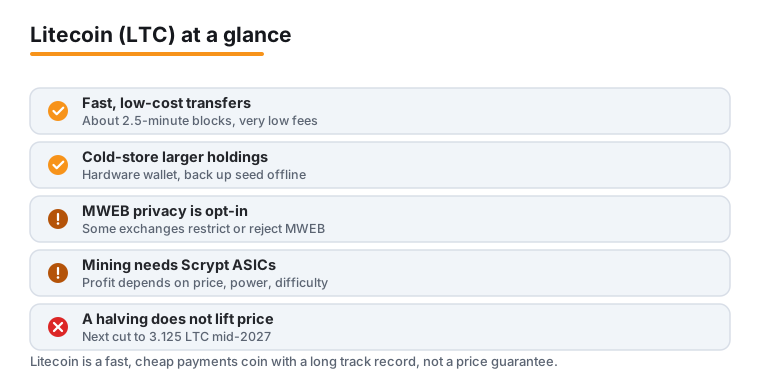
Litecoin is a decentralized, peer-to-peer digital currency that runs on its own public blockchain. Like Bitcoin, it has no central issuer or administrator: transactions are validated by a global network of computers, and the rules are enforced by software that anyone can inspect because the code is open source.
Charlie Lee released Litecoin in October 2011. The goal was not to compete with Bitcoin as "digital gold" but to make a coin better suited to everyday payments. To do that, the design changed several things:
- Block time of about 2.5 minutes, roughly four times faster than Bitcoin's ~10 minutes, so transactions tend to receive their first confirmation sooner.
- Scrypt as the mining algorithm instead of Bitcoin's SHA-256. Scrypt was originally chosen because it was more memory-intensive and, in the early years, friendlier to ordinary hardware.
- A maximum supply of 84 million LTC, exactly four times Bitcoin's 21 million cap.
- Generally low transaction fees, which makes small and cross-border transfers practical.
Over the years Litecoin has adopted upgrades that Bitcoin also uses or pioneered, including Segregated Witness (SegWit) and support for the Lightning Network for fast, cheap off-chain payments. In May 2022 it activated MimbleWimble Extension Blocks (MWEB), an optional privacy and scalability feature: users can move coins into extension blocks for more confidential transactions, but the main ledger stays transparent and using MWEB is entirely opt-in.
In practice, people hold or use LTC for a few reasons: as a faster and cheaper way to move value between exchanges and wallets, as a payment method accepted by a growing list of merchants and payment processors, and as a long-standing crypto asset with a recognizable track record.
How to buy & store LTC
Most people acquire Litecoin through a centralized exchange or a regulated crypto broker. The typical process is: create an account, complete identity verification (KYC) where required, deposit funds by bank transfer, card, or another supported method, and then place an order for LTC. Litecoin is widely listed, so it is usually available on major global and regional platforms.
Choosing where to buy
- Reputation and track record. Favor established platforms with a long operating history and transparent ownership over unknown sites.
- Regulatory standing. Check whether the service is registered or licensed to operate in your country. Requirements vary widely by jurisdiction, so confirm with the relevant local authority rather than assuming.
- Fees. Compare trading fees, spreads, and deposit/withdrawal costs, which can differ significantly between platforms.
- Security features. Look for two-factor authentication (2FA), withdrawal whitelists, and a clear security history.
If you buy peer-to-peer (P2P) directly from another person, treat it with extra caution: vet the counterparty's history and reviews, be skeptical of prices far below market, and use escrow where the platform offers it. Offers that seem too good to be true usually are.
Storing LTC safely
Leaving coins on an exchange is convenient but means a third party controls the keys. For meaningful amounts, moving LTC to a wallet you control is the safer default. Wallet options include:
- Hardware wallets (cold storage): physical devices that keep your private keys offline. These offer the strongest protection against online theft and are the usual recommendation for larger or long-term holdings.
- Software wallets (hot wallets): desktop or mobile apps that are convenient for spending but are connected to the internet and therefore more exposed.
Whatever you choose, a few habits matter more than any single product:
- Use a strong, unique password and enable 2FA on every related account.
- Write down your recovery phrase (seed) on paper or metal and store it offline. Anyone who has it can take your coins; no legitimate service will ever ask you for it.
- Always send a small test transaction first when using a new address.
- Double-check the destination address, since malware can swap copied addresses.
- Keep wallet software and device firmware up to date, and be alert to phishing sites that imitate real exchanges. Confirm the URL and look for HTTPS.
Buying, selling, or spending LTC can have tax consequences in many places. Keep records of your transactions and consult a qualified professional about the rules where you live.
Litecoin mining
Mining is how new Litecoin enters circulation and how the network confirms transactions. Miners compete to solve a Scrypt-based proof-of-work puzzle; the winner adds the next block and receives the block reward plus any transaction fees. As of 2026 the block reward is 6.25 LTC per block. The reward halves roughly every four years (every 840,000 blocks); the next halving is expected around mid-2027, cutting the reward to 3.125 LTC. Halvings continue until the 84 million cap is reached, projected far into the next century.
ASIC vs GPU mining
In Litecoin's early days you could mine with an ordinary CPU or graphics card. That era is over for competitive mining. Today Scrypt ASICs (application-specific integrated circuits) dominate because they are built to do one job and do it far more efficiently than general hardware.
| Factor | ASIC miners | GPU miners |
|---|---|---|
| Hash power | Very high for Scrypt | Low by comparison |
| Energy efficiency | High (purpose-built) | Lower |
| Upfront cost | Higher | Lower per unit |
| Flexibility | Locked to Scrypt coins | Can switch coins or be reused for gaming/other work |
| Obsolescence | Newer models can quickly outpace older ones | Retains general-purpose value |
The practical takeaway: for Litecoin specifically, modern Scrypt ASICs are effectively the only way to compete on the main network, while GPUs offer flexibility for people who want to mine a range of coins or repurpose hardware later.
Merged mining with Dogecoin
One distinctive feature of LTC mining is merged mining (also called AuxPoW). Because Dogecoin uses the same Scrypt algorithm, miners can secure both networks at the same time with no extra energy, earning LTC and DOGE rewards simultaneously. A large share of Dogecoin's hash power now comes from this arrangement, and the two networks' hash rates move closely together. For many operators, the combined reward is a meaningful part of the economics.
Solo vs mining pools
Mining alone means you only earn when you personally find a block, which can be rare and unpredictable. Mining pools combine many participants' hash power and split rewards proportionally, producing smaller but far steadier payouts. When evaluating a pool, weigh its size (larger pools pay more regularly but in smaller shares), its fee structure and payout method, its security and uptime record, and the quality of its support. Be wary of pools that advertise unrealistic returns.
Profitability and challenges
Mining profitability is never guaranteed. It depends on the LTC (and DOGE) price, your electricity cost, hardware efficiency, network difficulty, and pool fees. A rig that is profitable one month can break even or lose money the next if prices fall or difficulty rises. Other realities to plan for include heat and noise, hardware that depreciates as newer models launch, and the ongoing energy footprint of proof-of-work. Treat any earnings calculator as an estimate, not a promise, and model conservative scenarios before buying equipment.
LTC vs Bitcoin
Litecoin began as a fork of Bitcoin's codebase, so the two share a lot of DNA: both are decentralized, capped-supply, proof-of-work cryptocurrencies with public ledgers. The differences are deliberate design choices aimed at making Litecoin quicker and cheaper for transacting.
| Litecoin (LTC) | Bitcoin (BTC) | |
|---|---|---|
| Launched | 2011 (Charlie Lee) | 2009 (Satoshi Nakamoto) |
| Block time | ~2.5 minutes | ~10 minutes |
| Mining algorithm | Scrypt | SHA-256 |
| Maximum supply | 84 million | 21 million |
| Typical fees | Generally very low | Variable, can be higher |
| Common role | Faster payments / "silver" | Store of value / "gold" |
What this means in practice: Litecoin's faster blocks and low fees make it well suited to smaller, more frequent transfers, while Bitcoin's far larger network, liquidity, and brand recognition have cemented its position as the dominant store-of-value asset. The two are often seen as complementary rather than direct rivals. Bitcoin's network effect and adoption dwarf Litecoin's, but Litecoin's longevity, stability, and shared technical heritage have kept it relevant for more than a decade. Several upgrades, such as SegWit and the Lightning Network, were tested or adopted on Litecoin in parallel with Bitcoin.
What changed in 2025-2026
The last couple of years brought some of the biggest news in Litecoin's history. None of this is a reason to buy or sell anything; it is just useful context for understanding where the network stands today.
A U.S. spot LTC ETF is now trading
On October 28, 2025, the first U.S. spot Litecoin exchange-traded fund began trading on Nasdaq under the ticker LTCC, issued by Canary Capital. That put Litecoin alongside Bitcoin and Ethereum as one of the few crypto assets with a regulated U.S. spot ETF. A spot ETF lets people get price exposure to LTC through an ordinary brokerage account without holding the coin themselves. It does not change how the Litecoin network works, and an ETF wrapper does not remove the price risk of the underlying asset. You can read the issuer's own announcement at litecoin.com, and Bloomberg analysts had earlier put the odds of approval near certain, as reported by The Block.
MWEB privacy kept growing, and it is still opt-in
MimbleWimble Extension Blocks remain an optional layer: coins move into MWEB only when a user chooses to send them there, and the regular ledger stays transparent. Adoption climbed through 2025. The amount of LTC held inside MWEB reached an all-time high of about 402,000 LTC on December 16, 2025, according to Litecoin's 2025 recap. Wallets such as Cake Wallet and Electrum-LTC support MWEB sends. It is worth knowing the trade-off: because MWEB can hide transaction amounts, several South Korean exchanges delisted LTC in 2022 over anti-money-laundering rules, as The Block reported, and some platforms still do not process MWEB transactions. Always check whether your exchange or wallet supports it before sending.
Payments use stayed real, not just talk
Litecoin continued to see genuine payment volume rather than only speculation. On the processor BitPay it ranked among the top crypto assets by transaction count through 2025, and on CoinGate it accounted for roughly 14 to 15 percent of transactions. The network also processed its 3,000,000th block on November 9, 2025, and its hashrate hit record highs, points covered in the same 2025 recap. Telegram also added LTC to its built-in wallet for non-U.S. users in March 2025. For more on spending crypto day to day, see our guide to crypto payments.
Next halving and outlook
Litecoin's supply schedule is fixed in code. Every 840,000 blocks the reward paid to miners is cut in half, which slows the rate of new coins entering circulation. Litecoin has already gone through three halvings: 2015 (50 to 25 LTC), 2019 (25 to 12.5 LTC), and August 2023 (12.5 to 6.25 LTC).
What the 2027 halving actually does
The next halving is expected around July 2027 at block height 3,360,000, when the reward drops from 6.25 LTC to 3.125 LTC per block, the same figure Bitcoin reached in April 2024. In plain terms, the amount of new LTC created each day falls from roughly 3,600 to about 1,800. Because the date depends on how fast blocks are found, the exact day shifts a little; a live counter such as litecoinblockhalf.com shows the current estimate. A common misunderstanding is that a halving automatically pushes the price up. It does not. Supply mechanics are only one factor among many, and history is not a guarantee of what comes next.
What halvings mean for miners
For miners, a halving cuts block income in half overnight, so anyone running hardware needs to recheck whether their setup still covers electricity and costs. Merged mining with Dogecoin can soften the hit because the DOGE reward is unaffected by Litecoin's schedule. The deeper logic mirrors Bitcoin's; if you want the full reasoning, our Bitcoin halving guide walks through it.
How LTC differs from BTC today
Beyond the original design differences, a few things now set the two apart in practice. Litecoin offers optional on-chain privacy through MWEB, which Bitcoin's base layer does not have. Bitcoin's base layer added Taproot and is the main focus of Lightning development, while Litecoin leans on its low fees and 2.5-minute blocks for everyday transfers. There is also an experimental EVM-compatible Layer 2 called LitVM, a zero-knowledge rollup aiming to bring smart contracts and DeFi to Litecoin, with a mainnet targeted for 2026, described by litecoin.watch. Treat LitVM as early and unproven for now. The supply gap is structural too: Litecoin will issue 84 million coins versus Bitcoin's 21 million, and Bitcoin still has vastly more liquidity, holders, and institutional weight. For a side-by-side with other coins see Bitcoin, Bitcoin Cash, and our crypto comparisons. None of this is a recommendation; it is just how the networks look heading into 2026, and you should confirm anything that affects your money with primary sources.
Frequently asked questions
Is Litecoin a good investment?
No one can answer that for you, and this guide does not give investment advice. Litecoin is a volatile asset whose price can rise or fall sharply, and past performance does not predict future results. If you are considering it, only commit money you can afford to lose, do your own research, and speak with a qualified financial professional about your situation.
Can I still mine Litecoin profitably in 2026?
It is possible but not guaranteed. Competitive Litecoin mining now requires Scrypt ASIC hardware, and profitability depends on the LTC and Dogecoin prices, your electricity cost, network difficulty, and pool fees. Merged mining with Dogecoin can improve the economics, but you should model realistic, conservative scenarios with a current calculator before buying equipment.
How is Litecoin different from Bitcoin?
Litecoin uses a faster ~2.5-minute block time, the Scrypt mining algorithm, and an 84 million coin cap, versus Bitcoin's ~10-minute blocks, SHA-256 algorithm, and 21 million cap. Litecoin is generally positioned for fast, low-cost payments, while Bitcoin is more widely held as a store of value. They share most of their underlying technology.
What is the safest way to store Litecoin?
For larger or long-term holdings, a hardware (cold storage) wallet that keeps your private keys offline is generally considered the safest option. Back up your recovery phrase offline, never share it with anyone, enable two-factor authentication on related accounts, and send a small test transaction when using a new address.
When is the next Litecoin halving?
The next halving is expected around mid-2027, at block height 3,360,000, when the block reward is scheduled to drop from 6.25 LTC to 3.125 LTC. Halvings occur roughly every four years. Exact timing depends on how quickly blocks are mined, so check a live countdown for the latest estimate.
Is there a Litecoin ETF?
Yes. The first U.S. spot Litecoin ETF began trading on Nasdaq under the ticker LTCC on October 28, 2025, issued by Canary Capital. It lets people get price exposure to LTC through a regular brokerage account without holding the coin directly. An ETF does not change how the Litecoin network works, and it does not remove the price risk of the underlying asset. This is general information, not a recommendation to buy or sell.
Does Litecoin have private transactions?
It can, but only if you opt in. Since May 2022, MimbleWimble Extension Blocks (MWEB) let users send more confidential transactions by moving coins into separate extension blocks that hide amounts. The regular Litecoin ledger stays transparent, and MWEB is never automatic. Note that because of these privacy features some exchanges, including several in South Korea, restrict or do not support MWEB transactions, so check that your platform handles them before sending.
Last updated: 2026-06.