Home › Crypto Regulation › Vanuatu
Bitcoin & Cryptocurrency Regulation in Vanuatu
Quick answer — Vanuatu, 2026
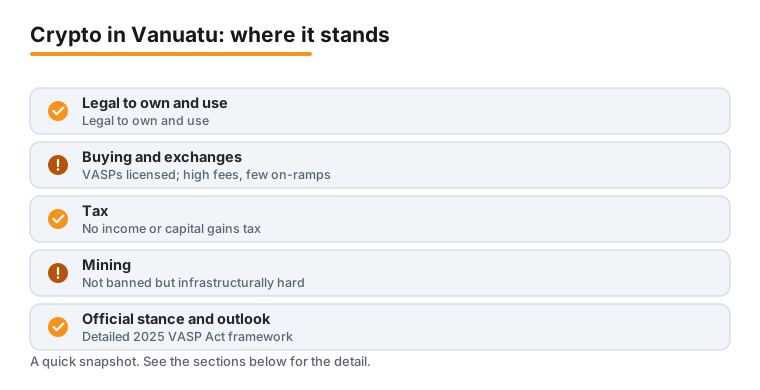
- Legal: Legal for individuals, not legal tender; providers licensed by VFSC
- Tax: No income or capital gains tax; 15% VAT applies generally
- Buying: Via international exchanges and P2P, limited local on-ramps
Vanuatu, a South Pacific archipelago of roughly 80 islands, has shifted from a lightly supervised offshore centre to a jurisdiction with one of the more detailed digital-asset regimes in its region. On 26 March 2025 its Parliament passed the Virtual Asset Service Providers Act No. 3 of 2025, and the Act came into force on 12 May 2025. It brings exchanges, custodians, transfer services and token issuers under formal licensing by the Vanuatu Financial Services Commission (VFSC), which the Act designates as the prudential and supervisory authority, with the Vanuatu Financial Intelligence Unit as the AML and CTF supervisor. For individuals, owning and using Bitcoin remains legal, and the country's well-known absence of personal income and capital gains taxes continues to shape how crypto is treated in practice.
This guide explains where things stand in 2026: the legal status of crypto, who regulates it, the key law and how licensing works, how crypto is taxed, the AML and KYC rules, how residents and visitors buy and use digital assets, mining, recent developments, consumer risks, and how to verify the rules with official sources. It is general information as of 2026 and is not legal, tax or financial advice. Vanuatu's framework is new and still being implemented, so always confirm the current rules directly with the VFSC and a qualified local adviser before acting. For wider context, see our crypto regulation guide.
On this page: Legal status · Who regulates it · Taxes · How to buy · Mining
Is Bitcoin and crypto legal in Vanuatu?
Yes. Buying, holding, selling and using Bitcoin and other cryptocurrencies is legal for individuals in Vanuatu. There is no prohibition on owning digital assets or transacting in them privately.
Legal does not mean legal tender, and it does not mean unregulated. Crypto is not recognised as official currency; the national currency is the vatu (VUV), and merchants are not obliged to accept Bitcoin. What changed in 2025 is that the businesses providing crypto services are now regulated. Under the Virtual Asset Service Providers Act No. 3 of 2025, any company offering services such as operating an exchange, transferring virtual assets, providing custody, or running a token offering must be licensed by the VFSC. So personal use is open, but operating a crypto business from or within Vanuatu requires authorisation and ongoing compliance.
Who regulates crypto in Vanuatu?
The single regulator for crypto businesses is the Vanuatu Financial Services Commission (VFSC). By virtue of the Virtual Asset Service Providers Act No. 3 of 2025, the VFSC is responsible for licensing and supervising Virtual Asset Service Providers (VASPs) and Initial Token Offerings (ITOs).
Vanuatu does not have a Western-style central bank acting as the crypto regulator; the Reserve Bank of Vanuatu oversees monetary policy and the vatu, while the VFSC handles financial-services licensing including virtual assets. The VFSC was given enhanced investigation and enforcement powers under the Act, and it states publicly that investments in virtual assets and cryptocurrencies are not protected by any statutory compensation arrangements in Vanuatu. The official VFSC virtual-asset pages and application guidelines are the authoritative reference for current requirements: VFSC Virtual Asset Service Provider.
Key crypto laws and frameworks in Vanuatu
The cornerstone is the Virtual Asset Service Providers Act No. 3 of 2025, passed by Parliament on 26 March 2025. It was developed over several years by the VFSC and government task forces on distributed-ledger technology and virtual assets, and it deliberately rejects a purely light-touch approach.
Key features of the framework include:
- Regulator: The VFSC licenses and supervises VASPs and ITOs.
- Definition of virtual asset: a digital representation of value that can be traded and functions as a medium of exchange, unit of account or store of value. Digital representations of fiat currency, securities and central bank digital currencies (CBDCs) are expressly excluded.
- International alignment: the regime is designed to align with standards from the Financial Action Task Force (FATF), the Asia/Pacific Group on Money Laundering (APG), IOSCO, the OECD and the EU, including the FATF Travel Rule.
- Fintech sandbox: the law provides for a sandbox so approved companies can test services for a limited period that can be renewed.
- Consumer protection caution: the VFSC warns that crypto investments are not covered by any statutory compensation scheme in Vanuatu.
You can read the legislation itself on the VFSC site: Virtual Asset Services Providers Act No. 3 of 2025 (PDF). Because the rules are detailed and still being implemented, treat any summary, including this one, as a starting point and confirm specifics with the official text and current VFSC guidance.
Licensing and registration of exchanges and VASPs
Under the Act, a company must not provide virtual-asset services unless it holds a licence authorising those services. The VFSC operates a class-based licensing structure. Reported license classes cover exchange, transfer, custody, financial services and token offerings, and a bank-related class (commonly described as classes D, D.1, D.2, D.3 and D.4). A business may need authorisation for more than one class depending on what it does.
The fee schedule for 2026 is substantial and now gazetted rather than merely reported from advisory sources. It was formally set on 16 January 2026 under the Virtual Asset Service Providers Order (Order No. 9 of 2026): an application fee of USD 50,000 plus a license fee of USD 100,000 per class, with the VASP regime structured as an extension of Vanuatu's existing financial-dealer licensing. The VASP licence sits on top of a Financial Dealers License (FDL), and the VFSC's own application requirements dated 29 January 2026 do not mention a Financial Dealers Licence prerequisite at all, but a commercial licensing adviser reports the VFSC will issue a VASP licence only to entities that already hold all four FDL classes (A, B, C and D), so verify this point directly with the VFSC, so an applicant that does not already hold the FDL must obtain it first. Under the Act the Commissioner is to approve or refuse an application within three months of receiving it, and an approval is valid for 12 months and may be renewed. Exact amounts and conditions can still change, so prospective applicants should confirm the current fee schedule and eligibility directly with the VFSC rather than rely on third-party summaries.
Licensing matters for providers, not for ordinary buyers. A foreign exchange serving Vanuatu users may or may not hold a VFSC licence. Using a regulated, reputable platform reduces counterparty risk. See our regulation hub for how other jurisdictions handle VASP licensing.
Crypto and Bitcoin tax in Vanuatu
Vanuatu is well known as a low-tax jurisdiction. It does not levy personal income tax, corporate income tax or capital gains tax, so there has historically been no crypto-specific tax on individuals trading, holding or mining digital assets. Vanuatu does operate a value-added tax (VAT) of 15 percent (raised from 12.5 percent on 1 January 2018) that applies generally to goods and services, but the buying and selling of crypto is not taxed the way a routine consumer purchase is.
Several points deserve caution:
- The absence of income and capital gains taxes is a feature of Vanuatu's general tax system, not a special crypto exemption. Treat any tax-free description as a snapshot, not a permanent guarantee.
- Licensed VASPs still face significant licence fees, levies and compliance costs even where profits are not income-taxed.
- If you are tax-resident in another country, your home jurisdiction will very likely tax your crypto gains regardless of Vanuatu's rules. Holding a passport or residency does not by itself change where you owe tax.
We do not state personal rates or thresholds here because they depend on your circumstances and can change. Confirm your position with a qualified tax adviser and the relevant authorities, and disclose income wherever you are taxable. See our crypto taxes guide for general principles. This section is informational only and is not tax advice.
AML, KYC and the Travel Rule
Anti-money-laundering and counter-terrorism-financing controls are central to the VASP regime. Licensed firms must apply AML and CFT programmes under the Anti-Money Laundering and Counter-Terrorism Financing Act No. 13 of 2014, including internal controls and enhanced due diligence under Parts 4, 5 and 6, suspicious transaction reporting to the Financial Intelligence Unit under section 20, sanctions and proliferation financing screening, record keeping, and the FATF Travel Rule. Section 27 of the VASP Act goes further than a reporting duty: an originating VASP must not execute a transfer of a virtual asset where the required and accurate originator and beneficiary information has not been obtained.
The framework is explicitly designed to align with FATF and Asia/Pacific Group standards, reflecting Vanuatu's need to manage the financial-crime scrutiny that offshore centres attract. For users, the practical effect is that transfers through licensed providers are not anonymous: expect identity verification when you open accounts and when you move larger amounts. The VFSC was granted enhanced investigation and enforcement powers to police these obligations, and operating without a required licence carries serious penalties.
Buying and using crypto in practice
Residents and visitors in Vanuatu typically buy crypto through international exchanges and apps rather than a large domestic ecosystem, funding accounts by bank transfer or debit and credit cards, alongside peer-to-peer (P2P) marketplaces for local-currency trades.
A typical process looks like this:
- Choose a reputable platform that serves Vanuatu, or a trusted P2P marketplace. Check its security history and whether it is licensed where required.
- Complete verification by providing the identity documents the platform requests to satisfy KYC requirements.
- Fund your account by a supported method, allowing for fees and any conversion through major fiat currencies, since vatu on-ramps can be limited.
- Place your order, ideally starting small while you learn the platform.
- Secure your holdings by moving anything beyond small balances to a wallet you control, and protect your keys and recovery phrases.
Bitcoin ATM coverage in Vanuatu is effectively nonexistent; public trackers do not list operational machines, which is unsurprising given the small, dispersed population. Crypto is also sometimes promoted for remittances, which matter to many Pacific households, but the all-in cost includes converting to and from local currency, where thin liquidity and spreads can erode the savings. Compare the total cost against established remittance services before relying on it.
Bitcoin mining in Vanuatu
There is no specific law banning or expressly authorising Bitcoin mining in Vanuatu, and the country is not a notable mining hub. The constraints are economic and infrastructural rather than legal.
The main challenge is electricity. Vanuatu's grids are relatively small and power can be costly compared with major mining regions, which makes large-scale proof-of-work mining hard to run profitably. The country does have renewable potential, particularly solar plus some hydro, so in theory miners pairing operations with renewable generation could reduce costs and impact, but this remains a niche prospect rather than an established industry.
Anyone considering mining should weigh energy price and availability, import duties on hardware, environmental considerations on small islands, and any business-registration or licensing obligations that may apply if mining is run as a commercial enterprise. Confirm the current position with local authorities before committing capital.
Recent developments (2025-2026)
The defining development is the passage of the Virtual Asset Service Providers Act No. 3 of 2025 on 26 March 2025, which made Vanuatu one of the first Pacific island nations to enact a comprehensive virtual-asset law. The Act was gazetted and entered into force during 2025, and the VFSC has since published application guidelines, digital-asset guidance and a virtual-assets risk assessment, alongside June 2025 supporting guidelines covering fit-and-proper assessment, cybersecurity, the FATF Travel Rule and Initial Token Offerings, which show the framework is operational rather than only on paper.
Through late 2025 and into 2026 the focus has been implementation: the VFSC has been issuing and refining licence application requirements, including the fee schedule formally gazetted on 16 January 2026 under the Virtual Asset Service Providers Order, and clarifying how the VASP framework sits alongside Vanuatu's existing financial-dealer licensing. Because the regime is new, requirements and interpretations may continue to shift. Always check the VFSC's current guidance rather than assume earlier figures still apply.
Consumer risks and protection
The single most important consumer point is the VFSC's own caution: investments in virtual assets and cryptocurrencies are not protected by any statutory compensation arrangements in Vanuatu. If a platform fails or funds are lost, there is no deposit-insurance-style backstop.
Other risks to weigh:
- Volatility: crypto prices can fall sharply and quickly.
- New and evolving rules: the framework is still being implemented, and penalties for unlicensed activity are severe. For carrying on virtual-asset-service-provider business without a licence, the Act sets a fine of up to VT 200,000,000 or up to 30 years imprisonment for an individual, and a fine of up to VT 300,000,000 for a body corporate.
- Limited local infrastructure: few on-ramps, no Bitcoin ATMs, and thin liquidity can raise real costs.
- Scams: fake apps, fraudulent platforms and guaranteed-return schemes target small markets as readily as large ones. Vanuatu has also featured in discussions of its citizenship-by-investment program, a separate matter from buying crypto that attracts international scrutiny and warrants specialist advice.
Protect yourself by using regulated, reputable providers, keeping records, securing your own keys, and getting professional advice for anything involving licensing, taxation or large sums.
Official sources and how to verify
Because crypto rules in Vanuatu are new and evolving, verify anything important against primary official sources rather than summaries. The most authoritative references are:
- Vanuatu Financial Services Commission - Virtual Asset Service Provider, the regulator's own hub for VASP and ITO licensing, application forms and guidance.
- Virtual Asset Services Providers Act No. 3 of 2025 (official PDF), the full text of the law.
- Parliament of the Republic of Vanuatu, where bills and Acts are published.
- Financial Center Association of Vanuatu - VASP Act announcement, an industry-body summary of the framework.
To confirm a licence, contact the VFSC directly through its official website. This page is general information as of 2026 and is not legal, tax or financial advice; readers should verify the current position with the VFSC before acting. For related reading, see our crypto regulation guide and the broader regulation hub.
Vanuatu crypto law at August 2026: what has moved
Since this page was last reviewed, one thing has changed materially: the Virtual Asset Service Providers Act is no longer Vanuatu's only crypto statute. Parliament passed a Stablecoins Bill in 2025 with its own regulator and its own licence, and Vanuatu appointed its first Commissioner of Stablecoins in July 2026. A rewritten central bank law that would make Reserve Bank digital currency legal tender was passed on 6 November 2025. Neither measure is administered by the VFSC, and neither has been confirmed as commenced, because both commence only on publication in the Gazette and no gazette notice could be verified for either.
| Measure | Stage at August 2026 | What it does | Timing |
|---|---|---|---|
| Virtual Asset Service Providers Act No. 3 of 2025 | In force | VFSC licensing of exchange (Class D), transfer (D.1), safekeeping (D.2), token offering and related financial business (D.3), and bank virtual asset activity (D.4) | Passed 26 March 2025, in force since 12 May 2025 per the VFSC risk assessment of 20 November 2025 |
| Stablecoins Act 2025 | Reported passed by Parliament; first Commissioner appointed July 2026; commencement not verified | Separate licence for stablecoin issuers under a Stablecoin Supervisory Commission, with reserve, redemption and audit rules | Commences on publication in the Gazette (section 62); existing issuers get 12 months from commencement to apply (section 61) |
| Reserve Bank of Vanuatu Act 2025 | Passed 6 November 2025, awaiting commencement notice | Defines currency to include Reserve Bank digital currency and makes it legal tender; extends Reserve Bank oversight to payment systems | Expected to come into effect in 2026 once a gazette notice including a date of commencement is published |
| VFSC application requirements for a VASP licence | Revised version dated 29 January 2026 | Sets out the business plan, governance, cybersecurity, AML/CTF, capital adequacy and wind down evidence the VFSC expects | Applies now, including to material changes by existing licensees |
| APG fifth round mutual evaluation | Technical compliance submission due 31 March 2026 | Full assessment of Vanuatu's AML and counter terrorist financing regime, with virtual assets a high focus area | Vanuatu is listed for an APG plenary in 2027 |
| EU high risk third country listing | Listed since 23 September 2016, unchanged | EU banks and exchanges must apply enhanced due diligence to Vanuatu linked customers and transactions | Current list amended by Commission Delegated Regulations (EU) 2026/46 and (EU) 2026/83, adopted on 3 and 4 December 2025 |
The Stablecoins Act: a second crypto regime beside the VASP Act
Vanuatu's Parliament passed a Stablecoins Bill in 2025 that sits alongside, not inside, the VASP Act. Section 1A establishes a Stablecoin Supervisory Commission (SSC) whose members are the Governor of the Reserve Bank or nominee as Chairperson, the Commissioner of the VFSC or nominee as Deputy Chairperson, the Director General of the Ministry of Finance and Economic Management, and a representative nominated by the Minister. Vanuatu named Jackson Miake as its first Commissioner of Stablecoins in July 2026, a role the Bill provides for the SSC to appoint on a five year term with one possible reappointment.
The Bill defines a stablecoin as a digital asset intended to be used for payments or settlement, where the issuer or licensee promises to redeem it for something of fixed monetary value, or represents that it maintains a stable value. Under subsection 2(1) no person may carry on a licensed stablecoin activity without an SSC licence, and under Schedule 1 an applicant must be a company incorporated in Vanuatu, an overseas company registered in Vanuatu, or a bank licensed by the Reserve Bank. The figures below come from the Bill as tabled in Parliament's Second Ordinary Session of 2025, and the Act as passed may differ in detail.
- Licence fee VT 10,000,000, renewal fee VT 3,000,000 (Schedule 2)
- Minimum paid up share capital of VT 200,000,000, or an equivalent amount in another currency that is freely convertible or approved by the SSC (Schedule 1)
- Reserve assets must include up to 60 percent US Treasury bills or cash and a minimum 30 percent insured bank deposits, and must be high quality and highly liquid (section 10)
- Holders can redeem at par value, and a licensee must honour a valid request as soon as practicable and, unless the SSC approves otherwise, not later than 3 business days after receipt (section 19)
- Issuers must not pay interest on stablecoins, and reserve income accrues to the licensee, not to holders (section 16)
- At least monthly published independent audit or attestation of reserve assets (section 15)
- In a winding up, stablecoin holder claims rank as a priority pro rata against the required reserves, with first priority for any shortfall (section 17)
- Contravening the licensing prohibition: fine up to VT 60,000,000 and imprisonment up to 2 years (section 51)
For a holder, the practical effect once the Act commences would be a statutory right to redeem a Vanuatu issued stablecoin at par and a priority claim on segregated reserves if the issuer collapses. It is not a compensation scheme, and it does not change the treatment of foreign issued stablecoins such as USDT or USDC. Section 62 says the Act commences on the date on which it is published in the Gazette. No gazette date is published on the Parliament or VFSC websites, and the SSC has not released any public licensing timeline, so confirm the position with the Ministry of Finance and Economic Management before relying on it.
Reserve Bank of Vanuatu Act 2025 and the case of the digital vatu
The Reserve Bank of Vanuatu Act 2025 was passed on 6 November 2025 and repeals the Reserve Bank Act [CAP 125]. It matters here for one reason. The Act defines currency as banknotes, coins and currency issued by the Reserve Bank, and includes currency issued by the Reserve Bank in digital form. Section 44 then provides that currency issued by the Reserve Bank is legal tender in Vanuatu, in the case of notes or digital currency for the payment of any amount, while section 41 keeps the sole right of designing and issuing currency with the Reserve Bank.
That is a legal basis for a central bank digital vatu. It is not recognition of Bitcoin or of private stablecoins as money, and it does not change the status of privately issued crypto, which remains outside legal tender. The Act also gives the Reserve Bank the function of regulating and overseeing payment systems and promoting their safety, soundness and efficiency, and reporting indicates providers of e-money and digital wallet services will fall within the purview of the Reserve Bank, facing stricter licensing obligations, minimum standards of operation and reporting obligations.
The Act commences on the date on which it is published in the Gazette. On the most recent verifiable public information it had not yet commenced and was expected to come into effect during 2026. No launch date, pilot or technical design for a digital vatu has been announced.
Why a Vanuatu link still triggers extra checks abroad
Two external processes shape how a Vanuatu resident or a Vanuatu registered crypto firm is treated by banks and exchanges outside the country.
- Vanuatu is on the European Commission's list of high risk third countries for money laundering, with a listing date of 23 September 2016, and it remained on the list after the December 2025 revision, which added Bolivia and the British Virgin Islands and delisted Burkina Faso, Mali, Mozambique, Nigeria, South Africa and Tanzania. The current list is amended by Commission Delegated Regulations (EU) 2026/46 and (EU) 2026/83, adopted on 3 and 4 December 2025. EU banks, exchanges and other obliged entities must apply enhanced due diligence to business relationships and transactions involving listed countries. In practice that means slower account opening, more documentation and more frequent source of funds questions for Vanuatu residents and Vanuatu incorporated firms.
- Vanuatu is being assessed in the Asia/Pacific Group on Money Laundering fifth round. The APG schedule lists Vanuatu's technical compliance submission as due 31 March 2026, with Vanuatu grouped for an APG plenary in 2027. Virtual assets are one of the high risk and high focus areas of the review, alongside online gaming and the citizenship programme. The result will decide whether Vanuatu's VASP regime is judged effective in practice rather than only on paper, and it is the single event most likely to change how Vanuatu licensed firms are treated internationally.
Frequently asked questions
Is cryptocurrency legal in Vanuatu?
Yes. Owning, buying, selling and using crypto is legal for individuals in Vanuatu. It is not legal tender, and businesses providing crypto services such as exchanges, transfer, custody or token offerings must be licensed by the Vanuatu Financial Services Commission under the Virtual Asset Service Providers Act No. 3 of 2025.
Who regulates crypto in Vanuatu?
The Vanuatu Financial Services Commission (VFSC) is the regulator. Under the Virtual Asset Service Providers Act No. 3 of 2025 it licenses and supervises crypto businesses and enforces AML, KYC and FATF Travel Rule requirements. The VFSC warns that crypto investments are not protected by any statutory compensation arrangements in Vanuatu.
Is crypto taxed in Vanuatu?
Vanuatu has no personal or corporate income tax and no capital gains tax, so there has historically been no crypto-specific tax on individuals. This reflects its general tax system rather than a special crypto exemption, and it can change. If you are tax-resident elsewhere, your home country will likely still tax your gains. This is not tax advice; confirm your position with a qualified adviser.
Do crypto exchanges need a license in Vanuatu?
Yes. Under the 2025 VASP Act, a company cannot provide virtual-asset services such as running an exchange, transferring assets or holding custody unless it holds a VFSC licence for the relevant class. Reported fees are substantial and penalties for unlicensed activity are severe, so always verify a provider's status and the current requirements with the VFSC.
Are there Bitcoin ATMs in Vanuatu?
No operational Bitcoin ATMs are currently listed in Vanuatu. Residents and visitors generally buy and sell crypto through international exchanges, mobile apps and peer-to-peer platforms instead.
How much does a Vanuatu VASP licence cost?
Under the Virtual Asset Service Providers Order No. 9 of 2026, gazetted on 16 January 2026, the fee is an application fee of USD 50,000 plus a licence fee of USD 100,000 per class. The VASP licence sits on top of a Financial Dealers License, and reporting indicates the VFSC issues it only to entities that already hold the FDL, so total set-up costs are higher than the headline figures. Confirm current fees with the VFSC, as they can change.
What are the penalties for running an unlicensed crypto business in Vanuatu?
They are severe. For carrying on virtual-asset-service-provider business without a required licence, the Act sets a fine of up to VT 200,000,000 or up to 30 years imprisonment for an individual, and a fine of up to VT 300,000,000 for a body corporate. The VFSC was also given enhanced investigation and enforcement powers. This is one reason to check that any provider serving you is properly licensed where required.
How do I verify the current crypto rules in Vanuatu?
Check primary official sources. The Vanuatu Financial Services Commission website is the authoritative reference for VASP and ITO licensing and guidance, and the full Virtual Asset Service Providers Act No. 3 of 2025 is published on the VFSC site. Because the framework is new and evolving, confirm any important detail with the VFSC directly before acting.
Does Vanuatu regulate stablecoins?
Vanuatu has legislated for it, separately from the VASP Act. Parliament passed a Stablecoins Bill in 2025 that creates a Stablecoin Supervisory Commission to license stablecoin issuers, with reserve composition rules, redemption at par value normally within 3 business days, a ban on paying interest to holders, at least monthly published independent reserve attestations, and a fine of up to VT 60,000,000 plus up to 2 years imprisonment for carrying on stablecoin activity without a licence. Vanuatu appointed its first Commissioner of Stablecoins, Jackson Miake, in July 2026. However the Act commences only on publication in the Gazette, no gazette date has been published, and no commencement could be verified, so confirm the current status with the Ministry of Finance and Economic Management. The rules would not apply to foreign issued stablecoins such as USDT or USDC.
Will Vanuatu issue a digital vatu?
There is now a legal basis for one. The Reserve Bank of Vanuatu Act 2025, passed on 6 November 2025, defines currency to include currency issued by the Reserve Bank in digital form and makes it legal tender for the payment of any amount, while keeping the sole right of issue with the Reserve Bank. The Act commences on publication in the Gazette and had not commenced on the most recent verifiable information. No launch date, pilot or technical design for a digital vatu has been announced, and private cryptocurrencies remain outside legal tender.
Is Vanuatu on any money laundering blacklist?
Vanuatu is on the European Union's list of high risk third countries for money laundering, where it has been since 23 September 2016. It stayed on the list through the December 2025 revision, which added Bolivia and the British Virgin Islands and removed Burkina Faso, Mali, Mozambique, Nigeria, South Africa and Tanzania. EU banks, exchanges and other obliged entities must apply enhanced due diligence to Vanuatu linked customers and transactions, which is why verification and withdrawals can take longer. Vanuatu is also being assessed by the Asia/Pacific Group on Money Laundering, with its technical compliance submission due 31 March 2026 and its evaluation listed for an APG plenary in 2027.
Has the VFSC actually licensed any crypto firms yet?
No list of licensed virtual asset service providers is published on the VFSC's virtual asset page as of August 2026, and no publicly named Vanuatu VASP licensee could be confirmed. If a platform tells you it is Vanuatu licensed, ask the VFSC directly to confirm the licence and its class before sending funds.
Which Vanuatu law covers money laundering for crypto?
The Anti-Money Laundering and Counter-Terrorism Financing Act No. 13 of 2014. Licensed VASPs and token issuers must implement internal controls and enhanced due diligence under Parts 4, 5 and 6, and where enhanced due diligence cannot be completed they must end the business relationship and file a suspicious transaction report with the Financial Intelligence Unit under section 20. The VASP Act adds the FATF Travel Rule on top, and section 27 bars an originating VASP from executing a virtual asset transfer where the required and accurate information has not been obtained.
Facts reviewed: 3 August 2026. Page updated: 3 August 2026.