Home › Crypto Regulation › Togo
Bitcoin & Cryptocurrency Regulation in Togo
Quick answer — Togo, 2026
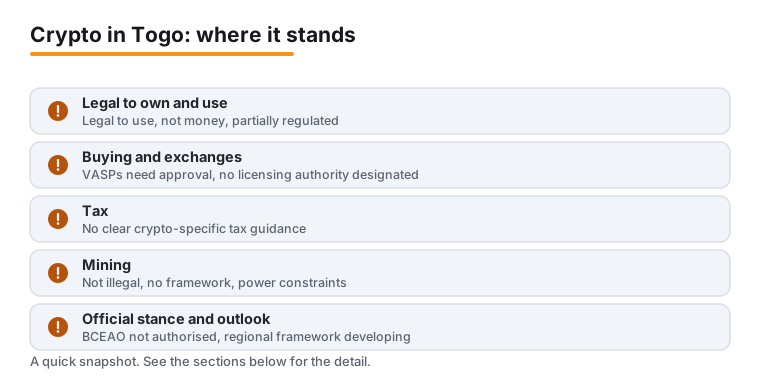
- Legal: Legal to use but not legal tender, only partially regulated under WAEMU
- Tax: No clear crypto tax guidance; general tax principles may apply
- Buying: No licensed local venue, use international exchanges and P2P via mobile money
Togo is a member of the West African Economic and Monetary Union (WAEMU, or UEMOA in French), shares the CFA franc (XOF) with seven neighbouring states, and has its monetary and banking rules set by the regional central bank, the BCEAO (Banque Centrale des Etats de l'Afrique de l'Ouest). That regional structure shapes almost everything about how Bitcoin and other crypto-assets are treated in the country. As of 2026, Togo has no stand-alone national cryptocurrency law: digital assets are neither formally authorised as money nor explicitly banned, and they are not legal tender. In practice, buying, holding and using crypto happens in a lightly governed space shaped by general contract law, regional anti-money-laundering rules, and foreign-exchange controls rather than by a complete crypto-specific framework.
One important shift is under way. The WAEMU uniform anti-money-laundering law, transposed from Directive 01/2023/CM/UEMOA, now brings virtual asset service providers (in French, prestataires de services d'actifs virtuels, or PSAV) within scope and makes their activity subject to prior approval or registration. The BCEAO has also created a committee to design a regional crypto-asset framework for the union. This guide explains what the current rules mean for users, traders, businesses and miners in Togo, and points you to the official sources to check before acting. It is general information as of 2026 and is not legal, tax or financial advice; verify your position with the BCEAO and Togo's authorities.
On this page: Legal status · Who regulates it · Taxes · How to buy · Mining
Is Bitcoin and crypto legal in Togo?
Owning and trading Bitcoin in Togo is not illegal. No statute prohibits residents from buying, holding or transferring crypto-assets, and an active peer-to-peer market exists alongside widely used mobile-money services. At the same time, crypto is not legal tender: merchants are under no obligation to accept it, and there is no deposit insurance, ombudsman or formal complaints route if a platform fails or a transaction goes wrong.
Across the WAEMU bloc the prevailing position is that crypto-assets are not recognised as official currency. The BCEAO has not authorised cryptocurrencies as a means of payment and has repeatedly warned the public about their high volatility and the risk of fraud, noting that these assets are not issued or guaranteed by any central authority. The honest summary for Togo is therefore: legal to use, but not money, and only partially regulated.
For wider context on how countries classify digital assets, see our overview of crypto regulation.
Who regulates crypto in Togo?
There is no single crypto-specific regulator in Togo. Oversight is shared across regional and national bodies:
- BCEAO (regional central bank). The Banque Centrale des Etats de l'Afrique de l'Ouest sets banking, payments and foreign-exchange rules for all eight WAEMU states. It has not authorised crypto as a means of payment and is leading work on a future regional crypto-asset framework. Official site: bceao.int.
- CENTIF-Togo (financial-intelligence unit). The Cellule Nationale de Traitement des Informations Financieres receives suspicious-transaction reports and coordinates anti-money-laundering enforcement, including risks linked to virtual assets. Official site: centif.tg.
- Ministry of the Economy and Finance. Responsible for national financial policy and tax matters: finances.gouv.tg.
Because the WAEMU uniform AML law subjects virtual asset service providers to approval or registration but has not yet formally designated the competent licensing authority, who exactly will license crypto businesses in Togo is still being worked out. Confirm the current position directly with the BCEAO and CENTIF-Togo.
Key laws and frameworks
Togo does not have a single dedicated crypto statute. Several layers of regulation apply, most of them regional:
- WAEMU uniform AML/CFT law (from Directive 01/2023/CM/UEMOA). Adopted by the UEMOA Council of Ministers on 31 March 2023 and progressively transposed by member states from 2024, this framework explicitly extends anti-money-laundering and counter-terrorist-financing obligations to virtual asset service providers (PSAV) and subjects their activity to prior approval or authorisation.
- BCEAO regional crypto-asset committee. The central bank has set up a committee tasked with developing a regulatory framework for crypto-assets in the union, signalling that clearer rules are being prepared but are not yet in force.
- BCEAO electronic-money and payment rules. The framework for licensed e-money issuers and the 2024 instruction on payment services govern mobile money and regulated digital-payment providers, and carry AML obligations. These target regulated e-money rather than crypto directly, but shape how banks and fintechs interact with crypto businesses.
- Foreign-exchange controls. WAEMU foreign-exchange rules give the BCEAO oversight of cross-border financial flows, which is increasingly relevant where crypto is used to move value across borders.
As of 2026 no comprehensive, crypto-specific statute is fully operational in Togo, and several implementing texts (including the body that will actually license PSAV) are still pending. Always confirm the current rules with the BCEAO before relying on any summary, including this one. See also our general guide to crypto regulation.
Licensing and registration of exchanges and VASPs
This is the area changing fastest. Under the WAEMU uniform AML law, the professional activity of a virtual asset service provider (PSAV) is now subject to prior approval or registration, and PSAVs face the same core obligations as other reporting institutions: customer due diligence, sanctions screening, record-keeping and suspicious-transaction reporting.
However, two practical points matter for Togo today:
- The competent authority responsible for issuing PSAV approvals or registrations had not been formally designated at the regional level when this framework took effect, and additional implementing texts are expected to define the conditions and procedures.
- As a result, there is no settled domestic regime under which a crypto exchange or custodian can hold itself out as fully licensed to operate in Togo. Be sceptical of any platform claiming to be government-licensed for crypto, and verify the claim directly with the regulator.
Most Togolese users therefore rely on international exchanges that accept users from Togo and on peer-to-peer marketplaces, rather than on a locally licensed venue. If you run or plan a crypto business, monitor BCEAO and UEMOA publications closely, because the licensing picture is expected to become more defined.
Crypto taxation in Togo
Togo has not published clear, crypto-specific tax guidance, so the treatment of crypto gains is uncertain and should not be assumed to be tax-free. General Togolese tax principles still apply, and the tax authorities can treat profits as taxable income depending on the facts.
For reference, Togo's general tax code includes a tax on capital gains from the onerous transfer of assets such as shares, corporate rights and State-issued mining titles or exploitation licences, but there is no published rule that specifically addresses how Bitcoin or other crypto-assets are taxed. Practical advice for residents:
- Keep detailed records of every purchase, sale and conversion, including dates, amounts in CFA francs and fees.
- Do not assume crypto profits are exempt; treat them as potentially taxable until you have clarity.
- Consult a qualified Togolese tax professional and confirm your obligations with the Ministry of the Economy and Finance before filing.
For background on how crypto is taxed generally, see our crypto taxes guide.
AML and KYC rules
Anti-money-laundering and know-your-customer rules are the most concrete part of Togo's crypto regime. Togo is a member of GIABA, the regional FATF-style body for West Africa, and applies the WAEMU uniform AML/CFT law that now covers virtual asset service providers.
In practice this means:
- Identity verification (KYC). Reputable platforms that serve Togolese users require identity checks. This is normal and reflects the AML obligations placed on regulated intermediaries.
- Customer due diligence and reporting. PSAVs and other reporting entities are expected to assess risk, screen against sanctions, keep records and file suspicious-transaction reports with the national financial-intelligence unit.
- National oversight by CENTIF-Togo. Togo's financial-intelligence unit coordinates AML enforcement. On 24 September 2025, CENTIF-Togo and the national AML coordination committee (CONAC), together with the Ministry of the Economy and Finance, held a workshop in Lome to share the results of a national risk assessment covering virtual assets and virtual asset service providers (AV/PSAV). Officials noted this assessment was meant to close a gap in Togo's earlier 2018 national risk assessment, which had not accounted for crypto-assets.
For users, the takeaway is to expect verification, keep clean records of the source of funds, and be prepared for larger transactions to attract scrutiny.
Buying and using crypto in practice
There is no domestic, government-licensed crypto exchange operating under a Togo-specific licence. Most Togolese who buy crypto do so through international exchanges that accept users from Togo and through peer-to-peer (P2P) marketplaces, which are popular across West Africa because buyers and sellers can settle in local currency using mobile money or bank transfer. Mobile-money wallets are often the practical on-ramp and off-ramp.
Points to keep in mind:
- Expect KYC on reputable platforms; avoid services that skip verification entirely.
- P2P trading carries counterparty risk: use platform escrow, check trader reputations, and never release funds before confirming receipt.
- Foreign-exchange rules can affect how money moves in and out of CFA-franc accounts, so large or frequent conversions may attract scrutiny.
- There is no local regulator to appeal to if you are defrauded, so due diligence is essential.
The regional payments landscape is modernising: WAEMU has rolled out an interoperable instant-payment system to speed up transfers within the bloc, and the BCEAO has explored a digital CFA. Over time these official rails may reduce the cost gap that currently makes crypto attractive for cross-border transfers.
Bitcoin mining in Togo
Togo has no specific legal framework that authorises or prohibits Bitcoin mining. In principle mining is not illegal, but it is constrained by practical realities rather than by crypto-specific rules:
- Electricity supply and cost. Togo imports a significant share of its power. Grid reliability and tariffs are the dominant factors for anyone considering mining; intermittent supply and electricity pricing can quickly erode profitability.
- Energy, import and customs rules. Equipment imports, customs duties and energy use are governed by general regulation, which large-scale operations would need to account for.
- No mining incentives. Unlike a few jurisdictions that court miners with cheap power, Togo offers no dedicated mining regime or subsidy.
Renewable capacity, including solar, has grown and could in theory support more sustainable mining, but there is no evidence of meaningful industrial Bitcoin mining in Togo today. Anyone exploring it should treat power procurement, import duties and tax treatment as the key questions to clarify with local advisers and the relevant ministries.
Recent developments (2025 to 2026)
Several recent signals point toward a more defined framework over time, even though the rules are still evolving:
- VASPs brought into AML scope. The WAEMU uniform AML law, transposed by member states from 2024, now subjects virtual asset service providers to approval or registration and to full AML/CFT obligations, although the body that will license them is still being settled.
- National risk assessment on virtual assets. On 24 September 2025, CENTIF-Togo, the national AML coordination committee (CONAC) and the Ministry of the Economy and Finance held a workshop in Lome to disseminate a national risk assessment covering virtual assets and their service providers. It was presented as an effort to update Togo's earlier 2018 assessment, which had not considered crypto-assets, and to adapt the country's financial-crime defences to current realities.
- Regulated payment rails tightened. Separately, the BCEAO extended, to 31 August 2025, the deadline for fintechs across the union to comply with its payment-services rules under Instruction 001-01-2024. This concerns licensed payment and e-money providers rather than crypto directly, but it shapes the regulated rails that crypto users rely on for on-ramps and off-ramps.
- Regional crypto-asset committee and conference. The BCEAO set up a committee to develop a crypto-asset regulatory framework for the union and, on 8 May 2026, hosted an international conference in Dakar on crypto-assets and digital innovation, calling for a balanced approach between innovation, stability and financial security.
- Payments modernisation. WAEMU launched an interoperable instant-payment system and the BCEAO has explored a digital CFA, part of a broader effort to make official rails faster and cheaper.
None of this yet amounts to a finished, crypto-specific statute in Togo, so treat the situation as fast-moving and confirm the latest position with the official sources below.
Consumer risks and protection
The defining risk in Togo is the absence of a complete, crypto-specific legal framework and of local consumer protection. Key risks include:
- No local recourse. Because crypto is not a regulated, protected product, there is no investor-compensation scheme and no local authority to pursue if a platform collapses or a fraud occurs.
- Volatility. Crypto prices can rise or fall sharply over short periods; only consider funds you can afford to lose entirely.
- Scams. Lightly regulated markets attract fraud. Be wary of guaranteed-return schemes, unsolicited investment managers, and platforms that cannot be independently verified. Togolese officials have flagged real cases in which promoters collected household savings and channelled them into crypto-assets through Ponzi-style schemes, leaving many local victims, so guaranteed-return crypto pitches deserve particular caution.
- Regulatory and forex risk. Tightening AML and foreign-exchange rules mean larger flows may attract attention, and future rules could change how existing users operate.
- Infrastructure gaps. Limited local on-ramps, no tracked Bitcoin ATMs, and variable internet and power add friction.
To protect yourself: use reputable platforms, complete KYC, secure your own keys with an offline backup of your recovery phrase, start with small test amounts in P2P trades, keep thorough records, and consult a qualified local professional about tax and legal exposure.
Official sources and how to verify
Crypto rules in Togo are set mainly at the regional level and are evolving, so always check primary sources rather than third-party summaries:
- BCEAO (regional central bank; banking, payments, foreign exchange and the future crypto-asset framework): bceao.int.
- CENTIF-Togo (national financial-intelligence unit; AML and virtual-asset risk): centif.tg.
- Ministry of the Economy and Finance of Togo (national financial and tax policy): finances.gouv.tg.
- UEMOA Commission (regional union texts, including the AML directive): uemoa.int.
This article is general information as of 2026 and is not legal, tax or financial advice; you should verify your specific situation with the BCEAO and Togo's authorities, and with a qualified local professional, before acting. You can also browse our wider country regulation guides.
Frequently asked questions
Is Bitcoin legal in Togo?
Yes. Owning and trading Bitcoin is not illegal in Togo, but it is not legal tender and is only partially regulated. There is no stand-alone national crypto law, the BCEAO has not authorised crypto as a means of payment, and there is no local consumer protection if something goes wrong. Activity falls under general contract law plus regional AML and foreign-exchange rules.
Who regulates cryptocurrency in Togo?
There is no single crypto-specific regulator. As a WAEMU member, Togo follows the regional central bank, the BCEAO, which sets banking, payments and foreign-exchange rules and is preparing a regional crypto-asset framework. Nationally, CENTIF-Togo handles anti-money-laundering oversight (including virtual-asset risk) and the Ministry of the Economy and Finance handles tax and financial policy. None of these has recognised crypto as money.
Do crypto exchanges need a licence in Togo?
The WAEMU uniform anti-money-laundering law now subjects virtual asset service providers (PSAV) to prior approval or registration and to full AML obligations. However, the competent authority responsible for issuing those approvals had not been formally designated when the framework took effect, and implementing texts are still pending. So there is no settled domestic regime yet under which an exchange can claim to be fully licensed in Togo; verify any such claim directly with the BCEAO.
How are crypto gains taxed in Togo?
Togo has not published clear, crypto-specific tax guidance, so the treatment of gains is uncertain. Do not assume crypto is tax-free: general tax principles can apply, and profits may be treated as taxable income. Keep detailed records of every transaction and consult a qualified local tax professional and the Ministry of the Economy and Finance to confirm your obligations.
Will I need to verify my identity to buy crypto in Togo?
Almost certainly. Togo applies the WAEMU anti-money-laundering rules and is a GIABA member, so reputable platforms that serve Togolese users require know-your-customer (KYC) verification. Expect to provide a valid ID, and be cautious of any platform that skips verification entirely. Keep clean records of the source of your funds, as larger transactions may attract scrutiny.
Are there Bitcoin ATMs in Togo?
No. As of 2026 there are no publicly tracked Bitcoin ATMs in Togo. Most users convert between CFA francs and crypto through peer-to-peer marketplaces, often settling via mobile money, or by withdrawing from international exchanges where supported.
Has Togo assessed the risks of crypto and virtual assets?
Yes. On 24 September 2025, CENTIF-Togo, the national AML coordination committee (CONAC) and the Ministry of the Economy and Finance held a workshop in Lome to share a national risk assessment covering virtual assets and their service providers. Officials said it was intended to update Togo's earlier 2018 national risk assessment, which had not taken crypto-assets into account. The exercise reflects growing official attention to money-laundering and fraud risks rather than a finished crypto law.
Are crypto scams a problem in Togo?
They are a documented concern. Togolese authorities have pointed to cases where promoters collected household savings and funnelled them into crypto-assets through Ponzi-style schemes, leaving many local victims. Because there is no local crypto regulator or compensation scheme to turn to, treat any guaranteed-return or unsolicited crypto investment offer with strong caution, and verify platforms independently before sending funds.
Facts reviewed: 30 June 2026. Page updated: 3 August 2026.