Crypto Inheritance: How to Pass On Your Coins and How Heirs Claim Them
Crypto has no forgot-password link and no next-of-kin form. Die without a plan and your coins can be lost forever; inherit some and you face a process nobody explains in advance. This guide covers both sides: how to set up a simple inheritance plan in an evening, which tools suit bigger amounts, the documents Coinbase and Kraken ask heirs for, how to hunt for hardware wallets and seed phrases without destroying them, what taxes apply, and the scams that target grieving families. It is educational content, not legal, tax, or financial advice; for a real estate plan, talk to a licensed professional where you live.
Why crypto does not pass on like a bank account
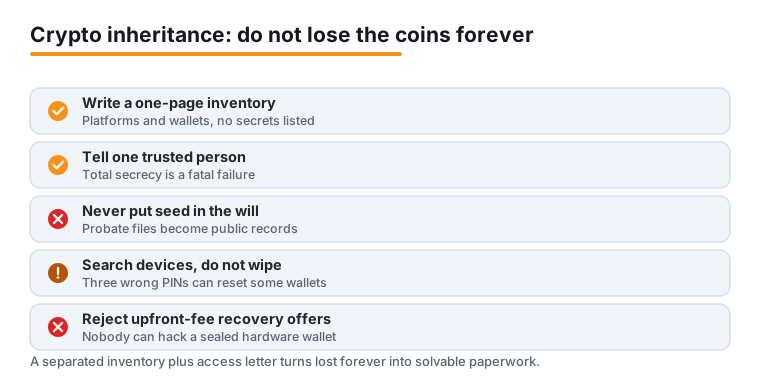
When a bank customer dies, the family shows a death certificate and some court papers, and the bank hands over the money. Self-held crypto is different in one brutal way: ownership is nothing more than knowing a secret. That secret is the private key, usually backed up as a seed phrase, a list of 12 or 24 ordinary words. Whoever has the words has the coins. If nobody has them, no court order and no support ticket can bring the coins back.
The losses are already enormous. Researchers at Chainalysis estimated back in 2017 that 2.8 to 3.8 million bitcoin, roughly a fifth of all coins at the time, were lost or stranded, and every year more holders die without telling anyone how to reach their wallets. The most famous cautionary tale is the Canadian exchange QuadrigaCX. When its founder died suddenly in late 2018, he was the only person with the keys, and the exchange collapsed owing clients about C$215 million. Investigators later concluded that much of the money was already gone through fraud, but the core lesson stands: one death, zero access.
There is a gentler category. Coins on an exchange like Coinbase or Kraken are custodial: the company controls the keys, so the problem is paperwork rather than cryptography. The first job in any crypto estate is figuring out which kind of holding you are dealing with.
First, map where the crypto actually lives
Crypto can sit in more places than people expect, and each has a different rescue path:
- Exchange accounts. Coinbase, Kraken, Binance, Crypto.com, Gemini and dozens more. Recoverable with legal documents, even if nobody knows the password.
- Hardware wallets. Small USB-stick-like devices from Ledger, Trezor, Coldcard or Bitkey. The device plus its PIN, or the seed phrase, gives full access; our cold storage guide explains how they work.
- Phone and browser wallets. Apps like MetaMask, Phantom or Exodus. Access depends on the unlocked phone or the seed backup.
- Paper and metal backups. Seed phrases on paper or steel plates, in safes and bank deposit boxes.
- Odd corners. Old laptops with wallet files from 2013, password managers, encrypted USB sticks, or bitcoin ETFs in a brokerage, which pass on like any normal security.
If you are the holder, write this map down on one page: which platforms, which wallets, roughly what is on each, where the backups are, with no actual secrets on the page. If you are the heir, build the map from the other direction: bank transfers to exchanges, tax paperwork (starting in early 2026, US exchanges send out Form 1099-DA, which names the platform), confirmation emails, and apps on the phone. Our wallets overview helps you recognize what you find.
If you hold crypto: a five step plan you can finish this week
Step 1: write the inventory. One page listing every exchange account and wallet, roughly what is on it, and where its backup lives. No passwords, no seed words, just the map.
Step 2: write an access letter and store it separately. This is the sensitive document: where the seed phrases physically are ("steel plate, gray home safe, code with my brother"), the hardware wallet PINs, and what order to do things in. Keep it sealed where your executor can reach it: a home safe, a lawyer's file, or a bank deposit box. The point is separation: no single item should be enough for a thief, but together they let your family in.
Step 3: cover crypto in your will or trust. The will says who inherits; the letter says how. Never put a seed phrase in the will itself, because wills become public records during probate, the court process that settles an estate. In the US, nearly every state has adopted a model law called RUFADAA that lets executors legally manage digital assets, and it works far more smoothly when the will explicitly grants that power, so ask for a digital assets clause.
Step 4: name a competent helper. If your executor is not technical, write down which professional to hire (an estate lawyer with crypto experience, or a known custody company) and which "helper" to refuse: anyone who makes contact first, asks for the seed phrase, or wants fees upfront.
Step 5: rehearse once a year. Can your heir, using only what you have left, find the inventory and the letter, and name their first phone call? A 15 minute conversation now saves months later.
Tools that make inheritance safer for larger amounts
Multisig with a custody partner. A multisig wallet needs several keys to move coins, for example 2 of 3: you hold one, a family member or lawyer another, and a company such as Casa or Unchained the third. Nobody alone can take the coins, but after a death the survivors plus the company can, and these services sell inheritance packages where staff walk your executor through recovery. Expect a few hundred dollars per year.
Split seed backups done properly. Trezor's multi-share backup uses a standard called SLIP39 to split a wallet backup into, say, 3 shares of which any 2 restore the wallet. One share to your heir, one to your lawyer, one in a deposit box: nobody alone can spend, and losing a single share loses nothing.
Built-in inheritance features. Block's Bitkey hardware wallet shipped an inheritance feature in early 2025: you name a beneficiary in the app, and a claim starts a six month waiting period, cancellable by you, before funds can move. Expect other wallets to copy this.
What exchanges offer: less than you would hope. Most big consumer platforms, including Coinbase, do not let you name a transfer-on-death beneficiary on a regular account; your will, trust or local intestacy law decides, and heirs go through the documents process below.
One warning: DIY constructions like dead man's switches, timelocked transactions and password-split encrypted files tend to fail exactly when needed. For most people, the paper plan plus one tool above is the right amount of engineering.
Mistakes that lose coins forever
Putting the seed phrase in the will. Probate files are public in much of the world, so a seed phrase in a will is a published invitation to take the coins.
Total secrecy. The opposite failure is just as fatal: nobody knows the coins exist, so nobody looks. Estates get settled, laptops wiped, notebooks thrown out. Telling one trusted person that an inventory exists already beats the most common failure mode.
Improvised seed splitting. People split 24 words into two halves and give one to each child. Now losing either half loses everything, and the halves still sat unprotected in two sock drawers. Use SLIP39 shares or multisig instead.
Storing the seed in email or cloud notes. It can be hacked while you are alive, and after your death the family may never get into the account anyway, since email providers run their own slow deceased-user processes.
Heir-side errors. Announcing an inheritance on social media paints a target. Typing a found seed phrase into a website "to check the balance" hands the coins to a phishing site. Paying an upfront fee to a recovery expert who contacted you first is almost always theft; our guides to crypto scams and crypto recovery explain how the legitimate version of that industry works.
Destroying evidence. Families clearing a house routinely sell or reset the one device that held the keys. Until the crypto is accounted for, treat every computer, phone, USB stick and word list as potentially worth more than the house.
Claiming a deceased person's exchange account, step by step
Exchange recoveries are bureaucratic but doable, and the pattern is similar everywhere.
Coinbase. The executor or court-appointed administrator submits a request through Coinbase's deceased account process: certified copies of the death certificate, the probate document naming you (Letters Testamentary, Letters of Administration, or a small estate affidavit where the estate qualifies), and your own photo ID. The representative opens their own Coinbase account, and once the review clears, the assets move there under the estate's control.
Kraken. The claim runs through Kraken's deceased client claims team: a color image of the official death certificate (funeral home certificates are not accepted), proof of your appointment as the estate's representative, and your photo ID, with extra documents sometimes requested.
Realistic timeline. The slow part is rarely the exchange; it is getting the court documents. Say your father dies in January holding $12,000 on Coinbase: the will is filed in February, the court issues Letters Testamentary in April (two to four months is normal in many US counties), you submit the Coinbase packet in May, and the assets arrive two to four weeks later. Six months start to finish is a decent outcome; small estate procedures are faster, estates with no will slower.
Three notes. Notify the exchange of the death early so the account is flagged against fraud. Do not log in with the deceased's saved passwords: it can break the platform's terms and computer access laws, and a new-device login often freezes the account anyway. And agree with the other heirs whether to sell or distribute coins, since that choice has tax consequences.
When the coins are in self custody: the careful treasure hunt
If the deceased held their own keys, the estate needs a working device plus its PIN, or a seed phrase backup. Search in this order:
- Safes, desks, filing cabinets and bank deposit boxes, looking for word lists (12, 18 or 24 words), steel plates, or cards that came with a hardware wallet.
- The devices themselves: anything like a USB stick with a small screen, plus old phones and laptops with wallet apps.
- Password managers and encrypted files, which often hold wallet passwords or photos of seed phrases; the estate may get in through the manager's own legacy process.
- Paper trails proving coins exist: exchange emails, bank transfers to crypto platforms, and tax forms.
Once you find something, slow down. Do not update, reset or "try a few PINs" on a hardware wallet; many devices punish wrong guesses, from ever-longer wait times between attempts to a full reset after as few as three wrong PINs. Do not type a found seed phrase into any website. The clean procedure, ideally with someone technical the family already trusts, is to restore the seed into a freshly set up hardware wallet, move the coins to wallets the estate controls, and record the date and value for taxes.
If you find a wallet but no PIN and no seed, the coins are usually out of reach. A few legitimate firms crack older software wallets and encrypted disks for a percentage on success, but modern hardware wallets with secure chips are built so nobody, including the manufacturer, can break in. Never pay an upfront fee to someone promising to "hack the blockchain"; that is not a thing, and it is the most common scam aimed at bereaved families.
Taxes on inherited crypto: US, UK and everywhere else
Tax offices treat crypto as property; the IRS digital assets page states the US position plainly.
United States. Two pieces of good news. Federal estate tax only touches estates above the exemption, $15 million per person from 2026, so the vast majority owe none. And heirs get a step-up in cost basis: the purchase price resets to market value on the date of death. If dad bought bitcoin at $5,000 and it was worth $90,000 when he died, an heir selling at $91,000 owes capital gains tax on $1,000, not $86,000. Record the date-of-death price in writing. Some states add their own estate or inheritance taxes; start with our United States regulation page.
United Kingdom. Cryptoassets count as property in the estate, and inheritance tax of 40 percent applies above the tax-free thresholds (the standard nil-rate band is £325,000, with more when a home passes to children). HMRC's cryptoassets manual confirms crypto belongs in the estate, and HMRC has been sending reminder letters to advisers who handle estate returns, telling them to check for cryptoassets and list them on the IHT400 form. Heirs then use the date-of-death value as their cost for later gains.
Elsewhere. Some countries have no inheritance tax but tax heirs when they sell; others tax the inheritance itself with family allowances. The constants everywhere: value the coins at the date of death, keep records of every transfer, and report honestly. Our crypto taxes guide covers record keeping that survives an audit.
A 30 minute starter plan
If you hold crypto and have done nothing yet, here is the minimum that turns "lost forever" into "a solvable paperwork problem":
- Tonight (10 minutes): write the one-page inventory: platforms, wallet types, where backups live. No secrets on the page.
- Tonight (5 minutes): tell one trusted person the inventory exists and where it is.
- This week (15 minutes): check your seed backup exists, is readable, and is stored apart from the device. Seal the access letter and put it where your executor can reach it.
- This month: add a digital assets clause to your will, or make a will if you have none. Keep the seed phrase out of it.
- This year: if your crypto is worth more than a car, price out multisig or an inheritance feature, and run one rehearsal with your heir.
And if someone has already died: build the map from their paperwork, secure every device before anything gets wiped, start probate early since it is the slowest step, and treat every unsolicited helper as a scammer until proven otherwise. The coins are more recoverable than the horror stories suggest, as long as nobody rushes.
Frequently asked questions
Can my family just log in with my passwords after I die?
It is risky. Logging into a dead person's exchange account can violate the platform's terms and computer access laws, and a new-device login often triggers a security freeze at the worst moment. The clean route is the exchange's deceased customer process. Self-custody wallets are different: there is no account to breach, so the executor restoring the wallet from the seed phrase and distributing coins per the will is normal procedure.
Should I put my seed phrase in my will?
No. Wills typically become public court records during probate, so a seed phrase in a will is effectively published. Put who inherits in the will, and put how to access the coins in a separate sealed letter, or use a trust, which stays private. The will can mention the letter exists without quoting anything from it.
What happens to crypto if someone dies without a will?
The coins follow normal intestacy rules: a court appoints an administrator and local law decides who inherits. Exchange accounts can still be claimed with the court papers, just more slowly. Self-custody coins are the danger zone: with no will there is usually no access letter either, and if nobody finds the keys, the coins are lost no matter what the law says.
Do heirs pay tax on inherited crypto?
Usually not at the moment of inheriting, unless the estate is large. In the US, federal estate tax starts above $15 million (2026) and heirs get a stepped-up cost basis to the date-of-death value, wiping out the deceased's unrealized gains. In the UK, 40 percent inheritance tax applies above the tax-free thresholds. In most countries the heir's later sale is a normal taxable disposal measured from the date-of-death value, so get that valuation in writing.
We found a hardware wallet but no PIN and no seed phrase. Is the money gone?
Probably, but stop before you make it certain. Do not guess PINs freely: many devices wipe or lock after repeated failures. Search again for the seed phrase, usually on paper or steel near where the device lived, or photographed in a password manager. If nothing turns up, a specialist firm can assess recovery, normally for a percentage of recovered funds and never for an upfront fee. Modern hardware wallets without the seed are generally unbreakable by design.
How long does it take for heirs to actually receive the crypto?
For exchange accounts, the platform's review usually takes two to six weeks once complete documents are in, but obtaining probate papers commonly takes two to six months, so plan for three months to a year overall. Small estate procedures cut that sharply. Self-custody coins move the moment the keys are found and restored: anywhere between the same afternoon and never, depending on how well the owner planned.
Last updated: 2026-06.