Crypto in Culture & Everyday Use Cases
For most of its history, cryptocurrency was discussed as a speculative asset: something to buy, hold, and watch on a price chart. That framing still dominates headlines, but it misses a quieter shift. Over the past few years, crypto has slipped into culture and ordinary routines, turning up in charity drives, video games, sports sponsorships, art markets, classrooms, and checkout lines. This guide walks through the most common real-world crypto use cases today, what actually works versus what is still experimental, and the practical trade-offs to weigh before you participate.
The aim here is to be useful and honest. Some of these applications are mature and reliable; others are early, risky, or oversold. This is general educational information, not financial, legal, or tax advice. Rules differ widely by country and change often, so confirm anything specific with official sources or a qualified professional before acting.
Crypto in everyday life
The most consequential crypto use cases are not flashy. They involve moving money cheaply and quickly across borders, and giving people a way to hold value when their local currency is unstable. This is where the technology has found the clearest product-market fit.
Cross-border payments and remittances
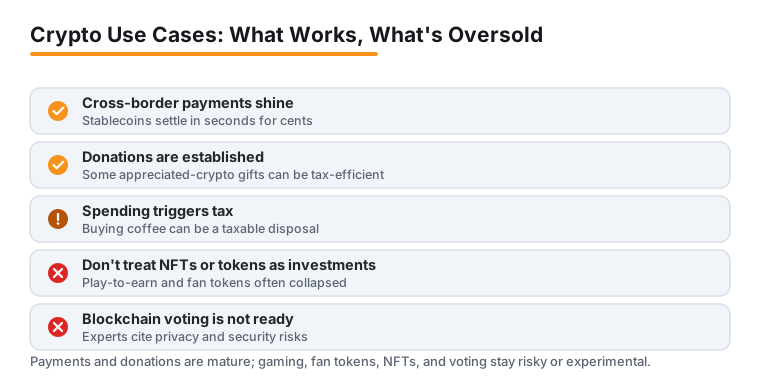
Traditional international transfers can be slow and expensive. According to World Bank data, the global average cost of sending a remittance has hovered around 6 percent of the amount sent. Stablecoins, which are crypto tokens designed to track the value of a currency such as the US dollar, can settle in seconds for network fees that are often a few cents, regardless of the destination. That gap explains why stablecoin transfer volumes have grown sharply, and why fintech apps and card networks have begun routing payments over blockchain rails behind the scenes.
Holding value in unstable economies
In countries that have experienced high inflation, dollar-pegged stablecoins increasingly function as informal digital savings accounts. Households, freelancers, and small businesses use them to preserve purchasing power and to invoice clients abroad without a foreign bank account. Bitcoin plays a similar role for some users, though its price volatility makes it less suited to short-term saving than a stablecoin.
Financial inclusion, with caveats
Crypto is sometimes described as a tool for the roughly billion-plus adults worldwide without a bank account. The promise is real in narrow cases: anyone with a smartphone and internet can receive a transfer. But the limits matter just as much. You still need connectivity, a way to convert between crypto and local cash, and enough technical knowledge to avoid scams and protect your keys. Price swings, confusing interfaces, and the risk of irreversible mistakes all temper the inclusion story. Treat crypto as one option among many, not a guaranteed fix for financial access.
Donations & charity
Charitable giving is one of the more established crypto use cases. Major nonprofits, universities, and donor platforms now accept digital assets, and specialized intermediaries handle the technical and compliance work for organizations that do not want to manage crypto directly.
Why donors and charities use it
- Borderless and fast: A supporter in one country can fund a cause in another within minutes, without correspondent banks or currency conversion delays.
- Lower friction for some transfers: Network fees can be small relative to traditional international payment costs, so more of a gift can reach the cause.
- Transparency: Because public blockchains record transactions openly, donors can sometimes verify that funds arrived at a charity's published address. This does not, by itself, prove how the money was ultimately spent.
The tax angle (United States example)
In the US, donating appreciated cryptocurrency that you have held for more than a year directly to a qualified 501(c)(3) charity is generally treated like donating appreciated stock. You typically avoid capital gains tax on the appreciation and may be able to deduct the fair market value if you itemize, subject to adjusted gross income limits and documentation rules. Larger gifts can require additional forms and, above certain thresholds, a qualified appraisal. The exact rules, dollar thresholds, and percentages change and vary by situation, so verify the current requirements with the IRS or a tax professional before relying on them. Rules in other countries differ entirely.
Honest limitations
Two concerns recur. First, blockchain transparency can coexist with donor anonymity, which regulators watch closely for money-laundering risk; reputable platforms apply identity checks on larger or fiat-converted gifts. Second, transparency at the donation step is not the same as accountability for outcomes. Crypto does not replace the basic due diligence of checking that a charity is legitimate and effective. None of this is tax or legal advice.
Gaming, sport & the arts
Culture is where crypto is most visible and also where the gap between hype and substance is widest. Some uses add genuine convenience; others are mainly marketing or speculation. It helps to separate them.
Video games and esports
Crypto and blockchain show up in gaming in a few distinct ways. The most useful is straightforward payments: tournaments and platforms can distribute prize money or pay players internationally faster than traditional banking, which matters in a global, online-first industry. More ambitious are "play-to-earn" and blockchain-based games, where in-game items are issued as tokens players can own and trade. The idea of true digital ownership is appealing, but many of these projects have proven unsustainable, with token values that collapsed once new-player growth slowed. Approach earnings claims skeptically, and never treat a game as an investment.
Sport
Professional teams and leagues have embraced crypto mostly through sponsorships, branded "fan tokens" that grant voting on minor club decisions and perks, and collectible digital memorabilia. These can deepen fan engagement, but fan tokens are volatile and confer no ownership stake in the club. The wave of crypto sponsorships has also seen high-profile failures, a reminder that a logo on a jersey is not an endorsement of safety.
The arts and NFTs
Non-fungible tokens, or NFTs, gave digital artists a new way to sell work and to earn royalties on resales programmed into the token. At their best, NFTs created direct artist-to-collector markets and funded creative communities. At their worst, they fueled a speculative bubble, plagiarism, and steep losses for late buyers. The technology persists in narrower forms, such as event ticketing and verifiable digital collectibles, but the get-rich-quick era has cooled. Buy art you value for its own sake, not as a guaranteed trade.
Spending crypto
Spending crypto on everyday goods has become noticeably easier, though it still requires a little setup. Three approaches dominate.
| Method | How it works | Best for |
|---|---|---|
| Crypto debit cards | A card linked to your crypto balance; the provider converts to local currency at the moment you pay, so the merchant sees an ordinary card payment. | Spending anywhere cards are accepted, without merchants needing to support crypto. |
| Direct merchant acceptance | Businesses accept crypto at checkout, often through a payment processor that settles to them in cash or stablecoins. Bitcoin's Lightning Network and stablecoins make small payments fast and cheap. | Paying merchants who advertise crypto acceptance; low fees on small amounts. |
| Gift cards and top-ups | Services let you buy retailer gift cards or mobile credit with crypto, letting you spend indirectly at stores that do not accept it. | Using crypto at mainstream retailers without a card. |
What has improved
The biggest change is speed and cost on the right networks. Bitcoin's Lightning Network can confirm small payments in about a second for fractions of a cent, and stablecoin transfers are similarly cheap, which finally makes day-to-day purchases practical rather than a novelty. Mainstream payment companies have also begun letting merchants accept crypto or stablecoins while customers pay with familiar tools, smoothing the experience on both sides.
Two cautions before you spend
- Volatility: If you spend a volatile asset like Bitcoin directly, its value can swing between the time you acquire it and the time you spend it. Stablecoins avoid this by design, which is one reason they dominate everyday payments.
- Taxes: In many jurisdictions, including the US, spending crypto is a taxable disposal. Buying a coffee with Bitcoin can technically trigger a capital gain or loss that you are expected to report. Keep records and check your local rules; this is general information, not tax advice.
A note on crypto and elections
One use case worth treating with extra caution is voting. The idea of blockchain-based elections, which promises tamper-evident records and remote participation, comes up often. A handful of small pilots have been run, but most election-security experts remain skeptical, citing risks around voter privacy, device security, and verifiability at scale. For now this is an experiment, not a proven civic technology, and it should not be confused with the mature payment and donation use cases above.
Frequently asked questions
What are the most practical, real-world uses for crypto today?
The clearest everyday use cases are fast, low-cost cross-border payments and remittances, holding dollar-pegged stablecoins as a hedge in unstable economies, charitable donations, and spending via crypto debit cards or networks like Bitcoin's Lightning Network. More cultural uses such as gaming tokens, fan tokens, and NFTs exist but are more speculative and less reliable.
Is it better to donate crypto or cash to charity?
It depends on your situation. In some countries, donating crypto you have held long enough and that has gained value can be more tax-efficient than selling it and donating cash, because you may avoid capital gains tax and still claim a deduction. The rules, limits, and paperwork vary by jurisdiction and change over time, so confirm the current details with a tax professional or official source. This is not tax advice.
Do I owe taxes when I spend crypto on everyday purchases?
Often, yes. In many places, including the United States, using crypto to buy goods or services is treated as disposing of an asset, which can create a taxable capital gain or loss based on how the price moved since you acquired it. Spending a stablecoin tracking your local currency usually minimizes gains, but you should still keep records and verify your local rules. General information only, not tax advice.
Are play-to-earn games, fan tokens, and NFTs good investments?
They should not be treated as investments. Many play-to-earn games and fan tokens have lost most of their value once initial enthusiasm faded, and the NFT market saw a sharp boom and bust. Enjoy these for the game, the fandom, or the art itself, and only spend money you are fully prepared to lose. Avoid anything promising guaranteed returns.
Can I really vote using blockchain?
Not in any widespread, proven way. A few small pilots have tested blockchain-based voting, but most security researchers warn it introduces serious risks around privacy, device security, and verifying results. It remains experimental and is far less mature than crypto's established payment and donation uses.
Last updated: 2026-06.