Bitcoin Upgrades: Taproot, Lightning & Privacy
Bitcoin's core rules change slowly and deliberately, but the network has never stopped evolving. Over the past decade a handful of carefully reviewed upgrades have made transactions cheaper to verify, smart-contract logic more flexible, and on-chain footprints harder to analyse. At the same time, a second layer called the Lightning Network has grown up alongside the base chain to handle fast, low-cost payments that would be impractical to settle individually on-chain.
This guide explains why Bitcoin upgrades happen the way they do, what Taproot and Schnorr signatures actually changed, how the Lightning Network enables instant micropayments, where privacy stands today, and how the community is preparing for longer-term threats such as quantum computing. It is written for readers who want an accurate, jargon-light overview rather than marketing claims. Nothing here is financial, legal, or tax advice, and figures such as network capacity change constantly, so verify current numbers and the status of any proposal with primary sources before relying on them.
Why Bitcoin upgrades
Bitcoin is a consensus system: tens of thousands of independent nodes must agree on the same rules, or the network splits. That makes change genuinely hard, and intentionally so. There is no central authority that can push an update. Proposals are written up as Bitcoin Improvement Proposals (BIPs), debated publicly, implemented in node software, and only take effect once a large majority of the ecosystem opts in. The whole value proposition of a monetary network rests on rules that cannot be quietly rewritten.
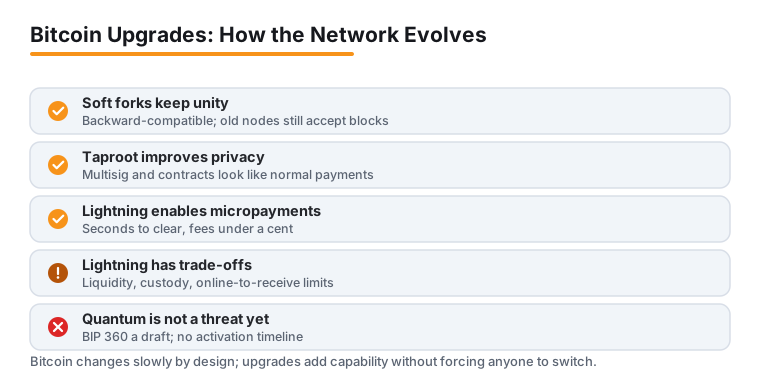
Most modern changes are deployed as soft forks rather than hard forks. A soft fork tightens the rules so that nodes running the old software still accept new-style transactions, keeping the network unified. A hard fork changes rules in a way that would reject old blocks, forcing everyone to upgrade or risk splitting into a separate chain. Bitcoin has strongly favoured backward-compatible soft forks for its major upgrades.
The upgrades that matter fall into a few themes the rest of this guide covers:
- Scalability - early Bitcoin could only confirm a limited number of transactions per second, and blocks fill during busy periods, pushing fees up. The response is a layered design: keep the base chain secure and decentralised, and move high-volume activity to layers on top.
- Efficiency and flexibility - changes such as Segregated Witness (SegWit, 2017) and Taproot (2021) reduced the data weight of certain transactions and made advanced spending conditions cheaper and more private.
- Privacy - several improvements make it harder for outside observers to link addresses and infer who is transacting.
- Long-term security - researchers are already studying how Bitcoin would migrate to quantum-resistant cryptography long before it is likely to be needed.
Bitcoin's starting point is worth recalling: the whitepaper appeared in 2008 and the first block was mined in January 2009, with the famous 2010 purchase of two pizzas for 10,000 BTC marking an early real-world use. The roadmap since has been about preserving that original peer-to-peer-cash promise while making it usable at scale.
Taproot & Schnorr
Taproot is the most significant Bitcoin upgrade since SegWit. It activated on the Bitcoin mainnet in November 2021, at block height 709,632, after roughly 90% of miners signalled support through a low-controversy process sometimes called Speedy Trial. Taproot is actually a bundle of three related proposals: BIP 340 (Schnorr signatures), BIP 341 (Taproot itself), and BIP 342 (Tapscript).
Schnorr signatures (BIP 340)
Before Taproot, Bitcoin used the ECDSA signature scheme. Schnorr signatures are an alternative that is widely regarded as simpler, faster to verify, and provably secure under standard assumptions. Their most useful property is linearity, which enables signature aggregation: several signatures can be mathematically combined into one. In practice this means a multi-signature transaction, or a complex contract requiring several parties, can be made to look like an ordinary single-signature payment on the blockchain.
Taproot and MAST (BIP 341)
Taproot introduced a new address and output type known as Pay-to-Taproot (P2TR). It lets a payment be spent in two ways: the simple key path, using a single Schnorr signature, or a script path that reveals one branch of a tree of possible spending conditions. The tree structure is built using a technique called MAST (Merkelized Alternative Script Trees). The key benefit is that only the branch actually used is ever published; all the unused conditions stay private and never touch the chain.
Tapscript (BIP 342)
Tapscript updates Bitcoin's scripting language so it can take full advantage of Schnorr and Taproot. It cleans up several limits and makes future script upgrades easier to introduce.
Why does this matter in practice? Taproot delivers three concrete improvements:
- Privacy - a simple payment, a multisig wallet, and a sophisticated smart contract can all appear identical on-chain, so observers cannot easily tell them apart.
- Lower fees and smaller data - aggregated signatures and the key-path spend reduce transaction size, which lowers cost.
- Better contracts - more complex conditions become cheaper and more practical, which also benefits second layers like Lightning.
Taproot adoption is gradual because wallets, exchanges, and services must each add support; the upgrade does not force anyone to use the new output type. You can check the current share of Taproot-using transactions on public block explorers and network dashboards.
The Lightning Network
Even with base-layer efficiency upgrades, settling every coffee purchase directly on the Bitcoin blockchain would be slow and costly. The Lightning Network is a "layer 2" built on top of Bitcoin to solve exactly this. It lets users transact off-chain, near-instantly and at very low cost, while still relying on the base chain for final security.
How payment channels work
Two parties open a payment channel by locking some bitcoin in a shared on-chain transaction. From then on they can update the balance between them as many times as they like by exchanging signed messages off-chain; only the opening and closing transactions are recorded on the blockchain. Because Lightning nodes are connected to one another, you do not need a direct channel with everyone you pay. Payments can be routed across multiple channels to reach their destination, and cryptography ensures each hop is paid only if the whole payment succeeds.
What it enables
- Speed - payments typically clear in seconds rather than waiting for block confirmations.
- Low fees - routing fees are usually a tiny fraction of a cent, which makes very small payments viable.
- Microtransactions - tipping a content creator, paying per article, streaming sats for streamed media, in-game payments, or machine-to-machine payments all become practical when fees are negligible. These use cases simply do not work on a base layer where each transaction carries a network fee.
- Global reach - anyone with a compatible wallet and an internet connection can send and receive value across borders without intermediaries setting exchange rates or hold times.
Getting started and the trade-offs
For most people, using Lightning is now as simple as installing a mobile wallet, since modern apps abstract away channel management. Advanced users can run their own node for more control. Be aware of the honest limitations the network is still working through:
- Liquidity - a channel can only send what its balance allows, so receiving capacity and routing liquidity must be managed; custodial and managed wallets handle this for you.
- Online requirement - to receive trustlessly you generally need to be online, though newer designs reduce this burden.
- Custody - some easy wallets are custodial, meaning a third party holds your funds; non-custodial wallets keep you in control but ask a little more of the user.
- Centralisation pressure - a relatively small number of well-funded routing hubs carry a large share of liquidity, a live concern for the network's decentralisation.
Development continues: recent protocol work includes BOLT 12 offers (reusable payment requests supporting subscriptions and better privacy), splicing (resizing a channel without closing it), and Taproot channels (which make channel opens and closes look like ordinary Bitcoin transactions). Public Lightning capacity is in the thousands of BTC across tens of thousands of channels, but these figures move constantly and much capacity sits in private channels that trackers cannot see, so treat any single number as a snapshot and check a live dashboard for current data.
Privacy improvements
Bitcoin is often described as anonymous, but it is more accurately pseudonymous. Every transaction is recorded on a public ledger, and addresses can sometimes be linked to real identities through exchanges, reused addresses, or chain analysis. Several upgrades and tools aim to weaken those links and give users more financial privacy. Privacy here means keeping ordinary financial details from being trivially tracked by anyone with a block explorer, not enabling wrongdoing.
What recent upgrades contribute
- Taproot and Schnorr - as covered above, these let different kinds of transactions look alike on-chain, so a multisig or a contract is not obviously distinguishable from a basic payment. This raises the cost of casual surveillance.
- Address types and reuse - using a fresh address for each receipt, which good wallets do automatically, makes it harder to cluster your activity.
Tools layered on top of Bitcoin
- CoinJoin - a collaborative transaction in which several users combine inputs and outputs so it becomes ambiguous which input paid which output. This is the practical reality behind loose phrases like "coin mixing" in older articles. Note that some custodial services treat coins that have passed through certain mixing tools differently, and the regulatory treatment of mixing varies by jurisdiction.
- Lightning routing - because most Lightning activity happens off-chain and payments hop through intermediaries using onion-style routing, individual payments are not individually posted to the public ledger.
- Payment processors and gateways - merchant tools can let a business accept Bitcoin without exposing a customer's full transaction history, and can reduce how much personal data is attached to a payment. They are a convenience and privacy aid for commerce, but a custodial gateway is still a third party that may collect data and apply its own compliance checks, so read its policies.
Honest limits and the regulatory angle
Privacy on Bitcoin is improving but partial. Determined analysis, especially where transactions touch identity-verified exchanges, can still de-anonymise users. Privacy techniques also sit in an evolving legal landscape: rules around mixing services, travel-rule reporting, and exchange disclosures differ widely between countries and change over time. None of this is legal or tax advice. If you handle Bitcoin in a regulated context, confirm your obligations with a qualified professional and the relevant official guidance rather than relying on general explanations.
FAQs
See the structured questions and answers below.
Frequently asked questions
When did Taproot activate, and do I have to do anything?
Taproot activated on the Bitcoin mainnet in November 2021 at block 709,632. You do not have to do anything; it is backward compatible. To benefit from its lower fees and improved privacy you simply need a wallet that supports Taproot (P2TR) addresses, and adoption is something each wallet and service rolls out on its own schedule.
Is the Lightning Network safe to use?
Lightning relies on Bitcoin's base layer for final settlement and uses cryptographic safeguards to prevent counterparties from cheating. The main practical risks are user-facing: using a custodial wallet means trusting a third party with your funds, and self-custodial setups require you to manage backups and, in some cases, be online to receive. For small everyday amounts most users find it reliable. Start with small sums, understand whether your wallet is custodial, and keep backups. This is not financial advice.
Does Bitcoin make my transactions private?
Not by default. Bitcoin is pseudonymous: every transaction is on a public ledger, and addresses can sometimes be linked to identities. Upgrades like Taproot and tools like CoinJoin and Lightning improve privacy, but determined analysis can still de-anonymise activity, especially where it touches identity-verified exchanges. Treat Bitcoin as transparent unless you take deliberate steps, and check the legal status of privacy tools in your jurisdiction.
Could a quantum computer break Bitcoin?
Not with today's hardware. A sufficiently powerful future quantum computer could, in theory, threaten the elliptic-curve cryptography Bitcoin uses to secure spending, which is why researchers are preparing migration paths well in advance. A draft proposal, BIP 360, introduces a quantum-resistant output type and has been merged into the BIP repository for review, but it remains a draft with no activation timeline and does not by itself address every attack scenario. Any real migration would be a major, carefully coordinated upgrade. Follow primary sources for the current status rather than headlines.
What is the difference between a soft fork and a hard fork?
A soft fork tightens Bitcoin's rules in a backward-compatible way, so nodes that have not upgraded still accept the new transactions and the network stays unified; Taproot and SegWit were soft forks. A hard fork changes rules in a way that older nodes reject, which forces everyone to upgrade or risk the chain splitting into two. Bitcoin has strongly preferred soft forks for its major upgrades to avoid fragmenting the network.
Last updated: 2026-06.